Orpheus and Eurydice in the Yidinji Lands of Babinda

I have taken this story verbatim from the free brochure produced by Babinda Information Centre Volunteers and funded by the Cairns Regional Council. 

The volunteer who gave me my copy, a gracious and helpful lady a good deal older than I, told me: The authors wrote this a very long time ago. They were a man and a woman who became knowledgeable about the local tribes. They both passed away many years ago.” I acknowledge my debt to those writers. I trust I have violated no-one’s copyright. I will be pleased to receive any information that will put me in contact with the heirs of the authors. 

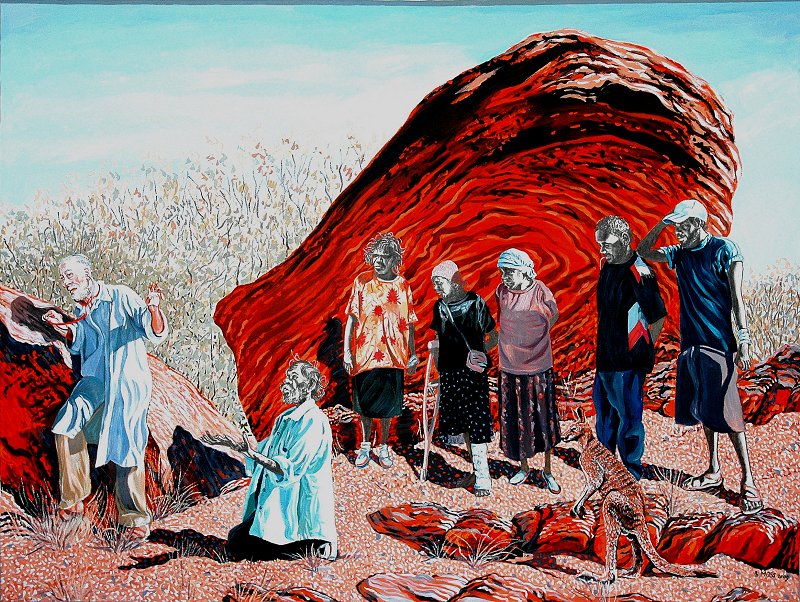
More fundamentally, I acknowledge the traditional owners of these lands and thank them for welcoming me here. I swam in these beautiful waters, enjoying them among the descendants of the original inhabitants. Mothers and fathers of brown kids and pink kids joined tourists, backpackers, Asian tour groups and an old white doctor, cooling upstream of all and danger and loss.  

“A long time ago, when the Yidinji tribe lived in the Babinda Valley, there was a tremendous upheaval that created these unusual shaped “Boulders” with their foaming, rushing waters. In the tribe was Oolana, a very beautiful young woman. Also in the tribe was Waroonoo, a very old, wise and respected elder. It was decided these two should be given in marriage to each other and so it was done. Some time later a visiting tribe can wandering through the valley and as was the custom of the friendly Yidinji, they made the strangers welcome, inviting them to stay. In the tribe was Dyga, a very handsome young man. All eyes were upon him for his grace and beauty. At first sight Dyga and Oolana fell in love.


“So great was their strong attraction for each other they arranged to meet secretly. Knowing full well their desire for one another would never be permitted they ran away. Oolana knew she could now never return as she was rightfully married to Waroonoo. They journeyed well up into the valley, spending wonderfully happy days together as they camped under Chooreechillum*, near the water’s edge.

The two tribes had been searching for them and it was at this spot they came upon the the two lovers. The wandering tribesemen seized Dyga, forcing him away 
(re)calling how they had been shamed and would never return and how they would travel far away and never return. The Yidinjis had taken hold of Ooolana and 
were dragging her back, forcing her to return with them to the rest of the tribe. Suddenly she broke away and violently flung herself into the gentle waters of the creek, as she called and cried for Dyga to return to her here, but the wandering tribe had gone and with them her handsome lover.

Would he ever return? Just at the very instant Oolana struck the water, a tremendous upheaval occurred. The land shook with terror and sorrow as Oolana cried for her lost lover to come to her. Her anguished cries spilled out as rushing water came cascading over the whole area. Huge boulders were thrown up and she disappeared into them. Oolana seemed to become part of the stones as if to guard the very spot where it all happened.

So to this day, her spirit remains.  Some say that at times her anguished calls cry out calling her lover to return – and that wandering travellers should take care

lest Oolana call them too close to her beautiful waters, for she is forever searching for her own lost lover, and this must always be.” 

Upstream the waters are wide and gentle. Downstream a little and around a bend the river narrows, the waters deepen and rush between mighty boulders that are 
grey and silent and solid and powerful. Leaping suddenly downward in great foaming furrows, the green waters crash from a height into a pool that roils and

froths in endless turmoil. “Very many have drowned here”, reads the notice. (“Caution, slippery kocks”, reads another notice, the capital ‘R’ helpfully altered to a ‘K’.) In the words of the copper in ‘Point Break’, pointing over his shoulders at the wild waters off Bells’ Beach where Patrick Swayzee has preceded them, “It’s death on a stick out there, mate.” 


Upstream where all is tranquil a young mother sat on the steps at the water’s edge, watching her children swim. She said, “It’s true. In my own lifetime in Babinda very many have drowned down there…very many. But only men drowned. Never a woman.” 


* Choorechillum, Queensland’s highest peak. Its whitefella name is Mt Bartle Frere.

Blog Wail

A week or so ago this blog wailed about the darkness of the news, the darkness at the heart of man. Two readers responded.
One referred to my wailing as my de profundis, an expression I’d seen bobbing along on the high cultural current over my decades, passing by unpassed. Now it came to me: from the depths. That rang a bell: David, warrior poet, king of ancient Israel, wrote a psalm,
min ha’ma’amakim, From the depths I called…’

Well, two answered my call.

From England, author, bloggish fruitcake maker and novelist Hilary Custance Green is writing her account of her father, a POW in the same camp as Weary Dunlop. He was
one of many untrained medical orderlies who worked in the camp under Canadian surgeon Jacob Markovitz. She writes: “I used to weep continuously as I read these accounts, but I found a dreadful tendency to habituate to the misery and cruelty…”

Robert Hillman, Australian novelist and ghostwriter of lives in ghastly times and climes, sent an antidote:

“Dear Howard – I’ve read your De Frofundis, and your blog about the Richard Flanagan book. I’ll get that book, most certainly, after all you had to say about it. The De Profundis was wonderful in its sincerity, Howard. It’s what all of (us) want to say. But you actually said it. And yet, you know, thank God that there are people of courage and grace in the world who also have a say. I’ve just finished writing a book (‘The Wailing Song’) for a guy who served – most reluctantly – in the Iranian armed forces in the last two years of the Iran-Iraq war. A situation arose when his most senior officer made a mistake, failing to issue an order to 2500 men under his command to withdraw to a ceasefire position in the face of an Iraqi advance. My guy knew of the mistake, and after awful soul-searching, decided to issue the order himself. If he had not, those 2500 men would have been massacred by the vastly superior Iraqi force. Usurping the authority of a Colonel when you are no more than a humble corporal will almost certainly get you court-martialed and hanged in the Iranian army. My guy accepted that he would be hanged, but went ahead and issued the order anyway – he was circumstantially in a position to do so, without having his authority questioned. The men were saved, my guy wasn’t hanged, due to the difficulty the Colonel would have had in explaining his blunder. Its one of those existential situations, a moment of truth, when all that you hope about yourself and believe about yourself is suddenly up for testing: do you have the courage to die at the end of noose in order to save others? Will your life have any meaning if you find a way to duck out? It must be like being thrust into an arena, a bright light directed at you. Here’s your chance. Yes or no?”

I know that moment of moral choice. I know it from reading with growing dread Conrad’s Lord Jim. I read it in the dread of self-knowledge that I would not rise to that challenge. However, since the start of my sixth decade I have imagined that I might.
(Free advice: read ‘Joyful’, which I enthused over in this blog half a year ago. Hillman writes in his own and in many voices of those who struggle in these depths and of some who rise in them).

Intersections, Signposts, Byways along the Road to the Deep North

I read a book yesterday. Started early, finished late. At intervals I had to break off reading to gasp, get to my feet, pace around. Then I sat down and resumed reading. Again I had to stop: I couldn’t read.:
my eyes were streaming and I was sobbing. Because I am a man and men do not give into tears I composed myself, went back to the book and finished it. Unusually for me, I was reading a novel I had read before.
My fortunate path through life is paved with storybooks, so many good books, a few even demanding the accolade of greatness. This is one of the great books.

The novel fictionalises the adult life of Edward (‘Weary’) Dunlop, an Australian surgeon and ‘war hero’, that shopworn term which perplexes and burdens the novel’s central figure for the decades
that remain to him after the War. Ï met ‘Weary’ late one Saturday night after he’d launched a friend’s book. I reminded him that my father and he had been classmates at Melbourne University
Medical School sixty years earlier. I mentioned Dad’s name. The old face looked down and away from me. There was no flicker of recognition: ‘Good man…very good man,’ he said, through the
whiskey of a long night and through the passing of too many years.

The novel which gives us the life and times and war of ‘Weary’ is decidedly unromantic. He is not a hero to himself, he’s simply perplexed, reluctantly drawn to greatness which he can never fathom.
The novel is a telling of one of Australia’s important stories. Like all the great stories the epic of the Burma Railroad (‘The Line’) carries the clout of magic and the endurance of myth.
We have read the tale before in an earlier triumph of storytelling, David Malouf’s ‘The Great World’.

One of Australia’s most original literary stylists is Nicolas Rothwell, the Áustralian’ newspaper’s northern correspondent. Rothwell delivered an oration recently in memory of Eric Rolls,
which was excerpted and published in the Oz a week or so ago. In the acutely elegaic piece Rothwell noted the death of the novel, lamenting exquisitely and I think romantically
on the passing of the genre into effete late middle age and irrelevance. As a keen reader of novels and of Rothwell, I read the essay in perplexity: here was a heartfelt requiem to the literary form of which Rothwell himself is a sublime practitioner. His novel ‘Belomor’ is a convincing rebuttal of his own thesis. If this were not enough to confuse and comfort me,
then ‘The Narrow Road to the Deep North”, Richard Flanagan’s Man Booker Prize winner, the cause of my gasping, crying, pacing, would demolish all doubt.

If I read Rothwell right it is not the novel that is dead but our capacity to hear a long story, to enter and journey and stay the distance in a world, to experience lives in their amplitude. We have become nerve-deaf, casualties of the quickening tempo of life, in particular of the crazed acceleration of information technology. I think this is what Rothwell means. I hope so. Because I travelled the Narrow Road to the Deep North, travelling to an extremity of feeling, going far out to sea into an enlargement, an expansion of my being. Mister Richard Flanagan told me a story that penetrated whatever is the deafness
of the age. He spoke to the same organs of wonder and imagination and belief that my mother and my father spoke to or read to when I was small. The same organs are alive and quivering in my grandchildren
when I tell them a story. We are, as Najaf Mazari – the Rug Maker of Mazr a Sharif – points out in ‘The Honey Thief’, ‘made of stories’. Stories are part of the protoplasm of the human. Rothwell knows this,
his writings show it.

Rothwell makes an important point, subtly and allusively as ever, but convincingly. In this continent the long story between covers is in its youth. There yet remains a task for literature to fulfill that is specific to this
country. The Australian novel is a necessary vehicle for the defining and redefining of our place here. If we are whitefella or blackfella we have a task ahead – to come to terms with our each otherness, to relate authentically to a landscape and to its stories, to Australia.

Between the covers of the Narrow Road Flanagan’s Dorrigo Evans and Darky Gardner take us a long way on that needed path. Novels such as this have the power to create new minds with new organs of knowing.

Coincidence

“My grandfather happened to be in Britain at the start of the First World War. He and his brothers farmed the family property in the Victorian high country. Somehow though, he was visiting England, a war was on, we were part of the Empire, so he joined up.
Meanwhile back in Australia, his brother volunteered. They wrote to each other with their news: it turned out both had been posted to the Middle East, but to different units in different locations.

“Grandfather and great-uncle tried to keep in touch, and when Grandfather was given leave on Christmas Day he wrote to Uncle Bob promising to meet him outside the General Post Office in King George Street in Jerusalem on that day. He’d meet Grandfather there at noon. It didn’t surprise him that he didn’t receive a reply – there was a war on. His brother’s silence didn’t make him change his plans.

“At noon on December 25 – I think it was 1916 – Grandfather took up his station outside the Post Office and waited for Bob. By 1.00pm Bob hadn’t appeared, but Grandfather wasn’t worried or surprised. There was a war on, they both had to cadge lifts from army transport vehicles. He waited. Grandpa was excited and nervous; he and Bob hadn’t seen each other since before the war.
Grandfather said he needed to go to the toilet but didn’t dare in case Bob came and found he wasn’t there and they’d miss each other. He told me he danced around for hours with his bladder filling and his hopes fading.

“By four o’clock it was getting cool, the day was coming to its end and Grandfather feared he’d wet himself. Bob never showed. Another soldier passing by told Grandfather there were public toilets around the corner and one block down.
Grandfather strode down the street, turned left and collided with another man in uniform. “Sorry mate”, he said, untangling himself. Through the gloom came the same words in the same voice. The two men peered at each other. It was Uncle Bob.
‘The funny thing was’ – Grandfather told me – ‘Bob never received my letter!’”

That story was told to me by a workmate in 1974. It has stayed with me these forty years. I know that post office, I know the cold and dark of evening in Jerusalem at Christmas.

Today I received a flattering (and I must say insightful) review of my novel “Carrots and Jaffas” from a lady I’ve never met who lives, reads, reviews and blogs in France. (Coincidentally, we found each other by chance.) Claire McAlpine is my reviewer’s name. Somehow Claire managed to compose her review through a period of family medical crisis. How the empty page draws the pen!
Towards the end of her piece Claire McAlpine remarks on the long arm of coincidence that reaches out towards the end of my novel. She is right. As I wrote the section in question I had in my mind the accidental finding of kin, of brothers, between my friend’s grandfather and her great uncle Bob. This closing stage of the book gives voice to a daydream that I fall into from time to time in my work as a locum doctor in outback Aboriginal communities. Medical work in those places is full of nightmare: so much loss, so much suffering , almost all of it preventable. In my reverie I dream of a utopian resolution of the actual. My writing always hopes for redemption. In the closing pages of “Carrots and Jaffas” I gave voice to that wishful state; I allowed the intelligence and the questing longing of my character ‘the Doc’ to be rewarded by coincidence.
And I know from first hand stories of Holocaust survivors who have been separated from kin, for decades beyond hoping, that fate is not always cruel, that brothers are sometimes found.

I Reblog her review and thank Claire for the time and effort she put into it during a difficult time.

Claire 'Word by Word''s avatarWord by Word

Allia NurseAll quiet on the blogging and reading front recently as life’s dramas intervened and demanded my full attention. Our daughter had a diabetic crisis 2 weeks ago and has been in hospital, she is stable now and happy to be home and said I can use this new picture she created for her Facebook page.

Consequently I have been carrying Carrots and Jaffas around with me and rereading passages, though I finished it more than 2 weeks ago and finally today had time while our son was at hip hop to move my scribbles here. Apologies Howard for taking so long to share your wonderful book.

Carrots and Jaffas is a wonderful example of how the virtual world allows us to come across writing voices that we don’t always find in bookshops or through mainstream publishers, that don’t require one to have publishing connections or be in the know. Just to be open…

View original post 836 more words

‘Joyful’ by Robert Hillman – A Review

There’s a CD I listen to when I want to write about something serious or something true or sad. It is Disc Two of ‘Dirt Music’, the album compiled by Tim Winton and Lucky Oceans to accompany Winton’s great and sad book of that name. Two tracks on the disc speak from the darkest room in the house of sorrow. (I refer to Sculthorpe’s ‘Dijille’ and to ‘Cantus in Memory of Benjamin Britten’ by Arvo Part). The grief is absolute. It neither cries nor shouts nor tears its hair out. It simply quivers and ultimately exhausts itself and lapses into barely audible human breaths. And thus into harmony with life. The experience leaves me quiet, reconciled – I suppose – by sheer truth. And beauty.

What has that to do with Robert Hillman’s new book, “Joyful”?  I read a passage in the later part of the novel where a character who has lost his only two children weeps silently in the utter darkness of a room in the mansion that gives the book its name. His quivering presence is sensed by his host, Leon Joyce, owner of “Joyful”. Joyce, who has been observing his own prolonged season of bottomless grief, stands, wordless and motionless. The weeping one comes to realise he is not alone. Each sorrows in silence, both men understand. No sign, no word. But something beyond words is known: the two men and the grateful reader make their way from that room in “Joyful” somehow reconciled to loss. And that is what Hillman’s book is about – its chief theme – how we humans risk all and lose all when we (inevitably) invest in passion.

Robert Hillman is not famous for misery, any more than Winton. The misery is there in the book as it is in life. But “Joyful” is also a story of the greatest vitality, the most audacious imagination, the most original characters, (from the carnal priest who absolves himself habitually, to Dally the Wordsworth-loving Iraqi Kurd, to the sexually hyperactive Tess, to the hapless Emily who cannot love any man who loves her, to the world-weary, gusset-guzzling, false-poet Daniel.) And the book is full of gems from the bowels of Hillman’s imagination that made me roar with unexpected belly laughing.

I defy the reader to get through “Joyful” without shedding tears of mirth and tears of joy. In short, I like it. I admire it. I respect it, I envy it, I treasure it. I’ll remember it.

joyful“Joyful’s” characters are destined to live in memory alongside Winton’s Fish and Lamb families that emerged from “Cloudstreet” and took up lodging in a nation’s treasury.

Text published “joyful.” Howard Goldenberg will launch it at Readings in Carlton at 6.30 pm on Wednesday 7 May. Please come along.

Ninety five years of wisdom

My friend Dr Paul Jarret keeps his brain (and the brains of his scores
of followers) alive with his daily email transmissions. I receive an
average of four a day. Paul was a surgeon, an aviator, a morbid
anatomist (that means he cut up dead bodies to discover their cause of
death). He has a wonderful memory and a wry and tender way with words.
His brain will celebrate its 95th birthday this sunday.

Happy birthday, Paul.

May you live – and write – to a hundred and twenty.

Earlier today I received this from Paul:

Remembering the sessions I spent as a Medical student in the Surgical
Amphitheater I wonder what the Professor thought we could see from that vantage point? Surely when he was a student he sat up near the ceiling and like us was barely able to identify the incision, much less the viscera. I suspect that today’s Medical Students are shown videos down to the finest detail.

One of my classmates in the Amphitheater recognized one of the nurses down below although capped gowned and masked, by a mole on the back of her neck with which he was familiar. He obviously was not contemplating the origin of the cystic artery after recognizing that mole.

I can only imagine what it is like to be a Medical Student with computers,
modern models and all of the teaching aids available today.

In spite of such advances in teaching doctors, we still get sick an average
of 12 times in our lifetime and get well 11 times.

Medicine will become a Science when patients quit recovering to the surprise of the Physician and stop dying unexpectedly and for no apparent reason.

Between you and me and the American Trial Bar, it ain’t ‘gonna happen!

PBJ

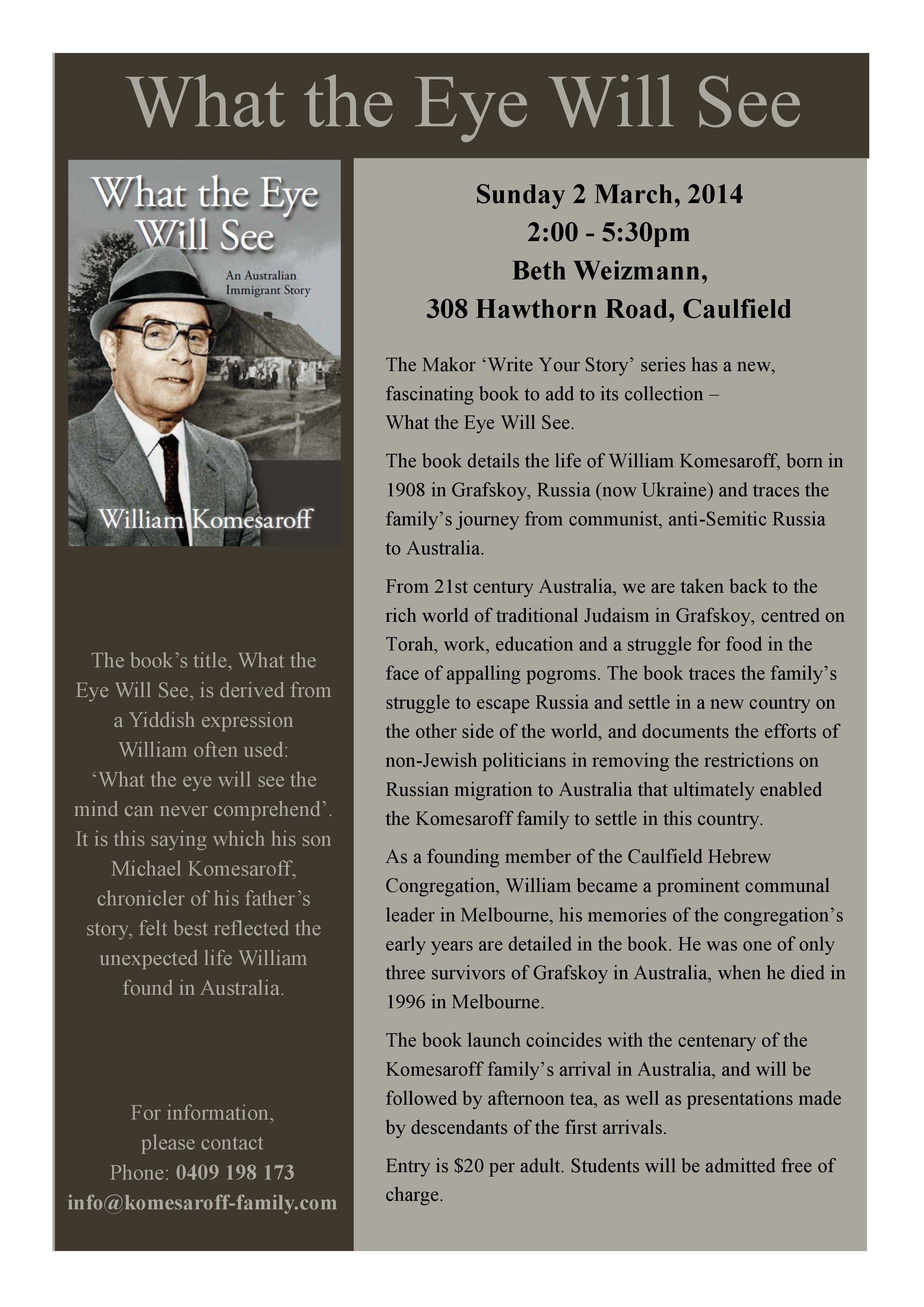
What the Eye Will See

A friend has published a memoir of his late father. When my own father passed away I wrote a memoir and published it.
The entire process was rewarding: I had honoured my father, I had told his story ‘that a later generation might know’. And I had managed my grief.
My friend Michael Komesaroff has achieved all those things with his memoir, “What the Eye Will See”. What stands out in the personality of Willie Komesaroff  (the author’s father) is his jealous protection of his good name, his deep to the bone integrity.
In addition to this private story the author has brought to bear the meticulous research skills that he employs as a visiting professor, consultant and journalist in his professional field, which is Asian mineral investment. The result is a small book with a big story. It is a very Australian story – the story of the Komesaroffs, a Jewish clan from the Ukraine; of their immigration to Australia during the years of the Russian Revolution at a time when Australian government policy expressly excluded migrants from that area.
How government policy was waived and how the Komesaroffs responded in the host country are the stuff of unseen greatness. This country’s gentile politicians who overcame public prejudice and government policy; the Moses figure of the Komesaroff clan who plucked his family from peril and set them up here; the manner in which that clan buckled down, worked hard, prospered, multiplied and rewarded Australia; this is the story of Australian migration success, writ large – but written as it were – in invisible ink. Such is the characteristic modesty and self-effacement of the Komesaroffs (noisy scion Michael conspicuously excepted) that although the clan is Melbourne’s biggest Jewish family and its members are giants of professions, they stay away from limelight.
“What the Eye Will See” allows us all to see and appreciate elements of the greatness of this country and the hidden greatness of some of its quieter achievers.
Michael invites my readers to the launch of the book. It will be a good afternoon.

What the Eye Will See launch invitation

What the Eye Will See launch invitation

Road to Recovery – (my piece published in Australian Financial Review)

Road to Recovery Financial Review article

This article appeared in the Australian Financial Review 3 January 2014. It first appeared in the Griffith Review 10th anniversary edition in 2013.This story is an edited version of a piece that will be published in 2015, in an upcoming book entitled ‘Burned Man’.

This Consciousness that is Aware

A few days ago I wrote and posted a poem. It dealt, narrowly, with a contemplated stroke. More broadly, I suppose more deeply too, it is the certain fact of my one day death that I interrogate.
It is a big question, or set of questions, for me. I am sure it is for others too.
My feelings were pressing, my need to express them was strong. Poetry was the needed medium.
This morning I awoke (still alive), moved limbs (no motor stroke) and opened a volume of poetry. The book fell open at this poem of Emily Dickenson, a poem I had not previously known. I read the work (no central stroke) and understood Emily had addressed similar questions.

“This Consciousness that is aware”

This Consciousness that is aware

Of Neighbors and the Sun

Will be the one aware of Death

And that itself alone


Is traversing the interval

Experience between

And most profound experiment

death

Appointed unto Men-


How adequate unto itself

Its properties shall be

Itself unto itself and None

Shall make discovery.


Adventure most unto itself

The Soul condemned to be-

Attended by a single Hound

Its own identity.

Emily Dickenson


After reading and considering, I recalled how Death (Emily always capitalises and personifies her erotic forces) is the subject, her opposite actor, in many, many poems. Many poems, but never too many. Such is the subject and such is the poet.
It was my great friend (and the greatest critic of this blog) who observed of my writing a couple of decades ago: “You realise, don’t you Howard, that everything you write is part of the process of coming to terms with your own death?”

Sperms

My recent mail swims with sperms. I send you these items to keep you informed.

Dr Paul Jarrett writes from Arizona:

I don’t know why spermatogenesis, the production of sperm, must take place at a temperature about 2 degrees below body temperature, but it does.

In order to insure propagation of the species – and this includes many other mammals – some means had to be employed so that a cooler environment than that within the peritoneal cavity, (where ovaries are completely comfortable), could be maintained.  The solution is to initiate the testicle at body temperature, an early necessity during organogenesis, and later in pregnancy move it outside where temperatures will be more easily regulated.  

Nerves provide temperature sensing while the cremaster muscles provide raising and lowering of the testes and further feed-back. Responding nerves provide for perspiration glands to produce sweat for evaporation and further cooling.  There are also mechanisms in place to minimize injury which I will not describe at this time.

Moving the testicle outside took a bit of doing.  During development of the embryo, (sometimes later-“Undescended Testicle) the testicle migrates out of the retroperitonal space through the Inguinal Canal to the Scrotum.  The process of peritoneum which forms the lining of the inguinal canal during this passage is pinched off at the Internal Ring if all goes well.  If not, a potential Inguinal Hernia exists with a pre-formed sac waiting for peritoneal contents to also migrate downward into the Inguinal Canal or Scrotal Sac.  This is known as an “Indirect Hernia”.  It happens with sufficient regularity to provide tuition for a Surgeon’s kids. I have repaired these from a few days old to well into old age.  They can occur in animals but are more common in bipeds. Continue reading