Mother’s Day – or Mothers’ Day or Mothers Day

This announcement was born as a boast but I make it today as a confession: I DON’T BELIEVE IN MOTHER’S DAY.* I don’t honour it, I don’t observe it (unless with quizzical disdain), I don’t respect it, (excepting as a smart marketing exercise. What began as a means of selling greetings cards in the off-season found eager recruits in floristry and in restaurantry – as well as in cafetery and lingerie. Mother/s Day has all the hallmarks of Hallmark and the hallmarks of the pulsing of empty cultures in new countries and guilty sons in the pub, at the footy, at work, at play – at living outside extended family.)

Climbing down from my lofty position of cultural oversight into the kitchen of my own life, I can identify a serious gap: my mother and I have not spoken to each other for almost five years.

I have dreamed of her. I have dreamed she dreams of me. Mum died in June 2009 and I miss her. I do not mourn for Mum: I grieve for my loss, for the delight of her company. Mum always made me smile. Always. In her breathless dying week I watched as Mum suffered one particularly horrifying attack: she gasped at air. It went on and on, as her lungs filled higher and higher with the fluid that would drown her at week’s end. I called a nurse, Nurse squirted a diuretic into Mum, the breathing slowed and Mum pulled off her oxygen mask, grinning: “You thought I was going to croak, didn’t you, darling? Well” – Mum was cackling now in the hilarity of the merry joke that was all her existence – “I didn’t, did I?”

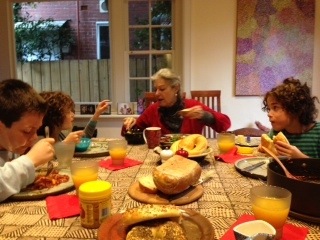
In my kitchen of now, I fry tomatoes and eggs and red kidney beans with onions fried in oil with garlic and smoked paprika and cumin. I serve this and avocado bathed in fresh lime juice and garlic-infused olive oil on a mountain of fresh bagels and specialty breads. All is prefaced by a glass of orange juice squeezed by my grandchildren. We serve this to the children’s grandmother and great-grandmother. Everyone gives gifts, festoons and cards (handmade, unHallmarked) to the old ladies. And I watch, a non-combatant. I look at my mother in law, fulfilled, filled with years. I come in, in from my chill principles, and I celebrate with them all.

*I’ve always felt the same away about Fathers Day and Valentines Day too.
20140511-050328.jpg

‘Joyful’ by Robert Hillman – A Review

There’s a CD I listen to when I want to write about something serious or something true or sad. It is Disc Two of ‘Dirt Music’, the album compiled by Tim Winton and Lucky Oceans to accompany Winton’s great and sad book of that name. Two tracks on the disc speak from the darkest room in the house of sorrow. (I refer to Sculthorpe’s ‘Dijille’ and to ‘Cantus in Memory of Benjamin Britten’ by Arvo Part). The grief is absolute. It neither cries nor shouts nor tears its hair out. It simply quivers and ultimately exhausts itself and lapses into barely audible human breaths. And thus into harmony with life. The experience leaves me quiet, reconciled – I suppose – by sheer truth. And beauty.

What has that to do with Robert Hillman’s new book, “Joyful”?  I read a passage in the later part of the novel where a character who has lost his only two children weeps silently in the utter darkness of a room in the mansion that gives the book its name. His quivering presence is sensed by his host, Leon Joyce, owner of “Joyful”. Joyce, who has been observing his own prolonged season of bottomless grief, stands, wordless and motionless. The weeping one comes to realise he is not alone. Each sorrows in silence, both men understand. No sign, no word. But something beyond words is known: the two men and the grateful reader make their way from that room in “Joyful” somehow reconciled to loss. And that is what Hillman’s book is about – its chief theme – how we humans risk all and lose all when we (inevitably) invest in passion.

Robert Hillman is not famous for misery, any more than Winton. The misery is there in the book as it is in life. But “Joyful” is also a story of the greatest vitality, the most audacious imagination, the most original characters, (from the carnal priest who absolves himself habitually, to Dally the Wordsworth-loving Iraqi Kurd, to the sexually hyperactive Tess, to the hapless Emily who cannot love any man who loves her, to the world-weary, gusset-guzzling, false-poet Daniel.) And the book is full of gems from the bowels of Hillman’s imagination that made me roar with unexpected belly laughing.

I defy the reader to get through “Joyful” without shedding tears of mirth and tears of joy. In short, I like it. I admire it. I respect it, I envy it, I treasure it. I’ll remember it.

joyful“Joyful’s” characters are destined to live in memory alongside Winton’s Fish and Lamb families that emerged from “Cloudstreet” and took up lodging in a nation’s treasury.

Text published “joyful.” Howard Goldenberg will launch it at Readings in Carlton at 6.30 pm on Wednesday 7 May. Please come along.

Gun and Pelvic Floor Control

My ancient friend (and immensley experienced) colleague in Arizona, Dr Paul Jarrett, is a humane and wise man. Despite our closeness, we do not agree on all matters, in particular, on gun control.
Put briefly, I favour gun control, Paul opposes it.

He forwards me this news item:

“Cops: Teen Had Loaded Revolver In Her Vagina”

It is not that I search for prurient headlines, they find me. Hey, I didn’t make this up.

One can not help but be intrigued by bizarre reports that come our way via the News.

Here for example is an unusual holster for a six-shooter. One wonders how “Quick on the draw” the wearer of such a weapon can become? One would expect that in a teen-ager it would be a tight fit, but one never knows about teen-agers any more.

I would never be able to complete a pelvic exam on this “heat packer”, I’d have my hands up.

PBJ

In this particular case, Paul and I are in agreement: this armed individual is a hazard to herself and to her intimates. Most concerning to us is the danger she poses to doctors.

All the Little Birdies on Jay Bird Street

To tweet or not to tweet?

I am not new.

I am not on drugs,

I am not really, truly comfortable on Facebook (friendless, a face without a body, a name without a spirit);

I am not on Survivor.

I am scarcely sociable. I suspect I am constitutionally disabled from social media.

Given all that should I be ” on” twitter?

I am not new. I bought a mobile phone, I made a call and then wanted to hang up. I turned my phone off, powered off, as the purser says before takeoff.

I am not new. I bought a CD player, listened to the disc then asked my son to turn the record over.

I am not new. my face looks like a scrotum – pleasant enough, but wrinkled.

I am not new. Twitter is new. I tweeted last week (@howiegoldenberg, apparently), and made my cerebral, pedantic self incomprehensible. I am a creature of big words, old habits, clumsy fingers, ponderous expression and I do not know what a hash tag is.

I am not new. I have achieved absurdity well before twitter, and have retained that condition. Do indeed to tweet to make myself absurd? I am told I need to poll my readers and followers on the question. I am so unnew I won’t be able to track the responses.

Should I tweet? The prime minister of turkey has just vowed to close down twitter. An Australian MP just took himself off twitter because of hate mail. Someone, he said, tweeted in the name of Tony Abbott and displayed an image of a penisface.

Should I risk someone drawing me a scrotum face? Should I, with all this, tweet? 

RSVP HG

Tracks

Tracks

Tracks

Tiny cinema. Although the tickets are numbered, you can sit where you like, the audience is so sparse.
Opening images of a waif, a child in a yellow dress, walking. You see her from behind as she walks before you. The camera – and your eyes – follow her tracks.
The remainder of the slow movie is much the same: the waif, now of adult years, walks and the watcher follows her tracks. “Tracks” is the name of the movie and the name of Robyn Davidson’s book that preceded it by some decades.

The adult waif informs unbelieving Centralians, “I am going to walk to the ocean.” She speaks with an affect of subdued dourness. There is a tinge of defiance in anticipation of skepticism. The character is defensive, often enough sour. A person alone, she imagines she is independent of approval, of fellowship. Halfway from Alice to the WA coast she discovers, suddenly, violently, her human need. She practically rapes her astonished companion, the awkward photographer whose incursions into her aloneness she resents and finally accepts. Clumsy in his American optimism and belief and cheer, he saves her life by dropping jerry cans of water ahead on her route.

The movie has little dialogue. The silence speaks, the emptiness of the continent speaks. Motifs recur – sand as the tabula rasa of existence, fire as companion, water as vivifier. And the land, “country” in the language of her Aboriginal friends ( she makes a few friends, all of whom exist on the uttermost edges of Australian society. In the unexpected sweetness of the waif’s friends the movie approaches caricature. The traces of sentimentality are forgiven, offset as they are by the central character’s acerbity.)
The land, on the other hand, is eloquent and true. No matter how dramatic the image of hill, of shimmering emptiness, of spinifex, of purpling distant ridges, those images are true. The land – tracked in this way only by Davidson, the lost Leichhardt and Aborigines – is immutably itself.

This viewer, watching Davidson’s traverse, felt the flood of deep knowing, of coming home.
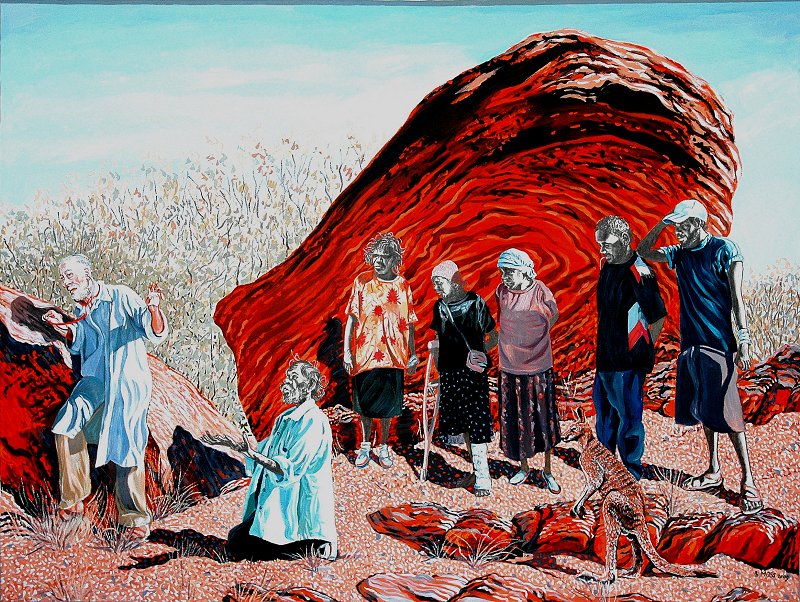
This land is the home of us whitefellas, a home known uniquely to relatively few, characters like Davidson, like Rod Moss, (artist and author of “The Hard Light of Day” and “One Thousand Cuts”). Their knowing is informed by the blackfellas who have shown them their home.

If you’ve missed this movie, don’t worry. Here for five minutes, gone tomorrow, I think it will never disappear. Like Davidson’s book the movie will be sought and valued so long as whitefellas are curious about the land, so long as we ponder our human aloneness.

A Message from the Moderator on Blog Policy

This is a belated message from the moderator of Howard Goldenberg’s blog.


As this is the first time that the moderator (not Howard) has posted on Howard’s blog, I’d like to take this opportunity to welcome you and thank you for your interest and comments.


Unfortunately the need has arisen for creation of a set of blog guidelines that perhaps should have been anticipated earlier.


Howard spends a significant amount of time and effort preparing content for his audience. He doesn’t get paid for this. He blogs because he likes writing and gets great enjoyment from receiving feedback as well as hearing differing views from his own.


Comments from followers with views that are differ from Howard’s or are critical of his opinions are both accepted and encouraged.


We support positive and productive discussions and we request that the tone and focus of comments are respectful.


Comments that are personally offensive, defamatory or may publicly humiliate the writer or others are unacceptable. Gratuitous personal attacks made under the guise of literary criticism will not be tolerated.


Future posts that are offensive, ad hominem or disrespectful will be removed. Repeat offenders will be denied access from posting future comments.


In the event that an objection arises to the moderator’s decision, the objection will be considered but ultimately the moderator’s decision is final.


I sincerely hope open discussion will continue for all followers of Howard’s writing and that free discourse is not impeded by negativity.

Thank you.

Road to Recovery – (my piece published in Australian Financial Review)

Road to Recovery Financial Review article

This article appeared in the Australian Financial Review 3 January 2014. It first appeared in the Griffith Review 10th anniversary edition in 2013.This story is an edited version of a piece that will be published in 2015, in an upcoming book entitled ‘Burned Man’.

Dying. Liberty. Law.

Philip Nitschke believes in liberty. In particular he believes in the right of a human being to die when he wishes to. He does not believe a government should trump that right.

I think, in principle – somewhat unexpectedly – I agree with Nitschke. Thus far.
I have seen my patients suffering intolerable pain that will not end. Governments, lawmakers, do not sit in the bedrooms of the dying. They cannot know how deeply disqualified they are here.
Nitschke has been a gadfly irritating the conscience of this country for decades now. I have felt an instinctive distance from him, quite unreasoned, candidly prejudicial. It was not until he declared (in response to questioning in a recent interview) that his philosophic touchstones are Camus, Marcuse and Nietsche, that my finger suddenly touched on the point of prejudice: Nitschke – Nietsche. The latter is a name to which no Jew can be insensitive. Like Wagner, like Eliot, a name carries echoes. I read Nietsche and I hear echoes of “Man and Superman”. Vibrating behind, the euthanasing of the ‘untermentsch’ in the Third Reich.
Nitschke thinks the euthanasing of people who are “tired of life”, as proposed in the Netherlands, is reasonable. The so-called  Groningen Protocol spells out criteria for infant euthanasia. The Belgian Senate approved by landslide proposals to extend euthanasia to children and to “people suffering dementia and other diseases of the brain.” The Royal Dutch Medical Association believes doctors can euthanase children because “a doctor’s primary duty of care is towards the patient.”
All this makes me shake my head. I know next to nothing of Nietsche, I have seen none of the context of the deliberations of my colleagues in the Royal Dutch Medical Association; I know nought of the Groningen Protocols (‘protocols’ – another word that echoes, echoes, echoes).
What do I know?
I know the problems of suffering are grievous.
I know that the ethical burdens are weighty.
I know just as severe pain cries out for relief, so societal dilemmas cry out for solution. People look to lawmakers to solve the problem by making a law. A law will be a relief, a slogan to comfort us.
I don’t believe that all problems can be solved by lawmakers.
I believe lawmakers have no right to legislate for one citizen to kill another.
I know there are some laws that some people will not carry out; and all too many others will.
I have no doubt that a society that authorises doctors to kill, kills trust in doctors.
Clearly what I know and what I think are insufficient. They are incoherent, not a policy, not a solution.
Human suffering cannot be outlawed.
Law is not the solution.
We are bound to pursue a solution.
But we might never find that solution.

A Pogrom in Islamdom

2013 has been the year of the burning church. Throughout Islamdom churches burn. 

It started before 2013. For over a decade I have seen my Coptic patient from Egypt beside himself with grief and anxiety as he watches his relatives trapped in fear, paralysed like a kangaroo doe in my headlights, unable to resolve – to flee or to stay?
He sits, this large man, in my consulting room and nurses his ulcer. Gaps, lacunae of silence in the consulting room and his eyes fill with tears as the silence falls and swells.
At present Egyptian Copts burn bright and hot enough to hit our papers. Syrian Christians burn.
Elsewhere, in Iraq, the oldest Christian community in the middle east convulses. In 1991, Christians in Iraq numbered 1.3 million people; today they number 300,000 to 500,000. Catholic Chaldeans, Nestorians, Orthodox, almost all Iraqi Christians are ethnic Assyrians. Assyrians speak Aramaic, lingua franca of Jesus. From time to time I meet a Christian from Iraq in the Children’s Hospital where I work. When I address him and his family in my rudimentary Aramaic (which is, of course, an inherited language for any Jew who has ever opened the Talmud), their faces open in disbelief, in joy, in homecoming from linguistic exile.
(While liberal Christian groups turn a blind ear to the slaughter of fellow Christians there exists but one country in the middle east where, as Gabriel Nadaf, a priest, declares, “we feel secure”. Guess which country.)
Last week 34 Assyrians died in a church bombing in Baghdad. In 2010 a series of ‘suicide bombings’ (call sign of the hero martyr, history’s adolescent crying LOOK AT ME! LOOK AT ME!) killed 58 people. There have been 71 church bombings reported in Iraq since 2004.
So much, so normal, so historically unremarkable. So much blood: thirty four here, fifty eight there. Have you seen how much blood there is in the body of but one human being? (I have. Cain did. God called to him saying: “The bloods of your brother call out to Me from the earth.”
Why bloods – in the plural? Because, explains the commentator Rashi, no-one had seen a human die before Cain. No-one knew how much blood
there was in one human brother.)
We know now about the blood of the human person. We cannot plead ignorance.
I remember another time – it was recent, only November 1938 – when houses of worship burned, when the bloods of my brothers cried out.
I remember the shameful silence of the decent civilised world. I remember the silence of churches, governments, communities in Australia
following the great pogrom that was the night of broken glass. I remember how my people was forgotten. I remember the silence.
I remember William Cooper and his Aborigines Advancement League raising the sole protest in Australia against the pogrom.
There are pogroms occurring throughout Islamdon. There is a great silence here.
Do we need to wait for another Australian Aboriginal leader to awaken this nation, to rouse its parliaments, its churches, synagogues and mosques, its noisy Boycotters, its pious Divestors, its smug Sanctioners, to cry: “I am my brother’s keeper?”

Nobody Doesn’t Like a Song

I

Whenever I wanted to read a poem to my father he’d make a face. He claimed he didn’t like poetry. I suspect it was the ambiguity in a poem that frustrated him. In fact Dad loved poems, the poems he committed to memory in his schooldays. He recited some of these often enough for them to take seed and grow inside me.

Now Dad is gone and it is I who recites his lines, learned at school around 1925:

Blow, blow, thou winter wind

Thou art not so unkind

As man’s ingratitude…

Thy tooth is not so keen

Because thou art not seen

Although thy breath be rude

I see Dad’s wry smile as he continued with lines that border on the cynical.

Sing Hey Ho, Hey ho unto the holly

Most friendship is feigning

Most loving mere folly

Dad was not cynical. So what appealed to him about this snatch from ‘The Tempest’?

I think it was the music.

Lots of people think they don’t like poetry. They would never read a poem – not willingly, not wittingly.

But they listen to songs. And a song is just a poem hidden inside music.

Think of the Beatles. Think of ‘Till there was you’. Think of ‘Elinor Mackenzie’. We loved those songs, not least for their poetry.

Nobody doesn’t like a song.

Continue reading