You are Invited

Once upon a time a redheaded warbler sang a song to a crowd of people gathered to hear her and readings from a book about two redheaded twins. As she sang the crowd chewed on antithetical foods – carrots and Jaffas, small, red spheroids of joy.

The singer was Clare Bowditch, songwriter, mother of twins-plus-one, social activist, actor, philosopher and articulate introspector.

The reader was Howard Goldenberg, author, marathon runner, marathon eater, marathon talker. He read (affectingly) from his new book, a novel about “Jaffas” and his identical twin “Carrots”, two boys who grow with souls enmeshed. One is kidnapped and the two must struggle to find how to lo live as individuals. The author makes them and their parents suffer; he makes the reader suffer; and after adventures in the Aboriginal outback (in ‘country’), Howard allows all (or almost all) to trace an arc of redemption.

The crowd had come to Readings in Glenferrie Road, Hawthorn, not to eat lollies, nor to chew on root vegies, but to hear and see Clare, to be near her in the intimate space (one of Melbourne’s sacred sites) of Readings bookshop.

Why Clare? Becauser of her twins? Because of old friendship between singer and author going back to her teen years? Because the singer – like the boys in “Carrots and Jaffas” lost a sibling in early childhood? Because of red hair?

The true reason is the Bowditch heart, the same that pulled in the crowd. The heart that can say, “I’ve had enough claps” and “I’ve always drawn from the pool of suffering for my art.”

As Emily Dickenson says: I like a look of suffering/because I know it’s true.

Clare Bowditch sings true songs. In the same way “Carrots and Jaffas” is a true story.

Did I say the event has taken place? That part was not true. It is still to come:

READINGS HAWTHORN, THURSDAY 22 MAY AT 6.30 FOR 7.00 PM. ALL WELCOME

‘Joyful’ by Robert Hillman – A Review

There’s a CD I listen to when I want to write about something serious or something true or sad. It is Disc Two of ‘Dirt Music’, the album compiled by Tim Winton and Lucky Oceans to accompany Winton’s great and sad book of that name. Two tracks on the disc speak from the darkest room in the house of sorrow. (I refer to Sculthorpe’s ‘Dijille’ and to ‘Cantus in Memory of Benjamin Britten’ by Arvo Part). The grief is absolute. It neither cries nor shouts nor tears its hair out. It simply quivers and ultimately exhausts itself and lapses into barely audible human breaths. And thus into harmony with life. The experience leaves me quiet, reconciled – I suppose – by sheer truth. And beauty.

What has that to do with Robert Hillman’s new book, “Joyful”?  I read a passage in the later part of the novel where a character who has lost his only two children weeps silently in the utter darkness of a room in the mansion that gives the book its name. His quivering presence is sensed by his host, Leon Joyce, owner of “Joyful”. Joyce, who has been observing his own prolonged season of bottomless grief, stands, wordless and motionless. The weeping one comes to realise he is not alone. Each sorrows in silence, both men understand. No sign, no word. But something beyond words is known: the two men and the grateful reader make their way from that room in “Joyful” somehow reconciled to loss. And that is what Hillman’s book is about – its chief theme – how we humans risk all and lose all when we (inevitably) invest in passion.

Robert Hillman is not famous for misery, any more than Winton. The misery is there in the book as it is in life. But “Joyful” is also a story of the greatest vitality, the most audacious imagination, the most original characters, (from the carnal priest who absolves himself habitually, to Dally the Wordsworth-loving Iraqi Kurd, to the sexually hyperactive Tess, to the hapless Emily who cannot love any man who loves her, to the world-weary, gusset-guzzling, false-poet Daniel.) And the book is full of gems from the bowels of Hillman’s imagination that made me roar with unexpected belly laughing.

I defy the reader to get through “Joyful” without shedding tears of mirth and tears of joy. In short, I like it. I admire it. I respect it, I envy it, I treasure it. I’ll remember it.

joyful“Joyful’s” characters are destined to live in memory alongside Winton’s Fish and Lamb families that emerged from “Cloudstreet” and took up lodging in a nation’s treasury.

Text published “joyful.” Howard Goldenberg will launch it at Readings in Carlton at 6.30 pm on Wednesday 7 May. Please come along.

On the Passing of a Great Writer

At the time of writing this, I have read scores of tributes to Gabriel Garcia Marquez, all of them as tweets. In other words, I have read nothing so far in mature media, (an expression that identifies me as a culturally bewildered old fart).

Great writers will have their say in traditional media.
Thus far the twitterers. Now me.

I was intrigued as I read these tweets. They poured, a growing stream of tributes, pausing at intervals, I suppose, to gather electronic breath, then flowing again. The process seemed as alive, as dynamic, as the flowing of a swift rivulet that paused on reaching rocks, only to cascade over and around them and plunge downstream in a Gabriel Garcia Marquezswelling spate. I felt excited by the energy I witnessed. I felt I heard the whisperings of legion one-hundred-and-thirty-character authors, everyone of them sounding forty years younger, forty years more at home here than I. Their twittering grew and grew to a chorus.
The energy was mildly thrilling as it gathered strength. It could frighten me if (forget “if”; think ‘\’when!”) it becomes a mob. I remember, too well I remember the cries at Cronulla; the cries of the mob as Dreyfus is cashiered (“Death to the Jew!”).
But I digress. Or do I digress? Only if the medium is not the message.

And what did I hear, what sense as the tweeting reached crescendo?
I heard love. I heard grateful appreciation. Marquez became a beloved writer. And his writing was the antithesis of the tweet. Substantial, considered, it paced itself with the uneven gait of the human.

I was impressed by the way tweeters reached for language worthy. None found his writing “awesome”; no-one said Marquez was “amazing”. No-one buried him in dead language.
Instead they offered back beloved lines. I record the four most quoted in ascending order of popularity:

Fourth: The only regret I will have in dying is if it is not for love.

Third: Nothing in this world was more difficult than love.

Second: Nobody deserves your tears, but whoever deserves them will never make you cry.

First: What matters in life is not what happens to you but what your remember and how you remember it.

Of these the first three are switches planted onto the pages of Marquez’ writing that light up a remembered feeling, an emotion recognised by the grateful reader.
The lines on memory appear more elusive than allusive. Subtle, demanding a pause, requiring meditation, the memory quote speaks to all who are mortal of what might remain, of the immortal.

What is my own response to Garcia Marquez’ writing? People call it magic realism. I recognise something older. I hear the thrust of story in the bud, bursting into flower. I hear the pulsing of the “Thousand Nights and One Night”. I hear storytelling.


The Boringest Cliché

1510472_366538920155302_968766595_nWe have all seen too many movies, read too many stories and attended too many plays where some person (always male), his hair thinning, his relationship failing, struggles endlessly to start his novel. Or to get over his writer’s block. Or to complete the bloody thing. Or to get it published.


Great writers have whinged greatly on this theme. Jonathan Franzen (The Corrections) and Nam Le (The Boat) have fretted memorably. The world has now read, seen and heard enough on the theme.


Yet, four and a half years of my (how much?) remaining time have disappeared in the creation of my own novel, “Carrots and Jaffas”. I watched and saw the sands of my time trickle profitlessly as through an hourglass. I wrote a masterpiece each morning and re-read lines, dead and drear, each evening. I took six months off work ‘to finish the novel’. Those months passed and a further draft joined the previous six in my waste paper basket.


For the past four and a half years I have lived that cliché. My wife and family have experienced that neglect.


Now Carrots and Jaffas poke their red heads (slab-shaped due to their premature arrival, ironically polar to the postmaturity of their story) out from the beautiful, bright covers that bear their names and Hybrid Publishers commissioned for them. The twins’ struggles to survive, their unnatural/supernatural/utterly natural intimacy, their delayed individuation, their painful discovery of separated self – all these have lived within me; and now Carrots and Jaffas face the world naked and without.


They tremble before you.

Two Writers Wrote My Novel

One of the two, a good bloke, would get up too early in the morning, charge himself with caffeine, and – sparking with imagination and creative drive – write passages of prose that really excited me. I liked that bloke. The second, born on the same day as the first, was much older. A sour individual, crepuscular and nocturnal in habit, he’d cast a jaundiced eye over the other bloke’s matutinal erections and scorn them into impotence. He’s scratch out every virtuoso phrase, he’d cut through digression and elaboration. Mean as catshit, he believed less was more, and least was most. I found him unpleasantly convincing. I hated the bastard.

Both antagonists worked on Carrots and Jaffas from start to finish. They managed to draw out a six-month project to four and a half years. By the time the book was printed I was nearing sixty-eight and I resolved I was done with the novel: how many more fifty-four month projects did I have left? Bugger the novel, I decided. I’d read them still, I just wouldn’t write any more.

Three months later I had finished my second novel. Titled “A Threefold Cord”, it is a novel for shared reading between an adult and a child of eight to twelve. And it is a cracker. The book comprises sixty-seven chapters of action, suspense, hilarity, and the unremitting contest between good and evil. In addition there is sufficient reference to bodily functions to delight and liberate a well brought up child.

As the book raced towards Chapter Sixty I informed my oldest grandson I would end it after the sixty-seventh. “Why, Saba?”
“Because I am sixty-seven.”
“But what if it’s not finished?”
“Doesn’t matter. I’ll just stop.”
“But you can’t!”
“Yes I can. I’m the boss of this book.”
“But…” The notion of such a summary ending outraged him.
I relented: “I might just start a second book where this one finishes…”
Grandson’s 10-year old face blazed with a happy prospect: “Wow! A series!”
Where were the antagonists of “Carrots and Jaffas” during the writing of “Cord”? I sacked them. I simply wrote for my five oldest grandchildren, aged eight to ten years. No virtuoso passages, no miserly pinching, “Cord” was a conversation with five kids who knew my voice, five kids whose tastes I knew: tastes I had helped to create.
My older daughter, a combined Regan and Goneril in her criticism towards my writerly Lear, assures me no child will tolerate a book with such a title as dull as “A Threefold Cord”.

I know she is wrong. Grade Four at a primary school near Shepparton served as unwitting testers when their teacher resolved to read aloud a daily chapter. Ordinarily, she informs me, the wrigglers would wriggle, the whisperers would whisper and the autists would be up and away. But when she read a Threefold Cord all sat, transfixed. The teacher got through five chapters on the first day.
Since then the children and grandchildren of selected Australian literary figures have read Cord and approved it mightily. From time to time over coming weeks I’ll post the odd sample chapter and you’ll see I am right: “A Threefold Cord” is, as I remarked earlier, a cracker.

Not a Vegetable, not a Lolly, Something entirely Novel

Carrots and Jaffas

Carrots and Jaffas

I have just given birth to two brainchildren. Named ” Carrots and Jaffas”, the two are alive and well and between the covers of a book of that name available from Hybrid Publishers.

The conception of these identical twin red-headed boys was painful; the gestation was prolonged; the birth leaves their parent happy, proud, excited and sore. And, to tell the truth, a bit nervous.
Will the world love my newborns?
Will they survive?
They said, everyone has a novel in them: what if they meant everyone has a navel. I do.

They said the novel is dead. But kindle and axon and hundreds of bookshops around Australia seem unaware of the news. Readers will find carrots and jaffas – the novel, not a veggie, not a lolly – in bookstores from April or as an e-book from iTunes or Amazon.

See the sample attached: C&J 1-1

Please tell me what you think.

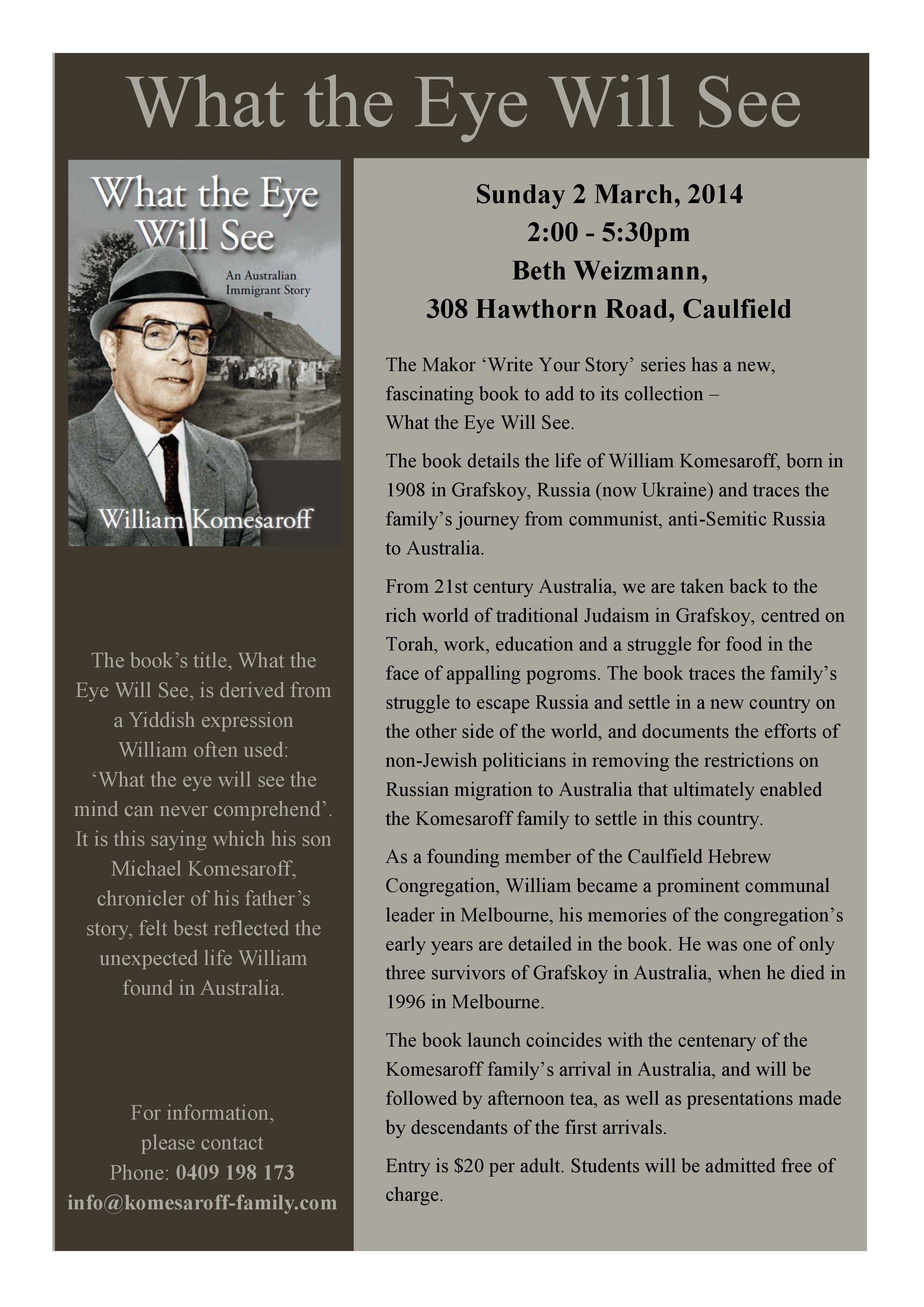
What the Eye Will See

A friend has published a memoir of his late father. When my own father passed away I wrote a memoir and published it.
The entire process was rewarding: I had honoured my father, I had told his story ‘that a later generation might know’. And I had managed my grief.
My friend Michael Komesaroff has achieved all those things with his memoir, “What the Eye Will See”. What stands out in the personality of Willie Komesaroff  (the author’s father) is his jealous protection of his good name, his deep to the bone integrity.
In addition to this private story the author has brought to bear the meticulous research skills that he employs as a visiting professor, consultant and journalist in his professional field, which is Asian mineral investment. The result is a small book with a big story. It is a very Australian story – the story of the Komesaroffs, a Jewish clan from the Ukraine; of their immigration to Australia during the years of the Russian Revolution at a time when Australian government policy expressly excluded migrants from that area.
How government policy was waived and how the Komesaroffs responded in the host country are the stuff of unseen greatness. This country’s gentile politicians who overcame public prejudice and government policy; the Moses figure of the Komesaroff clan who plucked his family from peril and set them up here; the manner in which that clan buckled down, worked hard, prospered, multiplied and rewarded Australia; this is the story of Australian migration success, writ large – but written as it were – in invisible ink. Such is the characteristic modesty and self-effacement of the Komesaroffs (noisy scion Michael conspicuously excepted) that although the clan is Melbourne’s biggest Jewish family and its members are giants of professions, they stay away from limelight.
“What the Eye Will See” allows us all to see and appreciate elements of the greatness of this country and the hidden greatness of some of its quieter achievers.
Michael invites my readers to the launch of the book. It will be a good afternoon.

What the Eye Will See launch invitation

What the Eye Will See launch invitation

A Cherub

Working here on the old camel trails, we commonly encounter a Rasheed, an Ahmed or an Akbar.

And there is always a story.

This particular little ’Afghan’ is 15 months old, a cherub with round cheeks and light brown curls.

When you see a face like this you cannot stop yourself from smiling.

A child with a face like this finds himself in a world where every adult smiles at him. He likes this world that seems to love him so.

Sarah, his mum, has the same ripe-fruit cheeks.


What is the cherub’s story?

Sarah explains: “Akbar’s great grandfather was a cameleer. His great grandmother was Aboriginal. Here – you can read about it in this book.”  Sarah hands me a heavy paperback, titled “Linden Girl”, by Pamela Rajkowski. The subtitle reads: a story of outlawed lives.

There is always a story, and that is the cherub’s story. It is the story of a couple and their encounters with Law. The Law forbade this cherub to exist.

Continue reading

Malpa

About ten years ago an old man consulted me as his doctor of second choice. (His own doctor was away; really I was the doctor of no choice.) A compact man, charming, he smiled beneath a tidy military moustache and carried a Veteran’s Gold Card. Eventually he promoted me to doctor of equal choice. In this capacity I doctored him to death.

In due course I received a letter from the son of the deceased, thanking me. Not for his father’s dying but for the doctoring. Eventually the son and I met.  A remarkable man: no moustache, same charm, huge human warmth.

The son’s name is Don Palmer. He says he used to work for God – in the Anglican franchise. Eventually he resigned from Holy Orders and created Malpa, the imaginative project born of urgent compassion and imagination that teaches Aboriginal kids how to become ‘Young Doctors’.

His story inspired a chapter in my forthcoming novel, Carrots and Jaffas, the story of a couple of identical twins, violently separated. With Don’s blessing I pinched his idea. My chapter reads as follows: Continue reading