(Someone told me recently a blog post is supposed to be of six hundred words. It sounded like one of the Laws of the Universe, like when we have an Equinox and when we have a Solstice. The Law reached me too late to stick. What follows is a story longer than the prescribed six hundred words. If you read it to its end you will understand I post it now to encourage a friend.)
Wrestling with the Murderer
***
It was in the late ‘nineties that I first met Chief Inspector John Bailey, the son of a policeman who had been awarded the George Cross posthumously. I had come to Albury expressly to hear the story of Eric George Bailey, the police officer who arrested his own murderer.
In the course of that first meeting John Bailey showed me the George Cross that the King of England awarded to his father. A large man, he hefted the silver cross in his palm, raising and lowering it slowly, in time with the cadence of his weighted words, as he told me of his father’s life and death. Then he passed it to me. The medal, small in John Bailey’s hand, surprised me with its weight. Bailey said, “It’s what I have had to remember my father. It’s a rare and precious thing, a George Cross, but it’s not a father.
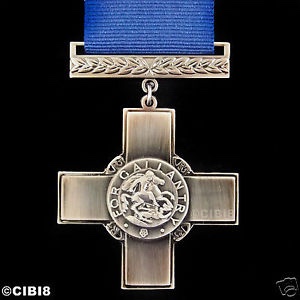
“I’ve got to pass it on, the medal. The Police Museum wants it, but I won’t let it go to them. I’ve seen too many things disappear from there, precious things, things that ought to remain when a man is gone, things that honour a person. This one was my father’s. “I’d trust the War Museum in Canberra. I’d be happy to see it go there, but not the Police Museum.”
The Chief Inspector was a tall man, stooping more for courtesy than for age, more or less pear shaped. Only his nose and his fingers were thin, arrows of curiosity projecting into the world before him. His eyes, hooded in age-loosened skin, looked at me, hawk-like, as he nodded slowly, “No, not the Police Museum.”
Bailey excused himself: “There’s a book I want to show you. I’ll bring it out.” I sat in the late afternoon sun on the Baileys’ small verandah and pondered the old man’s words: it’s not a father.
John Bailey returned carrying a copy of “They Dared Mightily”, an account of all Australians who had won the Victoria Cross or the George Cross. I learned that only about 400 of the latter have ever been awarded; in the echelons of courage it is the full equal of the Victoria Cross; and together with the VC it is the only royal honour ever awarded posthumously. Bailey opened the well-thumbed volume at page 279, pointed to his father’s citation and handed it to me to read. A quietly spoken man, he wanted me to know how history recalled his father, but he would not declaim or boast. The record must speak for itself.
The full citation was published in a supplement to the London Gazette of 25 October 1946 and read in part:
St. James’s Palace, S.W.1, 29th October, 1946.
The King has been graciously pleased to make the undermentioned awards of the GEORGE CROSS: —
Eric George BAILEY (deceased), Sergeant 3rd Class, New South Wales Police Force.
At about 8.30 p.m. on the 12th January, 1945, Sergeant Bailey (then a Constable 1st Class), whilst on duty in Adelaide Street, Blayney had occasion to speak to a man whose movements were suspicious. During the questioning the man pulled a revolver from his pocket and fired a shot which struck Bailey in the stomach. The Constable immediately closed with his assailant who fired two more shots. Although fast succumbing to his injuries and suffering from the effects of shock and haemorrhage, Bailey continued the struggle with the offender and held him on the ground until assistance arrived. Shortly afterwards he died. The fortitude and courage manifested by this Police Officer, in spite of the mortal injuries sustained by him at the outset of the encounter, constitute bravery and devotion to duty of the highest order.
Almost in passing there follows an account of an earlier act of heroism, desperate and unsung:
On 20 April 1939 he moved to Moruya, here he was highly commended for his part in the rescue of survivors from the fishing trawler, Dureenbee, which had been attacked by a Japanese submarine on 3 August 1942. He was transferred for the final time, to Blayney, just eight days before his death.
The face of Eric George Bailey looks out from his photograph on page 280. It is a young face, small and fine-boned beneath the broad visor of his police hat. The gaze is steady. I looked up at John Bailey and there was the same steady look. The look of the young man who was his father. In coming to Albury to learn about Eric George Bailey, GC, the father. I had no expectation of this man, his son. I had not imagined him. The son, I soon learned, was a story in his own right.
I asked John Bailey for his own recollections of his father’s passing. He was glad to oblige: ”Just before my father left the house to go to work, he paused and bent down to me and rubbed my head. He kissed my mother. He reached down to pat my little sister. Then he went through the doorway. I never saw him alive again.”
When John Bailey spoke he was irresistible. Speaking slowly, his voice emerging from his deep body, he chose his words carefully, simple words, spoken steadily by the old policeman, who regarded me steadily as he spoke. John Bailey looked across the small verandah towards me – and beyond me – to the scene he described. He looked at me, bringing me with him into that scene. It was alive in him as he spoke. I was soon to see that it had been alive to him ever since his father died, on January 12, 1945.
“The previous evening my father had said to all of us, ‘Tomorrow is the start of a new life.’ He and mother had brought us to the town of Blayney a week previous. Father had a week of leave that he used to settle us into our house and into the town.
“I remember Father brought a whole trailer load of onions and garlic with us to Blayney. He was a great gardener. He had grown them at his previous posting and he spent the last day of his leave fixing chook wire high under the roof in the garage to keep the onions and garlic dry.
That night Father said: ‘Tomorrow’s the day, the start of a new life.’
The next afternoon he walked out through the door for the 3.00 o’clock shift… I can still see him going out the door…”
“Father was one of nine children, the youngest. His family didn’t have much. My father didn’t own a pair of shoes until he was ten years old. He left home when he was fourteen to join the Post Office. He was a telegram boy. When he was twenty he joined the Police Force in Sydney. He worked for a while in Traffic, like all of them. Then he asked for a posting to the country. He was from the country himself… from Tenterfield. His people were farmers there.
“Father had married my mother in Sydney. She was a Sydney girl. When they were posted to the country it was to The Rock, not far from here…
“The Rock is a pretty small town. There were only a couple of hundred people. It was a one-man police station. It must have been a terrible shock to my mother, coming from Sydney to a place like that. But she accepted it.
“After The Rock Father was posted to Gundagai. I was born in Gundagai, in 1929. Then we went to Narrandera, then to Deniliquin, then Balranald. Every posting we went further west. Do you know Balranald?”
I shook my head. I knew the other towns he named: Narrandera is only 19 miles up the road from my home town of Leeton.
“Well, you would know Hay then – Hay, Hell and Booligal – Balranald is further out still… I remember the summers in Balranald. They were hot. The police house was very hot. A low roof…it was tin. One day the Chief Commissioner called in at the Station and Father invited him up home. He stopped with us for the night. I remember him and Father, both sitting out the back in the hot night. There was Father in his singlet, sitting with the Chief Commissioner of Police. He stripped down to his singlet too.
“That’s my first memory of the Chief Commissioner.
I met him again… after…
The Chief said to Father: ‘How can your wife live in this heat, a woman, with a child?’ So we were posted to Moruya. We were there from 1939 to 1945.”
“We arrived at Blayney on January 3, 1945. Father started work in Blayney on January 12. He was shot that first day.
“My father was the only police officer to arrest his own murderer.”
A John Bailey pause. He lifted the little black leather casket and hefted it a couple of times. He put it down again.
When he resumed John Bailey shifted to the present tense: “Father walks the three quarters of a mile to work. On his way he stops at the picture theatre, to introduce himself to the proprietor. Father is the new police officer; he wants to meet the people who do business in the town.
Just then a man runs in, shouting that a man is waving a firearm about in the Exchange Hotel. Father knows the Exchange. We stayed there our first few nights in Blayney while they got the Police House ready for us.
“Father goes straight to the Exchange. In the Lounge they point out a man wearing a sort of uniform. He’s talking excitedly. Father doesn’t want an over-excited man with a firearm inside with all those people. He says: ‘You had better come outside with me.’
“They go outside. The man is wearing the uniform of the American Merchant Marine. Father questions him – name and address and so on. His answers aren’t satisfactory. He does say he is staying at the hotel. Father says ‘I think we had better search your room.’
Now the man becomes really agitated. He pulls out a handgun. Father says: ’Give that to me.’ He takes a step towards the man. The man shoots at my father. The bullet enters the left side of my father’s abdomen, passes through his liver, then up into his chest and lodges finally in his right shoulder.
“My father begins to bleed. My father closes on the man and grabs him by the arm. They wrestle and my father throws him to the ground. He comes to rest in the gutter, where they continue to wrestle. My father is getting weaker, but he manages to get on top of him.
The man still has the weapon in his hand, and my father attempts to take it while the man tries to shoot again. He manages to discharge the weapon but Father has deflected the gun so the shot goes astray. The bullet is found later in the ceiling of the hotel verandah. The man shoots again but my father has forced his wrist forward so the shot goes this time into the man’s forearm, where it shatters the bones and lodges in his elbow…”
There is another Bailey pause. The old policeman is looking downward and across his own verandah, across the years, at two wounded men in their mortal struggle. There is no anger in his expression, only sorrow.
The voice, the telling, is delivered like the plain fact testimony that I’ve heard police officers give in a court of law – no verbal colour, nothing in the words to convey hurt. Only the silences between words, only the pauses, allow me a sense of the speaker’s experience.
Old Man Bailey does not once refer to the killer by name – he remains ‘the man’ throughout – but the police officer is ‘Father’, flesh of his flesh. The father and his memorialising son have the colour and heat of human relationship. ‘The man’ has no human connection.
John Bailey resumes: “The gunman cannot escape. My father’s body is heavy upon him, his gun arm is shattered. My father has been bleeding heavily. Two railway detectives arrive at the scene from the railyards close by. They had heard the shots. Father says: ‘Take the handcuffs and cuff him. They are on my belt.’
The detectives put the handcuffs on the gunman, and someone calls an ambulance. The ambulance takes Father to the hospital in Orange, thirty miles away. My father dies on the way to hospital from loss of blood.”
Silence.
Then John Bailey repeats: “My father is the only police officer that I know of who arrested his own murderer.”
***
“An officer came to the house and told Mother that Dad was hurt. She went away with the officer and I took my little sister to the neighbours’ house. We stayed the night in the house of Death. That was the neighbours’ name – Death. They pronounced it Deeth.
“ I saw my father once more – in the casket, at the funeral. My father was 38 years old when he was killed…
“The Force paid full Police honours to my father. There was a procession at the funeral, with the Police Band, the Mounted Police, a motor cycle escort, officers marching in formation.
Afterwards we packed up and went to Mother’s people in Sydney. That was Bondi. Later there was a function to award my father the Geoff Lewis Trophy – that’s the annual police award for valour. At the function the Chief Commissioner said to Mum, ‘I want your boy John in the Police Force.’ He wanted to look after me for my father’s sake and for my mother. But mother didn’t want it. I didn’t either, really.”
“My father said I should go into the Post Office and that was the plan. I never intended to join the force. But after the funeral, the Chief Commissioner said to Mum, ‘How old is your son, here?’
Mother said I was fourteen.
The Chief said as soon as I was old enough I should join up: he would keep an eye on me.
So, when I was fifteen I went to the Recruiting Office. I wasn’t very big. Officer Russ Sadler was a big man. He said: ‘You delivering a telegram, son?’ I told Officer Sadler I was going to join the force.
He measured me and he weighed me and he said they wouldn’t take me. I was too small. ‘Go home and eat some Weet Bix, son’, he said. ‘Come back when you’re bigger.’
But the Officer-in-Charge, a Scot called Gordon McKechnie, bellowed and wagged his finger at the junior officer and told him off. ‘This young bloke is going to be a policeman. Sign him in.’
“So, even though I was less than five feet nine tall and I weighed less than ten stone, they let me into the Police Cadets – on a condition: I had the three years as a cadet to become tall enough and heavy enough. And I soon grew and I made the height and weight comfortably.”
I could see that he did. John Bailey, even in old age, was tall enough and heavy enough. Ample in fact.
***
John Bailey pointed again to the book. I read again the citation. It described the actions of Officer Bailey. It steered well clear of any feelings. The officer saw his duty and he did not hesitate.
Only one year after his father’s death, John Bailey enters the fatal force. He serves for forty-five years. I wondered aloud,” Did you sometimes remember your father’s death during those years? Did you look over your shoulder as you went about your work?” What I did not ask – but I wondered – when he was a young father, did he not recall the night when grim-faced officers took his stricken mother away, leaving him, a fourteen year old boy to take his small sister to the neighbours called Death?
“I never forgot my father. I thought about him whenever I worked alone. As a country policeman I was usually alone. One night I was at home. I heard someone screaming wildly in the front room. I pulled my trousers on and there was a man in there, terrified, in a panic. He was shouting – something about a man, a gun. Someone had been shot in a house close by. “I pulled my boots on and ran straight there. I went into the house and saw the body. He was dead. I could see that straight away. Half the face had been shot off. It must have been a shotgun.
The gunman had to be somewhere close by. There was no-one else in the house. I went outside to look for the killer. It was dark. I didn’t want to turn on my torch and show him a target. I listened. There was no sound. I was pretty sure he was in the garden somewhere. I spent three quarters of an hour trying to find him.
“I did think of my father…
I tried to move quietly. Eventually I found him. He was sitting against the back fence, dead. He had shot his own face off.”
***
I did some research into ‘the man’ who murdered Eric George Bailey. I read he was released from gaol only two days before the murder. The man was a professional crook whose specialty was stealing passengers’ luggage from railway stations. He’d spent some time in prison for theft elsewhere in country New South Wales. On his first day of freedom he stole a couple of suitcases from a railway station. In one of these he found an American uniform.
It was just after closing time at a gun shop in Sydney that ex-prisoner Thomas Couldrey (alias Cyril Norman) knocked on the door of the shop. He persuaded the proprietor to admit him on the pretext of Couldrey’s planned departure before opening hour on the morrow. Couldrey examined a number of guns as if to make a purchase, loading one. He distracted the shop-keeper then attacked him, shooting him dead. He then looted the shop of weapons and ammunition and cash, which he packed into a suitcase. He travelled with that suitcase to Blayney, where he booked into the Exchange Hotel. Here, dressed in the American uniform, he proceeded to drink rapidly. It was there that ‘the man’ met Eric Bailey. It was outside the hotel – where Bailey chose to question him for the greater safety of patrons – that the officer said: “I think I’d better search your room.”
In time Couldrey recovered from the injuries he sustained in the struggle with the policeman who arrested him. He stood trial, was convicted and sentenced to death by hanging. In the event the sentence was commuted. Couldrey died in prison some years later of natural causes, thought to be tuberculosis.
***
By the time I met the son John, he had retired from the Police Force. We met at his home in Albury where he cared for his wife whose memory was failing. It was not old age or his wife’s infirmity that brought about Bailey’s retirement; it was, he said, disgust.
Four decades after his father’s murder Chief Inspector John Bailey underwent an exhaustive sequence of interviews and assessments that would have seen him promoted to Commander. He progressed smoothly through every stage. Next, Bailey underwent examination by an Ethics Panel. This was the final stage. From here promotion would be a formality: “There were five examiners on that panel. I recognised the faces of a couple of them, I knew the names of a couple more. The fifth was a senior man in the magistracy. I knew that name too. Everyone in the force knew him, the greatest paedophile in the state. Everyone knew, everyone turned a blind eye. And that… that man was about to determine my ethical fitness. It sickened me. I withdrew my candidacy. Not long after I retired.”
***
Much of this account I wrote shortly after first meeting John Bailey. Earlier he had recovered from ostensibly successful surgery for colon cancer, only for it to recur. His daughter Chrissie knew what this must portend. Her young children did not know and, she decided, should not know. Not yet.
So the time was not right for me to tell the story of John Bailey’s long, long struggle. Meanwhile he had other things on his mind, a great task before him in the care of his failing wife. After many years, when Mrs Bailey was beyond caring or knowing, John allowed his wife to move into professional care. Now he could retire from his second career. In the years that followed John Bailey wrestled with his own murderer, an opponent more like a tag team, returning now as cancer, now as open heart surgery, now as diabetes, now as blindness, finally near his heart. He yielded only at the final fall.
***
My oldest friend Johnny Wanklyn phoned me from Albury. He produced only a few words, the bare few. Long before my friend became John Bailey’s son-in-law he’d been the elder man’s close friend. John married Bailey’s daughter and the two Johns remained tight.
Johnny had called a few times over the previous week or two. The first time Johnny wanted to know: “What’s the best place in Melbourne for chest diagnosis?” Unspoken was our shared knowledge of the colon cancer. The new problem was a mass in his chest. More calls followed: “The local specialist wants a biopsy – should it be taken in Albury or in Melbourne?” The last call: ”The old man’s too ill for any procedure.”
John Bailey’s son flew from Far North Queensland; his grandchildren gathered from Melbourne, from Geelong, from Christchurch. And now, the minimum, the inevitable: “Doff, John has passed.” My friend’s voice failed him.
Eventually he managed, “Bye for now.”
***
It was only six weeks previously that John Bailey and I talked over a long dinner at the house of his daughter, Chrissie and his son-in-law, John Wanklyn. I was about to fly to Wadeye, reputedly one of Australia’s most lawless towns. After a long career spent as an officer of the law in rural and regional areas, John Bailey was keenly interested: “I’ll be anxious to hear what you find in Wadeye. Tell me what you think.”
I readied myself to offer the veteran copper my apologetics, some extenuation of Aboriginal lawlessness. Old Man Bailey put down his glass. He raised his right hand, clawed by age and arthritis, and waved away my preconceptions of his preconceptions: he had none; he had, in his eighties that rare attribute – a genuinely open mind on Aboriginal matters. “Howard, I am glad you are going. Be sure to write and tell me about the town and the life there. Write and tell me what you see.” I did go, I did write. But I didn’t manage to complete my long piece about Wadeye – one of Australia’s hidden cultural capitals – in time to share it with John Bailey.
The uncompletedness of my task was a weight. I felt I owed some personal debt to John Bailey, to his remarkable life and lineage and service – this man who lost a father and gained a vocation through a murder.
***
A year after her father’s passing, John Bailey’s daughter supplied information he had not seen fit to mention to me. “Pa was honoured many times by the force. In 1972 they awarded him the Police Long Service and Good Conduct Medal; in 1986 he was awarded the National Police Medal; and in1988 they gave him the NSW Police Medal with 6th Clasp. Do you know what that means?”
I didn’t.
“It means they awarded him with that honour on six separate occasions.”
A Bailey pause.
“So the force honoured Pa lots of times in his lifetime. And one final time after he died: that was at his funeral. There was a motor cycle vanguard and a motor cycle rearguard. Police officers in numbers. The local chief commander spoke. Pa was buried in his dress uniform, with all his decorations attached. A Police flag covered the casket and Pa’s police hat rested on it.
“One funny thing happened that day. I wouldn’t have seen the funny side at the time: a member of the motorcycle escort recognised the driver of the hearse. The man was a disqualified driver who’d lost his license through drink driving or some other offense. I don’t know what the copper did about it, but I know what he didn’t do. He didn’t arrest the driver on the spot and spoil Pa’s funeral.”
Postscript: I sent John Bailey’s daughter my notes. She wrote: “It took me a little while to brace myself to open it…You tell a story that I know, and have known for most of my life. But you have woven into the fabric of this new telling, the very essence of my father and his long-felt and deep loss of his father. I often think that the answer to the question “who would you invite to the ultimate dinner party?” would be, my father and grandfather, just to see and hear them together.
Thank you for reuniting father and son in words. I know Pa would have seen it as a precious and tangible thing to hand on to his children, grandchildren and beyond …”
I dedicate this story to a friend who is wrestling in another mortal struggle.


 howardgoldenberg