Only Connect


The marathon began, like all my best marathons – and like all my worst – after too little sleep and too much coffee. Even before I start I know I will learn something today. Every marathon brings its own teaching.


I run alone. I train alone. All my running comrades have aged and retired, some defeated by injury, others redeemed by family. Alone, but never lonely, today least so, with friends waiting at Mile 23 and wife and kin at Mile 25. My wife Annette had her fill of marathons decades ago. The novelty of travelling to an inconvenient, often inaccessible rendezvous and waiting there for some hours just to sight and greet and embrace and encourage a sweaty spouse has worn off. Yet today bears the promise of Annette.


Fifty thousand-plus of us runners moved by ferry and by bus to Staten Island, New York’s forgotten borough. All had drunk copiously from early morning, against the inevitable drying out of our bodies during the run. After 90 minutes on the bus we debarked, bladders groaning, seeking relief.


I looked around me. I saw bushes aplenty but of toilets I saw none. The official marathon booklet warned us runners (on pain of disqualification!) not to use the bushes. I found a very long queue leading to the portable toilets which bore the name Royal Flush. I jiggled, moving from one foot to the other. Looking up, I saw many others in this queue and in others adjacent, dancing the urinary gavotte.


(I know no way of reporting the grit of the marathon without dealing with the seamy reality of the body. When we mammals run our bodies heat up. To contain that heating, a dog will pant, but we human mammals sweat. By the end of the marathon the human kidney is under siege from breakdown of muscle protein, the circulation struggles to compensate for dehydration, toes purple and balloon as blisters fill with blood. Elsewhere, armpits and scrota shed skin, nipples bleed, bladder walls abrade each other and haemorrhage into urine already laden with albumin and urea. The runner eliminates a scant flow of disreputable gravy. Great runners are not immune: champions of major marathons have voided into their shorts, have shat themselves when their bowels outran them, and/or shed public menstrual blood on their way to victory. It’s not a glamorous sport.)


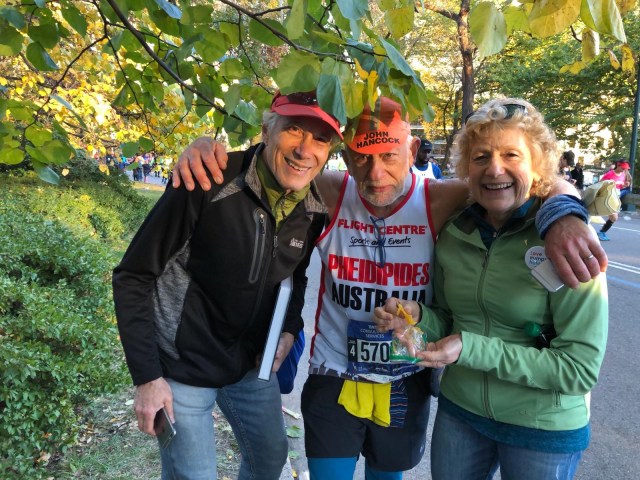
The morning was crisp and bright. The sun streaming through the window of the bus had warmed me luxuriously, but once out of the bus I crisped up nicely. Dunkin Donuts make a drink they call coffee and Americans pay good money to drink it. For us runners the drink was free. I welcomed it for the warming. My Wave in the marathon would not start for two hours, so I sat in the lee of a large tree and read the Book Section of the New York Times. A thin lady with fair skin, her freckles pale in the sunlight, wore a shirt blazoned with the dying words of Pheidipides, ‘Rejoice, my friends! Ours is the victory!’ The young woman claimed Pheidipides as her running inspiration. ‘Mine too’, I told her. She said, ‘I tell the story to my little girls, but I don’t dwell on his dying.’ Soon we were talking about books and favourite authors, and time trickled away pleasantly until Marshalls called my Wave to the starting corral. I suppose that was the story of my day; simple connection with another that would blind me to small things like tedium and pain and tiredness.


The day, like the poets, starts in gladness and ends in madness. Events, faces, sounds, sights and crowds merge into montage. Memory becomes a scrambled egg. A body starts out full of running, it sobers and slows, it falls into a plod, later it labours, only to speed up again, endorphin-fuelled. By the end of the race I remember all, but chronology blurs.


Every runner contemplates three distinct finishing times – the one most likely; the acceptable slower time; and the secret time, very fast, of the runner’s dreams. A couple of months ago I ran in Alice Springs with an injury. I completed the 26.2 miles in 344 minutes, equating to a mile every 13.13 minutes. Feeling fitter now and more hopeful, I dreamed of running this marathon in eleven-minute miles. A marathon is one of those things dreams are made on.


One thing certain: if I run more quickly than I can sustain I will regret it later. With my mind full of calculation, I heard a cannon fired somewhere in the distance. Runners shuffled forward towards a Starting Line none could see, the roadway rose beneath our feet and abruptly we were running up the long incline of the bridge over the Verrazano Narrows. I tried to forget how high we were above the waters. I tried not to run too fast. I noted with dismay the rough, harsh concrete surface that jolted my joints with every step.


I looked from one to another of my fellow runners in all their heterogeneity. (That’s another secret – distraction by the human landscape.) I saw we were thin, we were fat, we were tall, we were short, we were of all races; some of us were twisted, some wasted, some blind; one ran upon a metal spring in place of a foot; we were young, we were old – one runner older still, for on his back I read, ‘Born Before WWII.’ The man was weedy, his trunk narrow and his hair long and wavy, a white savannah. He radiated a perky energy, his marionette limbs jerking along effectively at roughly my own pace. After a time I lost him but we were to cross paths repeatedly over the coming hours.


We descended from the bridge into Brooklyn where the first of countless New Yorkers came out to bless us and feed us and celebrate us as we passed through their multifarious neighborhoods. Those New Yorkers held aloft signs. Some named their hero: ‘Daddy, we’re proud of you!’ ‘Miss Jones, Grade 4 think you rock.’ ‘Lucy, marry me. Please shower first.’ Others were philosophic: ‘Pain is temporary, glory is forever.’ ‘Pain is temporary, Facebook is forever.’ And, ‘Pain is just French for bread.’ 


And one sign humbled me with, ‘Stranger, I salute you.’ (The shock of the true. Who is this who speaks thus to my soul?)


I was dreaming I suppose when a sign told me I’d run three miles in 29 minutes. Too fast! I knew already my hope of a good time was ruined, the work of mutinous legs and wild ambition.


Bluetooth carried music through my hearing aids. Suzanne started me, followed by Sisters of Mercy, then Hey, That’s no Way to say Goodbye, So Long Marianne, and so on, through the Leonard Cohen songbook, eighteen songs over one hour and 18 minutes. From the Start on the bridge from Staten Island the entire album carried me into Brooklyn, but not beyond. This, I realised, would be a slow marathon of many albums. “Graceland” next.


Numerous young women brandished warning signs: ’Run faster, I just farted.’ (How rude.)

A tall black man at a pedestrian crossing held a sign that urged the endless passing stream, ’Speed up. I’m waiting to cross.’ (I larrfed.)


We runners too wove a legible thread, of words worn on our bodies, some playful, some sombre. I read tee-shirts as I ran. Cancer was condemned, Muscular Dystrophy unpopular, diabetes damned.  When I read ‘Pancreatic Cancer’ – remorseless killer of numerous close to me – I gulped. Quite a few runners simply wore the two names, ‘Martin Richard’, without elaboration. Those names rang a bell from Boston, 2013; Martin Richard was the 8-year old boy blown up by the gormless younger bomber. The photograph in the papers showed a child standing on the pavement, gazing outward; behind him a young man in a peaked cap, at his feet the fatal backpack. That was Memorial Day in Boston, 2013, the day our folly lost its innocence.


Other signs memorialized a friend or parent – ‘This is for you Dad’ – occasionally the name and likeness of a child lost to cancer. ‘Charlene 10/13/08 – 2/9/14.’ All lightness sinks when you run behind that shirt and you contemplate the heartsickness of the wearer. Others wore the names of the Pittsburgh Eleven. (I was one of those.) 


After I’d run a couple of hours an ugly low bridge loomed ahead. That bridge (by name, Pulaski)  obeyed New York’s Law of Concrete Bridges, which ordains a cement surface, pitted and rutted, intensely hostile to the runner’s foot, ankle, knee and hip. The bridges of New York City are many. Next comes Queensboro, the great bridge from Queens to Manhattan. Lying in wait are the Willis Avenue Bridge and the Madison Avenue Bridge. The five bridges of concrete reality.


The Pulaski marks 13 miles, the halfway mark. By all accounts Mister Pulaski was a good bloke: 

www.polishamericancenter.org


[Kazimierz Pułaski, (English Casimir Pulaski, born March 6, 1745, Warsaw, Poland—died October 11/15, 1779, aboard ship between Savannah, Georgia, and Charleston, South Carolina, U.S.), was both a Polish patriot and U.S. colonial army officer, hero of the Polish anti-Russian insurrection of 1768.]


Good bloke or otherwise, to the runner, Pulaski means fatigue. By this point 13 miles felt to me quite sufficient. A tee-shirt ahead of me agreed: “Why didn’t Pheidipides fall at 13 miles?” Up, jolting and wincing, up Pulaski and over, and there, two-and-a -half miles ahead rose the great metallic arcs of the vast Queensboro.


In the company of The Boy in the Bubble I started the long climb. Into Graceland and beyond I climbed on. With Diamonds in the Soles of her Shoes I climbed still. Outside my earphones the world was quiet. Runners ran and breathed and grunted with effort. No crowds on the bridge, no wild animating distractions.


In the quiet I sensed my lips were moving, Hebrew words emerging. “Hear O Israel, the Lord our God, the Lord is One.” I am my sole self, again and ever the four-year old child reciting the creed. From that time I’ve recited that initial verse of the “she’ma”, twice daily. From that age I’ve known it to be the final prayer of the Jew at the moment of death. Why now? Why here? Perhaps it’s the relative isolation of these miles on the bridge, perhaps the mere mechanics of plod induce trance. I cannot say, beyond noting how, as I walk or run this earth, ancient prayer will surface unbidden. Liturgy-laced, my life has been framed by the times and seasons of the prayers.


I ran on and I heard my mouth say, “Uvlechtcha baderekh”, and I heard my father teaching us small kids, “And you shall repeat them unto your children, and you shall speak of them as you sit in your houses, as you walk upon the way, when you lie down and when you rise up…”


On and up, on and up, Under African Skies I ran, on and up, Homeless and joint-shaken until the top where the road ahead was blocked by a huge red firetruck. The truck revved us up, its deep horn blasting, booming, blasting. Legs took heart, the road sloped down and to the left, freewheeling I allowed my speed to pick up as I jolted the long mile down to Manhattan.


In four previous NYC Marathons, First Avenue always defeated bonhomie. Debouching from the Queensboro Bridge, we ran into an ambush of ecstatic goodwill in First Avenue, with crowds wildly excited at our arrival in Manhattan.  Manhattan! – a name to conjure with, name of the great centre of excitement that is New York. However, runner beware:according to an article in the New York Times, Manhattan is derived from the local tribal language word Mannahatta, with a likely meaning, “island of many hills.”


Erst, the excited crowds were brief and the Avenue long. Crowds would thin, muscles flag, spirits wilt and on we’d run, and on, towards a distant island of further desolation, The Bronx. No desolation today: today the crowds do not thin, enthusiasm blooms at every side, the sun shines upon spectator and hero alike. Spectators in wild array, in every mode and manner of dress, watchers in love with their particular hero, in love with this stranger that is within their gates. The sun warms them, large plastic beakers of lager cool them and their cup runneth over. 


I’ve claimed often I’m the world’s slowest runner, adding, ‘a good walker will beat me’.  Here at 18 miles I see my words made flesh. Striding at my left a compact young woman (they’re all young now) walks smoothly past while I runshuffle on.


And here’s music!  A bunch of schoolgirl drummers, exuberant in sky blue, drummed and danced us up First Avenue. Harlem, where runners’ limbs are leaden, boomed to the beat of rappers. Everywhere rock bands with driving guitars and belting vocalists shook us as we plodded along, revving us up. All music up-tempo. In Brooklyn a Spiritual choir outside a church (emblazoned with the Star of David – go figure) flung soaring soprano sounds into the heavens. 


At twenty-two miles I overtook a young woman whose shirt read, ‘Running for Two.’ Apprehensively, wondering who she’d lost, I asked, ‘Will you tell me who else you run for?’ Her face lit up as she pointed to her belly: ‘My baby. I’m 10 weeks today.’ ‘Your first?’  (I meant the baby). ‘Yes’ – another bright grin – my doctor gave me the all-clear. (She meant the marathon.) The woman’s sheer delight infected me. Today, a maiden marathon, in 30 weeks a new human, born to love.


At length the golden light began to fade and the day cooled. At the same time my running slowed further and I too began to cool. I was heading up Fifth Avenue now, not that Fifth Avenue where every shop sells goods you don’t need and cannot afford, but a sylvan Fifth that curves and hides in the beechen green of Central Park.


Mile 22, mile 23, a steepish little uphill and I look around into the collar of crowd for a face I know. A doctor who has ministered to my family since my eldest daughter was 12 – that’s thirty-four years – has promised to meet me hereabouts with iced coffee. A voice roars from my left, ‘Howard!’and I totter over and accept a pint of the magic fluid.’ Brian and I shake hands, Onella beams, other voices from faces new to me tell me how great I am. And recharged with water, sugar and caffeine I’m of a mind to agree. Feeling at least a little greater I plow on, on toward another rendezvous.


The road curves and dips, the crowds are excited, solicitous, effulgent with love that seeks an object. ‘Nearly there! Nearly done!’ – they scream. People peer and read my shirt: ‘Australia! Australia! – seemingly exultant as their love is requited. 


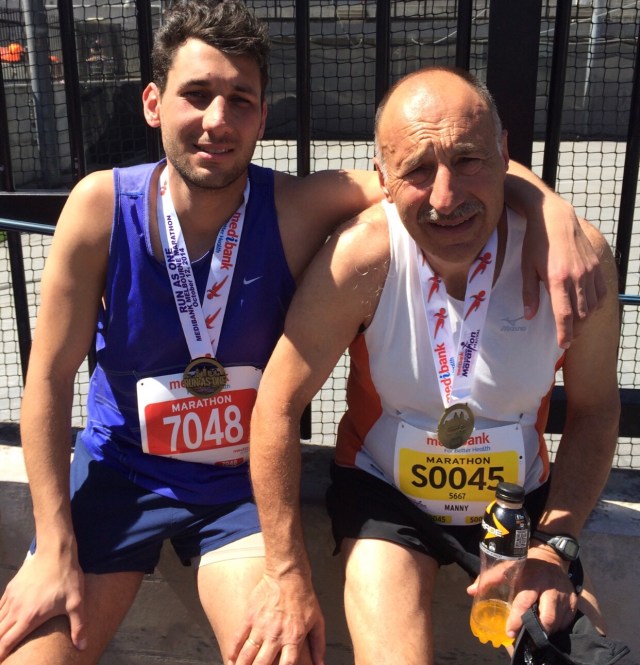
The crowds bring me back in time to the marathons I ran with Melbourne Marathon Legend (his actual, formal designation) Manny Karageorgiou. The Melbourne crowds adored Manny, as he transcended his malignancy, time and again rising from his bed to run Melbourne, while his Greek soul dreamed ever of running the Athens Marathon –  the Marathon marathon. Manny died last year, his dream unrequited. Two weeks from today his son Panayioti will run Athens in Manny’s stead.


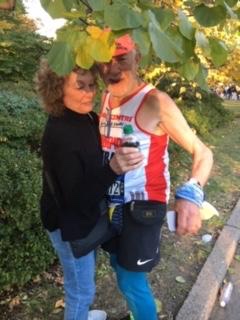
Mile 25, and when I sight upon my right a head of curls atop a short female form, I know I’ve arrived. My wife Annette runs from the verge, arms wide, smiling wide, and although there remain 1.2 miles to the Finish, I’ve arrived. I fall into those open arms and fold that small person and sob. A red head of curls at Annette’s right and a silver head at her left tell me my faithful sister Margot and my brother-in-much-more-than law John, are here too. Margot feeds me oranges that come all the way from China as I hold on to Annette, holding on for love, and holding so I won’t fall down. After a time I de-clutch and run on. And as in all my NYC Marathons, Margot runs alongside. The final mile and-a-bit are dull but painless. Nothing hurts as I crank the limbs into a jerky sort of sprint to the Line.


But someone else has fallen down. Mister ‘Born Before WWII’ lies face down on the bitumen. Gently, ever so gently, two large cops of the NYPD raise him from the road. His nose is bloodied but his smile is undimmed. ‘No, no, I don’t need a medic. No, I’m going to finish.’ With a cop cradling each arm, but under his own steam, the old man totters on. He will finish.


And as for me, my arrival happened before the Finish, back at Mile 25, back in Annette’s arms. I hurtle now across the Finish Line of diminished relevance, happy before I reach it. They give me a medal, they drape me in foil, they throw a blanket about me, but nothing hurts, nothing chills in this arrival, this return.
Appendix
And for the record Pheidipides Goldenberg, runner bib no. 57072, finished the  NYC Marathon in 5 hours, 34 minutes and 40 seconds, coming 118th of 231 runners aged between 70 and 75 years; 993rd of 1147 Australian runners.
The fastest Australian was Lisa Weightman (former Olympian, formerly Ondieki, nee Weightman), finishing in 2.29.11.
The fastest Australian male was Jarrod McMullen, finishing in 2.36.11.
The following day Jarrod crossed the North American Continent and the Pacific in 22 hours, seated next to Pheidipides Goldenberg, who crossed in the same time.

Why I Haven’t Written

This blog has been silent for a good while. I have been remiss. Happily, of the blog’s three-or-four hundred nominal followers, one only has complained. Perhaps she alone has noticed. The truth is a lot has happened: spring came to Melbourne; a surgeon cut my eyes open and melted my cataracts, bunging in a couple of new lenses; a dear friend has died; we experienced a hit-and-run road accident; and Bert the half-hearted came through his surgery and battles on.

I’ll start with the least material of these events, the road accident. I parked my wife’s pretty little red car outside a travel agency and went off to buy bok choi. I came back to find the front defaced and a note attached to the windscreen:

31 AUG 2018, 11:08 AM

CAR: WHITE HONDA CRV, YHO 815

LOVE,

FLIGHT CENTRE, SIX WITNESSES

I surveyed the alterations to my wife’s car, then entered the travel agency. The travel agents described the event, described the driver, wished me well in the manhunt and assured me they’d testify. They shared a lively indignation; the driver’s amorality offended them.

I post these particulars by way of invitation for the assailant to come forward, confess, throw herself upon my wife’s mercies and pay up. Under those circumstances we need not trouble the constabulary.

Surgery is one of the everyday miracles of life in a city like Melbourne. Two crazed lenses are literally melted in the eyes and sucked away like so much snot. New lenses are inserted and the world gleams. Then spring arrives. I see the green greener, and – thanks to the new hearing aids – the birds sing. (One of the saddest little lines in poetry closes Keats’ La Belle Dame sans Merci. The line of four words – and no birds sing – suffices for desolation.) Once again my spring sings.

Little Bert underwent his second heart surgery. His heart, sized like an apricot, was showing strain. A vascular detour improves his prospects. Inside Bert’s chest the so-called great vessels are like thin tubular spaghetti, cooked al dente. Somehow a surgeon cuts, stitches, reroutes, and attaches. Somehow blood flows through the pasta. And Bert breathes on. The praying continues.

In the mid-seventies I met a bearded maths teacher who took me on lengthening runs up and down the green hills of the Diamond Valley. His name was Dick. One day we paused on a high hilltop and watched the shafts of sunlight pierce the winter mists. A moment of silent communion followed as we share revelation. That was ten kilometers, said Dick. We breathed together, blowing out mist, thinking the same thought: If I can run ten, I can run a marathon. With Dick as my inspiration and my training partner, fifty-plus marathons followed. And a few weeks ago, Dick, who’d developed and survived lung cancer, Dick who never smoked, Dick died – of breathlessness. At his memorial service a large congregation paused and wondered: How is it we live? How is it we cease living? What is this miracle we call friendship? Which is the greatest wonder?

I write this aboard an aircraft from Phoenix, Arizona, where I’ve just said goodbye to friend Paul, struck down by a stroke on a Sunday morning late last year. I asked him had he felt fear. No, not fear. I found it difficult to dress for church with my right hand paralysed.

I’ve written previously of Paul, surgeon, aviator, morbid anatomist. Paul is a man of deep faith. He’s certain he’ll be reunited with Beverley, his beloved wife who died eighteen years ago. I noticed the words printed starkly on the band he wore on his left wrist: MEDICAL ALERT – DNR. Knowing his confident belief in rising again to bliss, I asked: Paul, does it make you sad to persist here in life? His voice of deep gravel remains strong and clear. His word choice carries all the old inventiveness, no stale phrases: After my stroke I’d awake in the mornings quite surprised still to be alive.

Paul and I sat outside in the heat of the Arizona afternoon while he smoked his daily cigar, holding it in his left hand. The right hand remains weak but to my astonishment the strength is returning steadily. Such vitality! I thought of the tiny trees growing in their cleft rocks at Fitzroy Crossing. Germinating from seeds dropped by birds, these miniature saplings force a root downwards through great basalt rocks, emerging into air as a tendril that dangles down to the river surface, down through the great waters to the muddy riverbed. His one-hundredth birthday falls early in 2019. After today I do not expect to see this marvellous man again. But on parting Paul asked, when will you come out this way again? The question was not facetious; he’s lived this long, why not a few more years?

Deaths, deaths. I write of them so often – naturally so, as I age and those I know slip away. In my work too, the farewells are many, and not all of them to elderly persons. Long ago a friend remarked of my writing that I what I was really doing was coming to terms with my mortality. At that time I didn’t see it. But I know now he was correct. I know too, death is not the worst thing.

Half-hearted and Nameless

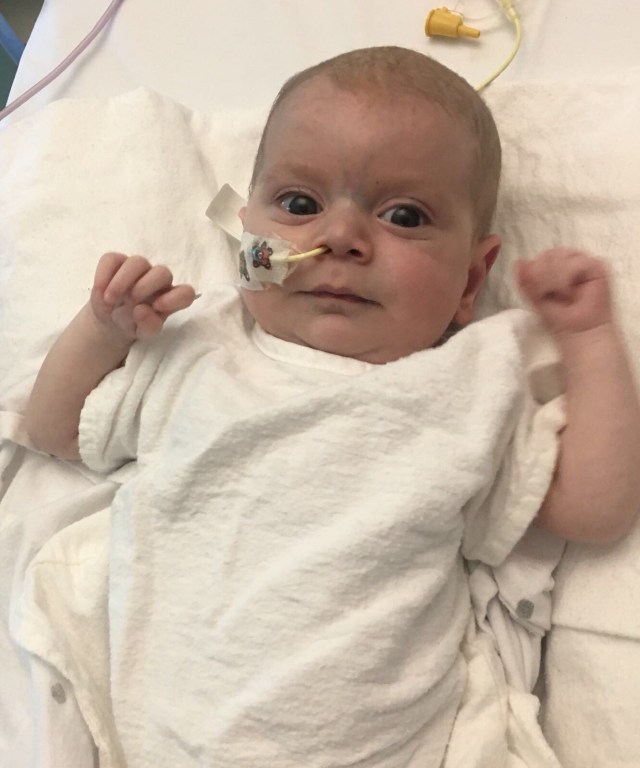
A military man I know who is also a man of the cloth, recently fathered a half-hearted child. The child is a boy. Although the boy is now four months old I cannot tell you his name: as well as heart-deficient this boy is nameless. Into the vacuum where a name should sound and resound I have secretly named him Bert.

Bert was born with an Hypoplastic Left Heart. Of all the congenital heart defects consistent with life, this is the most severe. When early prenatal scans demonstrated the defect, doctors warned the mother and father: The child might not be born alive. Of all the cities in the world to be born thus, Melbourne might be the very best. For in this location the very worst heart enjoys the very best outcome. And Melbourne is home to the Royal Children’s Hospital, where the cardiac surgeons achieve results superior to other centres around the world. Paediatric surgeons from the greatest hospitals in the USA perform the same procedures but without the same success. Their specialists visit the RCH to learn how the Melbourne team does it.

When my soldier friend told me of Bert’s heart condition my own heart sank. Without an adequate left ventricle circulation is critically impaired, the baby is breathless and often blue. The situation is serious, prone to deteriorate rapidly. Surgery of the highest intricacy is needed with critical urgency. Further surgery will follow within months, and more still as the child grows. If the child grows.

But Bert’s family are strangers to despair. Their faith buoys them. They pray. Their large family prays, their congregation prays, sister congregations join in a tidal wave of prayerful hope. The soldier father sets about studying Hypoplastic Left Heart Syndrome. He interrogates the cardiologist, the cardiac surgeon, surgical texts and research papers in the learned journals. Meanwhile baby Bert lies in Intensive Care puffing mightily, as his too little heart labours to circulate oxygen-poor blood around his body – most crucially to his brain.

The baby undergoes his first operation. Some hold their breath. Others pray. Bert comes through.

The nurses ask, ‘What’s his name?’

The parents reply, ‘We haven’t given him a name yet.’

‘When will you?’

‘When he’s fit enough we’ll circumcise him and we’ll give him his name.’

The nurses are confounded. They’ve come to love this little baby who puffs and puffs and keeps pulling through. Love demands a name. Administration demands a name. A non-name is given, a name for nurses to love him by, a name for administrators to administer by. Obeying the same imperative, I looked at the bony little battler and secretly started calling him Bert. But his true name, the name that will come to him dynastically or by parental vision or by revelation is not known. The day is not yet come.

A close bond weaves itself among the team that comprises on the one side a mother, a father, bigger brothers, grandparents, uncles and aunts, and on the other, a cardiac surgeon from Belgium, a cardiologist with a Chinese name, ultrasonographers, physiotherapists, cardiac nurses. The father masters and explains to me the eye-watering anatomic detail, embryology, circulatory physiology and pathology as well as the sequence of cardiac surgeries that is needed for Bert to live and to grow. And (in the locution of the family), God willing, to undergo ritual circumcision and to receive his name.

When I visit Bert in Intensive Care, I find the usual grim intent of such a Unit softened. A tenderness prevails, a gentleness, the amalgam of a family’s faith and the distinctive ethos of the institution. It is in Paediatrics where you find the kindest clinicians, and human sensitivity at its highest. The Chinese cardiologist procures for himself a religious almanac so he can know the dates and times when the family will observe Sabbaths and Festivals. He doesn’t want to cause them needlessly to contravene the strictures of telephony at such times.

Bert learns to smile. An MRI searches for hypoxic and other brain damage and finds none. Bert learns to suckle, taking in nourishment made specifically for him, taking in too, mother love, mother touch, smell and sound. Bert lies at his mother’s breast and feels that heartbeat that reassured and made him through the months that he grew, until he came into the world without a fully formed heart. Bert’s bony cheeks begin to flesh out, but he gains weight painfully slowly. The cardiologist explains Bert’s heart has to work so hard it burns up almost all the energy he consumes. The date of the second surgical operation must be brought forward, lest a wonky heart valve be damaged further.

The soldier rabbi father and I became friends when he himself was a runted collection of skin and bones and spirit, aged four years. It was he who knocked on my door one Sabbath morning with a request from his mother to visit his sick sister in their house around the corner. That sister was sped to hospital that morning, never to return to her home. None of us has recovered from her ordeal and her loss.

Tomorrow, or as soon as an Intensive Care bed becomes free, the baby son without a heart and without a name will undergo his next surgery. If you are the praying kind, spare a prayer for him. You can call him Bert.

Dennis


When I was born my elder brother was two years and two months old. When my brother died he was sixty-two. Tonight my younger brother and I will remember our firstborn brother. We’ll recite Kaddish together in his memory.


When I was newly born Dennis filled my baby carriage with all of his toys, submerging me. I didn’t recall that; our mother told me of it. She said Dennis loved his new brother so much he wanted me to have all his toys. All of our lives Dennis gave away everything that was his.


Dennis and I always bathed together. When I was five years of age, and trusting, Dennis conned me into an act of fellatio in which he pissed in my mouth. I recall that clearly.


I’ll light a memorial candle tonight. The candle burns longer than twenty-four hours. When I walk into my night kitchen the small flame takes me by surprise. I stop and I remember. The small flame flickers and falls. It looks about to die, but then it rises and burns brightly.


I sit alone in the kitchen and the truth comes to me anew: we all flicker before we die. But Dennis! Dennis had such a force of life. I see him pushing Mum in her wheelchair along a steep winding path, pushing her up, up, to catch the sea view from a peak at Wilson’s Promontory. The tyres sink deeply into the sand but Dennis, by sheer force of will, propels Mum forward and upward.


Dennis the fearless. Dennis undaunted, never defeated. When his affairs took a reverse I’d worry for him, but he’d say, ‘It’s always darkest before the dawn.’  Dennis meant that, he believed it, he lived by it.


Life brought ease to the second brother, a harder path to the firstborn. Dennis rejoiced for me in all my little successes. He knew no envy, never felt usurped by the younger brother who got the birthright. He bought me a holy book and inscribed it with his heart’s blood: ‘For my brother Howard. God must be proud of you.’


Dennis had the gregariousness of the deeply lonely. I sit and leaf through his address book, an odd keepsake. The crammed pages teem with names, so many names, names of down and out people he’d find and succour. These people, themselves lonely, found in my brother a man who’d give away all his own toys. 


Dennis decided to undergo major surgery, hazardous surgery. I misgave. But he said, ‘Doff, It will cure my diabetes, I’ll get my life back.’  He had the surgery, his flame flickered and he died.


Eini, eini, yorda mayyim

My eye, my eye runs with water.


Ellul, 17-18, 5779.

Birth of a Pearl

My mother’s name was Yvonne but her sister’s children called her Bom. I believe that name was the gift of her toddler nephew for whom Yvonne was too large a mouthful. That scapegrace nephew entered Bom’s life before she had children of her own. From the first, the two treasured each other with the distinctive closeness of the boy who finds a second mother, and the sister (yet childless) who yearns to mother.

The aunt moved to the country town of Leeton where she promptly hatched a litter of her own, of which I was the second born. From time to time the nephew (it’s time to give him a name: let’s call him Barry) was sent to us in Leeton, where his sojourns were long and wild and wonderful. His parents sent him to us ‘for the country air’, ‘for his asthma’, ‘to recover from the injury when a stake went through his belly’. All understood the true reason: They sent Barry to us when his parents needed respite. Bom would take Barry to her bosom, and he thrived.

In Leeton Barry taught us the Facts of Life. I have found these Facts to be of enduring value. He taught us too, a game called Murder in the Chook House, which I have described fully in my book titled My Father’s Compass. But all wild things must end and eventually Barry would return to Melbourne.

Contrary to all prediction and expectation Barry reached the age of thirteen without being hanged. His family marked the occasion with a barmitzvah celebration in the grounds of their beautiful home. The heavens marked the occasion too, with the mercury reaching 112 degrees. A marquee appeared on the tennis court, glamourous women sprang up like so many flowering shrubs.  Barry behaved with mature grace, accepting gifts and tribute without complaint.

Among the adult company present that day one particular beauty stood out. She was a person, someone said reverently, from Channel Nine. We didn’t have TV but I’d heard of Channel Nine. This lady’s job was to be beautiful on television. Today she was being beautiful at Barry’s family home.

TV Beauty Brenda Marshall

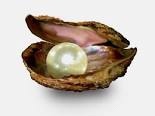
I came upon her seated in a shady spot next to my mum.  The two were talking. Beauty was admiring a pearl suspended from my mother’s throat.

What a beautiful pearl, Mrs Goldenberg!

Thank you. Daddy found it at the bottom of the sea and brought it home and gave it to me.

How? I mean where..?

Daddy was a pearl diver in Broome.

How wonderful!

Yes. He taught us girls  – that’s Barry’s mother and me – this poem:

When the first drop of rain

Fell from the clouds

Into the deep blue sea…

Mum’s manner of speaking carressed the words into being. They’d tumble from her and flow sweetly to you. Ready to be embarrassed, I watched TV Lady anxiously. Channel Nine was leaning forward, her red lips parted. I saw the pearls that were her perfect teeth. She leaned and listened and she did not move.

She was tossed, small and wistful, by the waves.

How minute I am in all this immensity, she cried.

And the sea replied: Thy modesty pleaseth me.

I shall make of thee a little drop of light.

Thou shalt be the fairest jewel among jewels…


The TV lady turned slightly to look again at Mum’s pearl pendant.

Thou shalt even rule woman.


Mum stopped, looked up at her companion, smiled:

And a pearl was born.

Ecclesiastes, 12, 1

A letter arrived inviting me to join a panel of former students addressing a bunch of peers from my old school. Panelists were to discuss a number of questions which all boiled down to If you knew then what you know now, what would you have done differently?

The questions made me think about my schooldays. I loved school. I felt happy. I thought the brutality of our teachers was somehow just the way of things, neither wrong nor right, simply conduct that lay beyond judgement. I didn’t like it – in fact when I witnessed it I’d whinny with the ugly mirth of the unpunished; when I received it I felt I might vomit. But then I didn’t like winter either. Winter and corporal punishment were both unpleasant and both lay beyond lawmaking.

As I reviewed our jungle behaviour my older self felt sad and ashamed. I wished we had been kinder. An instinct revealed to us whoever was the most vulnerable. Arriving as a new boy in mid-term I was conspicuously vulnerable and the hounds duly bayed and pursued me. Being new was a temporary condition; others suffered perpetually. In my turn I identified one or two of these and I teased them with relish.

In time I saw how that fat child, this gay person, that person whose father belted her every day, attracted the crows, and I declined to join in the pecking. In time two of these three were to die by their own hand; the third tried and failed.

I wasn’t fat, or gay. My father didn’t beat me. My schooldays were happy. Inspiring teachers inspired me; loving mentors nurtured me. I suppose I blossomed.

Half a century and more have passed since I lived in that arena of mind-nurture and bloodsport. My eyes, clouded now with cataract, my knees grating, my hearing dimmed, my balance wonky, my farting – ever a reckless delight – now hazardous, what advice would I offer today’s schoolchild? Should I say Rejoice in the days of your youth before the evil days come when you will say, “I have no pleasure in them”?

I watch those tender green shoots anxiously as they don school garb and they venture into their jungles. I hold my breath and hope. Will she make her way? Will she find a friend? What wise words might I proffer?

Instead of speaking words I hope I might hold my peace and let her be, and let her become.

Autumn Notes, IV

As I write this it’s still autumn. I need to point that out lest winter arrive before this is posted. You know how pedantic my blogmeistress can be.

Winter is lurking, waiting its moment. I left the hospital last night and walked into the dark and rain. Rather than wait in the wet for the correct tram I took another which would take me close to the station. ‘Close’ was actually a mile or two. I enjoyed a philosophical walk through the bleak, absorbing heaven-sent water through hat, jacket and leather shoes. Three jolly Chinese women sheltered in a doorway beneath bright umbrellae that flapped in the wind. Nice and damp by now, I thought of the umbrella, a found object, furled, resting in my bag. If ever I’d have an umbrella moment this would be it. I don’t like umbrellas – a prejudice from childhood dressed up as a principle. The umbrella stayed furled.

On the tram this morning three young women sat and consulted their screens. Melbourne passed by them, damp, dark, unnoticed. Their devotion was religious. One of the three wore an eskimo jacket, her face fur-framed, her free hand clutching two slices of vegemite toast. The bread looked like rye. A semicircular bite in the upper slice showed where the screen interrupted the young woman’s breakfast. Twenty minutes after boarding, eskimo-lady alighted, her neglected toast undepleted. I mention the breakfast because it looked hearty, just right for the weather.

At the hospital last night I ate the meal I brought from home, a soup described as ‘Tuscan Lentil & Grain Broth’. A woman I know found the recipe in one of the weekend magazines. The soup was new to me. Among the ingredients were carrot, celery, onion (of course), garlic (gratefully), tomatoes, lentils, barley and a green called cavolo nero. That’s Italian for kale. I saw through the disguise; I don’t eat kale, like umbrellae – a matter of prejudice. Well I ate the soup, hot and hearty. Oh what a moment! The soup warmed me and filled me so all the wet and wind and cold that followed could not dampen the love I felt for the soupmaker. I decided I wanted her to be my wife. Which, happily, she is.

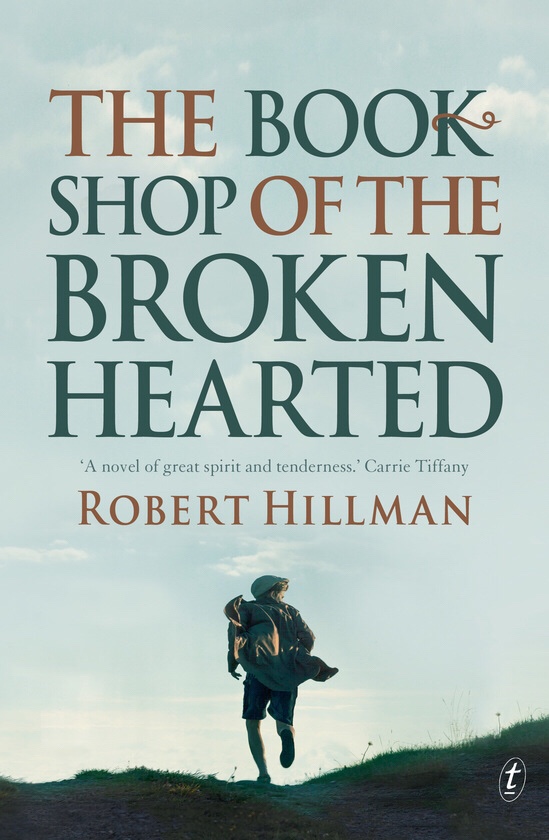
The Bookshop of the Broken Hearted

Every so seldom I come upon a book to treasure. Every day I read. I inhabit a forest of books,

I sleep between towers of books, some read, some half-read, most unread. No day goes unbooked.

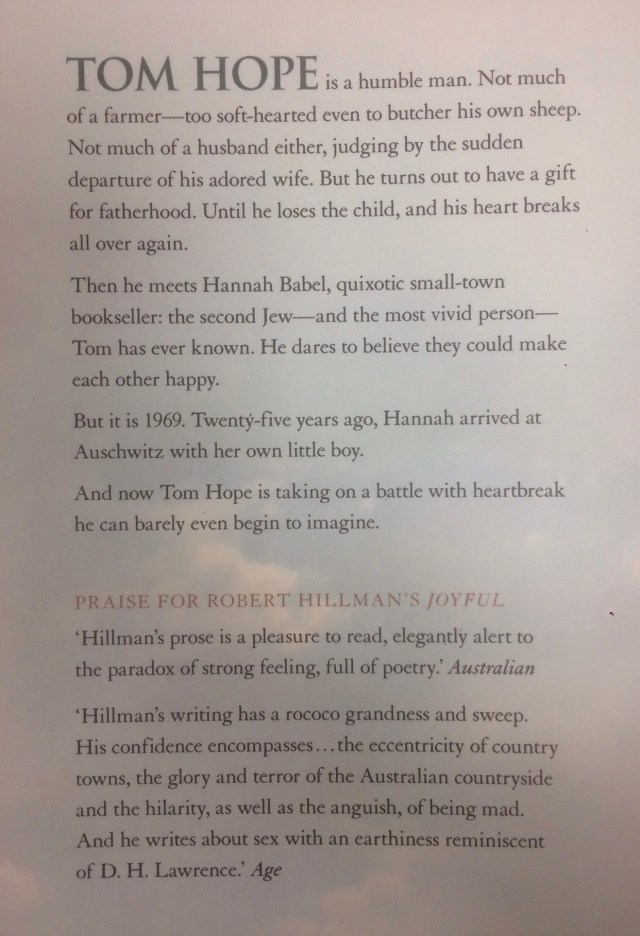
Some in my world of books inform or advise or enlighten. Others – not enough of them – delight or tickle me. Some inspire, some shock, others outrage and a few disgust me. Plenty bore me. But every so rarely comes a story that calls for that overused word, love. Robert Hillman’s ‘Bookshop of the Broken Hearted’ is a book to love.

What do I mean here by love? In two separate surveys carried out a decade or so ago, respondents were asked to name their most-beloved Australian novel. I saw listed many books I’d enjoyed, by authors I admire. Before reading the results I made my own nomination – Tim Winton’s ‘Cloudstreet’. I read the rankings, and there, topping both surveys, was Cloudstreet.’Just so: Winton’s characters, their stories, their rich and variegated humanness, are given to us in their fulness, given us to love. ‘Cloudstreet’ stays with the reader and is recalled with love. ‘To Kill a Mockingbird’ is another such.

Ripe for adding to that list is Hillman’s ‘Bookshop’. It broke my heart and it healed it. I laughed (my guffaws this morning alarmed a tramful of screen-trapped commuters) and I ached for the child. And for the adults who saw this child and that child torn from them I felt a distress that has visited me only once outside of a book, when the (false) report arrived that my child had a fatal malignancy.

‘Bookshop’ left me hopeful but not complacent. I will cherish the simple farmer who is the protagonist and I will tremble for him so long as memory abides.

I invite you come to Readings Bookshop in Carlton, to hear Robert Hillman in conversation with this happy blogger at 6.30 pm next Monday, May 7th.

Love and Treachery

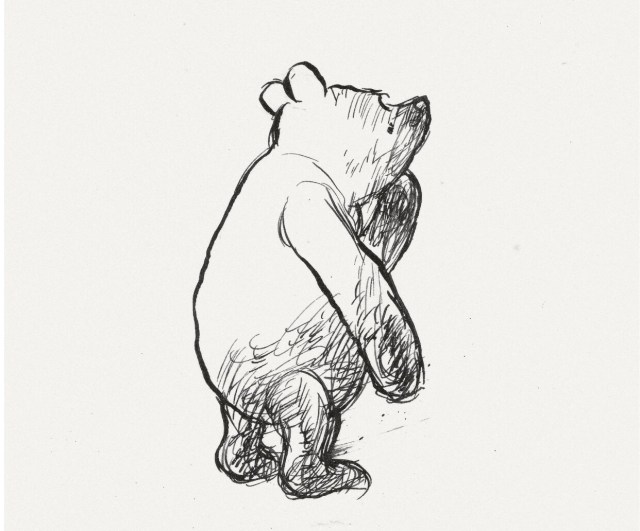
In the movie, ‘Goodbye Christopher Robin’, the grown-up Christopher confronts his father who has commercialized the son’s persona: ‘You weren’t writing a story, you were doing research.’

A.A. Milne feels the force and truth of his son’s accusation. Lifelong the son would refuse to accept any of the vast proceeds of the stories and poems that grew from a father’s love of words and a boy.

Two years ago a friend confronted me in pain and in anger: ‘When we talked I thought we were

speaking as two friends. But you were there as a writer.’ I felt the force of his pain and the truth of my treachery. In time my friend gave me the great gift of forgiveness but a feeling of shame lingers.

My mother used to read the Christopher Robin stories to me when I was very young. Oddly I don’t recall reading them to my own children, but when my first two grandchildren were aged about three I’d push them to my mother’s house, where we four would eat cakes and pastries and I’d read aloud

the poems from ‘When We Were Very Young.’ My mother and I felt strangely moved. The children seemed to enjoy the ritual; they certainly enjoyed the cakes. The lines, Do you have a rabbit/

I do like rabbits/But they didn’t have a rabbit/Not anywhere there… always lumped up my throat.

I did not need to turn and look to know Mum’s eyes were misting as I read.

I imagine those lines will always bring back to those grandchildren some primordial sensation, some thrill or echo of my ancient loves: my love of words, my mother’s love for those words, our love of the

sharing, our love for those cake-stuffed tenderlings whom I held on my knee.

Those children are bigger now. Soon they will be grown up. And they’ll watch their grandfather the word lover as he plunders life and writes his loves, and struggles with his traitor’s heart.

Goodbye My Friend

We are saying goodbye to Mannie today.

Mannie, my friend.

Mannie, whose loved ones weep today.

Manny, one sole man, who ran and ran.

Mannie whose race is finally run.

Mannie’s roots lie in Greece.

Mannie was true to his roots.

Those roots brought forth shoots who live and grow and bear fruit. The shoots are the children of Mannie and Demitra. When the young couple named their shoots they were visited by the muses: they named their children not Lucy but Alithea; not Robert but Panayioti; not Susan but Leni. The names carry meaning, love of course, and destiny.

Mannie did not give his children easy names, Aussie names, names to hide behind. He gave them what he received – a culture, a tradition, a history of beauty and pride.

Everyone knows of the feats of Manuel Karageorgiou, Mannie, who ran the first Melbourne Marathon and the second and the third and …

Manny was one of the eight. Eight glorious souls who had lived and toiled and wrought in every Melbourne Marathon from the first to the latest. Forty consecutive marathons. Foolish.

I want to suggest to the non-runner reader what Mannie’s folly entailed. Physiologists have identified an end point of energy. And adult human can run about 32 kilometres, then energy reserves are exhausted. After that the runner faces a wall. The runner digs into a core of belief and runs a further step. There remain ten kilometres, ten thousand steps. The runner digs further, drawing on pride, on mystic need, on love, on some truth in the soul. And the runner runs on, runs through a wrecked body. The runner now is pure spirit.

And then there are the final, agonising, ecstatic one hundred and eighty steps. The runner crosses the line and then the race is run.

A few paragraphs ago I began listing Mannie’s Melbourne Marathons. I stopped after three. Were I merely to list the forty your eyes would glaze, your mind would wilt, you’d leave the track that Mannie and the Eight would not leave.

My Greek friend always dreamed of running the Athens Marathon, a homecoming profound beyond imagining. But Mannie never allowed himself to run Athens because it clashed with Melbourne. And Mannie owed the event his presence, his being. Mannie would not desert his friends of the Eight.

I’d like you to visit www.howardgoldenberg.com and look up posts that tell of three of Mannie’s marathons. You’ll find them dated October 2014, 2015, 2016. And then read https://howardgoldenberg.com/2017/10/23/its-not-how-long-youve-got-its-what-you-do-with-it/ from October 2017.

I’ll reveal here some of Mannie’s medical history, normally a forbidden act. But Mannie as we know was not a normal man:

While on an early morning training run before the Melbourne Marathon a few years ago I sensed a solid bulk of human flesh approaching in the gloom. The flesh developed a face and the face shot a me smile through the mist. Mannie recognised me first.

Here he was, I knew, fresh from his bone marrow transplant. Preposterous – Mannie understood – to run a marathon with that illness, outrageous, with those therapies. He’d visited me the previous week to talk about running again. ‘The specialist says I shouldn’t run. Howard, is he right?’

‘I suppose he must be Mannie. One fall and your bones can break, so easily.’

It was a broken rib, cancerous, we both recalled, that uncovered Mannie’s diagnosis.

Mannie looked at me. Mannie knew I was no cancer expert, just a runner. His look was a plea; he wanted a reprieve.

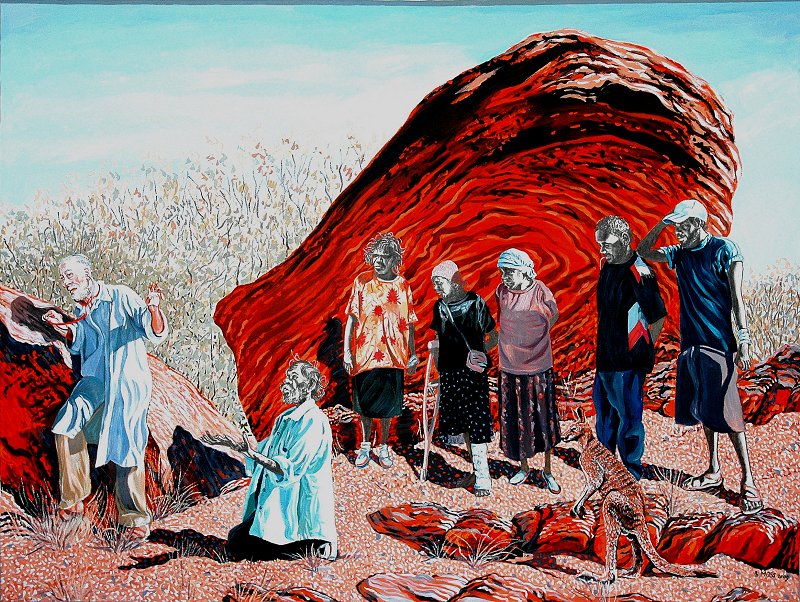
I said I could tell him what was the safest course. But then I told him about my mother:’Late in Mum’s life her health was shattered by strokes, but the spirit of the wanderer that had taken her to the bright and the dark ends of the globe, burned still. My sister and I were going to fly to Uluru. Mum wanted to come. She said, “If I stay at home I’ll die one day anyhow. I’d sooner go and see and find and know; and if I die doing it, I’ll have seen the rock. That would still be a good deal for me.” Mannie thanked me and left.  You know what Mannie decided.

I referred before to Mannie’s folly. I’ve seen marathons. I’ve seen and felt the interest and the indifference of spectators. I’ve seen the fellowship of running. I’ve felt the loneliness of the Malta plains. I’ve seen the splendour and I’ve seen the blackness: both were present that day in Boston. I thought I had seen it all, until I ran a marathon with Mannie. An entourage ambushed him – a son, a brother, a younger leviathan figure, a clutch of attractive young women (I wondered who they were. I learned they were girlfriends of nephews of Mannie.) This phalanx of nonrunners surrounded Mannie, they spread widely across the road. Mannie was one runner among thousands, but he alone moved in this stream of flesh aching with love. They ran and ran alongside their hero – the older man, the fat man, the glamorous girls. They tasted fatigue but they would not leave him, not until he reached the next plank in Mannie’s platform of love; and this, of course, was Demitra. ‘DEM!’, he cried, and they kissed. And Demitra held their grandbaby. Mannie stopped. He held that chubby child close and inhaled her. And then he ran on.

I have written of a human, a person. I have written of him chiefly as the operator of a pair of legs. A person is more than that. More than a disease, more than his diagnosis. But in Mannie the runner I see the human and his fate. This man faced Nemesis and outran him for year after year. And when at last – five kilometres into the fortieth marathon, after Mannie stumbled and fell, then arose bloodied – it was Demitra who stepped from the footpath, who took his hand and led him away.

“..Old age hath yet his honour and his toil;

Death closes all: but something ere the end,

Some work of noble note, may yet be done…”

Farewell, Mannie. We will not see your like again.

Mannie’s family have let it be known they don’t want floral tributes to mannie. They’d prefer us to donate to the Myeloma Foundation in his memory. And of course, in his honour.