Intersections, Signposts, Byways along the Road to the Deep North

I read a book yesterday. Started early, finished late. At intervals I had to break off reading to gasp, get to my feet, pace around. Then I sat down and resumed reading. Again I had to stop: I couldn’t read.:
my eyes were streaming and I was sobbing. Because I am a man and men do not give into tears I composed myself, went back to the book and finished it. Unusually for me, I was reading a novel I had read before.
My fortunate path through life is paved with storybooks, so many good books, a few even demanding the accolade of greatness. This is one of the great books.

The novel fictionalises the adult life of Edward (‘Weary’) Dunlop, an Australian surgeon and ‘war hero’, that shopworn term which perplexes and burdens the novel’s central figure for the decades
that remain to him after the War. Ï met ‘Weary’ late one Saturday night after he’d launched a friend’s book. I reminded him that my father and he had been classmates at Melbourne University
Medical School sixty years earlier. I mentioned Dad’s name. The old face looked down and away from me. There was no flicker of recognition: ‘Good man…very good man,’ he said, through the
whiskey of a long night and through the passing of too many years.

The novel which gives us the life and times and war of ‘Weary’ is decidedly unromantic. He is not a hero to himself, he’s simply perplexed, reluctantly drawn to greatness which he can never fathom.
The novel is a telling of one of Australia’s important stories. Like all the great stories the epic of the Burma Railroad (‘The Line’) carries the clout of magic and the endurance of myth.
We have read the tale before in an earlier triumph of storytelling, David Malouf’s ‘The Great World’.

One of Australia’s most original literary stylists is Nicolas Rothwell, the Áustralian’ newspaper’s northern correspondent. Rothwell delivered an oration recently in memory of Eric Rolls,
which was excerpted and published in the Oz a week or so ago. In the acutely elegaic piece Rothwell noted the death of the novel, lamenting exquisitely and I think romantically
on the passing of the genre into effete late middle age and irrelevance. As a keen reader of novels and of Rothwell, I read the essay in perplexity: here was a heartfelt requiem to the literary form of which Rothwell himself is a sublime practitioner. His novel ‘Belomor’ is a convincing rebuttal of his own thesis. If this were not enough to confuse and comfort me,
then ‘The Narrow Road to the Deep North”, Richard Flanagan’s Man Booker Prize winner, the cause of my gasping, crying, pacing, would demolish all doubt.

If I read Rothwell right it is not the novel that is dead but our capacity to hear a long story, to enter and journey and stay the distance in a world, to experience lives in their amplitude. We have become nerve-deaf, casualties of the quickening tempo of life, in particular of the crazed acceleration of information technology. I think this is what Rothwell means. I hope so. Because I travelled the Narrow Road to the Deep North, travelling to an extremity of feeling, going far out to sea into an enlargement, an expansion of my being. Mister Richard Flanagan told me a story that penetrated whatever is the deafness
of the age. He spoke to the same organs of wonder and imagination and belief that my mother and my father spoke to or read to when I was small. The same organs are alive and quivering in my grandchildren
when I tell them a story. We are, as Najaf Mazari – the Rug Maker of Mazr a Sharif – points out in ‘The Honey Thief’, ‘made of stories’. Stories are part of the protoplasm of the human. Rothwell knows this,
his writings show it.

Rothwell makes an important point, subtly and allusively as ever, but convincingly. In this continent the long story between covers is in its youth. There yet remains a task for literature to fulfill that is specific to this
country. The Australian novel is a necessary vehicle for the defining and redefining of our place here. If we are whitefella or blackfella we have a task ahead – to come to terms with our each otherness, to relate authentically to a landscape and to its stories, to Australia.

Between the covers of the Narrow Road Flanagan’s Dorrigo Evans and Darky Gardner take us a long way on that needed path. Novels such as this have the power to create new minds with new organs of knowing.

Robert Hillman’s Review of Carrots and Jaffas

Identical, red-haired twin boys are born to Luisa and Bernard Wanklyn, who live in Melbourne. The year is somewhere in the fairly recent past. Since we’re in Australia, the twins are naturally nicknamed Carrots and Jaffas, the only alternatives being Bluey and Ranga. Luisa, the mother, is a native of Argentina; Bernard was born in Australia. When the boys reach the age of ten, Wilberforce Reynolds, an addled one-time addict, makes an attempt to steal them from their parents. There’s a bleak irony there – ‘William Wilberforce’ and ‘Henry Reynolds’ being the names of emancipators. Indeed, Wilbur Reynolds is acting out of a grotesquely misconceived impulse to redeem a life of ratbag behaviour by making a gift of the two boys to Greta, an Indigenous woman of the Flinders Ranges who played a role in raising white Wilbur many years past. Greta’s own two sons had been taken from her in the 1950s by men with the legal authority to do so. The two red-haired boys will compensate her, so Wilbur hopes. But Wilbur manages to steal only one of the boys, Jaffas. The agony of Jaffa’s parents is matched in its intensity by the agony of the twins, each left yearning for the touch of the other.

The impression the reader will be left with after a quick reading of Howard’s novel is of a drama constructed around an appalling crime and its widening repercussions. Hearts are torn out, and in the broader community, people who hear of the abduction on the news put a hand to the head and murmur: “Dear God!” But the story told here is far more thoughtful, far more involving than that. As it was bound to be. This is Howard Goldenberg’s first novel, but two works of non-fiction precede it, “My Father’s Compass”, a memoir of Myer Goldenberg, Howard’s dad, and “Raft”, a book that records Howard’s engagement as a doctor with Indigenous Australians in remote communities all over the continent. Each of these earlier books is distinguished by the vernacular philosophy of a thriving intellect, and by a quality of observation that yields one poetic insight after another. If we speak of intensity of feeling, insight and quality of enquiry, Carrots and Jaffas is of a piece with those earlier works.

The broad strategy of the novel, in my reading, is to allow the story to unfold through five movements – Birth, Growth, Catastrophe, Healing, Reunion. With this strategy in place, Howard gives himself the liberty to riff on the themes that brace his story: the binding force of love; the rigour of grief; the perseverance of hope; the will and the wherewithal to imagine the life we hope for, and especially, what we expose ourselves to when another human being becomes more crucial in our vital life than our own wellbeing. (We might think of Bacon’s Hostages to Fortune lines: “He who hath a wife and children hath given hostages to fortune” but we should cheer Bacon up a little and subvert his meaning by saying: “Anyone who loves has given hostages to fortune.”)

Out of these themes emerge the book’s two arguments. The first establishes the enigma of individuality, taking in the sources and purpose of human individuality, and the second demonstrates the stubborn persistence of those forces in the world that oppose evil.

Let me return to love, the great emphasis in everything that Howard writes. Here is the mother of the twins experiencing the growth of love for her newly born, prematurely born children:
Luisa laughed the laughter of tenderness and body fluids, of manic collapse, of sleepless necessity.
On an impulse, or in forgetfulness or in simple exhaustion of thought, Luisa picked up both babies at once…offered each baby a breast. Both sucked….two small heads swiveled and searched, bony limbs extended, antennae into the void. One arm, flung outwards, came to rest on a brother’s shoulder. Gazes locked, spines unarched, mouths resumed sucking, smoothly, to satiety.

This conveys the growth of love of a mother for her children, and also the dependence of each twin on the other. Carrots and Jaffas cannot satisfy themselves individually; both must be satisfied together.

Later, Bernard, the father, in his quest to grasp what being the father of two children who can barely be differentiated involves, quotes from a poem on the subject of identical twins:

“The twins retain/intimate knowledge of each other,/ Theirs alone-/Of mind and body and being –/a knowledge preceding speech,/Transcending speech: Knowledge subtle as song,/Deep as the womb,/Pure as echo./Identical twins: One? Two? One?”

I wrote an endorsement for Carrots and Jaffas before its publication, and said this, amongst other things: “Howard Goldenberg’s story of identical twins, violently parted at the age of ten, reveals the hunger that dwells in all of us to stand distinct in the gaze of God.” To achieve that distinction in the gaze of God is our human struggle; to demonstrate that we cannot be packed by the gross; that we are marked with an individuality that honours, in its way, the teeming variety of life in the world. Think of Hopkins poem, “Pied Beauty” in which God delights in “All things counter, original, spare, strange…”But for Carrots and Jaffas, that struggle for originality is over at birth, or even at conception. The gaze of God is the gaze of the identical twin. The suggestion of Howard’s book is that the mystique of the identical twin is closely related to the mystery of divinity in our lives. We are unlikely ever to know what the identical twin knows, and unlikely ever to know what God knows. But one thing we can know is this: God is Himself, Herself an identical twin.

Wilberforce Reynolds parts Carrots and Jaffas. He hadn’t meant to. He had intended to steal both boys. It is a feature of acts of violence that they often do even greater harm that the perpetrator intended. Wilbur’s hope is that he will win the approval of a woman, Greta, who suffered the theft of her own two boys. In Archie Roach’s haunting song, “Took the Children Away”, Archie says: “You took the children away, The children away. Breaking their mother’s heart, Tearing us all apart, Took them away.” Those who took away Indigenous children decades ago knew that they were causing grief, but felt that a greater good justified the harm. And this is also Wilbur’s rationalisation.

My head will be right, doing this good thing…it’s the right thing to do, to bring kids, to steal them and replace kids stolen from blackfellers.

Howard makes very clear that Wilbur’s failure of imagination re-enacts the failure of imagination of those who had conceived the scheme of parting Indigenous parents from their children so much earlier. Jaffas, after his abduction, cries out in his anguish: “Run! Run back to Carrots! Run!” and we think of Leah Purcell’s song, ‘Run, Daisy, Run!’

Jaffas finds himself in the care of Greta and the white Doctor Burns up in the Flinders Ranges, the oldest place on earth. The creation of each of these characters are amongst the finest accomplishments of the novel. This Healing movement of the book sees Greta revealing to the traumatised Jaffas stories of the land, of her country, while the Doc contributes tales of scientific discoveries, of Indigenous distress, of the land as understood by a white man. Neither the Doc nor Greta know the true story of Jaffas abduction; Wilbur had spun a plausible tale to explain why he was leaving the boy with Greta. The Doc begins to suspect that Wilbur’s story is rubbish, and he wonders whether Wilbur’s real motivation has something to do with Greta’s past. He asks her, one day, about that past:

My boys, they take my two boys. Never come back. I reckon they big fellas now, fathers. Maybe grandfather. I never see them. Maybe they die, maybe they just lost….That what happen. That what they do. Steal ‘em…

But back at Jaffas home, his brother is tearing himself apart with grief, while his mother, Luisa, torments herself with stories of the unspeakable things done to other abducted twins by a certain Doctor Mengele during the Second World War. The strong suggestion is that Luisa, herself a one-time victim of hideous violence under the Junta in Argentina, will go mad if she is never to see Jaffas again. I spoke earlier of those forces in the world that oppose evil, and of their power. While Luisa is losing her mind, guarding her remaining son with a maniacal determination, Greta and the Doc are painstakingly rebuilding hope in the abducted Jaffas, mending, healing. In the oldest region of the earth, the aged (and Doc Burns is no longer a young man, nor Greta a young woman) dispense hope and love to the young.

Howard Goldenberg’s novel brims with suggestion, as a novel should. And the suggestion I want to make a big deal out of is this: that love, human love, is the finest accomplishment of the imagination. Maybe it is too easy to use a word like ‘evil’ and expect that everyone agrees about what evil is. But we do know what ‘wrong’ is. It is wrong to snatch a child from the street and drive away on some mongrel errand. It is wrong to wrench children in their thousands from the embrace of their parents on some state-sponsored mongrel errand of larger scale. It is wrong to gather people in their millions into camps, reduce their existence to wretchedness, then murder them. To do wrong requires no imagination at all; merely malice or egocentricity. To do good requires imagination. The Doc and Greta imagine the path to recovery that Jaffas might follow, then urge him along it. Their imagination stands in strong distinction to Wilbur’s crude lack of imagination.

Howard Goldenberg’s book is itself the product of a fine, creative imagination, and of a big heart. Like all such works of literary art, Carrots and Jaffas adds a welcome something to our chances in the world.
Robert Hillman is the renowned author of sixty books, including “The Rugmaker of Mazr a Sharif ” (Wild Dingo Press). His most recent works are the celebrated novel, “Joyful” (Text, 2014), and a young adult novel, “Malini” (Allen and Unwin, 2014)

Robert launched Carrots and Jaffas at the Melbourne Writers Festival in August 2014 with his speech above. 
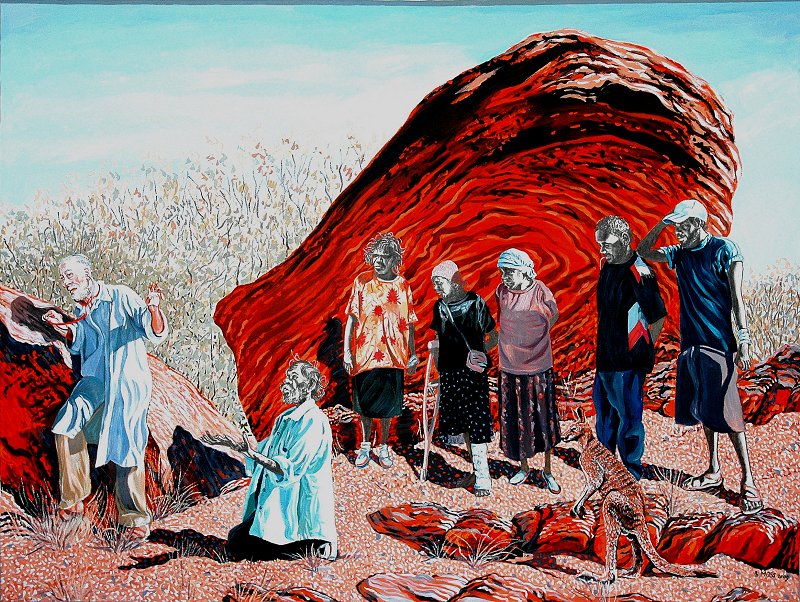
‘Joyful’ by Robert Hillman – A Review

There’s a CD I listen to when I want to write about something serious or something true or sad. It is Disc Two of ‘Dirt Music’, the album compiled by Tim Winton and Lucky Oceans to accompany Winton’s great and sad book of that name. Two tracks on the disc speak from the darkest room in the house of sorrow. (I refer to Sculthorpe’s ‘Dijille’ and to ‘Cantus in Memory of Benjamin Britten’ by Arvo Part). The grief is absolute. It neither cries nor shouts nor tears its hair out. It simply quivers and ultimately exhausts itself and lapses into barely audible human breaths. And thus into harmony with life. The experience leaves me quiet, reconciled – I suppose – by sheer truth. And beauty.

What has that to do with Robert Hillman’s new book, “Joyful”?  I read a passage in the later part of the novel where a character who has lost his only two children weeps silently in the utter darkness of a room in the mansion that gives the book its name. His quivering presence is sensed by his host, Leon Joyce, owner of “Joyful”. Joyce, who has been observing his own prolonged season of bottomless grief, stands, wordless and motionless. The weeping one comes to realise he is not alone. Each sorrows in silence, both men understand. No sign, no word. But something beyond words is known: the two men and the grateful reader make their way from that room in “Joyful” somehow reconciled to loss. And that is what Hillman’s book is about – its chief theme – how we humans risk all and lose all when we (inevitably) invest in passion.

Robert Hillman is not famous for misery, any more than Winton. The misery is there in the book as it is in life. But “Joyful” is also a story of the greatest vitality, the most audacious imagination, the most original characters, (from the carnal priest who absolves himself habitually, to Dally the Wordsworth-loving Iraqi Kurd, to the sexually hyperactive Tess, to the hapless Emily who cannot love any man who loves her, to the world-weary, gusset-guzzling, false-poet Daniel.) And the book is full of gems from the bowels of Hillman’s imagination that made me roar with unexpected belly laughing.

I defy the reader to get through “Joyful” without shedding tears of mirth and tears of joy. In short, I like it. I admire it. I respect it, I envy it, I treasure it. I’ll remember it.

joyful“Joyful’s” characters are destined to live in memory alongside Winton’s Fish and Lamb families that emerged from “Cloudstreet” and took up lodging in a nation’s treasury.

Text published “joyful.” Howard Goldenberg will launch it at Readings in Carlton at 6.30 pm on Wednesday 7 May. Please come along.

On the Passing of a Great Writer

At the time of writing this, I have read scores of tributes to Gabriel Garcia Marquez, all of them as tweets. In other words, I have read nothing so far in mature media, (an expression that identifies me as a culturally bewildered old fart).

Great writers will have their say in traditional media.
Thus far the twitterers. Now me.

I was intrigued as I read these tweets. They poured, a growing stream of tributes, pausing at intervals, I suppose, to gather electronic breath, then flowing again. The process seemed as alive, as dynamic, as the flowing of a swift rivulet that paused on reaching rocks, only to cascade over and around them and plunge downstream in a Gabriel Garcia Marquezswelling spate. I felt excited by the energy I witnessed. I felt I heard the whisperings of legion one-hundred-and-thirty-character authors, everyone of them sounding forty years younger, forty years more at home here than I. Their twittering grew and grew to a chorus.
The energy was mildly thrilling as it gathered strength. It could frighten me if (forget “if”; think ‘\’when!”) it becomes a mob. I remember, too well I remember the cries at Cronulla; the cries of the mob as Dreyfus is cashiered (“Death to the Jew!”).
But I digress. Or do I digress? Only if the medium is not the message.

And what did I hear, what sense as the tweeting reached crescendo?
I heard love. I heard grateful appreciation. Marquez became a beloved writer. And his writing was the antithesis of the tweet. Substantial, considered, it paced itself with the uneven gait of the human.

I was impressed by the way tweeters reached for language worthy. None found his writing “awesome”; no-one said Marquez was “amazing”. No-one buried him in dead language.
Instead they offered back beloved lines. I record the four most quoted in ascending order of popularity:

Fourth: The only regret I will have in dying is if it is not for love.

Third: Nothing in this world was more difficult than love.

Second: Nobody deserves your tears, but whoever deserves them will never make you cry.

First: What matters in life is not what happens to you but what your remember and how you remember it.

Of these the first three are switches planted onto the pages of Marquez’ writing that light up a remembered feeling, an emotion recognised by the grateful reader.
The lines on memory appear more elusive than allusive. Subtle, demanding a pause, requiring meditation, the memory quote speaks to all who are mortal of what might remain, of the immortal.

What is my own response to Garcia Marquez’ writing? People call it magic realism. I recognise something older. I hear the thrust of story in the bud, bursting into flower. I hear the pulsing of the “Thousand Nights and One Night”. I hear storytelling.


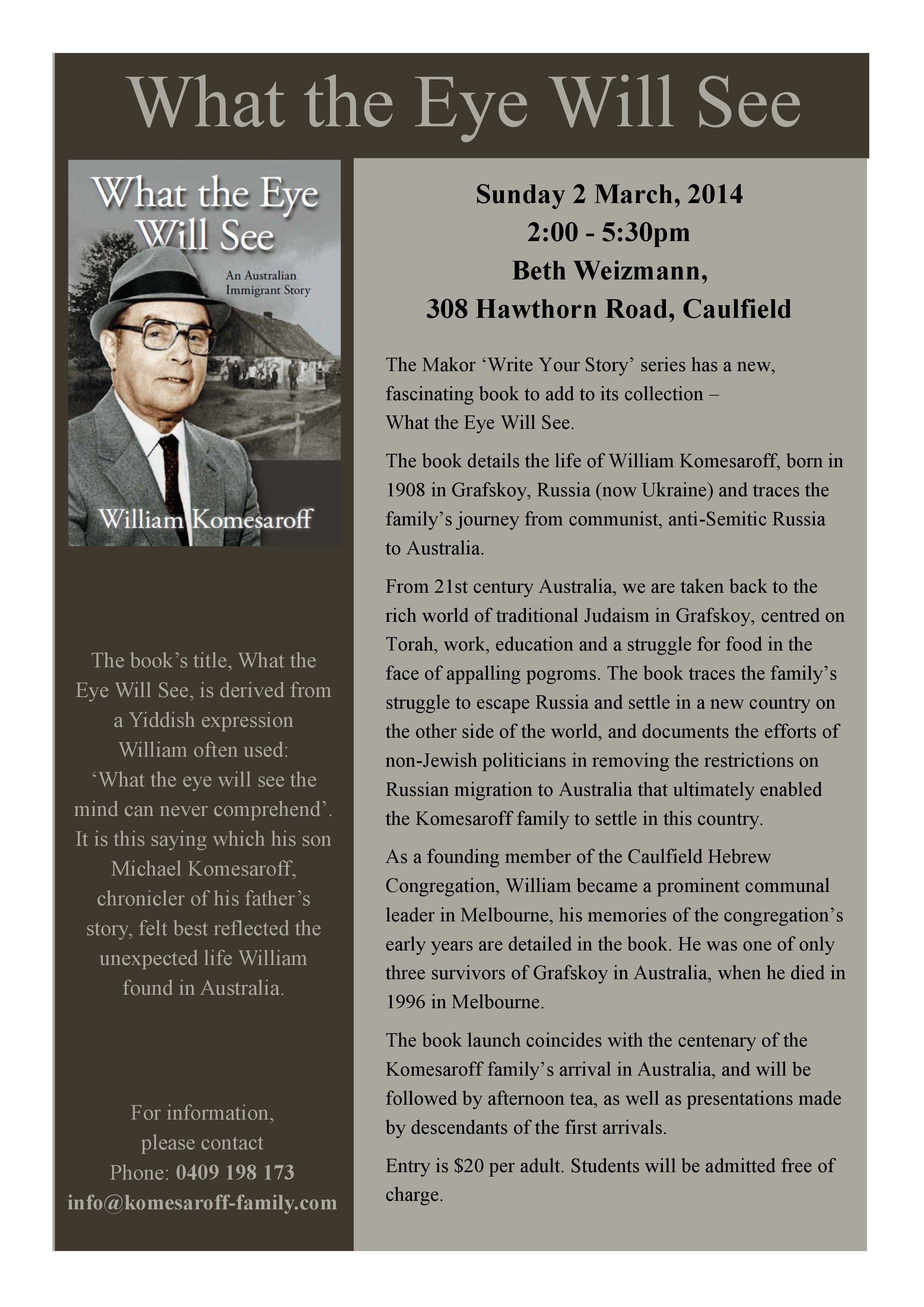
What the Eye Will See

A friend has published a memoir of his late father. When my own father passed away I wrote a memoir and published it.
The entire process was rewarding: I had honoured my father, I had told his story ‘that a later generation might know’. And I had managed my grief.
My friend Michael Komesaroff has achieved all those things with his memoir, “What the Eye Will See”. What stands out in the personality of Willie Komesaroff  (the author’s father) is his jealous protection of his good name, his deep to the bone integrity.
In addition to this private story the author has brought to bear the meticulous research skills that he employs as a visiting professor, consultant and journalist in his professional field, which is Asian mineral investment. The result is a small book with a big story. It is a very Australian story – the story of the Komesaroffs, a Jewish clan from the Ukraine; of their immigration to Australia during the years of the Russian Revolution at a time when Australian government policy expressly excluded migrants from that area.
How government policy was waived and how the Komesaroffs responded in the host country are the stuff of unseen greatness. This country’s gentile politicians who overcame public prejudice and government policy; the Moses figure of the Komesaroff clan who plucked his family from peril and set them up here; the manner in which that clan buckled down, worked hard, prospered, multiplied and rewarded Australia; this is the story of Australian migration success, writ large – but written as it were – in invisible ink. Such is the characteristic modesty and self-effacement of the Komesaroffs (noisy scion Michael conspicuously excepted) that although the clan is Melbourne’s biggest Jewish family and its members are giants of professions, they stay away from limelight.
“What the Eye Will See” allows us all to see and appreciate elements of the greatness of this country and the hidden greatness of some of its quieter achievers.
Michael invites my readers to the launch of the book. It will be a good afternoon.

What the Eye Will See launch invitation

What the Eye Will See launch invitation

Nobody Doesn’t Like a Song

I

Whenever I wanted to read a poem to my father he’d make a face. He claimed he didn’t like poetry. I suspect it was the ambiguity in a poem that frustrated him. In fact Dad loved poems, the poems he committed to memory in his schooldays. He recited some of these often enough for them to take seed and grow inside me.

Now Dad is gone and it is I who recites his lines, learned at school around 1925:

Blow, blow, thou winter wind

Thou art not so unkind

As man’s ingratitude…

Thy tooth is not so keen

Because thou art not seen

Although thy breath be rude

I see Dad’s wry smile as he continued with lines that border on the cynical.

Sing Hey Ho, Hey ho unto the holly

Most friendship is feigning

Most loving mere folly

Dad was not cynical. So what appealed to him about this snatch from ‘The Tempest’?

I think it was the music.

Lots of people think they don’t like poetry. They would never read a poem – not willingly, not wittingly.

But they listen to songs. And a song is just a poem hidden inside music.

Think of the Beatles. Think of ‘Till there was you’. Think of ‘Elinor Mackenzie’. We loved those songs, not least for their poetry.

Nobody doesn’t like a song.

Continue reading

Rod Moss and “One Thousand Cuts”

Rod Moss is a Ferntree Gully boy, a whitefella who found himself in Alice Springs thirty years ago and who stayed there.

In all the moral disorientation of the Centre, in its beauty, its grandeur, its squalor and its mystery; in the perplex of making and losing marriages, of fathering, of teaching, of reading deeply, of engagement with the dark cinema of darkest Europe, Rod Moss found friends in a clan of blackfellas living in Whitegate, one of the town camps.

Moss differed from most of us whitefellas who come to the Centre. He stayed. He painted (in a distinctive genre of his own creating) the lives of his friends. And through all the years of his staying and his painting and his friendships, Moss kept a journal. That journal gave birth to his first book, “The Hard Light of Day”. The book won the Prime Minister’s Prize for non-fiction. More significantly, the book won the praise of Ray Gaita, who described it as one of the best books he had ever read.

When I say Moss found himself in Alice Springs, I mean he found himself in ways most of us non-indigenous people never do: he found who he was, what he was doing here; he came to be in country.

When I say Moss found friends I also mean he lost them.

Those losses are recorded, drop by drop, blow following blow in Moss’ first book, and in the second, soberly titled, “One Thousand Cuts”.

I believe that in its swelling lament and its growing clarity, “One Thousand Cuts” surpasses even “The Hard Light of Day”.

In a remarkable sequence of events “One Thousand Cuts” will be launched at Readings in Carlton on Wednesday 9 October at 6.30pm. And a retrospective exhibition of Moss paintings will be opened at Anna Pappas Gallery two days later.

If Moss’ paintings are luminous, his writing a prolonged jazz riff,  the photographs are something else.

I invite readers of this blog to attend one or both of these events. I will be glad to see you.

Podcast of interview on Radio National with Waleed Aly, Howard Goldenberg and Rod Moss 8.10.13image

Robert Hillman’s ‘Gurrumul’ – Review by Howard Goldenberg

Gurrumul by Robert Hillman  Publisher: ABC Books

Gurrumul by Robert Hillman
Publisher: ABC Books

If autobiography is the least reliable genre in fiction then the authorized Life sits at its flakiest edge. That this is not true of Hillman’s “Gurrumul” is on account of the slipperiness of the subject.

Geoffrey Gurrumul Yunipingu emerges as shy, remote, elusive, cryptic, mischievous – an outer island in an archipelago of tongues. He does not so much emerge as submerge himself. Blind from birth, Gurrumul seems at times to be mute by choice. At others he makes himself perfectly clear to a whitefella, especially when working with his intimate collaborator, Michael Hohnen.

By book’s end Gurrumul remains hidden; only his music and the beauty of his features – a beauty we can enjoy and he can never perceive – speak to us.

No biographer could truly represent this life, (nor for that matter could he successfully misrepresent it). Wisely, Hillman does not attempt either. Instead he places the artist in his context. Chiefly that context is the complex of family (especially his bevy of aunties), community, land and Dreaming: in short, culture.

“Culture”, a term used promiscuously in conversations between the races, embodies meanings that are layered and expressed in dance, in music, in painting, in song, in storytelling and in land husbandry. The meanings are traditionally expressed obliquely, which is to say they are in part obscured. What Gurrumul does with these enfolded meanings appears to be a risky enterprise of his own, with calibrated departures from liturgical norms, a sort of jazz move in which he improvises within a theme and extends it beyond the limits of permitted custom.

Such a variation on a theme must be perceptible only to a tiny number of the millions who respond to Gurrumul’s music making. In this sense it is a secret, yet another, in  practice that skates ever along the outer edge of theunshareable.

When Gurrumul sings, whitefellas listen, enthralled. Literally, we are in a thrall, under a spell cast upon us by the spellbinding singer. We scarcely hear the words, we cannot parse them; and when we read their translations in Hillman’s book, the words in English are so simple as to appear banal: a profoundly false impression. And yet, and yet, we are transported. If beauty be truth, then truth is shown to us precisely as it is withheld. The subtlety of all this magic is clearly rendered in Hillman’s book.

To those who have read “My Life as a Traitor” and “The Rugmaker of Mazr a Sharif”, Hillman’s skill in rendering an alien culture will be familiar. It is in his later work, “The Honey Thief”, that Hillman manages to capture the artist in the act of working his art, in this case the sublime art of the Afghan (Azari) storyteller.

In the present volume Hillman attempts the extremely ambitious exegesis of the utterly untranslatable term, “Dreaming.” He succeeds, in this reader’s view, brilliantly. In twenty five years and over sixty working visits to remote Aboriginal communities, I have never felt I came so close to apprehending (I doubt any whitefella will ever comprehend) the Dreaming, as in Hillman’s “Gurrumul, his life and music.”

Hillman has succeeded remarkably in penetrating the life of art and ceremony (the two amount to much the same thing) on Elcho Island. Seven years ago while I worked on Elcho ceremony was active but off limits for whitefellas. Clearly Robert Hillman won the trust of capable cultural brokers on the island, who ‘let him in’ wherever this was permissible. In return, Hillman repays trust with respect that neither fawns nor condescends. In this his text avoids the vapid tone of comments on the book’s photographs.

Which leads me to the one regret I have about the book, a quibble perhaps, but an important one. In an important sense Hillman’s publisher subverts the author’s enterprise, which is to render in words an art that is ineffable. It is the format of the handsome volume that works against the writing. You look at the book, you find the cover images arresting – and to one familiar with the singing – quite new. The book itself cannot be held in the hand and read: it is biography in a coffee table format. You open the book, you start to read and you find yourself distracted repeatedly from the text by beguiling photographs which tell their own story quite compellingly, but quite out of sync with Hillman’s theme at any point.

Better justice might have been done to both text and photos by physically separating them.

In the end the book succeeds to a remarkable degree. Importantly, it demonstrates how, as whitefellas embrace Aboriginal culture, Australia is becoming more Australian.

Hillman’s book is bound to succeed beyond these shores as Gurrumul’s audiences around the world drink deeply in their thirst for some understanding of his life and his music.

The Last Lover of The Age

Dear Age

I have loved you now for sixty years. I have loved you in all seasons, for good reasons and despite the bad. I have loved you in pleasure and in pain.
It was you who, in 1953, introduced me to Collingwood, the football team that would always run second to the very mighty Melbourne.
My family made the pilgrimage to Melbourne every September for the Jewish High Holy Days, the annual Season of Judgement. It was the judgement of the Age that Collingwood would challenge and would fall short. So it came to pass year after year: the Age proposed and God disposed. Collingwood was David to Melbourne’s Goliath ; and when the Pies went down to the brook they found no smooth stones for their slingshot.

Yes, I loved you. I loved you for the Junior Age in which you published the writings of young readers. I loved you for your literary judgement when you judged my own writings worthy of publication.
I loved ‘A Country Diary’, by Alan Bell. Churchill sent Alan here during the War. His was to be a British voice to keep Australia British. Every Saturday Alan reported on the Australia of his very English garden in Diamond Creek. He kept readers informed about the first duckling sightings in spring. This very British voice did its job: Alan Bell and the Age won the war for Britain.
I loved you when you introduced me to ‘Family Matters’, Martin Flanagan’s weekly report about his pre-school children. He taught anew the old truth that you do not know you have known love until you have sat through the night comforting a child delerious with fever.
I loved you through the seventies when I saw through your selective reporting on Israel and on doctors. In those days the Age pursued three public enemies – Nasty Israel, Greedy Doctors and the Painters and Dockers. If I met someone for the first time at a party and I had to answer the question – what do you do for a living? – I’d say I was a painter and docker. It made no difference.
You no longer pursue the Painters and the Doctors but you pursue Nasty Israel still. Martin Flanagan went to Israel with the Peace Team. To retain his independence he paid his own way. You published his generally favourable reports and I loved you for that.
For a period in the nineties I read Helen Garner’s column in your pages on Wednesday mornings. What joy, what variety, what excellence.
Helen and Martin opened chinks to reveal their human selves and we readers learned more of our own human selves.
I loved you because you were not Rupert. Someone has to be not Rupert or we’d all be in Deep Murd.
I read The Australian wherever I am in the outback, simply because it is available. Impressively, it is available all over Australia. You can read that newspaper from cover to cover and you can weep for bleakness. It is not a good news newspaper. Neither, dear Age, are you – generally speaking. But every so quite often your shrunken front page cheers a reader who yearns and searches for sightings of the goodness of human beings.
Now, and terminally, we have the Internet. Fairfax News can be obtained daily on a screen. (Who is this Fairfax-come-lately? I long for auld lang syme.) So no-one needs newspapers any more.
The Age is preparing for its own Death Notice, slimming down to fit a narrow pauper’s grave.
When you die I will mourn you. You remain necessary. You have been a friend. And as another friend once remarked: no-man is so rich he can afford to throw away a friend.

Postscript: this morning I lit a fire in my fireplace, using yesterday’s Age in place of kindling. The fire took and burns warmly as I write.

“Slip me a Mickey”

Mum is about sixty. She speaks with her doctor son, aged thirty. He’s still a bit wet behind his medical ears.

Mum: One of these days I’ll have stroke darling…

Son, provoked: How can you know that, Mum? I’m a doctor and I’m not able to predict that. You can’t know you’ll have a stroke.

Mum: Well, I do have high blood pressure and my cholesterol is high. Those are the factors. Anyway, when I do, I want you to slip me a Mickey.

Son: You mean kill you? No! I won’t.

Mum: Alright, darling.

Son, contrite: Look Mum, if you do have a stroke, I’ll come and visit you every day. I’ll read every word of Dickens to you. And after that, I’ll read all of Shakespeare to you.

Mum: Thank you darling. That would be nice.


Son, six months later: Mum, remember how you asked me to knock you off if you had a stroke? Would you still want me to do that?

Mum: No, certainly not.

Son, triumphant: You see Mum, if you’d had a stroke, I’d have killed you – and you wouldn’t have wanted to be dead.

Mum: No, darling – I’d have been dead and happy, and you’d be alive and feeling guilty.


Fifteen years pass. Mum goes to see the Australian Ballet and suffers a mini-stroke. Her doctor – a specialist, not her son – starts her on aspirin. She suffers a cerebral thrombosis, a full sized stroke. Her hand is weakened and her memory is patchy. Her specialist decides she needs warfarin – rat poison – to thin her blood. After watching ”In the Name of the Father” with her doctor son she vomits suddenly. Son helps her to her feet, but she falls, a dead weight. Her son and her daughter in law heave and drag her to the car. They drive to hospital.

Mum’s blood has become so thin she’s suffered a cerebral haemorrhage. Her specialist doubts she will recover consciousness. She does so. While she remains in her coma someone in the hospital relieves her of her engagement ring. She never sees it again.

Mum wakes up. Half her hindbrain is demolished and with it her balance and her ability to walk. Her champagne voice loses its sparkle. She speaks huskily now, coughing often, searching for sounds to carry her meanings.

She says to her doctor son: I reckon the next stroke will get me.

What do you mean?

It will see me out. Dead.

Son, not irritably: I don’t know, Mum. How can anyone know?

Mum: I’ve had two strokes now. Isn’t that what they say – ‘three strokes and you’re out’?

The son laughs. The old lady laughs too. A stroke is a nuisance – “boring” is her word for it – but time spent with any of her children is recompense.

Belatedly the son recalls his promise – Dickens! Shakespeare! Mum, remember I promised to read novels and plays to you?

Did you darling?

I did promise, but I never came good.

Never mind, darling.
She squeezes his hand with her own – the one that still works.

The son launches into reminiscences of the time, more than thirty years distant, when they lived in the country. His stories bring back the days when her young body obeyed her quick mind, when it was she who nurtured the stumbling child. He finishes his vignette. The mother smiles, squeezes his hand again and thanks him: That was lovely darling.

Son: You know what, Mum? I’ve got lots of stories from those times. How would you like it if I were to write them all down and read them to you?

Mum: I’d love that darling.

He starts to write the stories. He supplies them to Mum and to her oldest friend from those days. The two old ladies feast their tear glands on the stories.


Mum needs a helper now to shower herself. Sometimes the helper takes leave and bathing her falls to a son, the oldest one, not the doctor.

Mum: Isn’t this awful for you, darling? Bathing an old wreck?

Eldest son: When I soap your back, I remember with my skin how you soaped me. It’s a return, a coming home. I bless myself for the privilege.


The stairs in her old home are beyond Mum. The doctor son and his grown son carry her up and down on wrist-linked hands. Mum asks: Don’t you boys want to euthanase me?

Son: At last I can do something for you in return for carrying me all my life.


Mum and Dad settle into their new single storey home. After a time, the doctor son asks: Mum, do you remember a conversation many years ago? You wanted me to give you a fatal overdose of a sedative if you ever suffered a stroke. Now that you’ve suffered a few of them, do you still feel the same?

Oh no, dear. Certainly not. Do you know why?

Her emphasis makes her wheeze and cough.

Son waits for the squall to pass: No Mum. Why?

Mum: I thought if I suffered a stroke I’d be handicapped; and I was right. And if I was handicapped, I’d lose my independence; and I was right. I thought if I lost my independence I’d be a burden; and I was wrong.

A pause.

You know – I’ve never been happier in my life.

He stares at his mother.

Mum: And the reason is I am surrounded by people who love me.


20130604-204052.jpg