The Elephant not in the Room

A roomful of people in the dusk of the inaugural Melbourne Jewish Writers Festival, expectant, keen to hear and discuss “Carrots and Jaffas”. I anticipated we’d be fewer. I should have known Emily Lubitz (from Tin Pan Orange) and Martin Flanagan (journalist) would attract people. But Emily sent a series of text messages.

2300 last night: “Howie, we might need a rain check. My waters just broke. I’ll see the doc before tomorrow’s gig. Am keeping my legs crossed.”

1100 today: “Howie, I’m in hospital but not contracting. I asked the doc can I duck out for a couple of hours. She looked at me as if I was crazy. Still hoping I’ll be the elephant in the room.”

1300 today: “I’m contracting. If it’s a redheaded boy we’ll call him Jaffas or Carrots.”

So, no Emily.

Martin Flanagan, journalist, novelist, anthropophile, led a conversation about the book, about my choice to turn from serious non-fiction to the novel, about stolen children – the ultimate wound, about twinness, about the problems and pitfalls of the whitefella writing about blackfellas.

An audience of committed, highly informed and compassionate people engaged us in a conversation about the interfaces between Australia’s first peoples and later comers. They explored the curious and recurrent engagement of blackfellas in Jewish affairs that started with William Cooper, and the reciprocal engagement by Jews in Aboriginal advancement.

Martin and our audience created an atmosphere of the most distinctive quality. Humans and their stories, people and their dreams, the mystery and the sanctity of the Dreaming, the heritage that is memory, the sacrament that is storytelling – all these were raised up and seen at their height.

We went home fulfilled.

20140602-210544-75944388.jpg

Wilson’s Promontory

Wilson’s Promontory – where the Australian mainland gropes south towards Tasmania and the Pole.
Wilson’s Promontory – in whitefella parlance, “The Prom”; to blackfellas, “Wamoom” – a place too special to live in, reserved for ceremony.
The Prom – a place sacred to whitefellas who do not reside there, vacation nomads.
Wilson’s Prom – where generations come and keep coming, where they need ballots to winnow the applicants; we who apply – we are the grass.
Wilson’s Prom – where four generations of my family have wintered and summered, most of them beyond remembering.

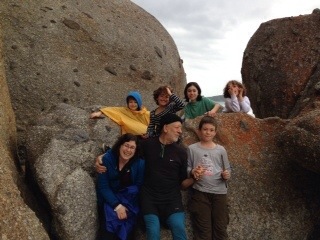
Some of my family spent this (prolonged) weekend at the Prom, both saplings and old growths, across the generations and down: two grandparents, their niece from Boston, her two children, the three children of our firstborn – all of us in that heightened state of aesthetic rapture as rugged mountains meet a moody sea.

We hiked and climbed great rocks, we jumped from them onto sand that squeaked, fell from them and upon them. We collected water from a mountain spring, we crossed small rivers and we peed into them, we ate and we ate, we read stories from the Jungle Book, we played chess and Scrabble and board games.
Screens were eclipsed.

Five young children from two different continents, different lives, met and blent, and were Australian in the special way that occurs ‘in country.’

Ten years ago, I wrote a poem here, memorialising a whale and my father, then one year gone.

WHALE MOURNING AT WAMOOM.

My father walked these hills and steeps;
Woke early ever, walked rugged rock-strewn track
To the lookout and back. Now he sleeps
Forever; and I rise with the sun
On this second day of this last new moon
Of the dying year,
And sound the shofar, the ram’s horn warning,
Then go for a run on a crystal morning.

My father walked till his dying year; I follow his track
Across the bridge,
Then up the hill and over a ridge –
Then back; pausing to view a sapphire sea.

High here, on air, at Wamoom, this southern
End of a continent,
Comes remembrance, a fifth element.
Midst earth and water I stand, content,
Basking in the gentle fire of an early sun,
Then turn
To start the slog and gasp and sweat – up hills
And tracks on the ridge of the returning run.

‘Stop!’ – cries the voice of my companion –
‘And turn!
And look out to sea, and see – there’s a whale!’
I stop and turn and look – and sight the sail-
Shaped fin, the hump of back, the mammalian
Brown-black, a bruise
On the blue face of the sea. Now it sinks again
And as I smile, give thanks and muse
It surfaces and plays, and sprays its spume
At the end of the dying year.

Another whale was here, beached, dead; while with my father
A decade ago, I saw it. We paid homage at its sandy tomb.

(from ‘My Father’s Compass’, Howard Goldenberg, Hybrid, 2007.)

20140525-185107-67867946.jpg

20140525-185655-68215464.jpg

You are Invited

Once upon a time a redheaded warbler sang a song to a crowd of people gathered to hear her and readings from a book about two redheaded twins. As she sang the crowd chewed on antithetical foods – carrots and Jaffas, small, red spheroids of joy.

The singer was Clare Bowditch, songwriter, mother of twins-plus-one, social activist, actor, philosopher and articulate introspector.

The reader was Howard Goldenberg, author, marathon runner, marathon eater, marathon talker. He read (affectingly) from his new book, a novel about “Jaffas” and his identical twin “Carrots”, two boys who grow with souls enmeshed. One is kidnapped and the two must struggle to find how to lo live as individuals. The author makes them and their parents suffer; he makes the reader suffer; and after adventures in the Aboriginal outback (in ‘country’), Howard allows all (or almost all) to trace an arc of redemption.

The crowd had come to Readings in Glenferrie Road, Hawthorn, not to eat lollies, nor to chew on root vegies, but to hear and see Clare, to be near her in the intimate space (one of Melbourne’s sacred sites) of Readings bookshop.

Why Clare? Becauser of her twins? Because of old friendship between singer and author going back to her teen years? Because the singer – like the boys in “Carrots and Jaffas” lost a sibling in early childhood? Because of red hair?

The true reason is the Bowditch heart, the same that pulled in the crowd. The heart that can say, “I’ve had enough claps” and “I’ve always drawn from the pool of suffering for my art.”

As Emily Dickenson says: I like a look of suffering/because I know it’s true.

Clare Bowditch sings true songs. In the same way “Carrots and Jaffas” is a true story.

Did I say the event has taken place? That part was not true. It is still to come:

READINGS HAWTHORN, THURSDAY 22 MAY AT 6.30 FOR 7.00 PM. ALL WELCOME

More Mother’s Day Thoughts

After my experience last Sunday I’ve decided I like Mothers Day. I enjoyed sharing vignettes of my old Mum. One of the first that I ever published, appeared in my first book, a memoir which I called “My Father’s Compass”. The vignette, a story about my 92 year old father battling the extinguishment of his great powers, and my mother battling nothing and accepting all, was titled: Falling gums.

“The phone rings at midnight. I walk towards the answering machine and listen for an urgent message. I do not pick up the receiver because it is Friday night, my Sabbath – Shabbat – when my soul visits paradise. When I am in paradise I do not answer the phone. There is no message.

Though puzzled – who would want to speak to me at midnight if it were not an emergency? – I begin to relax, then the phone rings again. Once again my machine offers to take a message, once again the caller is mute. I grab the phone. Dad’s voice says, ‘Mum is on the floor …’

‘I’ll come now,’ I say, and hang up. Dad and I have responded to the situation with the least possible desecration of the Sabbath.

Minutes later I let myself into my parents’ house. There, on the bedroom floor, in a tangle of limbs, is my mother. ‘Hello darling,’ she says. She looks up at me and gives me a grin. Recently, Mum’s front teeth have begun to desert her. Those teeth that remain are a picket fence, stained and in disrepair. Mum’s former serene smile has given way to a seven-year-old’s grin – all mischief and careless abandon.

I peer down at Mum’s legs. They are thin, too thin, except for her ruined knee which is swollen and misshapen. In the half light her skin is ivory. I crouch and put my hand on her leg and feel its cool and its smoothness. I touch my mother’s skin and I am her small child again.

A short time passes. ‘Does any thing hurt, Mum?’

‘No darling.’

‘Can you move your limbs, Mum?’

Dad’s voice breaks in: ‘Mum’s not hurt – she didn’t fall. She was reaching for the commode chair and she pushed it away instead of holding it still … she just slid gently onto the floor … I couldn’t stop her falling …’

Dad’s voice subsides. He sits on his bed and holds his head in his hands.

Mum speaks: ‘I’m quite comfortable, darling. It’s quite a nice floor, really.’ Another grin. I look at my mother. Her limbs are splayed and folded beneath and before her like so many pick-up-sticks. I wonder how I will pick them up.

‘If you like it on the floor, Mum, would you prefer to stay there until the morning?’

‘If you wish, darling.’ She extends a hand and pats my face.

I bend and begin to take her weight, my hands beneath her arms. Dad gets up to help but I knock him back because his heart is worn out and failing.

He recoils, recedes and sits down opposite me, his face wrought of grief and care. I feel a pang for my abruptness.

An in-drawing of breath, a grunt and Mum is aloft, her legs a pair of white flags hanging limply beneath her. Her arms are around my neck and we are locked in our accustomed embrace that has become so familiar since she began to suffer a series of strokes.

We know this moment well; each of us knows the sweetness of this slow dance. Neither of us would readily trade it, not even to make Mum whole again.

A moment later Mum is in her bed, covered up, wheezing, speaking breathily, her voice ravaged by stroke and by time: ‘Thank you, darling, what a treat!’ – and beaming with the simple pleasure of ­being tucked into her bed.

Dad, contrite, distressed, is saying, ‘I am sorry, darling. I hate to disturb you.’ And I am saying how pleased I am to come, and how come he didn’t speak into the machine when he rang. And Dad says, ‘I don’t know.’

‘Shabbat Shalom,’ I say, kiss them both goodnight, and go home.

Back home, but not yet in paradise, I sit a while and recall a conversation my friend Lionel reported to me. While driving with my father in the Flinders Ranges, Lionel asks this indestructible old man a singular question: ‘What are you afraid of in this life, Myer?’

My dreadnought father has fought all his sixty-seven years as a doctor against illness and injury. Of all diseases, I know that cancer and stroke fill him with terror beyond naming. And I recall, too, Dad confiding to me his fears for Mum: ‘I am grateful for every single day that I have her; and I am so frightened of the day that …’ He falls silent, his voice drowning in the grief of his imagining.

When Lionel asks his question, Dad looks up and out and away from inside him, and he sees those silent, massive and beauteous living things, so inviting in the outdoors and so treacherous. He answers, ‘Falling gum trees.’

The day after the ‘fall’ Mum and I are alone in the kitchen when she begins to laugh. The sound has a gasping quality. You have to pay close attention to discover whether she is choking again, or simply amused. She laughs louder then tries to speak at the same time.

Her voice is a concerto for bagpipes and windstorm. I lean close, into the teeth of the storm, and Mum says, ‘When I was on the floor last night, and I couldn’t get up, I started to laugh, and I couldn’t stop … and Daddy was furious!’”
‘Joyful’ by Robert Hillman – A Review

There’s a CD I listen to when I want to write about something serious or something true or sad. It is Disc Two of ‘Dirt Music’, the album compiled by Tim Winton and Lucky Oceans to accompany Winton’s great and sad book of that name. Two tracks on the disc speak from the darkest room in the house of sorrow. (I refer to Sculthorpe’s ‘Dijille’ and to ‘Cantus in Memory of Benjamin Britten’ by Arvo Part). The grief is absolute. It neither cries nor shouts nor tears its hair out. It simply quivers and ultimately exhausts itself and lapses into barely audible human breaths. And thus into harmony with life. The experience leaves me quiet, reconciled – I suppose – by sheer truth. And beauty.

What has that to do with Robert Hillman’s new book, “Joyful”?  I read a passage in the later part of the novel where a character who has lost his only two children weeps silently in the utter darkness of a room in the mansion that gives the book its name. His quivering presence is sensed by his host, Leon Joyce, owner of “Joyful”. Joyce, who has been observing his own prolonged season of bottomless grief, stands, wordless and motionless. The weeping one comes to realise he is not alone. Each sorrows in silence, both men understand. No sign, no word. But something beyond words is known: the two men and the grateful reader make their way from that room in “Joyful” somehow reconciled to loss. And that is what Hillman’s book is about – its chief theme – how we humans risk all and lose all when we (inevitably) invest in passion.

Robert Hillman is not famous for misery, any more than Winton. The misery is there in the book as it is in life. But “Joyful” is also a story of the greatest vitality, the most audacious imagination, the most original characters, (from the carnal priest who absolves himself habitually, to Dally the Wordsworth-loving Iraqi Kurd, to the sexually hyperactive Tess, to the hapless Emily who cannot love any man who loves her, to the world-weary, gusset-guzzling, false-poet Daniel.) And the book is full of gems from the bowels of Hillman’s imagination that made me roar with unexpected belly laughing.

I defy the reader to get through “Joyful” without shedding tears of mirth and tears of joy. In short, I like it. I admire it. I respect it, I envy it, I treasure it. I’ll remember it.

joyful“Joyful’s” characters are destined to live in memory alongside Winton’s Fish and Lamb families that emerged from “Cloudstreet” and took up lodging in a nation’s treasury.

Text published “joyful.” Howard Goldenberg will launch it at Readings in Carlton at 6.30 pm on Wednesday 7 May. Please come along.

The Boringest Cliché

1510472_366538920155302_968766595_nWe have all seen too many movies, read too many stories and attended too many plays where some person (always male), his hair thinning, his relationship failing, struggles endlessly to start his novel. Or to get over his writer’s block. Or to complete the bloody thing. Or to get it published.


Great writers have whinged greatly on this theme. Jonathan Franzen (The Corrections) and Nam Le (The Boat) have fretted memorably. The world has now read, seen and heard enough on the theme.


Yet, four and a half years of my (how much?) remaining time have disappeared in the creation of my own novel, “Carrots and Jaffas”. I watched and saw the sands of my time trickle profitlessly as through an hourglass. I wrote a masterpiece each morning and re-read lines, dead and drear, each evening. I took six months off work ‘to finish the novel’. Those months passed and a further draft joined the previous six in my waste paper basket.


For the past four and a half years I have lived that cliché. My wife and family have experienced that neglect.


Now Carrots and Jaffas poke their red heads (slab-shaped due to their premature arrival, ironically polar to the postmaturity of their story) out from the beautiful, bright covers that bear their names and Hybrid Publishers commissioned for them. The twins’ struggles to survive, their unnatural/supernatural/utterly natural intimacy, their delayed individuation, their painful discovery of separated self – all these have lived within me; and now Carrots and Jaffas face the world naked and without.


They tremble before you.

Two Writers Wrote My Novel

One of the two, a good bloke, would get up too early in the morning, charge himself with caffeine, and – sparking with imagination and creative drive – write passages of prose that really excited me. I liked that bloke. The second, born on the same day as the first, was much older. A sour individual, crepuscular and nocturnal in habit, he’d cast a jaundiced eye over the other bloke’s matutinal erections and scorn them into impotence. He’s scratch out every virtuoso phrase, he’d cut through digression and elaboration. Mean as catshit, he believed less was more, and least was most. I found him unpleasantly convincing. I hated the bastard.

Both antagonists worked on Carrots and Jaffas from start to finish. They managed to draw out a six-month project to four and a half years. By the time the book was printed I was nearing sixty-eight and I resolved I was done with the novel: how many more fifty-four month projects did I have left? Bugger the novel, I decided. I’d read them still, I just wouldn’t write any more.

Three months later I had finished my second novel. Titled “A Threefold Cord”, it is a novel for shared reading between an adult and a child of eight to twelve. And it is a cracker. The book comprises sixty-seven chapters of action, suspense, hilarity, and the unremitting contest between good and evil. In addition there is sufficient reference to bodily functions to delight and liberate a well brought up child.

As the book raced towards Chapter Sixty I informed my oldest grandson I would end it after the sixty-seventh. “Why, Saba?”
“Because I am sixty-seven.”
“But what if it’s not finished?”
“Doesn’t matter. I’ll just stop.”
“But you can’t!”
“Yes I can. I’m the boss of this book.”
“But…” The notion of such a summary ending outraged him.
I relented: “I might just start a second book where this one finishes…”
Grandson’s 10-year old face blazed with a happy prospect: “Wow! A series!”
Where were the antagonists of “Carrots and Jaffas” during the writing of “Cord”? I sacked them. I simply wrote for my five oldest grandchildren, aged eight to ten years. No virtuoso passages, no miserly pinching, “Cord” was a conversation with five kids who knew my voice, five kids whose tastes I knew: tastes I had helped to create.
My older daughter, a combined Regan and Goneril in her criticism towards my writerly Lear, assures me no child will tolerate a book with such a title as dull as “A Threefold Cord”.

I know she is wrong. Grade Four at a primary school near Shepparton served as unwitting testers when their teacher resolved to read aloud a daily chapter. Ordinarily, she informs me, the wrigglers would wriggle, the whisperers would whisper and the autists would be up and away. But when she read a Threefold Cord all sat, transfixed. The teacher got through five chapters on the first day.
Since then the children and grandchildren of selected Australian literary figures have read Cord and approved it mightily. From time to time over coming weeks I’ll post the odd sample chapter and you’ll see I am right: “A Threefold Cord” is, as I remarked earlier, a cracker.

Not a Vegetable, not a Lolly, Something entirely Novel

Carrots and Jaffas

Carrots and Jaffas

I have just given birth to two brainchildren. Named ” Carrots and Jaffas”, the two are alive and well and between the covers of a book of that name available from Hybrid Publishers.

The conception of these identical twin red-headed boys was painful; the gestation was prolonged; the birth leaves their parent happy, proud, excited and sore. And, to tell the truth, a bit nervous.
Will the world love my newborns?
Will they survive?
They said, everyone has a novel in them: what if they meant everyone has a navel. I do.

They said the novel is dead. But kindle and axon and hundreds of bookshops around Australia seem unaware of the news. Readers will find carrots and jaffas – the novel, not a veggie, not a lolly – in bookstores from April or as an e-book from iTunes or Amazon.

See the sample attached: C&J 1-1

Please tell me what you think.

Tracks

Tracks

Tracks

Tiny cinema. Although the tickets are numbered, you can sit where you like, the audience is so sparse.
Opening images of a waif, a child in a yellow dress, walking. You see her from behind as she walks before you. The camera – and your eyes – follow her tracks.
The remainder of the slow movie is much the same: the waif, now of adult years, walks and the watcher follows her tracks. “Tracks” is the name of the movie and the name of Robyn Davidson’s book that preceded it by some decades.

The adult waif informs unbelieving Centralians, “I am going to walk to the ocean.” She speaks with an affect of subdued dourness. There is a tinge of defiance in anticipation of skepticism. The character is defensive, often enough sour. A person alone, she imagines she is independent of approval, of fellowship. Halfway from Alice to the WA coast she discovers, suddenly, violently, her human need. She practically rapes her astonished companion, the awkward photographer whose incursions into her aloneness she resents and finally accepts. Clumsy in his American optimism and belief and cheer, he saves her life by dropping jerry cans of water ahead on her route.

The movie has little dialogue. The silence speaks, the emptiness of the continent speaks. Motifs recur – sand as the tabula rasa of existence, fire as companion, water as vivifier. And the land, “country” in the language of her Aboriginal friends ( she makes a few friends, all of whom exist on the uttermost edges of Australian society. In the unexpected sweetness of the waif’s friends the movie approaches caricature. The traces of sentimentality are forgiven, offset as they are by the central character’s acerbity.)
The land, on the other hand, is eloquent and true. No matter how dramatic the image of hill, of shimmering emptiness, of spinifex, of purpling distant ridges, those images are true. The land – tracked in this way only by Davidson, the lost Leichhardt and Aborigines – is immutably itself.

This viewer, watching Davidson’s traverse, felt the flood of deep knowing, of coming home.
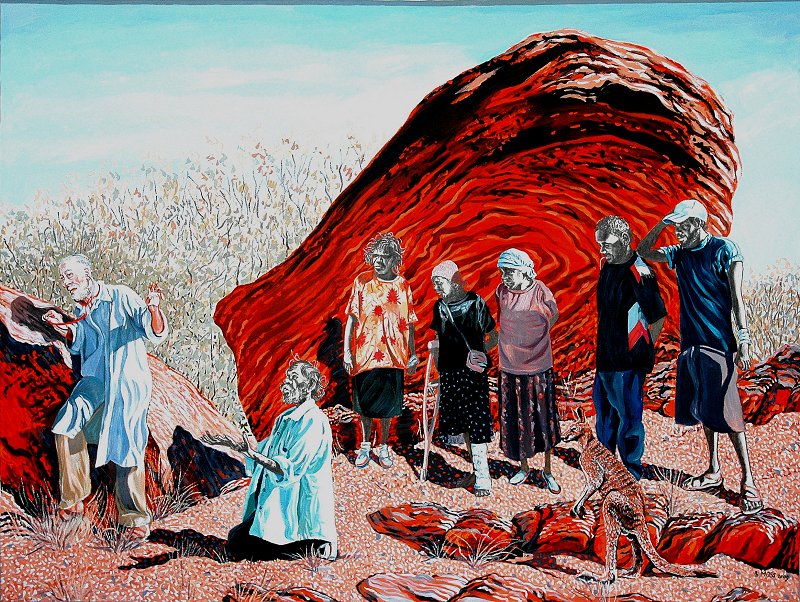
This land is the home of us whitefellas, a home known uniquely to relatively few, characters like Davidson, like Rod Moss, (artist and author of “The Hard Light of Day” and “One Thousand Cuts”). Their knowing is informed by the blackfellas who have shown them their home.

If you’ve missed this movie, don’t worry. Here for five minutes, gone tomorrow, I think it will never disappear. Like Davidson’s book the movie will be sought and valued so long as whitefellas are curious about the land, so long as we ponder our human aloneness.