From ‘Jerusalem Notes, 1967’. 

I was born in 1946. The State of Israel was born in 1948. I cannot remember a time in my own life when we did not have the Jewish state. Mine was one of many religiously observant families at the time whose experience of Zion was one of a longing that defined us. Jerusalem was our dreaming. Our emotions had not caught up with history. In 1967, I visited Israel for the first time. I went to pray at the Wall. It was a Thursday, market day in ancient Judea, a weekday when the Torah is read, both in ancient times and today. As a descendant of the priestly line of Aaron, although a visitor, I exercised a prerogative and gave the priestly blessing. Soon after it was time to read from the Torah. The layman conducting the service called: Let the Cohen come forward. Arise, Z’vi Yehonatan ben reb Melech hacohen. 

He was calling me first, using my patronymic, linking me with my preceding generation, choosing me – for my caste – to witness the reading of the Torah. It occurred to me that here I was, the first in my family in 1900 years to serve as a Cohen at the site of the Temple. It was a moment of déjà vu: I had been there before. I felt I was part of history and history was part of me. A light feeling and a deep one. 

The next afternoon, I returned to the Old City. I followed its narrow winding ways and realized after a while I was lost. I accosted a young man coming out of a house and asked, in Hebrew, directions to the Wall. He was about my age. He wore a dark suit and carried a cheap attaché case. He asked me in English: ‘From which country do you come?’ ‘

Australia.’ 

‘Australia! So far! Will you honour my house by coming inside for refreshment?’ 

I came inside and the young man introduced himself: ‘Yousef.’ I told him that was the name of my grandfather, who was born in Petakh Tikvah. ‘He never came here to Jerusalem. It was not possible for a Jew. Now I am here for him.’ 

Yousef ushered me to a narrow stairway. It was dark. I followed the stairs to a sunny balcony, where he sat me down and excused himself. I could see the Wall now, its stones creamy in the sunshine. Behind the Wall and looking down on it, was the Dome of the Rock. Beguiled, I sat in the sunshine 

and forgot who I was and who Yousef was. And who each of us was not. 

Footsteps behind me brought me back. Yousef carried coffee that he poured into a little cup. It had a muddy look, but it smelled good and tasted sweet. ‘What is that aroma, Yousef?’ ‘Cardamom. You do not like?’ 

‘I do, very much. Thank you.’ Next Yousef bought a large bowl brimming with baby mandarins.‘Clementinas. Please take, eat, drink. Please forgive me that I do not partake: it is Ramadan.’ 

Yousef told me he was a school teacher, but he was not teaching today on account of the Fast. Throughout my afternoon tea, Yousef was smiling. I must have smiled too. He wore a cheap suit and he carried a cheap valise, but he knew himself rich, living in Jerusalem and extending to a cousin the hospitality of Abraham who is Ibrahim, our father. Eventually, I left, my head swimming with Yousef’s directions to the Wall. As we parted, Yousef asked me to visit again next time I was in the Old City. I said I would. On numerous return visits, over the late months of 1967, and over decades since, my eyes would roam about the Old City, looking for a house with a balcony and a parapet, and a man of my years, with suit and valise, smiling. Yousef and I never found each other again. 

*** 

After taking my leave of Yousef, I set off for the Wall, striding after the setting sun. I soon got lost in an alleyway. I climbed an outer wall, and recited the Mincha prayer alone, in the late sunshine. I was reciting the Amida, the silent prayer, when a clattering disturbed me; stones were landing on a roof, around me and just next to my feet. I realized that someone was throwing these stones: someone did not welcome me here.
Last Prayer

I might die tonight

I don’t expect to

But I might…

I’m old.

I have my diseases.

I could go tonight, 

I’m eligible;

It’s not terrible.

We all must leave,

But before I leave

Just in case it’s tonight

Here’s my last prayer.

Hear me, I pray:

Hear me say

shema yisrael

Thanks for today

And yesterday:

Thanks for the mother,

the father in our Tabernacle

of love

And the sister,

The brothers

In that Tabernacle

Of love

Thanks for Annette, 

my love, my wife,

for her lovingkindness.

Netti, you are in my mind tonight.

My children so dear, 

Do you feel, do you hear

The pulse of my love

Tonight, 

As every night?

To the children of my children

You will not know until

Your own children

Have children

How you’ve sweetened 

This, the evening of my life.

If I’m to depart tonight

Let me today spare

For one in need

A kind face,

A kind deed.

Let me leave to my world

A smile, a laugh

As an epitaph.

Prayers

Not long ago a man holidaying with his family falls suddenly to the floor, crying to his little boy as he falls, Call an ambulance! The man does not speak again. He lies in a coma in the Intensive Care Unit of a little hospital in Bali, with injuries to his brain that can’t be measured or treated properly there.


Around the bedside of the man his mother and his 10 year-old son and his elder sister stand and try to understand. A mother looks at her only son; a sister, burdened by her knowledge of the brain, gazes at her wounded brother.  The sister’s husband grips her hand. The boy who gave the man his chance of life sees his father, inert, intubated, silent. The child has no language, no words, in his world overturned.


The mother, the sister, the child speak – when they can bring forth words from their grief – soft, urgent  murmurs of love. The brother in law breathes his prayers.


The man is surrounded by love and tears. Does he hear the murmured prayers of his loved ones? Will he learn one day of the care and the grief of his many, many friends?


An aircraft is sent from Australia to retrieve the man, to bring him home, to get the most advanced care. The plane is an airborne ICU with the super-nurse and the intensivist doctor who can keep the injured man safe as he crosses half a world.


All of this will be hideously expensive. The insurer pauses, ponders, plays for time as time races. How much time does the  wounded man have? The wounded man lies outside time, while his loved ones, their desperation growing, plan to fund the costs privately. 


The man flies home and is admitted to the excellent hospital. The family scrambles for flights, eventually rejoining the man who does not speak.


After all their frantic haste the family falls now into a world of no haste, a world of deliberate care. No idle speech. Words of yearning love whispered into the ears of the stricken. The words spoken aloud are the necessary words of critical work, as gauges flash, tubes drip, drip, drip and respirators observe their slow rhythm of rise and fall.


All wait.


Many come, the aunt, the man’s friends from today, and from all his yesterdays, stretching back to early boyhood. Solemnity sits heavily upon them.


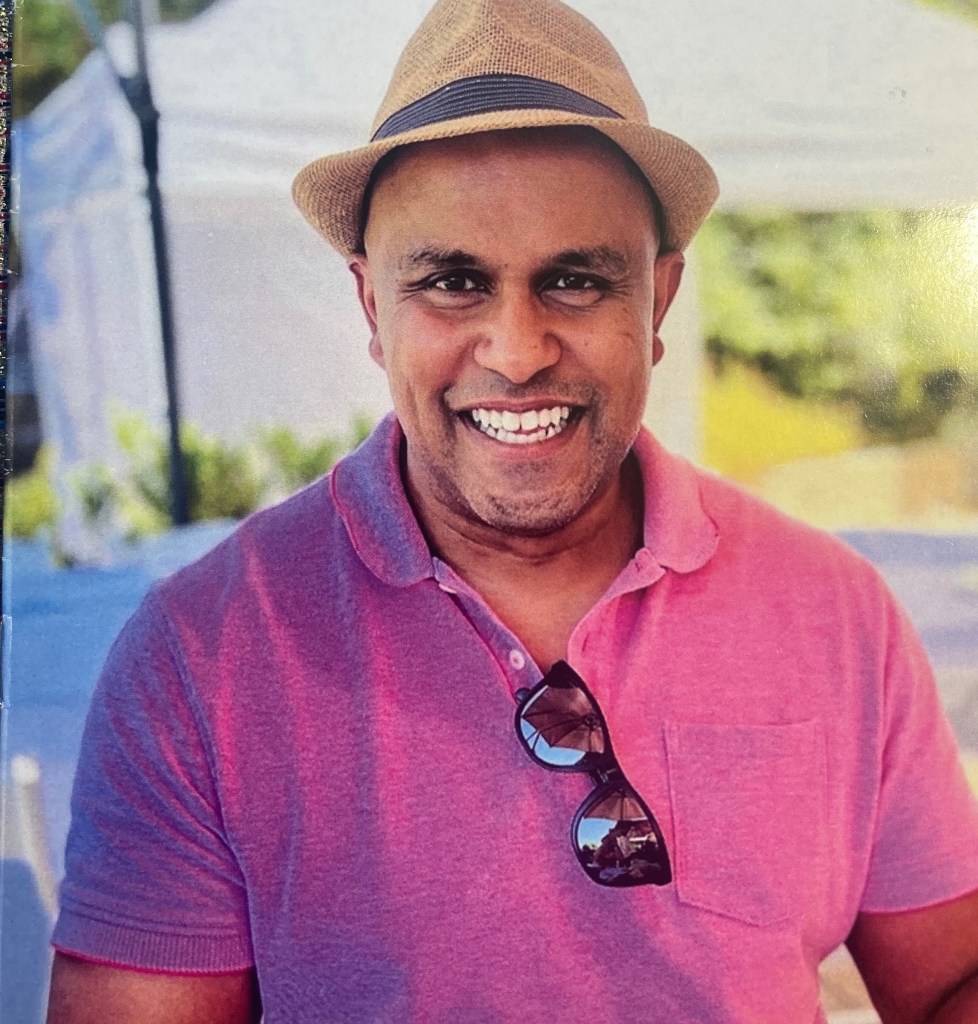
The man Raj, has a wide, wide smile. He has innumerable anguished friends and a family – to which I belong: Raj is my daughter-in-law’s brother, her younger brother who, from earliest times, she lived to protect. Sister and brother planned this holiday time together, with their spouses and children.

The sister landed in Bali only to learn that Raj had fallen, and had undergone emergency surgery that same morning.


In all the deliberating silence doctors search the damage. An early image unveils the haemorrhage-surge that tore through the delicate brain. Later tests answer the question we dread to ask: when stimulated, the unliving brain shows no response.

No flicker, no spark.


The brain subsists in its inscrutable dark. We in our world of talk and think and act, exist utterly separated from Raj. We are exiles from Raj’s new world.


Raj has known this world before. Before his birth, before his conception, Raj existed as thought, as hope, as desire. This world lacked Raj. When he came into being, Raj was answer to prayer, he completed a world.


Now Raj and we inhabit worlds distinct, we with memory, with yearning, and with lack.


Raj’s world is eternal, ours ephemeral. Confined here for our instant of being, we know nothing of eternity. From that place where Raj now abides for all time, time itself is exiled, together with pain.


Who knows, but perhaps prayer lingers there, together with love?


Story for the Cantor’s Wife


Running wearily past the kosher bakery, past the coffee shops, past the kosher providores, past the nearly-kosher food shops, I light upon a face I think I know. The face sits atop a tall figure who wears a black frock-coat, dark side whiskers and a once-black beard. I slow and the man hails me. He thinks he knows me. He speaks: can you come inside and make a minyan?


The man is not alone. Next to him stands another tall man, bearded, not young. Both men wear broad-brimmed black hats. The two wear beseeching looks. They edge closer. With the men standing thus closer than I’d wish, I realise I don’t know either of them. But they have guessed right: I am indeed Jewish and I understand their request. They are one worshipper short of a quorum.


I reply, I’m sorry, I’ve already davvened (recited my prayers) this morning.


Please, we have a mourner who needs a minyan for kaddish. 


I know what this means, I’ve shared the plight of this nameless someone, recently bereaved, who wishes to honour his dead. I tell the men, I haven’t prayed in shule for a long time.  My wife is immunocompromised and I mustn’t bring home a germ.


Long beseeching looks from two quarters. I relent: Alright, as long as there’s space for me to stand at a distance, in the rear.  


I follow the men into a side street. They lead me to a door in a nondescript building that I would not have noticed, and I follow the men inside. Through a second doorway, along a passage then up some stairs to a third doorway. The door opens to a wide space beneath a low ceiling. I look around; there’s space here for fifty minyanim, but the worshippers are few. I make my way to the back of this room which I recognise as a synagogue by the Holy Ark located at the distant front. I peer and sight a second Ark. Odd, a puzzle.


I expect my stay to be brief. Kaddish is one of the earliest prayers; I’ll stay, I’ll listen for the Mourner’s Prayer, I’ll join in the responses then sneak out. I’ll still make it home in time for the meal with my wife.


But Kaddish is not soon recited. This group follows a different order of prayer, in which the mourner’s prayer is recited late, not early. What’s more, these guys pray devoutly, with slow deliberation. I settle in for the long haul.


Discreetly I reach for my phone and send my wife a message: Sorry darling, detained in circumstances of unforseen sanctity.


I wait and wait, my mind adrift. From the distance, a man approaches. I don’t know him. He asks, What is your wife’s name in Hebrew?

I understand his purpose. He wishes to offer a public prayer for Annette’s recovery. Touched, I provide the information.  The man now sets before me a tin with a slot in the top into which the charitable congregant might insert a coin. To donate to charity is a mitzvah, a sacred act. The man places a coin next to the tin, to enable this mitzvah. Once again touched, I provide my own coin.  And settle down, happy to wait in this warmbed of piety.


At length we come to the closing psalms. All rise. A voice is heard; Yitgadal ve’yitkadash shmei rabah, magnified and sanctified be the holy Name. The prayer ends and I make for the door. A man, younger than all the rest, strides towards me, a wide smile breaking open his unshaved face. He says, You can’t possibly appreciate the great mitzvah you have done for me today.

What has this story to do with a cantor, or his dog, or for that matter, his wife? Simply this: running home a fortnight later, on precisely the same route, I paused for red lights at a traffic intersection. A musical voice cried: DoffanPaz! One person only calls me by that name, the young cantor, contemporary of my son.  A small dog on a lead looked up at me from beside the cantor’s ankles. Holding the upper end of the lead was a youngish woman who smiled at me.  The cantor introduced me to wife and dog.

For want of any better idea, I recounted the story above. The cantor’s wife smiled again. She said, You should write that story and print it on your blog. I like your stories. 

Such a compliment comes to me but rarely. I promised I’d write the story. And there you have it.


My Brother Calls me an Agnostic

Brother: Tell me Howard, does God exist?

HG: Why ask me? Why would I know better than you?

Brother: But I don’t know. It’s a mystery.

HG: It is.

Brother: No No No. Not for you it’s not.

HG: Why not?

Brother: Hang on, Howard. I’m asking the questions here. You’re the religious one. Do you believe in God?

HG: A classmate in grade six wrote an essay that offended me. He said there’s no such thing as believe. Either you know or you don’t. I wasn’t ready for his rigour. But I can’t fault his position. Either you know something or you don’t.

Brother: Exactly. I don’t know. That’s why I’m asking you: Do you know?

HG: Sometimes.

Brother: Answer me. Do you know or don’t you?

HG: Both.

Brother: Don’t dodge the question.

HG: I’m not. Sometimes I do know.

Brother: And the rest of the time?

HG: Look, I am the victim of a scientific education. Nothing in science is proven. My education in science taught me Heisenberg’s Uncertainty Principle. Heisenberg was interested in knowability of the position of an electron, I seem to recall. I learned the difficulty in knowability of everything. You could say my position is uncertainty.

Brother: So you’re an agnostic.

HG: I don’t know.

Brother: I know why you’re dodging the question. As an observant Jew you’re embarrassed. I’ll ask you a different question, why do you pray?

HG: That’s easy. I need to.

Brother: Who do you pray to? When you don’t know if God exists?

HG: You mean whom.

Brother: Don’t dodge. Whom do you pray to?

HG: God.

Brother: That’s absurd, isn’t it? Talking to someone when you don’t know He’s there?

HG: I can tell you what I do believe in, all the time…

Brother: What?

HG: I believe in prayer.

Brother: That would be even more absurd, wouldn’t it? To pray to a being when you can’t say he exists; and to believe in prayer when you know prayers aren’t answered.

HG: What prayers aren’t answered?

Brother: When Dad was dying you prayed for him to be cured!

HG: Not exactly. I prayed for him to be healed. But I can explain what it is about prayer I believe in.

Brother: I don’t think I’m interested until you answer the big question.

HG: Humour me. I believe in prayer like I believe in breathing. I need to do it. I need to say thank You. I need to cry halleluya! I need to cry out in pain. I need to keep faith.

Brother: Keeping faith with a God whom – whom, notice – you don’t know exists!

HG: I do know sometimes.

Brother: That’s crazy. What happens to your other faith – I mean Science?

HG: Science actually means knowing. But it’s only one way of knowing.

Brother: Let me remind you, either you know or you don’t know. If you know, that must mean scientific knowing.

HG: Wrong! I know lots of things through my senses: I know hunger, thirst, pain. You certainly do too. You know when you’re randy.

Brother: That’s true.  But it’s not religious truth. That’s not absolute truth. God is absolute or He’s nothing.

HG: I do know an absolute. I know love.

Brother: What’s that got to do with it?

HG: Possibly everything. When I worked at a Catholic hospital a nun said to me, God is love. I didn’t get it. I asked her to explain. She repeated, God is love, and she left me to puzzle over it. I thought it sounded profound, but mysterious. That was nearly fifty years ago. It’s still a mystery to me. But I can tell you what you believe in.

Brother: What?

HG: Love. You love your children.

Brother: You’re twisting words. You and your nun. If you believed in love as God, you’d worship love. You’d pray to it. You’d personify it. But you’re actually an agnostic. Probably a Godfearing agnostic.


HG: Fair enough. There is another angle on love and God. It’s in Les Mis: To love another person is to see the face of God.  Too banal for you? Let me tell you how I do know God is real.

Brother: How?

HG: I visited The Breakaway at Coober Pedy.

Brother: So?

HG: I stood there in that desert immensity. Silence. Vast emptiness. And the still soft voice that spoke without sound.

Brother: And God?

HG: I stood in creation and I knew the Creator.

Brother: Very nice. But unconvincing.

HG: I’m not trying to convince you. I’m searching on my own behalf. But I know you’ve stood in immensity and been overwhelmed.

Brother: When? Where?

HG: In Yosemite. At the foot of El Capitan. We stood there together, with Dad. The universe spoke to us all, no words, no sound, but a state of inspiration.

Brother: I didn’t see God there. Feeling overwhelmed, feeling uplifted like that, that’s not knowing. That’s something distinct from knowing.

HG: It is knowing, you just don’t recognise it. Let me tell you of your knowing that you don’t know to be knowing. Deep knowing, incontrovertible knowing, beyond argument, beyond doubt.

Brother: I’m all ears.

HG: When you listen to music, when you know its beauty is truth, when that knowing clinches in your being. Sometimes I know God like that.

Brother: You’re twisting again. You don’t now whether God exists. You’re an agnostic.

HG: You think you know that. Hold on to it as an article of faith if it helps you. But would you like to know why I pray when I’m in a non-knowing state?

Brother: Tell me.     

HG: When faith eludes me, I pray to keep faith. I keep faith with Dad. I keep faith with his father, with all the fathers – and with the mothers – who’ve prayed.

Brother: Perhaps your prayers are a request to God to please be.

HG: If God exists, that is The Great Fact. I can’t think of anything more prudent than praying to cover that possibility. But that’s not why I do it. I do it because I love it. It’s the marriage of words to existence.

Brother: What?  

Mum Interviews God

Friday, eighteen minutes before sunset. Mum stands before the candelabra, strikes a match, holds it to the wick, pauses and watches until a flame rises, blue at the wick, yellow at the fringe.  She applies the same match to a second candle, which obliges with a sturdy flame just in time for Mum to drop the match-end that was about to burn her. She lights the third and last candle. Again she watches briefly, now drops the match and holds her hands – cupped palms upward – above the dancing flames. Now starts the ballet I have witnessed and loved since earliest childhood, as Mum’s hands move up, then down, up again and down, then a third rise and fall, as she caresses air and brings up the light of Shabbat.

Mum’s hands move to her face and shield it from sight. I won’t see Mum’s face again until she completes her interview with God. She whispers a blessing. Then silence. What is she doing? Unlike us boys Mum does’t wear her religion on her sleeve, nor, for that matter, on her head. Mum’s discourse is free of theology. She is not one for external display. But this moment – these moments – she dedicates to One who is outside and above that world in which she cooks and reads and dreams and loves. 

I wait. We all wait. All of us, her four children, our father, smelling the smells of the sabbath meal, all suddenly ravenous. We’ve recited our prayers, we’re ready. But we must wait while Mum talks to God. Mum lowers her hands, turns to us, “Good shabbos, darlings.” Her eyes shine behind tears.

Eighteen minutes before sunset on a Friday, sixty-five years on. Mum stands before the candelabra, takes a match and strikes a flame. This is no longer a simple act: to do this, to light the candles one by one, to judge when to hold the burning fragment and when to drop it, Mum must release her grip on the kitchen bench. Since the haemorrhage that tore through the back of her brain, none of Mum’s motor functions is simple: to stand, to remain standing, to direct the fingers to strike a match, to light a candle, to articulate words, every act a challenge to be met and overcome. The three candles rise, yellowblue, to Mum’s wavering matchstick. She drops the match and now her hands caress air. Once, twice, three times, those slender hands, those long fingers still graceful, rise and fall. Now the hands rise to Mum’s face and hide it, and we hear her whisper the words. No sound now as we watch and wait.

After one of these lengthening quiets, I ask Mum what it is that demands so much of the Creator’s time. “What are you saying, Mum?” 

“I’m asking God to care for you all, darling.”

Mum has four children. She had a husband but he died a few years ago. She has grandchildren who have become adults, she has a rising score of great-grandchildren, she’s accumulated children-in-law, grandchildren-in-law. Every one is precious, each has individual needs, each must be singled out and presented to God for blessing. Blessings must be tailored: Heal this one, strengthen that one, protect that third, comfort him, calm her, bring them peace.  

We wait and we wait. Mum and God have much to discuss, as God’s old friend comes to Him again with her weekly agenda of love.  

Summer Stories: Just Dirt

Before arriving in Coober Pedy I read of The Breakaways, an accessible scenic spot of some sacred significance. Once in town I asked directions. These were simple enough to alarm me: ‘Turn right at the Stuart Highway, turn right at the signposted track and drive to the end of the road.’  And – ‘You  best get there in time for sunset or sunrise, when the colours are stronger. Other times it’s bleached by the sun.’

The Stuart bisects our continent. I’ve never found myself alone on the Stuart before. The road roars with lorries and road trains that hug the tail of your smaller vehicle at their permitted 110 kilometres an hour. But this early morning my car alone moved through the dark along the Stuart. Cloud covered the stars. The car radio was silent. A velvet cloak sat upon the earth. I knew I was alone.

The kilometres slipped behind me as I raced to catch a doubtful sunrise. A tiny signpost flashed into sight and out. Had I missed the turnoff? I laughed aloud at my famed ability to get lost. But no – a few minutes on a large sign read: THE BREAKAWAYS. So-named, I read, because chunks of the planet appear broken off from the surrounding scarp.  One or two locals, indigenous people, shrugged when I mentioned The Breakaways: ‘Never been’, said one. ‘Just dirt’, said a second.

The velvet was breaking up. Teal blues split the clouds, a lightening over my shoulder from the east, the dark surface now reddening, the black grasses greening. Earth awakening, but everywhere, silence, stillness. The dirt track shifted beneath my tyres, the car, tipsy, slid from side to side, my passage never quite controlled, not fully skidding. Up a rise, the end of the road. Once out the car the first sensation a blast of wind, night-cooled, but warming towards today’s 46 maximum.  A wooden barrier separated me from a sudden void. The earth fell away at my feet, a vast valley, roughchopped, opened before me. The wind tore up the slopes and away. Nothing else moved. No sound. No life. Stepping forward felt like sacrilege.

I stood still and gazed, astonished. Unprepared for an encounter none could prepare for, I simply stood. My eyes flew up the slopes of table-topped massifs and followed the fall of abrupt clefts. Hills of caramel pink and nude rocks of white ochre in a repeating pattern of rise and fall, fall and rise. And no sound at all. Was this the birthplace of the world? Would that scrubby shrub at the valley floor burst into unconsuming flame?

I stood for some time as one at prayer. I knew an aloneness and a silence and a stillness that must have spoken to my soul. In time I returned to time and I took up the elements of my ritual dawn prayers and I prayed and I gave thanks. I felt kin to others who have stood here over the millennia and contemplated creation. I made my poor homage.

At length a living thing came to me in the stillness, a blowfly. The fly sniffed and sipped, and finding my skin dry, it went its ways. The wind whipped my tallith which made to join the insect in flight. Alone again, no human on earth today had better access to his Creator. If a voice had called, ‘Howard, Howard’, I believe I’d have answered, Hineni.

My prayers done I walked to the display that detailed the nearby salients. The text, authorized by a local elder, hinted opaquely at their sacred significance. The place has its true name, Kangu. Behind me at a short remove was the bearded dragon, Cadney, over there was Pupa, two dogs lying down.  And in front was Kalayu, the emu, father caring for his chicks. The area is an initiation site for young boys. Its elaborated meanings are secret, forbidden. This is meet. Sufficient to be here in mystery.

A side track to Pupa beckoned and I ran. Ochreous powder cushioned my feet. The track took me down and around. Soon I was at the valley floor and the mighty forms rose up, thronging about me. This was ‘just dirt’ and I human clay, a small thing in all the greatness. I thought of the miracle of being, I thought of annihilation. So easy here, to slip, to fall, to break an ankle. In a day or two the heat would finish a crippled runner. The thoughts carried no drama, little colour. Death in this valley would be ordinary; it was living and moving that were out of the order of things.

I was alive and moving. I turned and I ran back up the hills.

A Guest of the Emir

Recently I enjoyed the hospitality of the Emir of Dubai. Overnight Qantas flew me from Australia to the Emir’s desert airport where I boarded one of his aircraft, bound for Malta via Larnaca. At 0720 I found my seat in the very front row of Economy. As we were not due to take off until 0750 there was sufficient time for me to recite shacharith, (literally, the dawn prayer).


I looked around. I saw no other yarmulkes. On the other hand, there were no hijabs either, nor keffiyehs. I pulled out of my backpack all the elaborate paraphernalia of my morning prayer – tallith, tefilin, siddur and stood for a moment, irresolute. I recalled the prayers of my family on the eve of a previous Emirates flight: ‘Dad, you can’t do all those rituals on Emirates. It’s provocative. It’s not safe. Please, Dad, don’t do it!’


I unfolded my tallith. Not just any old prayer shawl, this was the final gift to me of my father. Very late in Dad’s life I took him to Gold’s where he bought this tallith for me and I bought one for him. An absurd exchange? Possibly so. It was one we had ritualised over a couple of decades: at the kosher grog shop, I’d shout Dad to arak or slivovitz for Passover and he’d buy me a brace of claret and Kiddush wine. Happy to enhance the other’s observances we’d grin and embrace and bless each other.

I looked at the tallith and felt the fall of many curious eyes. I thought of Dad and I wrapped it around my head and stood, enfolded, for a few moments of remembrance. Then I showed my face.


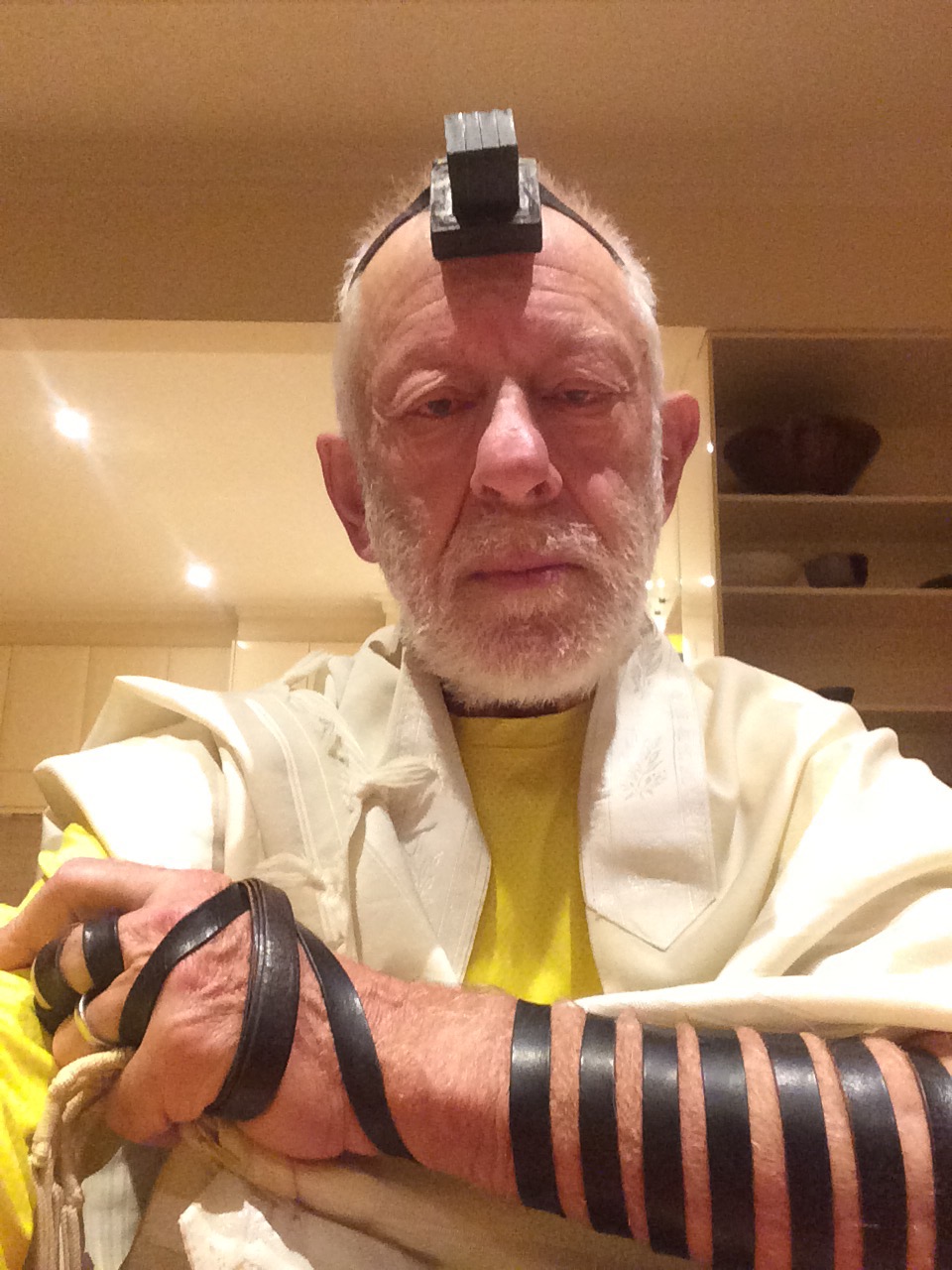
Standing in my seat in Economy I realised I was providing a live show for the roughly 160 gentile persons filing slowly past my seat at the front, en-route to their own. I had more colourful display in store for them. I pulled out the small bag of royal blue velvet that holds my tefilin. These small black leather boxes, fashioned after an ancient craft, contain Torah verses meticulously inscribed on vellum. Tefilin symbolise key rememberings that are mandatory every day upon every Jew. Attached to the little boxes are long black leather thongs by which I bind one box high on my left arm and another to the centre of my forehead. The verses thus are bound to my heart and my mind.


The unfolding of tefilin, the minute and precise steps of the placing and binding, punctuated at prescribed intervals by the reciting of rabbinic and prophetic words, constitute a dance no less exacting than the mating of brolgas. Three hundred and twenty eyes took in the old choreography. 


Upon completing my devotions I removed one leather box, kissed it perhaps a little more reverently than usual and coiled its straps. I did the same with the second. Finally I folded my tallith. The ceremony of prayer at an end, I took in my fellow passengers. We were Filipinas, Chinese, Occidentals, and a fair smattering of persons of Middle Eastern appearance. No-one had raised the alarm, no-one objected to my sectarian display.


When at last I sat down, the man next to me asked: ‘Where do you come from?’

‘Australia. And you’re from Korea?’


A large smile. Surprised, happy to be recognised, he nodded. He and his wife and his volleyballer-tall daughter were heading for Malta, as I was. ‘For our holidays’, he said. And what was it that drew me to Malta? The Conference of Arts and Sciences, certainly. And yes, the marathon. But before all that I was coming to listen for the voices and hear the stories of dead Jews.


Going to the Wall

My family used to be employed in Jerusalem. Unfortunately our family business was disrupted for a time by conflict and conflagration. In what appeared to be arson, on the ninth day of the month of Av in the year 70 of the Current Era, our office was burned down. 
The office I refer to was the Holy Temple where my forebears would officiate in rituals of sacrifice, in mediating and arbitrating disputes, in quarantining suspected carriers of contagious disease and in blessing the people. As the reader will realise we worked as lawyers and doctors and priests. After the burning my family was unable to go to our office for nineteen centuries. Then in 1967 we returned. The other day I went back to the office where I resumed working in the family business. 
It happened like this.
My two eldest grandchildren, both aged thirteen, accompanied my wife and me on our current visit to Israel.
The boy, a pretty secular fellow whom we’ll call Jesse, walked down to the Wall with me. He understood the antiquity of the Wall and something of its sanctity. Praying is not his specialty. ‘What will I do, Saba?’
‘I pray there, Jesse. Some people write their prayer on a slip of paper and insert it into a crack between stones.‘
‘What should I pray for, Saba?’
‘Think of the thing that you most want in the world, Jesse. Ask for that. It could be some deep and secret thing, something you wish for yourself or for someone else.’
Jesse has seen suffering. Earlier he saw a man begging. Well made, about the age of Jesse’s father, the man requested small change, blessing anyone who donated. The man walked on a distance from Jesse, turned away and covered his face with his hands. His shoulders shook.
At the Wall, Jesse pressed his lips against the glowing stone. He leaned his forehead against the Wall for some time, his lips moving. Then he posted his slip of paper into a tiny eye socket in the stone.
As we walked away backwards, Jesse stopped me and threw his arms around me. He said, ‘That was a really important experience, Saba. Thank you for taking me here…I love you, Saba.’
We rejoined my wife and Jesse’s cousin, whom we’ll call Ellie. They too had prayed at the Wall. Ellie’s fair features glowed: ‘Saba and Savta, that was wonderful.’ My hands twitched, a spasm in unemployed muscles. I recalled I was a Cohen, a lineal priest: I was in the blessing trade. I rested my palms on Ellie’s head. My fingers splayed and I searched for some voice. The voice shook as I recited the ancient words: ‘May God bless you and keep you…’ Here I was back at the old workplace, here was Ellie, flesh of my flesh.
I had waited 2000 years to get back to work. I annointed her fair head with my salt tears. 

Walking with my Father*, after all this Time

Most Saturdays I walk with my father. Saturday is shabbat, when I go to shule (synagogue) in the morning and walk home alone afterwards. It is this walk that I take with Dad. It works like this: services at the shule of my choice finish around noon-thirty – precisely the time my family will be gathering at home. No-one wants to risk coming between a Goldenberg and her food at meal time; too dangerous. So just a few moments before the congregation sings the concluding hymn, Adon Olam, I duck out of shule and hurry homeward.

 
When it comes to a prayer or a song a Goldenberg is not one to short-change his Maker. So, striding like my father before me, I sing that song as I walk, feeling anew the melody I sang with my father through our decades of shule-going together. In fact, Dad and I shared two different melodies to Adon Olam, one of them quite beautiful, the other even lovelier – or should I say – slower, sweeter, more expressive of longing. We loved them both, I love them still, and so I sing – first one of the two, then the second.
 
When I was a timid child I attached myself devoutly to the final lines of this song:
Into His hand, I entrust my soul
While I sleep and when I awaken;
And while ever my soul remains with me –
The Lord is with me – I will not fear.
 
But of course I did fear. First I feared the wolves and the bears that would come for me in my bedroom from the grim tales of Europe; later I felt afraid of snakes, of adults who shouted at me, of the world. I felt safe with Mum and with my dreadnought father, and – more perilously – with my risk-taking brother Dennis. I did a lot of fearing and I seized needily at the comforting closing line of Adon Olam. I’d sing it to myself when I walked alone in the dark.
 
***
 
Dad sang sweetly, his light tenor voice rising high above the circumambient baritone drone of fellow worshippers. He’d look intent as he sang, for music spoke to Dad more truly than words. Dad always claimed he didn’t like poetry, but he loved song. Music reached Dad in his secret places of abiding anxiety, it inspired him and carried his hopes, his love of life, his belief in beauty.
 
It was late in Dad’s life that he surprised me, speaking once of Adon Olam: Whenever in my life I’ve felt afraid, that last line has come to me. As a child I’d sing it to myself when I was walking alone in the dark.
 
Now a man walks home alone. Approaching threescore and ten he walks, still vigorously, as his father walked. He sings softly as he walks. Adon Olam swells in his throat. His voice slows to climb the penultimate arc of old melody, he holds that high note, then allows his voice to fall, to slide peacefully, into peace.

The man walks home alone but never alone.
 
· *’Walking with my Father’ was a chapter title in my first book, ‘My Father’s Compass’ (Hybrid, 2007). That memoir recorded my life with my father that had ended with death at a great age, a few years earlier. It was that book in which I first went public with my (possibly regressive) ancestor worship.