Let Me Die! Help Me!

The right to die has found its voice. Past generations heard little of that claim, the cri de coueur of our day.

I imagine we never wanted to die so much as we do now. In previous times when life was short, brutish and mean we struggled to stay alive. But now Medicine has taken over. Deaths are prevented, delayed and deformed. Few families in advanced societies have been spared the grotesque spectacle of a loved one subjected to medically prolonged dying.

Because we enjoy better health we live longer lives. Because we reach old age we accumulate the mutations that overwhelm our defences. Cancer results. The cancer epidemic is the trophy won for us by medical advances. And so Medicine sets out to fight its ugly daughter. We cut out tumours, we poison them with chemotherapy, we shrink them with X-Rays, we outwit them with genetically engineered antibodies. Many are the gains, great are the costs.

Eventually dying happens.

Death frightened me when I was younger. Now I can see death as a sometimes friend. John Keats nursed his brother through the long death of tuberculosis. Then Keats himself became tubercular. He knew what lay in wait for him: cachexia then death. The terminus he contemplated was like late–stage cancer, the body self-starved, the mind too aware, the complexion ghastly pale, the skin empty, disfigured:

                                                The weariness, the fever, and the fret 

                                                Here, where men sit and hear each other groan; 

                                                Where palsy shakes a few, sad, last gray hairs, 

                                                Where youth grows pale, and spectre-thin, and dies; 

                                                Where but to think is to be full of sorrow 

                                                And leaden-eyed despairs –


Keats wrote dreams of an easy death (in his Ode to a Nightingale):

                                                           Darkling I listen; and, for many a time 

                                                           I have been half in love with easeful Death, 

                                                           Call’d him soft names in many a mused rhyme, 

                                                           To take into the air my quiet breath; 

                                                            Now more than ever seems it rich to die, 

                                                           To cease upon the midnight with no pain, 

                                                           While thou art pouring forth thy soul abroad 

                                                           In such an ecstasy! 

                                                           Still wouldst thou sing, and I have ears in vain— 

                                                           To thy high requiem become a sod. 


When recently I posted ON EUTHANASIA I anticipated readers might react strongly. I was right: most who responded – on–line and off-line – experienced my thoughts as a wound. I learned how a doctor is expected to relieve all suffering. A doctor is a trusted friend. Once the doctor denies his patient her right, she feels he has betrayed her. The wounded person’s gaze is not directed here to the doctor as a moral agent, not as a person entitled to moral autonomy, simply as one who could help, who now, abruptly, at this last critical and defining moment, acts selfishly.

I wrote that changing a law does not necessarily serve wisdom. The reality here is no conceivable law can resolve all of the problems of our competing needs and values. We need relief. We need a doctor who respects our autonomy. We need a doctor who will not sit in lofty judgement.  We need a doctor who will protect life and now we need one who will take life. And we need to know he’ll protect when he should and take when we seek it. The forgotten need is that of the doctor to reconcile those parts of his work. Putting it a different way, if the doctor, in trying be all those things, violates her own being, inevitably she disintegrates. She must give away her integrity. And then all lose.

I read the responses. I felt them, the tremor of the soul that prompted brave, naked, passionate disclosure of self.  My mind went back to deaths I have known, deaths I have conducted. I recalled the baby who aspirated meconium in the birth canal. The baby’s chest heaved as it worked to ventilate lungs clogged with a material of the texture of bitumen. We ventilated him, he did not improve, he did not die. He would not die. Morning after morning I entered NICU and there he was, his skin marbled, his chest rising and falling in obedience to our machine. His life felt like a reproach. We had turned on the machine. I learned then that the decision to bring in the technology is more onerous than to withhold, to wait.

I recalled the first person to ask for my mercy. That person was my mother, the one who had given me life. Mum would have been sixty, I thirty. ‘Darling’, she said, ‘I have high blood pressure, I have high cholesterol; one day I’ll have a stroke. When that happens, I want you to slip me a mickey.’

I understood Mum’s reference to ‘a mickey finn’ – a lethal draught.

‘Mum, NO!’ – was my instinctive response, which I quickly softened with promises to read favourite literature to her.

Twenty or more years later Mum duly suffered stroke after stroke, the final one devastating. My son and I carried her up the stairs one day and I asked her whether she recalled our conversation. She did, clearly. I asked Mum whether she regretted my failure to ‘slip her a mickey’. Mum’s blithe response did not surprise me. Whichever way she might have responded would not prove any argument, would be particular, not general, would not resolve the next sufferer’s dilemma.

I sat with the heat and the passion and the pain of this debate. Having little faith in lawmakers to solve the problems of human existence and oblivion, I searched for some useful fragment to proffer. I recalled those numerous patients who had made written Advance Care Directives. For the simple doctor these expressions of your wishes are a godsend. I read them and I am ruled by your refusals. Some decline ventilation, some explicitly forbid ICU, some decline antibiotics or feeding by tube. Many directives are less specific: ‘Do nothing more than keep me comfortable.’ ‘Let me die with dignity.’ These last call for my deepest self-search. They challenge me to imagine what  comprises and what violates your dignity. They draw my mind into the unknowable tomorrow. But these directives too are helpful. Your opaque request demands my vision of your humanity. It’s a big ask and it’s a fair one. My parents asked of their children that we allow them to die with dignity. We did our best and we saw Mum and Dad pass more or less peacefully from us with our honest best. It’s a big ask but I feel equal to it.

So that’s my first suggestion: COMPOSE YOUR THOUGHTS, EXPRESS YOUR WISHES, WRITE THEM DOWN, GIVE THEM TO YOUR DOCTORS (IN THE PLURAL), TO YOUR LOVED ONES, TO YOUR LAWYER.

No guarantees.

The second idea came to me as I wondered about by own expertise in the matter of ending life by intent. I must do it unerringly. You don’t want to wake up mute and paralysed after I have botched it. Your family doesn’t want to see you struggle or convulse or vomit then inhale, gag and gasp. I’d need training. Then it came to me: the legalized euthanaser must be trained, supervised and certified. You’d want him to know the relevant law, the protocols. The euthanaser might benefit from ethical training. I am sure the practitioner will need pastoral support and peer supervision. He’ll need to be able to recognise and resist the opportunist heir-designate who wants Aunt Nancy knocked off before her care costs consume too much of the inheritance. (I had to do this once.)

So here’s my second suggestion, this to the lawmakers: A PERSON MUST BE LICENSED TO END LIFE. THE LICENSE WILL ASSURE THE COMMUNITY AND PROFESSIONAL PEERS THAT THE PRACTITIONER IS TRAINED, COMPETENT, HONEST AND WILLING. That final adjective might save many patients from the painful disappointment of denial of help by a doctor not prepared to end a life. (That doctor might be me.) You might or might not be able to respect the difficulty of a doctor who feels torn between your need and his vanity/arrogance/integrity/different sense of defining mission, but you need not suffer a humiliating rebuff in your extremity of need.

As I wrote earlier, a change of law cannot resolve everything.

It’s Not How Long You’ve Got, It’s What You Do With It

I’ve got six to twelve, the older man said.

The younger man said quietly, they give me three to six.

But you never know, said the elder, my count is down. A little. I might get longer. Doctors can be wrong…If the count keeps falling, I might last longer than the twelve; I might be able to take the family to Greece next year. I’d love to go…

The younger man said I want to get to my brother’s wedding in February.

Silently we did the sums. February will be after three months.

The elder man’s oval face creased. He said to the younger: maybe you can get into a trial. I’m on a trial drug. My count is down, a bit. Are you on a trial?

No. I’m not eligible. I don’t have the mutation.

The elder urged the other to do things, to try things, not to accept predictions as solid fact: They can be wrong you know.

The young man smiled his crooked smile, stretching the wasted side into momentary symmetry. I know, he said. At first they gave me twelve months. That was five years ago.

The elder man’s eyebrows shot up. Wow, he said, that’s beating the odds. His earnest face relaxed, happier now. Are you on chemo?

I have been. On and off. It’s stopped working.

I keep hearing about people who have their brain tumours removed. Couldn’t they try that?

They did. Twice.

Twice? The elder man winced. He was trying everything, fighting the younger man’s disease.

Whenever he spoke the younger man’s voice was quiet. A physiotherapist, he was trained in disability. Now it had come to him, kept coming, unfolding in his body. His brain analysed each stumble, he processed the growing weakness down the left side, every step was improvised, his studied speech experimental, not bitter.

I stumble too, said the elder man. Last week, I was only one kilometre into the marathon when I stumbled. The ambulance men would have taken me away but Howard here wouldn’t let them. It’s just the foot, it flops.

The younger man said you can get an orthotic to keep the foot straight. They work. They’re not comfortable but you won’t stumble.

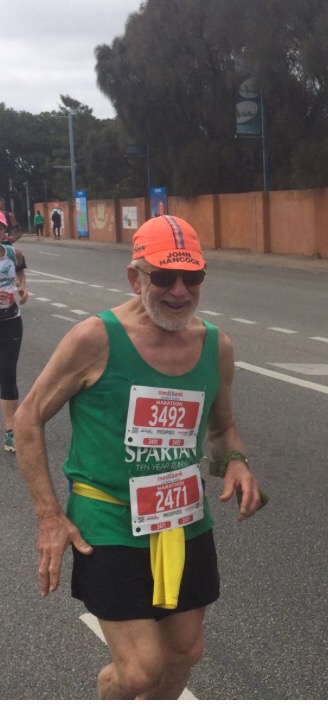
The ‘stumble’ was a crash. Down he went, his heavy body accruing momentum that his muscles could not brake. Six of the last eight months in hospital had seen powerful tissues soften and shrink, proud muscles, muscles that had carried this man 39 times the full 42.185 kilometres and across the Line. One of the Legendary Seven, last Sunday he lined up for his fortieth. He walked, he trotted, he shivered wildly, then he fell. Bent forward at my feet the man groaned loudly. He crouched, his head folded under his belly and he groaned again. Blood oozed, first from his knees, soon from the heels of his palms.  Two tall young men materialised, one on either side of the fallen man. They asked questions, good paramedical questions. The athlete groaned. I said, He’ll be alright.

The ambos said, He doesn’t look too flash.

I said, I’m his doctor.

What’s his diagnosis?

Everything, I said. He’ll be right.

At the prospect of unwelcome rescue the runner hauled himself up the helping arms of his son and his doctor. His sister-in-law mopped blood. The tissue was soon soaked. He said to his son, I’m shivering. Can I have your jumper?

He started walking again. People in the crowd recognised him. He was one of the Seven. Good on you, they cried. Legend! Keep going!

The man kept going. So did his teeth, chattering violently now, drumming time with his gait. The doctor in me wondered about fever, the return of infection that had seen him in hospital again and again.

A little short of the Fitzroy Street landmark his wife intercepted him. She took his arm and guided him gently to the kerb.

***

The younger man and the elder had not met before, although each had heard me speak of the other, a person like him, another with a problem that doctors could not cure.

The younger man regarded the elder. This rotund man, this athlete, this grandfather who’d three times risen from his sickbed to run so far. He sat at a remove from his stricken body, his face alight in wonder.

I nudged the younger: tell him what you’ve been doing since your diagnosis. The younger man spoke a little in the voice I have come to know, the voice he always uses when speaking of his living while dying. The voice speaks softly, a grin riding above the speaking mouth, ironic knowing in the background. The elder sat and listened. He heard of the classes the younger man runs for children with disabilities: They’re the kids no-one can do anything for. I mean no-one can fix them. There’s no cure for their cerebral palsy or their intellectual deficit or their severe ADHD.

The younger man did not mention to the elder how he teaches children they can be anything, do anything. His own life is the textbook, held open to the kids.

How do they come to you? Do you advertise?

Not as such. More word of mouth.  And there’s the website*.

A smile dashed across the younger man’s face: We start off each time with a group hug. It’s more a gang tackle – they race across towards me and throw themselves onto me and we hold each other. It will be fun tonight. The younger man glanced at his failing left leg:  Until now my balance and strength have been fine. Tonight I’ll go down and I’ll stay down. He laughed. It was a merry laugh, no irony, just the laugh of a man looking forward to sharing with his small friends the joke that is his health. The joke that is all health that is broken or twisted or failing.

We ate, all of us suddenly hungry. The younger man’s left hand rested in his bowl of hot dhal. I looked down, wondering when he’d remove it. The hand stayed put. The brain that should have perceived and sent the message to the hand neglected its work. The brain has been invaded and the invasion continues.

I asked them both, Don’t you feel angry? (I felt angry.)

The older man said, Why would I feel angry? Look, I’ve lived, I’ve got my wife, my children, a grandchild. I have a lot, I’ve lived. I feel sorry for my mother. She rings me every day, every single day. She worries.

A moment passed while we thought our thoughts. I felt for the younger man sitting at the side of the elder and hearing of the joys of a life lived, of a man full with his generations.

The younger man said, I’m not angry about this. He pointed to his head. I just get angry when doctors won’t listen. I nodded. Some of my starchier colleagues are uncomfortable with a patient  who is more than his disease, one who charts his path, who travels his world so widely and deeply as my friend.

A week earlier I asked the younger man was he frightened of dying. He said no. Later, a characteristically quirky text appeared on my screen: On the way down in the lift I worked out why I wasn’t scared. Dying isn’t scary – if you get it wrong then you stay alive.

*www.camerongill.com.au

Keeping Quiet

A young poet friend shared a poem with me. Gabriel Garcia Marquez declared the poet – Pablo Neruda – to be the twentieth century’s “greatest poet in any language.”

Such an accolade claims plenty poetic licence: does Mister Marquez read Sanskrit? Korean? Swahili? Arrernte?

Never mind: I think Mister Marquez is a good judge.

What is this power of the artfully selected offering of words?

This power that rivals music?

Read the poem; best of all, have someone read it aloud to you while you sit with your eyes comfortably closed:

Keeping Quiet Pablo Neruda


Now we will count to twelve and we will all keep still.

For once on the face of the earth, let’s not speak in any language; let’s stop for one second, and not move our arms so much.

It would be an exotic moment without rush, without engines; we would all be together in a sudden strangeness.

Fisherman in the cold sea would not harm whales and the man gathering salt would not look at his hurt hands.

Those who prepare green wars, wars with gas, wars with fire, victories with no survivors, would put on clean clothes and walk about with their brothers in the shade, doing nothing.

What I want should not be confused with total inactivity. Life is what it is about; I want no truck with death.

If we were not so single-minded about keeping our lives moving, and for once could do nothing, perhaps a huge silence

might interrupt this sadness of never understanding ourselves and of threatening ourselves with death.

Perhaps the earth can teach us as when everything seems dead and later proves to be alive.

Now I’ll count up to twelve and you keep quiet and I will go.

Magnified and Sanctified

It’s been ten years, Den, and only now do I feel I can say goodbye to you.

You were sixty three, I was sixty one. You died on Friday night. Your son brought the news to us at our shabbat table.

We buried you on the Sunday. We laid you to rest at an odd corner of the Jewish burial ground, beneath a young gum tree. I looked at the tree at that time and I remembered Dad’s fear of falling gums. I thought, here you are again, going against Dad’s prudent judgement. And I smiled.

You lie now, beyond the judgement of humans. Many were the people who judged you, fewer were those who tried to walk a mile in your shoes. They were big shoes.  Like everything about you, very big. Magnified, sanctified… People who did understand loved you extravagantly, in proportion to your extravagant life.

And now I can let you go. From the time of our final conversation I dreamed of you. The dreams were dreams of helplessness. You could not help yourself, I needed to help, I tried to help, but in those dreams, I could not. You called me that last time. The phone woke me from a dreamless sleep. Your speech rustled and crackled, the sweetness of your voice ruined by seven days with the breathing tube. You had rallied, they’d removed the tube; now, with your breathing failing, they needed to replace it. Your voice crackled: ‘Doff, they want to put the tube back. What should I say?’

I heard your breathing, a rasping, gasping sound. ‘Do as they say Den.’

‘Is it my best chance?’

‘Den, it’s your only chance.’

They returned you to your coma and they replaced the tube. Three days later you breathed your last.

At the cemetery we said, magnified and sanctified be the holy name.

One evening during the week of shiva my son led the prayers in honour of his uncle. He loved you Den. We loved you.

For ten years I dreamed of you, restless dreams, frantic. I was unable to help. Then I started writing about you and the dreams stopped. Now I sleep without the dreams. Sleep in peace beneath your gum tree, Den.

Death Visits

Death visited last week, snatching away a lady whom we’d expected would recover. She was 87 years of age, a little disorganised in her brain, not vigorous but not too ill. We admitted her to hospital in the morning for observation and nursing care. Her elder sister had dementia too. She visited in the afternoon, escorted by her carer, a slim Asian woman.
 
 
At 3.00pm our patient enjoyed her afternoon tea. At four she took a nap. While asleep she stopped breathing. Big sister called us. Her cardiogram showed a heart attack. Her end of life instructions read: NO CPR. NO RESUSCITATION. She died. I left the dead concealed behind curtains and approached the living. I leaned and spoke clearly: ‘Your sister has just died in her sleep.’ It was the carer who fell onto the shoulder of her client, crying. The elder sister comforted her: ‘Don’t be upset. You get used to that.’ The calm features of the Asian woman twisted in grief, her face suffused. What silent sorrow of her own had been roughly torn open?


Meanwhile death had been stalking another two of my patients for days. I could hear his tread closing on them, unhurried, inexorable. For the younger of the two, death – release from her cancer – could not come soon enough. She begged, 'Let me die. Help me to die.' We gave her all we had, our promises of kindness, the usual feeble half-answers. She lapsed into a dull quiet, defeated by our timorousness.
 
 
The elder patient was far from ready. She had lived through the Second War in Europe, had seen much. Late at night she grasped my hand, breathlessly contriving a voice that filtered feebly through her oxygen mask. She pulled me close: ‘What will happen to me?’
I looked at her aged face, searching her: ‘Are you afraid?’
‘Yes.’
‘What are you afraid of?’
’Dying.’ She looked hard into my face.
‘You don’t need to feel afraid. When the time comes you will fall sleep. You will not suffer. You will sleep and you will not wake up. We won’t let you suffer.’
The old lady brought my hand to her chest and gripped it hard, pulling me closer. We breathed together in the darkness. No voice. Her smile said her thanks.
 
 
I went to my quarters and fell fast into sleep.  My phone rang. When the screen read ‘Unknown Caller’, I knew it would be the hospital calling. Surmise told me death had arrived for one or other of my friends. No, not yet. A third patient, more peremptory, had summonsed death by swallowing two weeks’ medications. With one hundred and forty tablets inside her she dictated to the nurse the disposition of her possessions: ‘Give my good overcoat to this one. Give the money that’s coming to me to that one.’ 
 
 
Sleep was slow to return. I lay and calculated the effects of twenty-eight strong blood pressure tablets, and an overdose of aspirin. I must have slept, for the ringing of my phone disturbed me. ‘Unknown Caller’ again. No, no-one had died. A child had a red throat.
 
 
Over the following hours of darkness ‘Unknown Caller’ rang six times. Asthma, wet lungs, fever. No death. At dawn the call hauled me from deep sleep: ‘Come now! Cardiac arrest!’ A large inert body, a small nurse pushing down hard, again and again and again. A flickering trace on the cardiac monitor, a chain of us thumping an unwilling heart, injections of adrenaline, a failed electric shock. No pulse at the wrist. I called a pause, the hopeful triangles on the monitor fell into a flat line. No breaths, no heartbeat. The husband of the inert figure stood, watching, his hand on his mouth. We tried again.
 
 
After a time I called a second halt. I listened for a heartbeat. I listened and watched for breathing. I shone a torch into pupils and found them wide with death. I walked across the room to the husband and said, ‘Your wife has died.’ A massive man, erect, he crumpled into silent weeping. His heaving trunk was enveloped instantly in the embrace of a woman I had not sighted. I spoke into the bereaved man’s free ear, ‘She didn’t suffer. She was unconscious from the instant she fell.’ The embracer’s arm groping blindly, grabbed me, held me hard in the grieving ruck.
 
 
At length I extricated myself. The small nurse from Uganda wiped his eyes. Another nurse said hoarsely, ‘I was at school with the husband.’
After certifying the death and writing my notes I left the hospital. Outside, the chill of an Alice Springs morning felt welcome on my skin. I wandered to a park and attended to my dawn prayers, delayed by a death.

Silent Singer

 
The voice floated across my lonely motel room in Darwin. The sound of slow sweet lament suited my mood in that anonymous room in a lodging for transients. The voice sang of home, of home lost, of home dreamed and remembered. In that room, at that season – the three weeks of mourning for Jerusalem and the Temple – the voice sang to me of loss, my own and the singer’s.
 
 
After a period working on Elcho Island I had arrived in Darwin at day’s end, had wandered blindly about the Darwin Festival, blindly had selected this CD of Elcho singers. Later, in the light I read their names. I recognised ‘Yunipingu’: hadn’t he been Australian of the Year? But this would be a different Yunipingu.
 
 
Only a couple of years later that floating voice had percolated through the ears  of the entire nation, seeped into our being and changed us. Distinctive as didgeridoo, his voice was recognised everywhere. His solo album was the cultural event of the year. Realising how a voice had become the sound that we recognised ourselves by, I wrote. “Australia is becoming more Australian.”  
 
 
Born in 1971 the singer passed away last week. He died during the three weeks of mourning. I listen to ‘Warwu’ and I feel for my country, impoverished. The singer has passed from us. So much loss, so many, so young.


click on this link to hear him singing 'Warwu': https://www.youtube.com/watch?v=XhkMP89rRMk

Traralgon Marathon Report

Given the event took place over a week ago this report is pretty tardy. The truth is I have nothing to report.
If you’d asked me for my report thirty-nine years ago, I’d have leaped into print. Likewise had you enquired in June 1990, I’d have been bursting with news. In 2000 I reported on my run with Fidel. Even though he rode much of the way in my car, Fidel was awarded a Finisher’s medal as First Dog across the line. And in 2007 there was news of a different order.

But in 2017 I have nothing to report.

The Traralgon Marathon is Australia’s senior event. This year marks its fiftieth running. As well as being our first marathon, Traralgon is Victoria’s Country Marathon Championship. All in all a pretty lustrous affair. Competing under his nomme des jambs of Pheidipides, Howard Goldenberg ran his maiden marathon at Traralgon thirty-nine years ago. That year 181 runners started and 141 finished. I still have the official printout of the results. At the foot of the second of two roneoed sheets of paper (this report antedated the internet), you’d read: In 141st place, Pheidipides Goldenberg; time: 4 hours, 31 minutes, 31 seconds.

Every time I run a marathon I write one. That simple passage through time and space, so simple, so elemental, you mightn’t credit it worthy of remark. But every running feels remarkable to the runner. In the marathon the runner encounters the sole self, discovering some things that are unwelcome and others that make the runner feel a little proud. In a marathon, as Zatopek remarked, we all die a little. The event is charged with significance for this runner because the essentially solitary passage through time and space always involves encounters with others. It is the comradeship, the fellow feeling, the respect that elevate our experience. In that sense the marathon is a metaphor for our lives.

A watcher of the Barcelona Olympic Marathon might have caught images of the leading bunch of five as they passed their drink stop with seven kilometres to go. They had, running in intense humidity and heat, slowly outpaced a score of household names from Kenya and Tanzania and Korea and Japan and Australia. These five were the bravest of the brave on that particular day. One of these five, one only, would become immortal. Four of the five grabbed their special drinks at the 35 KM mark. The fifth grabbed and missed. And ran on, turning back being out of the question. The four drank and ran and drank again. One of those four passed his unfinished drink to the fifth. I do not recall whether the drink-giver won the event – I fancy he did not – but in that moment he joined the Immortals. In such small moments we see the glory of the marathon.
All this reads a bit portentously. Most running – and all of mine – is more comedic or shambolic than deep. In the field of my third Traralgon I sighted at the Start the esteemed and beloved Cliff Young, Australia’s most famous potato farmer, a previous winner of the Westfield Sydney to Melbourne Ultramarathon. Cliffy used to go on his training runs wearing his hobnail work boots. If he needed a haircut he’d trot the thirty kilometres from his farm to Colac, then run back home again. That day in Traralgon I wondered if I’d manage to get close to him. Around the three KM mark my legs became over-excited and accelerated and I hauled him in. Running a couple of paces behind Cliff I admired the light lacework of his tracksuit material. I drew closer. The lacework was in fact the work of a legion of hungry moths. Through the mothholes I could see and admire the pale skin of those spindly old legs.
‘Old men forget: yet all shall be forgot/But he’ll remember with advantages/What feats he did that day.’ Thus Shakespeare. It was in Traralgon that I ran my best marathon time. In those better years I’d usually finish in three and a half hours – not flash but respectable. Around 1990, everything went well. By the twenty km mark the field was well strung out, each runner alone with his thoughts and his hopes and his faltering strength. Somehow on this day only my shoelace faltered. I heard a slap, slap, slap – one slap at every second stride. I looked down; my right shoelace had untied itself. I stopped, resting my foot on the lower timber of a little footbridge. I tied the lace and cursed myself for the loss rhythm. 

Where strength falters it is rhythm that lulls the unthinking legs with metre that beguiles like music or poetry. I straightened and placed one foot forward, then the second, now the first, now the second. And here, quickly, rhythm returned. I ran on and on. I passed a browsing cow. She looked up and gazed at me, ruminating. I passed a lonely church. I counted cars parked on the verge, calculating numbers of worshippers.


Approaching Traralgon on the return loop I saw the smoking chimneys of the power station blackening the winter blue with coal smoke. Crossing the river I was welcomed by a pelican gliding overhead in his landing approach. I blessed the bird of good augury. After that I think I thought of nothing. At forty kilometres I felt weary and I cursed the distance remaining. I slowed, realising I was about to ruin everything. I never recovered my pace. I cursed my feeble will.

A short time later that felt like a long time I crossed the Line. My time of three hours and fifteen minutes and thirteen seconds was to be my best ever.

Four weeks before this year’s Traralgon I ran a brisk 6.2 kilometres on unforgiving concrete. I thrashed along, full of surprised pleasure in my pace. Later, when I checked the elapsed time (35 minutes) I was reminded how, nowadays, mediocrity is beyond me. After the encounter with the concrete my right knee started to hurt. The after-pain of running always reminds me of the achievement that brought it about. Pain always passes but while it lasts I smile with small pride.

In 2007 my elder brother Dennis, always thirsty for my company, offered to come along with me to Traralgon. With him Dennis brought a hitch-hiker, his flatmate and devoted companion, Sahara the Hound. Sahara was a dog I never managed to like. In this I came closer than most. For Sahara was a raucous, snapping, yelping creature, anti-social, sociopathic in fact. Sahara yapped and snarled her way into the rear of the car, lay down on the seat, growled a bit and fell into silence, then into sleep. For the duration of the two-hour drive Dennis and I spoke as brothers do, of nothing and of everything. We arrived, I registered and showed Dennis the Finish Line. ‘I estimate I’ll get here in four to four-and–half hours,’ I told him. My estimate was incorrect; I crossed the line in 3 hours, 45 minutes, beating the only other sixty-plus-year old male by a handy margin. In disbelief I checked and rechecked my time.

As ever, Dennis swelled with pride at the achievement of his younger brother. Here I was, 2007 Traralgon and Victorian Country Marathon champion (male, sixty-plus). I duly added the achievement to my Resume.

During the drive home, Sahara slept again. Again Dennis and I chatted. Dennis told me of a question he’d been mulling: ‘ I’ve decided: I’m going to have the operation, Doff. I’ll lose weight and I’ll be able to exercise. I’ll have more energy because I won’t have sleep apnoea anymore. The doctor says I’ll be cured of my diabetes.’ I misgave but said nothing. ‘Doff, I know you’re super-cautious. I’m the opposite. I’ll have the operation and I’ll get my life back!’ I hoped he would. Dennis went on: he’d complete his MBA in a month or so, he’d graduate then he’d have the surgery. After recovering from the operation Dennis said he’d revive his business.

Two months later Dennis graduated at the head of his class, with High Distinction. In September he underwent bariatric surgery. Fourteen days later he died of complications. Every June the Traralgon Marathon comes around and I remember.

In 2017 my training was the best for years. I entered, paid, arranged to travel with a support team comprised of a friend and his 11-year-old son. We booked overnight accommodation in Traralgon and I saw my physio about the oddly persistent knee ache. My physio, a gifted and devoted torturer, rubbed and pressed and stretched me. She prescribed exercises, with which – to our mutual surprise – I complied. And my knee hurt more. I had an x-ray that showed a pristine joint and a panel of four physios gathered in conclave before the light-box to advise me. I rested the knee as they suggested. I took the dicey non-steroidal anti-inflammatory medication that threatened my remaining kidney function. My physio taped my knee. I rested further and lost fitness. Two days before race day I could not walk to the toilet without pain. We cancelled the accommodation. The good people at Traralgon Harriers gave me a rain check to 2018.   

In 2017 I have nothing to report.


Footnote (kneenote, really): my knee feels better every day.

Mother’s One Hundredth Birthday Party 

I’ll invite my brother and his family and Mum’s nephews and nieces, her great-nephews and great-nieces, and my children and their children, as well as some of my friends who were also Mum’s friends. But Aly Ong won’t be there. He’ll be back on the plantation in Malaya. My sister Margot won’t be with us; she lives in New York so she’s excused. It was all Margot’s idea, really, this idea of a family party. She’s inviting her kids from New Rochelle and Philadelphia and Boston and all their children and they’ll tell stories and eat pavlova in Margot’s pavilion by the Hudson. And we in Melbourne will feast and reminisce by the Yarra. Well, within cooee of that river.
 
 
In their generation Mum and her younger sister Doreen were masters of the pavlova, grandmasters really. The meringue edge was firm, the interior light and mallow, the whole edifice of air stupendously high. When Dennis ran his restaurant he turned to Mum to bake pavlovas which he’d serve in massive slices topped with whipped cream and passionfruit and strawberries …. and lust. Now the mantle has passed to Margot.
 
 
Will it spoil the party that Mum won’t be coming? Well, it would be lovely if she were to attend, but it’s big ask. Mum will be there, though. She never really left.
 
 
(Let me tell you about Mum and Aly Ong. Back in the ’sixties Aly came to Melbourne under the Colombo Scheme, a government initiative whereby Australia would educate Asian students and send them back home to become leaders in their own, developing countries. Aly studied Accounting with my brother Dennis and the two were close friends. That meant Aly became an habitue at number 15 Atkinson Street, Oakleigh, eating pavlova and Mum’s form of fried rice that must have made him laugh. But Aly was too polite to laugh.
 
Aly was shy. Left to himself he’d never have raised the courage to ask Mum for the loan of her car. But having Dennis as a friend meant you were not left to yourself. ‘Mum, Aly needs to borrow your car tonight. He’s got a date.’
Aly blushed: ‘Oh, no Mrs Goldenberg, I really don’t need…’
‘Of course you can use the car Aly. With pleasure.’
So Aly took the car.
 
He returned a few hours later, looking shaken. I asked him what was wrong. He shook his head, saying nothing. I saw tears forming. ‘I must speak to Mrs Goldenberg, was all I could get out of him. Mum was in bed upstairs, in one or other of her various states of partial consciousness. I told Mum Aly needed to see her. He was in some distress.
 
 
Mum descended: ‘Hello Aly darling. Did you have a nice time?’
‘Mrs Goldenberg, something terrible has happened. I crashed your car!’
‘Oh, Aly, are you hurt?’
‘No, Mrs Goldenberg, but the car…’
‘Are you sure you’re alright, Aly? And your friend? Is she alright?’
‘’Yes, thank you Mrs Goldenberg, quite sure. But I’ve smashed your car.’
Mum’s car was new, brand new. It was a Holden Premier, top of the range, with iridescent green duco and beautiful tan leather seats, Holden’s first foray into luxury.
‘Oh, never mind about the car, Aly. Sit down and have a cup of tea and some pavlova.’)
 
 
Mum was born on June 8, 1917, and she did not have to wait very long to become acquainted with death. Her father died when she was twelve and she lost her mother three years later. Falling happily into the care of Gar, their miraculously liberated and liberating grandmother, the girls thrived. After her parents died Mum accepted the reality of death. On visits to Melbourne Mum would drive us past the Brighton Cemetery and remark, ‘Mummy and daddy are in there.’ It took me a while to work out what and who was ‘in there’, and why. It was disorienting to hear ‘mummy’ and ‘daddy’, words I attached to living, loving, parents, indispensable supports of my being. But Mum’s tone was blithe. Death held no fears for her. Not personally, not for herself.
 
 
But for Doreen, Mum trembled. In her middle and later life Aunty Doreen fell sick often and fell hard. Once or twice I found Mum in tears: ‘I’ve told Dor I have to peg out first.’ In the event Aunty Doreen did Peg out before Mum, dying in her late eighties of heart disease that exhausted her will to live on. Then Dad died, and my younger brother Barry said, ‘Don’t you go getting any fancy ideas, Mum.’ Only two years later Dennis died, Mum’s firstborn and first loved. Mum said, ‘I’ve always known death is part of life.’ And I said, ‘Mum, don’t think you’re allowed to die.’
‘I’ll do my best not to, darling. I’ve never died yet.’
 
 
One week before her ninety-second birthday Mum’s best was no longer sufficient. She won’t be at her one hundredth birthday party, but we will excuse her dying. She can be forgiven one lapse.
 

At that Precise Spot at that Exact Moment

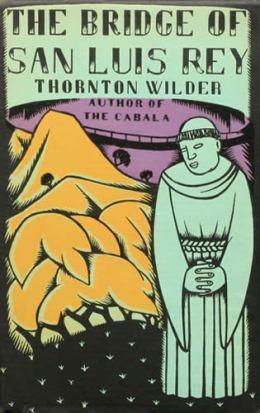
Centuries ago a bridge suspended high above an Andean valley collapsed. As a handful of travellers fell to their deaths, a Franciscan Friar approaching the bridge witnessed the event. Hundreds crossed that bridge every day. He never doubted God had decided to end those lives for a reason. Certain those lives had reached their completeness, Friar Juniper set out to investigate, to prove meaning in the seeming randomness. The author Thornton Wilder wrote a short, intense account of the monk’s quest in his book ‘The Bridge at San Luis Rey.’


Thirty years ago I made the winding climb from the valley floor to Marysville’s lovely Steavensons Falls. Half way up, nearing a bend in the cool and green, I encountered a plaque that read:  

IT WAS AN ACT OF GOD ON A WINDLESS MORNING 

          FOR THAT PARTICULAR TREE TO FALL 

         AT THAT PARTICULAR PLACE AND TIME 


PETER JOHN SYMONS AGED 19 YEARS 

MAXWELL JAY HUTTY AGED 18 YEARS 

DOROTHY PATRICIA MCNALLY AGED 15 YEARS

JANINE CLARK AGED 13 YEARS


The plaque had aged, its sheen lost. The text begged the Great Question. A smaller question lay buried in the ordering of names, listed – not alphabetically but by age. The fact of ordering betrayed the human need that pressed upon the text’s composer, the need to overcome chaos, to quell the fear of existential meaninglessness.


On an idyllic summer day in the heart of Melbourne, streets milled with innocents in their hundreds, in their thousands. They were schoolchildren, adults, workers, lovers. They were foreigners and out-of-towners here for the tennis, they were suited business people and bewigged barristers. They were in the liveable city where life was blessed by a gentle sun, a sweet torpor, a Friday feeling. One of those thousands was a baby boy whose life was about to end at the age of three months; one a twenty-two year old woman who bubbled with laughter; two were men, aged 25 and 33 years. A fifth was ten years old, a school girl.


On Patriots Day, 2013, thirty thousand of us set off to run from the village of Hopkinton to Boston, 26 miles and 185 yards away. The marathon started at 10.00 in the morning. One million Bostonians lined the route, standing outside until all had passed, cheering us on. Boston loved us all, from the elite to the aging plodders. Celebrating this, their ceremony of innocence, the spectators offered us oranges, bananas, sausages, beer. They held up signs: YOU ARE ALL KENYANS. At 2.46 pm the first bomb exploded at the Finish Line, followed moments later by the second. Of the many hundreds shouting and cheering in Boylston Street, three were killed, 264 injured. One of those killed was a boy aged eight. Sixteen survivors lost limbs.


In Wilder’s classic novel, the Friar spends years seeking the proof of divine design in the chaos and cruelty of life. His researches culminate in a book in which simple faith is upheld by simplistic conclusions. Wilder writes:


I shall spare you Brother Juniper’s generalizations. They are always with us. He thought he saw in the same accident the wicked visited by destruction and the good called early to heaven…


The book being done fell under the eyes of some judges and was pronounced heretical. It was ordered to be burned in the Square with its author. Brother Juniper submitted to the decision that the devil had made use of him…The little Friar was given to the congenial flames… he called twice upon St Francis, and leaning upon a flame he smiled and died.


In the final few pages Wilder makes clear his rejection of The Friar’s ‘generalizations.’ Instead he writes of those who loved and lost and lamented and never healed. All these live out their days numbed, unable to find solace or meaning. One by one, they cross the lonely years and confess their grief, their self-blame, to an aged Abbess, herself bereaved of the two who used to be orphans in her care. All the bereaved live out their days waiting for death.


For the present generations, living in our scientific age, reared as we are with data to slake our thirst for the rational, attempts to rationalise last week’s experiences fail to satisfy. Instead explanations are felt as an affront. The image of a pram, upended, empty, upon the bloodied street; a child lying face down, entirely alone in death, torn from her mother and sister who struggle for life elsewhere, in Intensive Care Units; the Japanese stranger – still unidentified – who dies alone and unknown, far from his home – who, in the face of these, can find comfort in pious nostrums?


Ultimately Wilder’s Abbess finds, not explanation, not meaning, but reconciliation: Even now – she thought – almost no-one remembers Esteban and Pepita but myself… soon we shall die and all memory of those five will have left the earth, and we ourselves shall be loved for a while and forgotten. But the love will have been enough. Even memory is not necessary for love. There is a land of the living and a land of the dead, and the bridge is love, the only survival, the only meaning.


As in Boston after the bombs, once the fatal car had passed, the people of Melbourne beheld those injured, those lost in wild surmise, those stunned. The cabbie who leaped from his car, the citizens who took travel brochures, garments – whatever they found to hand – to bind wounds, all became sudden trauma nurses and paramedics. So too the shop attendants who streamed from department stores with towels to stanch haemorrhage, with a board torn from a wooden pallet to splint a broken leg.

 A terrible beauty born.


Australia Day in Doomadgee

Doomadgee, we write it
In our orthography
Really should be
Dumat’ji
 

No flag raising here
No speech or ceremony
On Australia Day
In Doomadgee
 

River runs warm
Kiddies swim and swarm
On Australia Day
In Doomadgee
 

Uncles bashing
In Australian passion
On Australia Eve
Here in Doomadgee

 
Broken hand, broken
Jaw, cut faces and more:
That’s Australia Day
In Doomadgee.
 

Adam Goodes
Too far away
This Australia Day
In Doomadgee
 

A busy day this
Australia Day
In the hospital
In Doomadgee
 

We plaster, we suture
Like there’s no future:
Future no feature 
of Australia Day,
Not here, no way, 
In Doomadgee
 

The end of Australia Day –
Quietness falls
In hospital halls
Of Doomadgee
 

But short the respite –
Quick! Elder sick,
Dying On Australia night –
Dying here in Doomadgee?
 

Quiet, quiet, his voice, his breath –
Small his smile at threshold of death –
Good night Australia:
System failure in Doomadgee
 

Beside him, quiet woman – or girl –
His guard and ward in this world
Trembles, faces an Australian day
Elderless in Doomadgee.
 

He slips away from teeming kin
Who hold tears and keening in;
A dreadful peace on Australia Day
And quiet, this night in Doomadgee.