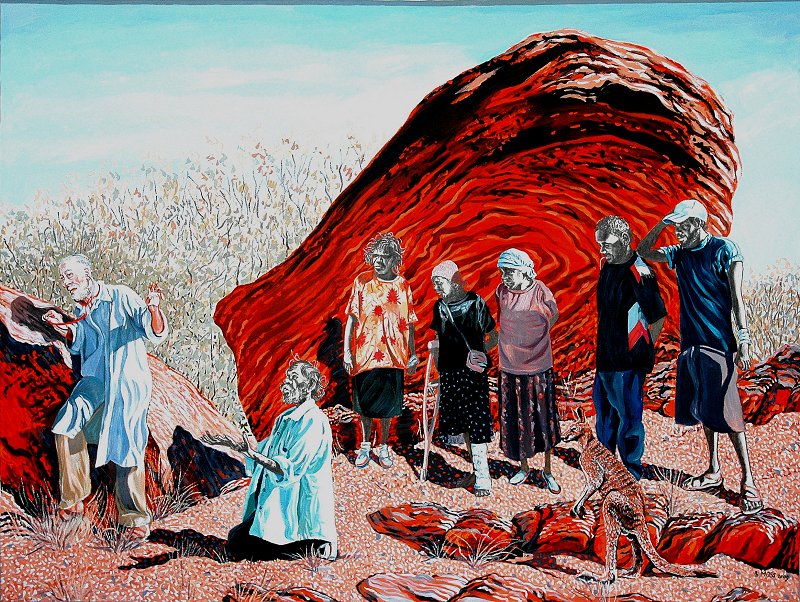
Two Doctors in Doomadgee

Letter from Doomadgee

27 January, 2014.


Dear Australia,


Before I arrived the only thing I knew of Doomadgee was the name; that was the surname of the man who died on Palm Island. That name seemed compounded of doom and tragedy. But of the community itself I was glad to know nothing in advance of my arriving.


Steve the factotum drove me from the airfield. The aged street sign said:


Welcome to Doomadgee

Population 1200


Steve said: “More like 2000.”

I met the young Aboriginal doctor. He said: “More like 3000.”


A road sign said:


NT Border 103 KM.


The weather forecast said: Cloudy. Maximum 34 degrees.

That night the nurse said:” It felt hot so I looked at the thermometer on my verandah. The thermometer said: ‘52 degrees.’”


I said to the young Aboriginal doctor from Mt Isa, himself a grandson of respected elders of this community: “I’m the wrong doctor. I don’t have the language, the cultural currency…You are the right sort of doctor.”

He said: “There are nearly one hundred of us now. There were quite a few of us in my year at James Cook.”

The two of us spent most of Saturday together indoors. Between snatches of cricket and tennis on TV and poring over Murtagh’s tome on General Practice, he wanted to talk about religion (his new found Christianity, my old found Judaism), about work, about vocation. He asked me to name my favourite story from the Bible.

He told me his. I waited for a parable. Instead he said: “Jephtah and his daughter. I read that story and I put the book down and I said, ‘Lord, I need time to come to terms with this.’”

We spoke of our families and our upbringing, how he hankered for some city life while knowing his destiny lay in the country – on country – this country, this country his father had shown him and taught him and inculcated into him from early years; and I told him of my lifelong hankering for life outside the city while knowing my destiny lay there.

I said: “I wrote a book about my father – he was a country GP – and about my childhood in the country. And another book about my experiences working in remote Aboriginal communities. You can get copies of those books if you’re interested.”

He said: “No. I don’t read books. Only medical textbooks.”

I looked at him.

He conceded: “I did read two other books. My teacher said if I didn’t read them I couldn’t pass English.”

I looked at him again. I said: “I know you read. You read all the time – the Bible.”

Yes. Yes, that’s so. I’m always reading the Bible. But books, they’re not in my background. We didn’t have books at home.”

After hours of searching conversation my colleague posed a question. He preceded it with a statement. He said: “I want my work to mean something. I want my working life to improve the lives of Aboriginal people.” He swallowed the consonants whenever he spoke that word. He softened the ‘g’ in ‘Aboriginal’ so it was like a triple ‘n’, gutturalised. He paced and paused, paced again. He said: “I want to ask you a question. You’ve been a GP for a long time; I am just starting. What should I do? I mean what should I do now, while I’m completing my training? What particular field should I try to master? What will be most useful for Aborinnnal people?”

I offered some answers, thinking aloud, feeling my way through a variety of ideas. Eventually I said: “Any answer I give will be less important than the question.”

What do you mean?”

I mean, you aren’t asking a casual question. This is a quest. So long as you keep asking I think the quest will lead you where you need to go.”

Then I said: “You know we whitefellas do our best but we never achieve what we set out to do. I think the answers won’t come from whitefellas alone; some of the changes have to come from blackfellas. It will be like cancer – you don’t find the cure, the single thing that wipes out the entire problem; you find an improvement here, a sectional breakthrough there. So the Pearsons and Yunipingus and Langtons and the others, they’ll come up with some initiatives; and some of those will take root and some might bear fruit.”

My friend nodded hard. He said: “Exactly!”


***


On Australia Eve, the rain belted the roof all night. Australia Day dawned bright, cooler. We went down to the river. At the spillway the Nicholson flowed a kilometre wide. Warm brown water, shallow. Steve had said: “No big crocs here. Only little snappers – freshies.”

I trusted him. I waded with the younger doctor through warm shallows down to the waterfall. Everywhere we went in those shallows Aboriginal toddlers paddled, babies sat on the laps of slender young mums. The Nicholson flowed a thin caramel around and over shiny brown bodies.

The young doctor spoke to all he met. All were, one way or another, his kin. He said: “Hello brother”, and “Hello sister.”

He said, “Hello Aunty”, and “Hello Uncle.”

He knew what to say, how to say it. He found connections with strangers.

He knew his country; he was the right doctor; he had the language.
Australia Day in Doomadgee

Doomadgee, we write it

In our orthography

When really –

It should be – Dumat’ji


No flag raising here

No speech or ceremony

On Australia Day

In Doomadgee


The river runs warm

Kiddies swim and swarm

On Australia Day

In Doomadgee


Blackfellas bashing

(It’s the national fashion)

On Australia Eve

Here in Doomadgee


Broken hand, broken

Jaw, cut faces and more:

That’s Australia Day

In Doomadgee.


Adam Goodes

Too far away

This Australia Day

From Doomadgee


A busy day this

Australia Day –

Hordes in the wards

In Doomadgee


We plaster and we suture

Like there is no future:

Future no feature of Australia Day,

Not here, no way, in Doomadgee


The end of Australia Day –

Quietness falls

In hospital halls

Of Doomadgee


But short the respite –

Quick! Elder sick!

Dying on Australia night?

Dying here – in Doomadgee?


Quiet, quiet, his voice, his breath –

Small his smile at the threshold of death –

Good night Australia:

System failure in Doomadgee


Beside him, quiet woman – or girl –

His guard and ward in this world

Trembles, facing an Australian day

Without him in Doomadgee.


He slips away from his teeming kin

Who hold their tears and keening in;

A dreadful peace on Australia Day

And quiet, this night in Doomadgee.

A Cherub

Working here on the old camel trails, we commonly encounter a Rasheed, an Ahmed or an Akbar.

And there is always a story.

This particular little ’Afghan’ is 15 months old, a cherub with round cheeks and light brown curls.

When you see a face like this you cannot stop yourself from smiling.

A child with a face like this finds himself in a world where every adult smiles at him. He likes this world that seems to love him so.

Sarah, his mum, has the same ripe-fruit cheeks.


What is the cherub’s story?

Sarah explains: “Akbar’s great grandfather was a cameleer. His great grandmother was Aboriginal. Here – you can read about it in this book.”  Sarah hands me a heavy paperback, titled “Linden Girl”, by Pamela Rajkowski. The subtitle reads: a story of outlawed lives.

There is always a story, and that is the cherub’s story. It is the story of a couple and their encounters with Law. The Law forbade this cherub to exist.

Continue reading

Malpa

About ten years ago an old man consulted me as his doctor of second choice. (His own doctor was away; really I was the doctor of no choice.) A compact man, charming, he smiled beneath a tidy military moustache and carried a Veteran’s Gold Card. Eventually he promoted me to doctor of equal choice. In this capacity I doctored him to death.

In due course I received a letter from the son of the deceased, thanking me. Not for his father’s dying but for the doctoring. Eventually the son and I met.  A remarkable man: no moustache, same charm, huge human warmth.

The son’s name is Don Palmer. He says he used to work for God – in the Anglican franchise. Eventually he resigned from Holy Orders and created Malpa, the imaginative project born of urgent compassion and imagination that teaches Aboriginal kids how to become ‘Young Doctors’.

His story inspired a chapter in my forthcoming novel, Carrots and Jaffas, the story of a couple of identical twins, violently separated. With Don’s blessing I pinched his idea. My chapter reads as follows: Continue reading

Wandering

My father’s father’s name was Joseph. Born in 1886 in Petach Tikvah in Turkish Palestine, Joseph Goldenberg stowed away on a ship at the age of twelve, passing his Barmitzvah date without celebration before disembarking alone in Australia. Papa, as his grandchildren called him, arrived here with five shillings, a working knowledge of Yiddish and Arabic, and no English.

He left his home and his family as a child, remaining an observant Jew throughout his lonely years until his marriage, and beyond, through a long life.

Dad used to say his father was like Joseph in the Bible, a faithful Jew from childhood to old age, steadfast through long exile and separation from his home and family.

Dad found lifelong inspiration in his father’s example.

My own father, Myer Goldenberg (z’l), grew up in Melbourne, married and took his bride, Yvonne Coleman, to the small Riverina town of Leeton, where the couple lived for 14 years, raising four children as knowledgeable and observant Jews. Dad never thought this was remarkable, but it was an unusual achievement and it certainly inspired this son.

Indelible memories come to me from time to time as I recite the Shema, of Dad teaching me to read and to translate every word of this, the first and the last prayer of our Jewish lives. I would sit on his knee, Dad holding his worn and oft-repaired siddur in front of me, his finger showing me each letter and his voice speaking these words time and again: and you shall teach them to your children, and you shall speak of them when you sit in your house,and when you walk by the way, and when you lie down and when you rise up…


A Jewish education of this intensity and intimacy is a rare and precious thing. It left this son with the unorthodox confidence that I could live an orthodox life fully and independently anywhere, with or without a community or a congregation to support me. My father’s example assured me that my own observances, my Jewishness, were proof against distance. Dad had taught me how to be a Jew as I walked by the way.

Dad never had any delusion that distance was a good thing. Well before we reached Barmitzvah age, Mum and Dad had resettled the family in Melbourne, where Dad showed (through his subsequent scores of years of service to Shules,) that the question was not whether he needed a congregation, but what could he contribute to one.

But the ‘harm’ was done. By the time we left Leeton, I had absorbed my father’s aberrant example of distance-proof faithfulness; and ever after I have lived a maverick belief in walking by the way, to remote places, well off the Jewish trade routes, taking with me the observances my father taught me. Over the decades, that phrase in the Shema has come to hint to me that a Jew should actively go bush – as Moses did in his shepherd days, as Elijah did while on the run from the king – to find God.

How did I know about Moses and Elijah? How too did I know about the midnight walk in the wilderness of Jacob; and of his encounter with the wrestling angel? It was Dad’s fault, of course: it had been Dad who brought these heroes of the spirit to life within me.

And so it was that I’d bake challah (read damper) in Leigh Creek, read Megillath Eicha by candlelight in Arnhem Land, host the Jewish residents of Alice Springs for Shabbat meals, discuss Zionism with a knowledgeable Elder in the Ngaanyaatjarrah Lands, sing Hebrew songs with one of the Strong Women at Galiwin’ku, sound the Shofar in Ellul at Wamoom; and celebrate Shabbat in the Andyamathanha wilderness with one of Melbourne’s leading rabbis.

(And so it was that I was been absent so often and so painfully from shules, from tolerant children and perplexed grandchildren, from a neglected wife and from a lonely mother.)

All of this unorthodox conduct had some unexpected results. I found what Joseph finds when sent by

his father to “see the peace of his brothers”. Wandering, lost in the wilderness, Joseph meets a mysterious stranger who asks – in a singular phrase – “what will you seek?”

Joseph replies, in a sentence that is equally pointed

syntactically, “(it is) my brothers (whom) I seek.”

The brothers whom I found are the first Australians. In encounter after encounter over a decade or more I have met and worked with Aboriginal people in the outback, discovering much about them, more about my

Jewish self, and writing, writing all the time of these experiences.

(That writing gave birth to a book, Raft, launched at Melbourne Writers festival in 2009.)

And deeply moving to me were those experiences as a practising Jew, when alone in God’s creation, I’d wrestle with the angel, and where I’d catch the echo of a still soft voice.

And, morning and evening, as I’d rise up and lie down in those far places, I’d recite the Shema, that prayer of portable Judaism that my father taught me.

Road to Recovery – (my piece published in Australian Financial Review)

Road to Recovery Financial Review article

This article appeared in the Australian Financial Review 3 January 2014. It first appeared in the Griffith Review 10th anniversary edition in 2013.This story is an edited version of a piece that will be published in 2015, in an upcoming book entitled ‘Burned Man’.

A Pogrom in Islamdom

2013 has been the year of the burning church. Throughout Islamdom churches burn. 

It started before 2013. For over a decade I have seen my Coptic patient from Egypt beside himself with grief and anxiety as he watches his relatives trapped in fear, paralysed like a kangaroo doe in my headlights, unable to resolve – to flee or to stay?
He sits, this large man, in my consulting room and nurses his ulcer. Gaps, lacunae of silence in the consulting room and his eyes fill with tears as the silence falls and swells.
At present Egyptian Copts burn bright and hot enough to hit our papers. Syrian Christians burn.
Elsewhere, in Iraq, the oldest Christian community in the middle east convulses. In 1991, Christians in Iraq numbered 1.3 million people; today they number 300,000 to 500,000. Catholic Chaldeans, Nestorians, Orthodox, almost all Iraqi Christians are ethnic Assyrians. Assyrians speak Aramaic, lingua franca of Jesus. From time to time I meet a Christian from Iraq in the Children’s Hospital where I work. When I address him and his family in my rudimentary Aramaic (which is, of course, an inherited language for any Jew who has ever opened the Talmud), their faces open in disbelief, in joy, in homecoming from linguistic exile.
(While liberal Christian groups turn a blind ear to the slaughter of fellow Christians there exists but one country in the middle east where, as Gabriel Nadaf, a priest, declares, “we feel secure”. Guess which country.)
Last week 34 Assyrians died in a church bombing in Baghdad. In 2010 a series of ‘suicide bombings’ (call sign of the hero martyr, history’s adolescent crying LOOK AT ME! LOOK AT ME!) killed 58 people. There have been 71 church bombings reported in Iraq since 2004.
So much, so normal, so historically unremarkable. So much blood: thirty four here, fifty eight there. Have you seen how much blood there is in the body of but one human being? (I have. Cain did. God called to him saying: “The bloods of your brother call out to Me from the earth.”
Why bloods – in the plural? Because, explains the commentator Rashi, no-one had seen a human die before Cain. No-one knew how much blood
there was in one human brother.)
We know now about the blood of the human person. We cannot plead ignorance.
I remember another time – it was recent, only November 1938 – when houses of worship burned, when the bloods of my brothers cried out.
I remember the shameful silence of the decent civilised world. I remember the silence of churches, governments, communities in Australia
following the great pogrom that was the night of broken glass. I remember how my people was forgotten. I remember the silence.
I remember William Cooper and his Aborigines Advancement League raising the sole protest in Australia against the pogrom.
There are pogroms occurring throughout Islamdon. There is a great silence here.
Do we need to wait for another Australian Aboriginal leader to awaken this nation, to rouse its parliaments, its churches, synagogues and mosques, its noisy Boycotters, its pious Divestors, its smug Sanctioners, to cry: “I am my brother’s keeper?”

376,000 Footsteps in the Sisterhood of Man

It was the running of the Jews. Not in Khazakstan but at Melbourne’stan.

Historically, you only saw a bunch of Jews running if there was a fire or a pogrom. But yesterday hundreds of Jews were afoot, an infrequent event since the original Fun Run across the Red Sea. (On that occasion all the Israelites crossed the line. The Egyptians failed to finish.)

We Jews were not alone at the Tan: joining us were Africans from the Horn and from Mandela country; a pair of Iranians, a smiling Swiss, sundry Catholic Australians; the odd Chinese, a couple of Argentines and their Australian born progeny. And my wife and my not-very-old oldest grandchild.

If a kilometre is one thousand metres and the average human pace is one metre, and the circumference of the ‘Tan’ is 3.76 kilometres, then a single lap represents 3760 paces. Yesterday saw 376000 paces in the sisterhood of man.

My team, “Queue Jumpers”, named in honour of those disgraceful individuals who do not go through the correct channels, raised about 1800 dollars. The entire event raised in excess of $20,000, to be spent in two struggling Aboriginal communities in far north NSW and in a Community Centre for queue jumpers from Darfur.

Over coffee, before the event Akbar the Persian storyteller told a story. Akbar has elevated my runs over 25 years – ‘one quarter of a century’, he observes – with folktales from his homeland. Yesterday’s story: The revolution was coming in Iran. We knew people, Bahai, whose houses were burnt by militants. A friend said to us – do not stay in your house. It is not safe. They will burn your house next.

We decided to leave. We went to a cousin’s house. But another warned – ‘this house will be burned tonight.’

We had to leave. We all ran from the house but a man with a big automatic weapon stood outside. He said: ‘Do not go. They will burn this house only when my body is dead.’

That man was Savak. Secret Police. But we did not wait. Instead we ran. We ran to the house of the parents of this young woman…

Akbar here indicated his niece, Paloma. It turns out that Paloma -‘dove’ in Spanish – speaks Spanish fluently. This dove was born in Bristol. She takes up the story: My father was in America. He bought a red Ford Mustang. I sat in the back; there were only two doors. He brought the Ford Mustang to Bristol and he drove us, Mother and me and Father, to France, then all across Europe, all the way to Iran. I was four when we left Bristol, but I remember the red car, I remember I sat in the back.

Akbar takes up the story: We ran to the house of Paloma’s father and mother, all of us – myself, my parents and my cousin. Paloma’s family took us in and we stayed. We stayed in their house for nine months and we were safe.

And then we came to Australia.

Akbar smiled. He said it was time for a real Persian story. He told a folk story, of Mullah Nasruddin. Akbar’s story took us to a different age, a different place. We sat in the sunshine and watched and listened to the genial teller of tales as he smiled and talked.

Then we arose and ran, we Aussies, we Jews, we Muslims; we Africans and Catholics; we old and wrinkled ones, we new and sprightly ones; we arose and ran 376,000 footsteps in the Sisterhood of Man.


Yami Lester, Boundary Rider

I recognised the name as soon as I saw it at the head of the medical chart: ‘Yami Lester’. The man who entered my consulting room looked anywhere between fifty and eighty, short and stocky, his eyes hidden behind black wraparound glasses. The white stick he carried was redundant at the moment of his entering as a younger man, also Aboriginal, piloted him on his arm. Yami’s hair was a shock of silver, his smile a bolt of white across the brown of his smooth round face.

“I want a prescription for Viagra, Doctor.”

The language was accurate, the delivery winning, a composite of confidence and charm. I felt myself swell into the moment; it was not that this was my first ever request for Viagra (at that time a new and prohibitively expensive drug); nor that this was Yami, man of legend: I think it was the smile.

Jose Feliciano smiled like that. So did Stevie Wonder. I recall the unsettling witticism of the day about the smiles of those blind men: Why does he smile like that?

Because he doesn’t know he is black.

***

Last week I wandered into Out of Print, a shop that sells old forgotten books. I left sixty dollars lighter and weighed down by a treasury – Rider Haggard and Edgar Rice Burroughs for my grandkids, poems by Drawoh Grebnedlog for me, some novels for Annette (wife of this blogger) – and Yami, the autobiography of Yami Lester.

Yami writes as he speaks. Truth rolls out of him unvarnished, unemphatic, undodgeable. No style, just substance. The writing of a man who does know he’s black, but knows something greater: he owns his land, the land owns him in return. Lester knows an owning that no whitefella Australian can know.

Here is Lester on the historic blinding at Maralinga after the British and Australian governments tested the atom bomb on Yami’s lands:

The ground shook and a black mist came up from the south…Later on I lost my sight and my life was changed forever. If I had my eyes I would probably still be a stockman. Because I haven’t I became a stirrer.

Here is Yami again, this time on Nelson Mandela:

For a long I’d wanted to meet that man, hear his voice in person, to touch him…I had tears in my eyes when I shook his hand. He’s been struggling in Africa with his people for a long time and even after twenty-seven years in gaol he’s still strong and alert. And when I listened to him I could see that what’s happening in Australia to Aboriginal people is the same as what’s happening to black people in South Africa in lots of ways.

And in his Epilogue Yami recalls beautifully the moment he became a father: I could hardly believe it. I don’t know how long I stood there…I had that smile on my face I get sometimes, and sang out, “It’s a boy, a bouncing baby boy. Another boundary rider, just like me.”

***

I warned Yami, “Viagra’s really expensive.”

That smile again: “Don’t worry about that, Doc. I’ve got this.”

He produced the Gold Card that Veteran’s Affairs issues to returned servicemen and their widows, the card that opens the vaults of government largesse to the selected, the card we gave Yami in return for his eyes.

Glad to be able to help, I asked: “How long have you had problems with erections,Yami?”

“Oh I don’t have any problem with that. Not me. No, it’s for my friend here.” And Yami pointed to his pilot.

A Review of One Thousand Cuts, by Rod Moss

One Thousand Cuts by Rod Moss

One Thousand Cuts by Rod Moss

One Thousand Cuts: Life and Art in Central Australia

A book of the dead?

Yes, explicitly so.

Names are named, a violation of all norms, all practice in both whitefella and blackfella Australia.

Rod does this by virtue of trust, explicit consent, indeed the command of Rod’s friends.

Rod Moss’ singular role – to witness, to record and transmit.

Rod Moss grew up in the country. Well, in the 1950’s the Dandenong Ranges were country-ish. But he was never “in country” until some time well into his long apprenticeship under Edward Arranye Johnson, in and around Alice Springs.

Moss’ first book, “The Hard Light of Day” recounts that apprenticeship, which began with a spontaneous act of neighbourliness and evolved through friendship to become a connection of spiritual father to son. The building and the losing of that bond are the subjects of that first book, winner of the Prime Minister’s Award. It might sound like a large statement that the second book builds on and exceeds the first in its power. It does so by the swelling sorrow of loss after loss after loss, of the weight of pain.

The present volume is unique in the way it illuminates the experience of being “in country” – an opaque expression that whitefellers who work outback hear often from blackfellers. Subtly, delicately, in a characteristic Moss undertone, being ‘in country’ becomes luminous. The light is shed by Moss as he moves around Arranye’s hereditary domain as his named spiritual heir.

Moss gives us birdsong, birdflight as he walks beneath. He breathes the breezes and tempests that flutter or flatten foliage and carry mood or prophecy.

He names and describes the fauna – from grub to reptile to marsupial – that create the country.

Moss does all this in the same manner as in his painting. His colours are florid, his verbal sallies frequently outrageous, his attack fearless. But in all this bravura there’s nothing flash or glib, as Moss walks and paints and photographs the lands of his spiritual patrimony, bearing the loss of spiritual father (and of many brothers and sisters), accruing more and more losses until their weight becomes unbearable.

Most of the losses come abruptly. Each comes with the force of a thump to the solar plexus.

Moss, with his reader at his shoulder, absorbs blow after blow.

At this point we have Moss Agonistes, crying: “It rains in my heart. One drop at a time.”

Moss misses a much anticipated funeral: “I find myself crying on Saturday morning …Though I was sad at the gravesite, it has taken until now, opening the brochure and studying the commemorative words…for me to be sobbing.”

Continue reading