Aunty Pearly’s Sorry Business

I think many families have an aunty who is not really an aunt. That sort of aunt, usually a contemporary of a parent, is a person treasured across generations. You inherit that sort of aunty.

For many of my Jewish school friends in the fifties and sixties that was the only sort of aunt and uncle they knew: their parents’ blood siblings had perished in the gas chambers. Afterwards, close contemporaries were clutched and held closer, people who shared the stories and the memories.

The auntness of Pearly wasn’t woven of that tragic weft. Pearly was the sister of the wife of my father’s brother Abe. The earliest encounter I recall with Aunty Pearly occurred on a winter’s evening at the start of half a year of exile from my home and family. My older brother Dennis and I were to board with Aunty Clare and Uncle Abe in Melbourne, while Dad sold his medical practice in Leeton, our hometown. Transactions of that type take a long time.

The evening was erev shabbat, Sabbath eve, that fulcrum in the week that still finds me emotionally suggestible. The sun set and sank, and with it my mood.

While I enjoyed a period of self-pity – always the sincerest of emotions – our cousins Ruth and Carmel spoke elatedly: “Aunty Pearly’s coming for Shabbat. She always gives us a whole Vanilla Nougat or a Cherry Ripe. Each!

I didn’t know Aunty Pearly. She wouldn’t know me. Vanilla and Cherry and Pearly would be strangers to me. My sincerity deepened.


A knock at the door, a scamper of cousins, gleeful ‘thank you’s, and a deepish womanly voice called: “Where’s Dennis? Where’s Howard?”

Down the short hallway the voice approached, a bulky figure loomed, a smell of perfume, a slash of lipstick, and we were hoisted, one after the other, up into the soft valley between two mountainous breasts. Pearly handed me a Violet Crumble Bar. To Dennis she gave a Vanilla Nougat.

Somehow this stranger knew me, liked me, perhaps even loved me. In that instant I loved Aunty Pearly and the feeling never changed.


When Pearly’s real nephew – a blood nephew – called me early on a Sunday morning sixty years later, his slow agricultural voice had slowed further. “Aunty Pearly just passed away. The funeral will be tomorrow.” The day of Pearly’s passing was filled with celebrations at far ends of a widening clan: there was a Barmitzvah to attend of the grandson of my wife’s cousin and the wedding of the son of my first cousin. Such mixing of significant life moments!


Next day a wintry afternoon found us in a garden burial ground. In this light the grass took on a deeper shade. Black clothing against the green brought a sombre richness.

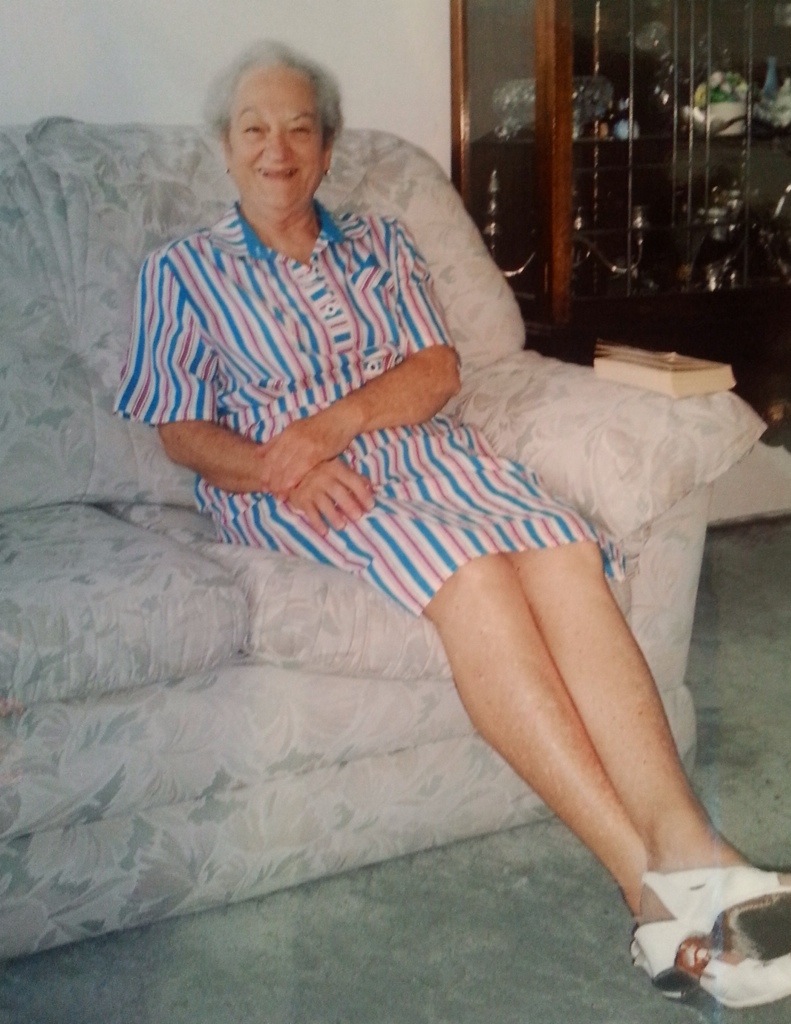
A crowd, many, many scores of people, gathered. Although some of the names eluded us we all knew each other’s faces from generations of family events. This was a gathering of the many from the fringes of a number of intermarrying clans. Pearlie was one of seven siblings. All of her siblings married and multiplied. Pearlie alone never married: she’d smile and call herself an unclaimed treasure. She treasured her siblings’ children and grandchildren, and their spouses, a growing multitude. But there were non-bloods there as well, numerous as her true kin. Pearlie gathered the young in her wake and we followed her, long after our own youth had gone, to her end. Everywhere eyes shone while mouths smiled, people cradled each other, faces looked serious but not in grief; for aunty Pearly died at the right time – before her dementia could ruin her, her slow cancer suddenly accelerated and she was gone.


Aunty Pearlie led a religious life. Her sacred places were the MCG and the Melbourne Synagogue. She never wavered from the worship of her idols at the Melbourne Football Club. But today it was the curate from her synagogue who led the ceremonies. It was a sweet moment when the young man – no relation to Pearlie or to anyone present – called her “Aunty Pearlie” as we all had. He was another honorary nephew, full of affectionate personal reminiscence. Pearlie’s life of faith ensured she would not be buried by a stranger.


In Aboriginal communities a burial takes place after indeterminate delay long enough for families to scrape the money together for a funeral. Then follows a further chapter of mourning where people gather from across a life history, from across a continent, for the Sorry Business.

Jews are buried with all decent haste. Then our own Sorry Business follows, the precisely calibrated period of shiva when first degree relatives sit low to the floor and receive condolence from their community. But Aunty Pearlie had neither spouse nor children to sit in her honour. Instead we gathered the next two evenings for successive memorial services at her synagogue. Same crowd as at the garden funeral, swollen now, and at a different venue. The Melbourne Synagogue is grand, cavernous, dripping with history, but too often attended by too few. A beautiful shell, the Shule waited for throngs that rarely came. But Aunty Pearlie came, Shabbat after Shabbat, at festival times, at all seasons. Over nearly seven decades she befriended each new rabbi, kept him company in his inevitable disillusion, saw him leave and welcomed and supported his highhoping successor. In this manner Aunty Pearlie outlasted seven Rabbis.


In the course of the Sorry Business I learned more of Pearlie’s growing up in Brisbane, of her service in WWII, of her friendships there with many women and men including a young Zelman Cowen. Pearlie seems to have won and kept many devoted friends.


Poignantly, one who resided so deeply in so many affectionate bosoms left no son to recite the mourning prayer Kaddish for her. Anxiously, I waited to see who might step forward and assume the mantle of the sons who never were. An aged brother in law, still erect, together with his not young son, and a couple of his not young cousins, all recited it together. One or two, more fluent in the Aramaic, led the others as they hobbled and stumbled in and out of time with each other. The four men freighted the feeling and the yearning of us hundreds, all of Aunty Pearly’s “young ones”, all of us wanting hard for her to be sung and storied, lamented and remembered, celebrated in this her holy place. Hundreds of us, all with our personal memories of some moment like mine with a Violet Crumble Bar when I was a child missing a mother’s love.
 

20140616-064031-24031367.jpg

The Twin Bond

He’s a big bloke in all directions, tall and broad. His face is round and it smiles widely as he enters the Doc’s consulting room. He has an open gaze.

The Doc makes room for the big man to pass.

“Thanks Doc.” He offers a large hand. Doc’s hand disappears inside his patient’s. The grip is manly firm, manly gentle.

“My name’s Alexander, Doc. Call me Alex.”

“Good to meet you, Alex.”

“I’ve got hypertension. Need a repeat of my tablets.” He smiles, his jowls rise and shine and recede. He tells the Doc he is sixty six. He is a man who invites conversation.

The Doc asks Alex where he lives.

“Port Augusta. Been there forever. Born there. Father met mother there, in primary school.

They’re long gone.

I’ve got a sister, a good bit older.

I had a brother – we were twins…”

The glow on Alex’s large face gives way to something deeper as the man slows his flow. Something is happening. Homage? Damage?

The Doc wants to know: “Were you identical?”

Alex nods. “And close.”

He clears his throat.

“What happened to your twin?”

“Cancer.”

In Alex’s mouth, the word is a sentence.

“You know we only saw each other three times in the last thirty years, but we were close.”

The Doc looks at him.

“Very close…Thirty years back he went to New Zealand for a fortnight and he stayed. He came back to see me, stopped with me here, for 12 months. Here we are together.” Alex fishes in his wallet and pulls out an old colour photo. Two large round men in their thirties sit in a small fishing boat and smile goofily into the sun. The light bleaches their faces and sets fire to their red hair. One of the men rests his hand on the other’s shoulder.

“After that year he went back to N.Z. To his friends and his life.

Then he got sick and died. Cancer.”

“It was tough?”

The serious face recedes inward for a moment. The Doc is forgotten. Alex is alone with memory of the feeling, with feeling returned.

He looks out at the younger man: “Knocked me around something terrible.” He stops, shakes his head.

“People used to ask us: ‘What’s it like being twins?’

We’d ask each other: ‘What’s it like not being a twin?’”

The Doc looks away while the other man composes himself. At length he resumes. His face is earnest now as he searches for words to carry feeling: “You know, I lost my son. Suicide.

My wife and I only ever had the one son… Terrible…

I wouldn’t wish it on anyone.

But it’s my brother I think of. Half of me is gone.”

The old man’s eyes are wet. “It’s been seven years…”

A pause as he searches for dates…“Seven years and one day.

There wouldn’t be a single day when I don’t think of my brother.

The large man takes his prescription and shakes the Doc’s hand. He conjures a smile for the Doc and he leaves.

Wilson’s Promontory

Wilson’s Promontory – where the Australian mainland gropes south towards Tasmania and the Pole.
Wilson’s Promontory – in whitefella parlance, “The Prom”; to blackfellas, “Wamoom” – a place too special to live in, reserved for ceremony.
The Prom – a place sacred to whitefellas who do not reside there, vacation nomads.
Wilson’s Prom – where generations come and keep coming, where they need ballots to winnow the applicants; we who apply – we are the grass.
Wilson’s Prom – where four generations of my family have wintered and summered, most of them beyond remembering.

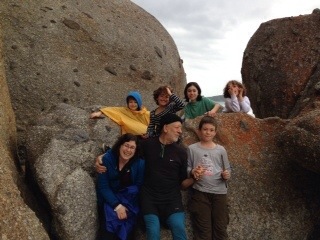
Some of my family spent this (prolonged) weekend at the Prom, both saplings and old growths, across the generations and down: two grandparents, their niece from Boston, her two children, the three children of our firstborn – all of us in that heightened state of aesthetic rapture as rugged mountains meet a moody sea.

We hiked and climbed great rocks, we jumped from them onto sand that squeaked, fell from them and upon them. We collected water from a mountain spring, we crossed small rivers and we peed into them, we ate and we ate, we read stories from the Jungle Book, we played chess and Scrabble and board games.
Screens were eclipsed.

Five young children from two different continents, different lives, met and blent, and were Australian in the special way that occurs ‘in country.’

Ten years ago, I wrote a poem here, memorialising a whale and my father, then one year gone.

WHALE MOURNING AT WAMOOM.

My father walked these hills and steeps;
Woke early ever, walked rugged rock-strewn track
To the lookout and back. Now he sleeps
Forever; and I rise with the sun
On this second day of this last new moon
Of the dying year,
And sound the shofar, the ram’s horn warning,
Then go for a run on a crystal morning.

My father walked till his dying year; I follow his track
Across the bridge,
Then up the hill and over a ridge –
Then back; pausing to view a sapphire sea.

High here, on air, at Wamoom, this southern
End of a continent,
Comes remembrance, a fifth element.
Midst earth and water I stand, content,
Basking in the gentle fire of an early sun,
Then turn
To start the slog and gasp and sweat – up hills
And tracks on the ridge of the returning run.

‘Stop!’ – cries the voice of my companion –
‘And turn!
And look out to sea, and see – there’s a whale!’
I stop and turn and look – and sight the sail-
Shaped fin, the hump of back, the mammalian
Brown-black, a bruise
On the blue face of the sea. Now it sinks again
And as I smile, give thanks and muse
It surfaces and plays, and sprays its spume
At the end of the dying year.

Another whale was here, beached, dead; while with my father
A decade ago, I saw it. We paid homage at its sandy tomb.

(from ‘My Father’s Compass’, Howard Goldenberg, Hybrid, 2007.)

20140525-185107-67867946.jpg

20140525-185655-68215464.jpg

Into the Danger Kitchen

My great nephews are visiting from Boston, and suddenly there’s danger in the kitchen. It started when the older one was the only one: he must have been about eighteen months of age when his mother took him to an allergist for his atopic eczema. That doctor said: ”He’s at the age where he’ll range and browse and try foods that he could be allergic to. Here’s a prescription for an Epi-pen. Inject him with it if he stops breathing.”

The child’s great-uncle, a veteran family doctor, grunted: “Typical American medicine – over diagnosis, over-eager intervention.” The child’s grandfather, an eminent psychiatrist, harrumphed, ”Bah! Humbug!”

Sometime later the mother – my niece – took that child to a pizza parlour where he took a bite of a sesame bun. He chewed once, he chewed again, he gasped, he scratched frantically at his now reddening skin. Then he stopped scratching – and breathing. His mother called 911 and gave him a shot with the Epi-pen. The ambulance arrived shortly afterwards and found the child breathing.

Back to the over treating over-diagnosing doctor who advised: “There could be multiple allergies.” He tested and found anaphylactic allergies to sesame and also to egg, and to tree nuts. Lesser allergies were found to zucchini and squash, pollens and dust mites. The doctor tested for sensitivities to antibiotics. He said, “Well you can’t kill the boy with zucchini or squash, but you could with a cephalosporin. That’s an antibiotic.”

The parents decided to have another child. The younger brother was born and before he had a chance to meet a sesame seed he was tested too. This little feller had his own anaphylactic allergies – to wheat, and to the gluten in barley, rye and spelt, as well as to egg and kiwi fruit. Pollens and dust mites were allergens of a lesser order.

My niece added three to seventeen-point-five and realised nature had dealt her a tricky hand: what one child could eat safely might kill the other. And verse-vica. She and her chocolate-allergic husband have raised these two diabolically matched and unmatched children to twelve and nine years respectively. They subsists on celery and prayer, in Boston, a good place if you have complicated health: they have lots of typical American doctors there, all over-diagnosing and over-treating and keeping kids alive and well.

Now the kids are visiting us in Melbourne. They stepped into our danger kitchen. Their very-great-aunt asked what they’d like to drink. “Water , please, Aunty.”

My wife poured tap water into two surgically clean tumblers. The boys drank as we stood by, Epi-pen in hand.

20140519-232727-84447495.jpg

You Can’t Chop your Momma Up in Massachusetts…

In January 2002, I went to Boston to cut a deal. The deal, a covenant really (in Hebrew, a brith), originated between God and Abraham. Abraham was the first to cut the deal. My job in Boston was to renew it in the flesh of my eight-day old great-nephew. When it was all over bar the feasting, all present joined in the heartfelt prayer: Just as he has entered into the brith, so may he enter into the Torah, into the nuptial canopy and into good deeds.

Then we joined in heartfelt feasting.

In the next room the baby, newly named Elisha, slept quietly. Quietly too, he bled into his diaper*.

When we checked on him we found him – as in the vision of the prophet Ezekiel – languishing in his blood. I applied pressure. This works nine times in ten. Elisha bled on. I sutured a little bleeder and waited. The baby boy bled on.

His mother and father and I bundled him up and raced him down the January street to the pediatrician’s* office. Boston is cold in January but we didn’t notice. The paediatrician’s nurse applied a tight bandage, saying reassuringly: ”Pressure always stops this sort of oozing.” Really?

Elisha bled on quietly. He remained pink and warm and peaceful.

An ambulance raced us across town, bells and siren ringing, to the Boston Children’s Hospital. Bearing all the authority of my years and my professional status, expressing myself with composed urgency and gravity, I gave Elisha’s history to a triage nurse; then to a nurse practitioner; after her to a surgical nurse and then to a medical student. All took notes, all reassured us pressure would do the trick, the ooze was slight, it would settle, Elisha looked well. All disappeared without trace.

Finally I met an Accident and Emergency physician from Iran and a Urology Resident from Israel. Beaut fellows both, they understood and honoured the Covenant of Abraham. The Israelite confided the story of his own son’s recent Brith Millah. And he spoke to the truism which comforts all surgeons: Healthy blood will always coagulate.

Meanwhile the sleeping baby boy oozed on. It was midday now, three hours after the Brith. A test gave Elisha’s blood count at forty percent. He slept on. And trickled away.

My brother surgeons took Elisha to the OR where, with the aid of the operating microscope, they ligated some minute bleeders. They invited me into OR where they demonstrated with some pride, a pink rosebud of glans, surrounded by a coronet of catgut sutures. “Look, no ooze”, they said.

No ooze is good news.

It was now three pm and I had missed my flight to the West Coast.

I hung around for an hour longer. At the next diaper change we saw the slightest pink loss. The same at the next change. And the next.

All the clinicians pronounced Elisha well. Cured. I should fly home, confident his little problem was fixed.

Misgiving, guilty at my surgical failure, I flew to LA and rang my niece from the airport. “He looks good, Unc. Hardly any ooze at all.”

I flew home to Australia.

A day later, Elisha’s mum called: “Elisha has haemophilia*, Uncle. The bleeding wasn’t your fault, not anyone’s fault, a mutation.”

Within weeks it became clear Elisha’s haemophilia was graded severe. Every second day of his life, Elisha has an intravenous injection of Clotting Factor Eight. On this regime he’s a healthy fellow.

Last week the World Haemophilia** Congress was underway in Melbourne with Elisha’s mum in attendance. She brought Elisha with her, together with his non-haemophiliac younger brother. Although I haven’t checked the pink rosebud I last saw in OR, the Elisha I see looks brilliantly healthy. Next January his multi-continental kin will gather in Boston to celebrate as, in fulfilment of our prayer, Elisha enters into the Torah at his barmitzvah.

· *In America they spell it thus.

· ** In Oz we spell it this way.

More Mother’s Day Thoughts

After my experience last Sunday I’ve decided I like Mothers Day. I enjoyed sharing vignettes of my old Mum. One of the first that I ever published, appeared in my first book, a memoir which I called “My Father’s Compass”. The vignette, a story about my 92 year old father battling the extinguishment of his great powers, and my mother battling nothing and accepting all, was titled: Falling gums.

“The phone rings at midnight. I walk towards the answering machine and listen for an urgent message. I do not pick up the receiver because it is Friday night, my Sabbath – Shabbat – when my soul visits paradise. When I am in paradise I do not answer the phone. There is no message.

Though puzzled – who would want to speak to me at midnight if it were not an emergency? – I begin to relax, then the phone rings again. Once again my machine offers to take a message, once again the caller is mute. I grab the phone. Dad’s voice says, ‘Mum is on the floor …’

‘I’ll come now,’ I say, and hang up. Dad and I have responded to the situation with the least possible desecration of the Sabbath.

Minutes later I let myself into my parents’ house. There, on the bedroom floor, in a tangle of limbs, is my mother. ‘Hello darling,’ she says. She looks up at me and gives me a grin. Recently, Mum’s front teeth have begun to desert her. Those teeth that remain are a picket fence, stained and in disrepair. Mum’s former serene smile has given way to a seven-year-old’s grin – all mischief and careless abandon.

I peer down at Mum’s legs. They are thin, too thin, except for her ruined knee which is swollen and misshapen. In the half light her skin is ivory. I crouch and put my hand on her leg and feel its cool and its smoothness. I touch my mother’s skin and I am her small child again.

A short time passes. ‘Does any thing hurt, Mum?’

‘No darling.’

‘Can you move your limbs, Mum?’

Dad’s voice breaks in: ‘Mum’s not hurt – she didn’t fall. She was reaching for the commode chair and she pushed it away instead of holding it still … she just slid gently onto the floor … I couldn’t stop her falling …’

Dad’s voice subsides. He sits on his bed and holds his head in his hands.

Mum speaks: ‘I’m quite comfortable, darling. It’s quite a nice floor, really.’ Another grin. I look at my mother. Her limbs are splayed and folded beneath and before her like so many pick-up-sticks. I wonder how I will pick them up.

‘If you like it on the floor, Mum, would you prefer to stay there until the morning?’

‘If you wish, darling.’ She extends a hand and pats my face.

I bend and begin to take her weight, my hands beneath her arms. Dad gets up to help but I knock him back because his heart is worn out and failing.

He recoils, recedes and sits down opposite me, his face wrought of grief and care. I feel a pang for my abruptness.

An in-drawing of breath, a grunt and Mum is aloft, her legs a pair of white flags hanging limply beneath her. Her arms are around my neck and we are locked in our accustomed embrace that has become so familiar since she began to suffer a series of strokes.

We know this moment well; each of us knows the sweetness of this slow dance. Neither of us would readily trade it, not even to make Mum whole again.

A moment later Mum is in her bed, covered up, wheezing, speaking breathily, her voice ravaged by stroke and by time: ‘Thank you, darling, what a treat!’ – and beaming with the simple pleasure of ­being tucked into her bed.

Dad, contrite, distressed, is saying, ‘I am sorry, darling. I hate to disturb you.’ And I am saying how pleased I am to come, and how come he didn’t speak into the machine when he rang. And Dad says, ‘I don’t know.’

‘Shabbat Shalom,’ I say, kiss them both goodnight, and go home.

Back home, but not yet in paradise, I sit a while and recall a conversation my friend Lionel reported to me. While driving with my father in the Flinders Ranges, Lionel asks this indestructible old man a singular question: ‘What are you afraid of in this life, Myer?’

My dreadnought father has fought all his sixty-seven years as a doctor against illness and injury. Of all diseases, I know that cancer and stroke fill him with terror beyond naming. And I recall, too, Dad confiding to me his fears for Mum: ‘I am grateful for every single day that I have her; and I am so frightened of the day that …’ He falls silent, his voice drowning in the grief of his imagining.

When Lionel asks his question, Dad looks up and out and away from inside him, and he sees those silent, massive and beauteous living things, so inviting in the outdoors and so treacherous. He answers, ‘Falling gum trees.’

The day after the ‘fall’ Mum and I are alone in the kitchen when she begins to laugh. The sound has a gasping quality. You have to pay close attention to discover whether she is choking again, or simply amused. She laughs louder then tries to speak at the same time.

Her voice is a concerto for bagpipes and windstorm. I lean close, into the teeth of the storm, and Mum says, ‘When I was on the floor last night, and I couldn’t get up, I started to laugh, and I couldn’t stop … and Daddy was furious!’”

Mother’s Day – or Mothers’ Day or Mothers Day

This announcement was born as a boast but I make it today as a confession: I DON’T BELIEVE IN MOTHER’S DAY.* I don’t honour it, I don’t observe it (unless with quizzical disdain), I don’t respect it, (excepting as a smart marketing exercise. What began as a means of selling greetings cards in the off-season found eager recruits in floristry and in restaurantry – as well as in cafetery and lingerie. Mother/s Day has all the hallmarks of Hallmark and the hallmarks of the pulsing of empty cultures in new countries and guilty sons in the pub, at the footy, at work, at play – at living outside extended family.)

Climbing down from my lofty position of cultural oversight into the kitchen of my own life, I can identify a serious gap: my mother and I have not spoken to each other for almost five years.

I have dreamed of her. I have dreamed she dreams of me. Mum died in June 2009 and I miss her. I do not mourn for Mum: I grieve for my loss, for the delight of her company. Mum always made me smile. Always. In her breathless dying week I watched as Mum suffered one particularly horrifying attack: she gasped at air. It went on and on, as her lungs filled higher and higher with the fluid that would drown her at week’s end. I called a nurse, Nurse squirted a diuretic into Mum, the breathing slowed and Mum pulled off her oxygen mask, grinning: “You thought I was going to croak, didn’t you, darling? Well” – Mum was cackling now in the hilarity of the merry joke that was all her existence – “I didn’t, did I?”

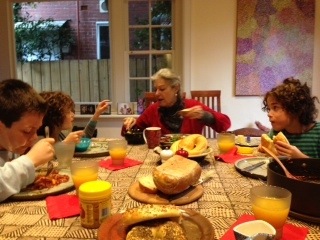
In my kitchen of now, I fry tomatoes and eggs and red kidney beans with onions fried in oil with garlic and smoked paprika and cumin. I serve this and avocado bathed in fresh lime juice and garlic-infused olive oil on a mountain of fresh bagels and specialty breads. All is prefaced by a glass of orange juice squeezed by my grandchildren. We serve this to the children’s grandmother and great-grandmother. Everyone gives gifts, festoons and cards (handmade, unHallmarked) to the old ladies. And I watch, a non-combatant. I look at my mother in law, fulfilled, filled with years. I come in, in from my chill principles, and I celebrate with them all.

*I’ve always felt the same away about Fathers Day and Valentines Day too.

20140511-050328.jpg

Carna Pies!

images-10The boy had always said the words; at home he’d yell them to the heavens, and in later years he’d yell them across the crowd towards the players: Carna Pies!

He’d yell into the sound that swelled around him, yelling in an ecstasy of feeling. It was a reflex – more than a reflex – it was a spasm. In full throat, in full cry, he was somehow one with the ‘Pies. He was passion, he was hope. Carna Pies, he’d scream, and the scream was prayer, purer than the ritual prayers which he recited faithfully, facing Jerusalem, every morning and every evening.

He never really understood how many things he meant by Carna Pies. He only began to understand when he wrote a letter in Hebrew to a friend. Both of the friends were Collingwood supporters, had yelled Carna Pies together as boys, yelled it as men, then the friend went away and settled in Israel. Now he was writing and feeling those memories. He wanted to translate the old words, but how do you translate Carna? And in which other language could ‘Pies be birds?

He rendered Carna Pies! as ‘Let the ravens of the brook ascend!’ It was not the same, but in the poetry of the words he recognised something. The same tone was there in the Magpie motto – Floreat Pica – Latin words, a scholar’s formula. The mock formality of the words satirized the frenzy of the raw vernacular, and honoured it somehow.

As he got older he glimpsed more of his meanings in Carna Pies!

He wasn’t born into the cult of the Magpie. Every year he would travel from his home town in the Riverina to Melbourne for the solemnities of the High Holydays. This was the season of the birthday of the world, and of the annual Day of Judgement.

On these visits to the city of his birth his father always took the “Age”. He liked it for its seriousness. He’d put aside the sports pages and the boy would read them, wrestling with the broad sheets that dwarfed his small frame. Avidly, he’d read about the footy finals. Every year Melbourne were expected to win and Collingwood to be contenders, and ultimately, gallant losers.

And every year, after the Day of Judgement, what had been written had come to pass: Melbourne were premiers and Collingwood were not quite good enough. Carlton were nowhere in sight.

The boy and his brothers chose their own allegiances. His older brother chose Carlton because their father had been born there; his younger brother chose Melbourne because it was on top; and he chose Collingwood because they were David, and one day, David might overcome Goliath.

The boy became familiar with disappointment. He came, in time, almost to enjoy the nobility of losing gallantly.

When the boy was nine, his family left the country town and moved to Melbourne, but it was years before the boy actually went to the footy.

He’d listen to the radio broadcast religiously – a tricky task for an observer of the Sabbath. He’d listen to grand final defeats at the hands of Melbourne and others, and he’d live in daydreams in which Gabelich would gallop endlessly into open goalmouths, and Weideman would avenge all wrongs and the siren wouild never blow until Collingwood were ahead.

In 1990 he actually saw the magpie come into full flower. Not since 1958 had the ravens of the brook thus ascended. He saw Daicos kick a goal from an angle that defied Euclid. He saw Gavin Brown rise from the stupor of his concussion to mark and goal, and goal again. He saw Darren Millane rampant on the wing, Darren Millane of happy memory soaring towards the sun, before crashing to his death only weeks later.

He stood among those thousands, among those tens of thousands, stood and roared Carna Pies! At his side was his son.

Father and son had walked the many kilometres to the ground. They would not drive because Saturday is the Sabbath. Faithful together in their observance of the letter of the Mosaic Law, joyous together in their neglect of its spirit, they shared this day. In the world there were only those who supported Collingwood and those who wished they were Collingwood supporters.

The son always regarded the father as a fine weather supporter, one who’d leave a match early when the cause was hopeless and the end was nigh. The boy was one eyed and wondered why his father would bother using an extra eye to see two sides to the struggle.

The boy did not know the father’s secret.

For the father loved footy even more than he loved Collingwood. He had loved Carlton’s Bruce Doull, he’d loved Malcolm Blight, Paul Roos, Timmy Watson – he loved all the laughing cavaliers who hadn’t realised that winning was everything.

He loved Dougie Hawkins who left his name on the wing of a club’s lost home.

And when the premier declared a state funeral for Teddy Whitten, footy’s smiling assassin, he wept and he approved.

(Ah, he mused, they don’t make nostalgia like they used to.)

And now Collingwood found itself an accidental contender in another Grand Final. Amazingly, among all the people who were Collingwood supporters and among all those who wished they were Collingwood supporters, the father found himself the possessor of two tickets for the Grand Final. And so they went, father and son, to see whether the magpie might yet flower again.

They would never win: David never beats Goliath. It doesn’t happen. The Maccabees had no chance against the might of Antiochus, Ho Chi Min was never going to beat Uncle Sam, Collingwood had no show against Barrassi’s team in 1958…

But it would not pay to get hopeful.

So they went and they watched and they saw the miracle almost happen. They saw how, but for the will of Michael Voss, the ravens of the brook might have ascended.

They walked home – it was Sabbath again – through the warm rain of early spring. The son, now a man, and the father, still a boy, walked together those many kilometres, and their feet were not heavy beneath them.

They had seen a marvellous match, a mighty struggle. They had each seen what they wanted to see – the father happy because winning was not everything, the son consoled because the ‘Pies could only improve – the son, with quickening steps returning to his wife and to their unborn child who might one day walk with him, and see, and shout Carna Pies!

The Boringest Cliché

1510472_366538920155302_968766595_nWe have all seen too many movies, read too many stories and attended too many plays where some person (always male), his hair thinning, his relationship failing, struggles endlessly to start his novel. Or to get over his writer’s block. Or to complete the bloody thing. Or to get it published.


Great writers have whinged greatly on this theme. Jonathan Franzen (The Corrections) and Nam Le (The Boat) have fretted memorably. The world has now read, seen and heard enough on the theme.


Yet, four and a half years of my (how much?) remaining time have disappeared in the creation of my own novel, “Carrots and Jaffas”. I watched and saw the sands of my time trickle profitlessly as through an hourglass. I wrote a masterpiece each morning and re-read lines, dead and drear, each evening. I took six months off work ‘to finish the novel’. Those months passed and a further draft joined the previous six in my waste paper basket.


For the past four and a half years I have lived that cliché. My wife and family have experienced that neglect.


Now Carrots and Jaffas poke their red heads (slab-shaped due to their premature arrival, ironically polar to the postmaturity of their story) out from the beautiful, bright covers that bear their names and Hybrid Publishers commissioned for them. The twins’ struggles to survive, their unnatural/supernatural/utterly natural intimacy, their delayed individuation, their painful discovery of separated self – all these have lived within me; and now Carrots and Jaffas face the world naked and without.


They tremble before you.

So Foul and Fair a Day

Howard at the Boston Marathon 2013

Howard at the Boston Marathon 2013

When I solicited funds as a charity runner in the 2013 Boston Marathon I promised to write a report on the race and my donors’ ‘investment.’ The moment the race started I started to compose my report. The mood was light, the crowd a united force of love, the events and sights all affirming a shared humanity. This would be a report of smiles. The serious counterpoint would be the 26.2 long miles.

At 2.07pm the mood changed. After that the playful response would feel profane. But I did promise a race report.

I slept on the matter. The evil was great and real, certainly. Real too was the goodness. Both demand to be written.

***

Does any runner sleep well the night before a marathon? I don’t. To prevent dehydration on race day I drink plenty through the previous day and every cupful demands its exit through the night. I am excited, nervous, a kid before his birthday party. Boston, after all, is to marathoners as Wimbledon is to tennis players. An enormous privilege, unearned by any effort of my legs, paid for in thousands of donated dollars.

The playful mind must be carried by legs that are 67 years old. Some prudence surfaces. The sixty-seven year old prepares methodically. The experience of forty past marathons insists I vaseline my second toes (which always blister), my armpits (which chafe), my nipples (which bleed) and my private bits (none of your business).
To prevent my shoelaces untying over the distance I double knot them: a trivial detail? No, not in Boston, for it was at the start line of one Boston Marathon back in the seventies that the favourite, noting his arch rival’s single-knotted shoes, bent down and double-tied them.

Continue reading