What Can We Do Once We Lose Our Freedom?

We started gmail and we surrendered the final shred of privacy. We used the net and opened ourselves to every hacker, most of them those we elected. We read of the twin towers and were alarmed; we saw the beheadings and were rattled. Those we elected rattle us often and hard and by reflex and in all sincerity and – as in the case of asylum seekers – in the sincere anxiety that we might unelect them. Once thoroughly rattled we allowed our governments to suspend habeas corpus. We are each of us now, all citizens, all merely Mohammad Hanifs, awaiting the knock on the door of our terror police.

Terror has triumphed. As it usually does. Terror wins when we pay heed – as we need to; it wins when we panic – as we need not.

So what can we do once we lose our freedoms?

I saw an odd movie a score or more years ago in which an Orwellian change had occurred and citizens were forbidden to own books. Books were collected and burned. Publishers were taken away for re-education. The Good Book says: ‘Of making books there is no end.’ But this was an end.

A few resisted, silently abandoning the cities, coming together to meet in the forest. Here each escapee became a talking book. One became ‘War and Peace’, another recited ‘Animal Farm’. Those whose mental muscles were less hypertrophied recited ‘Ozymandias’, or ‘Waiting for the Barbarians’, or the Twenty-third Psalm. All these texts threatened the regime that murdered thought. All reciters risked death but inherited life.

Back here in my real life. I resolve to read poetry every day. I’ll rescue myself and succour others.

Robert Hillman’s Review of Carrots and Jaffas

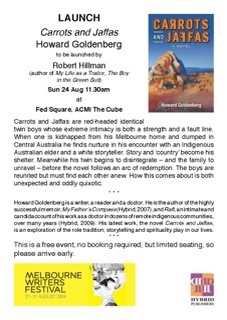
Identical, red-haired twin boys are born to Luisa and Bernard Wanklyn, who live in Melbourne. The year is somewhere in the fairly recent past. Since we’re in Australia, the twins are naturally nicknamed Carrots and Jaffas, the only alternatives being Bluey and Ranga. Luisa, the mother, is a native of Argentina; Bernard was born in Australia. When the boys reach the age of ten, Wilberforce Reynolds, an addled one-time addict, makes an attempt to steal them from their parents. There’s a bleak irony there – ‘William Wilberforce’ and ‘Henry Reynolds’ being the names of emancipators. Indeed, Wilbur Reynolds is acting out of a grotesquely misconceived impulse to redeem a life of ratbag behaviour by making a gift of the two boys to Greta, an Indigenous woman of the Flinders Ranges who played a role in raising white Wilbur many years past. Greta’s own two sons had been taken from her in the 1950s by men with the legal authority to do so. The two red-haired boys will compensate her, so Wilbur hopes. But Wilbur manages to steal only one of the boys, Jaffas. The agony of Jaffa’s parents is matched in its intensity by the agony of the twins, each left yearning for the touch of the other.

The impression the reader will be left with after a quick reading of Howard’s novel is of a drama constructed around an appalling crime and its widening repercussions. Hearts are torn out, and in the broader community, people who hear of the abduction on the news put a hand to the head and murmur: “Dear God!” But the story told here is far more thoughtful, far more involving than that. As it was bound to be. This is Howard Goldenberg’s first novel, but two works of non-fiction precede it, “My Father’s Compass”, a memoir of Myer Goldenberg, Howard’s dad, and “Raft”, a book that records Howard’s engagement as a doctor with Indigenous Australians in remote communities all over the continent. Each of these earlier books is distinguished by the vernacular philosophy of a thriving intellect, and by a quality of observation that yields one poetic insight after another. If we speak of intensity of feeling, insight and quality of enquiry, Carrots and Jaffas is of a piece with those earlier works.

The broad strategy of the novel, in my reading, is to allow the story to unfold through five movements – Birth, Growth, Catastrophe, Healing, Reunion. With this strategy in place, Howard gives himself the liberty to riff on the themes that brace his story: the binding force of love; the rigour of grief; the perseverance of hope; the will and the wherewithal to imagine the life we hope for, and especially, what we expose ourselves to when another human being becomes more crucial in our vital life than our own wellbeing. (We might think of Bacon’s Hostages to Fortune lines: “He who hath a wife and children hath given hostages to fortune” but we should cheer Bacon up a little and subvert his meaning by saying: “Anyone who loves has given hostages to fortune.”)

Out of these themes emerge the book’s two arguments. The first establishes the enigma of individuality, taking in the sources and purpose of human individuality, and the second demonstrates the stubborn persistence of those forces in the world that oppose evil.

Let me return to love, the great emphasis in everything that Howard writes. Here is the mother of the twins experiencing the growth of love for her newly born, prematurely born children:
Luisa laughed the laughter of tenderness and body fluids, of manic collapse, of sleepless necessity.
On an impulse, or in forgetfulness or in simple exhaustion of thought, Luisa picked up both babies at once…offered each baby a breast. Both sucked….two small heads swiveled and searched, bony limbs extended, antennae into the void. One arm, flung outwards, came to rest on a brother’s shoulder. Gazes locked, spines unarched, mouths resumed sucking, smoothly, to satiety.

This conveys the growth of love of a mother for her children, and also the dependence of each twin on the other. Carrots and Jaffas cannot satisfy themselves individually; both must be satisfied together.

Later, Bernard, the father, in his quest to grasp what being the father of two children who can barely be differentiated involves, quotes from a poem on the subject of identical twins:

“The twins retain/intimate knowledge of each other,/ Theirs alone-/Of mind and body and being –/a knowledge preceding speech,/Transcending speech: Knowledge subtle as song,/Deep as the womb,/Pure as echo./Identical twins: One? Two? One?”

I wrote an endorsement for Carrots and Jaffas before its publication, and said this, amongst other things: “Howard Goldenberg’s story of identical twins, violently parted at the age of ten, reveals the hunger that dwells in all of us to stand distinct in the gaze of God.” To achieve that distinction in the gaze of God is our human struggle; to demonstrate that we cannot be packed by the gross; that we are marked with an individuality that honours, in its way, the teeming variety of life in the world. Think of Hopkins poem, “Pied Beauty” in which God delights in “All things counter, original, spare, strange…”But for Carrots and Jaffas, that struggle for originality is over at birth, or even at conception. The gaze of God is the gaze of the identical twin. The suggestion of Howard’s book is that the mystique of the identical twin is closely related to the mystery of divinity in our lives. We are unlikely ever to know what the identical twin knows, and unlikely ever to know what God knows. But one thing we can know is this: God is Himself, Herself an identical twin.

Wilberforce Reynolds parts Carrots and Jaffas. He hadn’t meant to. He had intended to steal both boys. It is a feature of acts of violence that they often do even greater harm that the perpetrator intended. Wilbur’s hope is that he will win the approval of a woman, Greta, who suffered the theft of her own two boys. In Archie Roach’s haunting song, “Took the Children Away”, Archie says: “You took the children away, The children away. Breaking their mother’s heart, Tearing us all apart, Took them away.” Those who took away Indigenous children decades ago knew that they were causing grief, but felt that a greater good justified the harm. And this is also Wilbur’s rationalisation.

My head will be right, doing this good thing…it’s the right thing to do, to bring kids, to steal them and replace kids stolen from blackfellers.

Howard makes very clear that Wilbur’s failure of imagination re-enacts the failure of imagination of those who had conceived the scheme of parting Indigenous parents from their children so much earlier. Jaffas, after his abduction, cries out in his anguish: “Run! Run back to Carrots! Run!” and we think of Leah Purcell’s song, ‘Run, Daisy, Run!’

Jaffas finds himself in the care of Greta and the white Doctor Burns up in the Flinders Ranges, the oldest place on earth. The creation of each of these characters are amongst the finest accomplishments of the novel. This Healing movement of the book sees Greta revealing to the traumatised Jaffas stories of the land, of her country, while the Doc contributes tales of scientific discoveries, of Indigenous distress, of the land as understood by a white man. Neither the Doc nor Greta know the true story of Jaffas abduction; Wilbur had spun a plausible tale to explain why he was leaving the boy with Greta. The Doc begins to suspect that Wilbur’s story is rubbish, and he wonders whether Wilbur’s real motivation has something to do with Greta’s past. He asks her, one day, about that past:

My boys, they take my two boys. Never come back. I reckon they big fellas now, fathers. Maybe grandfather. I never see them. Maybe they die, maybe they just lost….That what happen. That what they do. Steal ‘em…

But back at Jaffas home, his brother is tearing himself apart with grief, while his mother, Luisa, torments herself with stories of the unspeakable things done to other abducted twins by a certain Doctor Mengele during the Second World War. The strong suggestion is that Luisa, herself a one-time victim of hideous violence under the Junta in Argentina, will go mad if she is never to see Jaffas again. I spoke earlier of those forces in the world that oppose evil, and of their power. While Luisa is losing her mind, guarding her remaining son with a maniacal determination, Greta and the Doc are painstakingly rebuilding hope in the abducted Jaffas, mending, healing. In the oldest region of the earth, the aged (and Doc Burns is no longer a young man, nor Greta a young woman) dispense hope and love to the young.

Howard Goldenberg’s novel brims with suggestion, as a novel should. And the suggestion I want to make a big deal out of is this: that love, human love, is the finest accomplishment of the imagination. Maybe it is too easy to use a word like ‘evil’ and expect that everyone agrees about what evil is. But we do know what ‘wrong’ is. It is wrong to snatch a child from the street and drive away on some mongrel errand. It is wrong to wrench children in their thousands from the embrace of their parents on some state-sponsored mongrel errand of larger scale. It is wrong to gather people in their millions into camps, reduce their existence to wretchedness, then murder them. To do wrong requires no imagination at all; merely malice or egocentricity. To do good requires imagination. The Doc and Greta imagine the path to recovery that Jaffas might follow, then urge him along it. Their imagination stands in strong distinction to Wilbur’s crude lack of imagination.

Howard Goldenberg’s book is itself the product of a fine, creative imagination, and of a big heart. Like all such works of literary art, Carrots and Jaffas adds a welcome something to our chances in the world.
Robert Hillman is the renowned author of sixty books, including “The Rugmaker of Mazr a Sharif ” (Wild Dingo Press). His most recent works are the celebrated novel, “Joyful” (Text, 2014), and a young adult novel, “Malini” (Allen and Unwin, 2014)

Robert launched Carrots and Jaffas at the Melbourne Writers Festival in August 2014 with his speech above. 
Dog Days

Fidel at the beach on his last day.

Fidel at the beach on his last day.

Patchett opens her story with, “Two days before my dog Rose died…”* Who of us who has ever loved a dog can resist the urge to read on? Flung into foreknowledge of a death – knowledge humans share, but which animals might be – who knows? – spared, we realise this death is imminent. While many of us imagine we’d welcome such foreknowing of our own end, few could bear it. Patchett, it is clear, feels that burden of knowing.

Then there’s the dog’s name, Rose: this dog is particular. She has an owner, a name giver. Giving a name is an act of appropriation, literally a claim of belonging. Rose belongs to Ann. Sahara belonged to my brother Dennis; and Fidel belonged to my son-in-law Pablo. And, to our surprise, a widening circle of others.

My firstborn brother spent most of his last decade as the sole resident in a family sized dwelling. A gregarious, family-minded man, his loneliness would have been bleak without Sahara. To those who did not love her, Sahara, was completely unlovable, too small, too low slung, raucous and aggressive; she was in addition a sneaking, nasty, opportunistic biter. To Dennis alone was she cherished; blind to her antisocial nature, her repellent effect on all creatures on two legs or four, Dennis pampered her. He loved Sahara. She was his housemate, his friend, his nearest relative.

Happily for Dennis he never saw Sahara’s last days. After he died, one of his friends materialised in our house of mourning and volunteered to take her in. Relieved of a most undesired heirloom, we seldom speak of her. She lives on, however, under her own name, between the covers of my novel ”Carrots and Jaffas”, in which she functions as an unexpected redeemer. My fear is she might be alive somewhere in the flesh. A roar, a blur, a quick bite, sudden blood, quicker flight, you’ll recognise Sahara by her toothmarks.

***

By any standard Fidel was a Border Collie gentleman of refined habits. He growled only when a stranger ventured too close to the latest newborn of his household; he barked only at the one great hound to invade his territory outside Alma Espresso; he was quite useless as a watchdog. Fidel’s sole lapse of etiquette was his habitual piddling on my mother’s loungeroom carpet, but we excused that as the imperative of territory.

Fidel loved to run. I loved to run. Long after my running companions fell away to ruined knees or rescued marriages, Fidel kept me company on long lonely early morning runs. Young women smiled at me, my maleness forgiven in the company of Fidel.
Fidel was first dog across the line in the Traralgon Marathon of 1998. He was photographed smiling at my side with his medal around his neck. The officials were not to know he’d travelled some of those 42.185 kilometres – unwillingly and under protest – in my daughter’s car.

Fidel parted with his testes without complaint, he raised three small boys and won the hearts of widening circles of kin with his never ending grin and his always sweet breath. Like all his bottom sniffing kind Fidel seemed immune to odour. He’d keep me company when I was seated on the loo. Once in that small room he ventured forward, making mistaken fellatious overtures. Fidel and I were close but I drew the line here.

One day Fidel seemed tired, the next day apathetic; the third day he was rescued by surgery and transfusion (at the hands of his loving vet-in-law) from death by catastrophic internal haemorrhage. The vet-in-law confided he had had incurable cancer. Six weeks later my wife and I said our goodbyes to Fidel – my jowls quiver and my lower lip trembles as I recall it – at the seaside, his happiest hunting grounds where he was wont ever to chase seagulls into mocking flight. We embraced him and whispered last words. We knew what we knew; we wondered what Fidel knew? Not for the first time I kissed him.

***

Ann Patchett won the Orange Prize and a Pulitzer for ‘Bel Canto’. She won me first with a small booklet titled ‘The Bookshop Strikes Back’ (Bloomsbury, 2013), a safe enough speculative buy at $2.50, handsomely rewarding.

In her remarkable book, “This is the Story of a Happy Marriage”, Ann Patchett describes the passing of Rose. Rose was small, lap-sized, not a real dog to love and run a marathon with. From her opening phrase Patchett won me.

After Rose dies, Patchett writes: “I came to realize…there was between me and every person I had ever loved some element of separation…arguments and disappointments…over time people break apart, no matter how enormous the love…and it is through the breaking and the reconciliation, the love and the doubting of love, the judgment and then the coming together again, that we find our own identity and define our relationships.
Except…I had never broken from Rose…”

Patchett recruited me into her love, convinced me, changed me, enlarged my understanding.
What more can we ask of a writer?

*This must be the most arresting start since Annie Proulx’ “Postcards”, which opens with the protagonist’s realisation that the person with whom he has – one breath past – shared an unspecified se xual act has died in that act.

How to Widen the Gap

In my novel “Carrots and Jaffas” a whitefella doctor working in an outback Aboriginal community has a recurring daydream. The doctor’s dreaming is of a pathway into a healthier unobese, normotensive, undiabetic, heartwell community. That pathway is the path of a sugarless past, a path followed by gatherers and hunters, who are not fast and fizzy food consumers.

That dreaming, a sort of longing for escape from the simple carbs that destroy his flock, that widen the Gap, is born from the reality the Doc sees at the checkout in the community’s foodshop. The local people stock their trolleys, proceed to the checkout, proffer their paycards and wait. The cost of the foods frequently exceeds the funds in the card. The customer removes this food, that food, the next – until the tally equals the funds. First to go are milk, vegies, fruit. Then meat. Finally the customer is left with white bread and brown fizzy cola.

The Doc reels at the choices, at the grip on appetite and taste of these poisons: “more harmful – because more widespread  – than alcohol”. The Doc, an old utopian, dreams of a switch to the Zero option, the sugarless drinks that will please the taste for sweet and the pull of caffeine…The Doc does not fear the scaremongering over artificial sweeteners; thirty years ago these were going to cause cancer. Thirty years on he is still waiting for those cancers. Meanwhile sugar’s harm is here, everywhere…

The experience of that old doc is my experience precisely. In fifty communities, over twenty five years, I have seen these carbs at work on babes in arms, on youths and matrons, on aunties and uncles. In go those carbs and the gap widens that we are successfully closing elsewhere.

A Good Life

A few months ago a man and I were engaged in a conversation. The talk ranged widely over the man’s new book and mine, over asylum seekers to indigenous health, then to my odd affection for running marathons. We visited the Boston Marathon of 2013 and the bombing that brought the event to a halt before I could reach the finish line.

While we talked like old friends, as occasionally happens with an engaging new friend, we were not alone. An audience of tens of thousands listened to us on local radio. Our conversation was coming to an end when the interviewer paused, mused for a moment, shot me a half grin and said: “Howard, I see you as an idealist, a person trying to do good in the world. So I want you to give me an answer to a question I ask myself every day: ‘How does a person live a good life?’”

The interviewer is an awarded journalist aged about forty, a father of young children. He smiled, acknowledging how his question had flown in and landed abruptly in a chat that had satisfied itself with surfaces. Stumbling, I gave a suitably useless answer. I groped for something wise but not too portentous and I came up with something incoherent.

Two months have passed since the challenge of that question. I realise I did have an answer. I have had it for ages. It is couched in religious terms but you could remove the divinity from it and still retain an essence that responds to my radio host. It comes to me from a fellow who lived more than two thousand years ago who had gathered an audience of his own (rather like a radio host of ancient day). His name was Micah. He distilled his understanding of life for his public, teaching them as follows: He hath shown you, O man, what is good: and what does the Lord require of thee – only to do justly, to love mercy and to walk humbly with thy God?

Coincidence

“My grandfather happened to be in Britain at the start of the First World War. He and his brothers farmed the family property in the Victorian high country. Somehow though, he was visiting England, a war was on, we were part of the Empire, so he joined up.
Meanwhile back in Australia, his brother volunteered. They wrote to each other with their news: it turned out both had been posted to the Middle East, but to different units in different locations.

“Grandfather and great-uncle tried to keep in touch, and when Grandfather was given leave on Christmas Day he wrote to Uncle Bob promising to meet him outside the General Post Office in King George Street in Jerusalem on that day. He’d meet Grandfather there at noon. It didn’t surprise him that he didn’t receive a reply – there was a war on. His brother’s silence didn’t make him change his plans.

“At noon on December 25 – I think it was 1916 – Grandfather took up his station outside the Post Office and waited for Bob. By 1.00pm Bob hadn’t appeared, but Grandfather wasn’t worried or surprised. There was a war on, they both had to cadge lifts from army transport vehicles. He waited. Grandpa was excited and nervous; he and Bob hadn’t seen each other since before the war.
Grandfather said he needed to go to the toilet but didn’t dare in case Bob came and found he wasn’t there and they’d miss each other. He told me he danced around for hours with his bladder filling and his hopes fading.

“By four o’clock it was getting cool, the day was coming to its end and Grandfather feared he’d wet himself. Bob never showed. Another soldier passing by told Grandfather there were public toilets around the corner and one block down.
Grandfather strode down the street, turned left and collided with another man in uniform. “Sorry mate”, he said, untangling himself. Through the gloom came the same words in the same voice. The two men peered at each other. It was Uncle Bob.
‘The funny thing was’ – Grandfather told me – ‘Bob never received my letter!’”

That story was told to me by a workmate in 1974. It has stayed with me these forty years. I know that post office, I know the cold and dark of evening in Jerusalem at Christmas.

Today I received a flattering (and I must say insightful) review of my novel “Carrots and Jaffas” from a lady I’ve never met who lives, reads, reviews and blogs in France. (Coincidentally, we found each other by chance.) Claire McAlpine is my reviewer’s name. Somehow Claire managed to compose her review through a period of family medical crisis. How the empty page draws the pen!
Towards the end of her piece Claire McAlpine remarks on the long arm of coincidence that reaches out towards the end of my novel. She is right. As I wrote the section in question I had in my mind the accidental finding of kin, of brothers, between my friend’s grandfather and her great uncle Bob. This closing stage of the book gives voice to a daydream that I fall into from time to time in my work as a locum doctor in outback Aboriginal communities. Medical work in those places is full of nightmare: so much loss, so much suffering , almost all of it preventable. In my reverie I dream of a utopian resolution of the actual. My writing always hopes for redemption. In the closing pages of “Carrots and Jaffas” I gave voice to that wishful state; I allowed the intelligence and the questing longing of my character ‘the Doc’ to be rewarded by coincidence.
And I know from first hand stories of Holocaust survivors who have been separated from kin, for decades beyond hoping, that fate is not always cruel, that brothers are sometimes found.

I Reblog her review and thank Claire for the time and effort she put into it during a difficult time.

Claire 'Word by Word''s avatarWord by Word

Allia NurseAll quiet on the blogging and reading front recently as life’s dramas intervened and demanded my full attention. Our daughter had a diabetic crisis 2 weeks ago and has been in hospital, she is stable now and happy to be home and said I can use this new picture she created for her Facebook page.

Consequently I have been carrying Carrots and Jaffas around with me and rereading passages, though I finished it more than 2 weeks ago and finally today had time while our son was at hip hop to move my scribbles here. Apologies Howard for taking so long to share your wonderful book.

Carrots and Jaffas is a wonderful example of how the virtual world allows us to come across writing voices that we don’t always find in bookshops or through mainstream publishers, that don’t require one to have publishing connections or be in the know. Just to be open…

View original post 836 more words

Sewn Lips

The “Guardian” reports on a detailed litany of sub-standard medical care at Christmas Island.

I read the piece with interest and with some recognition: I had worked there earlier, before the present ‘off-shore processing’ (the hasty export of the unwanted) was instituted. Initially I kept silent. Then I wrote the following, which is the introductory chapter to a suite of stories which will appear in 2015 in my next book of non-fiction, “Burned Man.”

“Sewn Lips

A few years back I signed up to work for a short time as a doctor caring for Asylum Seekers detained on Christmas Island. I went with every impure intent. Indignant over my country’s conduct towards refugees, I headed to the island determined to observe, to record and to betray: I would witness wrongdoing and I would expose it.

But I signed a Confidentiality Agreement: now my lips were sewn. So I would have to resort to allegory, to obliquity, to any literary device to tell unforbidden truths while avoiding forbidden fact. And of course I had every right to report on my own state of mind.

In the event the Administration thwarted my plan: I saw no wrongdoing, detected no bruises, smelled nothing: nothing to report. Stolid unimaginative warders ran a barely decent prison. Good nurses, skilled young medical colleagues, experienced mental health nurses were on hand to attend to generally healthy, universally miserable patients.

Keeping the system honest from the outside, the Red Cross visited and the Australian Newspaper snooped.

And we servants of the nation did everything by the book. We followed all the rules and Conventions. We – the system now incorporated me – we kept Australia’s nose clean. Assiduously, conscientiously, courteously, with perfectly consistent meanness, we kept our clients (they weren’t patients, my true client was the Government) we kept them healthy, we kept them confused, we provoked them by systematic delay.

We drove them mad.

Australia’s impeccable gulag calibrated its practices to equality with the countries of origin. We managed to be just as cruel without raising a bruise.

Meanwhile, doctors were drinking every night. One guard took his own life, another attempted suicide. One mental health worker was dismissed for ‘fraternising’. In fact, she visited her 18-year old client who had been held incommunicado for 36 hours in a psychiatric ‘facility’ (lovely facile word, drained empty, morally bleached) in Perth. She understood her authority ended once she delivered her patient to the Psychiatric Hospital, but his need and her care did not.

I returned to Australia proper and resumed my life. Back now with family, a free person, a citizen, surrounded by comforting supports, I found I had brought the island with me. Contaminated, implicated by national service in unkindness policy, I was troubled by dreams. Night after night, in darkness and unable to speak, I saw myself doing things I had not actually done.

In those dreams I did Australia’s work. I lived the nightmare we perfected.”

The Guardian article by Oliver Laughland: http://www.theguardian.com/world/2014/may/27/doctors-litany-of-medical-neglect-of-asylum-seekers-still-largely-ignored?CMP=soc_568

20140528-094805-35285111.jpg