Remembering at the Wall

Jerusalem in high summer. We awaken at 4.30, depart the apartment at 5.00 and already the sky is blue, cobalt blue.

Jerusalem is quiet. The roads are quiet. Quiet is rare in this city that teems with the pious, the fervent, the urgent.

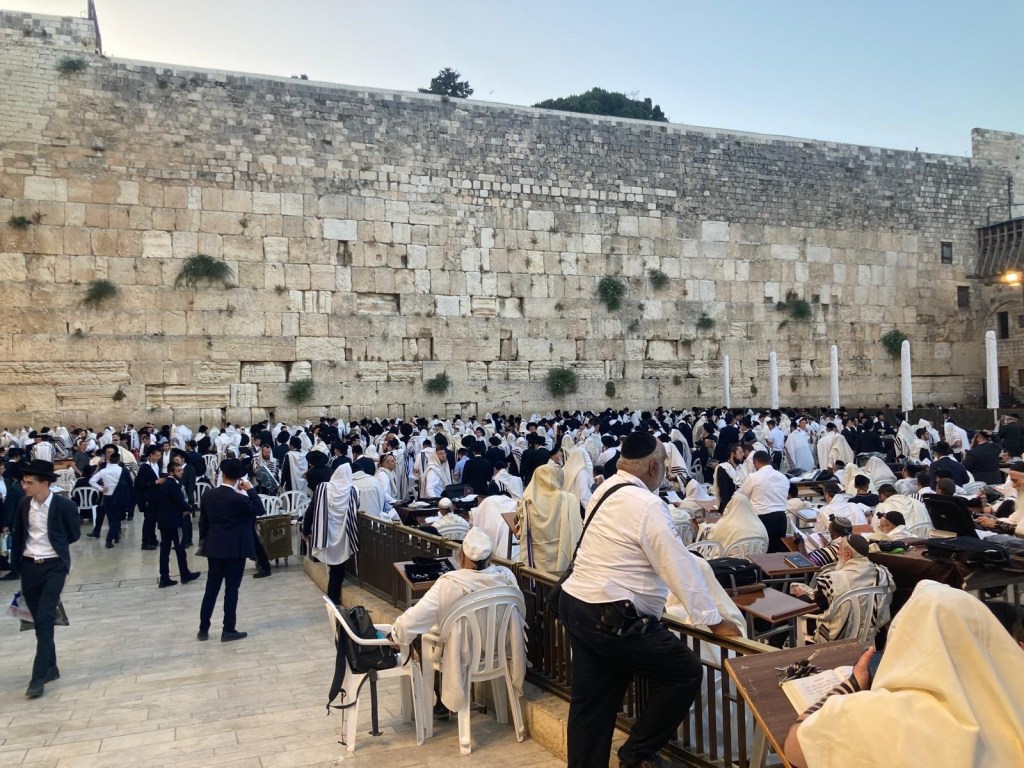
Wondering whether we’ll find people enough at the Wall for a minyan (quorum), we walk with fast steps along twisting ways. We need a quorum in order to recite Kaddish, the mourner’s prayer. Erupting from an alley into the broad square we sight the Wall. Before it, in their many hundreds, the devout, already at prayer.
We three are not in mourning, we are here to remember. We are our mother’s surviving children. An indispensable fourth is her son-in-law John, devoted to Mum now as in life. The remembering starts with the first sighting of the Old City’s perimeter wall. How ancient, these creamy stones, mutely dramatic, forever contended. So many conquerors, so many defeats, such passions, stones soaked in blood.


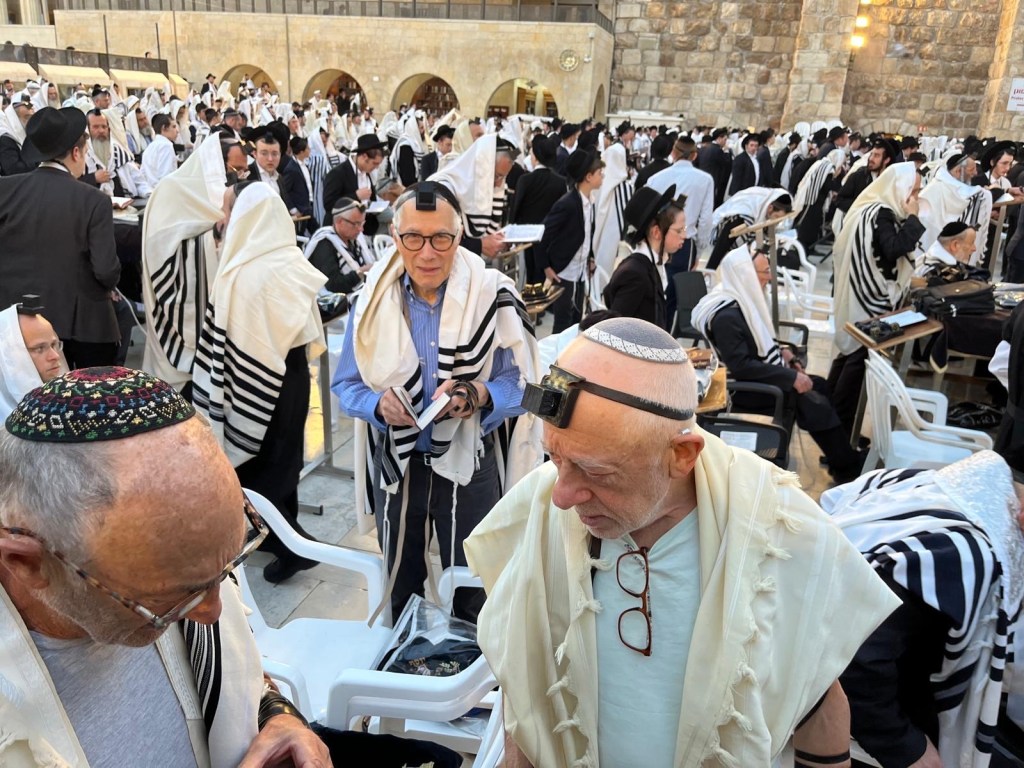
From the plaza, we sight many minyans of minyans, male bodies cloaked in tallithot (prayer shawls). Some wave and sway, others shake metronomically, all moving to intensify intention. One youth in front of me flings his arms to the heavens, his hands clench and unclench in his entreating to God. May his prayers be answered for the good.

Past the beggars, past worshippers of all stripes, past Haredim Caucasian, and Haredim North African, past modern orthodox, past the odd Ethiope, past a pair of the pious deeply asleep, my brother and I wind and wend to the far side where, separated by less than one metre, our sister will hear us recite kaddish.
A memory of my first visit. November 1967. It’s afternoon in early winter, the air crystalline, the skies blue. An impromptu service is in progress. I attach myself to a congregation that is the chance aggregation of the moment. Those elect who are of the line of Aharon the High Priest offer their hands for a Levite to wash, prior to giving the priestly blessing. I raise my washed hands and intone: May the Lord bless you and keep you…

An afterthought lands: here I am, delivering this blessing at the Temple. This my forebears did for centuries until the Temple was destroyed, almost precisely nineteen hundred years ago. My people went into exile. At some stage in the 1800’s my grandfather’s grandparents returned to the land, settling in Petakh Tikvah, the Gateway of Hope, far to the north of here.

Is it possible that I am now, in 1967, the first lineal priest in my family to officiate here since the year 70 C.E.? 

Today, together with my brother I will offer that same blessing. The blessing concludes: May the Lord lift up His face unto you, and give you peace.

Peace!

Our mother was a serene soul. She lived a long life of love, somehow happy through all of life’s losses and afflictions. Today, I remember her and honour her, without sorrow or pain. Late in her life, Mum said to me, You know I never did anything remarkable or distinguished. I never was famous or exceptional. But I did give birth to four children and I raised them and they all love me. So I suppose I was successful.

Mum, you don’t know the half of it: so well did you love us four, that every single one of us felt sure that we were your favourite.

Mum lived her life of peace. I can imagine her in no other state than peace. She went with heart at ease. My tears today are not for Mum. I shed a few sweet tears for this son who misses her. But many are my tears for my people, detested today, deserted by fair weather friends, threatened today, abroad and at home. There is tension in the air, fear too, appalled pain and grief. And mighty resolve.

But here, at this hour of pure air and quiet, Jerusalem is at peace. Have I ever attended prayers so quiet, so ruly? We hundreds recite the words, a soft hum rises from many lips. Until the Amidah (the silent devotion). Quietnessnow, perfect and complete. Torsi swing, sway and shake, hands clench and unclench. 

Prayers completed, kaddish recited, Mum honoured, I make my way to my sister Margot. We fall into a fierce hug that does not quickly end. My body heaves with sobs. I’m a good sobber. There’s much to shed tears about. Tears for the present pain, tears of hope for the future good.
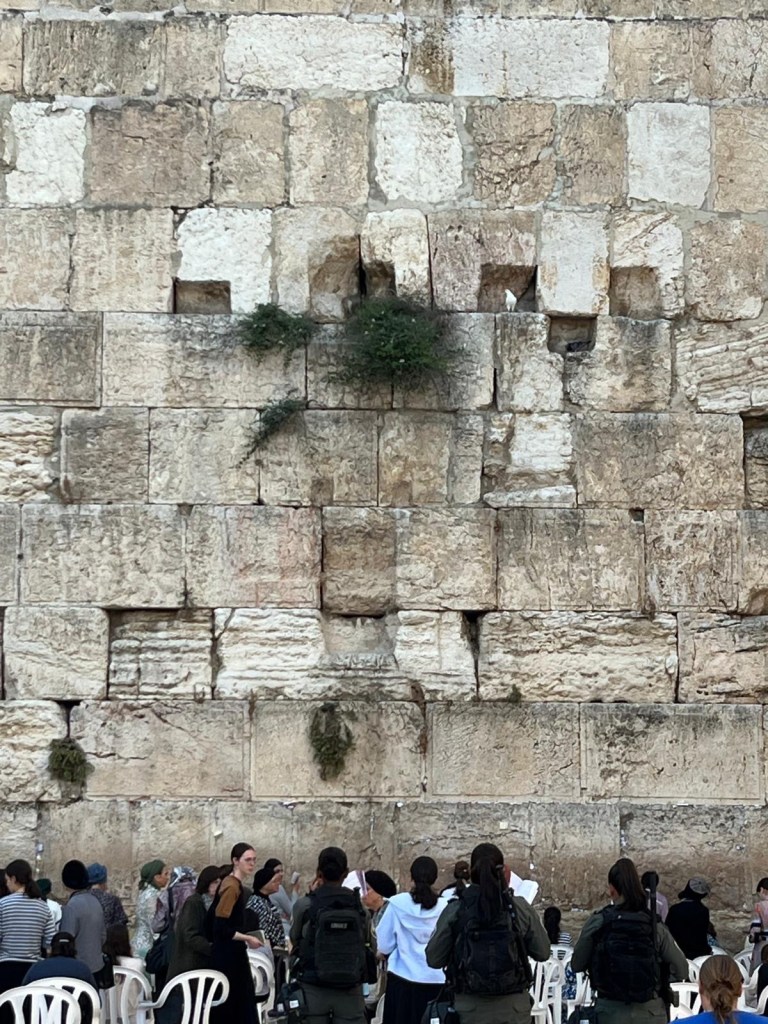
White dove high in the cleft of the Wall

Story for the Cantor’s Wife


Running wearily past the kosher bakery, past the coffee shops, past the kosher providores, past the nearly-kosher food shops, I light upon a face I think I know. The face sits atop a tall figure who wears a black frock-coat, dark side whiskers and a once-black beard. I slow and the man hails me. He thinks he knows me. He speaks: can you come inside and make a minyan?


The man is not alone. Next to him stands another tall man, bearded, not young. Both men wear broad-brimmed black hats. The two wear beseeching looks. They edge closer. With the men standing thus closer than I’d wish, I realise I don’t know either of them. But they have guessed right: I am indeed Jewish and I understand their request. They are one worshipper short of a quorum.


I reply, I’m sorry, I’ve already davvened (recited my prayers) this morning.


Please, we have a mourner who needs a minyan for kaddish. 


I know what this means, I’ve shared the plight of this nameless someone, recently bereaved, who wishes to honour his dead. I tell the men, I haven’t prayed in shule for a long time.  My wife is immunocompromised and I mustn’t bring home a germ.


Long beseeching looks from two quarters. I relent: Alright, as long as there’s space for me to stand at a distance, in the rear.  


I follow the men into a side street. They lead me to a door in a nondescript building that I would not have noticed, and I follow the men inside. Through a second doorway, along a passage then up some stairs to a third doorway. The door opens to a wide space beneath a low ceiling. I look around; there’s space here for fifty minyanim, but the worshippers are few. I make my way to the back of this room which I recognise as a synagogue by the Holy Ark located at the distant front. I peer and sight a second Ark. Odd, a puzzle.


I expect my stay to be brief. Kaddish is one of the earliest prayers; I’ll stay, I’ll listen for the Mourner’s Prayer, I’ll join in the responses then sneak out. I’ll still make it home in time for the meal with my wife.


But Kaddish is not soon recited. This group follows a different order of prayer, in which the mourner’s prayer is recited late, not early. What’s more, these guys pray devoutly, with slow deliberation. I settle in for the long haul.


Discreetly I reach for my phone and send my wife a message: Sorry darling, detained in circumstances of unforseen sanctity.


I wait and wait, my mind adrift. From the distance, a man approaches. I don’t know him. He asks, What is your wife’s name in Hebrew?

I understand his purpose. He wishes to offer a public prayer for Annette’s recovery. Touched, I provide the information.  The man now sets before me a tin with a slot in the top into which the charitable congregant might insert a coin. To donate to charity is a mitzvah, a sacred act. The man places a coin next to the tin, to enable this mitzvah. Once again touched, I provide my own coin.  And settle down, happy to wait in this warmbed of piety.


At length we come to the closing psalms. All rise. A voice is heard; Yitgadal ve’yitkadash shmei rabah, magnified and sanctified be the holy Name. The prayer ends and I make for the door. A man, younger than all the rest, strides towards me, a wide smile breaking open his unshaved face. He says, You can’t possibly appreciate the great mitzvah you have done for me today.

What has this story to do with a cantor, or his dog, or for that matter, his wife? Simply this: running home a fortnight later, on precisely the same route, I paused for red lights at a traffic intersection. A musical voice cried: DoffanPaz! One person only calls me by that name, the young cantor, contemporary of my son.  A small dog on a lead looked up at me from beside the cantor’s ankles. Holding the upper end of the lead was a youngish woman who smiled at me.  The cantor introduced me to wife and dog.

For want of any better idea, I recounted the story above. The cantor’s wife smiled again. She said, You should write that story and print it on your blog. I like your stories. 

Such a compliment comes to me but rarely. I promised I’d write the story. And there you have it.


Memorial Concert

I was the second in a bunch of four kids. Including parents we were a family of six. That was then.

In 2003, Dad died; a few years later our eldest brother died, three years after him, Mum died. Now we are three. The anniversary of Dad’s death fell this week. I wrote to the other two survivors:


sister, brother

I wish us all many more years of vigorous good health

It has been an empty yahrzeit* no ceremony, no minyan** to respond to my kaddish*** just a candle burning and reciting the bedtime shema and recalling how Dad taught us and translated, the words echoing his love of the text, his love of the tradition, and his love of us, to whom he was passing it all on and reciting the psalm: ”yea even though my father and my father have forsaken me…”
I thought of Dad at intervals through the day, but I didn’t build my day around acknowledging him

He was phenomenal – a brave man who made himself strong despite inner infirmity a man who inspired, a man to remember

we were blessed

love howard

Sister and brother wrote back, with their rememberings. Cousins wrote, and friends. It all felt mellow, a species of happy. There was a pleasure in remembering and in sharing memory.
I found myself wandering around, singing a song I hadn’t sung or heard for perhaps forty years. I heard myself singing: he sipped no sup and he craved no crumb…

This was one of the many songs that Dad, a singing man, especially liked.
When I realised what I was doing, I tried to recall one of Mum’s songs. Although Mum was a blithe old girl, she seldom sang. But a memory came of one song she did sing to me when I was very young. I remember her contorting her face as she sang, glee and hilarity bursting from her in self-parody, flinging the words from her with abandon:
cigarettes and whiskey and wild, wild wine they’ll drive you crazy, they’ll drive you insane…

I decided to record myself singing my parents’ songs. You can hear their memorial concert by pressing play below.

*anniversary**a congregation***a memorial prayer, recited only in congregational worship