A Message of Love Smuggled into a Suitcase

We live in a world in pain. In that world dark deeds, harsh words, inhumane policies are normal. God is conscripted and deformed in every form of violence. Truth is lost, our planet poisoned.
Seeing all this, hearing it, feeling it,a person might surrender and despair.
Then life sends a message.
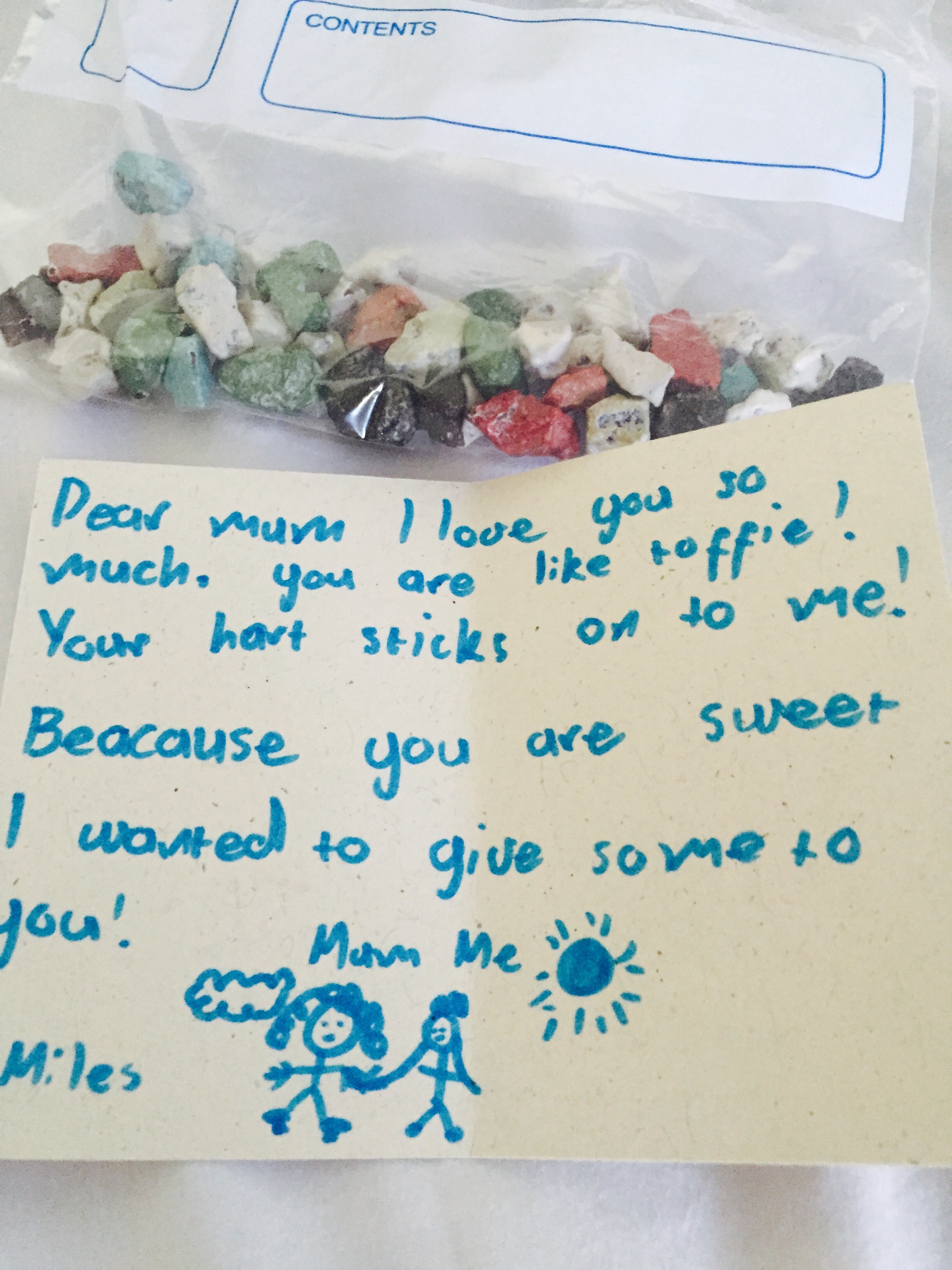
This is the message that came to me today.

  
Miles spent two weeks pocket money on this gift for his mother.

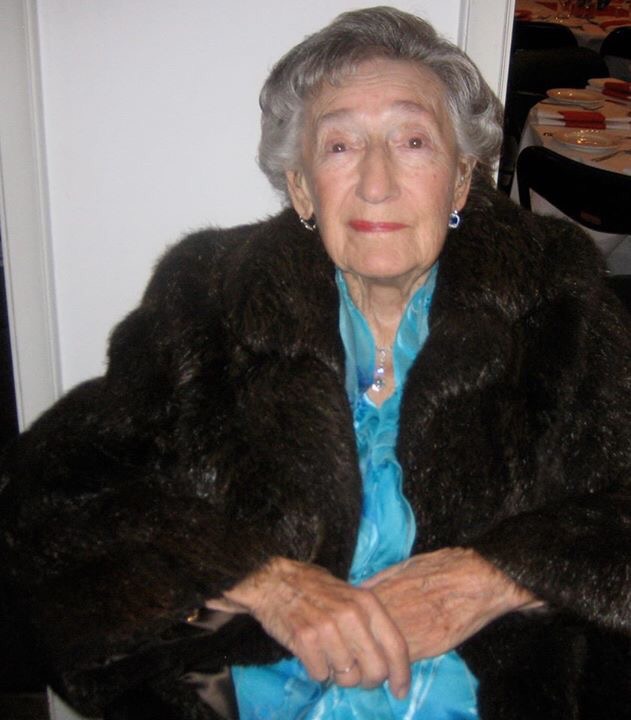
My Mum

My mother is dead. This is not news to me nor to an attentive reader of my musings on the net; Mum’s been dead since 2009. But the fact precedes the realisation. I feel the pleasure of being her son every time I think of her. That pleasure persists, felt it in the present tense. Especially today.

  To know my Mum was to smile. She was both vague and humorous, almost daffy, at least in respect of the weight of the world.

Mum knew sorrow. She lost both parents to natural causes in her childhood. She survived the death of her husband (‘he was a lovely man’) and a few years later, the death of her firstborn son, who lived, it seemed, solely to bring pleasure to Mum’s last years. A few days before her ninety-second birthday, battling the heart failure that would kill her only a few days later, Mum literally laughed at death. Already breathless, with fluid pooling suddenly in her lungs, she suffered a coughing fit, gasped, gasped more deeply, turned grey and slumped. A few milligrams of hero molecules and some litres of oxygen later, Mum awoke and grinned. From behind her mask she chuckled and gasped: ‘They thought I was going to croak, but I didn’t!’

Dad’s heart started to play up in the months preceding his demise. I felt a doctor son should warn my unworrying mother: ‘Dad’s heart disease could kill him, Mum.’

‘I know that darling. That happens to old people.’ And to comfort and prepare me, she added, ‘Death is part of life.’ 

Mum’s acquaintance with sorrow seemed to leave her unharmed. Events always had their brighter side. You could always laugh.

I wondered about this. This was not a shallowness. Mum loved generously in a way that would be reckless in any normal person. She’d invest in love, lose the entire capital and somehow end up liquid.

What was her secret?

Did she learn something early in life that helped her to surf, ever buoyant, upon the waves and dumpers?
All I have to account for my mother’s lightness of being are my memories and her stories.

Of her father: ‘Daddy was at sea on his lugger for weeks at a time. He’d spend the idle hours carving mother of pearl and tortoise shell to make jewellery for Mummy.’

‘Daddy used to give concerts at the Town Hall on his one-stringed violin. He was very artistic.’

Mum’s face is alight as she speaks. Her father is always ‘Daddy’, the affectionate diminutive bright in a daughter’s smile and lilt of voice. ‘When Daddy was dying the nuns asked the whole school to pray for him.’

‘Daddy carved this brooch from the mother of pearl and pearls he brought from the bottom of the sea. He made it for Mummy when they were sweethearts.’

‘During the Depression Daddy went bankrupt. He worked for a real estate agency after that.’ Mum points to a black and white photograph of the staff of the Agency. Four stiff middle-aged men and one commanding matron stare at the camera. As old as any but much the youngest in facial expression, my grandfather smiles impishly.

‘Then he got lung cancer and died.’

Driving past Brighton Cemetery, with a wave of a hand, ‘Daddy and Mummy are in there – just next to John Monash.’ A six year old boy cannot reconcile that champagne voice with the terrible intelligence of the death of parents. I wonder at first if ‘Mummy and Daddy’ might by some magic still live, ‘in there’.

Mum pronounces the famous surname, ‘Moanash.’

In my university years I need to correct her; ’Mum, it’s Monnash, not Moanash.’

‘No darling, it’s Moanash.’

‘Mum, three thousand people go to Monash Uni every day and they all pronounce it Monnash!’
‘Do they darling? I must be wrong then. It’s just we knew the family and they pronounced it Moanash.’
Of her mother: ‘Mummy died three years and three days after Daddy. She died of a broken heart.’ For Mum rheumatic heart disease is translated to a love that killed but never died.
‘Mummy was extremely elegant. She made her own clothes. If you look at her pictures you’ll see she always wears a half sleeve. Mummy’s arm was burned above the elbow and she always covered the scars.’ 

Of her philandering uncle; ‘Harold should never have married Grace. They lived perfectly happily while he kept her as his mistress. Once they married, Grace couldn’t tolerate his lady friends. After Harold took one lady friend on a cruise to Tahiti Grace never forgave him.’ Mum’s voice expresses wonder at the anger of a woman scorned. ‘So she tried to poison him by tampering with his heart medication. When that failed she removed the tacks from the carpet at the top of the stairs. Harold fell all the way down but he wasn’t hurt.’

Lots of stories, lots of memories, all recounted lightly. Did Mum have no bad memories? Or did she simply lack that faculty when to remember would create sorrow?

There was one. When Mum told me this in my own early childhood I felt swamped in vicarious grief. We were walking at the top of Pine Avenue in my home town of Leeton Mum paused outside the toy shop. ‘Howard I want to buy you a present. It’s important. You have to let me buy you something.’

Surprised by this; I didn’t need to be persuaded.

Mum went on: ‘When I was a little girl I didn’t allow Daddy to do that. He wanted it so much and I didn’t let him. It was a doll. Daddy took me into the toyshop and we both saw her. She was nearly as big as I was. I saw her and I loved her and I wanted her. I wanted her enough to burst. Daddy said, “Would you like that big doll, Yvonne?”

I wanted her so badly I felt it must be greedy to say yes. I shook my head. “Really?” – said Daddy. “I’d like to buy it for you. Say ‘yes.’” But I couldn’t say yes. Because I’d already said no. If I said yes now Daddy might think I was only pretending not to be greedy. He’d think I was greedy and bad for not saying what I truly wanted.

Daddy kept trying to persuade me. I kept shaking my head. Daddy looked hurt. My pride hurt Daddy and my foolishness hurt me. We left the shop, Daddy sad and confused and I too sad to cry. We left and I knew I would never have the dolly.’

One clear memory of sorrow. Clear, sharp, unbearable for the listening child. I said nothing because the sadness was stronger than my words. The only story of sadness I ever heard from my mother’s lips. All the rest – one day short of ninety-two years – is sunlight.


In an era where corporal punishment of children was everywhere and unremarked, Mum only ever smacked me on the bottom on two occasions. Afraid she’d hurt me, she didn’t have her heart in the job. On the second – and final – occasion Mum gave up when both she and I were overcome and helpless with laughter.
 
Here’s my best guess: her father (‘Daddy’) dies after a horrible illness; her mother (‘Mummy’) dies after a long, long illness. Aged fifteen she looks about her life. She sees Doreen, her younger sister, and ‘Gar’, her mother’s mother who moved in after ‘Daddy’ died. If that’s the worst life can do to her, she decides, life is worthwhile. There is still love.
In this all-female domesticity Mum learns from the example of Gar – herself an emancipated widow – that a woman ought be confident and fearless – of men (who are lovable and inferior) and of death. And Gar’s dictum, ‘what I cannot cure, I must endure,’ shapes the girl’s life.
 
Less than a decade later the girl will lose family in the Holocaust. In her seventies and eighties she will suffer stroke after stroke, culminating in a haemorrhage that tears her brain; she will lose fluency and clarity of speech, she’ll inhale perilously as she swallows, her gait will be shattered and continence lost. She will tell this son, ‘I’ve never been happier because I’m surrounded by people who love me.’ And as an afterthought, ‘I really think I could still drive, darling.’
 
She reviews her life: ‘I’ve never achieved any status, never followed a profession, never been well-known for anything. But I have four children who love me and that means something.’
Each one of the four feels so truly and well loved, we all feel morally certain we must be the favourite. All four of Mum’s children inherit, to a greater or lesser degree, Mum’s temperament. Of the four, it is Dennis whose life is most difficult, but he lives through loss and disappointment, ill health and frustration, buoyantly.
 
 
Today is Mum’s ‘yahrzeit’, the anniversary of her dying. In the Synagogue last night and again at dawn this morning, this son – this unmourning orphan – leads the congregation in prayer, recites Kaddish, and lights the memorial candle. He sheds no tears in remembering but he gives thanks.

Orpheus and Eurydice in the Yidinji Lands of Babinda

I have taken this story verbatim from the free brochure produced by Babinda Information Centre Volunteers and funded by the Cairns Regional Council. 

The volunteer who gave me my copy, a gracious and helpful lady a good deal older than I, told me: The authors wrote this a very long time ago. They were a man and a woman who became knowledgeable about the local tribes. They both passed away many years ago.” I acknowledge my debt to those writers. I trust I have violated no-one’s copyright. I will be pleased to receive any information that will put me in contact with the heirs of the authors. 

More fundamentally, I acknowledge the traditional owners of these lands and thank them for welcoming me here. I swam in these beautiful waters, enjoying them among the descendants of the original inhabitants. Mothers and fathers of brown kids and pink kids joined tourists, backpackers, Asian tour groups and an old white doctor, cooling upstream of all and danger and loss.  

“A long time ago, when the Yidinji tribe lived in the Babinda Valley, there was a tremendous upheaval that created these unusual shaped “Boulders” with their foaming, rushing waters. In the tribe was Oolana, a very beautiful young woman. Also in the tribe was Waroonoo, a very old, wise and respected elder. It was decided these two should be given in marriage to each other and so it was done. Some time later a visiting tribe can wandering through the valley and as was the custom of the friendly Yidinji, they made the strangers welcome, inviting them to stay. In the tribe was Dyga, a very handsome young man. All eyes were upon him for his grace and beauty. At first sight Dyga and Oolana fell in love.


“So great was their strong attraction for each other they arranged to meet secretly. Knowing full well their desire for one another would never be permitted they ran away. Oolana knew she could now never return as she was rightfully married to Waroonoo. They journeyed well up into the valley, spending wonderfully happy days together as they camped under Chooreechillum*, near the water’s edge.

The two tribes had been searching for them and it was at this spot they came upon the the two lovers. The wandering tribesemen seized Dyga, forcing him away 
(re)calling how they had been shamed and would never return and how they would travel far away and never return. The Yidinjis had taken hold of Ooolana and 
were dragging her back, forcing her to return with them to the rest of the tribe. Suddenly she broke away and violently flung herself into the gentle waters of the creek, as she called and cried for Dyga to return to her here, but the wandering tribe had gone and with them her handsome lover.

Would he ever return? Just at the very instant Oolana struck the water, a tremendous upheaval occurred. The land shook with terror and sorrow as Oolana cried for her lost lover to come to her. Her anguished cries spilled out as rushing water came cascading over the whole area. Huge boulders were thrown up and she disappeared into them. Oolana seemed to become part of the stones as if to guard the very spot where it all happened.

So to this day, her spirit remains.  Some say that at times her anguished calls cry out calling her lover to return – and that wandering travellers should take care

lest Oolana call them too close to her beautiful waters, for she is forever searching for her own lost lover, and this must always be.” 

Upstream the waters are wide and gentle. Downstream a little and around a bend the river narrows, the waters deepen and rush between mighty boulders that are 
grey and silent and solid and powerful. Leaping suddenly downward in great foaming furrows, the green waters crash from a height into a pool that roils and

froths in endless turmoil. “Very many have drowned here”, reads the notice. (“Caution, slippery kocks”, reads another notice, the capital ‘R’ helpfully altered to a ‘K’.) In the words of the copper in ‘Point Break’, pointing over his shoulders at the wild waters off Bells’ Beach where Patrick Swayzee has preceded them, “It’s death on a stick out there, mate.” 


Upstream where all is tranquil a young mother sat on the steps at the water’s edge, watching her children swim. She said, “It’s true. In my own lifetime in Babinda very many have drowned down there…very many. But only men drowned. Never a woman.” 


* Choorechillum, Queensland’s highest peak. Its whitefella name is Mt Bartle Frere.

Sylvia and Bruno, A Love Story

I watched an aged couple today as they made love.

She is in her late eighties, he’s a little older. Thirteen years ago, Sylvia (not her name)
became vague and forgetful. Bruno (not her husband’s name) passed the farm on to 
the children so he could care for Sylvia at home. For ten years this worked well, but as 
Sylvia became less active she gained weight and as Bruno aged he lost muscular 
strength, the strength that built the farm that sustained a family. Three years ago, Sylvia was admitted to the nearby nursing home. Bruno visits Sylvia every day.

Until today Sylvia had remained the most placid, easy-going resident in the home. When she was found this morning, burning with a high fever, pale and limp, helpless even to sit, breathing fast, her heart racing, her blood oxygen levels low, she remained that same tranquil, agreeable person.

“She’s severely demented”, said the nurse, “It’ll be cruel if we overtreat her. Let’s just 
keep her comfortable.” This is code for, let her die.’

When I met Sylvia at 0630 she gazed at me, eyes wide. Was this recognition? The opposite? What, who, remained behind that enquiring gaze?
‘Hello, Sylvia, I am the new doctor.’
Sylvia, her face pale, yellowed, smiled. I thought of my mother, another placid smiler.
Sylvia spoke, a voice soft, barely reaching my hard ears.
I leaned over her and listened as she spoke again: “You’re the doctor.”  
Attending at her bedside in the early morning, clad in my running shorts, vivid cap and colourful singlet, I don’t look like anyone’s idea of a doctor  – or a runner. But Sylvia knew. 
These were not the words of one ‘severely demented.’ 

I called Bruno, made the call that relatives know will one day come, the call they dread: ‘Bruno, I’m the doctor caring for Sylvia. She has a fever. I thought you should know… She’s not in danger, but we need to decide what treatment will be best for her and I’d like you to come in and give me your advice.’ A lot of words, too many words. Words to paper over insecurity, uncertainty.
Bruno thanked me for calling. He asked, ‘When would you like me to come, Doctor?’
‘Any time that suits you, Bruno.’
‘No Doctor, you’re a busy man. My time is my own. When will it suit you best?’
We agreed to meet at nine-thirty.

I studied Sylvia’s file. There was a reason for her long stare – she has glaucoma. And diabetes which will make her vulnerable to infection.
I read the family’s biographical notes: ‘Sylvia is a gentle, happy, quiet and kind person; compliant; she has sons, husband, extended family, friends who visit her often; she likes fruit, enjoys stories on television; she understands, even though she answers with only a few words. Please speak to her slowly.’ 
Elsewhere I read a relative’s observation: ‘I believe Sylvia does not have the ability to consent to or decline treatment.’
Once again I thought of Mum, a patient who’d always agree with a doctor, always wish to defer, to oblige.

I found Sylvia’s End of Life Directives: ‘Keep her clean and dry and as free of pain as possible. Please do not provide therapy that is futile. In the event of acute deterioration or critical event, she may have IV fluids, IV antibiotics, CPR, defibrillation not more than twice, a short course of ventilation.’

I tried to decode the directives: the family allows resuscitation, ventilation and defibrillation – more or less Intensive Care – while excluding futile treatments. But you never know whether intensive treatments might be futile. You do know CPR must be vigorous to succeed. In the words of an Emergency Medicine Physician of my aquaintance, ‘If you don’t break any ribs you won’t save them.’  And short ventilation slides easily into prolonged. Dying is prolonged and deformed; and any living that remains is disfigured.
This constitutionally gentle soul, comfortable in her frailty, undistressed even in her febrile state, would she welcome such rough treatment? What roughness, which bodily incursions, can the family tolerate? 
I needed Bruno to help me untangle this nest of contradiction.

At nine-thirty, I found Bruno seated by Sylvia, holding her hand. On her bedside table, a pear, freshly peeled and sliced, waited Sylvia’s pleasure. I introduced myself. Once again I told Sylvia I was the doctor. She looked at me, then over to Bruno. He nodded and her wide face relaxed and fell into a smile. Since my earlier visit her temperature had fallen and her breathing improved.

I listened to the front of Sylvia’s chest. I wanted to examine further, to hear the breath sounds at the lung bases. Sylvia, aged, weak and ill, would need help to sit up. Ordinarily I’d ask a nurse to support her but Bruno was here. Sylvia would know, her body would remember the touch of Bruno’s hands.
‘Bruno, when I sit your wife up, will you hold her shoulders for me?’ 
I hauled Sylvia’s upper body upright and Bruno leaned forward and placed one hand on each shoulder and steadied her. My stethoscoped ears listened intently to the breath sounds. Faint crackling betrayed the pneumonia I suspected.

Pneumonia, the old person’s friend. Will antibiotics save Sylvia? ‘Bruno, this is pneumonia. It’s a dangerous illness. Do you want us to use antibiotics? We’d give them through a vein…’
But Bruno, raised in a time and a school where the doctor gave orders, replied: ‘You’re the doctor. Whatever you decide will be for the best.’ 

Deep in cogitation, I applied the stethoscope again. Eventually I looked up. Two large brown hands, the joints wrecked by time and work on the farm, supported Sylvia’s creamy shoulders. Bent forward, held by her man, Sylvia gazed into Bruno’s eyes. I noticed her right hand. Sylvia moved it back and forth along the inside of Bruno’s forearm. Up to the elbow, back down to the wrist, up, down, Sylvia’s fingers stroked Bruno’s skin.
The fingers caressing, moving upon the silence.
Two people, oblivious of this interloper, oblivious of all, man and woman made love and confounded me: where I had wondered how much treatment would be too much, now I sensed how much the two still gave and received from each other, how precious to each was time with the other. 
How much treatment will be enough? 

Tearful in New York City

My red rimmed eyes smart. Tears fall. A victim of homeland security in the United States, I cannot blame the state of my eyes solely on the State of Siege. My blephs were reddened and my tears prone to fall before leaving Australia.

What is blepharitis?

In general I know –itis. -itis is my stock in trade – be it stomatitis, be it balanitis*, be it appendicitis – if it’s inflamed, it’s an –itis. My own inflammation is blepharitis. Blepharitis is the inflammation of an organ that has no known name: search as we might in medical dictionaries and in general lexicons we will find no blephs. But blepharitis, which is the inflammation of that part of your eyelid which is neither external skin, nor internal membrane, but the terminal edge of the lid, hurts in a niggling and mildly miserable manner. The seat of the problem is a scaly deposit, a scurf, somewhat like dandruff, that forms on the edge of the lid. With every blink that scaly stuff scratches the surface of the eye. The eye responds with perpetual tearing.

There is no cure for blepharitis.

My grandson Toby – known in this blog for his flirtations with danger and for his love of this grandfather – witnesses my tears as they swell to a fullness and fall. His insect features tighten with concern. He approaches, leans forward, pulling me down towards him,
studying my face anxiously. His rodent digits grab at my arms to arrest me: ‘Are you sad, Saba?’

His love makes me laugh for joy. My mirth augments the tearing. A full waterfall of affection and my blepharitis is somehow sweetened.

My son-in-law Dov, a rising genius in ophthalmology, advises me: ‘There’s no cure, but there is treatment; you need to dip a cotton bud in diluted baby shampoo then scratch away at the scaly stuff at the edge of your eyelids. I invite my readers to try this: most enjoy the practice quite as much as vaginal douching performed with sandpaper.

On the eve of my trip abroad, I decant some baby shampoo into a urine-less urine specimen jar. I seal the jar and pack it carefully in a nest of socks in my suitcase. On arrival in the United States I open my suitcase and read the enclosed:

NOTICE OF BAGGAGE INSPECTION.

To protect you and your fellow passengers, the Transportation Security Administration is required by law to inspect all checked baggage. As part of this process some bags are opened and yours was selected for physical inspection.

My suitcase has been selected! I feel honoured. Glad to protect my fellow passengers in this manner, I rummage for a pair of socks. My fingers report something unexpected, the tactile sensation of something cold and viscous and gooey, not unlike cooled semen. Sticky soggy socks everywhere swim in baby shampoo manufactured by Johnson and Johnson. The urine jar itself is fragmented, shards of plastic dripping yellow.

The shampoo treatment suspended, my blephs scale, my eyes smart and redden and weep. Without Toby’s loving concern blepharitis is no fun at all.

You Can’t Beat a Butter Batter

Fruit cake, rich, heavy, moist, in childhood the natural partner of a glass of icy-cold-milk-not-boiled-please-Mum, an entire fruit cake became my own every January eighth – my birthday cake, dating from around the time of my maybe fifteenth birthday, as I recall – Mum baked it, back in the butter days when doctors hadn’t discovered her soaring cholesterol, (we had our good times, we had our butter times), and Mum, always a superlative baker (who never essayed a sponge cake – ‘I can’t bake a sponge cake’) who kept two tins endlessly plenished with biscuits, biscuits Anzac, biscuits corn-flake, jam biscuits, biscuits nameless now in my aged forgettings; and cakes, always one waiting and ready for the nourishing of children, four of us, four who each secretly knew that he or she was the most loved of all by this mother who would say, in her much later years, “I never achieved much in my life, but I have four children who love me and that is enough”, and enough it was, especially as fruit cake, moist, heavy, from the deep delved earth, was never even my favourite, so many, so various and numberless and so rich and so high, light, soft, moist and sweet and buttery were all of them, but somehow, early one January, Mum must have asked, “What cake would you like for your birthday, darling?”, and I must have replied – thinking of how that uncooked cake batter, all floury and viscous with brown sugar and fruits in Rhine Castle kosher muscat wine, how much better raw in the mixing bowl than after baking three hours in the slow not-too-hot oven, how this batter beat all other raw cake batters by a rich mile – “Fruit cake, please Mum”, and Mum would have decided it was my favourite, and every eighth of January thereafter she presented me with a whole one, until that year, freshly married, freshly graduated, doing my first locum in a small town in Tasmania in January, I knew this would be the first year I’d go cakeless, that I’d graduated from that child nurturing, and my darling bride, a neophyte cook who would go on to surpass all before her as a chef, had the wisdom and the discretion not to venture into the cuisine where the mother-in-law shone and the cakes of breastmilk affection preceded her, so Annette forebore and the pampered young groom understood an end had come, but a day or two before the eighth, a parcel arrived in the post among all the letters from drug companies, the parcel wrapped in brown paper – my parents never threw out brown paper or string, they never forgot the Great Depression when, as I imagined it, there came to pass the World Crisis of No String and no Brown Paper – that parcel heavy, and under the brown paper a container unyielding to my fingers, and on the brown paper and addressed in Mum’s singular and elegantly jerky hand to “Dr. Howard Goldenberg, The Surgery, Deloraine, Tasmania,” and the address incomplete, the sort of address that destined your mail for the Dead Letter Office, but in the margin Mum’s plea:
“Mr Postie, It’s his birthday cake, please try to get it to him by the eighth: This Way Up”, and inside the paper was a cake tin and inside the cake tin was the birthday cake, fruit cake, still so good with a glass-of-icy-cold-milk-not-boiled, a single slice a gobstopper, but who ever stopped at a single slice?, not me, and so the January cakes came and came, butterless now in the puritanical regime imposed by philistine doctors, the cakes still came, until the strokes came, Mum’s left hand forgetting its cunning and the birthday cakes would surely stop now, but they didn’t, because Dad, himself a cook of meat and fish who never baked a cake in his life, saying ‘I can’t bake,” Dad stepped forward and made the annual fruit cake to Mum’s recipe, under Mum’s direction, and she presented it to a son expecting nothing this year or ever again, just grateful that Mum was still alive and loving and playful, and she not the least interested in the facts of disability, and so the cakes came and came until Dad went, and here I was, a boy of fifty-seven-and-a-half years who knew his fruitcake days were over; but no they were not, for there existed Mum’s firstborn, Dennis, born with butter in his mouth, a cook who believed in fat and cream and sugar and starch and no self control and no moderation especially in helping our Mum and never more than in celebrating his younger brother, the brother whom he might reasonably have seen as his supplanter, his usurper, but no, Dennis never felt those things, writing one January eighth, “Howard, I think God must be proud of you”, and now the cakes kept coming, butter reinstated, for there were never thoughts of tomorrow with Dennis, only of the abundant now and now was Howard’s birthday and it was his joy to help Mum make cake for her boy, and then, at the age of sixty-three Dennis underwent surgery and died and the cakes finally stopped…but no they didn’t, because Mum recruited her east-european carers, masters of the cuisine of heavy stodge, as her new sous chefs and she directed as they baked my fruit cakes – until the time Mum died and that would have been the end of the fruitcakes… except Mum left one granddaughter who loves baking as much as she loves her father; and that person is my youngest daughter Naomi, a devotee of the Creed of Cholesterol; devoutly does she mix bright-yolk eggs with buttery batter for a father whose januation ever is blessed with food-as-love, and so may it continue until I come to my Full Stop.

IMG_4032.JPG

Dalia Died

A friend wrote the other day to tell me Dalia died.

I met Dalia in 1972 at the nursing home she ran in Wattle Glen. You descended from the bitumen into a silvan retreat, the buildings concealed behind flowering native shrubs. A quiet path led to a doorway. Through the door you entered a different world: smells assailled you, disinfectant, cooking smells and behind them, always, the smell of urine, the smell of the elderly and incontinent.

Dalia greeted you, her voice musical, her fetching smile stretched over an uneven lower lip, the more fetching for assymetry, her accent French and very pleasing. The bushland at the entry and the greeting upon entering, these redeemed you amid the oppressive smells.

Dalia moved with you from patient to patient. Almost all of them were women, aged, their men long dead, their families generally distant through geography or choice. This young doctor, oppressed by bodies that did not work, by diseases medicine would not cure, by alienating disfigurement and by disfiguring debility, by drooling helplessness, dementia, strange behaviours, this doctor nearing quiet moral panic, redeemed, redeemed always by Dalia. Dalia would proceed to the bedhead, cradle the neck of her charge, sing to the patient the glad news of the coming of the doctor: Here is Doctor to see you, darling. You remember, this is Doctor Howard. He comes to you every week.

Dalia was not alienated, never distanced. Dalia embraced her guests, kissed their foreheads, fixed their pillows, fussed over painless areas of red skin that she would not allow to break down. Dalia spoke to her speechless, apparently demented patient, as if she were wholebrained, fully alert, fully human. Only after taking doctor aside, out of hearing, away from the presence of the stricken, would Dalia allow any concession to incompleteness.
A secular person, she recognised tenderly the spiritual yearnings of her charges, old women born in an earlier age when churchgoing was a norm and a religious outlook sustaining. Poor Thelma, she weeps, she weeps because God has rejected her. She wants to die, she prays for death, and because death does not come, she believes her God will not have her in his heaven.

Now death has come for Dalia. She was ninety two years old.

Dalia left Wattle Glen and our paths did not cross again until a few years ago, when our respective writings brought us together. The accent was still there, the smile, the relentless action of her critical mind, unwilling to yield on any of her concerns. And all her concerns were for humans. I read her memoir, a work of humbling honesty, of emotional privation in Belgium in the middle years of last century, of falling in love, of the ending of love, of emotional collapse, of recovery, of growth, of a thirst for learning. Hers was a life of learning, of ever journeying in her wisdom towards greater wisdom. I thought of Cavafy’s ‘Ithaca”.

As you set out on the way to Ithaca
hope that the road is a long one,
filled with adventures, filled with understanding.
The Laestrygonians and the Cyclopes,
Poseidon in his anger: do not fear them,
you’ll never come across them on your way
as long as your mind stays aloft, and a choice
emotion touches your spirit and your body.
The Laestrygonians and the Cyclopes,
savage Poseidon; you’ll not encounter them
unless you carry them within your soul,
unless your soul sets them up before you.

Hope that the road is a long one.
Many may the summer mornings be
when—with what pleasure, with what joy—
you first put in to harbors new to your eyes;
may you stop at Phoenician trading posts
and there acquire fine goods:
mother-of-pearl and coral, amber and ebony,
and heady perfumes of every kind:
as many heady perfumes as you can.
To many Egyptian cities may you go
so you may learn, and go on learning, from their sages.

Always keep Ithaca in your mind;
to reach her is your destiny.
But do not rush your journey in the least.
Better that it last for many years;
that you drop anchor at the island an old man,
rich with all you’ve gotten on the way,
not expecting Ithaca to make you rich.

Ithaca gave to you the beautiful journey;
without her you’d not have set upon the road.
But she has nothing left to give you any more.

And if you find her poor, Ithaca did not deceive you.
As wise as you’ll have become, with so much experience,
you’ll have understood, by then, what these Ithacas mean.

Ultimately Dalia became a therapist. I thought how fortunate were her patients, what gifts of life she brought them from her lifelong travels to Ithaca.

Dalia became a little unwell a few weeks ago, persisting in her vigorous ways until her last days. When abruptly her blood pressure fell due to a prolapsed heart valve, she asked the doctors to perform the operation they’d ordinarily reserve for one decades younger. When they explained the risk of technical success with accidental brain damage, Dalia elected to die. She accepted a trial of hero molecules for twenty-four hours; when these duly failed, she embraced morphia, chatted with her loved ones and went to sleep, rich with all she’d gotten on the way, and arrived at last in her Ithaca.

Her believer friend, the young doctor of 1972, prays his God will give her rest. At this Dalia would smile her crooked smile and pat me on the head indulgently and forgive my wishful thinking.

Robert Hillman’s Review of Carrots and Jaffas

Identical, red-haired twin boys are born to Luisa and Bernard Wanklyn, who live in Melbourne. The year is somewhere in the fairly recent past. Since we’re in Australia, the twins are naturally nicknamed Carrots and Jaffas, the only alternatives being Bluey and Ranga. Luisa, the mother, is a native of Argentina; Bernard was born in Australia. When the boys reach the age of ten, Wilberforce Reynolds, an addled one-time addict, makes an attempt to steal them from their parents. There’s a bleak irony there – ‘William Wilberforce’ and ‘Henry Reynolds’ being the names of emancipators. Indeed, Wilbur Reynolds is acting out of a grotesquely misconceived impulse to redeem a life of ratbag behaviour by making a gift of the two boys to Greta, an Indigenous woman of the Flinders Ranges who played a role in raising white Wilbur many years past. Greta’s own two sons had been taken from her in the 1950s by men with the legal authority to do so. The two red-haired boys will compensate her, so Wilbur hopes. But Wilbur manages to steal only one of the boys, Jaffas. The agony of Jaffa’s parents is matched in its intensity by the agony of the twins, each left yearning for the touch of the other.

The impression the reader will be left with after a quick reading of Howard’s novel is of a drama constructed around an appalling crime and its widening repercussions. Hearts are torn out, and in the broader community, people who hear of the abduction on the news put a hand to the head and murmur: “Dear God!” But the story told here is far more thoughtful, far more involving than that. As it was bound to be. This is Howard Goldenberg’s first novel, but two works of non-fiction precede it, “My Father’s Compass”, a memoir of Myer Goldenberg, Howard’s dad, and “Raft”, a book that records Howard’s engagement as a doctor with Indigenous Australians in remote communities all over the continent. Each of these earlier books is distinguished by the vernacular philosophy of a thriving intellect, and by a quality of observation that yields one poetic insight after another. If we speak of intensity of feeling, insight and quality of enquiry, Carrots and Jaffas is of a piece with those earlier works.

The broad strategy of the novel, in my reading, is to allow the story to unfold through five movements – Birth, Growth, Catastrophe, Healing, Reunion. With this strategy in place, Howard gives himself the liberty to riff on the themes that brace his story: the binding force of love; the rigour of grief; the perseverance of hope; the will and the wherewithal to imagine the life we hope for, and especially, what we expose ourselves to when another human being becomes more crucial in our vital life than our own wellbeing. (We might think of Bacon’s Hostages to Fortune lines: “He who hath a wife and children hath given hostages to fortune” but we should cheer Bacon up a little and subvert his meaning by saying: “Anyone who loves has given hostages to fortune.”)

Out of these themes emerge the book’s two arguments. The first establishes the enigma of individuality, taking in the sources and purpose of human individuality, and the second demonstrates the stubborn persistence of those forces in the world that oppose evil.

Let me return to love, the great emphasis in everything that Howard writes. Here is the mother of the twins experiencing the growth of love for her newly born, prematurely born children:
Luisa laughed the laughter of tenderness and body fluids, of manic collapse, of sleepless necessity.
On an impulse, or in forgetfulness or in simple exhaustion of thought, Luisa picked up both babies at once…offered each baby a breast. Both sucked….two small heads swiveled and searched, bony limbs extended, antennae into the void. One arm, flung outwards, came to rest on a brother’s shoulder. Gazes locked, spines unarched, mouths resumed sucking, smoothly, to satiety.

This conveys the growth of love of a mother for her children, and also the dependence of each twin on the other. Carrots and Jaffas cannot satisfy themselves individually; both must be satisfied together.

Later, Bernard, the father, in his quest to grasp what being the father of two children who can barely be differentiated involves, quotes from a poem on the subject of identical twins:

“The twins retain/intimate knowledge of each other,/ Theirs alone-/Of mind and body and being –/a knowledge preceding speech,/Transcending speech: Knowledge subtle as song,/Deep as the womb,/Pure as echo./Identical twins: One? Two? One?”

I wrote an endorsement for Carrots and Jaffas before its publication, and said this, amongst other things: “Howard Goldenberg’s story of identical twins, violently parted at the age of ten, reveals the hunger that dwells in all of us to stand distinct in the gaze of God.” To achieve that distinction in the gaze of God is our human struggle; to demonstrate that we cannot be packed by the gross; that we are marked with an individuality that honours, in its way, the teeming variety of life in the world. Think of Hopkins poem, “Pied Beauty” in which God delights in “All things counter, original, spare, strange…”But for Carrots and Jaffas, that struggle for originality is over at birth, or even at conception. The gaze of God is the gaze of the identical twin. The suggestion of Howard’s book is that the mystique of the identical twin is closely related to the mystery of divinity in our lives. We are unlikely ever to know what the identical twin knows, and unlikely ever to know what God knows. But one thing we can know is this: God is Himself, Herself an identical twin.

Wilberforce Reynolds parts Carrots and Jaffas. He hadn’t meant to. He had intended to steal both boys. It is a feature of acts of violence that they often do even greater harm that the perpetrator intended. Wilbur’s hope is that he will win the approval of a woman, Greta, who suffered the theft of her own two boys. In Archie Roach’s haunting song, “Took the Children Away”, Archie says: “You took the children away, The children away. Breaking their mother’s heart, Tearing us all apart, Took them away.” Those who took away Indigenous children decades ago knew that they were causing grief, but felt that a greater good justified the harm. And this is also Wilbur’s rationalisation.

My head will be right, doing this good thing…it’s the right thing to do, to bring kids, to steal them and replace kids stolen from blackfellers.

Howard makes very clear that Wilbur’s failure of imagination re-enacts the failure of imagination of those who had conceived the scheme of parting Indigenous parents from their children so much earlier. Jaffas, after his abduction, cries out in his anguish: “Run! Run back to Carrots! Run!” and we think of Leah Purcell’s song, ‘Run, Daisy, Run!’

Jaffas finds himself in the care of Greta and the white Doctor Burns up in the Flinders Ranges, the oldest place on earth. The creation of each of these characters are amongst the finest accomplishments of the novel. This Healing movement of the book sees Greta revealing to the traumatised Jaffas stories of the land, of her country, while the Doc contributes tales of scientific discoveries, of Indigenous distress, of the land as understood by a white man. Neither the Doc nor Greta know the true story of Jaffas abduction; Wilbur had spun a plausible tale to explain why he was leaving the boy with Greta. The Doc begins to suspect that Wilbur’s story is rubbish, and he wonders whether Wilbur’s real motivation has something to do with Greta’s past. He asks her, one day, about that past:

My boys, they take my two boys. Never come back. I reckon they big fellas now, fathers. Maybe grandfather. I never see them. Maybe they die, maybe they just lost….That what happen. That what they do. Steal ‘em…

But back at Jaffas home, his brother is tearing himself apart with grief, while his mother, Luisa, torments herself with stories of the unspeakable things done to other abducted twins by a certain Doctor Mengele during the Second World War. The strong suggestion is that Luisa, herself a one-time victim of hideous violence under the Junta in Argentina, will go mad if she is never to see Jaffas again. I spoke earlier of those forces in the world that oppose evil, and of their power. While Luisa is losing her mind, guarding her remaining son with a maniacal determination, Greta and the Doc are painstakingly rebuilding hope in the abducted Jaffas, mending, healing. In the oldest region of the earth, the aged (and Doc Burns is no longer a young man, nor Greta a young woman) dispense hope and love to the young.

Howard Goldenberg’s novel brims with suggestion, as a novel should. And the suggestion I want to make a big deal out of is this: that love, human love, is the finest accomplishment of the imagination. Maybe it is too easy to use a word like ‘evil’ and expect that everyone agrees about what evil is. But we do know what ‘wrong’ is. It is wrong to snatch a child from the street and drive away on some mongrel errand. It is wrong to wrench children in their thousands from the embrace of their parents on some state-sponsored mongrel errand of larger scale. It is wrong to gather people in their millions into camps, reduce their existence to wretchedness, then murder them. To do wrong requires no imagination at all; merely malice or egocentricity. To do good requires imagination. The Doc and Greta imagine the path to recovery that Jaffas might follow, then urge him along it. Their imagination stands in strong distinction to Wilbur’s crude lack of imagination.

Howard Goldenberg’s book is itself the product of a fine, creative imagination, and of a big heart. Like all such works of literary art, Carrots and Jaffas adds a welcome something to our chances in the world.
Robert Hillman is the renowned author of sixty books, including “The Rugmaker of Mazr a Sharif ” (Wild Dingo Press). His most recent works are the celebrated novel, “Joyful” (Text, 2014), and a young adult novel, “Malini” (Allen and Unwin, 2014)

Robert launched Carrots and Jaffas at the Melbourne Writers Festival in August 2014 with his speech above. 
Dog Days

Fidel at the beach on his last day.

Fidel at the beach on his last day.

Patchett opens her story with, “Two days before my dog Rose died…”* Who of us who has ever loved a dog can resist the urge to read on? Flung into foreknowledge of a death – knowledge humans share, but which animals might be – who knows? – spared, we realise this death is imminent. While many of us imagine we’d welcome such foreknowing of our own end, few could bear it. Patchett, it is clear, feels that burden of knowing.

Then there’s the dog’s name, Rose: this dog is particular. She has an owner, a name giver. Giving a name is an act of appropriation, literally a claim of belonging. Rose belongs to Ann. Sahara belonged to my brother Dennis; and Fidel belonged to my son-in-law Pablo. And, to our surprise, a widening circle of others.

My firstborn brother spent most of his last decade as the sole resident in a family sized dwelling. A gregarious, family-minded man, his loneliness would have been bleak without Sahara. To those who did not love her, Sahara, was completely unlovable, too small, too low slung, raucous and aggressive; she was in addition a sneaking, nasty, opportunistic biter. To Dennis alone was she cherished; blind to her antisocial nature, her repellent effect on all creatures on two legs or four, Dennis pampered her. He loved Sahara. She was his housemate, his friend, his nearest relative.

Happily for Dennis he never saw Sahara’s last days. After he died, one of his friends materialised in our house of mourning and volunteered to take her in. Relieved of a most undesired heirloom, we seldom speak of her. She lives on, however, under her own name, between the covers of my novel ”Carrots and Jaffas”, in which she functions as an unexpected redeemer. My fear is she might be alive somewhere in the flesh. A roar, a blur, a quick bite, sudden blood, quicker flight, you’ll recognise Sahara by her toothmarks.

***

By any standard Fidel was a Border Collie gentleman of refined habits. He growled only when a stranger ventured too close to the latest newborn of his household; he barked only at the one great hound to invade his territory outside Alma Espresso; he was quite useless as a watchdog. Fidel’s sole lapse of etiquette was his habitual piddling on my mother’s loungeroom carpet, but we excused that as the imperative of territory.

Fidel loved to run. I loved to run. Long after my running companions fell away to ruined knees or rescued marriages, Fidel kept me company on long lonely early morning runs. Young women smiled at me, my maleness forgiven in the company of Fidel.
Fidel was first dog across the line in the Traralgon Marathon of 1998. He was photographed smiling at my side with his medal around his neck. The officials were not to know he’d travelled some of those 42.185 kilometres – unwillingly and under protest – in my daughter’s car.

Fidel parted with his testes without complaint, he raised three small boys and won the hearts of widening circles of kin with his never ending grin and his always sweet breath. Like all his bottom sniffing kind Fidel seemed immune to odour. He’d keep me company when I was seated on the loo. Once in that small room he ventured forward, making mistaken fellatious overtures. Fidel and I were close but I drew the line here.

One day Fidel seemed tired, the next day apathetic; the third day he was rescued by surgery and transfusion (at the hands of his loving vet-in-law) from death by catastrophic internal haemorrhage. The vet-in-law confided he had had incurable cancer. Six weeks later my wife and I said our goodbyes to Fidel – my jowls quiver and my lower lip trembles as I recall it – at the seaside, his happiest hunting grounds where he was wont ever to chase seagulls into mocking flight. We embraced him and whispered last words. We knew what we knew; we wondered what Fidel knew? Not for the first time I kissed him.

***

Ann Patchett won the Orange Prize and a Pulitzer for ‘Bel Canto’. She won me first with a small booklet titled ‘The Bookshop Strikes Back’ (Bloomsbury, 2013), a safe enough speculative buy at $2.50, handsomely rewarding.

In her remarkable book, “This is the Story of a Happy Marriage”, Ann Patchett describes the passing of Rose. Rose was small, lap-sized, not a real dog to love and run a marathon with. From her opening phrase Patchett won me.

After Rose dies, Patchett writes: “I came to realize…there was between me and every person I had ever loved some element of separation…arguments and disappointments…over time people break apart, no matter how enormous the love…and it is through the breaking and the reconciliation, the love and the doubting of love, the judgment and then the coming together again, that we find our own identity and define our relationships.
Except…I had never broken from Rose…”

Patchett recruited me into her love, convinced me, changed me, enlarged my understanding.
What more can we ask of a writer?

*This must be the most arresting start since Annie Proulx’ “Postcards”, which opens with the protagonist’s realisation that the person with whom he has – one breath past – shared an unspecified se xual act has died in that act.

The Twin Bond

He’s a big bloke in all directions, tall and broad. His face is round and it smiles widely as he enters the Doc’s consulting room. He has an open gaze.

The Doc makes room for the big man to pass.

“Thanks Doc.” He offers a large hand. Doc’s hand disappears inside his patient’s. The grip is manly firm, manly gentle.

“My name’s Alexander, Doc. Call me Alex.”

“Good to meet you, Alex.”

“I’ve got hypertension. Need a repeat of my tablets.” He smiles, his jowls rise and shine and recede. He tells the Doc he is sixty six. He is a man who invites conversation.

The Doc asks Alex where he lives.

“Port Augusta. Been there forever. Born there. Father met mother there, in primary school.

They’re long gone.

I’ve got a sister, a good bit older.

I had a brother – we were twins…”

The glow on Alex’s large face gives way to something deeper as the man slows his flow. Something is happening. Homage? Damage?

The Doc wants to know: “Were you identical?”

Alex nods. “And close.”

He clears his throat.

“What happened to your twin?”

“Cancer.”

In Alex’s mouth, the word is a sentence.

“You know we only saw each other three times in the last thirty years, but we were close.”

The Doc looks at him.

“Very close…Thirty years back he went to New Zealand for a fortnight and he stayed. He came back to see me, stopped with me here, for 12 months. Here we are together.” Alex fishes in his wallet and pulls out an old colour photo. Two large round men in their thirties sit in a small fishing boat and smile goofily into the sun. The light bleaches their faces and sets fire to their red hair. One of the men rests his hand on the other’s shoulder.

“After that year he went back to N.Z. To his friends and his life.

Then he got sick and died. Cancer.”

“It was tough?”

The serious face recedes inward for a moment. The Doc is forgotten. Alex is alone with memory of the feeling, with feeling returned.

He looks out at the younger man: “Knocked me around something terrible.” He stops, shakes his head.

“People used to ask us: ‘What’s it like being twins?’

We’d ask each other: ‘What’s it like not being a twin?’”

The Doc looks away while the other man composes himself. At length he resumes. His face is earnest now as he searches for words to carry feeling: “You know, I lost my son. Suicide.

My wife and I only ever had the one son… Terrible…

I wouldn’t wish it on anyone.

But it’s my brother I think of. Half of me is gone.”

The old man’s eyes are wet. “It’s been seven years…”

A pause as he searches for dates…“Seven years and one day.

There wouldn’t be a single day when I don’t think of my brother.

The large man takes his prescription and shakes the Doc’s hand. He conjures a smile for the Doc and he leaves.