Howard is a doctor, marathon runner and author. He has written two non-fiction books, My Father’s Compass (2007) and Raft (2009). Carrots and Jaffas (2014) is his first novel. His latest novel is A Threefold Cord (Hybrid, 2107)
My friend from Rwanda has been a teacher to me. I listen to his beautiful voice: his words, exquisitely chosen, percolate unto my being. In those moments I am in harmony with my friend and with my essential self.
My friend from Rwanda lived through war in his homeland. He lost a brother in war. He watches TV images from Gaza. Children climb through the rubble.
I was one of those children, he says.
My friend from Rwanda watches TV and he sees children dying.
He cannot see Hamas putting the children in the way of harm.
My friend does not see self-defense. He does not see intent. He only sees genocide, where I am convinced of the opposite intent.
When my friend from Rwanda sends us footage that uses language of ethnic cleansing, of colonialism, he hurls me into a distance that neither of us wants. He cannot hear my words. Drenched in blood memories, clad hard in his own pain, he cannot know mine.
The man said to the woman, look how beautiful is the wide blue sea. The woman looked at the sea and saw what the man saw. She saw how the sea sparkled in the light of beginning. She saw its beauty and she knew this was what she wanted. She wanted to share it with the man. She felt something in her hand and when she looked she saw the man’s hand was holding hers. The two hands looked comfortable and strong together.
The woman said, yes, it’s very beautiful. It looks like it has no end.
The man said, we’ll need to build a boat. The man and the woman looked down and both saw how each hand held the other; how the hands were comfortable and strong together. The woman said, we can build this boat together and we can sail it together on this sea that has no end. And the man said, we’ll build our boat and we’ll care for it together and we’ll sail on the endless sea together and we’ll never stop.
The woman and the man understood it would take a long time to build a boat. They had long dreamed of the beautiful voyage that had no end. In their dreams their longing moved to their lips, and one murmured about the beautiful sea, and the other murmured about the voyage that has no ending, and the murmurs entered their sleeping ears and when they awoke they both knew they would build and sail together.
They knew too a boat must be safe and strong. They both knew that the beautiful sea could become fierce and dark and stormy. Their boat would have to be strong enough for great storms, for hot weather and for cold, for rain and for long dry times. Their boat would need high walls to keep out the sea, especially if children might come aboard.
The man and the woman worked hard and patiently. In childhood they had floated sticks in the rain that ran down the gutters into the great drains and they had pretended their sticks were sailing ships. But neither had never built a real boat before. They chose the good stout timbers of the kauri tree. They weathered the timbers and after one year the timbers were ready for shipbuilding. The man and the woman measured and sawed and glued and soon their timbers took the form of a boat. Then the man and the woman caulked the gaps between the timbers, and they daubed the inside with tar. Finally they painted the hull with marine varnish, and below the waterline they applied anti-fouling to stop barnacles from spoiling the stout kauri timbers.
The boat was ready to float. The man built a cabin to keep the sun and the rain and the wind from his crew; and the woman built bunks inside the cabin and a galley where food would be made for the crew.
The man and the woman slipped their boat into the water and they saw it floating and their faces shone like the sun that blazed upon the bright blue sea.
The final task was to create a crew. This took time and care. The crew arrived one at a time. They were very, very small. The woman placed each one gently onto a bunk that she had made. After a good many years the man and the woman had a full crew of small children, and the children knew no home other than their good safe boat and they grew there and became strong on the face of that shining sea. The woman looked at the crew, all hale and bronzed from the sun, and she said to the man, let’s set sail on our journey of no end.
The journey took them years. The children grew bigger and stronger. All of the children suffered falls and cuts and bruises and burned in the strong sun, but all of them healed. The man and the woman steered their boat away from storms and pirates, away from icebergs and reefs that might crash or tear their boat apart. Together the man and the woman and their crew visited islands and ports, from Mombasa to Saskatchewan. They saw volcanoes from Vesuvius to the great extinct Mount Erebus. They saw the great leviathan that leaped and blew, they loved the merry dolphins that escorted them, they knew the flying fishes and the jelly fishes, the octopus, the inky squid, the dignified seahorse. Their strong boat housed them and moved them and kept them afloat and the crew and the woman and the man knew their planet as they knew their boat, which was their world.
Sometimes a sudden tempest would arise. The children would cling to their bunks as the waves threw the craft high upon crests then plunged it deep into troughs, and the winds shrieked in the sheets and the rain fell in torrents that ran down the decking and into the sea. The children looked at the great waves of dark green and the foaming crests of white and their world was angry and unkind. Deep inside themselves they feared their boat would break and they’d all be lost. And they felt a mighty fear for the man and the woman who made their world and kept it afloat. The children wept but their cries could not be heard over the scream of the wind and the thunder of the skies. And the woman did not come and the man did not come and each child feared and cried and shivered alone.
And as suddenly as the squall arose it would subside. The sun shone upon a gleaming world and the terrified crew came up from below and joined the man and the woman who commanded their boat. And in that sunshine the world was at peace, the craft sailed on and the crew recovered.
In every storm the children knew those fears. And in every storm they understood the man and the woman could not comfort them. But luckily, after a few frightening storms the children found their own way to feel safe. The biggest child opened his eyes just as the boat climbed up, up, up a mighty wave then down, down, down the far side, and he saw the smaller crew weeping through closed eyes, and he sang to them. And as he sang the smaller ones heard snatches of sweet sound, a lullaby, and they opened their eyes and saw the singer was their big brother and they managed to smile. From that time, when storms came the crew would all climb onto the big bunk where the man and the woman slept, and they would hold each other and sing or hum and all knew they were not alone.
After every storm the children came out and looked anxiously at their boat, but the boat looked sound and the children mostly lost their fears. But the eldest child worried: how much violence, how many storms could the boat sustain and survive?
The storms came more often and they went on longer. The howling winds and the crashing seas were slower to make peace, and the children clung to each other and sang and hummed as they trembled and tried not to show their fear.
From time to time the man and the woman would steer the craft to a port and put in for repairs. And the boat’s invisible tears and strains and cracks and leaks were glued and tarred and caulked, the barnacles were sanded off the kauri and the hull repainted as before. And the boat seemed safe and strong. And the crew and the man and the woman continued their voyage.
One day the crew awoke to a frightful storm. They heard roaring and screaming. It was the voice of the wind that screamed and the voice of the sea and the thunder that roared. And the boat shook and the small crew members saw cracks opening between the timbers and water pouring in. The biggest little crew man grabbed a bucket and the smaller crew grabbed cups and bowls from the galley and all the small people filled their cups and bowls and bucket with the sea water and threw it over the side. Each of the crew filled and bailed and threw the waters away, each of them sensing they had to be the one who would save the boat. But it was no use: the waters came up through the floor boards and up to their ankles, then their knees. Now the woman came below and the man came with her and they told the crew what they already feared. Perhaps they already knew. Perhaps the sea waters had told the young crew that their beloved boat could no longer take them on their journey safely.
The woman spoke kindly and the man spoke gently. The man said, we will always protect you, and you will sail again in peaceful waters. The woman said, you will always be our crew even when we no longer sail this boat that was so beautiful. And as the two spoke gently and kindly, the children realised the screaming and the roaring had stopped. And the small ones thought, no, that’s not going to happen; this beautiful boat will be made better and we will all sail in it again. But the biggest crew child looked at the boards, all swollen and splintering, and he knew the boat would not sail again.
The boat did not sink straight away. The brave man and the sad woman steered it and sailed it to a safe place. The bow of the boat rested on dry land, and the man jumped ashore and the woman lifted the children from the broken boat and passed the crew, one by one, to the man who set them down on the shore. The smallest crew person wasn’t used to the feel of sand and grass underfoot, and started to cry. The other crew tried to comfort the smallest one, but they could not speak; their throats were full of a great ball of sadness, and when the man and the woman tried to cheer the sobbing child their throats blocked too. Suddenly all found voice and the voice they found was the voice of sadness and they wept together. And when at last they all finished weeping they looked one last time towards the boat they loved. But the boat had gone. Only a swirl on the surface of the sea marked where it had been.
June 4, the sun shines on Traralgon and it shines on me. At 6.30m when I head out, the temperature is 4 degrees C (“feels like 2 degrees C”). A heavy fog lies upon the earth.
A mystic silence reigns as I set out on the 42.195 kilometres of the Traralgon Marathon. Although I’m starting my run one hour before the remaining 61 runners, I am not alone; my eldest grandchild drives his electric skateboard at my side.
The sun comes up at 7.30, warming my body and my spirit. The track, a rail trail, gleams as we move along towards that rising sun. Cobwebs, suspended from grasses and bushes, each of them a so-delicate necklace, that sparkles with sunkissed dew.Cows graze nearby, leaving generous splats for us to dodge. (I succeed, my grandson not quite.)
On his back the grandson wears a pack, ferrying supplies to replenish my body: planets*, reptiles** and salt tablets, and a flagon of water, as urged by Emily, the endurance sports dietitian and triathlete. My own project looks modest in comparison to Emily’s. As the weeks before Traralgon shrank to days, I rationalised: It’s not that far. I’ll run as far as I can, perhaps halfway, and when I can’t run anymore, I’ll walk… I’ll discover whether my legs remain capable of 42,000 steps.
As often as I daydreamed thus in hope, came that voice of dull prudence, Don’t be silly. You’ve never been so undertrained,you’ve never been so old…
Where lies wisdom? Where hubris, where cowardice? Thoughts alternate. Yes I am old, yes, I’ve had a stroke and, yes, the end approaches. I could sit and wait, retire from life and all risk and hope; and wait gracefully to die. An aged man is but a paltry thing/A tattered coat upon a stick/Unless…Unless soul clap its hands and sing. A decision makes itself. I’ll run!
This lovely marathon course winds and bends its ways between tall trees and low bushes and no trees at all. In nearby fields of pasture, tall grey gumtrees stand, gaunt, without foliage. What killed these survivors of fire and flood? They stand, each alone, each a memorial statue of its own demise.
At 8.00 o’clock, we pause for salts and serpents*, of which Emily commanded me to consume three every hour. This pause refreshes legs and lungs. Plenished now, those organs respond eagerly to the delights and sights on all sides. We cross little bridges over small waters and large, each bridge individual, this one of wood, this of metal, this one grassed, the next gravelled, the next paved of wood.
This being a rail trail, we reach the former rail station at Glengarry. Here, Jesse the skateboarding grandson, helps me to flout fairness in sport. He procures my performance enhancing substance, astrong latte, please Jesse, with sugar! This encourages lungs and legs already high on endorphin.
Everything smiles as we plod without pain towards Toongabbie Siding, where we sight a dark figure that moves ahead of us across the landscape. We close on this shifting shape and recognise Nick, close friend and ever-generous chauffeur. He and Jesse leave now, for their return to commitments in Melbourne.
I come to the turn, which is the half-way mark, all smiles. Ah, happy runner, happy, happy foolish, self-fooled runner, strong in the legs but too weak in the head to read a map properly. Utterly unaware that this out-and-back marathon course is not symmetrical, I discover the Toongabbie Loop, which now adds five kilometres of running. Why do I smile? What cheers me in my benighted state? It is my own laughable absurdity that cheers me so.
Forty minutes pass in happy solitude. More cows of course, more trees, more sun, and, the occasional fast marathoner, who now overtakes me, overcoming my one-hour start. Back at Toongabbie siding I’m overtaken by Kirsty, my marathon friend from Boston and the South Australian bush. Where is Sally, the third of our Boston threesome? She follows, in better time than mine. We swap stories of our morning so far, we sip salted drinks, then ahead sweepsKirsty, a real runner, on her way to finish in four- and a-half hours.
Alone again in the sunshine, recalling my first Traralgon Marathon, the first of fifty-seven. Another sunny day in winter.
Traralgon is Victoria’s Country Marathon Championship and Victoria’s first. All in all a pretty lustrous affair. Running under his nomme de jamb of Pheidipides, Howard Goldenberg completed his maiden marathon at Traralgon thirty-nine years ago. That year 181 runners started and 141 finished. I still have the official printout of the results. At the foot of the second of two roneoed sheets of paper (this report antedated the internet), you’d read: In 141st place, PheidipidesGoldenberg; time: 4 hours, 31 minutes, 31 seconds.
Every time I run a marathon I write one. That simple passage through time and space, so simple, so elemental, you mightn’t credit it worthy of remark. But every running feels remarkable to the runner. In the marathon the runner encounters his sole self, discovering some things about herself she’d prefer not to know and others that make him feel a little proud. In a marathon, as Zatopek remarked, we all die a little. The event is charged with significance for this runner because an often-solitary passage through time and space always involves encounters with others. It is the comradeship, the fellow feeling, the respect that elevate our experience. In that sense the marathon is a metaphor for our lives.
A watcher of the Barcelona Olympic Marathon might have caught images of the leading bunch of five as they passed their drink stop with seven kilometres to go. They had, running in intense humidity and heat, slowly outpaced a score of household names from Kenya and Tanzania and Korea and Japan and Australia. These five were the bravest of the brave on that particular day. One of these five, one only, would go on to become immortal. Four of the five grabbed their special drinks at the 35 KM mark. The fifth grabbed and missed. And ran on. Turning back was out of the question. The four drank and ran and drank again. One of the four passed his unfinished drink to the fifth. I do not recall whether the drink-giver won the event – I fancy he did not – but in that moment he joined the Immortals. Such small moments are the glory of the marathon.
All this reads a bit portentously. Most running – and all of mine – is more comedic or shambolic than deep. In the field of my third Traralgon I sighted at the Start the famed and cherished Cliff Young, Australia’s most famous potato farmer, a previous winner of the Westfield Sydney to Melbourne Ultramarathon. Cliffy used to train in his hobnail work boots. If he needed a haircut he’d trot the thirty kilometres from his farm to Colac, then run back home again. That day in Traralgon I wondered if I’d get close to him. Around the three Kilometre mark my legs became over-excited and accelerated and I hauled him in. Running a couple of paces behind Cliff I admired the light lacework of his tracksuit material. I drew closer. The lacework was in fact the work of a legion of hungry moths. Through the moth holes I could see and admire the pale skin of those spindly old legs…
A cry in the wilderness brings me back to now. Another cry, shrill and repeated. A flash of impossibly curly fair hair, and a form on the track ahead. The hair and the form,and now the face, I recognise as belonging to Rachel, my firstborn. A long embrace and on we race, one full kilometre, after which Rachel gasps, I’ve just done a full marathon, and retires to her car to drive to Glengarry for a stop, a planet or two and more coffee.
Phil Kayumba, Rachel’s partner, now materialises, tall, lean, young, the swift spirit of hope. Phil sings but one song:
Howard goldenberg/looking good/running well
Howard goldenberg/looking good/running strong…
and today he’ll sing it often as he pumps me full of sunshine, breathing it into my ear as he spirits me to the Finish.
A long pause at Glengarry, more coffee, more chocolate planets, more gummy serpents. After a12-minute pause, we are off and ‘running’, really just plodding. Somehow nothing hurts. The sun smiles on me, Traralgon Harriers smile on me as thy run past. They cry, Go, Mister Goldberg!
Keep going Mister Goldberg!
Who are these strangers? Whomever they be, they are in league with the elements, with my kin, with my friends, with the volunteers who bless my path.
Phil is in my ear: Only 13 kilometres to go, you can do this Howie.
No Phil, it’s eighteen.
No Howie, just thirteen.
Phil is correct. In my masterful map-reading failure, I’ve undercounted the kilometres run. Phil’s news comes as a gift. Phil’s simple song sings itself to the rhythm of our falling feet:
Howard goldenberg/looking good/running well
Howard goldenberg/looking good/running strong…
One foot strikes the grassy path, the opposite foot follows. A stranger to volition, to strain, to suffering, I float above, with love at my side, love all around, love and joy awaiting and greeting me as I puff and plod absurdly the final thirty, hilly metres to the Finish. Cheers, a medal, drinks for the hero.
In all my scores of years’ ruminating about the meaning of a marathon, time and again recurs this deep and bright truth: my life is like the marathon, an effortful passage through space and time, made rich by love and companionship. Meaning congeals within me. As Malamud wrote, I am a man, which is not very much. But it is a great deal more than nothing.
I’ve known Goldenbergs for over one hundred years.
The couple from Palestine, they were the first. He was Joe and she Millie. He called her Mil.
Joe was restless, a striver, full of energy and ideas. He was a shouter. Millie would say timidly, I’m not deaf Joe. Later in her life Millie became deaf. Perhaps that was her defense.
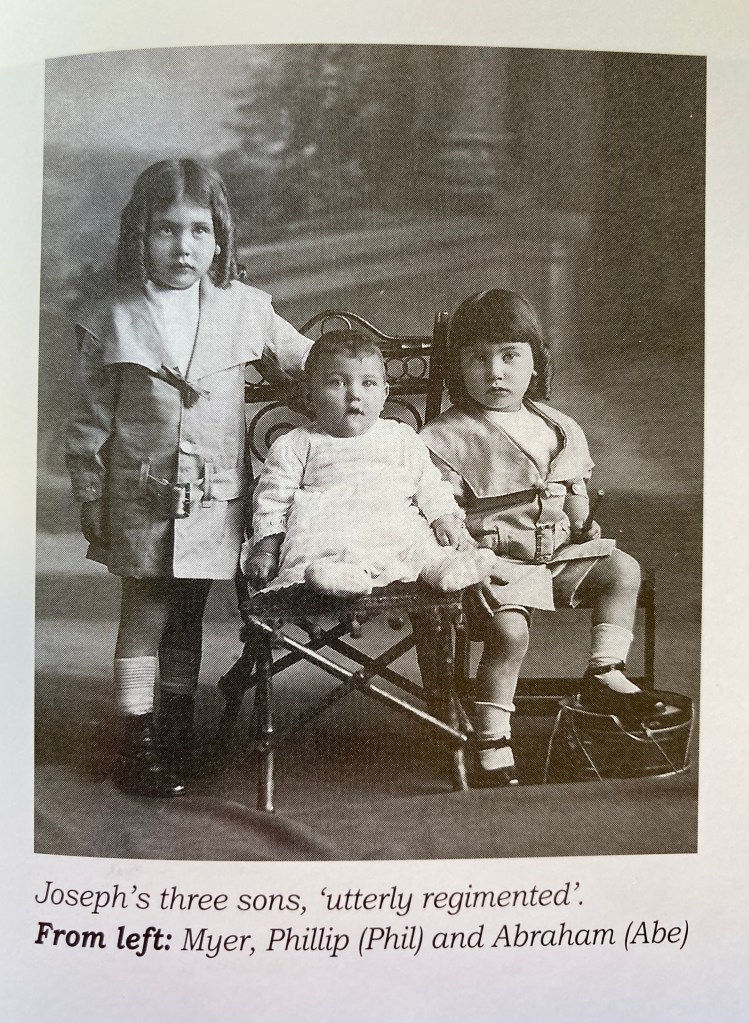
They must have been young when they married. Their first son was born in 1910, when Millie was just 21 and Joe slightly younger.
Millie
Was that firstborn conceived on me? I don’t recall. They had me built to order, me, together with a companion dressing table, two bedside tables and a swing mirror. There was a tall wardrobe too. All of us pieces were french-polished and elegant. We were expensive, craftsman built, well beyond the means of young immigrant battlers. In the dim bedroom of that dark house, we would have shone. Our lustre, our sheen would have declared to the world, these Goldenbergs, they’ve arrived.
How could Joe possibly afford us? The only way I can imagine would be a big win at the trots. Joe had trotters, I recall. I heard Joe confide to his first son, Myer, something that made me think. It was only a snatch of conversation, mind. I could be wrong. Joe told his son how he instructed the trainer on the eve of a race in which his trotter was the favourite, ‘not to wear the horse out’. Perhaps Joe planned for his own trotter to lose – against the odds. Perhaps he bet against his own horse and won big. Who knows?
Joe
In any event, I arrived at that big house at Number 6 Goathlands Street, I and the entire suite. I do recall Joe testing me for structural strength. In case his weight might not have been a severe enough test, Joe lay down together with Millie. That was early summer, I remember. In August the second baby, Abraham, arrived. Everyone loved Abe. Of the three Goldenberg sons, I knew Abe best because he never really left home. I mean long after he grew up and married Clara, he came back to that house, every day, to see his parents. I suspect he came back to bring some comfort to his mother, some softness. Joe was out in the world, Millie at home. Joe would come back home, full of the tensions of the day, he’d shout at Millie. Sometimes I’d hear her cry.
But they weren’t always like that. They had their better times, particularly on a Friday night. Those happier times bore fruit. The third son, Phil, was the last fruit of Millie and Joe. I know: I was there at his conception.
As Millie and Joe aged and as the boys grew up and left home, the big house at Number Six became quieter. The big bedroom where I’d reigned took on the air of a secret place, not frequented at daytime. Grandchildren arrived and explored and penetrated the gloom. Chirping as they approached, they’d enter and fall silent and sneak away. Perhaps Joe had roared at them. I don’t know, I couldn’t say. I do remember Myer’s second son entering one day. He opened the door, peered around and tiptoed into the room. Shafts of sunlight penetrated the gloom, heightening somehow the darkness of the wood, the sense of dusk at noon. He stopped, that skinny little kid, struck by the atmosphere. Was it the unnatural dark that frightened him? Or was it fear of his grandfather? I don’t know. Within seconds he was gone and we of the bedroom suite were alone with our secrets.
Years passed, decades. The three sons married and moved out. Late one night the telephone rang. The telephone was a daylight instrument in those days. A call at night was alarming. Joe answered: Hello! Hello! No! No… I’ll tell Millie.
I don’t know what Joe told his wife. I heard her wailing, saying repeatedly, I wanted to go before her, I should have gone first…
The big house watched Millie and Joe pass into old age. Joe smoked his daily sixty cigarettes and bloomed, while Millie withered from the inside. I thought at the time she was too timid to thrive. Perhaps she was too intimidated to live. Doctors said later that Millie died because her APC tablets destroyed her kidneys. But that amounts to the same thing; Millie needed all those painkillers for the headaches that life caused.
One day the empty old house filled with people. Some arrived early in the morning, big men, hairy, some with black beards, some grey, some white. Lots of sidelocks, big black hats. Joe and the boys – Myer and Abe and Phil – sat on low chairs every morning for about a week. I heard the beards chanting in a language that wasn’t English. Millie was not there. In the afternoon and in the evening the house filled to overflowing, the beards, women in another room, men whom the boys went to school with, even to kindergarten, faces from the early days, the days when Joe and Millie and her large family all lived in North Carlton. Days of richness without money, Abe said.
So many people, I heard crying, laughing, every day for a week. Then they all went home. The house was empty. Joe never slept on me again. He moved to the single bedroom, down the hall. I’d hear him crying in the night.
Then Myer’s second son started coming, Thursdays I think it was. He’d arrive after school and he’d stay the night. They’d sit in front of the TV, the old man and the boy, just the two of them. They watched until the close of transmission, around 10.30. The boy would go upstairs then ‘to study’ he said. And Joe would shuffle around, delaying his own bedtime.
It was good to feel life stirring, hear voices echoing in those dark rooms. I heard him tell the boy how he left school in the third grade to help support the family. We were poor in the old country. When there wasn’t enough food, my father’s new wife would feed her children first. The rest of us would go hungry. I went to work in the Turkish Post Office. The postmaster trusted me. One night I came home with the key to the Post Office. I wore only shorts. The key was big and heavy, made of bronze. I tucked it into my shorts but you could still see it. My father saw it and felt terrified. If anything went missing at the Post Office I’d be blamed and Father would pay. He sent me back with the key. He never let me go back. That’s when I started my own business. I became a watermelon seller. I sold melons to fishermen. I’d swim out into the sea, floating melons before me. Other boys did the same, but I made sure I swam out furthest. I’d be the first melon boy the fishermen would see as they sailed back to Jaffa at the end of the day. I knew they’d be thirsty and they’d pay.
Joe would lament to the boy about Millie. He’d recall old times, their younger days together, Millie’s beauty and allure. She had full, firm breasts…This left the boy lost for a response. I imagine he blushed.
Joe was liberal with his criticisms. He’d tell the boy, It’s a good thing your father is a doctor. He’d be useless at anything else…Then, He’s your father, I shouldn’t criticise him…but he’s my son so I have the right! He’s got no head for business…
There came a morning without words, without any sound or movement. Later there was the sound of a key in the lock. I heard Abe’s voice, Father! Father! There was no answer. I heard fast movements, doors opening, slamming, then Abe’s voice, Father! Father! Speak to me! Joe’s voice never replied. Not long after Myer’s voice spoke: He’s had a stroke, Abe. I’ll call an ambulance.
Silence followed. Nothing was heard for six weeks, then the house filled. I heard voices in all accents, old people, young, children. Crying, praying, chanting, laughing, people talking over each other, people from many places, from many times. People came and came. The front door never closed from early morning to after dark. Then after seven days silence fell.
I left the old house in a van. Together with the stately swing mirror, the bedside tables, the big, big wardrobe and the dressing table, I was taken to the small flat where Myer’s second son lived with his new wife. I was sixty years in the house of Millie and Joe Goldenberg.
Now begins my the next family era. There’s a new Goldenberg couple. I’ll spend the next half century under Annette and Howard. I’ll tell you some of their secrets presently…
“I’m serious, Raph. I see it as a moral test. If I fail it, I’ll realise it’s over: I’ll know I lack the moral strength.”
“What are you talking about, Dad?”
“Simply this. I’m confident my legs are strong enough. It’s my spirit that’s in question: do I have the drive or the staying power or…the spiritual reserve? My fear is I’ll tire and decide to walk, and if do I weaken and walk, I’ll know my marathon ambitions to be vain. Finished.”
“Walking a marathon is nothing to be ashamed of, Dad. Especially at your age.”
”Well, shame might be an over-reaction. But willpower has been my private point of pride. I wouldn’t feel proud if I walked, simply for a failure of will.”
Like every Australian boy I always wanted to shine at sport but, being timid and lacking drive, I didn’t. I absorbed sporting ideals, however. Inspired by Pheidipides I honoured endeavour; with de Coubertain, I decided the important thing was not to win but to try my best. Translated to distance running, this meant not to give up. If I could persist I would win self-honour. Through fifty-five previous marathons I’d gained sufficient self-honour to try a fifty-sixth, on this occasion in Traralgon. But an aged man is a paltry thing and I’m an alert witness to my own decay. This Sunday’s marathon could take me as long as six hours.
(My doubts in mid-2021 arise following twenty months of lying fallow. Covid cancelled all four of the marathons I’d planned to run in 2020. I’m out of practice, trained presently to run no further than 20 kilometres.)
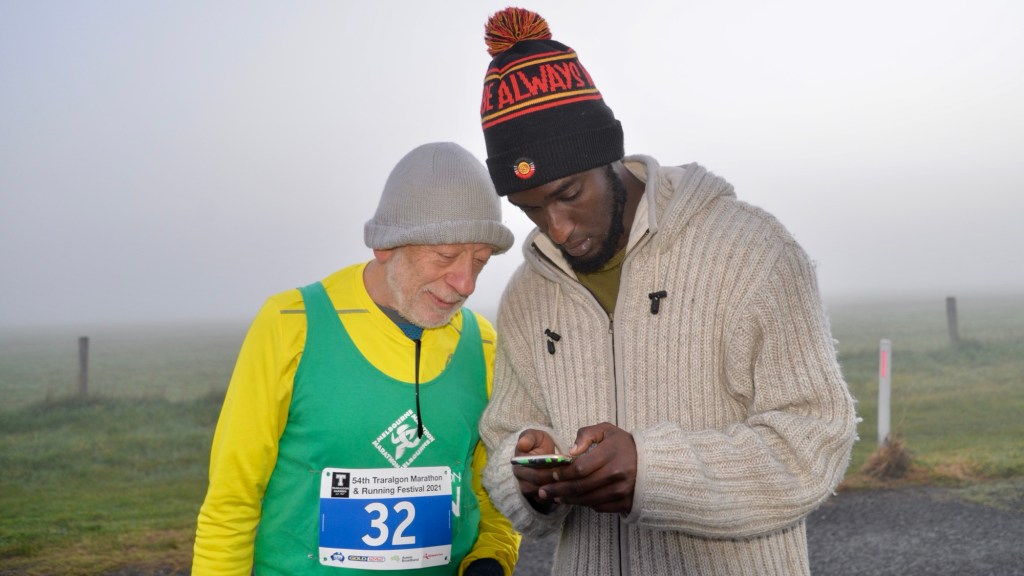
Over the following days the conversation with Raph plays again and again in my mind. Today, in Traralgon, my legs ask their question of will. My Rwandan yoga teacher, Philbert Kayumba, happens to be tall, slim, fit, a gifted distance runner. Phil accompanies me to Traralgon as my support person. Traralgon, I tell him, was the site of my catastrophic first marathon,as well as my fastest marathon.
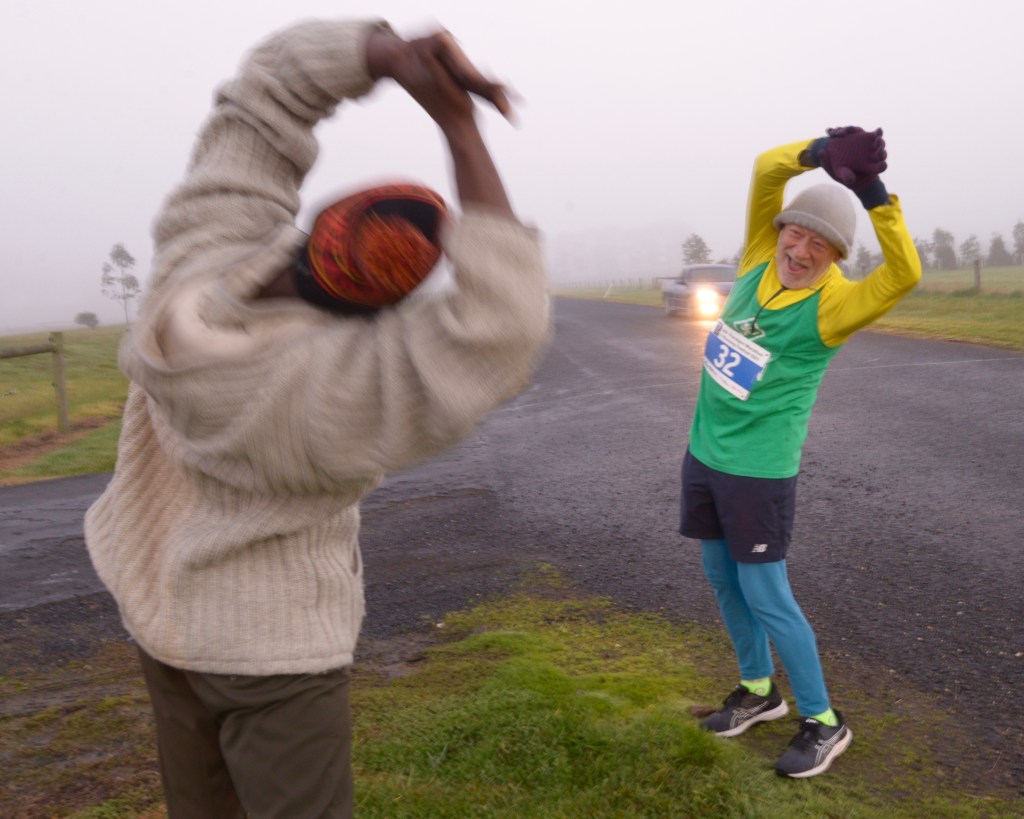
Today events conspire to help me. The good people who organise the event provide a special Early Start for the elderly and the unlikely. The weather forecast is for 1 degree Celsius. The Bureau adds, it will feel like minus1. In the event, the temperature starts at 8.7, rising to a windless 14 degrees at the finish. Gloved and cosy inside my six layers of shirting, I dance up and down skittishly at the Early Start. Phil instructs me to stretch, a religious ritual among runners that has always found me a disrespectful agnostic. Obedient today I do stretch. Colin, a friend of almost lunatic devotion, who has driven three hours through fog to photograph me at this early start, falls about laughing at the sight. He snaps his old marathon comrade actually stretching.
Photo by Colin Hockley
A short young man of rotund build joins me at the line. Luke, meet Pheidipides! Luke’s fist bumps my gloved hand. Good to meet you, Fylopidees! I regard my new comrade. At five foot tall and three feet deep, Luke looks like a serious rival for last place. He tells me his target time is six hours.
The Early Starter arrives late. Ready Gents? Go! The Starter clicks his phone and we go.
Four hours and 46 minutes later, I stop. This is the Finish but it will not be the end. The daunting corollary of gaining self honour today is the prospect of doing it all again in the future.
In the course of those hours and in the passage of those forty-two thousand and 188 steps, Phil drives to meeting points and provides me with drinks, carbohydrates and caffeine, all in calibrated quantities. He keeps up a relentless commentary upon my strength, my greatness. Bystanders cheer and Phil declares, He’s a machine.
During long intervals of running alone I enjoy the feel of the benign surface of this new route. The organisers have improved the long-famed event by routing runners along the Gippsland Rail Trail. The surface of soil topped lightly with gravel is ideal. The earth yields briefly beneath my foot before releasing it with a spring. Or that’s how it feels. Viewing Phil’s video of my old man’s shuffle alters all notion of springing.
Whatever the truth of my running form, Traralgon has provided the kindest surface I’ve encountered in fifty-six marathons, a runner’s benison.
On this foggy morning, Traralgon blesses the route with a shifting curtain, visible but impalpable, of filmy white mist; by turns the mist conceals then reveals the deep green of foliage and the bright green of pastures on either side. I run through a dim tunnel of quiet and peacefulness, faintly mysterious, with intermittent patches of brilliance ahead wheresunshine breaks through. The sights bring to mind the dark tunnels towards bright light described by people who think they have died and who ‘come back.’
Here memories of the lost arise to meet me. I think of Manny Karageorgiou, my friend, officially declared Legend of the Melbourne Marathon, one of only eight to have run every one of the first 41 Melbournes. I ran the fortieth of these at Manny’s side, knowing he was achieving the wildly improbable, Manny having literally emerged from his hospital bed to run. That was a day of glory. I shared the run with my friend, rejoicing at intervalswhen he’d be surrounded by his adoring family, all of them aware that their cherished Manny was doomed. Later that day I joined Manny’s circle of old friends and extended family at his home, where we ate and drank outside and rejoiced.
The agony of their love stays with me.
When Manny set out to run his forty-second Melbourne, he fell early. His nephew and I gathered him, bloodied, to his feet and he shuffled on. Minutes later, when his wife Dmitra sighted him, she gasped, took his arm and led him from the road.
When Manny died the Melbourne Marathon died for me. I never ran Melbourne again.
Phil’s video shows my starting form to be ponderous and stiff, with my neck bent absurdly forward, and my marionette body engaged in endless chase of that pendant head. Yet I know myself to running hard. So ‘fast’ am I, I realise I’m running with calculated imprudence. I’m following my plan to attack the first half of the marathon, to run at a rate I can’t sustain.As I haven’t run further than twenty kilometres in training, there is no pace I will sustain. So I set out at my recently improved training rate of six-and-a half minutes per kilometer.
For the initial ten kilometres I run alone with my thoughts. Phil appears before me on the track, radiating: I’m amazing, I’m looking strong, my form is impressive. In addition to these loving lies, Phil plies me with iced coffee and Black Forest chocolate. To drink without choking I must stop running. As soon as I put my drink down, Phil commands me: Keep moving, Howard. Don’t let your hips seize up. The respite is delicious, the resumption tolerable. Farewell, Phil, see you around 21ks.
Fast footfalls follow me, overtaking me swiftly. A tall male figure floats past, his strides smooth and strong. He’s the leading runner and he looks like a winner. A minute later runners Two and Three overtake me. They too look good. Admiration overtakes envy; such speed, such power and grace! Over the next quarter of the race, I have the opportunity to admire fifty or more runners faster than I. With every passing, runners exchange greetings, acknowledgement and encouragement. None of this is perfunctory. The respect is authentic. A runner knows the truth embodied in every passing comrade.
Keeping up this speed is getting harder. I negotiate with my legs, I put the hard wordon them: No excuses. I know you can do this. My legs plug resentfully on. Happily, every encounter interrupts such conversation. Volunteers cry out my praises. You can do this, they cry, as if they’d overheard my inward address to tiring legs.
Ahead on the track a tall figure waves to me. It’s Phil, meeting me somewhat before we arranged, around 18 kilometers. We’ll run together to the turn at 24 km and then back some distance. By then we’ll have reached 28 kms. Once there, with two-thirds of the distance behind me I’ll feel confident of finishing. It is at this stage that Phil tricks me. He leads me to the half-way and well past it without my realising. Never knowing I’ve reached that landmark, I forget to slow, and, thus deceived, I float on Phil’s oceanof goodwill without self-pity or ruminative arithmetic.
More chocolate, a draught of Coke, a peeled mandarine and Phil is off, leaving me in the company of a tall young woman whom I’ll call Louisa, who’s running her second marathon. Louisa shares my mandarine and keeps my mind distracted,telling me of her mother, who fights her recurrent breast cancer and her rheumatoid arthritis. We’ve gone plant-based and we’ve chucked away all the auto-inflammatories. Mum did a seven-day water retreat and now you wouldn’t know her for the woman she was. No pain, no drugs. Happy.
Louisa appears to be Mum’s sole support. Mum appears to be Louisa’s project. Dad’s back on the farm in Horsham, Louisa’s the carer child. I hear about the five failed IVF cycles. I gave up teachingand became a personal trainer. Did the study and got the qualification. All my work happens in early morning and in the evening. In between I have time for Mum. And this marathon stuff, that’s my outlet. No, there’s no partner. One day, when the stars align, we’ll find each other…I guess.
Arriving at the final drinks station I seize a cup of water and the opportunity for a breather. A voice announces, This is Pheidipides Goldenberg, everyone! Hello Pheidipides. It’s me, Barry Higgins! Huge grins, flesh shakes flesh. You’re going to write about this aren’t you? I nod. I always write my marathon and in Traralgon I send the Traralgon Harriers, who organise the event, a copy for their newsletter. Barry Higgins is the soul of this marathon, having run it more times than any other and having written a fine history of its first fifty years.
A bunch of marginally faster runners overtakes Louisa and me and edges ahead, stealing Louisa away. Left now to my own thoughts, I encounter Temptation. You’re feeling pretty weary, aren’t you?Wouldn’t those legs of yours enjoy a break? A little walk couldn’t hurt, could it?
The voices make sense. But this whole enterprise defies sense. A marathon runner is a grownup child at play. It makes no sense to run where you might walk. But watch the child at play, see how she gambols like the lamb in spring, like a newborn foal. We grownup runners defy sense, defy the years. Our legs remember the joy, the delight, of speed, and our brains, registering effort, imagine the body to be speeding.
My legs have posed their question. Will now responds in the negative. Dreadfully tired, I know I’ll not yield. I run on, tearful now, and joyous. I’ve passed my test. The sun shines, the mist has risen. I’ve removed layers of clothing as I’ve warmed, handing the sodden garments, one by one, to Phil, who bears them away. He reappears now, a beacon. He’ll run me home.
I run, awash with feelings of love and thankfulness for strength, for friendship, for the volunteers, for liberty, for this window in the pandemic, and for health. Especially for health. During the past week a message comes to me from Leni, Manny Karageorgiou’s daughter, telling me of the little boy born to her, whom she named Manoli in remembrance of Manny. Manoli is now aged three. He has been diagnosed with neuroblastoma, a rare and wicked malignancy of childhood. Manoli’scancer is Stage IV. In footage of Manoli, I see him gamboling for the simple joy of movement. His head is smooth, innocent of hair. When I report all this to my wife, my voice fails me. How is it I am so blessed while others must suffer?
The world smiles upon me as the distance to the Finish shrinks beneath my feet. Phil at my side, in my ear, sings his song of faith. You’re nearly there. Only two kilometres now. You’ve done a mighty thing. You’ve inspired me. I’ll run it myself next year. Keep going, Howard, keep it up. You’re running so strongly. We reach the final turn from the rail trail to the bitumen. Minutes later we come upon vehicles parked at the roadside. The Finish is just a few hundred metres ahead, at the top of a little hill. A hill! Read hell, not hill. Phil’s voice whispers a final blessing: I’ll leave you here, Howard. Only thirty metres, now. The crowd loves you.Go!
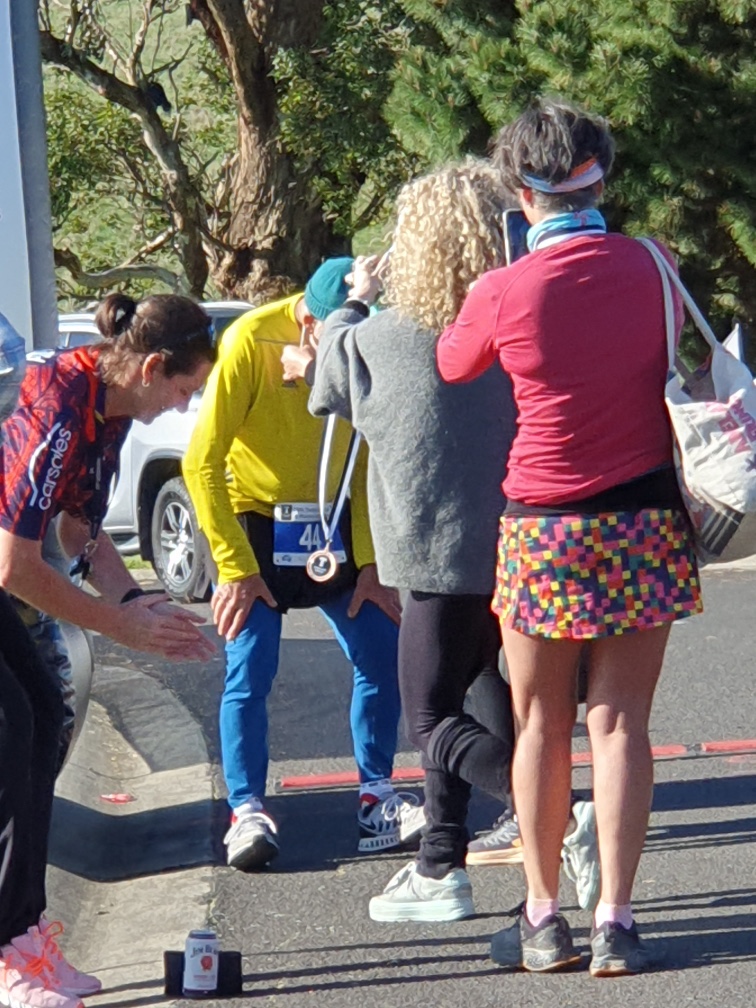
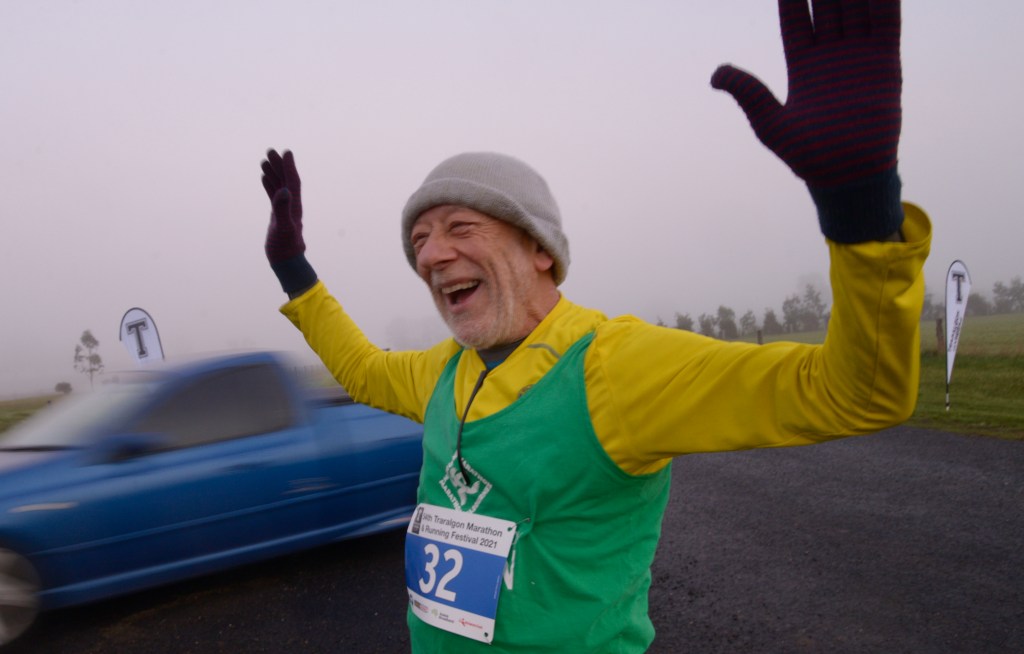
I go. The crowd does indeed care. They cheer as if I, Pheidipides Goldenberg, were their own. These people – runners long-finished, wearing their medallions, runners’ support persons, volunteers, organisers – these people have one voice that cries, together with Pheidipides of old, ‘Rejoice my brethren, ours is the victory!’
Photo by Colin Hockley
Footnotes: 1.Watch Phil’s video. I watched it and learned to respect my own absurdity.
The mother whom you are about to bring into being feels a pain in her belly. Your birth was due a couple of days ago but it doesn’t occur to the woman that she might be in labour. She phones her father, a doctor, soon to become a grandfather.
Dad, my tummy hurts. It’s been hurting all day. Could it be gastro?
Darling, you are pregnant. You have reached full term. Unless you have diarrhoea you’re probably in labour. Go to hospital.
The date is November 11, a date already doubly and indelibly significant for Australians. It’s the date you create a mother, a father, three grandparents, a great-grandmother, uncles, aunts, great-uncles, great-aunts. It’s the date you change our world.
All day you knock at life’s door. Day becomes night. In the Delivery Suite your mum-to-be squats and strains. In an adjacent waiting area, dimly lit, your yogi great-grandmother-designate squats and bears down, trying to birth you at a remove. The soon-to-be grandfather consults his wristwatch. This climactic second stage of labour has become prolonged. He knows a lengthy second stage imperils a baby. He sends a message to the obstetrician: Would you like an extra pair of hands in case the baby needs resuscitation?
The specialist says yes.
I enter and not long after, the door of life opens to you. You and I meet. You need no resuscitation. I hold you and I introduce you to the mother whom you have brought into being.
Thirty-six hours later I’m gazing at you, just a baby. You lie inside my pink cap. I’ve seen hundreds of babies, I’ve delivered hundreds, every one of them a miracle, every one of them scrutinised for irregularities by a clinical eye. You are no less imperfect than those hundreds. You are skinny, you look like an empty sock, your face isn’t quite symmetrical.
But some event or process, something visceral, something cosmic perhaps, is taking place and I am transmogrified: I am a grandfather; I love you. What is this joy? Your fingers curl and close around my finger and you grip me.
On the eighth day of your life you rest on the lap of your great-grandfather, I remove some skin and bring you into a Covenant. A drop of wine pacifies you. Your tribe jubilates. We know our long back story. Behold you! We see you and we behold our futurity.
Years pass, your parents send you to this grandfather to learn rituals, traditional melodies, ancient texts. At thirteen you are barmitzvah. Once again your clan rejoices and this time you can share it. You sense the power, the force field of love that is your extended family, the depth of our feeling. Profoundly you know belonging.
Life takes you through ups and downs. At eleven you walk with me, up, down, up and again down, to a distant lighthouse. A boy who buries strong feelings, you struggle and you achieve. You declare, I love you Saba. Later you say, I’ll bring my kids on this walk. And you add, I love you Saba.
Six years later, life is still up and down. We do that same walk again. This time it is the boy who stops and waits, and allows an aging Saba to catch up. Your words are few but they have not changed. The miles, the steeps, the struggle weld us once again.
This week you sit your last school examination. Your schooldays are behind you. We behold you, the first of your generation. Eighteen years have passed, enriched and intensified by your being. Eighteen years ago you gripped me, never to let me go.
I write to you from quarantine. My wife and I have been ordered to isolate ourselves.
Old friend, you and I are old. We have passed the threescore and ten years of the Psalmist. A short time ago we were heading confidently full steam ahead for one hundred. So we proposed. So life seemed to promise. But now, this virus.
Man proposes, Virus disposes. The virus has disposed of thousands. In Spain overnight, three hundred. Overnight in Italy, 800. I’ll write that more plainly. Three hundred persons. Eight hundred persons.At the start of the year all eleven hundred would have been steaming ahead. I imagine them looking confidently to the future as recently as the start of the month of March. By the close of the equinox all were dead. Few will be those who follow their caskets to their burial.
While going about my work in the past weeks I’ve found the most worried people have been those with the least to fear. Young parents have been terrified for their young children. Truly that suffering has been unnecessary. For most people younger than forty, COVID-19 is a milder illness than the ‘flu. I have heard of no deaths of children anywhere in the world. That should bring blessed relief, but although those facts are widely known, the fear for their young extinguishes parents’ peace of mind.
Curiously, we old ones need fear not so much for our young, as from them. The theory runs that children are unhygienic creatures that act as vectors for this novel virus (they certainly do that service for the influenza viruses), and they endanger and infect us older, more vulnerable subjects. That is why I am writing.
If you are over seventy, go inside now, close the door. Shun your children, ban the grandchildren. Ours is the age group in which most of those hundred of persons died. Ours is the sector at greatest risk of the pneumonia that fulminates and kills. Ours is the group who will not receive respirator treatment and Intensive Care when those services are rationed.
This is cautious advice that might later be seen to be over-cautious. As the W.H.O. Chief of the Ebola response advises, ‘Go early, go hard’ when it comes to responding to pandemic. There will be no second chances for us once we catch this catchiest of germs.
My wife and I passed a weekend of grotesque denial of the love between us and our grandchildren. Encounters were fleeting, spatial remoteness was enforced, no-one kissed, no-one cuddled. Time and again, puzzled children approached instinctively, loud voices repulsed them. Astonished, the children felt every instinct of love denied; and the deniers were precisely those wrinkled figures who ever doted and dandled. Suddenly loving behaviour was wrong.
My resolve wavered. My wife, the softest being in our family constellation, commanded austerity. One of my children has a newborn; we cannot visit, cannot cuddle, cannot relieve exhausted parents at 2.00 in any morning. Our daughters, both recovering from surgery, wait on us, rather than the reverse. The fibres of parenthood are warped and strained by fear of a new virus. And it is precisely those deprived adult children who direct us: go inside, stay inside, keep the world away. ‘‘We’d sooner miss out on you both for weeks or months than miss you forever.”
Old friend, I won’t be with you this Friday for lunch. We won’t see each other at the coffee shop in the mornings. Our house of worship is forbidden to us. Seeing each other as faces on a screen is a cold change after years, after decades of warm touch. I don’t know when we’ll be together in those old ways again. I reckon our best chance of those old pleasures again, some day on the far side of this fear and horror, is cold resolve today.
In a tsunami of reports about health, that arrive in an age of anxiety,
in a rising ocean of uncertainty
that’s inundating our islands of calm, while families driven from Idlib watch their babies freezing to death for want of shelter,
as oil becomes cheap,
as savings are savaged,
as panic feeds on panic,
as the old lack all words to comfort,
as the young tremble for the future,
as the future overtakes the moment – some thing good,
some moment of balm, some relief, an inlet, a lagoon of quiet joy: this baby this entire new person this changer of lives three kilograms and a handful of grams – of life
make her great-grandmother squeal
and squeal again, and again
with astonishment
Nana, surely you know by now, babies are born!
Nana, you had two of your own,
They each had three of their own, The day came when those six
Brought forth babies of their own.
Nana, why do you squeal,
what’s to astonish an old lady of ninety-three?
A baby, that’s to astonish
That’s to amaze, to heal, to comfort, to inspire,to thank God –
I remember you today, Den, with the candle burning and with the prayers of mourning.
I remember you in our boyhood home in Leeton, where a life of risk called you always, and you’d drag me and I’d follow, with terror and tremor and delight. I remember you taking me into Dad’s Surgery, that forbidden room, where the ever-present smell of anaesthetic ether warned a boy of the consequences that would follow. You found Dad’s blood pressure machine and you showed me how you could squeeze the rubber bulb and inflate the bladder. You kept showing me, squeezing, pumping, and the mercury climbed above 200, 250, 290, until the bladder burst, and liquid mercury ran everywhere.
When you were eight you decided we should pay a visit on Miss Paull, my teacher, Leeton’s aristocrat, in her residence at the Hydro Hotel. I followed you up the long hill. I followed you up the sweeping drive. Bold as brass, you announced to the man in the black suit, who opened the door, ‘We have come to visit Mis Paull’, and the man showed us in, and Miss Paull emerged, all white and willowy and English, and she said, ‘Good morning Dennis, good morning Howard, how utterly delightful that you should come. Please join me for morning tea.’ And the man in the black suit sat us down and spread white linen squares over our laps, and I was in heaven, nearly wetting myself in excitement. On the way out you heeded the call of your own bladder and you peed on the Hydro’s flowerbeds.
I sit and I remember you, my big brother, how you protected me when we were small. I remember, when I was fourteen, Dad summoning me to the forbidden room and sitting me down for a serious talk. The tremors again, but this time I wasn’t in trouble. Dad said,Dennis doesn’t have as easy a path in life as yours.
I didn’t want to hear this because I knew it to be true.
Dad continued:I want you to help him.My heart sank.
I did try, Den, but I lacked your boldness. When I saw other children bullying you I died twice. Others, children and adults and old people, loved you and cherished you, for the beauty of your soul, for your generosity.
You loved music with the abundance and the zest of all your loving. I remember you in ICU, in the room of your dying, and you lying there in your coma. Annette, your sister in law, played a Mozart CD for you, and you lifted your arms and you started to conduct. I hope that beauty stayed with you as you slipped away, Dennis.
It’s the 18thday of the month of Ellul, Den. I remember you and I miss you.
They sayFathers Dayis the invention of the people at Hallmark Cards. That doesn’t make it a bad idea. If someone told me Hallmark had just invented the wheel or the toilet brush or brotherly love, I hope I’d give those ideas worthy consideration.
Noit’s not Hallmark that’s my problem. (And Idohave more than one problemwithFathers Day, none more pressing than where to place the apostrophe. I have every confidence I’d dispute whatever verdict were chosen. You only have to look at this paragraph to see I like theapostrophe,I cherish it and I bewailits*public fate.)
When the first Sunday in September dawnsno-one feeds me breakfast in bed, no-one buys me neckties or self-help books orDIYapparati. And I never did any of these for my own father. (Well, almost never: when I was five my elder brother spent five shillings on a largetea cupfor Dad, which we presented as a jointFathers Daygift. The cup showed a man seated on an easy chair and smoking his pipe. Dad didn’t smoke and never drank tea. He held tea to be addictive,correctly so. That, after all,is its beauty and its purpose.)
Breakfast in bedcould not have enhanced the love that existed between my father and me**, nor would it have reduced the painmy brother and my father experienced in their ownsharedloving.
My own children accept my distance fromFathers Day(as fromMothers Day). They see it as just another eccentricity of their wilful father. Seven hundred telephone calls per annum from my children to that difficult father say all that needs to be said.
Numerous earnest homilies (‘Slow down, Dad’; ‘Don’t you think it’s timeyouworkeda bit less?’ ‘Have a good run, Dad, and don’t come back dead’; ‘I don’t want you riding your bike at peak hour, Dad. Ifanythingever happened to you…’)
Well of course one daythe anythingwill happen to me. And as far as fathers go, I’ll go happy, well fathered and well loved by those I’ve fathered.
Nowadays my children have their father on Brain Watch. About time. And one single day a year would not suffice for the purpose.
Note*: no apostrophe.
Note:** It took me 220 pages to sketch the love between my father and me,in ‘My Father’ Compass’ (Hybrid, 2007). A young man approached me after reading the book. He said,‘Ialways wanted to bea lovingfatherandno-one ever showed me how. But when I read your bookI knew.’









 howardgoldenberg