Virgin from Christmas Island to the Mainland

A man walks into my consulting room with a bouncing limp. He is tall and upright. He bows slightly and shakes my hand. The familiar courtesies.

I greet him: Salaam Aleikhum.

He responds: Aleikhum Salaam.

We exchange names. His name is Ahmed. He says: “My foot is painful. Please excuse me. I am afraid I must remove my shoe.”

His problem is visible through an opening in his sandal: the left great toe is infected. The flesh of the nail bed is hot and red, a crescent of swollen skin surrounding a sunken island of nail. The skin is shiny, stretched to bursting. A promising eyelet of pus peeps from beneath a corner of the cuticle.

The infected nail bed is about to burst in a flow of laudable pus. The pus will stink, Ahmed will feel better and so will I. Finally, a patient telling me a straightforward story. Finally a patient I can cure.

I treat the infection, dress the toe and ask Ahmed to return tomorrow to renew his dressing.

“I cannot come tomorrow.” His manner is politely regretful. “I will leave here tonight.” He speaks softly, practicality competing with swelling happiness: “I have my visa.”

Ahmed’s smile is a field of waving daffodils.

As it happens I will fly out tonight too. After three weeks of seeing patients here, Ahmed is the only one I meet to win a visa. The remainder reside in trailer parks of hope and despair.

Continue reading

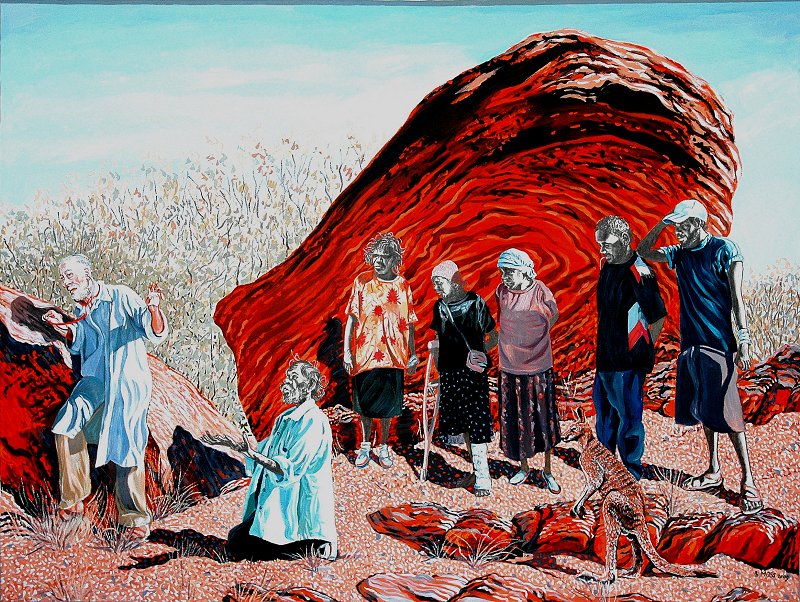
Rod Moss and “One Thousand Cuts”

Rod Moss is a Ferntree Gully boy, a whitefella who found himself in Alice Springs thirty years ago and who stayed there.

In all the moral disorientation of the Centre, in its beauty, its grandeur, its squalor and its mystery; in the perplex of making and losing marriages, of fathering, of teaching, of reading deeply, of engagement with the dark cinema of darkest Europe, Rod Moss found friends in a clan of blackfellas living in Whitegate, one of the town camps.

Moss differed from most of us whitefellas who come to the Centre. He stayed. He painted (in a distinctive genre of his own creating) the lives of his friends. And through all the years of his staying and his painting and his friendships, Moss kept a journal. That journal gave birth to his first book, “The Hard Light of Day”. The book won the Prime Minister’s Prize for non-fiction. More significantly, the book won the praise of Ray Gaita, who described it as one of the best books he had ever read.

When I say Moss found himself in Alice Springs, I mean he found himself in ways most of us non-indigenous people never do: he found who he was, what he was doing here; he came to be in country.

When I say Moss found friends I also mean he lost them.

Those losses are recorded, drop by drop, blow following blow in Moss’ first book, and in the second, soberly titled, “One Thousand Cuts”.

I believe that in its swelling lament and its growing clarity, “One Thousand Cuts” surpasses even “The Hard Light of Day”.

In a remarkable sequence of events “One Thousand Cuts” will be launched at Readings in Carlton on Wednesday 9 October at 6.30pm. And a retrospective exhibition of Moss paintings will be opened at Anna Pappas Gallery two days later.

If Moss’ paintings are luminous, his writing a prolonged jazz riff,  the photographs are something else.

I invite readers of this blog to attend one or both of these events. I will be glad to see you.

Podcast of interview on Radio National with Waleed Aly, Howard Goldenberg and Rod Moss 8.10.13image

The Preacher of Princes Bridge

You see him on the bridge when you pass among the midday crowds. Alone among the moving multitude, he stands stationary, his voice raised as he addresses us. In his hands is a slim black volume with cheap plastic covers. He reads, rather, he declaims from this book words of prophecy and of admonition.

The preacher’s voice is thin and high pitched, too feeble an instrument to serve his purposes without help. He augments the thin piping of his voice with a little microphone which emerges like the head of a small serpent from somewhere near his collar. The serpent’s head stays firmly in place within cooee of the preacher’s mouth, a mere kiss away, without visible support.

Assisted by this miracle, the preacher delivers his text. His voice starts high and ascends higher. The higher it rises, the softer it becomes. Eventually, the voice reaches its zenith where all sound ceases, then it falls again to shoulder height to begin the ascent of the next phrase.

Alone among all the movers at noonday, I stop to listen and to learn. Continue reading

Monanism

English: MONA - Hobart, Tasmania

English: MONA – Hobart, Tasmania (Photo credit: Wikipedia)

MONA is the Museum of New and Old Art in Hobart.  All of its promotional materials are written with tongue lodged firmly in cheek. One such refers to Monanism, a play on Onanism. This in turn is named for Onan, a figure in Genesis whose wife had suffered bad luck with her previous husband: he went and died on her. Onan decided to prevent pregnancy. He did this by spilling his seed on the ground, at once giving rise to the eponym and leading to the naming, some three millennia later, of a parrot in the USA. (Onan the parrot belonged to Dorothy Parker, who named him thus because the bird too “spilled his seed upon the ground.”)

MONA is remarkable. Submerged in a hillside it is a museum without windows. Visitors are entombed for the duration of their visit. Dominant themes of the artworks are sex and death. All this might warn off a visitor, suggesting a visit will be a dark or morbid experience. This in turn is the museum’s little joke at its own expense, an instance of Monanism at play.

Cynics who view Hobart as Australia’s petrified forest – views that are themselves stale and petrified – simply feed into the joke and the pleasant surprise that is MONA.

We* visited MONA yesterday. It is fabulous. The entire experience is exciting, playful and confronting. To remark that the collection is eclectic is to discover how inadequate and weary is that term for artworks that range in date from antiquity to today, to tomorrow. And to some time well beyond tomorrow.

My two favourites are Arthur Boyd’s “Melbourne Burning” and another work, commissioned for MONA and titled “Untitled”. This looks like a giant spud; it’s about the size and shape of a Morris Minor motor car, and like that vehicle, it has small windows through which you can peer into the interior. Here, red apples fall vertiginously from the grip of finger-like branches at eye level towards small wells, or open cupolas, containing water. The effect is enchanting, both magical and charming. And mysterious. I looked and felt as Moses might from a mountain peak in Moab: I could see but never hold a view of endless allure and promise.

(It should be obvious that I cannot recall the name of the artist; it’s an Armenian name. Like his work, he remains untitled…)

Boyd’s “Melbourne Burning” recalls a work by Breughel the Elder. It expresses the artist’s mixed up, unnamable and profoundly distressed reactions to WWII. In the painting life both destroys itself and asserts itself in grotesque and cruel ways. I have not been moved so strongly by a work about war since viewing Picasso’s “Guernica” in MOMA (no relation to MONA).

My mind exercised itself throughout the visit. Tracey Moffatt’s mixed painted and photographic work is as brilliant as anything there. This Aussie artist (of mixed extraction, including Aboriginal) stands as a peer alongside any of the ambiguists and tricksters at MONA. Her work, “Something More”, seeks to confuse meanings – particularly of cultural identity – by emphasizing its own ‘fakeness’. (Wikipedia)

In my experience, culture is very hard on the feet: a trip to an art museum always leaves me footscore. Not so at MONA.  The experience set my mind to dancing. But my feet feel fine. [Unlike old Onan, who, soon after his marriage, left his bride a widow once again (See Genesis, 38, vv 1-10).]

*This blog has a spouse who accompanied me to MONA.

How Many Camels?

I
How many camels will you take for your daughter?
Not such an unusual question in the Gulf perhaps, but on the deck of a
large passenger ship bound from Genoa for Fremantle, it takes Herbert
unprepared.
I will give you ten camels. What do you say – ten camels for your daughter here?
The man indicates the elder of the two girls.
Herbert looks at his girls. He looks and sees Helenka, his firstborn,
an elf flitting and dipping at will as she plays with Masha, who is
not yet ten. They are playing with their dolls.
At this lull in adult conversation, Helenka looks up. She sees no sign
that she is the subject of the stalled conversation – nor an object.
She takes Masha’s hand and pulls her across the deck to play
hopscotch.
The stranger is watching too. His appraising eye follows the movement
of the elf as she leaps and glides at hopscotch. He sees slim legs
flashing, a hint of fulness at the hips. He looks at the child – a
question still unasked, sees womanhood – a trader’s answer.
The stranger takes Herbert’s silence as rejection of an insufficient
offer. He speaks again: Twenty camels then. What do you say to twenty?

II
In his little dress shop, Herbert is in the clothing trade. Fort
Street, Fremantle is not a chic address, but his clientele is worldly
enough – they come from all corners of the world: in the course of
their escape to Australia, to Fremantle, they have seen the worst of
the world.
Worldly – and fussy too. Never mind the quality, is it cheap? Never
mind style, what’s the price?
But Herbert is worldly too. He understands that his heavy accent is
not a marketing advantage, but that a pretty face and a winning manner
might be.
His older daughter is worth twenty camels: this is Helenka whose face
might have launched so many ships of the desert. So, every day, after
school finishes and on Saturdays, Helenka works as a marketing
advantage in the clothing trade.

III
A couple comes into the shop. The lady has little English, has brought
her man as interpreter. They converse in a Slavic language, which the
marketing advantage happens to comprehend. Helenka shows a seemingly
intuitive understanding of the lady’s needs and her budget. She
selects and shows the lady dresses which cost no more than she is able
to pay. No more, but scarcely a penny less. The lady makes her
purchase and is content. Her bored interpreter notices the imminent
woman inside the child’s school uniform, and loses his languid air.
The child is the only person in attendance and his hungry eyes take it
all in.
A week later, the couple returns to the shop, this time as last time,
well after school closes. The lady needs her new dress altered, which
is quickly arranged. Hungry Eyes is not quickly ready to leave,
however. He chooses dresses, brings them to the young shopgirl, makes
slow enquiries, appears very interested but makes no purchases. He
says he will think about it.
I come again back, he says.

IV
Here in Australia, people are slow and casual. Herbert and Alida are
intense and restless. After a short time, they open a second shop,
this one in Station Street, Fremantle. They still live above the Fort
Street shop. Alida has newly-arrived cousins, fresh from Europe. They
have no home and no income. Alida and Herbert install them above the
second shop, where there is sufficient space for the cousins to live,
and to sew dresses for the shops. Now the newcomers have both a home
and a business.
Freda runs the Station Street shop and it consumes her.
Herbert is an early riser. Each morning he practises yoga, standing on
his head for up to an hour at a time. During this time, his scrotum is
suspended upside down, practically weightless. At all other times, he
feels its full weight and urgency. As soon as Helenka returns from
school, she takes over in the shop from Herbert and he is free to go
elsewhere and attend to his urgency.
And above the shop, Helenka’s mother, back from Station Street,
mothers Masha, washes and cleans, and cooks for two households. Soon,
more cousins arrive in Fremantle, then more, washed ashore, wave upon
wave, generated by the after shocks of Europe. Alida helps them all,
feeding as many as will come and eat.
At such times, Helenka is alone in the shop. She is alone when – true
to his word – Hungry Eyes comes again back.
He asks for an item of apparel which cannot be found on the racks in
the showroom. Helen says she’ll go and look for the item in the
stockroom. She is taken by surprise when Hungry Eyes follows her
there. She turns to explain that he can wait in the shop – she will
bring it, but he moves forward, keeps on moving until he has backed
her against the back wall. She discovers then, as his body rubs
against hers, upwards, downwards, forwards and backwards, that he is
just like her violin teacher back in Hamburg: he is a rubber. At least
he is not like her French teacher, not a feeler.
She is not surprised when the rubbing abruptly stops, nor by his
moments of gasping, nor by his rapid retreat with that funny gait.
And she is not surprised when he comes again back, again.
For his part, Hungry Eyes is most surprised by the large Alsatian in
the stockroom, which Helen has borrowed from the Greek boy next door.
And when the Alsatian snarls and bares large fangs at him, Hungry Eyes
runs, with very efficient gait, from the shop and does not return. Continue reading

A jury of his peers: twelve good men and true

On the third day it is not difficult to find a seat in the courtroom. The crowds that spilled and filled the streets on Monday have stayed away. I sit in the back row of the rectangular courtroom. The presiding officer in his traditional robes and the stenographer and the sheriff occupy the frontmost places. They sit facing the barristers. At their left sit the jury, two rows of mature faces and bodies, leaning forward, held tight in attention to every word and gesture. Serious people, taking their serious duties seriously.  Opposite them, the defendant is seated so far to the left of the court that I can see his profile from the very back.

The defendant sits alone. Neither relatives nor his lawyers are at his side. Unlike his clansmen present in court, he is thin, with the body and bearing of an athlete. With his crown of tight black curls he might be an ancient Spartan at an Olympic Games. His full lips are a cherub’s. Lean and triangular, his not very black face is a wedge of concentrated intent, sharp enough to split the phalanx of jurors opposite.

Along with the judge, the lawyers are the actors here. They speak only sufficiently loudly for the judge and jury to hear. They stand with their backs to us, their quaint wigs and heavy black gowns somehow not absurd. They address witnesses gently, their speech respectful, patient even in cross-examination. On March 7 last year, how did you spend the day? What alcohol was it you were drinking? What time in the day did you begin to drink? Do think you were affected by alcohol? ‘Little bit drunk, not full drunk’: can you explain that to me? I see – full drunk means you lie down and fall asleep. So, on that day you were not full drunk?

Due procedure, due ceremony, due deference: a man is on trial for his liberty; a man, a citizen, a human being.

Seated next to me is a spherical lady who might be in her thirties. I ask her does she know the defendant: I’m Liam’s aunty, she whispers.  In Alice, in Yuendumu, avuncular status might make you closer than a parent – or precisely the opposite, your foe.

But Aunty’s bearing is not hostile towards her nephew.

Clustered in the row in front of ours are half a dozen more who would be relatives and supporters of the accused, men, women, two children. Even the children are quiet, church-quiet, respectful to the rituals.

Continue reading

The Work is Great

After I failed to save his aged father from the march of time and a
meeting with Mister Death, I met a secret Australian hero. His name is
Don Palmer.
Don is a passionate man. He used to work for God.  His job as a
minister of religion offered good prospects for long-term employment
but the Boss was a perfectionist and Don left.
He retired and set up an organization called MALPA. Malpa aims to
create change in indigenous communities by harnessing the energies of
the young and the authority of the Elders. One of its projects is the
Child Doctors initiative, an idea that Don pinched from remote
communities in Peru, as well as other spots on the globe not well
favoured by health services.
The initiative is brilliant. I describe it in my forthcoming novel,
“Carrots and Jaffas” (watch this space): small children are selected
and licensed by elders to receive and transmit health and hygiene
messages to their peers and families.
The personnel are blackfeller kids; no whitefellers get rich, none are
overpaid in Don’s program.
Don visited Utopia – birthplace of the Aboriginal art movement that
has beautified our lives and put Australia on the world map of modern
art.
The art is beautiful, the conditions that Don saw are otherwise.
Don writes (in part):

Dear Friends

I have just returned from Utopia. The name Utopia is an Orwellian joke, surely.
What I saw is a national disgrace.
In tiny communities the sewerage is not being collected by the
council. It is thought to be as punishment for
people like Rosalie Kunoth-Monks and her mob trying to stand on their
own feet. She says this is “slow genocide”. With naked children
playing where the septic tanks spew out across the land around their
hovels it would take a brave person to say she is wrong. Except it is
pretty speedy genocide if my knowledge of the effects of hookworm is
anywhere near correct. Some children played in urine soaked t-shirts.
Meanwhile our PM appears in a
star studded media event declaring her love of Aboriginal people and
the Close the Gap progress.
Some said that the Labor party is spooked by the
mass black vote for the CLP and will shamelessly try to parade their
“sincere concern” – according to the bloke we stayed with in Utopia –
Gary Cartwright, an ex Labor politician in the NT. He says he could
not bear to vote for Labor again.

Those at the impressive health clinic are delighted we (ie Malpa) are
going to be involved.
They have been impressed with the effectiveness of the traditional
medicines that local people use.
So much so that they have started using themselves.
A meeting with the local school principal also elicited support. She
has 17 micro schools to manage.

Rosalie and her children are truly incredible. I am touched that they
are choosing our Young Doctor project to respond to the horror that
her mob faces daily. I feel confident that they will capably make this
their own and drive it through.

Rosalie is hopefully getting approval from her Elders Council on
Monday. To work well the project requires local capacity. I am
delighted to say it is there.

At the little place we stayed in  there
was a tap at the back with a thick pipe
running off it. This was the water supply for about 50 people who
lived in the grass on a fifty meter radius off the back veranda. There
was no electricity, but they would sit around fires singing gospel
songs. I wonder what they were
thanking God for?

At one point Rosalie introduced me to a Senior man with the words “His
father fought for this country.”
I quickly calculated his age and assumed she meant WWII. I said to him
“World War II, like my father?” Rosalie quietly pointed at the earth
and said “No, THIS country”.

[Interesting side bar.

My “daughter” Nora Nelson Jarrah Napaltjarri discovered that the
Supreme Court, where her mural graces the foyer floor, has been
selling a range of products using her design but without consultation
or royalties! The highest court in the NT abusing the Federal laws
about Indigenous
art! She is very cross I am helping her pursue the matter…]

Don

Don Palmer’s Malpa project runs on donations, largely from
Deutschebank, a foreign concern that is very concerned with our own
people.
If you google “Malpa – Australia”, you’ll learn more about their
projects to improve child health in remote indigenous communities. It
would be a hard old stony heart that is not moved by what Malpa does.
As you read you’ll learn more about Don Palmer, a whitefella who is
doing our job outback.

The work is great and the time is short: it is not for you to complete
the work but nor are you free to stand aside from it (Babylonian
Talmud).

I don’t believe Don would be offended if any reader of this decided to
make a donation.

Howard

Broaden the Intervention?

I am working in my general practice in the CBD when the phone rings. The receptionist’s voice is urgent: Howard, there’s a man collapsed outside on the street. Can you go?

I can. Grabbing a few tools, I race out into the street where a small crowd is gathering around a man in a suit. He lies flat on his back on the footpath outside the bookshop. Behind his head is a cylindrical object in a brown paper bag. Liquor leaks through the brown paper.

The man lies hard against the foot of a large window displaying the cream of our written culture. The man would have leaned against the window for support, fallen and stayed where he fell.

The man lies, motionless. The authority of my stethoscope opens a space for me between spectators, ambulance callers, vociferous suggesters, silent gawkers, head cradlers. The stethoscope reassures, the suggesters fall silent.

The man we all regard, the man we all fear, does not respond to questions. Nor to deep pressure of my thumb against his forehead. He lies insensible in Martin Place, grunting his shallow breaths, creased face purpled and puffy, grey hair, grey suit awry. Beneath my finger a thin pulse beats, fast and feeble.

His breath is a brewery. The wrist in my hand is criss-crossed with ancient slash marks, white against ashen skin.

It is 10.00 a.m.

This is a human person of my age, nameless to us, nameless to himself, his being reduced by alcohol and secret griefs.

The ambulance arrives and I go back inside.

*** Continue reading

Hungering, Christmas Island

Something is wrong, something is upside down. The hunger striker and I stare at each other from opposite sides of a scaffold that neither of us constructed.

I follow the protocols, which are wise and worthy. But it is all wrong, everything is upside down.

My job is to work to improve or protect health. I have to find a way, to create a language that the patient and I will share; to locate and level the place where we will meet.

This contract is not spelled out nor ever inked; elsewhere there is no need. The patient is here, I am here, we can get down to work.

But when I attend the hunger striker all of this is inverted and twisted out of shape. The person whom I attend is not a patient: the person gives no sign, has no wish for my attention.

The non-patient never called me; I am a part of the system that he imposed upon first; now the system imposes me upon him.

The non-patient and I have opposite wishes: mine is to protect life and vital organs, his to destroy them.

The generality of patients whom I see here in the Detention Centre come to see me on my own territory; I mean the clinic. But the starver is weakened, usually lying in his room in the Compound which is located behind high, stout electrified fencing. The nurse and I walk along long corridors without natural light. Serial serious doors unlock to admit us and lock again behind us. We emerge into sunlight in an expansive open area, surrounded by discrete bedrooms for two persons.

Continue reading

Don’t Vote

Student demonstrators of the May 4th Movement ...

Tiananmen Square in May 1919. (Photo credit: Wikipedia)

Don’t Vote, It Only Encourages The Bastards

When I first saw that bumper sticker message I thought it was funny. Now it seems a fair comment on Australia’s elected politicians.

In Australia the law obliges me to vote; in most other places voting is optional. The alternative to voting is to take the chance that others will do so and they’ll elect the wrong bastard. If a relatively small number of passive non-electors had gone to the polls in Florida eight years ago, this planet might now, under outgoing President Gore, be on the road to salvation.

This coming week voters in the elections that really matter will or won’t encourage the bastards. An act of God, Hurricane Sandy, has done what a thousand PR people couldn’t do: it has made Obama look like a president. Looking like is the thing in western elections, is more influential than being president.

The elections in the USA are as important to the American people as Melbourne Cup Day is to Australians.  It is the day that stops a nation.

A huge proportion of voters will not get around to voting. These stay at homes will determine the flavor and much of the content of our lives in Australia in the coming decade or two.

Those Americans who do not vote, like those who do, are exercising choice. They are electing whether or  not to vote.

Two days after the presidential election in the USA, voting will take place in the People’s Republic of China for the leadership of that country. There are a lot of citizens in China but only 2,270 voters. These are the delegates, chosen in secret, to the Communist Party Congress, the first in ten years.

In Australia our elections are always held on a  Saturday, usually late in the year.  When I was a child my parents would wait for three stars to appear in the sky, signifying the conclusion of the Sabbath, then they’d rush off to the local primary school – my school – to vote. It seemed exciting. On their return I’d ask which party they voted for. Mum would never say. Instead she made one of her Declarations of Faith: in Australia we are fortunate; everyone is entitled to vote; no-one can force you to tell whom you chose. I remember how Mum seemed to glow with the pride of being a voter in Australia.

The Chinese Communist Congress will be held in the Great Hall of the People, next door to Tiananmen Square. The results of these elections have been known for months, ever since Bo Xilai, a man of ambition and powerful enemies, was expelled from the Politburo for serial adultery, corruption and implication in a murder case involving his wife.

Chinese would-be democrats won’t be thronging to learn the outcome, singing Are You Going to Tiananmen Square?  They’ve been there, done that, seen the tanks.

We in Australia will not have a vote, while masses of Americans and selected Chinese choose the bastards who will determine our future.