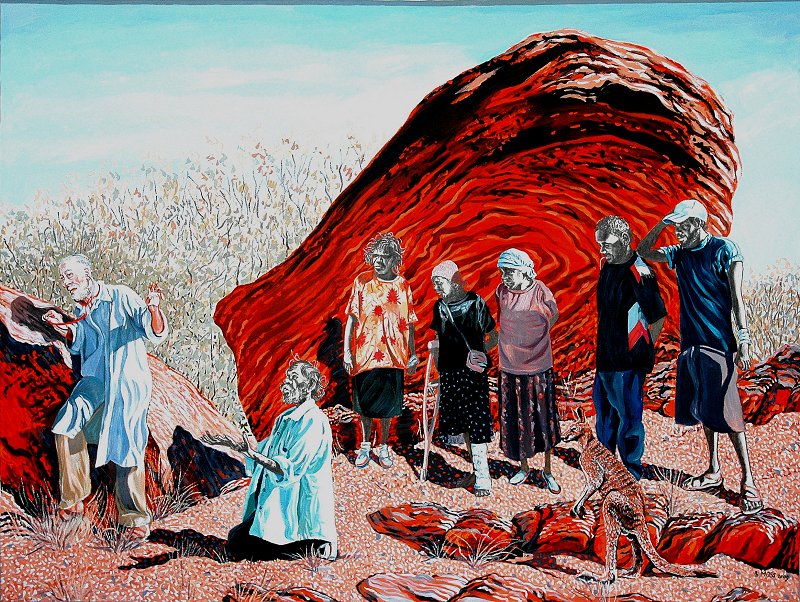
Only Connect


The marathon began, like all my best marathons – and like all my worst – after too little sleep and too much coffee. Even before I start I know I will learn something today. Every marathon brings its own teaching.


I run alone. I train alone. All my running comrades have aged and retired, some defeated by injury, others redeemed by family. Alone, but never lonely, today least so, with friends waiting at Mile 23 and wife and kin at Mile 25. My wife Annette had her fill of marathons decades ago. The novelty of travelling to an inconvenient, often inaccessible rendezvous and waiting there for some hours just to sight and greet and embrace and encourage a sweaty spouse has worn off. Yet today bears the promise of Annette.


Fifty thousand-plus of us runners moved by ferry and by bus to Staten Island, New York’s forgotten borough. All had drunk copiously from early morning, against the inevitable drying out of our bodies during the run. After 90 minutes on the bus we debarked, bladders groaning, seeking relief.


I looked around me. I saw bushes aplenty but of toilets I saw none. The official marathon booklet warned us runners (on pain of disqualification!) not to use the bushes. I found a very long queue leading to the portable toilets which bore the name Royal Flush. I jiggled, moving from one foot to the other. Looking up, I saw many others in this queue and in others adjacent, dancing the urinary gavotte.


(I know no way of reporting the grit of the marathon without dealing with the seamy reality of the body. When we mammals run our bodies heat up. To contain that heating, a dog will pant, but we human mammals sweat. By the end of the marathon the human kidney is under siege from breakdown of muscle protein, the circulation struggles to compensate for dehydration, toes purple and balloon as blisters fill with blood. Elsewhere, armpits and scrota shed skin, nipples bleed, bladder walls abrade each other and haemorrhage into urine already laden with albumin and urea. The runner eliminates a scant flow of disreputable gravy. Great runners are not immune: champions of major marathons have voided into their shorts, have shat themselves when their bowels outran them, and/or shed public menstrual blood on their way to victory. It’s not a glamorous sport.)


The morning was crisp and bright. The sun streaming through the window of the bus had warmed me luxuriously, but once out of the bus I crisped up nicely. Dunkin Donuts make a drink they call coffee and Americans pay good money to drink it. For us runners the drink was free. I welcomed it for the warming. My Wave in the marathon would not start for two hours, so I sat in the lee of a large tree and read the Book Section of the New York Times. A thin lady with fair skin, her freckles pale in the sunlight, wore a shirt blazoned with the dying words of Pheidipides, ‘Rejoice, my friends! Ours is the victory!’ The young woman claimed Pheidipides as her running inspiration. ‘Mine too’, I told her. She said, ‘I tell the story to my little girls, but I don’t dwell on his dying.’ Soon we were talking about books and favourite authors, and time trickled away pleasantly until Marshalls called my Wave to the starting corral. I suppose that was the story of my day; simple connection with another that would blind me to small things like tedium and pain and tiredness.


The day, like the poets, starts in gladness and ends in madness. Events, faces, sounds, sights and crowds merge into montage. Memory becomes a scrambled egg. A body starts out full of running, it sobers and slows, it falls into a plod, later it labours, only to speed up again, endorphin-fuelled. By the end of the race I remember all, but chronology blurs.


Every runner contemplates three distinct finishing times – the one most likely; the acceptable slower time; and the secret time, very fast, of the runner’s dreams. A couple of months ago I ran in Alice Springs with an injury. I completed the 26.2 miles in 344 minutes, equating to a mile every 13.13 minutes. Feeling fitter now and more hopeful, I dreamed of running this marathon in eleven-minute miles. A marathon is one of those things dreams are made on.


One thing certain: if I run more quickly than I can sustain I will regret it later. With my mind full of calculation, I heard a cannon fired somewhere in the distance. Runners shuffled forward towards a Starting Line none could see, the roadway rose beneath our feet and abruptly we were running up the long incline of the bridge over the Verrazano Narrows. I tried to forget how high we were above the waters. I tried not to run too fast. I noted with dismay the rough, harsh concrete surface that jolted my joints with every step.


I looked from one to another of my fellow runners in all their heterogeneity. (That’s another secret – distraction by the human landscape.) I saw we were thin, we were fat, we were tall, we were short, we were of all races; some of us were twisted, some wasted, some blind; one ran upon a metal spring in place of a foot; we were young, we were old – one runner older still, for on his back I read, ‘Born Before WWII.’ The man was weedy, his trunk narrow and his hair long and wavy, a white savannah. He radiated a perky energy, his marionette limbs jerking along effectively at roughly my own pace. After a time I lost him but we were to cross paths repeatedly over the coming hours.


We descended from the bridge into Brooklyn where the first of countless New Yorkers came out to bless us and feed us and celebrate us as we passed through their multifarious neighborhoods. Those New Yorkers held aloft signs. Some named their hero: ‘Daddy, we’re proud of you!’ ‘Miss Jones, Grade 4 think you rock.’ ‘Lucy, marry me. Please shower first.’ Others were philosophic: ‘Pain is temporary, glory is forever.’ ‘Pain is temporary, Facebook is forever.’ And, ‘Pain is just French for bread.’ 


And one sign humbled me with, ‘Stranger, I salute you.’ (The shock of the true. Who is this who speaks thus to my soul?)


I was dreaming I suppose when a sign told me I’d run three miles in 29 minutes. Too fast! I knew already my hope of a good time was ruined, the work of mutinous legs and wild ambition.


Bluetooth carried music through my hearing aids. Suzanne started me, followed by Sisters of Mercy, then Hey, That’s no Way to say Goodbye, So Long Marianne, and so on, through the Leonard Cohen songbook, eighteen songs over one hour and 18 minutes. From the Start on the bridge from Staten Island the entire album carried me into Brooklyn, but not beyond. This, I realised, would be a slow marathon of many albums. “Graceland” next.


Numerous young women brandished warning signs: ’Run faster, I just farted.’ (How rude.)

A tall black man at a pedestrian crossing held a sign that urged the endless passing stream, ’Speed up. I’m waiting to cross.’ (I larrfed.)


We runners too wove a legible thread, of words worn on our bodies, some playful, some sombre. I read tee-shirts as I ran. Cancer was condemned, Muscular Dystrophy unpopular, diabetes damned.  When I read ‘Pancreatic Cancer’ – remorseless killer of numerous close to me – I gulped. Quite a few runners simply wore the two names, ‘Martin Richard’, without elaboration. Those names rang a bell from Boston, 2013; Martin Richard was the 8-year old boy blown up by the gormless younger bomber. The photograph in the papers showed a child standing on the pavement, gazing outward; behind him a young man in a peaked cap, at his feet the fatal backpack. That was Memorial Day in Boston, 2013, the day our folly lost its innocence.


Other signs memorialized a friend or parent – ‘This is for you Dad’ – occasionally the name and likeness of a child lost to cancer. ‘Charlene 10/13/08 – 2/9/14.’ All lightness sinks when you run behind that shirt and you contemplate the heartsickness of the wearer. Others wore the names of the Pittsburgh Eleven. (I was one of those.) 


After I’d run a couple of hours an ugly low bridge loomed ahead. That bridge (by name, Pulaski)  obeyed New York’s Law of Concrete Bridges, which ordains a cement surface, pitted and rutted, intensely hostile to the runner’s foot, ankle, knee and hip. The bridges of New York City are many. Next comes Queensboro, the great bridge from Queens to Manhattan. Lying in wait are the Willis Avenue Bridge and the Madison Avenue Bridge. The five bridges of concrete reality.


The Pulaski marks 13 miles, the halfway mark. By all accounts Mister Pulaski was a good bloke: 

www.polishamericancenter.org


[Kazimierz Pułaski, (English Casimir Pulaski, born March 6, 1745, Warsaw, Poland—died October 11/15, 1779, aboard ship between Savannah, Georgia, and Charleston, South Carolina, U.S.), was both a Polish patriot and U.S. colonial army officer, hero of the Polish anti-Russian insurrection of 1768.]


Good bloke or otherwise, to the runner, Pulaski means fatigue. By this point 13 miles felt to me quite sufficient. A tee-shirt ahead of me agreed: “Why didn’t Pheidipides fall at 13 miles?” Up, jolting and wincing, up Pulaski and over, and there, two-and-a -half miles ahead rose the great metallic arcs of the vast Queensboro.


In the company of The Boy in the Bubble I started the long climb. Into Graceland and beyond I climbed on. With Diamonds in the Soles of her Shoes I climbed still. Outside my earphones the world was quiet. Runners ran and breathed and grunted with effort. No crowds on the bridge, no wild animating distractions.


In the quiet I sensed my lips were moving, Hebrew words emerging. “Hear O Israel, the Lord our God, the Lord is One.” I am my sole self, again and ever the four-year old child reciting the creed. From that time I’ve recited that initial verse of the “she’ma”, twice daily. From that age I’ve known it to be the final prayer of the Jew at the moment of death. Why now? Why here? Perhaps it’s the relative isolation of these miles on the bridge, perhaps the mere mechanics of plod induce trance. I cannot say, beyond noting how, as I walk or run this earth, ancient prayer will surface unbidden. Liturgy-laced, my life has been framed by the times and seasons of the prayers.


I ran on and I heard my mouth say, “Uvlechtcha baderekh”, and I heard my father teaching us small kids, “And you shall repeat them unto your children, and you shall speak of them as you sit in your houses, as you walk upon the way, when you lie down and when you rise up…”


On and up, on and up, Under African Skies I ran, on and up, Homeless and joint-shaken until the top where the road ahead was blocked by a huge red firetruck. The truck revved us up, its deep horn blasting, booming, blasting. Legs took heart, the road sloped down and to the left, freewheeling I allowed my speed to pick up as I jolted the long mile down to Manhattan.


In four previous NYC Marathons, First Avenue always defeated bonhomie. Debouching from the Queensboro Bridge, we ran into an ambush of ecstatic goodwill in First Avenue, with crowds wildly excited at our arrival in Manhattan.  Manhattan! – a name to conjure with, name of the great centre of excitement that is New York. However, runner beware:according to an article in the New York Times, Manhattan is derived from the local tribal language word Mannahatta, with a likely meaning, “island of many hills.”


Erst, the excited crowds were brief and the Avenue long. Crowds would thin, muscles flag, spirits wilt and on we’d run, and on, towards a distant island of further desolation, The Bronx. No desolation today: today the crowds do not thin, enthusiasm blooms at every side, the sun shines upon spectator and hero alike. Spectators in wild array, in every mode and manner of dress, watchers in love with their particular hero, in love with this stranger that is within their gates. The sun warms them, large plastic beakers of lager cool them and their cup runneth over. 


I’ve claimed often I’m the world’s slowest runner, adding, ‘a good walker will beat me’.  Here at 18 miles I see my words made flesh. Striding at my left a compact young woman (they’re all young now) walks smoothly past while I runshuffle on.


And here’s music!  A bunch of schoolgirl drummers, exuberant in sky blue, drummed and danced us up First Avenue. Harlem, where runners’ limbs are leaden, boomed to the beat of rappers. Everywhere rock bands with driving guitars and belting vocalists shook us as we plodded along, revving us up. All music up-tempo. In Brooklyn a Spiritual choir outside a church (emblazoned with the Star of David – go figure) flung soaring soprano sounds into the heavens. 


At twenty-two miles I overtook a young woman whose shirt read, ‘Running for Two.’ Apprehensively, wondering who she’d lost, I asked, ‘Will you tell me who else you run for?’ Her face lit up as she pointed to her belly: ‘My baby. I’m 10 weeks today.’ ‘Your first?’  (I meant the baby). ‘Yes’ – another bright grin – my doctor gave me the all-clear. (She meant the marathon.) The woman’s sheer delight infected me. Today, a maiden marathon, in 30 weeks a new human, born to love.


At length the golden light began to fade and the day cooled. At the same time my running slowed further and I too began to cool. I was heading up Fifth Avenue now, not that Fifth Avenue where every shop sells goods you don’t need and cannot afford, but a sylvan Fifth that curves and hides in the beechen green of Central Park.


Mile 22, mile 23, a steepish little uphill and I look around into the collar of crowd for a face I know. A doctor who has ministered to my family since my eldest daughter was 12 – that’s thirty-four years – has promised to meet me hereabouts with iced coffee. A voice roars from my left, ‘Howard!’and I totter over and accept a pint of the magic fluid.’ Brian and I shake hands, Onella beams, other voices from faces new to me tell me how great I am. And recharged with water, sugar and caffeine I’m of a mind to agree. Feeling at least a little greater I plow on, on toward another rendezvous.


The road curves and dips, the crowds are excited, solicitous, effulgent with love that seeks an object. ‘Nearly there! Nearly done!’ – they scream. People peer and read my shirt: ‘Australia! Australia! – seemingly exultant as their love is requited. 


The crowds bring me back in time to the marathons I ran with Melbourne Marathon Legend (his actual, formal designation) Manny Karageorgiou. The Melbourne crowds adored Manny, as he transcended his malignancy, time and again rising from his bed to run Melbourne, while his Greek soul dreamed ever of running the Athens Marathon –  the Marathon marathon. Manny died last year, his dream unrequited. Two weeks from today his son Panayioti will run Athens in Manny’s stead.


Mile 25, and when I sight upon my right a head of curls atop a short female form, I know I’ve arrived. My wife Annette runs from the verge, arms wide, smiling wide, and although there remain 1.2 miles to the Finish, I’ve arrived. I fall into those open arms and fold that small person and sob. A red head of curls at Annette’s right and a silver head at her left tell me my faithful sister Margot and my brother-in-much-more-than law John, are here too. Margot feeds me oranges that come all the way from China as I hold on to Annette, holding on for love, and holding so I won’t fall down. After a time I de-clutch and run on. And as in all my NYC Marathons, Margot runs alongside. The final mile and-a-bit are dull but painless. Nothing hurts as I crank the limbs into a jerky sort of sprint to the Line.
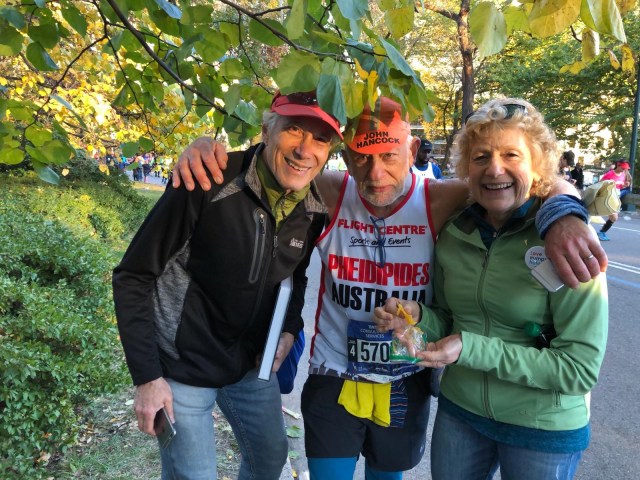


But someone else has fallen down. Mister ‘Born Before WWII’ lies face down on the bitumen. Gently, ever so gently, two large cops of the NYPD raise him from the road. His nose is bloodied but his smile is undimmed. ‘No, no, I don’t need a medic. No, I’m going to finish.’ With a cop cradling each arm, but under his own steam, the old man totters on. He will finish.


And as for me, my arrival happened before the Finish, back at Mile 25, back in Annette’s arms. I hurtle now across the Finish Line of diminished relevance, happy before I reach it. They give me a medal, they drape me in foil, they throw a blanket about me, but nothing hurts, nothing chills in this arrival, this return.
Appendix

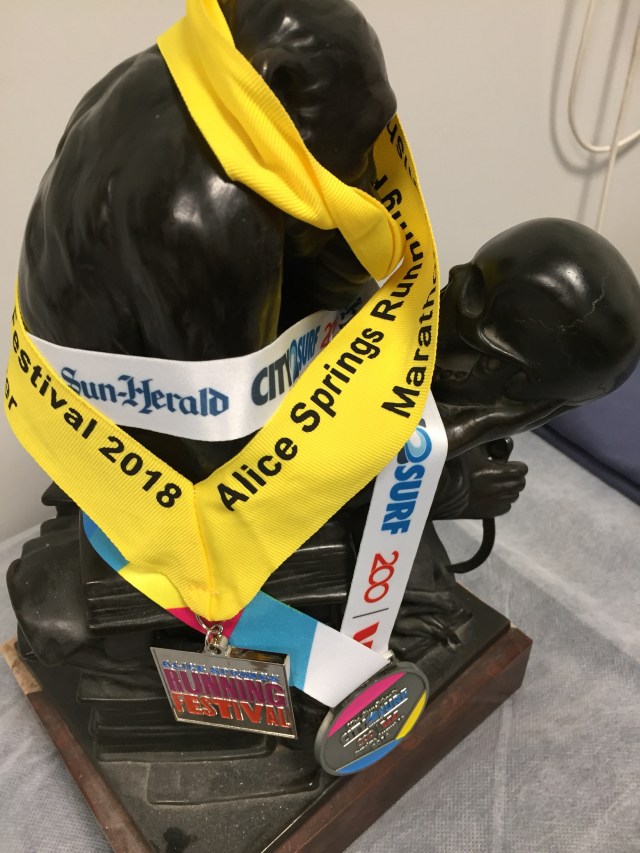
And for the record Pheidipides Goldenberg, runner bib no. 57072, finished the  NYC Marathon in 5 hours, 34 minutes and 40 seconds, coming 118th of 231 runners aged between 70 and 75 years; 993rd of 1147 Australian runners.
The fastest Australian was Lisa Weightman (former Olympian, formerly Ondieki, nee Weightman), finishing in 2.29.11.
The fastest Australian male was Jarrod McMullen, finishing in 2.36.11.
The following day Jarrod crossed the North American Continent and the Pacific in 22 hours, seated next to Pheidipides Goldenberg, who crossed in the same time.

Fifty thousand believers

I hike across Manhattan this morning to pick up my runner’s bib and electronic chip for the New York City Marathon. I’ve run this event four times before; somehow the Kenyans always beat me. On the last occasion I placed 6000th of 36,000 runners and felt pretty pleased with myself. That was about 1998. That was twenty years ago, in the lives of humans, a full generation. A generation on, my body tells the story of my degeneration.

The sun shines, the autumn leaves glow gold and blush red. The thronging streets empty into the Jacob Javitz Convention Centre. THe human tide washes me before it and sets me down gently before overhead signs that read: BIB NUMBERS 1-100; NUMBERS 100-1000 and so on, all the way to Numbers 70,000-80,000. My number is 57,072. The bib persons shine their smiles of American teeth at me. They welcome me. From Australia? Wow! How old are you? Wow!

I approach the line where you try on the official souvenir shirts for size. In America the seats in airport lounges are very wide. In this country I think I’ll be a SMALL. The SMALL t-shirt is tight and smells richly of the hundreds who’ve sweated within it before me. I need MEDIUM. To my left a dozen or two women of all shapes and ages tear off their shirts and expose their underwear. An unexpected display. They do this to try on the souvenir shirts for size.

I wander aimlessly around the vast hall in a beatific state. Accents of all nations, shirts of all nations, languages enough for Babel, smiles, smiles on all sides. What – as the poet asked – is all this juice and all this joy? Unbidden, unchanging, my own teeth have organised themselves into a crooked grin. This huge assemblage, all for the simple task of bib-getting and shirt-receiving; these mere thousands here of the many tens of thousands who’ll run with me on Sunday all look idiotically happy.

Why? For what? Eighty thousand adults all gathering for play. Eighty thousand innocents.

As I leave the happy concourse and thread my way through the incoming thousands I pass two police officers. They wear bullet-proof vests and helmets. They grip in their arms their weighty submachine guns. Fifty-one marathons down and I’ve never seen this before. But something broke last Shabbat in Squirrell Hill. A fabric was torn in Boston in 2013. When they told me then the race was called off because bombs had gone off I kept running. I would not believe it. This, this glorious foolishness was the marathon, this the ceremony of innocence.

Feeling mounts within me. The physiology of imminent weeping signals intensity. It comes to me that this might be my last one. And if it be the last, ‘What larks, Pip old chap! What larks!’

Not Pittsburgh

I call and invite myself to visit with my friends David and Nancy in Pittsburgh. Nancy is a paediatrician and David a paediatric psychiatrist. Their lives in work are an inspiration to me. I get onto David. He’s welcoming and hospitable as always. ‘We’ll love to have you. What are your dates, Howard?’

‘Last week in October.’

‘That’s unfortunate’, said David, ‘I’ll be attending the meeting of the Academy of Child and Adolescent Psychiatry at that time, in Seattle. You couldn’t come to Seattle, could you?’

I can come and I do. And so I don’t go to Pittsburgh.

In Seattle, a sizeable city where the rain falls, coffee shops and bookshops abound – as in Melbourne. The coffee is good, just about good enough to compensate for the weather. Like Melbourne, Seattle is a UNESCO World City of Literature. I feel at home in Seattle’s mists and drizzle, with Seattle’s coffee and bookshops, and in the city’s richness of cultural endowment.

I attend the conference and I soak up the latest research into adolescent mental health. I see how my friend David knows everyone, how they cherish and venerate him, how the younger researchers find him inspiring. Over thirty years’ leading child psychiatry in Pittsburgh David has contributed richly to his field. Adolescents without number he saves from death by despair. A few years back I see him at his work, one-on-one with kids whose lives are blighted from the start. I see and I marvel at the pioneering work that keeps these kids alive and helps them thrive.

It turns out the Academy are honouring David, choosing him to give the Plenary Address. On occasions like this Americans enjoy pomp and formality. The Plenary is a grand event. Every delegate attends. A great hall fills. David and his fellow Illuminati – numbering perhaps one hundred – occupy tiered rows of seats facing the audience. The audience of seven hundred delegates and their friends and spouses fills the remaining rows. Oratory bursts into flower, moving with the spirit from Grandee, to Honoree, to Celebrity, to Worthy Worker. As Yeats wrote, ‘…all’s accustomed, ceremonious’.

I sit in the front, opposite my friend, myself aglow in his glory. David sits, pregnant with the words that will distill his wisdom. But before he will speak, we must hear from a Traditional Leader of the Peoples native to this area. Her name, we read, is Connie McCloud. A short, stout woman rises to her feet before us. She is not young. I notice her heavily tinted spectacles. You don’t need sunnies in Seattle; perhaps her sight is impaired. The woman does not move until a younger man with brown skin offers an arm, which she accepts, and she descends ponderously to the lectern. The President of the Academy introduces the speaker: ‘ It is an honour for me to present Connie McCloud to offer us her Blessing and her Welcome. Miss Mc Cloud has led her people, the Puyallup, for over thirty years.’  Someone adjusts the microphone to her height. Connie McCloud stands and regards us, visitors to her lands. She thrusts a fleshy arm upwards and she gives voice.

The voice is at one moment strong, freighted with pride and feeling, the next moment faltering beneath that heavy freight. The woman tells us proudly of her country, of its sacred mountain, its waters, its nourishing salmon, its deer, its skies and clouds and forests. ‘We have always been here! Despite all attempts to bring that to an end, we have always been here!’ The voice rises and the woman declares, ‘And God damn it, we are still here!’

She flings her stout arm backward and upward: ‘Our sacred mountain, which you will be told is Mount Rainier, is Tacoma. A newcomer named it for a friend of his, a magistrate named Rainier. Mister Rainier never visited these lands. He never saw our mountain.’  I’m reminded of Alice Springs, named for Alice Todd, absentee wife of the telegraph surveyor. The true name of that place is Mpartwe.

The speaker speaks of her lineage. She names her father, names his, then traces both to the brother of Great Chief Seattle. (As far away as Australia we’ve know that name for the lines attributed to him upon the imminent surrender of his lands: ‘Every part of the earth is sacred to my people. Every shining pine needle, every sandy shore, every mist in the dark woods, every meadow, every humming insect. All are holy in the memory and experience of my people.’)

At length Connie Mc Cloud says, ‘Here is my blessing. Here is my prayer for your success here in our lands. Here is my prayer that your wise people, your leaders, will find a cure for this suicide that takes away our young people.’ Oratory comes to its end as Connie Mc Cloud bursts into song. None of us non-native persons has heard song such as this. An ageing woman’s voice rises and falls, consonants and vowels sewn together into a strange fabric of slow rhythms and novel patterns, make their way into our stilled being. A sense of something solemn, something authentic and ancient and potent, penetrates us. The song rolls along, a river of sound that flows, from age to age, with steady pace, to its last syllable. We know a serious peace. I look up. David is mopping his eyes even as I do the same.

https://www.theolympian.com/news/local/article203194544.html

When at length David does speak, it is of death – of the premature loss of our young at their own hands. David is not a morose person. His rubicund features glow with ready playfulness. The life and the play reside alongside the gravitas of the protector of young lives. David’s theme this evening is ‘Saving Holden Caulfield.’  The reference is to Salinger’s The Catcher in the Rye, in which Holden Caulfield imagines himself as the catcher of children who tumble helplessly over a sheer cliff at the edge of a ryefield. David and his colleagues are the catchers below the ryefields from which our true life teenagers leap.

David begins with a light-hearted remark that I don’t catch. He twinkles and his audience relaxes. Then it’s down to business: ‘After all these years we’re seeing not a fall in teenage suicide, but a rise. After all these decades of research and treatment we’re not winning. It’s not as if we don’t know what works: research has shown us what works; we’re simply not implementing it. After these many years in the field my mind turns to retirement, to enjoying the grandchildren. But there’s that graph’ – David points to the rising line of trend on his slide – ‘and I’d like to see it point downward before I leave the field.’

David flies back to Pittsburgh, to Nancy and his children and his grandchildren. His house stands 500 yards from The Tree of Life Congregation where a family gathers on Shabbat to name their eight-day old baby boy.  A man posts on Facebook, ALL JEWS HAVE TO DIE. The man enters the congregation and the following are named among those who die:

• Joyce Fienberg, 75, of Oakland;

• Richard Gottfried, 65, of Ross;

• Rose Mallinger, 97, of Squirrel Hill;

• Jerry Rabinowitz, 66, of Edgewood;

• brothers Cecil Rosenthal, 59, of Squirrel Hill, and David Rosenthal, 54, of Squirrel Hill;

• married couple Bernice Simon, 84, of Wilkinsburg; Sylvan Simon, 86, of Wilkinsburg;

• Daniel Stein, 71, of Squirrel Hill;

• Melvin Wax, 88, of Squirrel Hill;

• and Irving Younger, 69, of Mount Washington.

Why I Haven’t Written

This blog has been silent for a good while. I have been remiss. Happily, of the blog’s three-or-four hundred nominal followers, one only has complained. Perhaps she alone has noticed. The truth is a lot has happened: spring came to Melbourne; a surgeon cut my eyes open and melted my cataracts, bunging in a couple of new lenses; a dear friend has died; we experienced a hit-and-run road accident; and Bert the half-hearted came through his surgery and battles on.

I’ll start with the least material of these events, the road accident. I parked my wife’s pretty little red car outside a travel agency and went off to buy bok choi. I came back to find the front defaced and a note attached to the windscreen:

31 AUG 2018, 11:08 AM

CAR: WHITE HONDA CRV, YHO 815

LOVE,

FLIGHT CENTRE, SIX WITNESSES

I surveyed the alterations to my wife’s car, then entered the travel agency. The travel agents described the event, described the driver, wished me well in the manhunt and assured me they’d testify. They shared a lively indignation; the driver’s amorality offended them.

I post these particulars by way of invitation for the assailant to come forward, confess, throw herself upon my wife’s mercies and pay up. Under those circumstances we need not trouble the constabulary.

Surgery is one of the everyday miracles of life in a city like Melbourne. Two crazed lenses are literally melted in the eyes and sucked away like so much snot. New lenses are inserted and the world gleams. Then spring arrives. I see the green greener, and – thanks to the new hearing aids – the birds sing. (One of the saddest little lines in poetry closes Keats’ La Belle Dame sans Merci. The line of four words – and no birds sing – suffices for desolation.) Once again my spring sings.

Little Bert underwent his second heart surgery. His heart, sized like an apricot, was showing strain. A vascular detour improves his prospects. Inside Bert’s chest the so-called great vessels are like thin tubular spaghetti, cooked al dente. Somehow a surgeon cuts, stitches, reroutes, and attaches. Somehow blood flows through the pasta. And Bert breathes on. The praying continues.

In the mid-seventies I met a bearded maths teacher who took me on lengthening runs up and down the green hills of the Diamond Valley. His name was Dick. One day we paused on a high hilltop and watched the shafts of sunlight pierce the winter mists. A moment of silent communion followed as we share revelation. That was ten kilometers, said Dick. We breathed together, blowing out mist, thinking the same thought: If I can run ten, I can run a marathon. With Dick as my inspiration and my training partner, fifty-plus marathons followed. And a few weeks ago, Dick, who’d developed and survived lung cancer, Dick who never smoked, Dick died – of breathlessness. At his memorial service a large congregation paused and wondered: How is it we live? How is it we cease living? What is this miracle we call friendship? Which is the greatest wonder?

I write this aboard an aircraft from Phoenix, Arizona, where I’ve just said goodbye to friend Paul, struck down by a stroke on a Sunday morning late last year. I asked him had he felt fear. No, not fear. I found it difficult to dress for church with my right hand paralysed.

I’ve written previously of Paul, surgeon, aviator, morbid anatomist. Paul is a man of deep faith. He’s certain he’ll be reunited with Beverley, his beloved wife who died eighteen years ago. I noticed the words printed starkly on the band he wore on his left wrist: MEDICAL ALERT – DNR. Knowing his confident belief in rising again to bliss, I asked: Paul, does it make you sad to persist here in life? His voice of deep gravel remains strong and clear. His word choice carries all the old inventiveness, no stale phrases: After my stroke I’d awake in the mornings quite surprised still to be alive.

Paul and I sat outside in the heat of the Arizona afternoon while he smoked his daily cigar, holding it in his left hand. The right hand remains weak but to my astonishment the strength is returning steadily. Such vitality! I thought of the tiny trees growing in their cleft rocks at Fitzroy Crossing. Germinating from seeds dropped by birds, these miniature saplings force a root downwards through great basalt rocks, emerging into air as a tendril that dangles down to the river surface, down through the great waters to the muddy riverbed. His one-hundredth birthday falls early in 2019. After today I do not expect to see this marvellous man again. But on parting Paul asked, when will you come out this way again? The question was not facetious; he’s lived this long, why not a few more years?

Deaths, deaths. I write of them so often – naturally so, as I age and those I know slip away. In my work too, the farewells are many, and not all of them to elderly persons. Long ago a friend remarked of my writing that I what I was really doing was coming to terms with my mortality. At that time I didn’t see it. But I know now he was correct. I know too, death is not the worst thing.

Half-hearted and Nameless

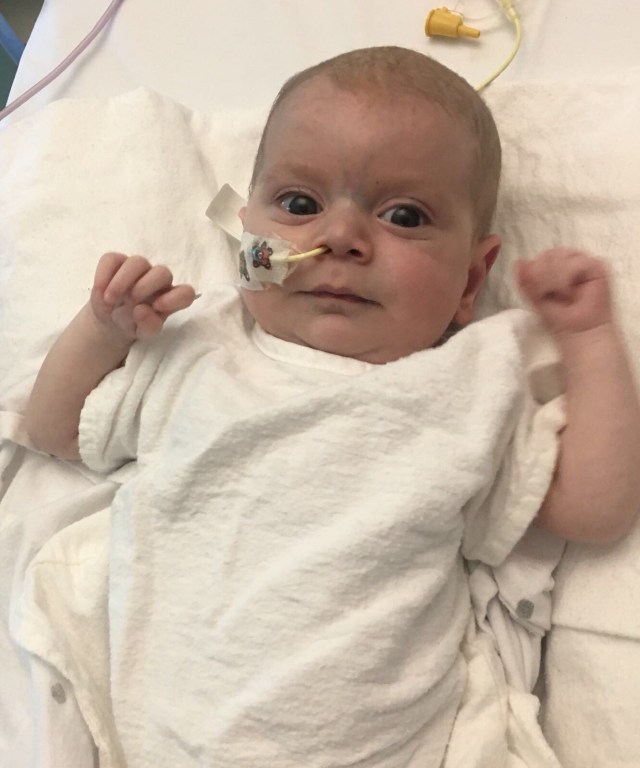
A military man I know who is also a man of the cloth, recently fathered a half-hearted child. The child is a boy. Although the boy is now four months old I cannot tell you his name: as well as heart-deficient this boy is nameless. Into the vacuum where a name should sound and resound I have secretly named him Bert.

Bert was born with an Hypoplastic Left Heart. Of all the congenital heart defects consistent with life, this is the most severe. When early prenatal scans demonstrated the defect, doctors warned the mother and father: The child might not be born alive. Of all the cities in the world to be born thus, Melbourne might be the very best. For in this location the very worst heart enjoys the very best outcome. And Melbourne is home to the Royal Children’s Hospital, where the cardiac surgeons achieve results superior to other centres around the world. Paediatric surgeons from the greatest hospitals in the USA perform the same procedures but without the same success. Their specialists visit the RCH to learn how the Melbourne team does it.

When my soldier friend told me of Bert’s heart condition my own heart sank. Without an adequate left ventricle circulation is critically impaired, the baby is breathless and often blue. The situation is serious, prone to deteriorate rapidly. Surgery of the highest intricacy is needed with critical urgency. Further surgery will follow within months, and more still as the child grows. If the child grows.

But Bert’s family are strangers to despair. Their faith buoys them. They pray. Their large family prays, their congregation prays, sister congregations join in a tidal wave of prayerful hope. The soldier father sets about studying Hypoplastic Left Heart Syndrome. He interrogates the cardiologist, the cardiac surgeon, surgical texts and research papers in the learned journals. Meanwhile baby Bert lies in Intensive Care puffing mightily, as his too little heart labours to circulate oxygen-poor blood around his body – most crucially to his brain.

The baby undergoes his first operation. Some hold their breath. Others pray. Bert comes through.

The nurses ask, ‘What’s his name?’

The parents reply, ‘We haven’t given him a name yet.’

‘When will you?’

‘When he’s fit enough we’ll circumcise him and we’ll give him his name.’

The nurses are confounded. They’ve come to love this little baby who puffs and puffs and keeps pulling through. Love demands a name. Administration demands a name. A non-name is given, a name for nurses to love him by, a name for administrators to administer by. Obeying the same imperative, I looked at the bony little battler and secretly started calling him Bert. But his true name, the name that will come to him dynastically or by parental vision or by revelation is not known. The day is not yet come.

A close bond weaves itself among the team that comprises on the one side a mother, a father, bigger brothers, grandparents, uncles and aunts, and on the other, a cardiac surgeon from Belgium, a cardiologist with a Chinese name, ultrasonographers, physiotherapists, cardiac nurses. The father masters and explains to me the eye-watering anatomic detail, embryology, circulatory physiology and pathology as well as the sequence of cardiac surgeries that is needed for Bert to live and to grow. And (in the locution of the family), God willing, to undergo ritual circumcision and to receive his name.

When I visit Bert in Intensive Care, I find the usual grim intent of such a Unit softened. A tenderness prevails, a gentleness, the amalgam of a family’s faith and the distinctive ethos of the institution. It is in Paediatrics where you find the kindest clinicians, and human sensitivity at its highest. The Chinese cardiologist procures for himself a religious almanac so he can know the dates and times when the family will observe Sabbaths and Festivals. He doesn’t want to cause them needlessly to contravene the strictures of telephony at such times.

Bert learns to smile. An MRI searches for hypoxic and other brain damage and finds none. Bert learns to suckle, taking in nourishment made specifically for him, taking in too, mother love, mother touch, smell and sound. Bert lies at his mother’s breast and feels that heartbeat that reassured and made him through the months that he grew, until he came into the world without a fully formed heart. Bert’s bony cheeks begin to flesh out, but he gains weight painfully slowly. The cardiologist explains Bert’s heart has to work so hard it burns up almost all the energy he consumes. The date of the second surgical operation must be brought forward, lest a wonky heart valve be damaged further.

The soldier rabbi father and I became friends when he himself was a runted collection of skin and bones and spirit, aged four years. It was he who knocked on my door one Sabbath morning with a request from his mother to visit his sick sister in their house around the corner. That sister was sped to hospital that morning, never to return to her home. None of us has recovered from her ordeal and her loss.

Tomorrow, or as soon as an Intensive Care bed becomes free, the baby son without a heart and without a name will undergo his next surgery. If you are the praying kind, spare a prayer for him. You can call him Bert.

Waterfall

I’ve just watched a short film which shocked me. Basically the movie captured the knifing by one human being of another. Shocking enough to see real footage of the live cutting of a human, but the knifor actually got the knifee in the eye.

I watched the youtube to prepare myself. Next week I will be the knifee. I’ve selected my knifor, a charming young woman who talks with me about books. If someone is going to poke a knife in your eye you might as well choose a good conversationalist. Because, they tell me, I’ll remain awake throughout the procedure in which she’ll remove my cataract.

Years ago I consulted a doctor about some red blood cells that had bobbed up in my urine. I felt well, I had no pain, the organ in question looked as good as ever it did. The doctor and I found ourselves in agreement: it’s probably not cancer. But we’d better take a look, he said. I agreed. The doctor then described the procedure of taking a look, a matter of tubes up my tube, a matter of lube within my tube…

Yes, but what about anaesthesia?

Don’t worry about that, said the doctor, we’ll use xylocaine jelly.

But I do worry about that. Put me out, please.

Don’t be a baby, said the doctor.

So I remained awake. Someone removed my undies. Dumpy middle-aged women wearing scrubs didn’t bother to glance, let alone admire, while the man, an awardee of the Order of Australia, travelled north through a passage that had known southbound traffic only. Electrifying.

I’ve been re-reading Philip Roth’s ‘American Pastoral’ in preparation for next week’s book chat. Next week, if I see my way clear, I’ll let you know how I go. Meanwhile if you enjoy a good vomit, google Cataract Surgery for the Layman you tube.

Dennis


When I was born my elder brother was two years and two months old. When my brother died he was sixty-two. Tonight my younger brother and I will remember our firstborn brother. We’ll recite Kaddish together in his memory.


When I was newly born Dennis filled my baby carriage with all of his toys, submerging me. I didn’t recall that; our mother told me of it. She said Dennis loved his new brother so much he wanted me to have all his toys. All of our lives Dennis gave away everything that was his.


Dennis and I always bathed together. When I was five years of age, and trusting, Dennis conned me into an act of fellatio in which he pissed in my mouth. I recall that clearly.


I’ll light a memorial candle tonight. The candle burns longer than twenty-four hours. When I walk into my night kitchen the small flame takes me by surprise. I stop and I remember. The small flame flickers and falls. It looks about to die, but then it rises and burns brightly.


I sit alone in the kitchen and the truth comes to me anew: we all flicker before we die. But Dennis! Dennis had such a force of life. I see him pushing Mum in her wheelchair along a steep winding path, pushing her up, up, to catch the sea view from a peak at Wilson’s Promontory. The tyres sink deeply into the sand but Dennis, by sheer force of will, propels Mum forward and upward.


Dennis the fearless. Dennis undaunted, never defeated. When his affairs took a reverse I’d worry for him, but he’d say, ‘It’s always darkest before the dawn.’  Dennis meant that, he believed it, he lived by it.


Life brought ease to the second brother, a harder path to the firstborn. Dennis rejoiced for me in all my little successes. He knew no envy, never felt usurped by the younger brother who got the birthright. He bought me a holy book and inscribed it with his heart’s blood: ‘For my brother Howard. God must be proud of you.’


Dennis had the gregariousness of the deeply lonely. I sit and leaf through his address book, an odd keepsake. The crammed pages teem with names, so many names, names of down and out people he’d find and succour. These people, themselves lonely, found in my brother a man who’d give away all his own toys. 


Dennis decided to undergo major surgery, hazardous surgery. I misgave. But he said, ‘Doff, It will cure my diabetes, I’ll get my life back.’  He had the surgery, his flame flickered and he died.


Eini, eini, yorda mayyim

My eye, my eye runs with water.


Ellul, 17-18, 5779.

Bonobo in Mpartwe

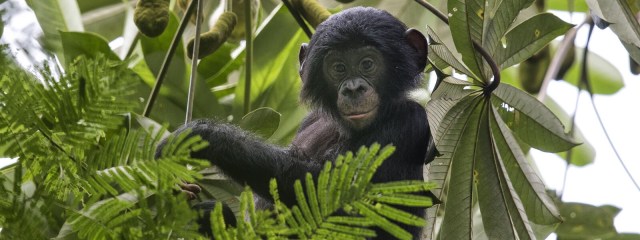
The barber chatted as he clipped my whiskers. He spoke of the bonobo, a term I did not know. I listened, intrigued. Later I did some reading and learned the following:

Primatologist Frans de Waal states bonobos are capable of altruism, compassion, empathy, kindness, patience and sensitivity.

In Alice Springs last Sunday I came across a cluster of individuals that answered to De Waal’s description of bonobos. This was unexpected, as bonobo populations have – until now – been confined to the Congo.

It happened like this.

On the second Sunday of August the great city of Sydney underwent the annual convulsion in which 80,000 people walk, jog or run from the centre of the city to Bondi Beach. That massed migration is called The City to Surf. To that great convulsion I added a minor tremor. The course is 14 kilometres long, equivalent to one third of a full marathon. In order to test my recovery from injury I ran the course twice, starting at Bondi around 6.00 am, reaching the starting line in the city, where I did a u-turn and returned to Bondi. My injured knee did not complain, my small grandchildren decided I was a hero, and I was happy. The dodgy knee surely would be fit for a full marathon the following week.

Following a prolonged period of injury in 2017, I underwent successful knee surgery, after which I did some rehabilitation, and resumed running, feeling grateful and blessed. I increased my distances by degrees, until in January this year I ran a half-marathon distance in the Dominican Republic. I set my eyes on a return to the full marathon. But then I reinjured the same knee. I rested it from running and I hoped. After three weeks of devout hoping the knee had not improved. I consulted a leading knee physiotherapist who demonstrated a marked weakness in the quadriceps muscles that operate the knee joint. I had failed my own imperative: in recovery from orthopaedic surgery the surgeon achieves only forty percent of the job; the remaining sixty percent is up to the patient.

Belatedly I strengthened the wounded knee. For a further two months I did not run. My quads bulged. Strangers stopped me in the streets to admire, to photograph, to lust.

The knee still hurt with every step but the muscles were mighty.

Permitted now to run again, I took some anti-inflammatory medications to pacify the knee. The medications inflamed my kidneys, but the knee still hurt.

A doctor spent a long time regarding my sore knee. Synovitis, he said. He looked at x-rays and costly scans. Bone on bone, he said. Finally he injected some cortisone with local anaesthetic, which confused and deluded the knee. I resumed running, building up by degrees until I could run a half-marathon distance. The knee complained, but not loudly.

I took stock. I had run my latest marathon in Malta, eighteen months previously. That was number fifty. There followed a desert epoch of injury in which I was obliged to miss marathon after marathon. Now in August, I saw looming the City to Surf. One week further out was the Alice Springs Marathon, one of my three favourites. [It is with no disrespect that I favour the Alice event above the Melbourne Marathon (run seventeen times). Likewise Alice beats the Gold Coast (three marathons). Even New York’s mighty event (thrice run) means less to me than the marathon in Alice.]

It came to me last Sunday as I set out on my tenth marathon in the Centre that I’d never really run it right. The town is not truly Alice; those springs aren’t hers. For all I know Alice Todd never saw the waterhole where her husband, Superintendent of Telegraphs, named it for her. In that act of naming, Todd drowned Mpartwe.

Thus I mused as I passed for the first time between the towering walls of Ntaripe. Until now I’d referred to the place as ‘Heavitree Gap’, a name chosen grotesquely for the English town where they hanged witches.

As my right foot struck the concrete path through Ntaripe my knee winced and grimaced. But who, looking upward through those mighty towers of gold, could think a leaden thought? I ran on. Three kilometres into the race, I had hewn for myself already my definitive place. In a field of twenty-nine runners, twenty-eight ran before me.

I passed the next numerous hours in solitude.  The road led east, following the path of Yeperenye, the caterpillar, that created both Anthwerrke , Emily Gap (no-one knows who Emily was) and Adnuringa, the Emu (Jessie Gap – again no-one can account for the name).

That creation caterpillar won my respect. Twenty-one kilometres long, the path of Yeperenye is a fair jog. The sun shone, a brisk wind blew hard into my face and cooled my burning skin as I conducted a conversation with a complaining knee.

Knee: Ouch.

Pheidipides (my running name in Ancient Greek): Yes, I know.

Knee: Ouch, ouch, ouch.

Pheidipides: I know, I know. You think I’m not tiring?

Knee: What are you going to do about it?

Pheidipides: Look at it this way: every ouch is one step fewer to run. Two, actually.

Knee: What do you mean two?

Pheidipides: Do you hear the left knee whinging? It’s run just as many steps as you. It’s just as old. Every ouch brings us two steps closer to the finish…


Every three kilometres my knees and I arrived at an encampment whence face-painted clowns, Father and Mother Christmas and people wearing hi-vis, rushed towards me, shouting, Water? Jelly Beans? Vaseline? Blue Drink?

These individuals, aged from ten to seventy-five, were volunteers, later identified as Bonobo.  They assured this last-placed runner he was doing marvellously well, he’d make it, no worries, he was looking good. Some even said, not so far to go now.

Although little of what they said was true, it all did me a power of good. I’d stop, drink water, chat with the Bonobo, kindly declining unkosher Jelly Beans while consuming kosher jelly snakes in a range of colours. After downing a red snake, a green snake, a yellow one and a purple, it occurred to me I carried within me my own rainbow serpent. My knee would fall silent, my strength would regather, and off I’d trot.

Solitude lulls. Distance lulls. Rhythm anaesthetises. One leg follows its brother and the mind falls into Low Battery Mode. Thoughts of sublime inanity wander across a terrain of emptied cerebrum. Somehow the mind pays no heed to the ouch of every second step. If I had a thought during the initial 28 kilometres, it ran as follows: yep, I’m tired, yep, I’m sore, but not so tired or sore I need to stop. I must have told myself this simple story about every hundred metres. It worked; I never raised sufficient self-pity to stop running.

I reached the half-way mark and celebrated with a white snake. Good. Tasted like pineapple. Halfway is huge. The mind, the legs, the lungs, the muscles, the will, all organs know, with every following step, that more has been accomplished than remains to conquer. A feeling grows, it swells into a knowing, I will finish this. I dreamed. Nothing daunted. Time, old enemy, held no terrors. Distance? Just more of the same. And all I need do was to look up and succumb to enchantment. Enchantment is precisely the term here. The country is sung, chanted. The country is great, the runner an ant. Reality coalesces into a bowl of cloudless blue, a ball of gentle gold, cliffs of glowing rock. The land belonged to me and I to the land.

And at every three-kilometre mark were the friendly primates, endlessly patient, endlessly benevolent, feeding hope and belief into my being. At intervals in the slow and slower second half I’d hear a volunteer wondering, Howard, do you reckon you’ll catch your plane? Time calculations were beyond me. Care as well. Drifting, swooning, drooping my way back towards Mpartwe, time and I were estranged. How did they know, these primates, I had a plane to catch? How did they know my name? My names, actually; one or two addressed me as Pheidipides.

An ambulance kept me close company all through the second half. The driver paid me the slow, kindly insult of evident concern. Did I want a lift? Did I need a drink?  Would I like a break?

I wanted none of these. In fact I regarded the vehicle with wary mistrust. I knew the rules. The Rulers of the Marathon warned all participants the event must close at twelve noon. There would be no road patrols after that time, no drinks, no volunteers, no Carers exercising Duty of Care. Anyone who hadn’t finished by twelve would be scooped up and conveyed to the finish. Those were the Rules. Such ignominy!  Such self-disgrace! I knew I would resist arrest.

Never a really ruly individual, I truly disliked the Rule of Care in this event, the rule that forbade me to start an  hour or so before the Start proper. Duty of Care, they insisted absurdly. A marathon and a duty of care are essential antonyms. In truth a participant runs at own risk, explicitly so, as stated in the Waiver every single one of us signs. I promised myself if I finished today I would start next year at the hour I needed. Let them disqualify me as they ruly might!

With these ungracious sentiments I wound my way back through Ntaripe. But one kilometre to go. Dreaming again, my mind knowing it was past noon, knowing but uncaring; my body swam, like a weary sperm that scents the ovum, over those final twelve hundred and ninety-six steps.

A penultimate bend, then down a small slope to the final corner, where a marshall spoke, his voice thickened, crooning like a mother to her young, nearly there, nearly there. My own voice choked. Raising a hand in thanks I sank beneath the surface, unable to speak.

A roaring, a swelling sound, a tide of exultation. Rod Moss, my oldest friend in Alice, stands at the kerb. His voice utters benediction, his words are lost, I plunge towards the Line. The legs sprint, both of them. A screaming multitude rejoices – runners, their families, their friends and lovers, officials, volunteers – faces everywhere, beauteous faces, shining with some personal joy. I hear Howard! Howard! at all sides. What is all this juice and all this joy?


Later a friend sends me a printout which confirms a Personal Worst time (of nearly six hours) that frankly astonishes me. Pheidipides Goldenberg finished 29th in a field of twenty-nine. The printout demonstrates too, how the Ruling Officials broke their own rules in allowing me to finish beyond the noon cut-off. Indeed the people of the marathon, the runners, the officials, the volunteers, these are our bonobo.

POSTSCRIPT: If you chance to read the resume of Howard Goldenberg you’ll note this late insertion: Howard is the 2018 Alice Springs Marathon Champion (male), (over 70 years).

Grace on a Tram

I caught the tram this morning. Truly caught it. Chased it like a mad thing, dodged traffic banked up behind it, weaved, sprinted, kept balance. Climbed aboard, collected my breath, took a seat and took in my surroundings. And pleasant surroundings they were, for seated opposite me was a colourful and pleasing sight: a young woman, slim, with wavy lime-and-blond coloured hair, who sat and ate a banana.


Her lime-blond hair matched her bright lime socks. At her hip hung a patchwork cloth bag, alive with colour. Her black patent leather ankle boots gleamed. Just above the orifice into which banana descended and disappeared steadily before my fascinated gaze, a small nose ring looped between her nostrils. The young woman was thin but not starved. She worked steadily at her banana until she came to the moment of social truth (for some, the moment of crisis), the end of the banana, the moment when the skin demands of the eater a decision.

I watched. Would she ditch with a deft flick the peel beneath her seat? Might she instead reach into her bright bag of cloth for a plastic bag? The young woman (I decided she was nineteen years of age) did neither. She simply sat, and the peel sat on her lap, dying.

The dying of a banana peel is swift in onset. The peel, once devoid of the flesh that shaped it and gave it purpose, quickly shrinks and darkens, losing all meaning. Its yellow bloom gone, it darkens, collapses and becomes an elegy for its own shabbiness.

So the three of us sat there for a while, the lady, the banana peel and the watcher. Throughout, the winter sun shone bright through the window of the tram, transfiguring all. My eyes watered for brilliance, and my bones thawed.

After a time a man entered. Tall, wide and round, the man moved slowly into our space in the back section of the tram. His shabby clothes were black, his curls were black and his skin was black. He lowered above us for a time, directing his gaze where no eyebeams might intersect. His fleshy lips moved soundlessly. His hairy right hand clutched a sheaf of papers upon which columns of figures descended in lines from the top of each page to the bottom. The pages had the grey, slightly smudged look of photocopies. I peered at the pages, curiously. The man held them as a child might clutch a Teddy Bear, a talisman held close, disregarded, but not to be surrendered readily.

The man finished looking at nothing and lowered his fleshy self onto a seat between and opposite the lime- banana woman and me. We three found ourselves at the points of an equilateral triangle. The man, oblivious, muttering like the scriptural Hannah, was not a prepossessing person. His bulk projected itself towards the woman, towards – who knows? – possibly into her space.

I guessed she might feel intimidated. I half expected her to rise and remove herself. I watched tensely. The man’s free hand rose, coming to rest close to his ear. He spoke. His speech was not directed, the speech, I surmised, of telephony. I looked up and between his splayed fingers no telephone was seen. The tram lurched, the man lurched in his seat, his clothing shifted above his large belly. His naked flesh, baby-like, helpless, pleaded his innocence.

Now the young woman moved. She leaned forward and sideward, her angular face closing on the man’s. She said something I did not catch. The man did not catch it either. The woman’s lips moved again and I was able to read them.  I saw the words, Can I help you?  The man saw, or heard, too.  After some time he spoke, now facing the young woman, his back to me. I had no clue what he said or asked. But the woman was nodding, Yes, yes, all the way to the city.  You’re on the right tram. Her face, still close, relaxed and opened widely into a smile. The girl nodded again, her smile shone upon the man. Eyes locked, the two sat for a time without moving.

At length the man sat back in his seat and relaxed, unfolding himself, pouring himself liberally into the space left around him by peak hour riders keeping a fastidious distance.

The sun lit the man’s tight black coronet of curls. Those curls crouched as a perimeter around his bald patch that I could now see gleamed in the morning light.  The tram rode on a short space, then stopped. The young woman rose and walked towards the exit. I did not want her to leave, not yet, not before I could thank her, bless her.

The tram stopped, the woman descended and I watched as her slim form weaved a colourful path through the city crowds.

Birth of a Pearl

My mother’s name was Yvonne but her sister’s children called her Bom. I believe that name was the gift of her toddler nephew for whom Yvonne was too large a mouthful. That scapegrace nephew entered Bom’s life before she had children of her own. From the first, the two treasured each other with the distinctive closeness of the boy who finds a second mother, and the sister (yet childless) who yearns to mother.

The aunt moved to the country town of Leeton where she promptly hatched a litter of her own, of which I was the second born. From time to time the nephew (it’s time to give him a name: let’s call him Barry) was sent to us in Leeton, where his sojourns were long and wild and wonderful. His parents sent him to us ‘for the country air’, ‘for his asthma’, ‘to recover from the injury when a stake went through his belly’. All understood the true reason: They sent Barry to us when his parents needed respite. Bom would take Barry to her bosom, and he thrived.

In Leeton Barry taught us the Facts of Life. I have found these Facts to be of enduring value. He taught us too, a game called Murder in the Chook House, which I have described fully in my book titled My Father’s Compass. But all wild things must end and eventually Barry would return to Melbourne.

Contrary to all prediction and expectation Barry reached the age of thirteen without being hanged. His family marked the occasion with a barmitzvah celebration in the grounds of their beautiful home. The heavens marked the occasion too, with the mercury reaching 112 degrees. A marquee appeared on the tennis court, glamourous women sprang up like so many flowering shrubs.  Barry behaved with mature grace, accepting gifts and tribute without complaint.

Among the adult company present that day one particular beauty stood out. She was a person, someone said reverently, from Channel Nine. We didn’t have TV but I’d heard of Channel Nine. This lady’s job was to be beautiful on television. Today she was being beautiful at Barry’s family home.

TV Beauty Brenda Marshall

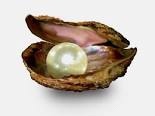
I came upon her seated in a shady spot next to my mum.  The two were talking. Beauty was admiring a pearl suspended from my mother’s throat.

What a beautiful pearl, Mrs Goldenberg!

Thank you. Daddy found it at the bottom of the sea and brought it home and gave it to me.

How? I mean where..?

Daddy was a pearl diver in Broome.

How wonderful!

Yes. He taught us girls  – that’s Barry’s mother and me – this poem:

When the first drop of rain

Fell from the clouds

Into the deep blue sea…

Mum’s manner of speaking carressed the words into being. They’d tumble from her and flow sweetly to you. Ready to be embarrassed, I watched TV Lady anxiously. Channel Nine was leaning forward, her red lips parted. I saw the pearls that were her perfect teeth. She leaned and listened and she did not move.

She was tossed, small and wistful, by the waves.

How minute I am in all this immensity, she cried.

And the sea replied: Thy modesty pleaseth me.

I shall make of thee a little drop of light.

Thou shalt be the fairest jewel among jewels…


The TV lady turned slightly to look again at Mum’s pearl pendant.

Thou shalt even rule woman.


Mum stopped, looked up at her companion, smiled:

And a pearl was born.