Human Writes

While in London I’ve been reading the local Big Issue. Lots of ads.
I decided to respond to one, headed Human Writes.

The ad invites the reader to write to someone on Death Row in USA. To become penfriend to a condemned person.
I don’t know any murderers, not knowingly anyway.
I wouldn’t begin to know whether my future penfriend is guilty.
The little I know of criminal justice suggests the possibility that my penfriend would have been represented differently- ie better – in Australia. And the strong likelihood that he would be male and black.
I make the guess he is in fact guilty.
I don’t imagine I’ll ever know or want to know.

Should I enter upon this relationship?
I who have nothing to lose, much to gain?
I – a writer, who trawls his life for his materials – who might well become my penfriend’s exploiter?

I seek the reader’s reaction.

I will write to humanwritesuk@yahoo.co.uk

So can you.

20140331-081600.jpg

Report from Womadelaide

Early visits to Womadelaide exposed audiences to plentiful Jewish song, to Ladino and Hebrew, to Jewish and Israeli musicians, cantors, singers and folklorists.

Since Israel’s Gaza operations I find the Womadelaide landscape depleted of that Jewish and Israeli richness. That portion of the landscape has narrowed, possibly as a pioneering and undeclared expression of BDS, possibly as a coincidence. Of late Jewish people have encountered a lot of coincidence.

***

The guitarist of Tinpan Orange walks quietly onto the stage, as one might who lacks a foreskin.

I know his state: I circumcised him. (Does Womadelaide realise?)

The prepuceless one sings discreetly, sweetly, alongside the keyboardist and the violinist, as Emily his sister, publicly pregnant and wearing fruit and flowers in her hair, takes centre stage.

I know and love them so I have nothing dispassionate to say about this group, but the Frenchman sitting next to me on the grass murmurs his pleasure in the small quietness that follows every song.

At the conclusion of the concert the Frenchman stands and stretches, and we exchange slow smiles as we do after sleeping on a plane; as we do

upon waking with a person whose name we will never know, one with whom we have shared an hour of pleasure. The Frenchman says: I am at this festival three days now, and I listen to many concerts. This one is the most beautiful. This is the best, with Hanggai.

Hanggai is a gaggle of old Mongols that fiddle and bellow and sing. A couple of men of picturesque antiquity occupy either extremity of front stage wearing rags that upon closer examination are national dress. The two bow their traditional fiddles with a solemnity that belies the leaping tempi of their tunes. Behind them are instrumentalists, half-seen, whose clamorous attack upon percussion never amounts to an assertion of personality or individuality. The bellows at centre stage is a weight lifter, semi-nude in his cut-away jerkin of dyed and carved cowhide. His latissumus dorsi and pectoralis muscles are exclamation marks, his biceps are upper case. He strides to and from the edge of the stage, a lion pacing out his territory, his voice a roar.

He enjoys a good deal of self-approval in his imagined kingdom. We in the audience are charmed and amused.

And then Hanggai sings. A drone flows and rises from somewhere, higher notes join with a pounding bass, rhythmic sounds gain power and tempo, building and building to a pitch that swamps physiology: my chest is an echo chamber that pounds and vibrates to a beating from without. What is that sound? That deep, deep vibration coming from under ground, or rumbling from clouds unseen? On it drones, constant yet syllabic, hinting at a human source.

I glance to the thin old men, seated, as all leap and throb and swing about them. Sedate, studious, swinging chicken wing arms in their bowing, fiddling and singing.

From one of the two that sound emerges, that throat singing which is the group’s aural autograph. The throat releases its unearthing power through a mouth that smiles withal. I rest my pleasuring eyes upon the fiddlers: their eyes, their sparkling eyes, are gay. 

Carminho is introduced as a fado singer. She personifies (as I am informed by the braziliophone seated behind me) a classic grammatical contradiction. That is, “fado” signifies a singer is in the masculine gender while this singer is feminine. Every line, every phrase of her Portuguese lament (never really a song) seems to end in the “u” sound (heard as in “tutu”, but spelled “o”, the suffix of the masculine). After applause that never rises beyond the perfunctory, the singer thanks us: “Obligattu/o”. A woman would properly say “Obligatta”, murmurs the braziliophone. The singer is a woman lamenting, even thanking, in a man’s grammar.

I sit on the grass, one of a teeming multitude, all steaming in the Adelaide heat. The woman starts with a moan that rises quickly to a scream, her willow frame erect even as her voice shakes and shrieks and dissolves into staccato sobs. Portuguese seems to be a relative of Spanish – here, greeting a loved one, Carminho sings buon dia, amor –(good day, beloved) – but the words lack the flowing sweetness of Spanish. Portuguese, at least in fado, must be chewed and swallowed or spat out. Fado, like the Argentine bandoneon, is an instrument without a single happy note. And that is what we have come here for. For the fado, the Portuguese cry of pain, of fate. But I find this singer lacking in depth. She lacks – or neglects – the lower vocal register. However all about on the grass are figures and faces that are rapt, absorbed. Only half engaged myself I muse upon the crowd. Here are olive-skinned faces old enough to remember sons, brothers, husbands, lost in the colonies, in the wars, in Angola and Mozambique. And here are African faces, African voices conversing in Portuguese: these might have been the colonized. Fado carries the griefs of their losses too.

Afterwards my family and I exchange impressions. I am the only one who feels disappointed. Remembering Maritza, haunted by Maritza who sang here four or five years ago, I experienced anti-climax today. For me, Maritza’s is the authentic sound: I like a look of agony because I know it’s true.

My family recalls Maritza too and concedes the difference. That’s why they enjoyed Carminho better. Carminho is not a complete stranger to the light, to human joy.

Finally, Pokey La Farge. Pokey is as good as his name. This man is the antithesis of the fado singer, his music the roughhouse stuff of mid-west America. Harmonicas wail and rattle, fiddles fiddle, other strings are plucked in a frenzy, while bow-tied in his chequered shirt and his braces, Pokey paces the stage exhaling his riotous self-satisfaction in rollicking song.

And we in the audience, we inhale it deeply. The only times a saw a crowd of people so deeply and broadly happy were 1968, 1990 and 2010. And on those occasions the heavens smiled too, for Collingwood had won the premiership.
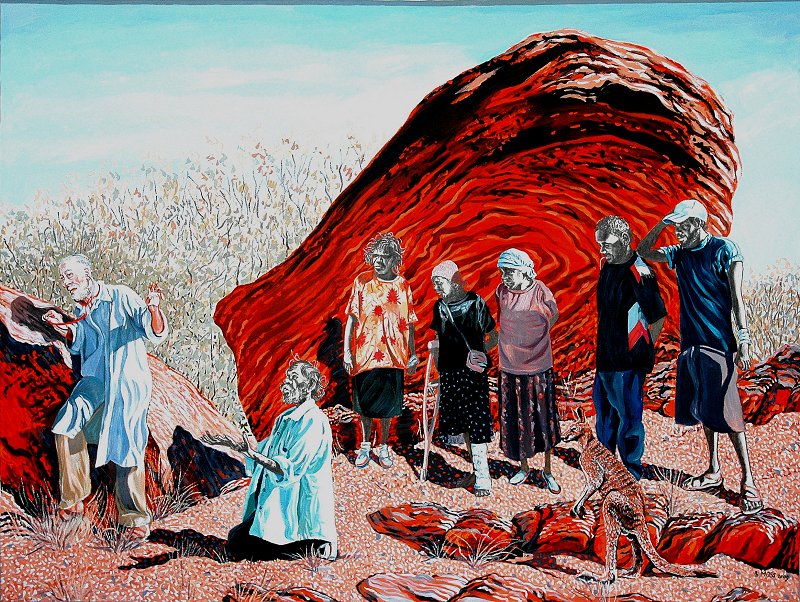
Wandering

My father’s father’s name was Joseph. Born in 1886 in Petach Tikvah in Turkish Palestine, Joseph Goldenberg stowed away on a ship at the age of twelve, passing his Barmitzvah date without celebration before disembarking alone in Australia. Papa, as his grandchildren called him, arrived here with five shillings, a working knowledge of Yiddish and Arabic, and no English.

He left his home and his family as a child, remaining an observant Jew throughout his lonely years until his marriage, and beyond, through a long life.

Dad used to say his father was like Joseph in the Bible, a faithful Jew from childhood to old age, steadfast through long exile and separation from his home and family.

Dad found lifelong inspiration in his father’s example.

My own father, Myer Goldenberg (z’l), grew up in Melbourne, married and took his bride, Yvonne Coleman, to the small Riverina town of Leeton, where the couple lived for 14 years, raising four children as knowledgeable and observant Jews. Dad never thought this was remarkable, but it was an unusual achievement and it certainly inspired this son.

Indelible memories come to me from time to time as I recite the Shema, of Dad teaching me to read and to translate every word of this, the first and the last prayer of our Jewish lives. I would sit on his knee, Dad holding his worn and oft-repaired siddur in front of me, his finger showing me each letter and his voice speaking these words time and again: and you shall teach them to your children, and you shall speak of them when you sit in your house,and when you walk by the way, and when you lie down and when you rise up…


A Jewish education of this intensity and intimacy is a rare and precious thing. It left this son with the unorthodox confidence that I could live an orthodox life fully and independently anywhere, with or without a community or a congregation to support me. My father’s example assured me that my own observances, my Jewishness, were proof against distance. Dad had taught me how to be a Jew as I walked by the way.

Dad never had any delusion that distance was a good thing. Well before we reached Barmitzvah age, Mum and Dad had resettled the family in Melbourne, where Dad showed (through his subsequent scores of years of service to Shules,) that the question was not whether he needed a congregation, but what could he contribute to one.

But the ‘harm’ was done. By the time we left Leeton, I had absorbed my father’s aberrant example of distance-proof faithfulness; and ever after I have lived a maverick belief in walking by the way, to remote places, well off the Jewish trade routes, taking with me the observances my father taught me. Over the decades, that phrase in the Shema has come to hint to me that a Jew should actively go bush – as Moses did in his shepherd days, as Elijah did while on the run from the king – to find God.

How did I know about Moses and Elijah? How too did I know about the midnight walk in the wilderness of Jacob; and of his encounter with the wrestling angel? It was Dad’s fault, of course: it had been Dad who brought these heroes of the spirit to life within me.

And so it was that I’d bake challah (read damper) in Leigh Creek, read Megillath Eicha by candlelight in Arnhem Land, host the Jewish residents of Alice Springs for Shabbat meals, discuss Zionism with a knowledgeable Elder in the Ngaanyaatjarrah Lands, sing Hebrew songs with one of the Strong Women at Galiwin’ku, sound the Shofar in Ellul at Wamoom; and celebrate Shabbat in the Andyamathanha wilderness with one of Melbourne’s leading rabbis.

(And so it was that I was been absent so often and so painfully from shules, from tolerant children and perplexed grandchildren, from a neglected wife and from a lonely mother.)

All of this unorthodox conduct had some unexpected results. I found what Joseph finds when sent by

his father to “see the peace of his brothers”. Wandering, lost in the wilderness, Joseph meets a mysterious stranger who asks – in a singular phrase – “what will you seek?”

Joseph replies, in a sentence that is equally pointed

syntactically, “(it is) my brothers (whom) I seek.”

The brothers whom I found are the first Australians. In encounter after encounter over a decade or more I have met and worked with Aboriginal people in the outback, discovering much about them, more about my

Jewish self, and writing, writing all the time of these experiences.

(That writing gave birth to a book, Raft, launched at Melbourne Writers festival in 2009.)

And deeply moving to me were those experiences as a practising Jew, when alone in God’s creation, I’d wrestle with the angel, and where I’d catch the echo of a still soft voice.

And, morning and evening, as I’d rise up and lie down in those far places, I’d recite the Shema, that prayer of portable Judaism that my father taught me.

Road to Recovery – (my piece published in Australian Financial Review)

Road to Recovery Financial Review article

This article appeared in the Australian Financial Review 3 January 2014. It first appeared in the Griffith Review 10th anniversary edition in 2013.This story is an edited version of a piece that will be published in 2015, in an upcoming book entitled ‘Burned Man’.

Exultation is

Exultation is 

The going out

Of an inland soul

To sea

The train leaves Southern Cross right on time at 7.10. No queueing, No Security. No fumes.

The price of a cup of coffee at Southern Cross does not amaze the buyer nor does the drink disgrace the bean. (The cup is of paper; you can’t have everything.) Once aboard, no safety sermons, no-one forbidding standing or moving about the cabin, no weight limits, no serpentine lines of tired, tense travellers with toddlers to repress.

How old fashioned this iron caravan. The carriage rolls, moving in its jazz rhythms forwards, side to side, moving as it did in the rides of childhood, in those long slow rides across time, across the wide, dry land, singing clickclack past silent mobs of kangaroo, putting to flight soundless pink-grey clouds of galah, slipping past indifferent cows looking at me in philosophic enquiry, rolling past stands of eucalypt, no two gumtrees the same, every one the same – whether elegant, smooth and pastel, or scarred, twisted and greygreen – every gum tree declaring I am Australia, I survive, I thrive, I endure, every gumtree bearing, proffering vital knowings.

Only the cabinet has changed. Gone is the sign requesting passengers not to use the appliance while the train is standing at the platform. A press of a button, an airliner’s hiss, and everything disappears without trace.

The twenty-first century city, where they’ve gone about as far as they can go, the city, with its looming concrete overpasses, its car-teeming freeways and tollways, its roar and bustle, its gouging, its uprooting, its foetid air and gritty, its smoking and choking, its babel towers rising up to the heavens, its pavements grey; this great, enfolding and alarming home to millions and to me; this violence, this violation, this nature denying, this horizon hiding, this coded mute cry, this city slips away. And I ride.

The ride beguiles. It seduces. It invites nostalgic romancings of the past, endless retrogression, convenient forgettings of how railways were themselves violators of countryside, the out of control, accelerating agency of dangerous change.

The train to Albury accelerates, exhilirates into the green.

And for all that nostalgia is malignant – 

acceleration is/the going out/of an inland soul/to sea

Past the houses, past the headland/to deep eternity…  

A nod to Yeats, a filching from Paterson and a bow and apology to Emily Dickenson.

Patriots Day 2013

The Boston Marathon is the oldest and most celebrated of the mass marathons. You need to qualify. Twice I qualified and ran. in 2005 I ran again, this time as fundraising runner. I never won the race: hometown decisions, I guess.

Today’s Boston was to be my fourth. I was running as a fundraiser, this time for the Michael Lisnow Respite Centre. This morning I visited their HQ in Hopkinton, near the starting line. I met people who face their colossally difficult lives with genuine joy. I met the fundraisers who punctuate their serious marathon training by devoting themselves for months to help fund this small enterprise.

Why am I going on at this length about these small matters in the face of the bombings?

You need to be in Boston on Patriots Day to appreciate the celebration that is the Marathon. A city of less than one million comes to a stop; people take their chairs, their picnic rugs, the treats they will give to the runners; they line the 26.2 miles and stay all day, cheering on every runner; they hold banners – everything from “You are all Kenyans” to “Kiss me, I’m flexible”.

Picture Melbourne on Cup Day or Grand Final day without the booze.

Boston is high on its marathon and the runners. Patriots Day is the time to enjoy the embrace of the people of Boston.

If you have the good fortune to be a charity runner, you run at the tail of the field, feeling that embrace, the surges of love for the people – usually young – who are supporting local causes. Often the fundrunner commemorates one lost or saved or suffering the disease she runs for.

One young woman survived melanoma; another is in remission from her leukaemia. I have close relatives saved from those diseases. So, apparently, do hundreds in the crowd who roar their gratitude.

One, a spoonerist, runs with the words: Cuck Fancer. The crowd echo her sentiment.

Someone else came to the Marathon today with a different purpose than to celebrate. Someone whose malignity exceeds his knowledge: his bombs exploded near the finish around the four-hour mark; in an elite marathon like this, the ‘bulge’ – the greatest concentration of finishers – occurs 30 to 60 minutes earlier. The terrible toll might have been much heavier.

I plodded to the 22 mile mark, when a spectator offered me a slice of orange. His kindly young face looked troubled. “There have been explosions near the finish line. The marathon has been temporarily suspended.”

Naively I ran on. Perhaps they’d resume the event.

A mile further on, I was one of very few still running. Police and runners were mingling on the course, faces troubled. Hands held mobiles, sending text messages; local phone coverage was out. Some wept wrenchingly, their features distorted in grief or shock or anxiety for others ahead on the course. Many had relatives waiting near the Line.

My progress from mile 22 to 25 was slow. The crowds fell quiet. Overhead, helicopters gathered and clattered. Police vehicles racing everywhere, ambulances, sirens shrieking, tore between barriers as the crowds melted out of their path. Not for the first time, the matter of placing one foot in front of another felt slight. Here was immediate danger and evident bloodshed.

Police turned back those of us who were running into danger. I needed to contact family – in Boston, in New York, in Israel, in Australia (where I had bled my friends to donate to the Respite Centre). I had no phone. Strangers handed me theirs, refusing my offers to pay. I asked a teenager for directions to the Citgo sign, a local landmark, where my relatives would collect me; the teen insisted on escorting me the mile distance to make sure I found it.

As I waited, strangers seeing this stranded runner, stopped to offer help. One bloke, himself a (non-marathon) runner, wanted to give me his jacket so I wouldn’t get cold. Passers by touched me, or took my hand to shake. One stopped, gazed at me, shaking his head. He said, “I am sorry.”

Boston silenced, in shock, in grief. Its citizens reaching out to each other in spontaneous solidarity,as we see repeatedly in Israel following such atrocities. More than that, people felt implicated in a wrong, embarrassed: their guests had been hurt, frightened, frustrated. They turn their goodness upon me and I feel like crying.

A terrible beauty born.

Monanism

English: MONA - Hobart, Tasmania

English: MONA – Hobart, Tasmania (Photo credit: Wikipedia)

MONA is the Museum of New and Old Art in Hobart.  All of its promotional materials are written with tongue lodged firmly in cheek. One such refers to Monanism, a play on Onanism. This in turn is named for Onan, a figure in Genesis whose wife had suffered bad luck with her previous husband: he went and died on her. Onan decided to prevent pregnancy. He did this by spilling his seed on the ground, at once giving rise to the eponym and leading to the naming, some three millennia later, of a parrot in the USA. (Onan the parrot belonged to Dorothy Parker, who named him thus because the bird too “spilled his seed upon the ground.”)

MONA is remarkable. Submerged in a hillside it is a museum without windows. Visitors are entombed for the duration of their visit. Dominant themes of the artworks are sex and death. All this might warn off a visitor, suggesting a visit will be a dark or morbid experience. This in turn is the museum’s little joke at its own expense, an instance of Monanism at play.

Cynics who view Hobart as Australia’s petrified forest – views that are themselves stale and petrified – simply feed into the joke and the pleasant surprise that is MONA.

We* visited MONA yesterday. It is fabulous. The entire experience is exciting, playful and confronting. To remark that the collection is eclectic is to discover how inadequate and weary is that term for artworks that range in date from antiquity to today, to tomorrow. And to some time well beyond tomorrow.

My two favourites are Arthur Boyd’s “Melbourne Burning” and another work, commissioned for MONA and titled “Untitled”. This looks like a giant spud; it’s about the size and shape of a Morris Minor motor car, and like that vehicle, it has small windows through which you can peer into the interior. Here, red apples fall vertiginously from the grip of finger-like branches at eye level towards small wells, or open cupolas, containing water. The effect is enchanting, both magical and charming. And mysterious. I looked and felt as Moses might from a mountain peak in Moab: I could see but never hold a view of endless allure and promise.

(It should be obvious that I cannot recall the name of the artist; it’s an Armenian name. Like his work, he remains untitled…)

Boyd’s “Melbourne Burning” recalls a work by Breughel the Elder. It expresses the artist’s mixed up, unnamable and profoundly distressed reactions to WWII. In the painting life both destroys itself and asserts itself in grotesque and cruel ways. I have not been moved so strongly by a work about war since viewing Picasso’s “Guernica” in MOMA (no relation to MONA).

My mind exercised itself throughout the visit. Tracey Moffatt’s mixed painted and photographic work is as brilliant as anything there. This Aussie artist (of mixed extraction, including Aboriginal) stands as a peer alongside any of the ambiguists and tricksters at MONA. Her work, “Something More”, seeks to confuse meanings – particularly of cultural identity – by emphasizing its own ‘fakeness’. (Wikipedia)

In my experience, culture is very hard on the feet: a trip to an art museum always leaves me footscore. Not so at MONA.  The experience set my mind to dancing. But my feet feel fine. [Unlike old Onan, who, soon after his marriage, left his bride a widow once again (See Genesis, 38, vv 1-10).]

*This blog has a spouse who accompanied me to MONA.

Bostonians reach out and turn their goodness on me

The Boston Marathon is the oldest and most celebrated of the mass marathons. You need to qualify. Twice I qualified and ran. In 2005 I ran again, this time as fundraising runner.

Today’s Boston was to be my fourth. I was running as a fundraiser for the Michael Lisnow Respite Centre. This morning I visited their HQ in Hopkinton, near the starting line. I met people who face their colossally difficult lives with genuine joy. I met the fundraisers who punctuate their serious marathon training by devoting themselves for months to help fund this small enterprise.

Why am I going on at this length about these small matters in the face of the bombings?

You need to be in Boston on Patriots’ Day to appreciate the celebration that is the marathon. A city of less than one million comes to a stop; people take their chairs, their picnic rugs, the treats they will give to the runners; they line the 42.4 kilometres and stay all day, cheering on every runner; they hold banners – everything from “You are all Kenyans” to “Kiss me, I’m flexible”.
Picture Melbourne on Cup Day or Grand Final day without the booze. Boston is high on its marathon and the runners. Patriots Day is the time to enjoy the embrace of the city’s people.

If you have the good fortune to be a charity runner, you run at the tail of the field, feeling that embrace, the surges of love for the people – usually young – who are supporting local causes. One young woman survived melanoma; another is in remission from her leukaemia. I have close relatives saved from those diseases. So, apparently, do hundreds in the crowd who roar their gratitude.

Someone else came to the marathon today with a different purpose than to celebrate. Someone whose malignity exceeds his knowledge: his bombs exploded near the finish around the four-hour mark; in an elite marathon like this, the ‘bulge’ – the greatest concentration of finishers – occurs 30 to 60 minutes earlier. The terrible toll might have been much heavier.

I plodded to the 35-kilometre mark, when a spectator offered me a slice of orange. His kindly young face looked troubled. “There have been explosions near the finish line. The marathon has been temporarily suspended.”

Naively I ran on.

A kilometre further on, I was one of very few still running. Police and runners were mingling on the course, faces dark. Hands held mobiles, sending text messages; local phone coverage was out. Some wept wrenchingly, their features distorted in grief or shock or anxiety for others ahead on the course. Many had relatives waiting near the Line.

The crowds fell quiet. Overhead, helicopters gathered and clattered. Police vehicles racing everywhere, ambulances, sirens shrieking, tore between barriers as the crowds melted out of their path. Not for the first time, the matter of placing one foot in front of another felt slight. Here was immediate danger and evident bloodshed.

Police turned back those of us who were running into danger. I needed to contact family. Strangers handed me their phones. I asked a teenager for directions to a local landmark, where my relatives would be; the teen insisted on escorting me.
As I waited, strangers stopped to offer help. One bloke wanted to give me his jacket so I wouldn’t get cold. Passers by touched me, or took my hand to shake. One gazed at me, shaking his head. “I am sorry,” he said.

Boston silenced, in shock, in grief. Its citizens reaching out to each other in spontaneous solidarity. More than that, people felt implicated in a wrong, embarrassed: their guests had been hurt, frightened, frustrated. They turn their goodness upon me and I feel like crying.

A terrible beauty born.

Reproduced from The Age 17 April 2013.

The Age Boston piece

20130417-084521.jpg

Spring is Here – Get Ready for Summer

Great Britain, April, 2013.

There is news of a sighting. More precisely, there’s a report that someone in Bristol claims a sighting. It might even be true – perhaps the someone did sight the sun in Bristol, briefly, the day before yesterday. The day before I arrived.

In Whiteladies Road, Bristol, a sandwich board is full of sunny optimism: SPRING IS HERE, it sings, GET READY FOR SUMMER. The advice that follows makes alarming reading:

FULL LEG 10 pounds

BIKINI 15 pounds

BRAZILIAN 18 pounds

No-one in Bristol should shed nature’s protective fur. For that matter, no-one anywhere in Britain ought to follow that advice.

***

Gippsland Lakes, Victoria, Australia, March, 1990.

A lady, middle-aged, bellows across the water from the deck of her rented yacht. She projects her fruity English accents in the direction of Dad’s boat. My aged uncle sits on Dad’s deck, enjoying the day’s end.

The early evening has turned decidedly cool. Dad and his crew shelter below decks, while Uncle sits above, nodding pleasantly from time to time in the English lady’s direction. As dusk descends, Uncle, who is deaf, drinks in the peace.

The English lady and Uncle have not been introduced. The lady is pleased to share her life story with Uncle. She tells him about her travels and her maritime experiences.

Visiting the daughter, actually. Lives here in Orstraliah. Married here, what?

Uncle nods, smiles.

Always enjoyed boating, all of us. Cowes Regatta, what not. Husband’s vice commodore there.

Another nod.

Cool evening. Reminds one of a coolish time at Cowes. Husband and I went for a quiet evening sail. Left the club, tooled around till dark, turned for home. Monster squall blew up. Caught us unawares – below decks taking cocktails. As one might – moon above the yardarm, what?

Uncle – watching a pelican gracefully spilling air, gliding, teasing his sight in slow, elegant inevitability – misses his cue, fails to nod.

His locutor raises her voice helpfully.

Nasty Squall. Tipped the bally boat over. Husband and I took to the dinghy. Squall passed. Squalls do. Boat out of sight, had to row to land.

Uncle, enjoying the first stars behind the lady, looks attentive. From time to time, as her jaws come to rest, Uncle obliges with another nod.

Rowed all night. Dashed cool by morning. Rowed right up to the jetty at the Club, there’s Reginald, Club Commodore, strolling along the pier. Calls out to us: “Lovely morning for an early row.”

One had to explain: ”Not rowing for fun, Reggie. Bally shipwrecked. Learned something from the experience, though: never knew the purpose of hairs on one’s pussy, Reggie – keep one warm in a shipwreck.”

Copyright, Howard Goldenberg, 7 April, 2013

What I Have Been Doing With Your Donated (and Undonated) Monies

Late Training Notes from the Bristol Downs.

I promised to report on your Unusual Investment. (If, as you read this, you don’t know about that Investment, please visit these links http://hopkintonrespite.com or
http://www.youtube.com/user/HopkintonRespiteTV
It is not too late for your dollars to join the nearly-four thousand dollars that preceded yours, whose donor investors will never see them again.)
Since I first wrote to you the grass has not grown beneath my feet. A certain amount of tinea has, but this is inevitable: I have been training hard. The Boston Marathon will be run on Monday 15 April and investors in my little Scheme are helping the Michael Lisson Memorial Respite Centre.
Michael’s mother, who created the Centre, wrote one week ago, reminding me that Michael died on the day of the 100th running. I ran that day, unknowing. Now I know and marathon running feels like a small matter.

They ought to call the Downs the Ups, these vast, everlasting, uptwisting hills. Or the Steeps. From one end of the Downs you can’t see the other for distance. And even if you could, you couldn’t – because of the mists. In spring, season of mists and frosts.

My father, not a lewd man nor crude, told few risqué jokes. However this semi-liquid air brings to mind one of Dad’s one-liners: Did you hear about the man who took his girlfriend out into the night air and mist?

Enough complaining. Hilly Bristol, like coastal Israel, is terrific training ground for Monday’s Boston Marathon. We’ll run up the Newton Hills between miles 18 and 21, hills famous for breaking hearts, but the Bristol Ups, like the long, high dunes of Herzliyah, have toughened mine.

This is my race preview. I have trained long and hard, six days a week, resting only on the Sabbath. Each run feels easier than the last. Gone is the sense of labour in a run of a mere hour’s duration. My legs feel wonderful, muscular and light. There is the little matter of the creaking discomfort in the left knee – my good knee – a new sensation. The knee hurts only when it bears weight. Best ignored.

With the exception of a 3.5 hour run in the Jerusalem Forest all my training runs have been solitary. This is not of my choosing: running with a friend is four times easier than running alone. This is true for all runs, over all distances. I know: I have done the maths. However all my friends have stopped running; they have heard the call and they have gone inside for dinner or for breakfast or to their homework or to dull duty. So I run alone.

In Bristol Alfred Lord Tennyson has kept me company. Some fluke or inadvertence has selected the poems of Tennyson on my i-phone. Useless here in the UK for telephony, my i-phone has become the perfect companion. Deaf and mute to the world outside my earbuds, my Apple sings the songs of my choosing, or in this case, the poems of my non-choosing.

He was keen on death, was Lord Alfred. From ‘Ulysses’, where he found romantic allure in Death, the Adventure; to the dying of King Arthur; to the demise of the Lady of Shallott; through lyric after lyric, the Laureate spoke to me, morning after morning, of death. Last Sunday he spoke to me at great length of the loss of his friend Arthur Hallam.
Endless his grieving, dark his spirits, Tennyson’s mood finds its echoes on these misty Downs.

That day found me running near the railing that kept me from stepping out into air and falling hundreds of feet in near-dark to the river, tirra lira, below. A blaze of red in the gloom, patches of white at shoulder height; what are these? A brief breather is permitted. The patches of white turn out to be cards, handwritten by members of a local junior cricket team and a junior football team, in memoriam to a teammate. The blaze of red is a football club scarf inscribed in black marking pen: Russell Simmons # 14.
Fresh posies of daffodil and another, paler flower, bloom from the railings.

No-one else in sight. No-one to ask or tell. No-one else to lament. My head bends, defeated. A sudden roar, a cry of raw sorrow bursts from my throat. My voice thickens, my eyes are wet.

Running is an easy thing, marathon training now trivial.

Shaking my head, shaking it to shed reality, I look up once more. There are more words to be read on that blood-red scarf: You’ll never walk alone.

Postscript: Afterwards I Googled Russell Simmons, deceased Bristol sportsman, and felt still sadder.

Copyright, Howard Goldenberg, 10 April, 2013

20130411-184933.jpg