Five Hours to Run, Fourteen Hours to Write, One hour to Read

“Rain, Snow, Winds of Storm –

Nought shall make me afraid.”

Flying east from the West Coast every third person seems to be a slim female heading for Boston. All of them blonde, all appear younger than their years, all wear the BAA jacket from a previous Boston Marathon. They bring their own health foods which they chew with religious solemnity; they have no truck with airline pap. Heading east with the same purpose I feel those Boston stirrings. We pilgrims know our Mecca.

I recall my previous Bostons. Amazingly, for a runner of no real distinction, I’ve managed to run four of them. Amazing because you have to qualify for Boston, a feat I’ve never quite managed. In1987 I completed the Application Forms and addressed a begging letter to the Race Director:

Dear Mr Morse,

You might not be aware that Australia celebrates its two-hundredth birthday this year. You might also be unaware that Melbourne – where I live and run, and Boston – where you live and run, are sister cities. As you will see from my application my ‘qualifying’ time of three hours and thirty-one minutes is not quite fast enough. I believe I can run a qualifying time but Melbourne has no recognised marathon for me to run before the cutoff date.

I write to appeal to you: here is your chance to cement the Australian-American alliance. If we wait until Australia’s three-hundredth anniversary, I’ll probably be too old. Please consider.

Yours,

Pheidipides* Goldenberg.

Weeks passed. Months passed and no word. I needed to know, so I rang the Boston Athletic association and asked to be connected to Mister Morse. A voice came through the phone: Who is this?

I’m an Australian runner, running as Pheidip…

Are you the guy who wrote that crazy letter?

You’re all set. You’re good to go!

So I went.

That was a day like they’re forecasting for Monday – cold, wet, miserable. And triumphant.

Some time after the event I began to wonder whether Melbourne and Boston are indeed

sisters.

My brother-in-much-more-than-law, John, planned to run the one hundredth Boston with me. A member and regular runner with the New York Road Runners Club, he qualified easily. I planned to run Melbourne to qualify but the event clashed with the Festival of Shavuoth. I sure as shit don’t run on Shavuoth.

I approached the Melbourne people with a plan. I’d run the course one week early and they agreed to provide me with a certified time on presentation of a statutary declaration of my finishing time. They told me they’d mark the course one week early, and I couldn’t possibly get lost. I ran, I found no marks, and I did get lost – repeatedly. I ran with witnesses, doubling back whenever I took a wrong turning. We subtracted the time expended on

extra distance and came up with a net time of three hours and twenty-six minutes, comfortably inside the qualifying time. Boston honoured the Melbourne Marathon certificate and John and I ran together.

Although the arithmetic was scrupulous, it had to be wrong. In 1998 I wasn’t beating 3:30 by that margin. This time it was Boston’s birthday I honoured.

The third time I ran as a charity runner. I wrote to everyone I know, promising them an investment opportunity like no other. I offered an absolute no-risk guarantee: donor-investors would never get their money back. We raised over five thousand dollars to aid research at Boston Childrens Hospital, the great institution that saved the lives of my two nephews, and so many others. As usual in Boston, I ran poorly and felt fulfilled.

The fourth Boston I raised money for the Michael Lisnow Respite Center, yet another local institution where tragedy is transmuted.

That was in 2013, the year of the bombs. I was not permitted to finish.

Now once again I am a fundrunner, this time for ‘Stepping Strong’, the inspiring initiative of the parents of a lovely young woman whose horrific injuries almost took her life in 2013.

Five Bostons without a single dinkum qualifying time. The story of a fortunate man.

In Boston on race day I consult the weather forecast. Yesterday they predicted eleven degrees Celsius. Today they revise it down to eight.

American weather prophets express themselves in percentage probability. Today’s prophecy: one hundred percent likelihood of rain.

While I wait in the meagre shelter of the light rail station my body confirms the forecast. Hugging myself, clapping hands for warmth I wait glumly. The light rail ride is warm but all too brief.

I descend and hike to the bus that will take me to the Start at Hopkinton. Waiting in the line I shiver.

Once aboard the bus the old bloke next to me announces he comes from Nova Scotia. Stick thin, too tall to sit straight in the bus, he wears five layers including a windbreaker. Although he ran his last marathon in Dubai his body remembers the cold.

We introduce ourselves. He’s Robert. I extend a hand, he offers a collection of long bones: Glad to meet you, Howard.

Good to meet you, Robert.

We shake.

Robert aims to finish under four and a half hours. What about you, Howard?

What about me? Unusually, I haven’t identified a target for myself. I know I want to finish, something they wouldn’t let me do in the year of the bombs. That DNF leaves a scar in a runner whose sole boast is persistence. More than pride suffered wounds that day: belief was harmed as little Martin Richard, Krystle Campbell and Lingzi Lu died at the Finish in Boylston Street.

Before that day ‘The Finish’ never carried a double meaning. After Boston 2013, every ‘Finish’ carries a doubt.

I jolt myself from reverie. Forced to consider times, I know I want at least to beat my last effort, a painful four and a half hours on an Arctic day in Melbourne.

Boston usually lifts my spirits. Even with the bombings two years ago the mood abroad of unity and amity redeemed the day.

But the clothes I wear this day are not equal to the cold. Near me another veteran grumbles: there are only three things I hate at a marathon – rain, cold and wind. And today we’re gonna get them all.

Only minutes after leaving the bus I start to shiver as drizzle fulfills the prophet’s one hundred percent confidence. Memories of bone chill in my last marathon in Melbourne gloom me up thoroughly.

But Boston, being Boston, doesn’t allow a stranger to shiver: Take this jacket, sir. The volunteer has collected the jacket from a runner, one of the fleet of foot whose race has already started. Volunteer lady, twenty years younger than I, mothers me into the jacket, pulls the hood over my ears. There you go sir. Wear it until it gets too hot for comfort, then hand it to any volunteer and we’ll make sure it goes to the homeless. I begin to defrost and Boston brightens within me.

The announcer introduces our Starter. Wave Four, the slowest and the last to start, includes the bent, the broken and us ten thousand fundrunners who’ve raised funds for various charities. The Boston Athletic Association honours our Starter in recognition of her service to this village where she has conducted her family grocery since 1943. Big it up for the Hopkinton family grocer, folks. Usually too insubordinate – too Australian – to big it up when ordered, somehow I join the clapping for the grocer lady.

At some signal that I cannot hear nor see, Wave Four is released for the 26.2 miles. Now I shuffle, then trot, now tread a wary path between speeding legs that weave about my prudent hypotenuse. After one kilometre we start to run. This running is too easy; the steep declines murder muscles.

Before a marathon most runners prepare their ‘splits’, calculated times for each section of the race. My calculation is simple: never run a mile faster than ten minutes: any faster than this, I’ll burn up and be forced to walk the route into the early evening.

For ten miles I stick to my splits. After that time carries no meaning as I interrogate slowing thighs that have thudded down hill after hill. This strange sensation in my quadriceps muscles must betoken something, something portentous. A marathoner is a practised hypochondriac, fuelled by fears, searching ever for signs of doom, teasing meaning from meaningless sensations. Faced with the alternatives of hope and fear I elect to hope: let this thick feeling, this heaviness in the thighs reflect muscles bursting with all that pasta I took on board last night.

In this time without time I run inwardly, communing with my constant companions, doubt and fear. A voice penetrates, the public address: The leading runners just passed Heartbreak Hill. They’ll finish in a half hour.

The fundrunners on every side run for cures. My group seeks to cure trauma. Named for Gillian Reny, a nineteen-year old whose training to become a professional dancer was shattered with her leg, the ‘Gillian Stepping Strong’ team is as inspiring as that young woman, who dances her life yet.

Around me run the Liver runners, the Dana Farbers (cancer), the Cystic Fibrosis team, the Melanomas, the Multiple Sclerotics, Boston Childrens, Miles for Miracles, MR8 (for Martin Richard, aged eight). MR8 – a statement, a protest. Who can forget the carefree image of Martin with his wide toothy grin? The child wrote: No more hurting. Peace.

I recall another image. Standing with his back to the wall, his backpack at his feet, Dzhokhar Tsarnaev gazes impassively at the scene near the Line. Only a few feet in front of him he must see Martin and his seven-year old sister. He sees, he walks away, leaving his bomb behind the children.

Boston is healing but a fresh agony tears at this liberal community – the question of the death sentence for the bomber. Survivors and their families are painfully divided on the question. The voices I hear are Boston voices, measured, sober, heavy with unmediated pain.

Boston the town whose largest hoarding tolls the dead. The text reads in part, AMERICANS KILLED BY ASSAULT WEAPONS SINCE SANDY HOOK: 73,835.

Every runner’s singlet seems to memorialise someone. For Dad. Nigel and Luke. Barbara. Nanna and Nick. So many names, so many stories. The rain falls thickly now, drawing a heavy grey curtain and I do not venture to ask.

But the crowds refuse all gloom. Small children reach out and up from beneath umbrellas, high-fiving us grownups. Women whoop, men roar, the air screams benediction. Gloom begone!

We’ve passed through Ashland, running now between dark woods that line both sides of the road. Men dart from the track, turn their backs and drain overstretched bladders. An enterprising woman chases the men from the road. Does she plan to join them? No, instead she pees discreetly in the lee of a conveniently parked car.

Descending alarmingly still we pass through Natick. A lot of big beards here, tattoos, big stomachs. Harleys line the road. Music booms, the air rocks to Born in the USA and we ascetic creatures lift our feet, energized, at one with all them good old boys.

Uphill at last, then down, we’ve reached the Wellesley Hills. Here sing the sirens, the students of Wellesley College. The young women scream and carry placards, some subtle, some nearly subtle:

Kiss me, I’m from China.

Kiss me, I’m size D.

Kiss me, I’m French.

Kiss me, I do tongue.

A very married man, I blush and turn away, suddenly shy. But my legs respond. Lighter now, they want to bolt up the hills until I rein them in, reminding them of my ten-minute rule.

Around the halfway mark my legs declare themselves: they are just tired. This makes sense as my training has been limited to the half distance. Doubts bellow now, in chorus: Will you keep running? Will your resolve evaporate? Do you have the ticker? When will you give up and walk?

A huddle in black moving slowly to my right distracts me. I read the name “Achilles Club” on the black jackets of a group of four people who surround a racing wheelchair. Seated – no not seated – he’s half recumbent, in the chair is a black man, tall, not young. Two helpers drag the chair backwards up the hill, two others push from the front. The man has one operating limb, a leg that extends to the asphalt and pushes against it, helping to propel the chair backwards. I know the Achilles people, named for Homer’s wounded hero; they help people with disabilities to participate as athletes.

The hero in the chair silences my chorus. Abruptly I know myself again. I’ll finish this, and finish it running. This is only fatigue. That, and an exaggerated belief in my own frailty. A life lesson learned: I need to learn to give Father Time his due, but not to pay him in advance.

This certain knowing doesn’t buoy me much. There’s a bloody long way to go, it’s bloody unpleasant in this cold and wet, every step is hard, and there are no excuses.

Labouring onward I am visited by a thought, a sparkling discovery: This is stupid. I am too old for this. This will be the last. And just to confirm the resolution I add, No more! This sort of thinking is not new. I have thought this way during every one of my forty-five marathons. This time the decision feels compelling.

At every milepost I pause and drink a cordial composed of sugars, electrolyte and urine. Or something. I wash it down with a splash of water. These respites of thirty seconds allow muscles to recharge. I pick up my legs and for a time the going feels easier. Perhaps I was hasty. Maybe I needn’t stop doing this. I just need to train properly instead.

We start to climb what must be the outliers of Heartbreak, a hill whose start is undefined and whose finish is a coronary. These undulations have defeated greats: in the 1970’s Bill Rodgers won Boston four times; but on two other occasions he had to stop around here and withdraw.

HG Running Boston 2015

Refusing to look up, running now in my dour element, I know the drill. Steady and slow, plod, plod, up, up. Refusing to be lulled by the odd small decline, I remember and respect these hills. My wise legs, hardened on the granite grades of Wilsons Promontory, follow each other slowly, soberly, up, up.

My brain melts. Arithmetic fuddles me. Here’s the nineteen mile mark. The marathon is 26.2 miles. How many miles to go? Too hard!

Snatches of verse swim into my head: here in Emily Dickenson’s territory I seize upon:

I like a look of Agony

Because I know it’s true…

Shakespeare follows:

Blow, blow, thou winter wind

Thou art not so unkind

As man’s ingratitude…

Tennyson speaks to my remnant resolve:

Tho’ much is taken, much abides; and tho’

We are not now that strength which in old days

Moved earth and heaven, that which we are, we are…

Scraps from the Song of Solomon:

My beloved skips over the mountains

He leaps the hills.

This last fragment runs and runs, spooling endlessly, following the rhythm and tempo of my footfalls. I spend a long time – is it a long time? – I cannot be sure – with Solomon.

A cry from across the road: Uncle Howard! Uncle Howard! The crier is Ziva, my sister’s firstborn. At her side, sucking an enviably warm-looking thumb, stands her younger son Akiva, holding a placard in primary colours. The placard informs the field of thirty-two thousand that Uncle Howard is a champion.
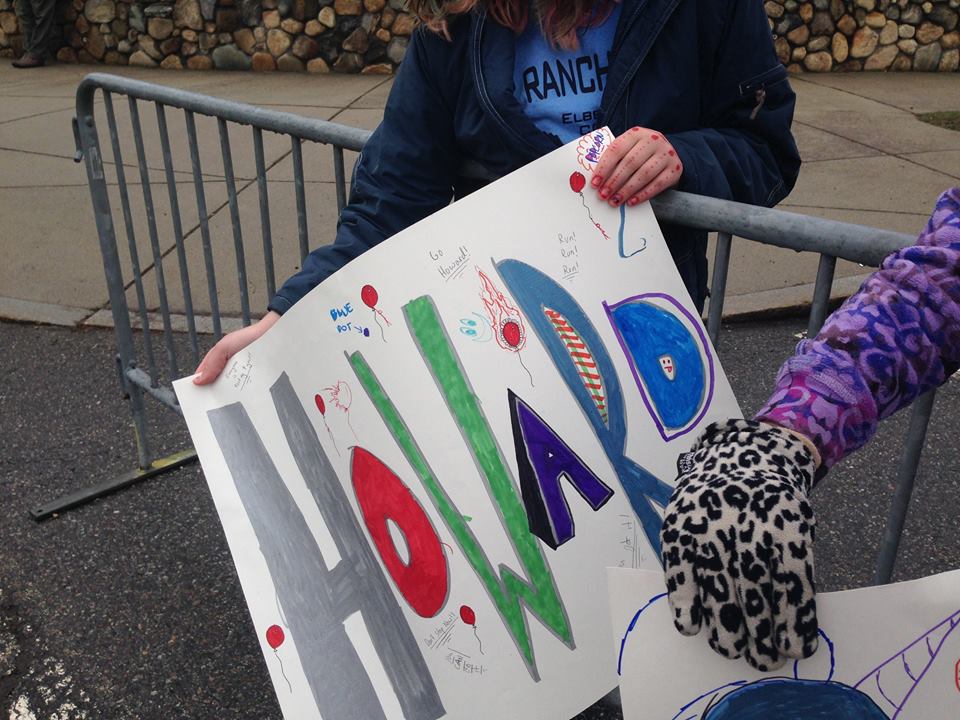
Howard sign

Akiva’s elder brother Elisha is not with us. He’s in hospital, recovering from a kick in the eye.

Shai black eye

The injured brother is represented by Grade Seven classmates, showing solidarity with Elisha. Some neighbours of Ziva have been gathered to watch her grateful old wreck of an uncle gobble a banana, reject a waterproof (too late), ignore the Coke Zero he requested, instead bolting and slurping electrolyte gels.

The uncle says sentimental things, kisses the niece, tries to kiss the great-nephew (who ducks adroitly) and runs off greatly cheered. Ringing in his ears are Ziva’s fatuous words – You’re running great, Uncle! – words he finds entirely convincing.

It is a still cheerful uncle who looks ahead and sights the stiffest and last of the uphills. Today marks the new moon of the month of Iyar in the Jewish calendar. Psalms from the day’s liturgy visit me:

This is the day the Lord has made –

Let us rejoice in it and be happy!

And that’s what happens. The way is long, the body is tired, but the mind is reconciled. I run on rejoicing.

Time to boast. Throughout the race I’ve been working the downhills. Instead of coasting, I’ve lengthened my stride – it hurts when I do this now – grabbing what acceleration I can. I tell myself I’m running an honest race, the best I can run. Steadfastly ignoring my stopwatch, I am yet aware my marathon pace is funereal. But some dumb pride glows as I run on, relishing the minute achievement of my imperceptible accelerations. I will run a Personal Worst today, which will yet be my absolute best.

Another boast: I recall a conversation between a champion marathoner and a commoner.

Slowcoach: I cannot believe your speed – running that entire distance in half the time it takes me.

Champion: And I cannot believe your endurance – running your hardest for twice as long as I can.

Today I will run nearly two-and–a–half times as long as the winner.

Ahead of me runs a solitary figure in pink, a youngish woman, quite tall, strong looking. Powerful shoulders emerge from her singlet; is she a triathlete? Whatever she is or does – this island – she piques my curiosity. Her independence wins my respect.

I recognise another woman, running like a draft horse half a pace ahead of me, the same Dana Farber runner I saw earlier wearing ‘Barbara’ on her singlet. She’s another island, plodding, oblivious of spectators and runners alike who are now jiving and singing along to a pounding ‘Sweet Caroline.’

I’d like to hear about Barbara. I pull alongside, am about to ask, then pause. I don’t want to hurt or shock the lady by referring to Barbara in an inappropriate tense, whether present or past. Please excuse me. Would you like to tell me the story of Barbara?

Briefly startled, the woman smiles: Yes, yes, I’d like that very much.

She tells me Barbara had cancer, but hers is a happier story. Thirteen years ago Barbara received a diagnosis of an aggressive, inoperable brain tumour. She might hope to live six months. At the time her children were three and one. She underwent treatment and was free of cancer for eleven years before the disease returned. This time it was six months.

I am so glad you asked me. I want people to know.

Moved by the telling, I murmur, It’s a sacred remembering her, speaking her name…

Yes, yes, I feel that too.

A young woman runner darts across our path from the far left to the barriers on our right. Crying words I cannot make out she throws her arms around two young women who stand together at the barrier. Three heads clinch in close embrace. The women exchange fierce kisses, then hold each others’ faces for a long moment in searching silence. Something has happened. Perhaps here, at this precise spot. Something tells me they arranged to rendezvous at this point. Was it here they heard the news two years ago, of a fourth – a friend? – when the bombs went off.

Running along Commonwealth Avenue now, only four miles to go. Only. Here’s a smallish lady, female, whose raincoat reads, Baby on Board. I pull alongside and cast an obstetric eye over her belly. Yes, she is.

How many weeks are you?

She smiles: Thirty-one. The doctors say it’s quite OK so long as I don’t overdo it.

Running a marathon is overdoing it – by definition. That’s the point of running the event.

She runs slowly, steadily on, looking quite comfortable. Slow as I am I outpace her. I leave her behind and ruminate happily on a new baby, a new life, some sort of consolation. If they call for a doctor, I’ll be ready.

Another familiar Dana Farber, this the one who wore ‘Nigel’ and ‘Luke’. Emboldened I ask, Those names you wear – cancer?

Yes.

Were Nigel and Nick twins?

Yes, identical.

Thud. No further questions asked, none required. The woman’s soft look must mirror my own; a sorrow shared.

Past the Citgo sign we turn. Soon we’ll see Boylston Street and journey’s end. But the 25 milepost forbids excitement. This is one subtraction I am equal to. The one mile that remains feels like a long sentence to serve. But the sentence is not solitary. I share it with the lame, the very elderly, the damaged runners, as well as quite a few who appear young and fit. We leave behind the tall pink girl, now walking, stolid still, and solitary.

From either side of the street the crowds hurl waves of noise, calling, cheering, praising us all in an ecstasy of joy. They love us. They love me. Our effort is theirs, our success their own.

Boston claims us, lives through us. Amazed, uplifted, I burn. And run steadily on. Down Hereford Street now, it’s roses, roses all the way. Here’s where they turned me back in 2013. I look around me. Police again are everywhere, but calm, calming, part of the Boston polity, our protectors.

The final turn. Three hundred metres to go. I can race this. I raise rusted knees, swing mechanical arms, rise up onto blistered toes and chase. No chance I’ll catch that young bloke five metres ahead and to my left; he’s racing too. That young woman just ahead has picked up speed as well. Bugger it: let’s go for gold! I sweep past the racing girl. I chase that young buck, knowing it’s futile, joyous in full-blooded pursuit. The feet beneath me fly over the wet roadway towards the Line, a royal blue slash just ahead. Ten metres out, I find a bit more. I lunge and vanquish Young Buck. We shake hands and I stagger a bit.

Medals, drinks, foods, fruit, Medical – all straight ahead! Keep going straight!

One hundred long metres further on a woman wraps me in an insulating foil robe. Ahh, that’s better. Another lady garlands me with the familiar Boston medallion, the weightiest trophy marathoners know. They are not young, not glamorous, just kindly, just volunteers – Bostonians. And we runners love every one of them, all nine thousands of them.

I turn around and sight Ms Pink, striding slowly across the Line. Her gaze nowhere, she’s mindless of completion. Her face is distorted and drenched. This is not rain, she is crying.

*For quite understandable reasons of security BAA requires a runner’s name to match that of the photo ID. Farewell, Pheidipides the brave, my hero since third grade!

I post this long report so a reader can feel the long slog of the marathon.

Additionally I offer and dedicate this post to the generous blog followers who donated to Stepping Strong.

If you missed out on the privilege of giving, please be aware the fund accepts donations until June 30. You can give soon and give often. https://www.crowdrise.com/brighamwomensboston2015/fundraiser/pheidipidesgoldenber
News Flash

NEWS JUST IN, FROM OUR MAN ON THE SPOT IN HOPKINTON, MASSACHUSETTS


BOSTON MARATHON CONTESTANT, PHEIDIPIDES GOLDENBERG, (RUNNING INCOGNITO AS HOWARD GOLDENBERG), WILL COMMENCE RUNNING ON APRIL 20  AT 1115 HOURS, BOSTON TIME.

THIS CORRESPONDS TO 0115, AUSTRALIAN EASTERN TIME ON TUESDAY 21 APRIL

KEEN JUDGES PREDICT  PHEIDIPIDES’ ELAPSED TIME (WHICH WILL INCLUDE TWO COFFEE BREAKS) AT 4 HOURS AND 45 MINUTES, CORRESPONDING TO A FINISH TIME OF 0600, AEST, TUES 21 APRIL..

THE THRILLING NEWS IS YOU CAN FOLLOW PHEIDIPIDES’ PROGRESS AT http://www.baa.org.BAA.ORG, BY KEYING IN HIS BIIB NUMBER = 25666  

MANY FANS AND FOLLOWERS TRADITIONALLY STAY UP ALL NIGHT ENJOYING ‘WAITING FOR PHEIDIPIDES’ PARTIES

THIS IS TO BE ENCOURAGED: WATCH YOUR DONATIONS MAKE THEIR PAINFUL WAY TO THE FINISH

ANY EMPLOYER WHO DOCKED A WORKER’S PAY THE FOLLOWING DAY WOULD BE UNAUSTRALIAN 

Where Do We Come From, What Are We, Where Are We Going?

This blog has spent the Passover period training for the Boston Marathon. Training has consisted exclusively of that intensive form of carbo loading which is the consumption of loads of matza. As matza is highly constipating carbo unloading has presented a challenge. Reminiscent of Martin Luther, who struggled mightily with his bowels, the Passover observer passes little.

In short I have been busy: as a result the blog has followed the admirable maxim of the ancient Sages of the Mishna: “Do much, say little”.

Shortly the blog will have much to report: of a visit to sit at the feet of another Ancient Sage, Dr Paul Jarrett, 95-year old surgeon of Phoenix Arizona; of fetching myrrh to Jack, the new babe born unto us Goldenbergs in San Francisco; of drinking GOOD COFFEE ! in New York City!!! (at ‘Little Collins’, my nephew’s celebrated joint on Lexington Avenue); of learning the latest in neuroscience from Joseph John Mann at Columbia Presbyterian; of Shabbat observing in New Rochelle; of entraining to Boston on the Sunday; and on Monday 20 April of observing Patriots Day in Boston.

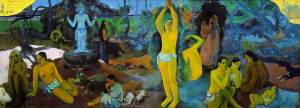
On Patriots Day much is afoot in Boston, when this Athens of the United States becomes Sparta. The public holiday commemorates the ride of Paul Revere and the start of the American Revolution. (I refer to Boston as Athens as an incubator of wisdoms but also as the place of Gauguin’s masterwork, ‘Where do we come from, what are we, where are we going?’ That painting and its title encapsulate the entire enterprise of human storytelling.
The painting is strategically located in a gallery situated directly across the road from Dunkin Donuts [Aussies must indulge the local spelling] where the donuts are certified kosher. But I digress.)

gauguin.org.au

For us runners Boston is THE marathon. More broadly, Boston, most humane of cities, hosts the most charitable of marathons. The event admits both the athletic elite and the footslogger, those who qualify by their speed over 26.2 miles and those who qualify solely by fundraising. I belong to the fundraising sluggards. This will be my fifth Boston, a further opportunity to put my feet to the service of the good. Unavoidably we come here to evil: in my old home town of Leeton a bride who loved the colour yellow is murdered unaccountably one week before her wedding day; in Boston bombs explode the innocence of thirty thousand runners and one million natives. Three die, two hundred and sixty four injured – many grievously – survive.

And I ask myself: Where do we come from, what are we, where are we going?

The small town of Leeton turns out to honour lost youth: multitudes gather in the park wearing yellow; married women hang their bridal gowns on front fences; on the victim’s planned wedding day brides all around the country add a dash of yellow to their apparel.
In Boston the city grieves, runners shake their heads, and return to the marathon with intent. Among them is one Gillian Reny.

“The Gillian Reny Stepping Strong Fund at Brigham and Women’s Hospital will support life-giving breakthroughs in limb reconstruction, bone regeneration, orthopedic and plastic surgery, and skin regeneration. Established by the family of Gillian Reny—a young, pre-professional dancer who was critically injured in the 2013 Boston Marathon bombings—the fund will fuel cutting-edge research and clinical programs in three areas:

Stepping Strong Research Scholars
: The Research Scholars project has two components: using stem cells to advance bone regeneration, and developing better methods to regenerate skin and heal wounds to reduce the suffering of amputation.  

Stepping Strong Trauma Fellowship
: The Trauma Fellowship will train the next generation of trauma surgeons in advanced techniques for treating acute and complex traumatic injury. Fellows will gain proficiency in surgical management, rehabilitation, limb reconstruction, and scar management.

Stepping Strong Innovator Awards: 
To inspire innovative research in areas including limb regeneration, limb transplant, advanced stem cell technology, orthopedic and plastic surgery, and bioengineering, BWH will offer Innovator Awards through an annual, competitive, request-for-proposal process. These awards will fund high-reward projects by our best and brightest physician-researchers.”

This is the good for which my feet will run on Monday April 20. This, like the wearing of the yellow, is the good that transcends evil. This is the good to which you can contribute. Go to:

https://www.crowdrise.com/brighamwomensboston2015/fundraiser/pheidipidesgoldenber
Back to Boston

Running a marathon is an undertaking of but a single dimension. At least that is how it appears to the non-marathoner: the runner places one foot in front of another and repeats that act 42,184 times. Inexplicable to many, perverse in fact. And in the course of the event the runner herself might feel the same: there is but one dimension which is distance. In physics we call this Space and it implies a further dimension which is Time. But we runners can quite forget time, becoming oblivious, entering a kind of fugue state. The corresponding sole dimension in the body is fatigue, a fatigue singularly profound in the lives of the modern first-worlder. And the moral or spiritual correlate is courage or the pursuit of courage.


In the course of the career of the continuing marathoner that analysis undergoes change. The change occurs by evolution or by revolution.

For some that revolution, that turning over, occurred at Boston in 2013. I ran Boston that day. I was among the thirty thousand on the course whose lives changed. We were outnumbered by the three million, the people of Boston who take us into their homes, who take us to their hearts, whose day of days is the third Monday in April, Patriots’ Day. Those people, acted like a polity wounded. The wound was psychic and social, a wound that was the denial of the hospitable self of Boston. On Patriots’ Day one million of the citizens of that small big city come out and stay out to watch their home event. They come out early and they stay late, cheering on not only the swift Kenyan but the aged Melbourne schlepper. To all they offer oranges, bananas, jelly snakes, beer, sausages, and Vaseline as groin balm.

The bombs went off and Boston exploded in grief and contrition. The world had come to celebrate the folly and the freedom of running too far; the world was their guest and abruptly the ceremony of innocence came to an end.

Too slow, too tardy, I missed the Finish Line explosions. Turned away by police at the top of Boylston Street I walked away through stunned and grieving Boston. Evening came on, the chill came down and Boston offered me the use of its i-phone, the gift of a jacket, the shelter of warm shops, the gentle pat on the shoulder. Bostonians wanted to drive me wherever I needed to go, then walked miles out of their way to conduct me to my family meeting place.


I flew home the next day.


Ever since Boston has sent me reports on its healing and rehabilitation. Most telling have been testimonies of the injured. One wrote of her amputation, her new prosthesis, her learning to walk and her completing the marathon the following year.


The research community of Boston has wasted no time in applying its collective brain to research into trauma and recovery. You can read some testimonies by clicking on this link.


http://www.nytimes.com/interactive/2014/04/13/us/100000002820641.mobile.html


In October last year Boston wrote and invited me to run as a guest in the 2015 marathon. Having just recovered from injuries (self-inflicted!) I leapt into training. And I decided to support the Stepping Strong Team that raises money for research into trauma such as Boston experienced. My wife and my daughter are psychologists, both practising in the field of trauma. Between them they have nearly fifty years’ experience in a field that is as endless as human cruelty. I see the work they do and the need. I wrote on the subject in yesterday’s Age:

http://m.theage.com.au/national/when-a-helper-needs-help-20150328-1m646f.html


I want to raise $1000.00 for the Boston research. I’ve kicked it off with $180.00 of my own. Please read and consider: if you want to make a contribution you can do so at https://www.crowdrise.com/brighamwomensboston2015/fundraiser/pheidipidesgoldenber


Atul Gawende and the Cane Toad

Running along the road in the early mornings through the sleeping town and out through the canefields I ruminate on Gawande’s important recent work, ‘Being Mortal’. I think of the quick and the dead and I think of the slowing that comes to the quick before they join the dead. 

Before me, beside me, ahead and behind lie cane toads, flattened by motor cars. Quick as they were but yesterday, they were not quick enough. Now they lie about me, very dead.


How, I wonder, does the cane toad die? I mean in nature, without cars, wheels and tarmacadam? Does Old Toad embrace his kin, exchange farewells, lie down and, like the stoic Inuit, wait? Does he – or do his relatives – euthanase him with their poison? It is to the merit of Dr Gawande that my thoughts soar to such heights in the mellow time before sunrise.


Back at the hospital I ask my fellow doctor, ‘How does the cane toad die when the motor car won’t put him out of his misery?’

Dr Danny is a Queenslander. He knows. Over ten minutes he enlightens me: ‘Scientists introduced cane toads to Queensland to defeat the cane beetle that was eating the crop. The idea failed – wrong toad, wrong beetles. Both thrived. The toad multiplied, spread throughout the waterways and headed west to despoil Arnhem Land and the Top End. 

Cane toads became so numerous they even outnumbered the next most prevalent pest, the Grey Nomad. Growing up in Bundaberg I never saw a road free of toads. There’d be thirty between our front door and the gate. They love Queensland. They feed on our lizards, our insects and our own frogs. Our frogs are cute. The toads are not.


‘But here’s the interesting thing. They’re dying out. There are roads where you mightn’t see a single toad. It’s almost eerie.’


Is it the motor car, I wonder?


‘No, not the car. No human agency can take the credit. That’s not for lack of trying. People carry golf clubs and practise their driving on the toads. They freeze them, which is said to be merciful. From time to time the ‘papers offer a prize for the greatest number of frozen toads. The Innisfail Advocate presents the winner with a voucher for a banquet of frogs’ legs at the local French restaurant.


All of this turns out to be a token gesture. None of it slowed the marchof the toad north and west. And the toad had no natural enemies. Birds would swoop, peck and die. The dorsal poison glands killed them. Man’s best friends died like flies: I mean small dogs; they’d bite and froth at the mouth. I had to wash out the mouth of my Grannie’s King Charles Cavalier whenever I went to stay with her. The dog never learned.


‘But the crow did. Crows swooped, upended the toads and bit their bellies, a poison-free zone. Toads died, crows crowed. The magpies watched all this and learned to do the same. Goodnight, sweet toad.’


Bloody still in tooth and claw, Nature operates with impartial grimness. But my question remains unanswered: what End of Life Directive does Old Toad give his offspring? How does the toad die? What lessons can we learn from this supremely ugly, universally loathed creature? 


Barring sudden death at the hand of man or God, I shall see the day when I will resemble the cane toad, unattractive and an ecological burden. This is the lot of humankind: just as we are born helpless, we return in old age to a state of helplessness some time before the end


We will lie and we will wait. 


Meanwhile, whether by command or uncommanded, the same body fluids will flow, the same needs persist – for company, for care, for loving touch, for music, for flowers, for light and mirth, for the sight of children at play. 

Some good soul or some sour misanthrope or some hired wheeler might wheel us outside into the garden where perchance we’ll sight the cane toad uglifying the scene in all his coarse vitality. And we will envy him.


The Faithful Fibroblast

Late last October the Boston Athletic Association sent me an email which read:

‘Dear Pheidipides Goldenberg*,

Kindly advise us of your postal address forthwith so we can forward the race package for your entry to the 2015 Boston Marathon.’

I sent my details forthwith and equally forthwith I began to train for the great event. Now, my alert reader might recall the sincerity and warmth with which I wallowed in self-pity in my incapacity last (southern) winter. I posted a piece titled ‘Farewell’ https://howardgoldenberg.com/2014/07/28/farewell-farewell/, a lament for injuries that would permanently prevent running. I indulged in a prolonged period of warming sorrow, recalling better times. After three decades of running that were halcyon my winter of 2014 was halcyoff.

I know well not to expect an injured and abused skeleton, aged in its late sixties, to heal. My forty-four marathons had smashed knee joints and mashed vertebrae. Sciatica taunted my left thigh with every footfall. I stopped running and I rode a weasel bike. This morally feeble substitute served until osteoarthritis screamed from my left knee whenever I pushed down on the pedal. I stopped all exercise and sulked and nursed that achilles’ limb.

Sulking did me good. After a team of physiotherapists rubbed and probed and pressed sore spots until I squealed; and having found those sorest spots they pressed harder and I squealed the more; and after they prescribed exercises too intricate for me to conceive, to be repeated thirty times a day; and after I tried each exercise once before giving it away; after all this I sulked. And in my sulking I enlisted the faithful fibroblast and it is to that unglamorous cell that I owe thanks.

I last met the fibroblast in my second year of medical school. That was in 1965. I learned then of that industrious cell, of its role in building connective tissues. The fibroblast is the humble builder’s labourer of the foetus. It creates the neonatal skeleton and muscles. Once the human – so intricate, so cunning, so elegant in design, so glorious in execution – has been built the fibroblast might deservedly rest on its laurels. But it does not. Instead it lurks and waits for any damage it might be called upon to repair.

Sprain an ankle and fibroblasts swarm to the site, building, building, building. They create a fibrous scaffolding which, together with nests of new capillaries, is appreciated as a hot swelling at the site of the tear in the ligament. Slowly, thanklessly, this busy little cell knits new fibres to replace the old. Slowly the damaged dancer or skier or hockey player rises and flies again.
But that leaper or runner or slider is fifteen or thirty. Chockers with fibroblasts, at those ages she is indestructible.

Then the day arrives that she turns fifty, when her collagen sags, her ovaries shrink, her mood sours and she sweats her nights through and celebrates the menopause ‘and all the daughters of song are brought low.’

Her man is even more pathetic when ‘desire fails and man goeth to his long home and the mourners go about the streets.’

On the other (more cheerful) hand the poet John Donne wrote:
‘… from rest and sleep
Which but thy pictures be
Much pleasure…’

My spine had rest and my knee slept. June came and passed and with it passed the marathon in Traralgon. August came and for the first time in ages I missed the marathon in Alice Springs. In October Melbourne ran its annual marathon without Pheidipides Goldenberg.

Then Boston sent me that email.

And together with Johnny Donne my knee sang and my spine caroled: ‘Death, thou shalt die,’ as I rose and ran. Since October I have tested the knees on the rocky slopes at Wilson’s Promontory. I have tried but failed to provoke the sciatic nerve in Central Queensland and in outback NSW. I have thrashed the skeleton in Pittsburgh, in New York and in Boston where, three weeks ago I ran the slopes of Heartbreak Hill. I froze but I felt no pain. The next week I ran fast up the length of London’s Muswell Hill to the top, then I turned around and galloped down. This short run constitutes a brutal abuse of synovial membrane, of articular cartilage, ligament and tendon.

I listened for protests from the body. But neither degenerate hip nor spinal nerve made any murmur. Incredulous, I gave thanks to the long ignored, sadly neglected, ever-faithful fibroblast.

One of my favourite poems for sulking is Ecclesiastes, 12. With language like this it’s a pleasure to be sad. Here’s a fuller portion for your enjoyment. You don’t need to run a marathon or injure your body:

1 Remember now thy Creator in the days of thy youth, while the evil days come not, nor the years draw nigh, when thou shalt say, I have no pleasure in them;

2 While the sun, or the light, or the moon, or the stars, be not darkened, nor the clouds return after the rain:

3 In the day when the keepers of the house shall tremble, and the strong men shall bow themselves, and the grinders cease because they are few, and those that look out of the windows be darkened,

4 And the doors shall be shut in the streets, when the sound of the grinding is low, and he shall rise up at the voice of the bird, and all the daughters of musick shall be brought low;

5 Also when they shall be afraid of that which is high, and fears shall be in the way, and the almond tree shall flourish, and the grasshopper shall be a burden, and desire shall fail: because man goeth to his long home, and the mourners go about the streets:

6 Or ever the silver cord be loosed, or the golden bowl be broken, or the pitcher be broken at the fountain, or the wheel broken at the cistern.

7 Then shall the dust return to the earth as it was: and the spirit shall return unto God who gave it.

8 Vanity of vanities, saith the preacher; all is vanity.

*My running name

Image

A Small Town in the Bush

Water is the secret, the theme, the meaning, the life of the town. If the town is to die it will be the failing – or the flowing – of water that will see its death.

Driving in at night I missed the river. Unaware even of the fact of the bridge, watching always for suicidal kangaroo, I followed the bitumen and missed the river. After unpacking I ran the shower. Who farted? Mother earth, is the answer: borne on bore water were those sulphurous fumes from antiquity. I lathered and rinsed. And rinsed again. Still slimy with slippery salts I towelled myself with vengeful vigour.

In the morning I brewed a bore water cuppa. It tasted fine, of coffee, not of earth’s bowel.

Before work I went for a run. Here was Terry, a cheerful sixty-year-old hosing the wide grassy expanses that surround the hospital. Modern sprinklers invented in, say,1950, would see the extinction of this man’s job.

Memorial Park with its humble cylinder of brown marble rising less than three metres from its plinth. From its pediment I read names from the Great War. This very small town offered up too many. Two of the dead bore the same family name.

Below the names from the First War were listed those who died in WWII. These names took up two of four wide rectangles of space at the base of the monument. Two rectangles remain for future names of dead from a nation that has always fought the distant wars of others.

A team of workmen clustered at a roadside. Beefy men all in their high-vis yellows, they watched as one of their number swung a sledge hammer. The hammer was a mighty instrument, the hammerer broadest of all, taller when recumbent. Four watched as one swung. A cement gutter cracked, disintegrated. Five men at work, working to undo the work of yesterday.

The shops sit behind their generous tin verandahs, shaded by rooves supported on wooden poles. The shops, house-proud but not fancy, wear old livery touched up and respectable. A notice offers me the chance to buy one of two coffee shops in the main street: it lists ‘large shop, vacant possession, on generous grounds with six-car shed and outbuildings’. “Hunter’s Supermarket” sits in dignified desolation beneath its formal signage. Its windows are covered on the inside by broadsheet newspaper. ‘For Sale’, says the sign.

At lunchtime I visit the emporium. Triple fronted, its three doorways lead to three sections. One displays work clothes, a second sells ‘guns and ammo’ and cooking implements ranging from basic aluminium to imported chefware. The third section offers saddles, riding boots, rodeo hats. The floors are of wood, the high ceilings of patterned pressed metal. ‘Handsome ceilings’, I remark to the sales lady. She nods, smiles attractively, and observes, ‘They leak when it rains. And the owners aren’t keen to repair the roof.’ Water again.

I am not here for the superstructure but for my own infrastructure: I need new undies. Sales lady leads me to them and removes to a discreet distance. Slim, tall in her tooled rodeo boots, her jeans scrolled and silvered at the seat, she’s a distraction. I find a pack of two pairs in interesting colours. The brand name is ‘Heavy Lifters.’ The sales lady keeps a straightish face: ‘It’s the name of a whole range of work clothes, not just, ah, men’s personal things.’

I buy some men’s personal things.

I show interest in men’s work shirts. These too are in electric shades of lime and purple. ‘They’d alarm my bride,’ I say.

Sales lady points me to a different rack of iridescence: ‘Why not you buy your bride one of these pretty shirts for girls?’

I settle for Goondiwindi Cream Soap, picturing my wife’s limbs, clean as Gunsynd’s.

At work my patients are generally aged. One group consists of slow moving stout people, retired, in their fifties and early sixties, who live here in town. The others, slimmer, gnarled of knuckle and sun blighted, are in their seventies and eighties. These live out of town on cattle properties which they continue to work. For the trip into town these folk dress smartly. Lots of colour, a quiet elegance.

It’s more enjoyable doctoring the farm folk with their accidents of activity than the town folk, who, although younger, are less healthy with their illnesses of inactivity.

In the waiting room no-one checks a wristwatch. All appear unhurried and relaxed and friendly. All but one, a hunched small lady, 83 years of age, who wears a floral yellow dress and a fierce mien. ‘I won’t see that other doctor! And don’t you try and give that useless tablet he gave me!’

At this stage, unaware of the identity of that other doctor or of the useless tablet or of the condition treated, I am at a disadvantage. The lady has me pinned to the ropes where she continues to batter me for the next twenty minutes. ‘Those blue tablets, don’t give me those!’

‘Which blue tablets?’ – diffidently.

‘You know the ones. I won’t take them. So don’t try to make me. I might look old but I’m still manhandling steers and I’m not simple.’

I study her file for clues.

‘Well? What are you going to do for me? Don’t give me any of your soft soap, young man. I’ve put up with this for long enough.’

I point out that I’m not her adversary, that it’s up to her to decide whether or not to trust me, and if she doesn’t trust me she should not waste her time on me.

She falls silent, her large mouth hanging slack as she regards me in surprise. I am surprised too. I’m starting to enjoy myself.

A truce is declared. Later in the waiting room, she informs the office staff, bellowing, ‘That new young doctor’s all right. Don’t you try to make me see that other one. I won’t have a bar of him.’

Day after day the skies are cloudless, palest blue, arching high to eternity. Not a cloud in sight. But yesterday low grey cloud hovered. The waiting room was full of talk. Veterans of too much faithless cumulus, the farmers were skeptical. Today all is blue again; the old men were right. One old bloke with a great hole in his leg – he came off his motor bike, digging out a divot of flesh – tells me: ‘There are three year old frogs out on my farm that don’t know how to swim.’

He laughs. A wounded leg and a dry dry spring don’t exhaust his well of good humour.

‘Any cane toads?’

‘No, no toads. Too dry for them.’

He laughs again.

Not all laugh. The visiting psychologist tell me, ‘I go out to the farms and visit the farmers regularly. In the droughts some despair.’

The temperature reaches forty – in October – and no-one remarks on it. The Bureau predicts a thunderstorm. It duly arrives. One peal of thunder, the temperature falls but the rains do not.

‘How is it on the farm?’ – I enquire of every farmer.

All respond, ‘It’s dry.’

‘Are you worried?’

‘Yes, it’s very dry.’

‘Is this the driest you’ve known it?’

‘2003 was worse. But this is bad…’

No-one says so explicitly but the floods of 2012 were worse than bad. In those few days lives turned, settled families in their dynasties saw nature’s violent face anew.

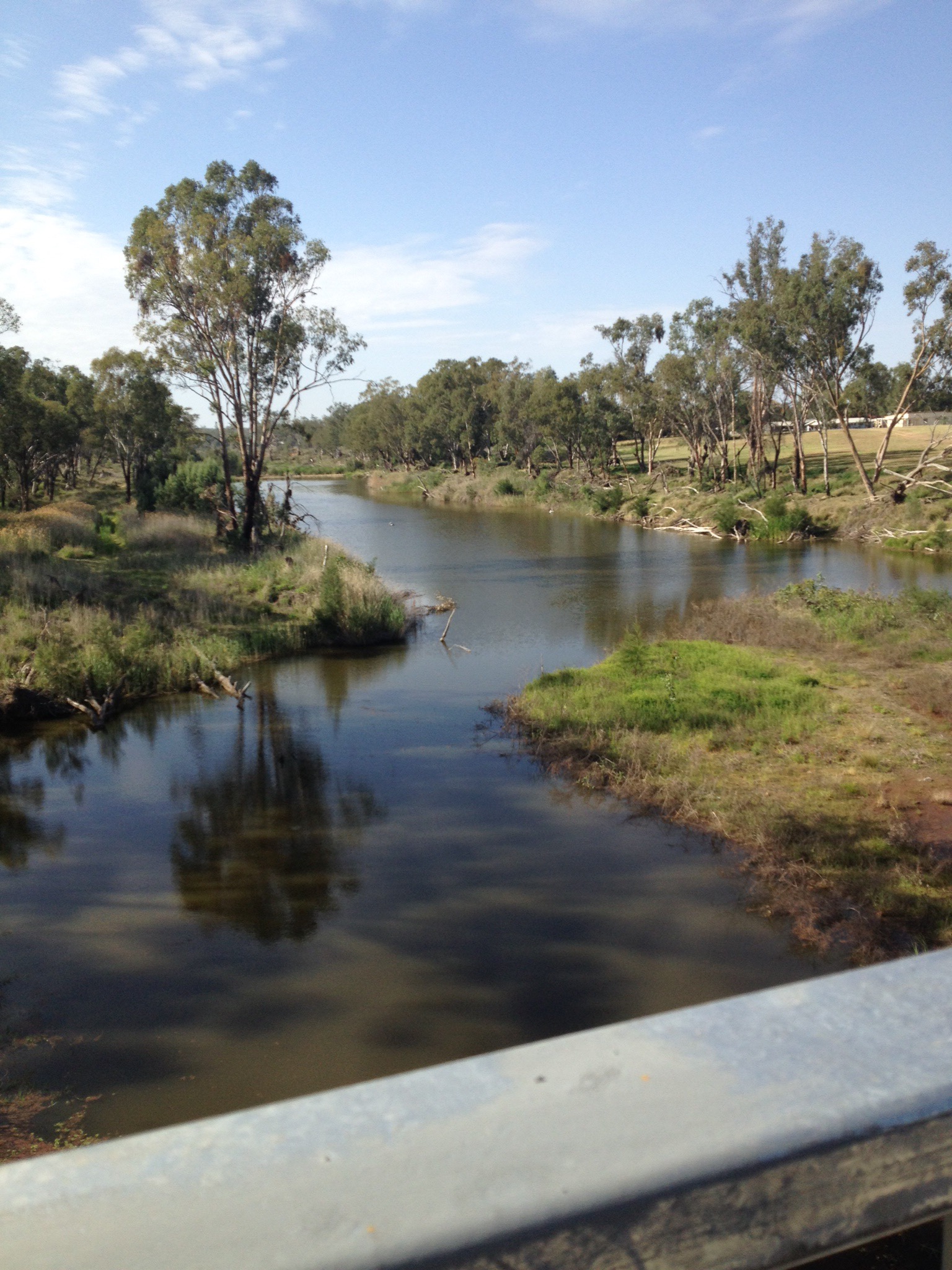
By the third morning I still had not sighted the river. On previous morning runs I headed north and south. This time I went east. Past the library on the main street in premises vacated by the extinct cinema; past the pool gleaming fluoridated blue; past The Great Artesian Spa; up a rise to the edge of town – and there was the bridge, a modern structure of cement and steel, its slow length elegant against the sky. Below, far below, indolent waters were a silver ribbon. Tall green grasses pleased the eye.

A slender roo, disturbed by this sole intruder, widened the gap in graceful bounds, then stopped and looked me over at leisure. A moment of shared wonder.

At the approach to the bridge a wall of dark granite, cuboidal, taller than me and wider than the hammer-wielder of the first morning, detailed the floods. Undemonstratively, without self-sympathy, in the manner of farmer conversation, the wall of stone gave fact and context:

1864 – 9.56 m,1949 – 4.86 m, floods in 1950, 1954,

then, in February 1956 the waters reached 7 metres; and in April the same year, 9.26 metres. Photographs show island buildings, white against the silent black of inland sea. Some left town. Most remained to face flooding again – in 1983, 1990, 2010. Then came the waters of February 2012, peaking at 9.84 metres, breaking the record of 1864. People speak flatly of ‘before the floods’ and ‘after the floods.’ I hear the same throughout the state.

One farmer replies to my stock enquiry with a quiet,’The dams are both dry. It’s fortunate we have a couple of bores.’ I look at him, his face etched with decades of flood and drought. He knows fortune.

No-one in back in the Collins Street practice uses that expression, it’s fortunate.

Something missing here. Someone not heard, stories not told. Where are the first owners? Further morning runs uncover traces. At the Information Centre an elaborate sign invites me to follow the Yumba interpretive trail: ‘Mon-Thurs mornings.’ Below this a handmade sign amends tour times: ‘Tues and Thurs.’

And to one side a larger, handmade sign advises

NALINGU

ABORIGINAL

CORPORATION

WISH TO ADVISE THE

YUMBA

INTERPRETIVE TRAIL

AND MITCHELL YUMBA

IS CLOSED

UNTIL FURTHER NOTICE.

But the first people are here. I see them with their ailments and their children at the hospital and the clinic. In the main street, Nalingu has its dusty offices, and just down the same street is the Aboriginal Health Centre. Inside this hive a small lady of middle years buzzes with purpose. She searches my face, wondering whether perhaps I might be a JP. She needs a JP to certify photocopies of documents for the tall Finn standing at my side. He’s jackerooing on a station. (The Finn does not look Aboriginal. But some say I don’t ‘look Jewish.’)

The lady finds time for my questions: Yes, this is a health centre and yes she’s here four days a week helping local Aboriginal people with transport and health appointments in the bigger town one hour east of here. And no, the bigger town doesn’t have a doctor at the Health Centre either, not regularly, just a couple of days a month. ‘But I look after things.’ She tells me all this with evident pride, vibrating with energy and quiet command. She looks up at her curious visitor, radiating confidence and belief in her role. I guess she’s the dynamo of a community that might otherwise not be a community.

Back at the clinic, a tall man in his late fifties has plenty of time to chat. He’s intrigued by the phenomenon of a Jewish doctor way out west; and I’m interested in his experiences as a cattle man. He’s been out here all his life but he sent his daughters to boarding school in the city. I ask my usual questions – how’s the farm going, water, rain, feed?

‘Well it’s hard. If it wasn’t a challenge I’d have to go and find one. But surviving here calls for something. I like that. I like to be tested. Every difficulty demands something of me. I want to create, I don’t want a dull existence. I’m lucky with my life here.’ He smiles, a smile of good teeth and good skin, the smile of broad vitality. Why has he come to see me today? ‘I’m well, but I spend my life in the sun. Will you check my skin? Any other tests or checks a fifty-eight-year old should have?’

We do the medical stuff then conversation resumes. He employs backpackers from around the world. ‘I look for people others won’t take – people with problems. With patience you find the goodness in a person and help them become productive. I’ve had alcoholics. They come to the station, I let them dry out, I expect them to be temperamental until they settle. Then you find the person with a problem has some drive that might have got them into trouble; now they have a chance to direct the drive productively. There’s pride in that. A small start to a better way. After three months they leave, and we are both winners.’

The cow man has questions for me – about my origins, any children, a wife? He tells me about his girls, working in distant places, how he encourages them to pursue their passions in their occupations, not to settle for work that won’t fulfill them.

‘Have you been to Israel, doctor?’ – in the city this is the litmus question of my decency, out here it’s a question couched in curiosity or envy.

‘Israelis inspire me. They have never had it easy but you can see their drive to survive. And they do it by innovation, by creativity. They’ve never had enough rainfall where they are, but they farm, they feed their people and they have create a surplus to export.’

IMG_3980.JPG

IMG_3980-0.JPG

Manny the Marathon Man

Manny Karageorgiou ran 42.2 kilometres yesterday, racing his oldest foe. At 58 years, Manny is the youngest of the Glorious Ten who have competed in and completed every single Melbourne Marathon. ‘Forty two kilometres’ – it rolls off the eye easily, but it’s a long way to travel on foot. My car gets tired over that distance.

Manny ran with the most reluctant consent of his oncologist. He delayed his stem cell transplant so he could keep faith with the Ten. This GP consented more readily despite the rib that fractured as it filled with tumour, despite the remaining bones waiting for fracture in the merest trip, bones brittle and chalky from the medicines and radiation. The GP consented; who could say ‘no’ to that beautiful face, a child’s face, appealing, smiling through the pain and fear, gentle, mild even before the cancer, tenderer than ever since the rib broke, as Manny sought to comfort his fearful wife and his children.

They came around, the family. They ran the late kilometres with him, the bitter second half of the marathon, they ran, a caravanserai of love and hope and tearful joy, along the endless steppes of St Kilda Road. Manny’s son ran the whole distance at his side. Pana, as Manny calls him is a strapping footballer, vigorous and fearless. Afterwards he would say, ‘I don’t know how anyone could run another marathon after experiencing the pain of the first.’ But Manny has run the Melbourne Marathons thirty seven times. He has outrun the Reaper. So far.

Why does he run?

He runs for faith, he runs for pride, he runs to be humbled, he runs for the self-glory of mortifying his flesh. He runs because he lives. He runs for all of us.

IMG_3865.JPG

Mending the Broken Runner

Spring months are the cruelest, mixing memory and desire. And I have felt the sun soft on my skin, have woken with birds that called me, watched the young and the not young but not broken, all at their running, running, running. And I have felt self-sorrow, sincerest of emotions, and I have felt the creeping entry of a green stranger. And I have resented and I have envied those runners, their unforgivably beautiful limbs, their light and loping tread. In short I became that miserable creature, the broken runner.

Yesterday I drove with daughter and grandboys to Wilson’s Promontory National Park. All was as ever it was; emu browsing, shy wallaby, slow wombat, delicate birds, hills, hills, hills, bouldered beaches and the odd ‘mountain’. Only in Australia, and perhaps the Netherlands, would you grace Bishop and Oberon as mountains. But when you run them your legs cry out and the mind, the mind has mountains.

There was Mt Bishop. We drove past and I told the kids, I used to run up there, all the way to the top. Unable to see the top, too small, too low in the car, the kids made no response.

This morning I awoke and the cabin slept. My knee felt OK. There were the car keys, here were running clothes unrun-in for five months, no family duty called, no excuse. Five minutes’ drive to the track saved me twenty minutes’ running dull bitumen. Here was the track, sandy, scattered with leafmeal, meandering into bush. My legs smiled and snuffed the battle with delight.

And I was running. And nothing hurt. And my lungs kept up with my legs. I ran carefully, judiciously. I avoided rocky footfalls, I paced myself, I spared the left leg and I climbed.

I climbed the twisting turning tilting track, gently, gently, enquiring ever of the knee, feeling no angry response.

The track was mine, mine alone, mine this domain, this splendour, these rugged crags, that ribbon of silver of tidal river, the dull green of bushland, the sweeter green of spring growth, the dead trees white, trees blackened by the fires but shooting green, greening too the great denuded gorges scoured by the floods.

All this juice and all this joy, all for me, a message, a consolation, hope in dried tubers.

The track softened beneath my gladding feet, the gradient gentled, the summit sighted.

There at the summit, the track ended at that same old tumble of broken shapes and abrasive surface: Snack Rock. Slowly I climbed those last metres, transferring weight, o so cautiously, sparing the knee, old man’s knee, unwelcome stranger’s knee, imperious ruler for five months of my youngering spirit.

I offered a line of thanks and ate my apple. I took my first selfie. I photographed the terrain.

And down I ran.

Now, descending, pain pounced and grabbed the rear of the injured knee. Small pain this, the same as I feel on the bike, pain of no portent. And as on the bike, brief of tenure.

Down, down, down, through avenues of wattle unnoticed earlier by the runner with head bent on the ascent. The wattles arching over me, an avenue of honour, reminding me, reminding me of the day I ran into a bunch of hockey players blocking the path ahead of me. This was a serious run, a timed solo marathon to qualify for entry to the hundredth running of the Boston Marathon. A cry from their leader, “Guard of Honour, Guard of Honour!”; and the hockey guys fell into two lines, raising sticks above my head, applauding me as I ploughed on.

There is honour in the long run, a tearful thankful joy, a discovering of the self. I felt all those, all that old knowing, all those strong sensations. And something else, something new – signs of life.

Dog Days

Fidel at the beach on his last day.

Fidel at the beach on his last day.

Patchett opens her story with, “Two days before my dog Rose died…”* Who of us who has ever loved a dog can resist the urge to read on? Flung into foreknowledge of a death – knowledge humans share, but which animals might be – who knows? – spared, we realise this death is imminent. While many of us imagine we’d welcome such foreknowing of our own end, few could bear it. Patchett, it is clear, feels that burden of knowing.

Then there’s the dog’s name, Rose: this dog is particular. She has an owner, a name giver. Giving a name is an act of appropriation, literally a claim of belonging. Rose belongs to Ann. Sahara belonged to my brother Dennis; and Fidel belonged to my son-in-law Pablo. And, to our surprise, a widening circle of others.

My firstborn brother spent most of his last decade as the sole resident in a family sized dwelling. A gregarious, family-minded man, his loneliness would have been bleak without Sahara. To those who did not love her, Sahara, was completely unlovable, too small, too low slung, raucous and aggressive; she was in addition a sneaking, nasty, opportunistic biter. To Dennis alone was she cherished; blind to her antisocial nature, her repellent effect on all creatures on two legs or four, Dennis pampered her. He loved Sahara. She was his housemate, his friend, his nearest relative.

Happily for Dennis he never saw Sahara’s last days. After he died, one of his friends materialised in our house of mourning and volunteered to take her in. Relieved of a most undesired heirloom, we seldom speak of her. She lives on, however, under her own name, between the covers of my novel ”Carrots and Jaffas”, in which she functions as an unexpected redeemer. My fear is she might be alive somewhere in the flesh. A roar, a blur, a quick bite, sudden blood, quicker flight, you’ll recognise Sahara by her toothmarks.

***

By any standard Fidel was a Border Collie gentleman of refined habits. He growled only when a stranger ventured too close to the latest newborn of his household; he barked only at the one great hound to invade his territory outside Alma Espresso; he was quite useless as a watchdog. Fidel’s sole lapse of etiquette was his habitual piddling on my mother’s loungeroom carpet, but we excused that as the imperative of territory.

Fidel loved to run. I loved to run. Long after my running companions fell away to ruined knees or rescued marriages, Fidel kept me company on long lonely early morning runs. Young women smiled at me, my maleness forgiven in the company of Fidel.
Fidel was first dog across the line in the Traralgon Marathon of 1998. He was photographed smiling at my side with his medal around his neck. The officials were not to know he’d travelled some of those 42.185 kilometres – unwillingly and under protest – in my daughter’s car.

Fidel parted with his testes without complaint, he raised three small boys and won the hearts of widening circles of kin with his never ending grin and his always sweet breath. Like all his bottom sniffing kind Fidel seemed immune to odour. He’d keep me company when I was seated on the loo. Once in that small room he ventured forward, making mistaken fellatious overtures. Fidel and I were close but I drew the line here.

One day Fidel seemed tired, the next day apathetic; the third day he was rescued by surgery and transfusion (at the hands of his loving vet-in-law) from death by catastrophic internal haemorrhage. The vet-in-law confided he had had incurable cancer. Six weeks later my wife and I said our goodbyes to Fidel – my jowls quiver and my lower lip trembles as I recall it – at the seaside, his happiest hunting grounds where he was wont ever to chase seagulls into mocking flight. We embraced him and whispered last words. We knew what we knew; we wondered what Fidel knew? Not for the first time I kissed him.

***

Ann Patchett won the Orange Prize and a Pulitzer for ‘Bel Canto’. She won me first with a small booklet titled ‘The Bookshop Strikes Back’ (Bloomsbury, 2013), a safe enough speculative buy at $2.50, handsomely rewarding.

In her remarkable book, “This is the Story of a Happy Marriage”, Ann Patchett describes the passing of Rose. Rose was small, lap-sized, not a real dog to love and run a marathon with. From her opening phrase Patchett won me.

After Rose dies, Patchett writes: “I came to realize…there was between me and every person I had ever loved some element of separation…arguments and disappointments…over time people break apart, no matter how enormous the love…and it is through the breaking and the reconciliation, the love and the doubting of love, the judgment and then the coming together again, that we find our own identity and define our relationships.
Except…I had never broken from Rose…”

Patchett recruited me into her love, convinced me, changed me, enlarged my understanding.
What more can we ask of a writer?

*This must be the most arresting start since Annie Proulx’ “Postcards”, which opens with the protagonist’s realisation that the person with whom he has – one breath past – shared an unspecified se xual act has died in that act.