Wandering

My father’s father’s name was Joseph. Born in 1886 in Petach Tikvah in Turkish Palestine, Joseph Goldenberg stowed away on a ship at the age of twelve, passing his Barmitzvah date without celebration before disembarking alone in Australia. Papa, as his grandchildren called him, arrived here with five shillings, a working knowledge of Yiddish and Arabic, and no English.

He left his home and his family as a child, remaining an observant Jew throughout his lonely years until his marriage, and beyond, through a long life.

Dad used to say his father was like Joseph in the Bible, a faithful Jew from childhood to old age, steadfast through long exile and separation from his home and family.

Dad found lifelong inspiration in his father’s example.

My own father, Myer Goldenberg (z’l), grew up in Melbourne, married and took his bride, Yvonne Coleman, to the small Riverina town of Leeton, where the couple lived for 14 years, raising four children as knowledgeable and observant Jews. Dad never thought this was remarkable, but it was an unusual achievement and it certainly inspired this son.

Indelible memories come to me from time to time as I recite the Shema, of Dad teaching me to read and to translate every word of this, the first and the last prayer of our Jewish lives. I would sit on his knee, Dad holding his worn and oft-repaired siddur in front of me, his finger showing me each letter and his voice speaking these words time and again: and you shall teach them to your children, and you shall speak of them when you sit in your house,and when you walk by the way, and when you lie down and when you rise up…


A Jewish education of this intensity and intimacy is a rare and precious thing. It left this son with the unorthodox confidence that I could live an orthodox life fully and independently anywhere, with or without a community or a congregation to support me. My father’s example assured me that my own observances, my Jewishness, were proof against distance. Dad had taught me how to be a Jew as I walked by the way.

Dad never had any delusion that distance was a good thing. Well before we reached Barmitzvah age, Mum and Dad had resettled the family in Melbourne, where Dad showed (through his subsequent scores of years of service to Shules,) that the question was not whether he needed a congregation, but what could he contribute to one.

But the ‘harm’ was done. By the time we left Leeton, I had absorbed my father’s aberrant example of distance-proof faithfulness; and ever after I have lived a maverick belief in walking by the way, to remote places, well off the Jewish trade routes, taking with me the observances my father taught me. Over the decades, that phrase in the Shema has come to hint to me that a Jew should actively go bush – as Moses did in his shepherd days, as Elijah did while on the run from the king – to find God.

How did I know about Moses and Elijah? How too did I know about the midnight walk in the wilderness of Jacob; and of his encounter with the wrestling angel? It was Dad’s fault, of course: it had been Dad who brought these heroes of the spirit to life within me.

And so it was that I’d bake challah (read damper) in Leigh Creek, read Megillath Eicha by candlelight in Arnhem Land, host the Jewish residents of Alice Springs for Shabbat meals, discuss Zionism with a knowledgeable Elder in the Ngaanyaatjarrah Lands, sing Hebrew songs with one of the Strong Women at Galiwin’ku, sound the Shofar in Ellul at Wamoom; and celebrate Shabbat in the Andyamathanha wilderness with one of Melbourne’s leading rabbis.

(And so it was that I was been absent so often and so painfully from shules, from tolerant children and perplexed grandchildren, from a neglected wife and from a lonely mother.)

All of this unorthodox conduct had some unexpected results. I found what Joseph finds when sent by

his father to “see the peace of his brothers”. Wandering, lost in the wilderness, Joseph meets a mysterious stranger who asks – in a singular phrase – “what will you seek?”

Joseph replies, in a sentence that is equally pointed

syntactically, “(it is) my brothers (whom) I seek.”

The brothers whom I found are the first Australians. In encounter after encounter over a decade or more I have met and worked with Aboriginal people in the outback, discovering much about them, more about my

Jewish self, and writing, writing all the time of these experiences.

(That writing gave birth to a book, Raft, launched at Melbourne Writers festival in 2009.)

And deeply moving to me were those experiences as a practising Jew, when alone in God’s creation, I’d wrestle with the angel, and where I’d catch the echo of a still soft voice.

And, morning and evening, as I’d rise up and lie down in those far places, I’d recite the Shema, that prayer of portable Judaism that my father taught me.

Road to Recovery – (my piece published in Australian Financial Review)

Road to Recovery Financial Review article

This article appeared in the Australian Financial Review 3 January 2014. It first appeared in the Griffith Review 10th anniversary edition in 2013.This story is an edited version of a piece that will be published in 2015, in an upcoming book entitled ‘Burned Man’.

Nobody Doesn’t Like a Song

I

Whenever I wanted to read a poem to my father he’d make a face. He claimed he didn’t like poetry. I suspect it was the ambiguity in a poem that frustrated him. In fact Dad loved poems, the poems he committed to memory in his schooldays. He recited some of these often enough for them to take seed and grow inside me.

Now Dad is gone and it is I who recites his lines, learned at school around 1925:

Blow, blow, thou winter wind

Thou art not so unkind

As man’s ingratitude…

Thy tooth is not so keen

Because thou art not seen

Although thy breath be rude

I see Dad’s wry smile as he continued with lines that border on the cynical.

Sing Hey Ho, Hey ho unto the holly

Most friendship is feigning

Most loving mere folly

Dad was not cynical. So what appealed to him about this snatch from ‘The Tempest’?

I think it was the music.

Lots of people think they don’t like poetry. They would never read a poem – not willingly, not wittingly.

But they listen to songs. And a song is just a poem hidden inside music.

Think of the Beatles. Think of ‘Till there was you’. Think of ‘Elinor Mackenzie’. We loved those songs, not least for their poetry.

Nobody doesn’t like a song.

Continue reading

A Review of One Thousand Cuts, by Rod Moss

One Thousand Cuts by Rod Moss

One Thousand Cuts by Rod Moss

One Thousand Cuts: Life and Art in Central Australia

A book of the dead?

Yes, explicitly so.

Names are named, a violation of all norms, all practice in both whitefella and blackfella Australia.

Rod does this by virtue of trust, explicit consent, indeed the command of Rod’s friends.

Rod Moss’ singular role – to witness, to record and transmit.

Rod Moss grew up in the country. Well, in the 1950’s the Dandenong Ranges were country-ish. But he was never “in country” until some time well into his long apprenticeship under Edward Arranye Johnson, in and around Alice Springs.

Moss’ first book, “The Hard Light of Day” recounts that apprenticeship, which began with a spontaneous act of neighbourliness and evolved through friendship to become a connection of spiritual father to son. The building and the losing of that bond are the subjects of that first book, winner of the Prime Minister’s Award. It might sound like a large statement that the second book builds on and exceeds the first in its power. It does so by the swelling sorrow of loss after loss after loss, of the weight of pain.

The present volume is unique in the way it illuminates the experience of being “in country” – an opaque expression that whitefellers who work outback hear often from blackfellers. Subtly, delicately, in a characteristic Moss undertone, being ‘in country’ becomes luminous. The light is shed by Moss as he moves around Arranye’s hereditary domain as his named spiritual heir.

Moss gives us birdsong, birdflight as he walks beneath. He breathes the breezes and tempests that flutter or flatten foliage and carry mood or prophecy.

He names and describes the fauna – from grub to reptile to marsupial – that create the country.

Moss does all this in the same manner as in his painting. His colours are florid, his verbal sallies frequently outrageous, his attack fearless. But in all this bravura there’s nothing flash or glib, as Moss walks and paints and photographs the lands of his spiritual patrimony, bearing the loss of spiritual father (and of many brothers and sisters), accruing more and more losses until their weight becomes unbearable.

Most of the losses come abruptly. Each comes with the force of a thump to the solar plexus.

Moss, with his reader at his shoulder, absorbs blow after blow.

At this point we have Moss Agonistes, crying: “It rains in my heart. One drop at a time.”

Moss misses a much anticipated funeral: “I find myself crying on Saturday morning …Though I was sad at the gravesite, it has taken until now, opening the brochure and studying the commemorative words…for me to be sobbing.”

Continue reading

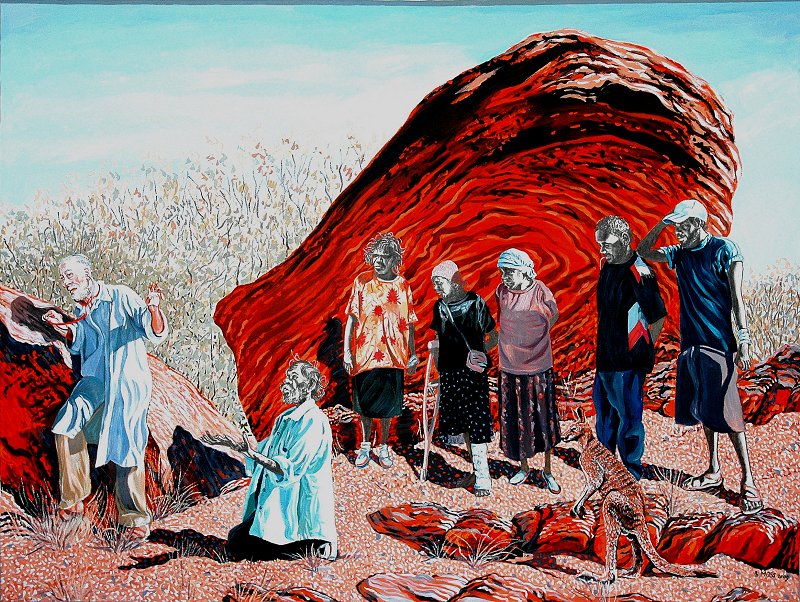
Rod Moss and “One Thousand Cuts”

Rod Moss is a Ferntree Gully boy, a whitefella who found himself in Alice Springs thirty years ago and who stayed there.

In all the moral disorientation of the Centre, in its beauty, its grandeur, its squalor and its mystery; in the perplex of making and losing marriages, of fathering, of teaching, of reading deeply, of engagement with the dark cinema of darkest Europe, Rod Moss found friends in a clan of blackfellas living in Whitegate, one of the town camps.

Moss differed from most of us whitefellas who come to the Centre. He stayed. He painted (in a distinctive genre of his own creating) the lives of his friends. And through all the years of his staying and his painting and his friendships, Moss kept a journal. That journal gave birth to his first book, “The Hard Light of Day”. The book won the Prime Minister’s Prize for non-fiction. More significantly, the book won the praise of Ray Gaita, who described it as one of the best books he had ever read.

When I say Moss found himself in Alice Springs, I mean he found himself in ways most of us non-indigenous people never do: he found who he was, what he was doing here; he came to be in country.

When I say Moss found friends I also mean he lost them.

Those losses are recorded, drop by drop, blow following blow in Moss’ first book, and in the second, soberly titled, “One Thousand Cuts”.

I believe that in its swelling lament and its growing clarity, “One Thousand Cuts” surpasses even “The Hard Light of Day”.

In a remarkable sequence of events “One Thousand Cuts” will be launched at Readings in Carlton on Wednesday 9 October at 6.30pm. And a retrospective exhibition of Moss paintings will be opened at Anna Pappas Gallery two days later.

If Moss’ paintings are luminous, his writing a prolonged jazz riff,  the photographs are something else.

I invite readers of this blog to attend one or both of these events. I will be glad to see you.

Podcast of interview on Radio National with Waleed Aly, Howard Goldenberg and Rod Moss 8.10.13image

Whom* By Fire, Whom* by Knife and Fork

The High Holydays are almost upon us. Jewish people are reflecting on their ways, repenting, seeking forgiveness from those whom* we have wronged, resolving to do better in the coming year.

The seasonal liturgy lists an intimidating list of “who’s” – fire, water, hunger, thirst; who in his allotted span and who before his span; who will be at peace, who will wander; who will pass in quietude, who in agony.

It makes you think.

The liturgy does prescribe antidotes – prayer, sincerely remorseful penitence and charity.

On the eve of Rosh Hashanah Jewish families gather to overindulge. We will be fifteen at our table and we’ll consume one bottle of wine and three sheep, numerous hens and sundry kine. We eat too much and drink too little. Next day, following a synagogue service lasting about five hours we go home and gorge ourselves, thereby putting ourselves at risk of “whom by knife and fork.”

We eat apple dipped in honey and we take honey on our round loaves of challah (read brioche, the “ch” in challah being like the final throat-clearing sound in Bach; the ch in brioche the same as in douche). The honey suggests the wish for a year of blessing. In our case that sweetness resides in the grandchildren who will throng and riot around our table, ensuring our New Year commences not in quietude but in full throated life.

My wish for my reader/s is that you might find this blog rewarding in the year to come, that you might buy the books that I’ll flog to you (a novel – Carrots and Jaffas – in early 2014; and A Threefold Cord – a novel in 67 chapters for 8-10 year olds, also in 2014, if not before.)

More disinterestedly, I wish for peace in the Middle East, a Collingwood premiership – at the moment both appear equally likely – and a year of euglycaemic health for us all.

Expressed as Shana Tova u’metukah

Sincerely,

Howard Goldenberg

*I realize that Leonard Cohen sings “Who by fire”. Likewise “Who” appears in the English translation of the Hebrew prayerbooks. However, I am persuaded on grammatical grounds that it is not what you know in this life that matters but whom you know.

Robert Hillman’s ‘Gurrumul’ – Review by Howard Goldenberg

Gurrumul by Robert Hillman  Publisher: ABC Books

Gurrumul by Robert Hillman
Publisher: ABC Books

If autobiography is the least reliable genre in fiction then the authorized Life sits at its flakiest edge. That this is not true of Hillman’s “Gurrumul” is on account of the slipperiness of the subject.

Geoffrey Gurrumul Yunipingu emerges as shy, remote, elusive, cryptic, mischievous – an outer island in an archipelago of tongues. He does not so much emerge as submerge himself. Blind from birth, Gurrumul seems at times to be mute by choice. At others he makes himself perfectly clear to a whitefella, especially when working with his intimate collaborator, Michael Hohnen.

By book’s end Gurrumul remains hidden; only his music and the beauty of his features – a beauty we can enjoy and he can never perceive – speak to us.

No biographer could truly represent this life, (nor for that matter could he successfully misrepresent it). Wisely, Hillman does not attempt either. Instead he places the artist in his context. Chiefly that context is the complex of family (especially his bevy of aunties), community, land and Dreaming: in short, culture.

“Culture”, a term used promiscuously in conversations between the races, embodies meanings that are layered and expressed in dance, in music, in painting, in song, in storytelling and in land husbandry. The meanings are traditionally expressed obliquely, which is to say they are in part obscured. What Gurrumul does with these enfolded meanings appears to be a risky enterprise of his own, with calibrated departures from liturgical norms, a sort of jazz move in which he improvises within a theme and extends it beyond the limits of permitted custom.

Such a variation on a theme must be perceptible only to a tiny number of the millions who respond to Gurrumul’s music making. In this sense it is a secret, yet another, in  practice that skates ever along the outer edge of theunshareable.

When Gurrumul sings, whitefellas listen, enthralled. Literally, we are in a thrall, under a spell cast upon us by the spellbinding singer. We scarcely hear the words, we cannot parse them; and when we read their translations in Hillman’s book, the words in English are so simple as to appear banal: a profoundly false impression. And yet, and yet, we are transported. If beauty be truth, then truth is shown to us precisely as it is withheld. The subtlety of all this magic is clearly rendered in Hillman’s book.

To those who have read “My Life as a Traitor” and “The Rugmaker of Mazr a Sharif”, Hillman’s skill in rendering an alien culture will be familiar. It is in his later work, “The Honey Thief”, that Hillman manages to capture the artist in the act of working his art, in this case the sublime art of the Afghan (Azari) storyteller.

In the present volume Hillman attempts the extremely ambitious exegesis of the utterly untranslatable term, “Dreaming.” He succeeds, in this reader’s view, brilliantly. In twenty five years and over sixty working visits to remote Aboriginal communities, I have never felt I came so close to apprehending (I doubt any whitefella will ever comprehend) the Dreaming, as in Hillman’s “Gurrumul, his life and music.”

Hillman has succeeded remarkably in penetrating the life of art and ceremony (the two amount to much the same thing) on Elcho Island. Seven years ago while I worked on Elcho ceremony was active but off limits for whitefellas. Clearly Robert Hillman won the trust of capable cultural brokers on the island, who ‘let him in’ wherever this was permissible. In return, Hillman repays trust with respect that neither fawns nor condescends. In this his text avoids the vapid tone of comments on the book’s photographs.

Which leads me to the one regret I have about the book, a quibble perhaps, but an important one. In an important sense Hillman’s publisher subverts the author’s enterprise, which is to render in words an art that is ineffable. It is the format of the handsome volume that works against the writing. You look at the book, you find the cover images arresting – and to one familiar with the singing – quite new. The book itself cannot be held in the hand and read: it is biography in a coffee table format. You open the book, you start to read and you find yourself distracted repeatedly from the text by beguiling photographs which tell their own story quite compellingly, but quite out of sync with Hillman’s theme at any point.

Better justice might have been done to both text and photos by physically separating them.

In the end the book succeeds to a remarkable degree. Importantly, it demonstrates how, as whitefellas embrace Aboriginal culture, Australia is becoming more Australian.

Hillman’s book is bound to succeed beyond these shores as Gurrumul’s audiences around the world drink deeply in their thirst for some understanding of his life and his music.

Further Deaths and a Birth in the High Arts

Peter de Vries is dead. This is sad but it is not news: he has been dead since 1993. It appears he will remain extinct. What is sadder is that none of his books is in print. You cannot buy any current edition of the works of this pre-eminent American humourist of the early post-war decades. From 1940 to 1986, he chronicled the full comedy of the full human tragedy.

De Vries found plenty of material for dark jokes in his war time military service, in his Calvinistic upbringing in the Dutch Reformed Church and in the death of his daughter from leukaemia. He transmuted grief into sobering mirth and we laughed ourselves silly. Now his books are no more.

Life is just as funny today as it was in De Vries’ lifetime. We have the media, the markets, religious institutions to entertain us. Our politicians are a joke. The pestilence that is our species still despoils the planet, continues to kill, it maims and lies still – and records its glory in the daily newspapers. The papers are on the way out, and soon or sooner the planet appears likely to kick us out too.

Meanwhile a distinctive genre of off-beat humorous fiction for which Australia was once famed has died, unlamented and unsung. I refer to the Annual Income Tax Return. In the 1970’s and 1980’s creative accountants and millionaires and gifted liars combined to create songs from the bottom of the harbour and paid no tax. How they laughed.

Nowadays the accountant is effectively a secret agent of the ATO. She shows no interest in creative fiction, steering me instead along the narrow and straitened path of maximum taxation. The tax return she creates is deadly non-fiction. She then charges me and – for all I know – receives a commission from the Tax Office. This would make her a double agent. We have here the makings of a spy story. Would that the story were fiction.

The news is not all grim. This new genre in literature, the Tax Spy story, incubates in a silence disturbed only by the sound of calculating machines at the ATO.


Book Alert

a long time ago i tutored a group of medical students at melbourne university

one of these was dominic wilkinson

dominic was an unusual student, interested in ethics, coffee, dumb animals and conversation

he was built like a greyhound*, played violin in an orchestra, created, directed and acted in commercial theatre, pedalled a bike everywhere, ran marathons, ate no food that had a mother and eschewed leather shoes

he read widely, had a quirky sense of humour and was far too bright to be a doctor.

straight away i recognized dominic as a fellow dilettant

i knew he would find no time to study for exams and that he would fail

and go on to some more creative field

i was nearly correct: dominic passed his exams, graduating at the head 9780199669431of his elite class

he trained in paediatrics (too easy), ethics (too simple), philosophy

( that gives makes my brain ache)

he won a rare and prized scholarship to oxford where he conquered,

returning to oz with more degrees than a thermometer

five minutes later he is a professor in adelaide and has written this book

i was right: i KNEW he’d turn his mind to something creative

if you have a a baby, plan to make one or ever were one, buy dominic’s book

or even if you just enjoy sex, because you never know…

howard goldenberg

*an expression of one of my patients: “like a greyhound – all dick and ribs”

Now for the official blurb:

In ancient Rome parents would consult the priestess Carmentis shortly after birth to obtain prophecies of the future of their newborn infant. Today, parents and doctors of critically ill children consult a different oracle. Neuroimaging provides a vision of the child’s future, particularly of the nature and severity of any disability. Based on the results of brain scans and other tests doctors and parents face heart-breaking decisions about whether or not to continue intensive treatment or to allow the child to die.

Paediatrician and ethicist Dominic Wilkinson looks at the profound and contentious ethical issues facing those who work in intensive care caring for critically ill children and infants. When should infants or children be allowed to die? How accurate are predictions of future quality of life? How much say should parents have in these decisions? How should they deal with uncertainty about the future? He combines philosophy, medicine and science to shed light on current and future dilemmas.”

Death or Disability? The Carmentis Machine and decision-making for critically ill children is published by Oxford University Press. It is now available via the OUP website on the link above, or via Amazon UKFranceCanadaUS (released in March) or Book Depository (free postage)