The Rubaiyat of Zoltan Klein

A Book of Verses beneath the Bough,
A Flask of Wine, a Loaf of Bread – and thou Beside me singing in the Wilderness –        And, Wilderness were Paradise enow!

I accepted the invitation to the launch event of ‘Bread, Wine & Thou’ without curiosity. But as the series of emails from the Event Manager mounted I sensed I should look a bit spiffy for the launch. So I wore my English Schoolboy Blazer. The addition of my backpack subtracted from the elegance of my outfit and together with my skullcap ensured I would look quite as odd as usual.

At the last moment I invited a friend, an art impresario held by all to be ineffably elegant.

The security man at the door, a gym giant in Armani, consulted a guest list longer than the Pentateuch. A show of expensive teeth: “Your names, gentlemen?”

“We are both Howard Goldenberg”, I said.

“Thank you sirs. Please take the elevator to the Second Floor.”

A disembodied voice from the rear of the elevator was heard: “Hi Howard”. It took a while to identify our host Yossi (also Zoltan Vinegar) Klein, obscured as he was by a cluster of tall, expensively draped women, mounted on very steep heels. Taller than all others in the lift a wide man with an interesting face stood next to Yossi. He did not speak.

The lift released us into the highly geometric womb of Cox Architecture, a space as inventive and unexpected in its proportions and planes and shapes as Federation Square. I had not previously heard of Cox, but I was given to understand its iconic condition.

Filling the space, throngs of elegant females and stylish males kissed a lot of air as they greeted each other with little shrieks and harmless hugs. I noted my companion and I were not the most expensively dressed persons present. Wine was sipped, quite exquisite looking entrees were served and everyone accepted a copy of ‘Bread, Wine and Thou.’

Eventually Zoltan took a microphone and spoke. For a time no-one noticed, for Yossi is, as his surname suggests, not tall. After a bit all fell silent. He spoke informally, disarmingly, unpretentiously. He said, “I wanted to create a literary magazine on the themes of food, wine and culture.” Those were precisely the words he used when he spoke to me a year earlier in ‘Batch’, the Kiwi coffee shop where he and I had sighted each other without speech over years. On that occasion Yossi said: “I’ve read your writing on Aboriginal Australia. I want you to write a piece on Aboriginal Cuisine for the first Number of ‘Bread, Wine & Thou.’ I can’t pay you.”

I accepted the commission and wrote something and turned up in my blazer and kippah and backpack. It must be clear from the harsh tone of my introductory remarks that I felt uncool, unfamous, outranked by the figures of beauty. But as Yossi spoke all that fell away. This man in his forties spoke of his dream and its fulfilment, the magazine – really a handsome book – that we held in our hands. Yossi opened with a joke about his Jewish mother. It was a good joke and we all laughed and Yossi relaxed. He thanked a legion of first names, burnishing each name with his deep appreciation. As Yossi spoke one hundred and fifty smart people from the uppermost echelons of food and wine stood, arrested. Cynicism and self-consciousness fell away. We were human together as Yossi stood, naked in his feeling. He said he was overcome. His voice cracked with emotion.

Later a Very Great Man accepted the microphone. He sat down and whispered, exercising the powers of greatness and of near-inaudibility over his audience. Just as Howard Goldenberg alone had never heard of Cox Architecture, neither had I recognised the Greatest Chef in the World, the tall wide man of the interesting features who rode the rising elevator at Yossi’s side.

  
The room worshipped. Upon completing his remarks the man folded Yossi in an embrace that hoisted him from the floor. Evading believers*, he strode from the room, disappearing into the night.

That this personage should have descended to Melbourne for Yossi was felt to be an enormous compliment to our host. As I listened to the chef speak of his career at length and in breadth I felt increasingly the greatness of Yossi. And when you read Yossi’s magazine I think you will feel the same.

Although ‘Bread, Wine & Thou’ is accessible on-line, I urge you, do not go for the virtual book; for modest moneys you can acquire the real volume. Collectors will treasure this, the first edition, a thing of truth and beauty.

IMG_6132

* I stole this lovely phrase whole from Les Murray’s ‘ A Perfectly Ordinary Rainbow’.
We Don’t Know their Names

An internet friend sent me some thoughts last week about the writing of the 2014 Nobel winner Patrick Modiano and his preoccupation with the lost. At the same time I was steaming towards the end of ‘Kamchatka’, a novel of the Disappeared in Argentina. Modiano wrote of Rita Bruder, a young French Jewess who went missing from her safe haven in a convent during the German occupation of Paris. Modiano is driven to search out the child’s fate. He cannot let the past and the lost rest unpursued.

I found myself acutely vulnerable to my e-friend’s story of stories. Partly it was the menace quietly gathering in ‘Kamchatka’ of the inevitable disappearing of a loved one; but more, the Modiano quest brought home a long overdue quest of my own: my destined search for my mother’s lost cousins. My knowledge of the cousins in question is slight and fragmented. It shifts in memory’s half light, lacking solidity, its textures diaphanous with the partial attention I must have paid in early childhood to a story my Mum told me. Seventy years after their presumed deaths in Auschwitz I feel the weight of silence.

My mother’s parents died of natural causes in her early adolescence. Somehow the orphan never lost her faith in living or her relish in it. Failing her Year Ten examinations she left school, trained as a bookkeeper, went to work and saved. In 1939, at the age of twenty-one Mum travelled alone to France where she had good clean fun. She spoke of dining with the Captain and the young officers on the Dutch ship which took her to Europe. She spoke of the beauty of Bali, then a Dutch outpost, almost untouched. On my mother’s return to Australia her younger sister Doreen asked her: ‘Are you still a virgin, Yvonne?’ ‘Yes,’ came the reply, ‘But it wasn’t easy.’ Mum made friends with men wherever she went, two of whom would bob up in our Leeton home while I was still too young for school. The two men, to the best of my knowledge, never knew each other. Their visits were separate and apparently independent events. We’d form a threesome for picnics by the river, the respective Continental, Mum and Howard, her four-year old chaperon. The men’s mysterious names – ‘Syd Viberow’, ‘Romain Hudes’ – intrigue me to this day. Googling has not relieved my curiosity.

These matters I recall well. I recall the smooth Continental gentlemen basking with my young and attractive mother on the riverbank. On one of those picnics we ate kedgeree. On another was it curried hard-boiled eggs? Europe was – I am confident – earnestly wooing; Mum remained Mum, Plato on the riverbank. I mean platonic; Mum might well have enjoyed being admired, but assuredly she liked her good fun clean. My memories are scatterings. Atmospheres are clearer than some factual details. Mum’s prudent inclusion in the picnics of an attention-hogging four-year old was strategic.

More scatterings: In Paris Mum’s tight black curly hair excites the admiration of a German hairdresser who marshalled her best English to compliment her: ‘You have vonderful viskers, Mademoiselle’; Mum’s accounts of the anxious urgings of the family back in 1939, to ‘come home now! There’s going to be a war.’ Mum is in no hurry. She spends time in France with her young cousins. Eventually she sails for home: ‘We slept on deck that last week, half expecting every night to be sunk by a U-boat. We arrived in Fremantle on the day war was declared.’ More good fun.

Much less clearly come memories of Mum’s cousins. The names are feminine and French, that I recall. Or I believe I recall it. They must be the daughters of Mum’s mother’s cousin. In 1939 they are teenagers, while Mum is twenty-two.

Mum says nothing to us children touching her cousins’ fate. But she must have known. I know that from the international telegrams that sped across the world late in1944; from Melbourne to Paris, from New York to Paris, with mounting anxiety. From Paris silence. From Melbourne to New York, from New York to Melbourne, in tones of deepening dread, cousins ask for word. There is no word. “Oed’ und leer das Meer”, ‘empty and waste, the sea.’ I know Mum knew; I found these telegrams among her papers after she died.

Mum and Dad bring up their four children very Jewish in the Riverina. In Leeton we children never hear of the Holocaust. We are as far from Auschwitz as Jews can be. Only three hundred miles south of us, Melbourne, thronging with survivors, is as close to Auschwitz as Australia can be. At the age of nine and a half I am translated from the Riverina to Mount Scopus in Melbourne. There, in a classroom full of Jewish children I am one of very few with living grandparents. I experience myself as a Jew whose family was safe, intact.

I regret now that innocence. A child who sat at the side of his father every Ninth Day of the Month of Av, listening to Dad as he lamented the destruction of the Temple and the sack of Jerusalem in the year 70 CE, knew nothing of Europe only a few years earlier. We sat on the thin, scratchy carpet of our dining room floor, the house lights turned off, a single candle our only light as Dad chanted the Book of Lamentations in its distinctive moaning and sighing melody. Dad translated and together we bewailed the ‘breach of my people’ at the hands of Rome. Sixty-plus years later I can feel that carpet itching my thighs. But the Third Reich never touched me.

Why was Mum silent? Assuredly she cared for ‘Sophie’ and ‘Josephine’ – names that lurk just beyond memory’s outer fringe, names that might even be true. Assuredly Mum knew. But she said nothing. No stranger to closer loss, Mum could and would speak of her beloved parents, tenderly but with a composure that unnerved this small child. Strangely disconnected from grief, Mum thrived as an orphan, much, much later as a widow, and even managed to live on in joy after losing her one lifelong companion, her sister Doreen; and after Doreen Mum lost her firstborn son. From her early years Mum knew loss but managed to keep sorrow a stranger.

At what cost, I wonder. I read Modiano and I understand the Nobel judges’ remark about ‘his art of memory.’ My mother practised her own arts of memory. Did she survive a life that was punctuated by loss by excision of sorrow? Perhaps what started as a young girl’s strategy led to atrophy and involution of the organs of sorrow. In that case my own memories of Mum’s account of Europe might be actually complete: do I in fact recall the entirety of the particles that Mum allowed herself?

I bless Mum for her faculty of joy. And now she is gone I must investigate my own faculty for grief. I want to find my cousins.

An Outbreak of Bibliophilia

Children, like humans, thirst endlessly for stories. My own seven grandchildren, who range in age from twelve-year old Jesse to two-year old Ruby, love stories. They thirst for story as we elders hunger to give story.

‘My son,’ remarked Rabbi Joshua to Rabbi Samuel (Babylonian Talmud, Tractate Sanhedrin), ‘More than the calf yearns to suck the cow longs to give suck.’ How do I know this maxim? That story dates back to the commencement of the academic year in March, 1965, when I purchased the latest edition of Samson Wright’s textbook of physiology. I opened the great tome and found at the foot of an otherwise blank second page the above quotation. The sole yarmulke wearer in the class, I was the only one of 120 students likely to have knowledge of the Talmud. But the passage was new to me. And I was astonished to read the quotation and its attribution in this secular text.

What have the lactation urges of the cow to do with human physiology? Everything, it happens: that interrelation of forces, that feedback loop, that mutual energising is the very stuff of homeostasis, which operates also in markets, in the climate and in the biological relationships between humans. The sage Rabbi Joshua nailed a great truth. But I fear I wander.

The entire purpose of children is to satisfy the need of humans to regale them with stories. The reason children don’t run away is their reciprocal story hunger. The reason we don’t chuck teenagers out is the promise they’ll one day employ their disturbing sexual organs to create grandchildren for us so we can resume storytelling. And that’s what happened: my adult children used their sexual organs for the pleasure of their parents, creating seven grandkids.

All seven served their grandparents well, occupying yearning arms and longing laps, snuggling in and subsiding to the song of the story. Then they learned to walk. Two of seven, both of them boys, took to their heels and never stopped running. In time, although those two learned to read, they never took it to heart; it is in motion that they find themselves, one in organised sports, the other in disorganised sport. (Readers of this blog will recall this boy and the rescue of his fingers when trapped in a bathplug.)

Their bookish grandfather gazes upon the boys and sighs. He calls them to the couch for a story but the call of their balls is louder. Off they run, to soccer, to cricket, to mayhem.

What will become of them? What will become of grandfather?

Later the ball-players have returned home. Grandfather wanders to the toilet. Before him, on the floor, lies a cornucopia of books; the disorganised sportsman comes to a stop in this place. And in this sanctum he reads.

The Sweet Taste of Revenge

The oldest friend of our married life is a parson. After inspiring and marrying hundreds of young believers and unbelievers and halfbelievers; and after watching their marriages fragment – fast or slow – and die, John concluded he was not a success in bringing people’s lives together. He left the parsonage and took up God’s work in a new business: in his own words, ‘I spent a year in gaol.’ The parson became a chaplain.
‘Long Bay Gaol was just like other congregations I’d worked in – lots of sinners, lots of righteous people (“I never did it… it was someone else’s fault…I was framed…”), and lots of people who couldn’t care less about religion. I didn’t mind the unreligious and they didn’t mind me. The convicted were just people, by and large. I found most of them likeable enough.
‘But a few of them were hard to like. There was one man who’d been convicted for trying to incinerate his girlfriend. She survived, horribly burned, but in the process he killed the masseuse who was treating her at the time. He was quite unrepentant, quite without conscience, but nevertheless he became one of my most frequent parishioners. He’d visit my office frequently, ostensibly for spiritual guidance. All he really wanted was the luxury of private conversation. I did not like him, but I couldn’t let on.
‘There were others in the gaol who were just as unlikeable. One was a warder, one of the ‘’screws’’, as the prisoners called them. This fellow treated the prisoners brutally. He was feared and hated. He used to visit me often and he was just as persistent, just as falsely pious and just as unwelcome as the murderer.
‘The murderer confided once how “cons” had their ways of getting back at the screws they hated most. He said, “Father, we piss in their tea.”
‘I understood how that might be. The best-behaved prisoners enjoyed the privilege of waiting on tables in the Officers’ Dining Room. That was where I ate. The prisoners prepared and serve beverages. One day I went to that Dining Room for lunch. I loaded my tray and sat at a table out of the way to enjoy some privacy. Out of the blue, bearing his own tray, that brutal fellow was at my shoulder, declaring, “Father, you don’t mind if I join you.”
I did mind of course, but I said the opposite, of course.
A prisoner turned up and asked us for our beverage order.
“Tea, white, two sugars,” said my guest.
I asked for the same. That waiter, my religious friend the incinerator, said, “Certainly, gentlemen, I’ll bring them presently.”
The con returned carrying two mugs. ‘This is yours, Father”, he said, as he laid my drink on the table. Then he walked to the other side of the table, placed the mug before the screw and said, “And this is yours, sir.” As he spoke he shot a huge wink in my direction.
‘What did you do, John?’
‘It was a moral emergency. If I remained silent I would be party to a wrong. If I spoke I would breach a confidence. I drank my tea. I watched the screw drink his.’

John’s story brought to mind my cousin’s account of certain events In Israel during the first Intifada. She wrote: ‘Consumers of a particular brand of hummus remarked on a change in the product. It didn’t taste bad, just subtly different. Closed circuit TV in the factory caught Palestinian workers wanking into the vats.’

***

Neither the hummus masturbators nor the prison micturators could have read the more recent American novel, The Help, in which a white racist woman consumes chocolate cake containing the ordure of the ‘help’ – an unfairly dismissed African-American woman.
I recount these stories to offer succour to a friend, a novelist, Margaret.
Now Margaret enjoys the attentions of a literary assassin, a relative by inheritance, a sort of outlaw-in-law. That person claims a critical authority and a mission to improve HCG by means of brutal dismissal.

The critic and the writer are destined to meet from time to time; what can Margaret do to fight back?

All the examples quoted have their appeal. The cake is of course, irresistible but time-consuming. The hummous is nourishing but beyond the resources of an unaided female. I suggest Margaret make her nemesis a cuppa tea – white, of course, with two sugars.

Once Upon A Writer

Once upon a time I was a writer… No, not once – thrice upon a time.

First time: in second or third class the teacher directed us to write a composition. We did as we were told. I enjoyed writing. My composition was chosen and read to the class. I was a writer and one year later, when the Melbourne ‘Age’ published a little piece, I was a published writer.

Second time: at medical school, achieving mediocrity in exams, I found relief editing and writing for a paper. I published what I wrote.

Third time: with a family now grown up and my own parents failing, I was a writer heavily charged with material. I wrote and my friends and family responded. Among the responders one friend in particular responded decisively. Often enough she responded derisively; and not just often enough but more often than enough.

I had good reason to pay attention to my critic friend. She had been an adult reader for many more years than I had been an adult writer. Further my critic was trained in criticism while I was untrained in writing.

Curiously my early vulgarity didn’t trouble her much. My sentimentality (an abiding tendency) excited little reproof. And even the structural shambles, the way narrative fell upon narrative by accident into a happy enough heap, provoked no rebuke.

The problem with my writing was the writer. Contrary to my critic’s command I did not write of Howard the way Howard should write of Howard. In truth this was not willful delinquency (another abiding tendency) but incomprehension. So stratospheric is my critic’s sophistication, her principles eluded me.

The pages of my first two books are Howard-haunted. Howard Bloody Goldenberg is to be found in the middle of every page or in its margin or inescapably behind every page, pages that can never be thick enough to disguise Howard. This drove my critic mad. It was not that Howard was full of himself (he is that) but that Howard was represented without precisely the ‘self-reflexivity’ (my critic’s term) that she demanded. ‘Howard’, she wagged her finger imperiously, ‘Howard, you are refusing to become the writer Howard should be. Your subject, your great subject, is Howard…’

This criticism, emphatic and oft-repeated, merely increased my self-consciousness. Eventually it would drive Howard from the page. Thus, in book number three (‘Carrots and Jaffas’) there exists a character who resembles Howard but is not Howard. Although that character is a male in his sixties, a compulsive storyteller, an outback doctor with a large nose and lavatorial obsessions, he is not Jewish, not Howard per se. In truth I no longer trusted Howard to create Howard. My critic had achieved something worthwhile; she had demolished a formerly impregnable exhibitionist. This was surely to the good, for Howard the person showed an objectionable and retrograde refusal to adopt my critic’s view of the world. (The critic started adult life as a social activist, becoming a member of a commune, a welfare worker, resolutely a conscious and conscientious proletarian. In time she learned the profound error of her ways and unlearned her early amused tolerance of Howard’s political softheadedness.)

Meanwhile Howard had become a blogger and my critic became my bloggee. I would write, my daughter would post and my critic would criticise. More and more my critic criticised Howard for not being my critic’s faithful disciple. At one stage, in outraged surprise, she accused me of being ‘green’.

Given this blog’s unrepentant diarising of Howard’s life, his thought, his memories and stories – in short this blog being Howard on the virtual page – my critic found the entire exercise personally provoking. Possibly intentionally so. Her criticisms of Howard were now unrelenting, and of course, public.

It is timely here to remind my reader that my critic is a friend, that she certainly wishes for nothing more than my improvement. She has in mind my ascension into a literary realm which exists clearly in her sight and quite outside my powers of vision. In her private love of Howard this friend is staunch. In public she is an attack dog. At first puzzled, later a little hurt, eventually wryly amused that such a thing might be, I accepted her blank rebuttal of my private objection to her tone. ‘Howard’, she wrote (publicly of course), ‘Once your writing emerges into the public sphere you cannot expect criticism to remain private.’ Fair enough. Perfectly logical, fully consistent with literary purity. And perfectly blind to the imperatives of friendship.

I came to accept a painful reality:

The moving finger writes,

And having writ, moves on;

Nor all thy piety nor wit

Can lure it back

Nor cancel half a word of it

(From the Rubaiyyat of Omar Khayyam)

Eventually the moderator of this blog published guidelines of the limits to decent blogly conduct; and the critic, declaring herself to be my ‘troll’ (to me a new concept), banished herself from these pages.

My critic helped me immensely. She forced me to examine every self-syllable I wrote. She required of me an intensification of my self-consciousness. To this day she shadows every line I write, shaping my writing to conceal my thought, as she peers through the ether for Howard malignancy, stimulating me to a meticulous attention to some standard I never grasped but for which I blindly reach. Of course the cost is a friend who, in the name of friendship, has shat upon friendship.

Blog On?

Like every wise man I operate in thrall to my womenfolk. One of those womenfolk helps me manage this blog. Readers might have observed the blog stuttering in its cantering gait recently. I have slipped from my regular Monday and Friday postings, to no-one’s great regret. Noting this delinquency the Blogmeistress has commanded me to address my readers with some questions. She says I need to ask you what you want me to write about. The conversation went like this:

BLOGMEISTRESS: Ask your readers what they want.

HG: Why?

BLOGMEISTRESS: Why what?

HG: Why bother them? They’re enjoying the rest.

B/MEISTRESS: You need to blog, so you’ll reach new readers…

HG: Why?

B/MEISTRESS: Why what?

HG: Why do I need readers – old or new – of my blog?

B/MEISTRESS: You need blog followers so they’ll become readers of your books: your writing is OK; it’s just your attitude to technology that stinks. You write passably but all three of your books have been worstsellers. You need to get known.

HG: Look, no-one, not a single person has written begging me for a new post. No-one misses them. A blog that appears on your screen twice a week is an imposition. I’m giving them a break.

B/MEISTRESS: Blog – or fail as a writer!

HG: When I blog I fail because I take time and energy away from serious writing.

BM: Blogging is serious. You’re an appalling snob. You’re going to fail.

So, dear reader, dear slumbering follower, here are the questions a wise man must ask:

What would you like me to write about?

The news – all miserable – that I whinge about already?

My moral quandaries, in which I flail and thrash in a mighty masturbation of the conscience?

Oddities, trivial observations, exercises in whimsy and gentle self-mockery? Or would you prefer brutal self-mockery?

Family stories? Isn’t your own family is just as lunatic as mine?

***

Here is the question I am forbidden to ask: Could you care less?

Sorry to disturb your hard-earned respite.

Blog Wail

A week or so ago this blog wailed about the darkness of the news, the darkness at the heart of man. Two readers responded.
One referred to my wailing as my de profundis, an expression I’d seen bobbing along on the high cultural current over my decades, passing by unpassed. Now it came to me: from the depths. That rang a bell: David, warrior poet, king of ancient Israel, wrote a psalm,
min ha’ma’amakim, From the depths I called…’

Well, two answered my call.

From England, author, bloggish fruitcake maker and novelist Hilary Custance Green is writing her account of her father, a POW in the same camp as Weary Dunlop. He was
one of many untrained medical orderlies who worked in the camp under Canadian surgeon Jacob Markovitz. She writes: “I used to weep continuously as I read these accounts, but I found a dreadful tendency to habituate to the misery and cruelty…”

Robert Hillman, Australian novelist and ghostwriter of lives in ghastly times and climes, sent an antidote:

“Dear Howard – I’ve read your De Frofundis, and your blog about the Richard Flanagan book. I’ll get that book, most certainly, after all you had to say about it. The De Profundis was wonderful in its sincerity, Howard. It’s what all of (us) want to say. But you actually said it. And yet, you know, thank God that there are people of courage and grace in the world who also have a say. I’ve just finished writing a book (‘The Wailing Song’) for a guy who served – most reluctantly – in the Iranian armed forces in the last two years of the Iran-Iraq war. A situation arose when his most senior officer made a mistake, failing to issue an order to 2500 men under his command to withdraw to a ceasefire position in the face of an Iraqi advance. My guy knew of the mistake, and after awful soul-searching, decided to issue the order himself. If he had not, those 2500 men would have been massacred by the vastly superior Iraqi force. Usurping the authority of a Colonel when you are no more than a humble corporal will almost certainly get you court-martialed and hanged in the Iranian army. My guy accepted that he would be hanged, but went ahead and issued the order anyway – he was circumstantially in a position to do so, without having his authority questioned. The men were saved, my guy wasn’t hanged, due to the difficulty the Colonel would have had in explaining his blunder. Its one of those existential situations, a moment of truth, when all that you hope about yourself and believe about yourself is suddenly up for testing: do you have the courage to die at the end of noose in order to save others? Will your life have any meaning if you find a way to duck out? It must be like being thrust into an arena, a bright light directed at you. Here’s your chance. Yes or no?”

I know that moment of moral choice. I know it from reading with growing dread Conrad’s Lord Jim. I read it in the dread of self-knowledge that I would not rise to that challenge. However, since the start of my sixth decade I have imagined that I might.
(Free advice: read ‘Joyful’, which I enthused over in this blog half a year ago. Hillman writes in his own and in many voices of those who struggle in these depths and of some who rise in them).

Intersections, Signposts, Byways along the Road to the Deep North

I read a book yesterday. Started early, finished late. At intervals I had to break off reading to gasp, get to my feet, pace around. Then I sat down and resumed reading. Again I had to stop: I couldn’t read.:
my eyes were streaming and I was sobbing. Because I am a man and men do not give into tears I composed myself, went back to the book and finished it. Unusually for me, I was reading a novel I had read before.
My fortunate path through life is paved with storybooks, so many good books, a few even demanding the accolade of greatness. This is one of the great books.

The novel fictionalises the adult life of Edward (‘Weary’) Dunlop, an Australian surgeon and ‘war hero’, that shopworn term which perplexes and burdens the novel’s central figure for the decades
that remain to him after the War. Ï met ‘Weary’ late one Saturday night after he’d launched a friend’s book. I reminded him that my father and he had been classmates at Melbourne University
Medical School sixty years earlier. I mentioned Dad’s name. The old face looked down and away from me. There was no flicker of recognition: ‘Good man…very good man,’ he said, through the
whiskey of a long night and through the passing of too many years.

The novel which gives us the life and times and war of ‘Weary’ is decidedly unromantic. He is not a hero to himself, he’s simply perplexed, reluctantly drawn to greatness which he can never fathom.
The novel is a telling of one of Australia’s important stories. Like all the great stories the epic of the Burma Railroad (‘The Line’) carries the clout of magic and the endurance of myth.
We have read the tale before in an earlier triumph of storytelling, David Malouf’s ‘The Great World’.

One of Australia’s most original literary stylists is Nicolas Rothwell, the Áustralian’ newspaper’s northern correspondent. Rothwell delivered an oration recently in memory of Eric Rolls,
which was excerpted and published in the Oz a week or so ago. In the acutely elegaic piece Rothwell noted the death of the novel, lamenting exquisitely and I think romantically
on the passing of the genre into effete late middle age and irrelevance. As a keen reader of novels and of Rothwell, I read the essay in perplexity: here was a heartfelt requiem to the literary form of which Rothwell himself is a sublime practitioner. His novel ‘Belomor’ is a convincing rebuttal of his own thesis. If this were not enough to confuse and comfort me,
then ‘The Narrow Road to the Deep North”, Richard Flanagan’s Man Booker Prize winner, the cause of my gasping, crying, pacing, would demolish all doubt.

If I read Rothwell right it is not the novel that is dead but our capacity to hear a long story, to enter and journey and stay the distance in a world, to experience lives in their amplitude. We have become nerve-deaf, casualties of the quickening tempo of life, in particular of the crazed acceleration of information technology. I think this is what Rothwell means. I hope so. Because I travelled the Narrow Road to the Deep North, travelling to an extremity of feeling, going far out to sea into an enlargement, an expansion of my being. Mister Richard Flanagan told me a story that penetrated whatever is the deafness
of the age. He spoke to the same organs of wonder and imagination and belief that my mother and my father spoke to or read to when I was small. The same organs are alive and quivering in my grandchildren
when I tell them a story. We are, as Najaf Mazari – the Rug Maker of Mazr a Sharif – points out in ‘The Honey Thief’, ‘made of stories’. Stories are part of the protoplasm of the human. Rothwell knows this,
his writings show it.

Rothwell makes an important point, subtly and allusively as ever, but convincingly. In this continent the long story between covers is in its youth. There yet remains a task for literature to fulfill that is specific to this
country. The Australian novel is a necessary vehicle for the defining and redefining of our place here. If we are whitefella or blackfella we have a task ahead – to come to terms with our each otherness, to relate authentically to a landscape and to its stories, to Australia.

Between the covers of the Narrow Road Flanagan’s Dorrigo Evans and Darky Gardner take us a long way on that needed path. Novels such as this have the power to create new minds with new organs of knowing.

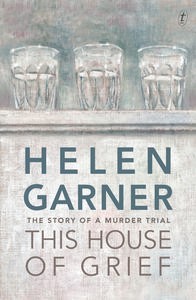
This House of Grief – by Helen Garner, A Review.

Helen Garner saw it on the TV news. Night. Low Foliage. Water, misty and black. Blurred lights, a chopper. Men in high-vis and helmets. Something very bad here. Something frightful.

It was truly very bad. A man had driven his car into a dam. He escaped from the car but his three small sons drowned. The man was charged with their murder and over the following eight years Garner attended the man’s exhaustive legal trials. She exhausted herself in the process of moral exploration of territory that is indeed, ‘dark, misty, black and blurred.’ Reading Garner’s ‘This House of Grief’ can exhaust a reader in turn.

Three hundred pages of scrupulous enquiry end with the author reflecting: ‘When I let myself think of Jai, Tyler and Bailey lying in their quiet cemetery…I imagine the possessive rage of their families: You never knew them. You never even saw them. How dare you talk about your “grief?”
But no other word will do. Every stranger grieves for them. Every stranger’s heart is broken. The children’s fate is our legitimate concern. They are ours to mourn. They belong to all of us now.’

Garner takes the deaths of the three children personally as if she were herself involved. She seeks to know whether they died by grievous mischance or by human intent. She needs to understand. She begs of fate, of the universe, ‘Oh Lord, let this be an accident.’ For us her readers – we who elect to follow her into this frightful something – Helen Garner attends the hearings as our emissary to that house of grief. We too need to know, we too seek to understand; the three lost boys are ‘our’ lost children.

Garner quotes three epigrams, each a succinct cry from a previous emissary, each a pair of hands flung upward in despair over the futility of the quest to comprehend.

He can’t possibly have done it. But there’s no other explanation.

There is no explanation of the death of children that is acceptable.

…life is lived on two levels: one in our awareness and the other only inferable…from inexplicable behavior.

On what account are Garner’s thoughts and reactions, naked here on page after page, a matter for a reader’s interest or a reviewer’s remark? What access has the reader to her deeps, her angst? Garner, the person on the page, our emissary, attends a day of ravaging evidence; afterwards she makes her way, blindly, solitary, to a bar for a vodka. On other occasions she resorts to magical thinking: If only Farquharson could be found not guilty, then the boys would not be dead…Garner pictures them in their domestic vitality, playing footy, watching cartoons, running with arms open for a cuddle. The only way I could bear it was to picture the boys as water creatures: three silvery naked little sprites,…who slithered through a crack and …sped away together.
Then, haunted by the chill of reality, she races homeward in her mind, to haul my grandsons …from their Lego and their light sabres, to squeeze them …until they squirmed. Young boys! How can such wild vital creatures die? How can this hilarious sweetness …be snuffed out?

And again, this longer account of the observer’s migratory flight of feeling: When I got home I sat on the back verandah mumbling to myself, sick at heart. My third grandchild came wandering around the house. He approached me without speaking, turned his back, and stood waiting to be picked up. I lifted him onto my lap. He was only a few months younger than Bailey Farquharson had been when he drowned. For a while the little boy sat on my knee. He relaxed his spine against my chest. Together we listened to the clatter of the high palm fronds, the wail of a distant siren. He glanced up sharply when a flight of lorikeets swerved chattering across the garden. Then he spread his right hand like fan, inserted a delicate thumb into his mouth, and tucked his head under my chin.

And yet only two hours later when he and his four-year-old brother disobeyed me… and went crashing and yelling down the hall to the kitchen like maniacs, rage blinded me. I ran after them, grabbed the nearest arm, and yanked its owner round in a curve. Before I could land a blow I got a grip on myself. The boys stood frozen in attitudes of flight. Nobody spoke. In a cold sweat I leaned against the cupboard door and took some trembling breaths.

Here Garner gives us her brittleness, her sense of near disintegration, her proximity in extremis to harming loved ones in her care; and subtly too, the boys’ “attitudes of frozen flight” recall the postures of failed flight of the boys in the drowned car.

There is a reticence, a holding back at certain points, a refusal to comment that shouts, no, screams, in unexpressed horror. Thus: The men from Major Collision looked into the car before they opened it to drain the water. Ten-year-old Jai was lying face down across the front seats with his head towards the driver’s door…
Seven-year-old Tyler lay on his right side behind the driver’s seat. His head was near the door and his legs were between the two front seats. Two-year-old Bailey was lying across the top of the baby seat, facing rearwards and still tangled in his safety harness.

It is not until the following page that Garner reveals the killer datum: all three seatbelts were unbuckled. It is this crushing fact that tells us that a child – or two children – struggled. It is this, delayed, that a writer striving for dramatic effect might have juxtaposed earlier and quite unbearably with those postures. As it is, the bodies lie diagonally, piercing my composure. I too need recourse to slithering fishes or to vodka or to clutching hard my own brood of near ten-year-old grandboys.

***

Writing to a friend some weeks following release of the book – a year or more I guess after the trial and the appeal and the retrial and the application to the High Court – after all had ended, Helen Garner said: “This is what I’ve learned from the last seven or eight years: ‘We are small. We are weak. We are mortal’… but I think I knew that already.”

After all had ended it had not ended at all.This House of Grief