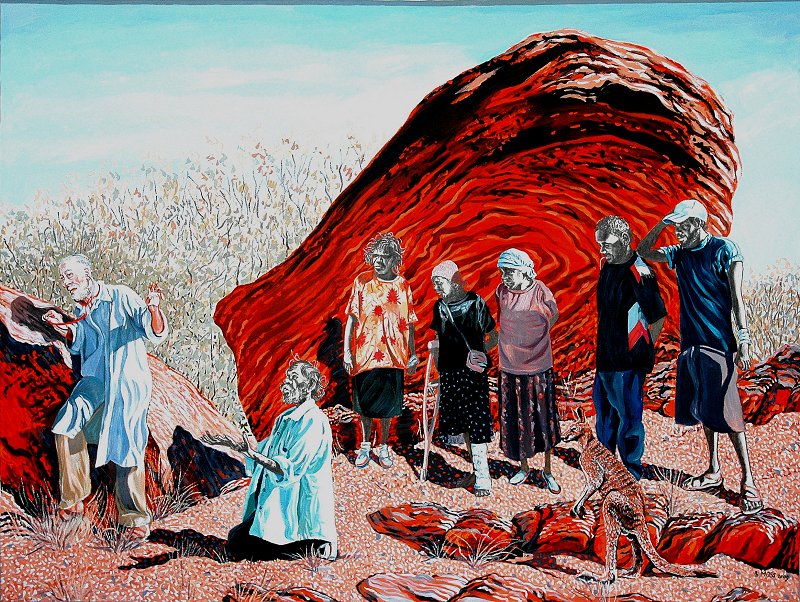
Robert Hillman’s ‘Gurrumul’ – Review by Howard Goldenberg

Gurrumul by Robert Hillman  Publisher: ABC Books

Gurrumul by Robert Hillman
Publisher: ABC Books

If autobiography is the least reliable genre in fiction then the authorized Life sits at its flakiest edge. That this is not true of Hillman’s “Gurrumul” is on account of the slipperiness of the subject.

Geoffrey Gurrumul Yunipingu emerges as shy, remote, elusive, cryptic, mischievous – an outer island in an archipelago of tongues. He does not so much emerge as submerge himself. Blind from birth, Gurrumul seems at times to be mute by choice. At others he makes himself perfectly clear to a whitefella, especially when working with his intimate collaborator, Michael Hohnen.

By book’s end Gurrumul remains hidden; only his music and the beauty of his features – a beauty we can enjoy and he can never perceive – speak to us.

No biographer could truly represent this life, (nor for that matter could he successfully misrepresent it). Wisely, Hillman does not attempt either. Instead he places the artist in his context. Chiefly that context is the complex of family (especially his bevy of aunties), community, land and Dreaming: in short, culture.

“Culture”, a term used promiscuously in conversations between the races, embodies meanings that are layered and expressed in dance, in music, in painting, in song, in storytelling and in land husbandry. The meanings are traditionally expressed obliquely, which is to say they are in part obscured. What Gurrumul does with these enfolded meanings appears to be a risky enterprise of his own, with calibrated departures from liturgical norms, a sort of jazz move in which he improvises within a theme and extends it beyond the limits of permitted custom.

Such a variation on a theme must be perceptible only to a tiny number of the millions who respond to Gurrumul’s music making. In this sense it is a secret, yet another, in  practice that skates ever along the outer edge of theunshareable.

When Gurrumul sings, whitefellas listen, enthralled. Literally, we are in a thrall, under a spell cast upon us by the spellbinding singer. We scarcely hear the words, we cannot parse them; and when we read their translations in Hillman’s book, the words in English are so simple as to appear banal: a profoundly false impression. And yet, and yet, we are transported. If beauty be truth, then truth is shown to us precisely as it is withheld. The subtlety of all this magic is clearly rendered in Hillman’s book.

To those who have read “My Life as a Traitor” and “The Rugmaker of Mazr a Sharif”, Hillman’s skill in rendering an alien culture will be familiar. It is in his later work, “The Honey Thief”, that Hillman manages to capture the artist in the act of working his art, in this case the sublime art of the Afghan (Azari) storyteller.

In the present volume Hillman attempts the extremely ambitious exegesis of the utterly untranslatable term, “Dreaming.” He succeeds, in this reader’s view, brilliantly. In twenty five years and over sixty working visits to remote Aboriginal communities, I have never felt I came so close to apprehending (I doubt any whitefella will ever comprehend) the Dreaming, as in Hillman’s “Gurrumul, his life and music.”

Hillman has succeeded remarkably in penetrating the life of art and ceremony (the two amount to much the same thing) on Elcho Island. Seven years ago while I worked on Elcho ceremony was active but off limits for whitefellas. Clearly Robert Hillman won the trust of capable cultural brokers on the island, who ‘let him in’ wherever this was permissible. In return, Hillman repays trust with respect that neither fawns nor condescends. In this his text avoids the vapid tone of comments on the book’s photographs.

Which leads me to the one regret I have about the book, a quibble perhaps, but an important one. In an important sense Hillman’s publisher subverts the author’s enterprise, which is to render in words an art that is ineffable. It is the format of the handsome volume that works against the writing. You look at the book, you find the cover images arresting – and to one familiar with the singing – quite new. The book itself cannot be held in the hand and read: it is biography in a coffee table format. You open the book, you start to read and you find yourself distracted repeatedly from the text by beguiling photographs which tell their own story quite compellingly, but quite out of sync with Hillman’s theme at any point.

Better justice might have been done to both text and photos by physically separating them.

In the end the book succeeds to a remarkable degree. Importantly, it demonstrates how, as whitefellas embrace Aboriginal culture, Australia is becoming more Australian.

Hillman’s book is bound to succeed beyond these shores as Gurrumul’s audiences around the world drink deeply in their thirst for some understanding of his life and his music.

What I Have Been Doing With Your Donated (and Undonated) Monies

Late Training Notes from the Bristol Downs.

I promised to report on your Unusual Investment. (If, as you read this, you don’t know about that Investment, please visit these links http://hopkintonrespite.com or
http://www.youtube.com/user/HopkintonRespiteTV
It is not too late for your dollars to join the nearly-four thousand dollars that preceded yours, whose donor investors will never see them again.)
Since I first wrote to you the grass has not grown beneath my feet. A certain amount of tinea has, but this is inevitable: I have been training hard. The Boston Marathon will be run on Monday 15 April and investors in my little Scheme are helping the Michael Lisson Memorial Respite Centre.
Michael’s mother, who created the Centre, wrote one week ago, reminding me that Michael died on the day of the 100th running. I ran that day, unknowing. Now I know and marathon running feels like a small matter.

They ought to call the Downs the Ups, these vast, everlasting, uptwisting hills. Or the Steeps. From one end of the Downs you can’t see the other for distance. And even if you could, you couldn’t – because of the mists. In spring, season of mists and frosts.

My father, not a lewd man nor crude, told few risqué jokes. However this semi-liquid air brings to mind one of Dad’s one-liners: Did you hear about the man who took his girlfriend out into the night air and mist?

Enough complaining. Hilly Bristol, like coastal Israel, is terrific training ground for Monday’s Boston Marathon. We’ll run up the Newton Hills between miles 18 and 21, hills famous for breaking hearts, but the Bristol Ups, like the long, high dunes of Herzliyah, have toughened mine.

This is my race preview. I have trained long and hard, six days a week, resting only on the Sabbath. Each run feels easier than the last. Gone is the sense of labour in a run of a mere hour’s duration. My legs feel wonderful, muscular and light. There is the little matter of the creaking discomfort in the left knee – my good knee – a new sensation. The knee hurts only when it bears weight. Best ignored.

With the exception of a 3.5 hour run in the Jerusalem Forest all my training runs have been solitary. This is not of my choosing: running with a friend is four times easier than running alone. This is true for all runs, over all distances. I know: I have done the maths. However all my friends have stopped running; they have heard the call and they have gone inside for dinner or for breakfast or to their homework or to dull duty. So I run alone.

In Bristol Alfred Lord Tennyson has kept me company. Some fluke or inadvertence has selected the poems of Tennyson on my i-phone. Useless here in the UK for telephony, my i-phone has become the perfect companion. Deaf and mute to the world outside my earbuds, my Apple sings the songs of my choosing, or in this case, the poems of my non-choosing.

He was keen on death, was Lord Alfred. From ‘Ulysses’, where he found romantic allure in Death, the Adventure; to the dying of King Arthur; to the demise of the Lady of Shallott; through lyric after lyric, the Laureate spoke to me, morning after morning, of death. Last Sunday he spoke to me at great length of the loss of his friend Arthur Hallam.
Endless his grieving, dark his spirits, Tennyson’s mood finds its echoes on these misty Downs.

That day found me running near the railing that kept me from stepping out into air and falling hundreds of feet in near-dark to the river, tirra lira, below. A blaze of red in the gloom, patches of white at shoulder height; what are these? A brief breather is permitted. The patches of white turn out to be cards, handwritten by members of a local junior cricket team and a junior football team, in memoriam to a teammate. The blaze of red is a football club scarf inscribed in black marking pen: Russell Simmons # 14.
Fresh posies of daffodil and another, paler flower, bloom from the railings.

No-one else in sight. No-one to ask or tell. No-one else to lament. My head bends, defeated. A sudden roar, a cry of raw sorrow bursts from my throat. My voice thickens, my eyes are wet.

Running is an easy thing, marathon training now trivial.

Shaking my head, shaking it to shed reality, I look up once more. There are more words to be read on that blood-red scarf: You’ll never walk alone.

Postscript: Afterwards I Googled Russell Simmons, deceased Bristol sportsman, and felt still sadder.

Copyright, Howard Goldenberg, 10 April, 2013

20130411-184933.jpg

The Harmonica Man of Elizabeth Street

It is lunchtime in Elizabeth Street and the foot traffic is in a
hurry. I am in a hurry, hurrying to my coffee, weaving in and out of
traffic before hurrying back to work. One  pair of legs is stationary
in all this traffic and fret. The legs stand against a shop window,
long legs in shabby grey trousers. My head swivels and my gaze works
upwards past a jacket of crumpled grey to a stubble of stippled beard
on a thin and craggy face.
A hand is raised to the face. It holds a harmonica which is applied to
a toothless mouth. Flabby cheeks inflate and empty, bellows for
music’s fire.
On the footpath at the musician’s feet is an upturned grey flannel
cap. He is a street performer, and as an habitual supporter of the
arts, I reach for a coin, but the tides and eddies of Elizabeth Street
carry me well past the busker before I can contribute.
Next time, I promise myself.
Next time I am in Elizabeth Street, I sight the man in plenty of time
to steer over towards him.  Up close now, I see the same harmonica,
the same hat, the same performance. The hat is empty. So, it seems, is
the harmonica, which is mute despite the musician’s respirations
through it. It appears that his lungs are so wasted away by time and
tobacco that the tides of air pass silently across his instrument. The
man is breathing: that is the totality of his act.
Upon him now, I reach into my pocket for coin, but the fob is empty,
and I have passed.
Next time, I promise myself.
But the next time I am in Elizabeth Street at the busking hour, the
harmonica man is not there. Is he breathing his art elsewhere? Is he
breathing at all?
Weeks pass. The chill of early winter gives way to the deep cold of
the solstice. A wind blows from the Antarctic, driving the coffee
crowd before it in its overcoats and its scarves, into safe cubbies of
caffeine and warmth.
And there, there in the thin grey pants and coat is the mouth
organist, breathing still, breathing inaudibly into his organ of mime.
The winds of winter and the moving feet make the only music in
Elizabeth Street.
On what does he subsist, this insubstantial being? Aged, alone in the
multitude, unfed, barely clad, unheard – where does he go at fall of
night?

A Trip to Cuba – Part 3

The People – kind, bright, gracious.

In Cuba, time is not money, money is not time. The people have not realised that they should exact a money price for the gift of time. Time is not (yet) a commodity. It remains a gift.

The Body – in Cuba, the body is nowhere repressed; everywhere it is expressed, accepted, celebrated. A fat, fat lady will wear body-defining lycra, in stripes that accentuate her plenitude. She hears music, and like everyone else, she’ll dance. It hasn’t occurred to her that she is unfeminine, unpretty, not sexy. (Marie Claire costs twice her weekly earnings, so she hasn’t read the truth about her body.) So she lives and dances, innocent of the truth. An unliberated woman.

A man stands facing us in a public place, his eyes and mind are elsewhere. Idly he scratches his balls. He takes his time, doing the job thoroughly. Like a long-legged fly upon the stream, his mind moves upon silence. He finishes his scratching, looks up, his eyes and mine lock, while Annette looks away to spare him embarrassment. She need not bother: the man looks into the distance again and loosens his three piece set from the grip of his undies.

The cityscape of La Habana – so rich in architectural beauty, frequently neglected, never abased.

The pride of these humble people.  There is no cultural cringe in Cuba, no sense that authentic life lies somewhere else. What they lack, what exists across the sea, is affluence, not life.

A feeling of security wherever we go in Cuba. No street is too dark and lonely to walk. Encounters with strangers are not alarming.

They say there is petty crime against property, but we see no sign of it. Crime against persons is rare.

(Perhaps, after the embargo, things will change: the Mafia will return, and introduce World’s Best Practice.)

The black Cubans – tall, beautifully made men and women, the men broad, the women slender. They carry themselves like aristocrats, their movement fluid and graceful.

The music – it is everywhere, and almost everywhere it’s live – performed before you or beside you or behind you. You can’t eat or drink, shop or walk without a chance encounter with music.

The music is of the people: it creates them as much as they create the music.

A music scholar wrote that Afrocuban music is the fruit of the love affair between the Spanish guitar and the African drum.

Music and pride are mutual creations in Cuba. Cubans know that their small nation creates a musical gift enjoyed and valued far beyond their homeland.

The Spanish Language – they’ve got words in Spanish for just about everything: it’s a whole nother language, you might say, and a wholly beautiful language. And the Cubans don’t laugh at you when you try to speak it.