More Mother’s Day Thoughts

After my experience last Sunday I’ve decided I like Mothers Day. I enjoyed sharing vignettes of my old Mum. One of the first that I ever published, appeared in my first book, a memoir which I called “My Father’s Compass”. The vignette, a story about my 92 year old father battling the extinguishment of his great powers, and my mother battling nothing and accepting all, was titled: Falling gums.

“The phone rings at midnight. I walk towards the answering machine and listen for an urgent message. I do not pick up the receiver because it is Friday night, my Sabbath – Shabbat – when my soul visits paradise. When I am in paradise I do not answer the phone. There is no message.

Though puzzled – who would want to speak to me at midnight if it were not an emergency? – I begin to relax, then the phone rings again. Once again my machine offers to take a message, once again the caller is mute. I grab the phone. Dad’s voice says, ‘Mum is on the floor …’

‘I’ll come now,’ I say, and hang up. Dad and I have responded to the situation with the least possible desecration of the Sabbath.

Minutes later I let myself into my parents’ house. There, on the bedroom floor, in a tangle of limbs, is my mother. ‘Hello darling,’ she says. She looks up at me and gives me a grin. Recently, Mum’s front teeth have begun to desert her. Those teeth that remain are a picket fence, stained and in disrepair. Mum’s former serene smile has given way to a seven-year-old’s grin – all mischief and careless abandon.

I peer down at Mum’s legs. They are thin, too thin, except for her ruined knee which is swollen and misshapen. In the half light her skin is ivory. I crouch and put my hand on her leg and feel its cool and its smoothness. I touch my mother’s skin and I am her small child again.

A short time passes. ‘Does any thing hurt, Mum?’

‘No darling.’

‘Can you move your limbs, Mum?’

Dad’s voice breaks in: ‘Mum’s not hurt – she didn’t fall. She was reaching for the commode chair and she pushed it away instead of holding it still … she just slid gently onto the floor … I couldn’t stop her falling …’

Dad’s voice subsides. He sits on his bed and holds his head in his hands.

Mum speaks: ‘I’m quite comfortable, darling. It’s quite a nice floor, really.’ Another grin. I look at my mother. Her limbs are splayed and folded beneath and before her like so many pick-up-sticks. I wonder how I will pick them up.

‘If you like it on the floor, Mum, would you prefer to stay there until the morning?’

‘If you wish, darling.’ She extends a hand and pats my face.

I bend and begin to take her weight, my hands beneath her arms. Dad gets up to help but I knock him back because his heart is worn out and failing.

He recoils, recedes and sits down opposite me, his face wrought of grief and care. I feel a pang for my abruptness.

An in-drawing of breath, a grunt and Mum is aloft, her legs a pair of white flags hanging limply beneath her. Her arms are around my neck and we are locked in our accustomed embrace that has become so familiar since she began to suffer a series of strokes.

We know this moment well; each of us knows the sweetness of this slow dance. Neither of us would readily trade it, not even to make Mum whole again.

A moment later Mum is in her bed, covered up, wheezing, speaking breathily, her voice ravaged by stroke and by time: ‘Thank you, darling, what a treat!’ – and beaming with the simple pleasure of ­being tucked into her bed.

Dad, contrite, distressed, is saying, ‘I am sorry, darling. I hate to disturb you.’ And I am saying how pleased I am to come, and how come he didn’t speak into the machine when he rang. And Dad says, ‘I don’t know.’

‘Shabbat Shalom,’ I say, kiss them both goodnight, and go home.

Back home, but not yet in paradise, I sit a while and recall a conversation my friend Lionel reported to me. While driving with my father in the Flinders Ranges, Lionel asks this indestructible old man a singular question: ‘What are you afraid of in this life, Myer?’

My dreadnought father has fought all his sixty-seven years as a doctor against illness and injury. Of all diseases, I know that cancer and stroke fill him with terror beyond naming. And I recall, too, Dad confiding to me his fears for Mum: ‘I am grateful for every single day that I have her; and I am so frightened of the day that …’ He falls silent, his voice drowning in the grief of his imagining.

When Lionel asks his question, Dad looks up and out and away from inside him, and he sees those silent, massive and beauteous living things, so inviting in the outdoors and so treacherous. He answers, ‘Falling gum trees.’

The day after the ‘fall’ Mum and I are alone in the kitchen when she begins to laugh. The sound has a gasping quality. You have to pay close attention to discover whether she is choking again, or simply amused. She laughs louder then tries to speak at the same time.

Her voice is a concerto for bagpipes and windstorm. I lean close, into the teeth of the storm, and Mum says, ‘When I was on the floor last night, and I couldn’t get up, I started to laugh, and I couldn’t stop … and Daddy was furious!’”
The Birthday Card

photo-1 photoI lent a book to a young woman I know. It was was one of those  works that tells you “How to Enrich your Life/Relationships/Soul” – books I find offputting because they presume to know me better than I do and to instruct me in a better path, the only path.

The young woman read to page forty or so and returned with my the volume and an expression of mild embarrassment. She opened the book and pulled out her bookmark.

I asked her: “How’s it going?”

“It’s quite helpful…”

I told her I never got past page forty: ”Too bloody know-it-all for me.”

But it wasn’t the book or its author that brought her back. The young woman handed me her bookmark.”This must be yours.” She blushed. ”I’m sorry, I found myself reading something personal…”

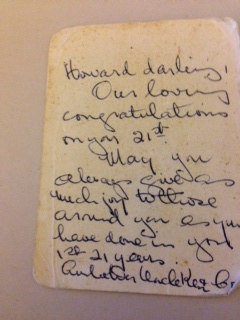
The bookmark was tiny, about two inches by three. Inches, because the card dates back to pre-metric days. It was was yellowed a little, its edges furred and thickened. On the obverse was a tiny posy of dried flowers, pressed, still intact. The date on the reverse side read January 8, 1967.

I think my mouth fell open. I recognized the handwriting – an odd and elegant hand, it looped and curled in a crisp and orderly way, warm yet somehow formal. No-one I know writes like that, not any more.

The writing was Mum’s!

The greeting was affectionate. It began, “Howard, darling…” It went on to congratulate me on my twenty-first birthday. The message spoke of my twenty one years, praising and prizing me in the way only one who had known me from birth could do.

I felt the rush and the glow of that primal love, the love that formed me. I felt deeply happy.

I looked up and faced the young woman. “Thank you.”

She averted her eyes from my face that was surely naked.

I looked down again and read the signature. It wasn’t Mum who had signed the card, but her sister, my Aunty Doreen. The handwriting so similar, the shared cuneiform of their bonded lives.

Now it was Aunty Doreen who returned to me, not displacing Mum, but present alongside her, together now as ever through their long lives. If Mum was Pollyanna, Aunty Dor saw a world in its rough reality. Orphaned early, the two turned to each other and went through their remaining scores of years love-laced and life-loving.

I held the card, soft in my hand, and thought of two women who knew me so well – better even than the author of the book I had loaned the young woman, witness to my intimate moment.

“Thank you”, I said again.

Cerebrovascular Accident

Ten or twelve
Only ten or twelve
Strokes of havoc
Quite unselve…

(from Binsley Poplars, Gerard Manley Hopkins)

Self-pity. It’s Amy Clampitt’s fault:
blame amy.
In her “Beethoven, Opus111” –
A poem, its title promising
Music, but its texture and girth
Thick with root and thorn, and earth,
The toil of her farmer father, the clodded
Soil his foe (and freiheit!) and moil,
She speaks of his dying, his escape
Into air, and I wondered: how will I
Go there?
I smiled to imagine his “last act,
to walk on air.”

But then I remembered: one hundred and seventy
on one hundred and ten, numbers that number my days, Dread then, of a stroke broke my smile:
To sit, endless,
Helpless, in my piss
And my shit? Well
That’s how I started, how my grandruby sits,
The happiest of souls, she laughs in fits –
Why might not I subsist, exist, persist –
Unlearn, and learn and earn to laugh like Ruby?
My Mum had strokes, stroke upon stroke –
The doctors lost count; but she, like Ruby,
Knew only stroke upon stroke
Of joy: I’ve never been happier in my life, Mum
Said. And meant it. And showed it.

Mum followed Beethoven into the quiet
Of the deaf, whither I tiptoe too: there
White noise abates, music awaits,
Remembered. And you hear less bullshite.

But if a vessel, sclerotic, brittle,
But block or blow or burst,
It’ll tear, shear, shatter my brain,
And blind me: in that pain – in that pain
Would I, could I smile again – in that dark?
If I, like eyeless Jacob upon the head of Ephraim
Rest my hand on Ruby: I’d smile again

But come that stroke
That stroke
That takes away words –
My words, coin of my world,
Uncoined then, mute, truly broke,
To speak no more, nor write –
Not to ask, nor thank, nor say: I think…
Nor pray.
Nor ask, scratch that itch;
Never again speak my love? Never indite?
Not utter?
Mouth fail, tongue in jail,
Hand flail, pen fall?
That stroke, that stroke,
What, never crack a joke?
Never?
No, not
Ever.

Self-pity is the sincerest emotion.

The District Medical Officer’s Logbook


Hg is a district medical officer in remote australia

The DMO takes phone calls from the remotest places in Australia

The cases he describes are typical and fictional. And true:

2100 hours – a large man screaming in pain from his twisted testis.

2105 – given morphine intravenously

2110 – still screaming; more morphine

2115 – in agony; crying; more morph

2118 – no better; given a fourth dose; settles; given an oral opiate for continued effect

2120 -2150 – called Flying Doctor, arranged retrieval to the Base Hospital, briefed Flight Nurse, briefed Emergency Dept at the hospital.

Plane will take off at 2235, pick up patient at 2355, ETA at hospital 0045 hours. He has six times the normal dose of opiate aboard his large body. He will undergo urgent ultrasound to confirm the diagnosis. If confirmed surgery will follow to save the testis.

Meanwhile the phone has not cooled in the DMO’s hand:

2107 hours – a doctor in an Aboriginal community some 2 flying hours away calls seeking retrieval of a 79 year old Aboriginal man, normally active, sociable, a traditional healer, a man of high degree who has suddenly fallen ill. His urine tests positive for infection and his high fever and racing heart and falling blood pressure register a likely septicaemia.

Air retrieval is urgent. DMO makes a further six phone calls to the parties to this retrieval. The plane will not arrive for a further three hours, leaving the remote nurse and the remote doctor with a failing treasure.

2204 – A triple zero call to the ambulance alerts all services to a rollover 20 kilometres from the nearest settlement, about 130 kms from the Base Hospital. Two grey nomads have hit their heads and walked away from the wrecked vehicle. They will be treated as fractured necks until a CT scan proves otherwise: a vehicle that overturns while travelling at 100 kph belts a neck with sudden brutality. Persons walking away from the car might never walk again.

2224 – An unconfirmed and unclear report of a third person trapped in the wreckage. Ambulances set out from the small community driven by remote nurses who handle everything from births to deaths to attempted hangings. None of those tonight, thankfully. So far.

2241 – Six hundred kms distant from the septicaemic old man another goes down with a similar illness. This man, aged sixty, looks eighty. We send a plane, knowing that the flight will not commence until 0300. Aviation hazard statistics show that risk is highest after 3.00 am. This retrieval will end at some time from 0600 to 0800, when the crew will be at their lowest ebb. More phone calls – at least six per evacuation, sometimes as many as twenty.

The DMO’s shoulders and neck tighten during the 13 hours of the night shift. The bladder calls but calls in vain.

2300 – a baby has bronchiolitis, needs oxygen, is supported capably in a clinic 350 kms from the nearest hospital. The planes are both out. Two nurses pack up babe, mother and all their gear into the ambulance and commence the 8-9 hour return trip. The nurses will be on call tomorrow night too.

2340 – a bloke has a headache. His head has ached for the last six days, ever since the rock chucked at him hit him on the head. He looks well enough, his vital signs are alright, but who knows which little artery bleeds quietly away, building, building a pressure on the brain that might bring a stop to respiration?

The DMO arranges this man’s evacuation for first thing in the morning. Meanwhile the man sleeps. He will probably wake up. The plane that retrieves him will also bring the station hand whose ovaries, tubes and womb are on fire with the infection that her man gave her before abandoning her 15 months ago.

Midnight and the calls come less frequently. The DMO climbs onto the couch by his desk and waits for oblivion. He yawns great, jawcracking yawns. He falls asleep. The phone rings at 0040: the nurse in the most remote community calls about a woman whose labour has started. The baby was expected in 13 days. Mother-to-be is nineteen and this is her first baby. Her English is poor, she is shy – or scared mute. The nurse – “I am not a midwife, doctor” – reckons the contractions are infrequent and brief. The waters have not broken. There is no blood. There will be no aircraft until 0930 at the earliest. The non-midwife will be alone in a room with a ticking womb through the remainder of this long night. Telephone calls proliferate – from DMO to obstetrician , to RFDS, to Emergency Department, to the flight nurse, and – repeatedly – to the solitary nurse in the clinic in Deepest Woop-Woop. Drugs are ordered to halt labour. Observations are taken, reported, discussed: Nessun Dorma.

The DMO keeps notes, trying to enter them in real time into the computer whose softwear has an inbuilt stuttering tendency, suddenly freezing in mid-sentence, then as abruptly thawing. From time to time the computer does its programmed unbooting. The DMO is old, computers are new and the NBN cannot come fast enough. The DMO swears a lot at the softwear while reserving the most supportive and encouraging words for his allies, the nurses, with their patients in their far and lonely posts.

The labouring lady sleeps. The non-midwife checks an inscrutable belly for contractions, peeks furtively at a pad for liquor or blood, listens to the baby’s heartbeat, monitors blood pressure,

The DMO wants to sleep. He lies down, looks balefully at the phone – silent for now – and delivers a little speech to himself: The phone will ring. It will wake me. That’s what I signed up for. That’s my job – no phone, no job. Don’t complain. The DMO finds this speech inspiring: he will fight on the beaches, he will fight in the streets, he will never, never… The phone rings. It is the flight nurse, reporting on the safe arrival of the old seer with sepsis. She needs the current observations on the second bloke. More telephony. More self-conversations about sleep, work, the meaning of life.

0350 – the ambulance service rings. A triple zero call has come in of a man, raging, threatening harm to himself and to others. The call came from a clinic 80 kms distant. The caller says the patient lives in House No. 174. Police have been called.

The DMO calls the clinic in that community, disturbs the sleep of a nurse who must go out into the dark to find a patient who hasn’t called her and who is quite unpredictable. DMO enlists her help but commands her to keep her distance until the Police arrive. Once she can safely assess the patient she is to call back and the DMO will face the mutually demeaning task of certifying another human insane. The nurse goes out into the cold – it is minus two centigrade. In the event she searches with the Police, fruitlessly. The harmer is not found.

0600 – the DMO briefs the flight nurse on the first of the day shift aircraft. Before this he answers phone calls from nurses supplying the latest observations and reports on their charges.

It is 0635. The shift will end at 0800 – give or take the handover to the day shift DMO, and the paperwork, and the catch-up note-keeping on the flukey computer.

The DMO decides to make a cuppa. Night will soon be over.

Nonmother’s Day

Apparently Mother’s Day is neither a public holiday nor a religious holy day. Anyone who is not a believer is nevertheless a moral outcast. Even Al Capone loved his mum, one day of the year. Mother’s Day is not ancient, rather it is the brainchild of a marketing opportunist at a greetings card company. The same is true of Father’s Day.

There is a problem with both Days: where to place the apostrophe. Is it the day of the one and only mother you happen to be celebrating? If so, it is Mother’s Day. But if all mothers, from the Madonna onwards, are celebrated, it becomes Mothers’ Day. But as mothers become more numerous, sentiment is diluted. Unless you are a politician gift wrapping pre-election pork for the barrel, you can’t get teary over every mother in the cosmos.

What should make us tearful is the abuse of the apostrophe. In the fruit shop – Lovely Navel’s; in the supermarket – New Seasons Spud’s; at the pharmacy – Retread your Old Condom’s Here.

Time Keeper

My mother, Yvonne, was famously late for everything.
One day, her sister, Doreen, visited Mum; it was the day before Mum was to undergo surgery. In old age, the two sisters always got together on the eve of any hospitalization of either one of them, in case the patient ‘pegged out’, as they put it.

Doreen was examining the contents of Mum’s jewellery box; Mum was indicating which piece would go to whom if she were to peg out.
Doreen held up pretty pendant watch on a gold chain. She said, “Yvonne, this is lovely. You should wear this watch more often.”
Dad, hearing this and all too aware of Mum’s tardiness, laughed:” Yvonne doesn’t know how to tell the time.”

“Yes, I do”, said Mum, “I just don’t approve of it.”

Naïve in Yangon

Part I:


I arrive red-eyed. By the time I leave after only 36 hours here, I’ll still be jetlagged. Sensations are  heightened at times, at others attenuated. Energy comes in uncertain surges, sleep arrives in waves, deep and short like a choppy surf.

As we passengers file from the aircraft into the terminal building a panoply of comic opera Military appears, variously uniformed. One bunch wears jackets of magenta and orange, a vivid combination. Armed with the Lonely Planet guide to Burma I gather Authority in this country is no joking matter.

The pink and orange boys wear serious expressions and serious firearms. One of these fellows watches humourlessly over the shoulder of each of the lady officials in Immigration.

My immigration lady has a moustache and no syllables to spare for conversation. I do not lighten her day with my jokes.

Outside the terminal an informal looking character beckons. He grabs my suitcase and leads me towards a ramshackle Japanese vehicle held together by desperation. My driver smokes through the half-hour drive to my hotel.  His smoke of choice is Red Ruby. Lest he run out he keeps three reserve packs, unopened, on the sill of his dashboard. The vehicle smokes too. This is Cuba revisited, sanctions country, a land where the motor vehicle is forbidden to die.

The road from the airport has many lanes, each a stream of cars of a similar character. We come to a stop where streams meet and merge. The pavements flow with Burmese people, uniformly slim, delicately slim.

Topeed traffic police stand and semaphore the traffic from their small circular islets of cement. Theirs is an improbable serpentine beauty. Everyone is thin: do the Burmese have enough to eat?  Or do they simply lack western junk food?

But the armed traffic cop who sits wide-arsed on his motor bike is a fat man. Eager to read an entire society from these early signs, I decide: In Myanmar if a man is fat man, he is a boss, ergo corrupt.

At a distance of a hundred meters I decide to dislike the fat cop.

While our stream sits becalmed, awaiting the signal from the brave traffic policeman in the white helmet, pedestrians at all sides flow fast onto the roadway towards us, striding purposefully, carrying books for sale. The books are all the same: the fine features of Aung San Suu Kyi gaze earnestly from the covers. The booksellers show no fear of milling cars or officers of the Law. The police pay no heed to the book trade.

We pass a number of golden pagodas that turn out to be one, seen vertiginously from a number of angles: this is the Great Shwedagon Pagoda. My driver says it is 6000 years old. (The spoilsports at Lonely Planet reckon it’s a mere 2500 years old, frequently remodeled, with the present incarnation dating from the 19th century.)

We arrive at my hotel and I pay the driver the derisory pittance he names. No extra charge for the gift of passive smoke.

I drop my luggage at my hotel. I have but one plan and objective in Myanmar, which is to meet the remaining eighteen Jews of Yangon.

I show the concierge the address of the Synagogue. He says it is not many miles away. One could walk.

Outside the front of the hotel I am greeted by heat and noise and bustle. And a young lady. Energy drains away. The young lady, clad in a demure suit of bodyclinging white and wearing a sort of cloth helmet with gorgeous stripes, smiles. Hers is the first of the many smiles of my 36 Yangon hours and one of the best. Would I like a taxi?

Yes, I suppose I would. No rush; I’d like to bask in the sunshine of that smile for a while.

Smiling lady procures a cab, converses with the driver, negotiates, reaches agreement. She instructs me firmly not to pay more than the stated eight dollars. The local currency is kyat, pronounced ‘chat’. The rate of exchange is inscrutable so in every transaction I allow myself to be screwed gracefully. These likable people have less than I and they ask very little.

The ride to the synagogue along sinuous ways is an inching progress and all the better for the intimate closeness to the man in the street – and the woman and the child and the beggar and the cripple – all pushing, pulling, carrying, selling, cooking, eating, feeding, begging.

We arrive at number 85, 26th Street, near Mahabandoolah Road. The driver smiles. His open mouth is a blood-red bath. His intoxicant is not Red Ruby but betel nut. Did I say blood-red? Thinner than blood, more vivid than blood, truly scarlet, the betel juice flows and splashes with the driver’s speech and smile. After decades of distant acquaintance from the printed page, betel in the flesh startles.

The Mosea Yeshua Synagogue is a bright white place in the Bhagdadi style, built to capture light. The trustee, one of the eighteen, expects me. He is a slim man, fine boned, his face a map of smile lines, his skin varnished. Gravely courteous, elegant in his pressed longhi and a very white shirt, he might be in his late fifties.

He speaks English softly, his vowels betraying the play of a number of languages behind his words.

I ask my artless questions of admiration and sentimental prejudgement but the replies slide past my understanding; my informant suffers from a serious affliction of his larynx, a poignant disability in the one person who might tell the story of the place that he embodies.

With quiet pride, he shows me photographs of an extraordinary congregational past; a Torah scroll, its parchment nut-brown; the entire house pristine, flooded in white and silence.

I came with hopes for conversations that would unveil touching details of flight, exile and faith among the remaining sons and daughters of the Jews of Mesopotamia. My hopes fade with the damaged voice of my informant.

When I ask to meet his fellow congregants, he replies opaquely. I never meet any.


Part II.


Back at my hotel after my Synagogue visit, deflated, absurd, I am not myself. I need sleep.

But first a shower.

The water is clean, the soap lathers. Quickly I am restored. I look outside. Broad daylight, not sleeping time.

Seven storeys below my window the traffic races around a bend. At the corner a slim woman sells papers from her makeshift newspaper stand. While she is engaged in a sale I sight a minute child in pink running from behind the woman towards the kerb, towards the rushing traffic. From my glassed-in vantage I shout a warning.

No-one would hear.

The child toddles on.

She is almost at the kerb when her mother wheels without haste, intercepts her daughter, scoops her up and embraces her.

Mother removes the child’s shift, lies her prone across her lap, and slides her hands up and down the slender back. The slow ballet of skin on skin continues for a good time.

Massage completed, mother dresses her child again and releases her to attend to a customer. Once again the roadway pulls the child, once again the child responds. Mother busily counts change.

My fingers work frantically at the window latch, but it will not open.

No sound from below as mother arrests her child at the kerb.

The newspaper vendor now sits and brushes the little girl’s hair. The child acquiesces, her hair falls in rich showers of black from the strokes of the busy brush.

Another customer. Mother sets her child upon a low stool and makes her sale.

She takes her child onto her knee, brushes again for a while, before securing the hair with ribbons of pink.

In addition to the outdoor newsagency the footpath is a restaurant. Clusters of people take their breakfast on low stools at the kerbside while others, squatting, cook in woks on spirit stoves. Are these family groups or are they customers? I cannot tell.

Meanwhile mother – mother of my child – prepares a meal in her own right. I see her feed the child something that might be noodles. The child sits on her mother’s knee, opening, accepting mouthfuls, while mother feeds and keeps her eye open for passing trade.

I gaze down from my eyrie, a grandfather empty of his young. I came to Yangon seeking one thing: this eluded me. In its place a mother and her child absorb me, urgently.

I discover I am not sleepy.

I decide to buy a newspaper.

Standing at the busy, busy street, I calculate the odds of a safe crossing. At length a break lets me through.

At the newsstand the mother cradles her child, curious about the old foreigner who peruses her papers and magazines.

In actuality I am simply enjoying the company. Mother’s cheeks are largely concealed by discs of the ubiquitous yellow-pink makeup. Smaller circles of the same cake the face of the little girl.

I am charmed.

Close up she has chicken limbs. Her face, a little too big for her body, is fullest in her cheeks, which are ripe apricots. She looks about 18 months of age. About the same as my newest grandchild.

Pretending it matters, I indicate the papers and magazines and ask: English?

A raised eyebrow.

Americano? America?

The lady is sorry. She shakes her head.

I am not sorry. I don’t care for the papers: these two are all the news that interests me. My purchase is a pretext, a means to allow me to thank them. I select a newspaper with its exotic typeface.

I pass a banknote in US currency.

The lady indicates she cannot change the 50 dollar bill.

I place it in her palm and close her hand around it.

Time to change the subject: I show her my camera; would she object if I take a photo of her child?

She is delighted.

I take a few snaps as mother looks on and beams. Beneath the discs of yellow-pink cake, her cheeks colour deeply.


Ruby

There you are on my screen, your face round and red and glowing.
I can see your fleshy cheeks, your extra chin.
Now you settle into your mother’s breast. I see your profile, your
pink ear, your welcome mat of thick black hair.
You are quiet, quiet, seen on my screen, seldom heard.

You arrived magically on the far side of the world in a land of short
dim days, days of rain and chill. In Australia, your grandfather –
this stranger grandfather – sweated and read dread warnings of
bushfire risk.

You are in the right place: your mother is your address. I sit in this
far country that will be your country, and I am not myself, not my
proper grandfathering self. My fingers have not touched your skin. My
eyes have not followed the rise and fall of your breathing. I haven’t
smelled you, haven’t heard you burp, seen you cry. I haven’t run a
soapy palm across your tummy.
Although I am a skilled and fearless nappy changer, I’ve never changed
you, made you fresh and clean and dry.
I should do these small intimate acts, then give you to your mum. She
will hold you and I will put my arm around her birth-swollen body;
I’ll rest my old cheek against her and I’ll feel again the newness of
flesh of my flesh of my flesh.

I am a pretender, Ruby. I await my time, our time.
I am not real.
When I see you I will run my finger beneath your chins and feel the
warmth of that soft cushion of flesh. I’ll rest you across my rocking
forearm, I’ll sing you my silly soft songs, I’ll feel your mass and
your space.
And you will make me real.

The Blood of Your Children

The blood of your children cries out from the earth
And we hear their blood cry
Not again,
Not the children;
In the bowels of Christ
Not the children

The blood of your children cries out
And we in Australia
Ask why those guns?
In the bowels of Christ
All those guns
With your children
Paying the price?

And we in Australia
Wonder,
Why would a mother…
Why did his mother?

And mothers fear
For their little ones
And fathers fear
For their guns
And from fear
Is born fear

And from fear, anger
Comes, then danger
And we reach
For our little ones
Daughters and sons
And some reach again
For their guns

Copyright, Howard Goldenberg, 17 December, 2012