Nobody Doesn’t Like a Song

I

Whenever I wanted to read a poem to my father he’d make a face. He claimed he didn’t like poetry. I suspect it was the ambiguity in a poem that frustrated him. In fact Dad loved poems, the poems he committed to memory in his schooldays. He recited some of these often enough for them to take seed and grow inside me.

Now Dad is gone and it is I who recites his lines, learned at school around 1925:

Blow, blow, thou winter wind

Thou art not so unkind

As man’s ingratitude…

Thy tooth is not so keen

Because thou art not seen

Although thy breath be rude

I see Dad’s wry smile as he continued with lines that border on the cynical.

Sing Hey Ho, Hey ho unto the holly

Most friendship is feigning

Most loving mere folly

Dad was not cynical. So what appealed to him about this snatch from ‘The Tempest’?

I think it was the music.

Lots of people think they don’t like poetry. They would never read a poem – not willingly, not wittingly.

But they listen to songs. And a song is just a poem hidden inside music.

Think of the Beatles. Think of ‘Till there was you’. Think of ‘Elinor Mackenzie’. We loved those songs, not least for their poetry.

Nobody doesn’t like a song.

Continue reading

A Review of One Thousand Cuts, by Rod Moss

One Thousand Cuts by Rod Moss

One Thousand Cuts by Rod Moss

One Thousand Cuts: Life and Art in Central Australia

A book of the dead?

Yes, explicitly so.

Names are named, a violation of all norms, all practice in both whitefella and blackfella Australia.

Rod does this by virtue of trust, explicit consent, indeed the command of Rod’s friends.

Rod Moss’ singular role – to witness, to record and transmit.

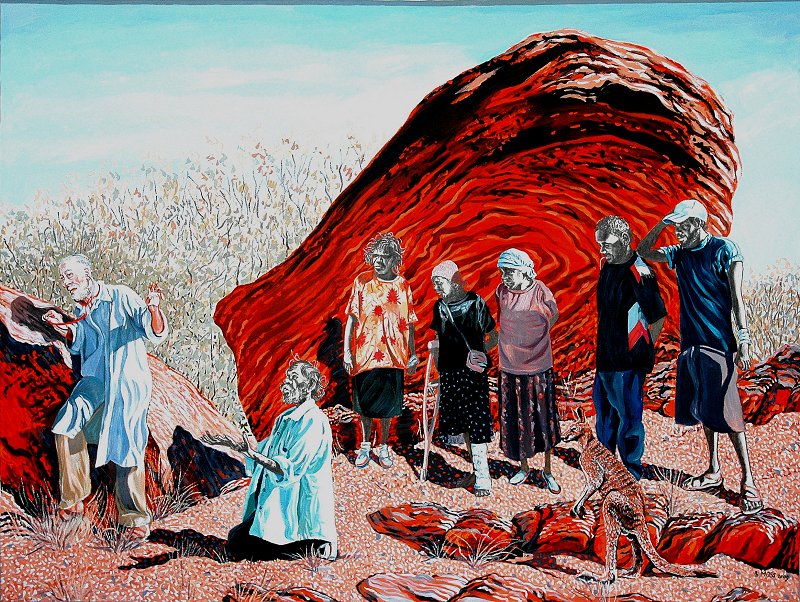
Rod Moss grew up in the country. Well, in the 1950’s the Dandenong Ranges were country-ish. But he was never “in country” until some time well into his long apprenticeship under Edward Arranye Johnson, in and around Alice Springs.

Moss’ first book, “The Hard Light of Day” recounts that apprenticeship, which began with a spontaneous act of neighbourliness and evolved through friendship to become a connection of spiritual father to son. The building and the losing of that bond are the subjects of that first book, winner of the Prime Minister’s Award. It might sound like a large statement that the second book builds on and exceeds the first in its power. It does so by the swelling sorrow of loss after loss after loss, of the weight of pain.

The present volume is unique in the way it illuminates the experience of being “in country” – an opaque expression that whitefellers who work outback hear often from blackfellers. Subtly, delicately, in a characteristic Moss undertone, being ‘in country’ becomes luminous. The light is shed by Moss as he moves around Arranye’s hereditary domain as his named spiritual heir.

Moss gives us birdsong, birdflight as he walks beneath. He breathes the breezes and tempests that flutter or flatten foliage and carry mood or prophecy.

He names and describes the fauna – from grub to reptile to marsupial – that create the country.

Moss does all this in the same manner as in his painting. His colours are florid, his verbal sallies frequently outrageous, his attack fearless. But in all this bravura there’s nothing flash or glib, as Moss walks and paints and photographs the lands of his spiritual patrimony, bearing the loss of spiritual father (and of many brothers and sisters), accruing more and more losses until their weight becomes unbearable.

Most of the losses come abruptly. Each comes with the force of a thump to the solar plexus.

Moss, with his reader at his shoulder, absorbs blow after blow.

At this point we have Moss Agonistes, crying: “It rains in my heart. One drop at a time.”

Moss misses a much anticipated funeral: “I find myself crying on Saturday morning …Though I was sad at the gravesite, it has taken until now, opening the brochure and studying the commemorative words…for me to be sobbing.”

Continue reading

Rod Moss and “One Thousand Cuts”

Rod Moss is a Ferntree Gully boy, a whitefella who found himself in Alice Springs thirty years ago and who stayed there.

In all the moral disorientation of the Centre, in its beauty, its grandeur, its squalor and its mystery; in the perplex of making and losing marriages, of fathering, of teaching, of reading deeply, of engagement with the dark cinema of darkest Europe, Rod Moss found friends in a clan of blackfellas living in Whitegate, one of the town camps.

Moss differed from most of us whitefellas who come to the Centre. He stayed. He painted (in a distinctive genre of his own creating) the lives of his friends. And through all the years of his staying and his painting and his friendships, Moss kept a journal. That journal gave birth to his first book, “The Hard Light of Day”. The book won the Prime Minister’s Prize for non-fiction. More significantly, the book won the praise of Ray Gaita, who described it as one of the best books he had ever read.

When I say Moss found himself in Alice Springs, I mean he found himself in ways most of us non-indigenous people never do: he found who he was, what he was doing here; he came to be in country.

When I say Moss found friends I also mean he lost them.

Those losses are recorded, drop by drop, blow following blow in Moss’ first book, and in the second, soberly titled, “One Thousand Cuts”.

I believe that in its swelling lament and its growing clarity, “One Thousand Cuts” surpasses even “The Hard Light of Day”.

In a remarkable sequence of events “One Thousand Cuts” will be launched at Readings in Carlton on Wednesday 9 October at 6.30pm. And a retrospective exhibition of Moss paintings will be opened at Anna Pappas Gallery two days later.

If Moss’ paintings are luminous, his writing a prolonged jazz riff,  the photographs are something else.

I invite readers of this blog to attend one or both of these events. I will be glad to see you.

Podcast of interview on Radio National with Waleed Aly, Howard Goldenberg and Rod Moss 8.10.13image

Robert Hillman’s ‘Gurrumul’ – Review by Howard Goldenberg

Gurrumul by Robert Hillman  Publisher: ABC Books

Gurrumul by Robert Hillman
Publisher: ABC Books

If autobiography is the least reliable genre in fiction then the authorized Life sits at its flakiest edge. That this is not true of Hillman’s “Gurrumul” is on account of the slipperiness of the subject.

Geoffrey Gurrumul Yunipingu emerges as shy, remote, elusive, cryptic, mischievous – an outer island in an archipelago of tongues. He does not so much emerge as submerge himself. Blind from birth, Gurrumul seems at times to be mute by choice. At others he makes himself perfectly clear to a whitefella, especially when working with his intimate collaborator, Michael Hohnen.

By book’s end Gurrumul remains hidden; only his music and the beauty of his features – a beauty we can enjoy and he can never perceive – speak to us.

No biographer could truly represent this life, (nor for that matter could he successfully misrepresent it). Wisely, Hillman does not attempt either. Instead he places the artist in his context. Chiefly that context is the complex of family (especially his bevy of aunties), community, land and Dreaming: in short, culture.

“Culture”, a term used promiscuously in conversations between the races, embodies meanings that are layered and expressed in dance, in music, in painting, in song, in storytelling and in land husbandry. The meanings are traditionally expressed obliquely, which is to say they are in part obscured. What Gurrumul does with these enfolded meanings appears to be a risky enterprise of his own, with calibrated departures from liturgical norms, a sort of jazz move in which he improvises within a theme and extends it beyond the limits of permitted custom.

Such a variation on a theme must be perceptible only to a tiny number of the millions who respond to Gurrumul’s music making. In this sense it is a secret, yet another, in  practice that skates ever along the outer edge of theunshareable.

When Gurrumul sings, whitefellas listen, enthralled. Literally, we are in a thrall, under a spell cast upon us by the spellbinding singer. We scarcely hear the words, we cannot parse them; and when we read their translations in Hillman’s book, the words in English are so simple as to appear banal: a profoundly false impression. And yet, and yet, we are transported. If beauty be truth, then truth is shown to us precisely as it is withheld. The subtlety of all this magic is clearly rendered in Hillman’s book.

To those who have read “My Life as a Traitor” and “The Rugmaker of Mazr a Sharif”, Hillman’s skill in rendering an alien culture will be familiar. It is in his later work, “The Honey Thief”, that Hillman manages to capture the artist in the act of working his art, in this case the sublime art of the Afghan (Azari) storyteller.

In the present volume Hillman attempts the extremely ambitious exegesis of the utterly untranslatable term, “Dreaming.” He succeeds, in this reader’s view, brilliantly. In twenty five years and over sixty working visits to remote Aboriginal communities, I have never felt I came so close to apprehending (I doubt any whitefella will ever comprehend) the Dreaming, as in Hillman’s “Gurrumul, his life and music.”

Hillman has succeeded remarkably in penetrating the life of art and ceremony (the two amount to much the same thing) on Elcho Island. Seven years ago while I worked on Elcho ceremony was active but off limits for whitefellas. Clearly Robert Hillman won the trust of capable cultural brokers on the island, who ‘let him in’ wherever this was permissible. In return, Hillman repays trust with respect that neither fawns nor condescends. In this his text avoids the vapid tone of comments on the book’s photographs.

Which leads me to the one regret I have about the book, a quibble perhaps, but an important one. In an important sense Hillman’s publisher subverts the author’s enterprise, which is to render in words an art that is ineffable. It is the format of the handsome volume that works against the writing. You look at the book, you find the cover images arresting – and to one familiar with the singing – quite new. The book itself cannot be held in the hand and read: it is biography in a coffee table format. You open the book, you start to read and you find yourself distracted repeatedly from the text by beguiling photographs which tell their own story quite compellingly, but quite out of sync with Hillman’s theme at any point.

Better justice might have been done to both text and photos by physically separating them.

In the end the book succeeds to a remarkable degree. Importantly, it demonstrates how, as whitefellas embrace Aboriginal culture, Australia is becoming more Australian.

Hillman’s book is bound to succeed beyond these shores as Gurrumul’s audiences around the world drink deeply in their thirst for some understanding of his life and his music.

“I lived in the era of Nelson Mandela”

English: Young Nelson Mandela. This photo date...

Nelson Mandela. 1937. (Photo credit: Wikipedia)

“I lived in the era of Nelson Mandela”.

That statement is something I can tell my grandchildren; and they in turn will say to their grandchildren, “My grandfather was alive in the days of Nelson Mandela”.

A person of that calibre does not pass this way every century.

I’d like to share the following article written by Roger Cohen that appeared in the

New York Times 8 July 2013.

Dreaming of Mandela

By ROGER COHEN

LONDON — The South African living for my family was easy. The staff changed the nappies. The houseboys brought the braziers to the right glow for the braai. Two gardeners were employed, one for the roses and one for the rest. When dinner ended the bell was rung, either by hand or by pressure of the foot on a buzzer beneath the carpet. A black servant would appear dressed in a white outfit.

My grandfather, Laurie Adler, and his friends donned their whites for Sunday lunch, preceded by a cocktail of “gin and two” (one third gin, one third Cinzano Bianco, one third Cinzano Rosso and “and full to the brim with ice”), before ambling off to play bowls.

At picnics on Table Mountain, a beret on his head, socks pulled up almost to his knee, Laurie would plunge a knife into the pale green watermelons, making a series of incisions before, with a flourish, allowing the succulent fruit to fall open in oozing red bloom. We feasted and left a trail of eggshells and bitten-out watermelon rind.

And on Robben Island, without watch or clock, Mandela maps time on the wall of his cell.

A particularity of the apartheid system was that blacks were kept at a distance except in the most intimate of settings, the home. They cooked and cleared away; they washed and darned and dusted; and they coddled white children. After the Shabbat meal on Friday night guests might leave some small token of appreciation on the kitchen counter (“Shame, I don’t have much change”) or slip a few rand into a calloused black hand.

Elsewhere lay the Africa of the Africans — the natives as they were often called — the distant townships of dust and dirt where water was drawn from a communal spigot, and homes consisted of a single room, and clothes were patched together from scraps of passed-down fabric, and the alleys were full of the stale stench of urine. I could smell the hardship in the sweat of the houseboys and see it in the yellowish tint of their eyes.

And on Robben Island, Mandela records on a South African Tourism desk calendar the humiliations inflicted by white prison warders.

A relative told me his first political memory from the early 1950s was of a great tide of black walkers streaming from Alexandra township — “like the Jews leaving Egypt,” he said, but of course no liberation awaited. The blacks were protesting against a one-penny hike in bus fares. Moenie worry nie, Laurie always insisted — don’t worry. He had been born in South Africa in 1899, my grandmother Flossie in 1900. They should know.

South Africa was as good a place as any for a Jew to live in the 20th century. A friend of the family let slip a sentiment widely felt but seldom articulated: “Thank God for the blacks. If not for them it would be us.” Jews on the whole kept their heads down; better just to keep stumm. Flossie voted for Helen Suzman’s anti-apartheid Progressive Party and then prayed the National Party remained in power. She was not alone in such genteel hypocrisy.

And on Robben Island, Mandela cultivates not hatred — that would be too easy for the whites — but the power of patience and perseverance.

The blacks were a form of protection. If you are busy persecuting tens of millions of blacks you do not have much time left over for tens of thousands of Jews. For South African Jews, aware of the corpse-filled ditches of the Europe they had fled, the knowledge of the 69 blacks cut down at Sharpeville in 1960 was discomfiting. But this was not genocide, after all. Most, with conspicuous exceptions (more proportionately among Jews than any other white South Africans), looked away.

Why think of a black man in a cell for his just beliefs when you could gaze at the canopy of purple-blue jacaranda blossom over the avenues of Johannesburg? Everything seemed untroubled, unless you caught a glimpse of ragged black men being herded into police vans. Then a cousin might say, “I suppose they don’t have their passes. Enjoy the swimming pools, next year they will be red with blood.”

And on Robben Island, Mandela learns that not even a life sentence can condemn a man to abandon the mastery of his soul.

I have been dreaming of Mandela. An old idea: He who touches one human being touches all humanity. I have been murmuring his name: He broke the cycle of conflict by placing the future above the past, humanity above vengeance.

He reminded us of what is most precious in Jewish ethics: What is hateful to yourself, do not do to your fellow man — or, as the Mosaic book says many times, you are to treat the stranger well for “you were a stranger in a strange land.” Repair the world. Be a light unto nations.

The truth is we did not deserve him. We could not even imagine him. But, as I learned young in South Africa, the human spirit can avert even inevitable catastrophe.

A version of this op-ed appeared in print on July 9, 2013, in The International Herald Tribune.