Paint Me As I Am

A poet sent me this poem. It is a poem I could never write. It is the poem of a spirit stronger, freer and bolder. When a poem as true as this comes my way I feel I know the poet, I’d recognise him by the beauty of the poem. I marvel at the freedom he claims and I rejoice for him, while holding my breath as he skelters along life’s unseen edge. My timid spirit prays, ‘o let him not fall off the edge.’ 


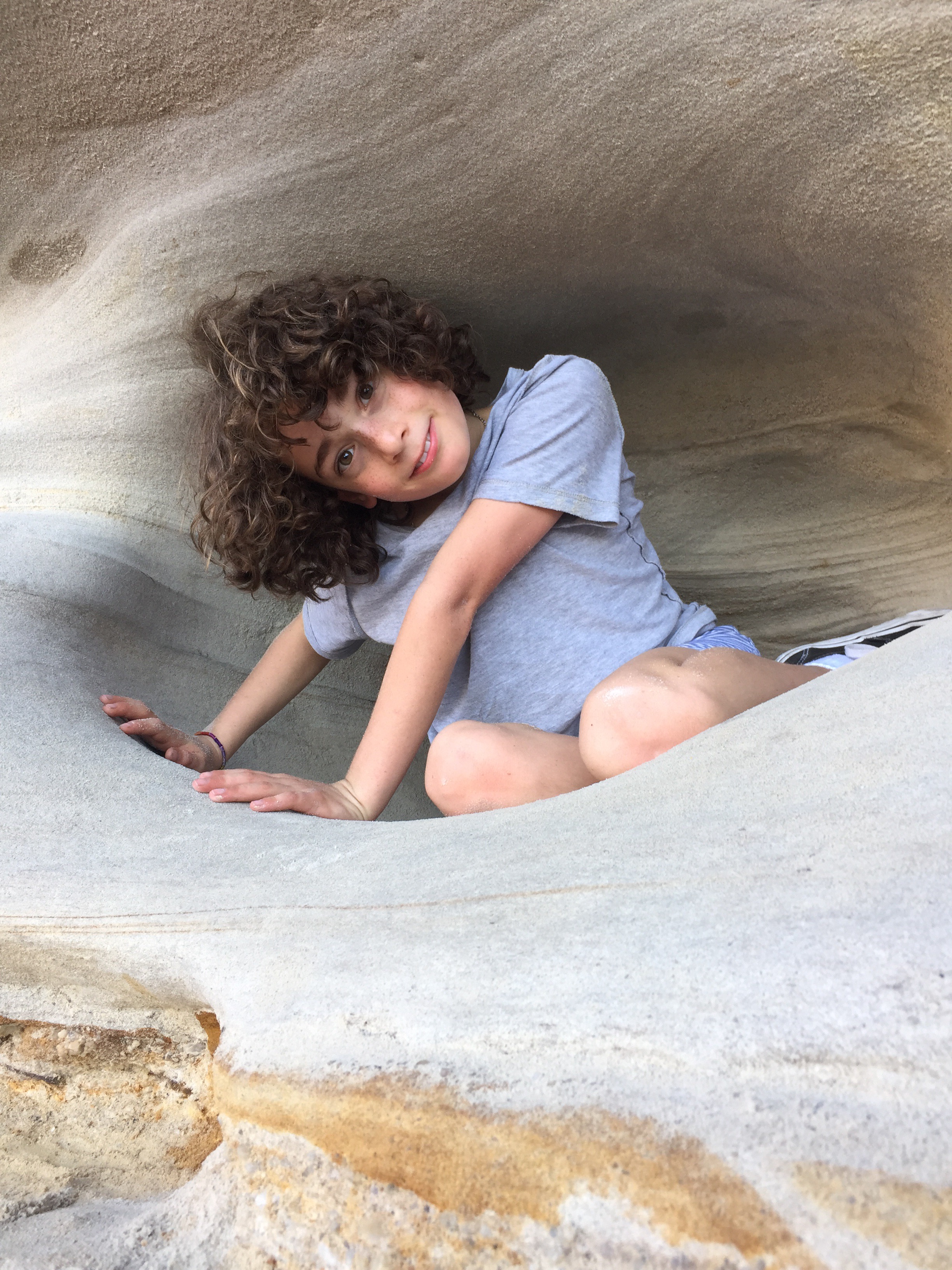
Paint Me As I Am


Why don’t you paint me as I am?             

Running and reading, with waves and

Sand tangling in my hair.

With fire in my hands. 

Paint me as a surfer, catching opportunities like a wave.


Paint me without dark paint, for I am not

only shades of grey.  

Paint me somewhere else, where dew moistens leaves

and the chilly air circulating around me that

makes every fibre of my being feel alive.


Paint me with my wrinkles, for those are signs of me laughing.

Paint me so my tears and scars don’t show.


Paint me with my nightmares but most of all, paint me with my dreams.

                           – Miles, aged 11


Garland Makers

Emerging from my early morning train I follow the subterranean tunnel that will lead to a city lane and daylight. There by the stairway stands a figure in the dimness, a fiddle at her chin, a bow in her right hand. I catch a glimpse of a t-shirt emblazoned with a black skull on a ground of brilliant white. A musician is playing Bach in a catacomb in Melbourne.


The musician plays. Later she will answer my query: “It’s Bach, one of the minuets.” Like any commuter I hurry by. A piccolo latte later I return to the tunnel. I have, after all, ten minutes of leisure, ten minutes free from scampering from screen to screen. I stand at a remove where I watch the slow bowing of her right hand and the nimble darting fingers of her left.


The musician plays. I don’t recognise this music, something slow and languid; liquid sounds flowing, flowing, peak hour crowds hurrying, hurrying. The musician plays, the commuters exit and I stand and I listen. In my hands I hold ‘Review’ from the weekend paper. Between melodies I read a poem by Judith Beveridge. The poem, titled ‘To a Garland Maker’ starts:


‘It must be good to be a garland-maker –

Your daughters carrying water, working with you

Braiding feathers, shells, leaves…’


Somehow the poem clinches the moment for me. Some obscure connection takes place. Perhaps it’s simply the gladsome encounter, unexpected, with the beautiful. I drop a bank note into the musician’s empty violin case. Between pieces I approach: “Please forgive my enquiry… what else do you do? In music, I mean?”     

“I’m at the Conservatorium. I’m studying.”


I withdraw and the musician plays again. Once again sounds drawn by slow bowing to an unhurried tempo, once again sounds not of this century nor of the last. Is there perhaps defiance in her choice of the unfashionable, of the non-popular? Most mornings the busker in this tunnel is a singlet-clad Springsteen, twice this girl’s age. But his music is far younger. His guitar case fills quickly with coin and notes.


My ten minutes of slow pass quickly. I’ve been in reverie, prompted by the playing and the poem:


‘Daughters

who will adorn you at your funeral with blossoms

picked at dawn.’


Following the poet’s images of daughters and aged mothers a vision comes to me of this same girl, three score years in the future, her delicate face coarsened by years and care. As I walk away my mind takes me to an elderly lady I know. She suffered a stroke a few years ago and recovered all movement but her speech was affected. Now words tumble from her mouth in lively disorder. My friend knows what she wants to say but her brain plucks the wrong word from her lexicon. The old lady has much to tell but her speech trips her up. She lives alone in the old family home, her gaiety unquenched.


In my reverie I hear the fiddler with her slow music, I hold the poet’s images of garland-making daughters, of disfiguring time, and of an old lady who cannot talk straight. Yeats wrote of ‘Gaiety transfiguring all that dread’. It is art I suppose, the access to beauty, that brings us to the sunlight.

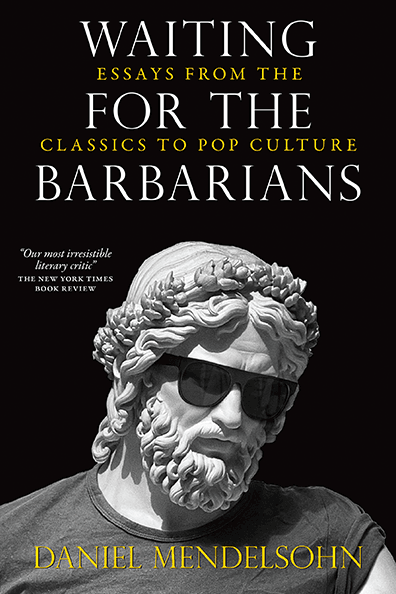
Waiting for the Barbarians

In Washington they’ve arrived and taken up residence
What is it that we are waiting for, gathered in the square?
       The barbarians are supposed to arrive today.
—Why is there such great idleness inside the Senate house?
   Why are the Senators sitting there, without passing any laws?
       Because the barbarians will arrive today.

       Why should the Senators still be making laws?

       The barbarians, when they come, will legislate.
—Why is it that our Emperor awoke so early today,

   and has taken his position at the greatest of the city’s gates

   seated on his throne, in solemn state, wearing the crown?
       Because the barbarians will arrive today.

       And the emperor is waiting to receive

       their leader. Indeed he is prepared

       to present him with a parchment scroll. In it

       he’s conferred on him many titles and honorifics.
—Why have our consuls and our praetors come outside today

   wearing their scarlet togas with their rich embroidery,

   why have they donned their armlets with all their amethysts,

   and rings with their magnificent, glistening emeralds;

   why should they be carrying such precious staves today,

   maces chased exquisitely with silver and with gold?
       Because the barbarians will arrive today;

       and things like that bedazzle the barbarians.
—Why do our worthy orators not come today as usual

   to deliver their addresses, each to say his piece?
        Because the barbarians will arrive today;

        and they’re bored by eloquence and public speaking.
—Why has this uneasiness arisen all at once,

    and this confusion? (How serious the faces have become.)

    Why is it that the streets and squares are emptying so quickly,

    and everyone’s returning home in such deep contemplation?
       Because night has fallen and the barbarians haven’t come.

       And some people have arrived from the borderlands,

       and said there are no barbarians anymore,
And now what’s to become of us without barbarians.

Those people were a solution of a sort.
 

In Canberra, they are circling…


(P V Cavafy, trans Daniel Mendelsohn)


Australia Day in Doomadgee

Doomadgee, we write it
In our orthography
Really should be
Dumat’ji
 

No flag raising here
No speech or ceremony
On Australia Day
In Doomadgee
 

River runs warm
Kiddies swim and swarm
On Australia Day
In Doomadgee
 

Uncles bashing
In Australian passion
On Australia Eve
Here in Doomadgee

 
Broken hand, broken
Jaw, cut faces and more:
That’s Australia Day
In Doomadgee.
 

Adam Goodes
Too far away
This Australia Day
In Doomadgee
 

A busy day this
Australia Day
In the hospital
In Doomadgee
 

We plaster, we suture
Like there’s no future:
Future no feature 
of Australia Day,
Not here, no way, 
In Doomadgee
 

The end of Australia Day –
Quietness falls
In hospital halls
Of Doomadgee
 

But short the respite –
Quick! Elder sick,
Dying On Australia night –
Dying here in Doomadgee?
 

Quiet, quiet, his voice, his breath –
Small his smile at threshold of death –
Good night Australia:
System failure in Doomadgee
 

Beside him, quiet woman – or girl –
His guard and ward in this world
Trembles, faces an Australian day
Elderless in Doomadgee.
 

He slips away from teeming kin
Who hold tears and keening in;
A dreadful peace on Australia Day
And quiet, this night in Doomadgee.


Once Upon a Poem 


Once, when two persons were walking together at day’s end, the elder of the two remarked on the sunset. He spoke and said:


the sky is burning

in my mind


Once Upon a Story


Once, when two were walking on the beach the younger saw a rock that looked like Leviathan and she said:


Last night I was here and that rock wasn’t a rock.

Last night I saw it move from the sea. It moved up the beach and it came towards me. It was a whale. It chased me up the sand and I ran and I ran and I didn’t stop running until I got home.


Once Upon a Song


Once, when two walked together a song drifted towards them. The song had no words. The sounds of the song reached them from somewhere higher or darker or hidden. The sound surrounded them. The flapping of wings, the whoosh of flight, made them think of birds. And the drift and drone, the rise and fall, the start and pause, mad them think of a breathing. Perhaps a person. Perhaps their planet.
Once and Always


The poem and the story and the song came and went, went and came, always different, ever the same. The song and the story and the poem bound the younger to the elder and both of them to all who came after and to all who came before.


Sometimes the two remembered or wondered or dreamed or knew: the song and the poem and the story had been there before they were, before the sunset, before the rock. Perhaps song, poem and story had brought the sunset and the rock and the flapping wings into being.


The two knew they could exist only in a world of story and poem and song.


At the Fragrant Church

 
I went to the church today
Not, I admit, in order to pray –
Rather you might say,
To pry,
To spy.
 
Outside the church
In desert sun’s scorch
Littering the porch, lay
Gum droppings, eucalypt
Bark, twig, in mad disarray.
 
Silent the shrine,
White, quiet, fine,
And a smell rose up,
And spoke: ‘breathe deep,
Take pleasure, take, keep!’
 
Is it camphor?
In all candour
I cannot say, but can report
The heated gum odour
Lifted me wholly in transport.
 
The river gums here –
“My aspens dear” –
Grow, persist, survive,
Through rains, flood, mud
And when long droughts arrive –
 
And they speak to me
And say, ‘Wrinkled man, grey,
Gaze on our bark, ridged too
And stark, and keep good humour:
Breathe deep, deep, inhale our aroma.’
 
And so I do. And on church porch did today
Despite the heat, one hundred Fahrenheit,
To read what and when – I never dreamed if –
Services there’d be, on twenty-fifth. And confounded,
Found nought; no report. Really? Reel, sniff –
 
That sweet fragrance’ll
Endure by chancel,
By happy chance,
Though town’s broke and townsfolk
Leave with parting glance.
 
The church stands, white,
Quite quiet. And by it –
All around, littering the ground –
Pragmatic, aromatic, lies gumbark,
Fruit of time’s wound,
Immanent, permanent
And profound.

The coal resource exhausted, the town on death row, the mining townsfolk have drained away to seek their separate fortunes elsewhere. Too few faithful remain for a quorum or even a service on Christmas Day.

A Lime

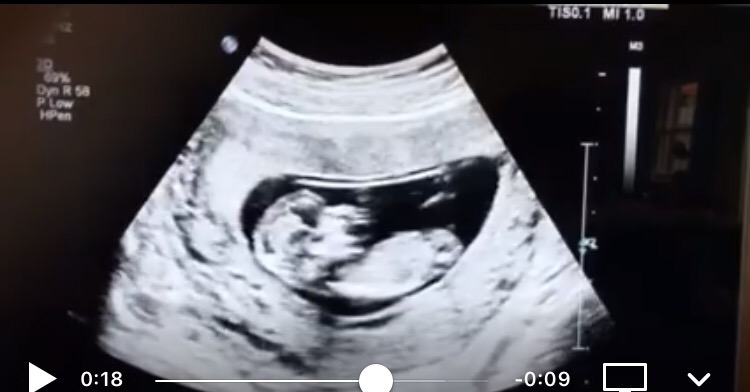
The doctor showed them the spine, the limbs, the minute digits. The heart in its cage, beating, beating, beating. Kidneys, liver, lungs, all manner of organs, organised and working against their day.
The watchers watched and listened and wondered. Their unborn, unknowing it was watched, moved, metabolised and grew. This watching, this lovecharged voyeurism through a window that opened only half a century ago. They saw their unborn, alone, confined, silent, breathing bathwater, drinking sewage, content withal. The watchers felt awe and hope. The man leaned over and held the woman and came away sticky with gel.
 
The doctor said, it’s the size of a lime. The man and the woman closed their palms against a mental lime. They saw with their hands how big, how small was their unborn. The woman giggled with delight.
 
They told me and I thought of the days I delivered babies – that age before ultrasound, when mother, father and doctor looked on the baby and the baby looked on them in equal discovery. Ultrasound alters human relation. Now fathering starts thirty –four weeks before the father is born into fatherhood.
 
I thought too of Judith Wright and her secret love and her poem:
Woman To Man
The eyeless labourer in the night,

the selfless, shapeless seed I hold,

builds for its resurrection day—

silent and swift and deep from sight

foresees the unimagined light.
This is no child with a child’s face;

this has no name to name it by;

yet you and I have known it well.

This is our hunter and our chase,

the third who lay in our embrace.
This is the strength that your arm knows,

the arc of flesh that is my breast,

the precise crystals of our eyes.

This is the blood’s wild tree that grows

the intricate and folded rose.
This is the maker and the made;

this is the question and reply;

the blind head butting at the dark,

the blaze of light along the blade.

Oh hold me, for I am afraid.
 

A Perfectly Routine Call

Woman injured, perhaps a fall,
A fracas? Who knows –
Perhaps a brawl?

Over the phone the nurse tells all:
Neck injuries…
She’s in a collar:
I call Flying Doctors: 
Eight thousand dollar.
 

I take notes: a punch to the mouth
And she fell;
Got a kicking to the head
And the belly as well
 

Her neck is tender
C2-3, where the cord is slender
She can feel, can move…
That doesn’t prove
We’ll mend her.
 

I take it all down, arrange the flight.
In afterthought,
I ought
Ask ‘Who? How?’ – at least:
It was a male. I called the police.
 

I take notes, recording in full
The news that’s not news,
That minds like mine 
Refuse
To take it in at all
 
Nurse gives name:
Like a punch to my mouth
Then a kicking,
Shame like flame
To burn my aorta –
 
The name – that ordinary name –
Is the same 
That we gave
Our newborn 
Daughter.

The Delinquent Chromosome and the Marathon Runner 

Most of us have no intercourse with our forty-six chromosomes. They perform their work honourably in intracellular obscurity and we leave them alone. Not so for my friend Manny Karageorgiou: his Chromosomes Numbers 13 and 14 have conspired to mutate. This mutiny came to light late in 2013 when he broke a rib without trying. He simply breathed or coughed or heaved a carton and the rib quietly cracked.
 

What Manny has tried to do – what he has managed to do every year for 37 years – is to run the 42.195 kilometres of the Melbourne Marathon. Manny is one of a tiny and diminishing band of brothers to achieve this feat. This, their 38th year, they number only eight.


When Manny’s rib cracked he consulted his doctor. In their shared innocence, patient and doctor initially believed they were dealing with a painful area in Manny’s chest, a mere nuisance, an impediment to running: and Manny had a marathon to run. The Marathon would call him. Come October Manny would obey the call and run. Always the Melbourne Marathon, always and only Melbourne. Athens too, has called Manny. Deep in his Greek heart’s core he hears that call. He feels aeonic tremors, he hears echoes across time of Pheidipides at Marathon field. Manny feels, he hears and he yearns to join the runners in Athens; but year after year that marathon clashes with Melbourne’s.


Manny could not run both. Melbourne held him: captive of his love for the Melbourne, of his obligation to its history, of his loyalty to his old comrades, Manny stopped his ears to Athens in October, he turned his back on the Aegean and, busted rib and all, he ran Melbourne. That was last year. For a period of time between the fracturing of the rib and that Sunday in October, my colleagues filled Manny’s body with poisons – thalidomide, dexamethasone, bortezomib – in their attempts to put down the chromosomal mutiny. The short term for that poisoning is high-dose chemotherapy. 


When I wrote of Manny’s marathon in 2014, runners from around the world responded in awed respect of the man who’d run thirty-seven Melbournes, and who’d prepared and run it this time with a diseased rib and a poisoned body.


All that was in 2014. Since then Manny has undergone autologous haemopoietic stem-cell transplantation. The chemical savagery of this procedure – doctors have to poison every blood-producing cell in his body – can cure or kill. It did not kill Manny. But the mutiny grumbles on, bones everywhere are eroded, they await their moment of innocent impact or small tumble. One crack and a marathon runner will have run his last.


Manny’s haemato-oncologist, a compassionate and scholarly man, forbids running. He knows too well Manny’s disease. My guess is he has never run a marathon, is innocent of the joy, has never known the intensity of that blood-filled, tear-filled passage through space and time to self-realisation. For his part, Manny knows little about his proliferating mast cells, rogue daughters of his body’s revolution; he knows less of the osteoclasts punching holes in his bones; and nothing of the dysregulation of an oncogene translocated to his perfidious chromosome 14. But Manny knows enough. He understands the doctors do not speak of cure, he accepts the unending medication, he understands the risks of running. But he takes the occasional light run.


I haven’t asked Manny, ‘Do you run to live?’ I sense that the occasional light run is the answer that Manny’s mind or body drives him to. When Manny asks this family doctor, ‘Do you think I can run the marathon again this year?’ – the question I hear is: ‘Am I permitted to live before I die?’ And who am I – captive of my own marathon dreaming – to deny Manny? I decide I will run Melbourne at Manny’s side.


***


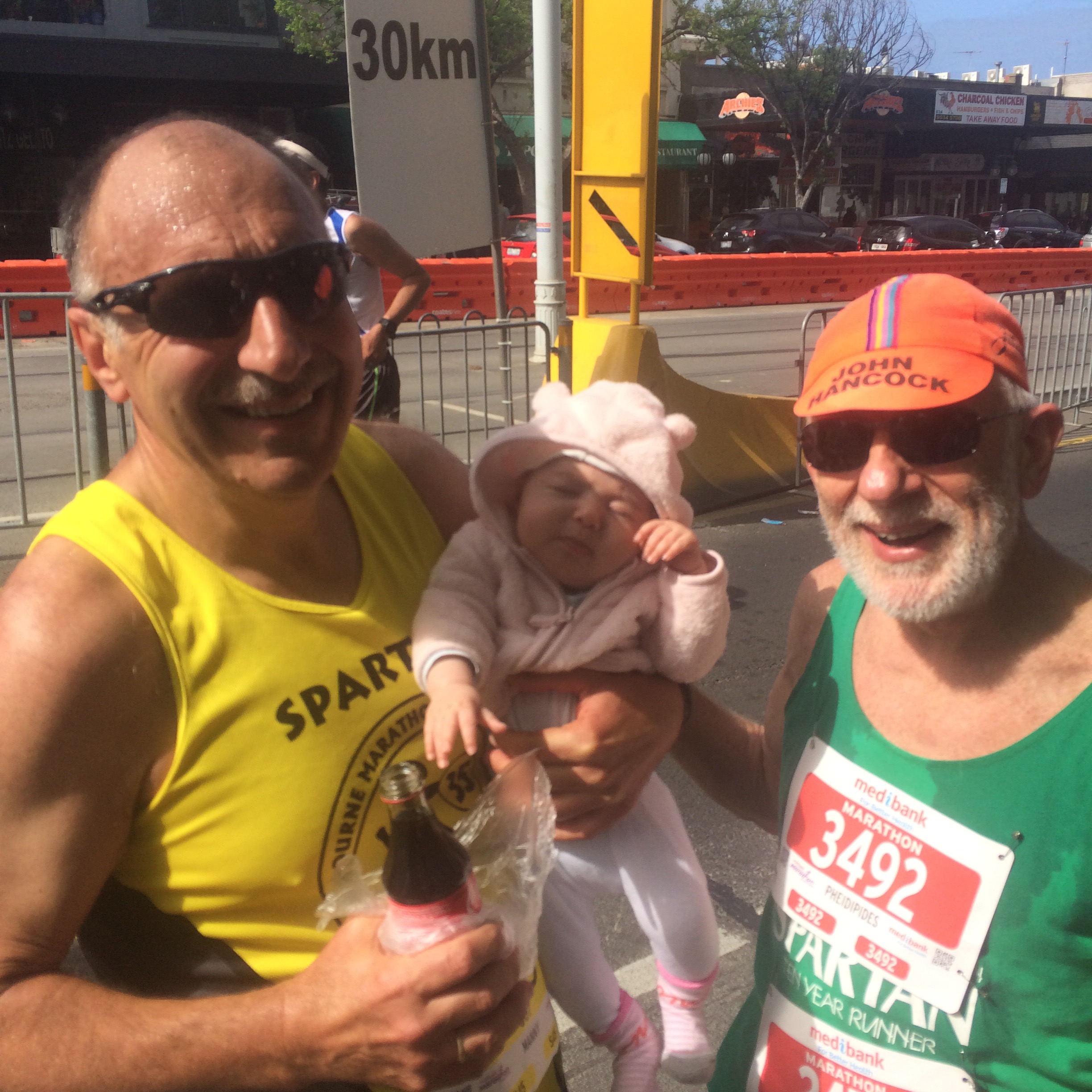
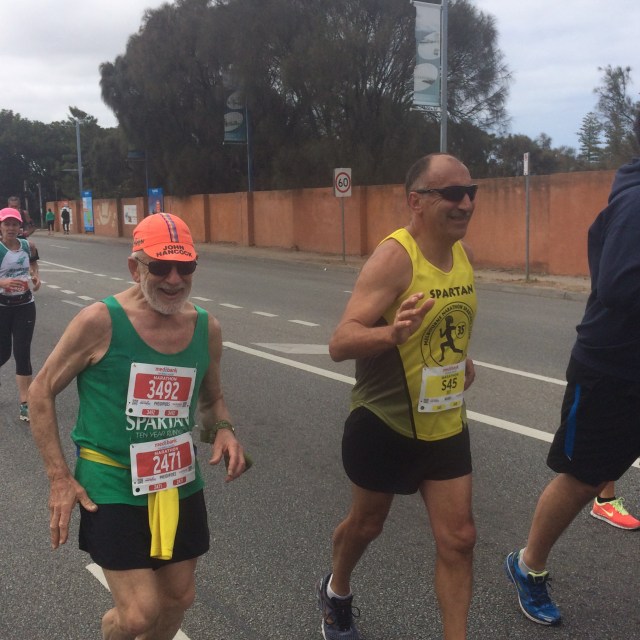
Lining up at the rear of the field of seven thousand dreamers before the Start, Manny implores me for the seven thousandth time: ‘Promise you’ll leave me behind once I’m too slow for you, Howard. I don’t want you to sacrifice your time for me.’ Manny never dreams he’s honouring me. But even before the gun sounds, runners reading the rear of Manny’s shirt salute him: ‘Legend!’ – they cry – ’Thirty-five Melbourne Marathons! Amazing!’ They clap him on the back, not realising Manny’s shirt sells him short by two marathons. Manny does not correct them. The same people spill glory and goodwill onto me in my Spartan’s shirt: ‘Go Spartan!’


A beautiful morning for running. Beneath low cloud a light breeze cheers and cools us as we snake along boulevards and run spirals through Melbourne’s parklands. Manny’s prudent pace suits me. I search for bodily pains to fret about. Nothing: silence from the supposed stress fracture in my left foot, nothing from the torn right calf muscle that I have rested from four weeks. The opposite calf sends alarms, but these are false. Pheidipides Goldenberg has no complaints.


Running half a pace behind Manny I take him in, not as the indoor person I have known, but Manny as runner. His build is not classic Kenyan: Manny is constructed of old materials, a series of chunks assembled one on top of the second. Impressive that he has lugged this unpromising torso through thirty-seven marathons. Projecting below that torso are the legs which are Manny’s secret. Beautifully muscled, elegantly defined beneath skin shining with vitality and sweat, Manny’s legs look decades younger than he as they pump smoothly, rising, descending, devouring distance.


Approaching the thirteen kilometre mark, Manny grinds on steadily, shouting out greetings to figures who come into view and earshot, his comrades, these, fellow members of the hallowed eight. To a man they look old. And calm. The marathon is their familiar foe. It holds no terrors, no surprises for them. Not for the first time, I recall Tennyson’s Ulysses as he looks upon his comrades:


Souls that have toil’d, and wrought, and thought with me –

That ever with a frolic welcome took

The thunder and the sunshine…

You and I are old;

Old age hath yet his honour and his toil;

Death closes all; but something ere the end,

Some work of noble note, may yet be done…   


With a cry of a different temper, Manny swerves, his voice joyous. He mounts the kerb, sweeps a good-looking woman into his arms, kisses her face, her hair. She pushes him away a little, looks at him searchingly. Satisfied, she smiles: ‘You look good, darling, you look wonderful. You’re running smoothly.’ The good-looking woman is Manny’s wife Demetra. She plenishes us both with cola and kisses, promising to find us again ten kilometres down the route. Manny releases his wife, takes a step, turns back, grabs Demetra again, crying into her hair, ‘I love you, darling’, and sets off again. I look down and try to deal with a lump that has risen in my throat.


Heading out toward the beach now we are bathed by sun and cooled by the breeze. Aaah, blessed day. The first Kenyan, having turned and now heading homeward, glides past us on air. Shouts of wonder rise from all throats as runners and spectators alike react to this shock of the beautiful. 


‘That’s my street there, Howard, Number 141. Please join me and my family at any time from 3.00. Bring your wife. Please.’ I want to join Manny and his family. If I finish in time I’ll certainly be there. Until now, Manny has spoken little while I have spoken more. A quieter person, he places one foot before another, repeatedly, steadily, and runs inwardly. I ask from time to time, ‘How are you going, Manny?’ ‘Not great. Not as good as last year.’ Not feeling great but not complaining either. As we swing out along the beach road and past Café Racer, a bunch of bystanders suddenly flows onto the road in our path and Manny’s face relaxes and falls into a wide smile. Hugs, handshakes, claps on Manny’s back, kisses on Manny’s face from two toothsome young women, and Manny keeps smiling and keeps on running. The interlopers pump sunshine up Manny’s arse and run alongside him. For the best part of an hour we run with the posse and through all that time Manny is smiling.
We come to the turn and the posse whoops and cheers as Manny turns for home. Manny is brother to one, uncle to a couple, second cousin to a few more, godfather to another. The kissing females are godson’s girlfriend and her girlfriend. The brother is shorter than Manny, genial, younger, rounder and pretty fit. He stays the distance for the full hour as do godson and one of the kissers. Others, out of shape or out of condition, fade away and re-join us later. Finally, with farewells, more clasps and shakes and blessings the mob falls away. ‘See you at my place, darling!’ ‘See you after three, Manny!’ The mob loves Manny and he them. Afterwards he tells me, ‘They’re here to meet me every year. Every year at the same spot. They never fail.’ A little later Manny says, ‘Dem and I are taking the whole family to Athens next year…it won’t be at marathon time of course.’

Increasingly I relish Manny’s invitation to join him and the family. These people run to the beat of a familiar drum.

  Back on the road, unescorted by Manny’s family, I have a question: ‘Manny, are you Manuel or Emmanuel?’

‘Manuel. They call me Manny. Also Manoli.’ 

Manny, Manoli – these affectionate diminutives are the aural furnishings of a life. Cushioned at every mention of his name, the man lives his life in relation, in connection, not alone, never – so long as these names are heard – alone. Back on the road, the solid road, returning from my abstractions, back with Manny-the-person I notice him struggling wordlessly. What silent erosion within his skeleton, what deposition of para-proteins in his kidneys, what mischief in his marrow, hampers this champion? Conversely (and most striking), how remarkable the redemptive effect of the loving presence of Manny’s family!


Around the corner and into Fitzroy Street where the crowds thicken and the cheering is a roaring without end, we allow ourselves a fifty-metre walk up the ugly little hillock placed here for the torment of the tiring runner. I reckon we’ve run better than two thirds of our 42.195 kilometres. Manny bursts into joyous shouting: ‘My baby! My baby!’ Emerging from the midst of the thronging cheerers is the adoring Demetra, bearing encouragement and affection and more Coke. And a baby! – their first grandchild. Manny cradles the pink bundle, adores her like a Magus. To me Demetra passes chocolate! I’m dubious about this; I’ve never eaten chocolate in the middle of a run. Will I like it? Will it like me? Too late – it’s melting in my sweaty paw. Now it’s inside me, followed by a bottle of Coke. Supercharged with caffeine and sugar and fluid I am invincible. In Demetra’s arms, holding his pink grandbaby, Manny looks the same, but once around the corner and out of sight, he looks and feels utterly vincible.


Around the corner now and into St Kilda Road, the broad thoroughfare closed to traffic in honour of us marathoners. The sun shines, the day has warmed, everyone who is not running enjoys the balm. Runners enjoy the painful raising of knees, the heavy hurt in the thighs, the weight of weary, weary bodies that started running almost four hours ago. The 32 – kilometre sign tells us there are only ten kilometres to go. Only ten kilometres to go feels to a runner as welcome as only ten more years might sound to a prisoner serving life. The experienced runner knows the second half of a marathon starts at 32K.


We plod in the sunshine. The field has thinned as faster runners leave us behind and others – the broken, the breaking, the bleeding, those limping – fall behind us. Here to one side of us, runs Eeyore, a young woman from England. She runs smoothly ahead then stops, bends forward in apparent pain, and breaks into a slow walk, and soon she is at our side again. Eeyore replies to my clinical enquiries morosely. I encourage her, I pump sunbeams, I tell her she should be proud. I should shut up and allow her to enjoy her misery. Eeyore and Manny and Pheidipides keep company intermittently until the final few hundred metres. Just ahead and to our left runs an aged, arcuate Japanese runner. His age might be anywhere from fifty to seventy. He clings to a line, a crack visible in the road’s surface where one layer of tarmac meets its neighbour. Dourly, silently, mute to my greetings, his spine twisted into a boomerang convex to the left, Japan runs the lines. His speed is no better than ours but I bet he could run all the way to Hokkaido without stopping.


A soft sound issues from the female who runs half a pace ahead on our right. The slight sound recurs – the grunt of a person in pain? – pulls me close. No not a grunt, it’s a moaning, the woman’s lament for her suffering self, her threnody sung for self-comfort. She’s about forty, shapeless, pale, a moving emblem of tortured humanity. The moment brings me back to the Olympic Marathon (I think it was at Barcelona) where a Swiss or French runner, whose name I seem to recall was Dominique Something approached the Finish. No-one who witnessed the sight of this tall, thin woman, faltering and staggering in her final lap of the stadium will forget her in her extremity. The brutally hot day, the merciless steeps of Monjuic in the approach to the stadium, the criminal timing of the event in such heat had all but undone her. She lumbered into view, slowed, stooped, seemed to recover herself and advanced. Time and again she seemed at the point of falling. Officials were seen to move toward her, then to retreat. Appalled viewers on screen and in flesh begged wordlessly for it to end, but Dominique stumbled on. Twenty, thirty metres from the Finish she fell. Officials came to her aid and in so doing ended her chance of completing the Olympic Marathon. It is Dominique whom I hear now as this woman moans.


It is no disrespect to acknowledge that we belong to the dregs of the marathon world: among the select who run marathons, possibly the most resolute and vigorous of people, our sub-group group is the most enfeebled. And all the more honour to us who persist. On we go, pausing for drink every three kilometres, enjoying the excuse to walk twenty, thirty metres. Then up again with weary legs, up and back into the slow steady tread that our heartbeats allow us, that is all our breaths and our body salts and our fluid reserves and our moral reserves can support. We walk, we pause to walk thirty guilt-free walking paces, then on again we run, and on. Manny and I negotiate small contracts: we’ll run without stop to the top of this short rise, then we can coast down the farther side; we’ll run and not stop until we reach the next drink stop, then we’ll reward ourselves with cool fluids and a splash of water; we’ll run now and will not stop until we reach the MCG, and then…


We enter the great stadium side by side. The huge grandstands tower about and above. We insects crawl the margins below. At my left Manny says, ‘It’s magnificent, isn’t it?’ It is, it is indeed. We swing our arms, pumping our reluctant thighs into action, we raise our heads, then hoist ourselves onto our toes for the final 150 metres. Two aging men, one with an intact skeleton, the second much ravaged, swing around the bend. We pass the bent man from Japan: his face, transmogrified, is a rising sun; and Manny and I are sprinting, and sprinting we fall across the Line.
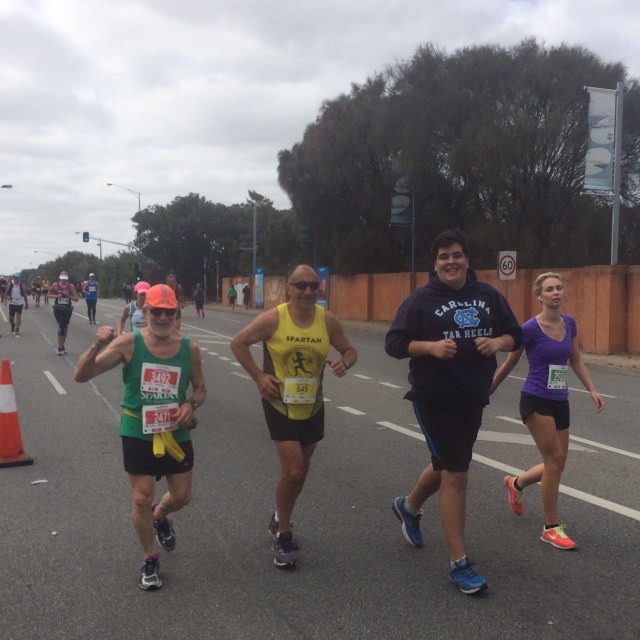


POSTSCRIPT: I have written elsewhere of my inadvertent double entry (and double payment) in this year’s Melbourne Marathon. I duly wore two bibs – each with its distinct number – and with them, both electronic timing chips. I had speculated that Pheidipides Goldenberg might record a finish in both last and second-last places. If you google Melbourne Marathon Results 2015 you will see how closely I anticipated the result. And you’ll find, ahead of me by one second, Manny, Manuel, Manoli Karageorgiou. 


The Rubaiyat of Zoltan Klein

A Book of Verses beneath the Bough,
A Flask of Wine, a Loaf of Bread – and thou Beside me singing in the Wilderness –        And, Wilderness were Paradise enow!

I accepted the invitation to the launch event of ‘Bread, Wine & Thou’ without curiosity. But as the series of emails from the Event Manager mounted I sensed I should look a bit spiffy for the launch. So I wore my English Schoolboy Blazer. The addition of my backpack subtracted from the elegance of my outfit and together with my skullcap ensured I would look quite as odd as usual.

At the last moment I invited a friend, an art impresario held by all to be ineffably elegant.

The security man at the door, a gym giant in Armani, consulted a guest list longer than the Pentateuch. A show of expensive teeth: “Your names, gentlemen?”

“We are both Howard Goldenberg”, I said.

“Thank you sirs. Please take the elevator to the Second Floor.”

A disembodied voice from the rear of the elevator was heard: “Hi Howard”. It took a while to identify our host Yossi (also Zoltan Vinegar) Klein, obscured as he was by a cluster of tall, expensively draped women, mounted on very steep heels. Taller than all others in the lift a wide man with an interesting face stood next to Yossi. He did not speak.

The lift released us into the highly geometric womb of Cox Architecture, a space as inventive and unexpected in its proportions and planes and shapes as Federation Square. I had not previously heard of Cox, but I was given to understand its iconic condition.

Filling the space, throngs of elegant females and stylish males kissed a lot of air as they greeted each other with little shrieks and harmless hugs. I noted my companion and I were not the most expensively dressed persons present. Wine was sipped, quite exquisite looking entrees were served and everyone accepted a copy of ‘Bread, Wine and Thou.’

Eventually Zoltan took a microphone and spoke. For a time no-one noticed, for Yossi is, as his surname suggests, not tall. After a bit all fell silent. He spoke informally, disarmingly, unpretentiously. He said, “I wanted to create a literary magazine on the themes of food, wine and culture.” Those were precisely the words he used when he spoke to me a year earlier in ‘Batch’, the Kiwi coffee shop where he and I had sighted each other without speech over years. On that occasion Yossi said: “I’ve read your writing on Aboriginal Australia. I want you to write a piece on Aboriginal Cuisine for the first Number of ‘Bread, Wine & Thou.’ I can’t pay you.”

I accepted the commission and wrote something and turned up in my blazer and kippah and backpack. It must be clear from the harsh tone of my introductory remarks that I felt uncool, unfamous, outranked by the figures of beauty. But as Yossi spoke all that fell away. This man in his forties spoke of his dream and its fulfilment, the magazine – really a handsome book – that we held in our hands. Yossi opened with a joke about his Jewish mother. It was a good joke and we all laughed and Yossi relaxed. He thanked a legion of first names, burnishing each name with his deep appreciation. As Yossi spoke one hundred and fifty smart people from the uppermost echelons of food and wine stood, arrested. Cynicism and self-consciousness fell away. We were human together as Yossi stood, naked in his feeling. He said he was overcome. His voice cracked with emotion.

Later a Very Great Man accepted the microphone. He sat down and whispered, exercising the powers of greatness and of near-inaudibility over his audience. Just as Howard Goldenberg alone had never heard of Cox Architecture, neither had I recognised the Greatest Chef in the World, the tall wide man of the interesting features who rode the rising elevator at Yossi’s side.

  
The room worshipped. Upon completing his remarks the man folded Yossi in an embrace that hoisted him from the floor. Evading believers*, he strode from the room, disappearing into the night.

That this personage should have descended to Melbourne for Yossi was felt to be an enormous compliment to our host. As I listened to the chef speak of his career at length and in breadth I felt increasingly the greatness of Yossi. And when you read Yossi’s magazine I think you will feel the same.

Although ‘Bread, Wine & Thou’ is accessible on-line, I urge you, do not go for the virtual book; for modest moneys you can acquire the real volume. Collectors will treasure this, the first edition, a thing of truth and beauty.

IMG_6132

* I stole this lovely phrase whole from Les Murray’s ‘ A Perfectly Ordinary Rainbow’.