Health is not a Human Right

I am about to make some shocking suggestions: 

Health is not a human right.

The Morrison-Turnbull budget cuts to Medicare Rebates are not completely bad.
Running in the dark this morning, I noticed the illuminated sign outside the local hospital. It read:

PRIVATE HOSPITAL.


I felt unhappy reading that. A hospital is a place where human beings help other human beings with their health. The meaning of a hospital cannot be realised with that label. ‘Private’ tells the reader that some humans will be admitted and others turned away. Privacy as a personal property might well have been eclipsed by the internet, but ‘private’ survives with this message, unkind to some, saying ‘keep out.’


If health were a right we’d need to outlaw Down’s Syndrome, premature death and disability. We would legislate and make ourselves ridiculous. The error of language here betrays an error of thinking. We cannot assert a right to health, but we can create a right to equal access.


I am a private doctor. I am a public doctor. The public is composed of private persons. I treat one person at a time, privately. That is, personally, confidentially; two humans together, doing what every human does in a lifetime: ordinary transactions of care.


Doctors generally share a number of characteristics. We are serious, careful, committed and proud. We are defensive of our liberties, self-righteous and voracious of cures. We are expensive; I mean someone, somewhere, always pays for cures. In its new budget the government has pegged Medicare rebates. This skewers doctors and patients: either the doctor loses or the patient loses. There is nothing new in this.


When Hayden-Whitlam introduced Medicare I bulk-billed everybody. I thought it was a wonderful thing that a person, be she rich or poor, might consult a doctor equally. I thought so then and I think so still. To assure doctors they would not lose, the Hayden-Whitlam Government set up a referee who increased the rebate in pace with the rising costs of practice. This was costly. So the government told the referee to stop indexing rebates. And I stopped bulk billing. Often patients found themselves facing a choice – see the costly doctor or feed the family. When this occurred all doctors I know abated their fees so the patient might afford both cure and food.


What a government does in tightening benefits is to create the need for a new force to operate in care. The force is not one of rights but of grace. The doctor and the patient gaze upon each other as we did through all history, unmediated by refunds and rebates, freer now of the obscuring presence of the insurer. Two humans in a situation of human need.


The words ‘Private Hospital’ jolt me. They remind me that health is not merely a matter of economics or of civil rights, but of civil opportunity.


The Last Refugee

Imagine this. A disaster at sea, a lifeboat adrift, full of survivors, now despairing, now in hope, as land takes form through the mists ahead. A form is seen in the water. The boat comes alongside, the form is human and alive. The human extends an arm in supplication. Weary survivors take the limb and heave. The lifeboat, already heavily laden, tilts, takes water. The heavers persist in their heaving and the boat takes more water. A murmur within the boat swells to a cry: “Let him go!”

But the human is already aboard. The boat rights itself, the shouting subsides to a murmuring. The boat drifts on.

Imagine this: a second story. Australia prospers, confidence surges and trust becomes the settled order of things. Somehow Australia’s peoples lose their fears of difference, neither Sharia nor Tjukurrpa nor Kosher is imposed by any person upon any other person, but all are respected and all thrive. The leaders of the government decide to lead opinion rather than to follow it. They declare, “We who have plenty can take in those who have nothing more their need and their stories. Let us welcome them, let them come in!”

And so it comes to pass. Australia booms, its empty lands are claimed, cultivated and nurtured under the guiding hand of the first inhabitants. Australia feeds its peoples, feeds Asia, and prospers greatly. The seekers for asylum fulfil the promise that every newcomer brings. Australia accepts scores of thousands, who succeed in the new land and become part of the community. The community now takes in hundreds of thousands as History smiles upon the land and even the climate shows clemency.

The seekers for refuge are numberless, the land is vast, its resources seem endless. Eventually the land is filled. The flow of seekers for refuge slows to a trickle. It stops. All now are saved, all are safe. But wait! A boat. Aboard the boat are two persons. They extend supplicating arms. The peoples of Australia, accustomed to rescue, habituated and drenched in its ethos, wish to help. But their land is full. There is no room for newcomers. Australians squeeze up together, they wish to rescue those people who extend those arms. They make room, a little room: just one, one alone can be squeezed in. But there are two humans in the boat.

Imagine this: a third story. A lifeboat full of survivors of shipwreck drifts in an uncertain sea. This boat is full. Its gunwhales barely clear the calm surface. Whenever the seas rise all bail mightily to save the boat that saves them, and the boat remains afloat. The boat drifts on.

A shape is seen ahead in the water. As the boat comes alongside, the shape moves, cries, flings human words of thanks, raises an arm in supplication. All aboard the craft can see, all understand: “This lifeboat is barely afloat. If we take in this human his weight will sink us; every one of us – every human person – is lost.”

So much for my little stories. Readers of this blog are well acquainted with my pain, my outrage, my shame. All that old stuff. My eruptions of moral rage have brought a brief pleasure, a relief not unlike the visceral satisfaction of purging. But these explosions achieve nothing, convince no-one who is not already convinced, influence no-one in government.

A couple of years ago I spoke at an awards ceremony for defenders of human rights. I told my lifeboat stories. I pointed out Australia’s lifeboat is not full. I was grand in my flight of brave words and noble ideals. I carried the audience, which, led by two Federal parliamentarians, rose as one to applaud. Afterwards each of the parliamentarians, one a frontbencher in the government, requested a copy of my speech which they’d put up on their websites. One confided: ”You have said what we would like to say but cannot.”

What to do? What more to do? What can we – we powerless people do – beyond voicing our outrage, our shame, our grief? Firstly, we must continue to raise that human voice, to give human words to the suffering of fellow humans. That voice, those words, these are the marks of our being human. These words, the irreducible minimum:

Written in Pencil in the Sealed Railway-Car

By: Dan Pagis

here in this carload
I am eve
with abel my son
if you see my other son
cain son of man
tell him I

But what more? As my little stories suggest, ultimately we persons of good will – and I mean that to refer to my fellow Australians at large – sooner or later must face a terrible choice. At the end of all our rescuing there will always be one more supplicant, one too many for our resources, for our lifeboat. We will face a choice. This is Sophie’s choice, whereby we will chose one to be saved and send another – a human other – to perdition.

But Australia’s lifeboat is not yet full. So, what more, what wiser, what more potent act can we non-governors do? The answer cannot be simple, but our powers of imagination, of thinking hard and speaking softly, have helped in the past. Thus Petro Georgiou of happier memory, with Jozef Szwarc, softened the adamantine policies of John Howard. The image of a dead child floating in the shallows of Lesvos softened the policies of Tony Abbott.

I know of one small group in a faith congregation that has approached leaders of other faiths in an attempt to think hard together and to speak softly together to those who govern. State governors have spoken for their people, saying, give us the children; let them not return to offshore detention. Dr David Isaacs blew a whistle on his return from offshore that mobilised doctors and nurses at Melbourne’s Royal Children’s Hospital and now at Lady Cilento in Brisbane. The RCH refuses to discharge child patients to places of detention. We must understand that for what it is: the RCH is not some Marxist commune, not a place of sedition. It is rather an emblem in the state of Victoria. It stands for the highest skill and care. When the RCH speaks it carries Victoria. None gainsays its voice or its acts.

So, what to do? Think hard, confer, suggest, bring ideas to government. One idea, hardly original, strikes me as promising: let Australia progressively divert funds, currently used for offshore detention, towards a respectable, respectful supra-national staging and assessment process in south Asia. There we would maintain accessible, supportive consular representation. No-one would need to board a leaky boat, no-one would need to jump a queue, no human person would come to Australia and be called by a SIEV number. Our brothers and sisters would arrive with their own names.

We might save money, we might not. Neither governments nor we the governed see these issues in money terms: governments never count the cost when augmenting our cruelties; and we bleeding hearts never count beans. No, these issues are strangely unmonetised. The people of Australia hanker quietly to regain some self-respect.

Respectful policies will save lives. We might save our souls.

Do you have a better idea? Work on it, tell your minister of religion, your minister of the crown, the playgroup mothers, the neighbours. Governments need to follow. It is up to us to lead. We won’t save everyone, but we can hardly do worse than we do at present.

“I was never very good at Math. I was never so bad at Math that I bought a lottery ticket.”

The maxim printed above was authored by Paul Jarrett, my friend in Phoenix. This ancient Phoenician is longer in the tooth than a sabre-tooth tiger and keen as mustard in the brain department. He locates himself as somewhat to the right of Barry Goldwater, an American conservative to make today’s Tea Partiers blush pink in comparison.
 

The Jarrett advice rings painfully true, not just of lottery tickets, but of gambling generally. I have seen lives ruined by the winning of a lottery; lives lost to suicide by failure to win at the track, the casino, the local gambling shop. I have known a stockbroker, a man of conscience and long experience, his retirement ruined by the depressive illness that followed losses – not his own, his clients’ – who gambled on the Exchange. I have seen desperate ugg-booted women in curlers, seated joylessly playing poker machines at 6.00 am.


Here’s a farmer that hanged himself on expectation of plenty…*


Last week’s paper told of a poor Sydney resident, shackled to menial employment by his immigrant’s accent, learn with resentment of a neighbour’s lottery prize. The immigrant kidnapped the winner’s son for ransom. In chloroforming him he inadvertently killed him. In one act the kidnapper lost his ‘prize’ and a father lost his son. In the next act the kidnapper lost his freedom for life. 


Paul Jarrett and Bary Goldwater

 I am in short, that miserable, un-australian being, a wowser. Like Paul Jarrett I was never very good at Math…


*From the porter scene in Macbeth


I No Longer Know my Country

I Left Home a Few Days ago and When I Returned it wasn’t there

Australia is my home; it has been since adventurous forebears from England and France arrived in the 1840’s and 1850’s, and desperate forebears came in the 1890’s. Nowadays we might call these people economic migrants and queue jumpers.
I flew from my home country last Thursday and returned yesterday morning. I read the paper and I knew I was no longer at home. My home had gone. I might never get it back. What had changed?

Border Force to have up to 6000 armed officers

Border Force in Australia sbs.com.au

Border Force in Australia sbs.com.au

I read the headline. I didn’t understand it. This Border Force would be deployed not on the border but inside my home. Most of its officers would be armed, many already are ‘trained for use-of-force operations.’ I sat and I wondered: what ‘operations’ inside our borders do they contemplate? Against whom are they armed? Who is the enemy within?

In the home where I used to live people trusted each other. We were different and we were OK. Some of us were very different indeed: in the small country town of my boyhood a sole Jewish family lived, trusted and trusting. That family was my own. Trust was rewarded, we were neighbours, we became friends, we knew each other and we were citizens together.

In the home where I became a father I met a man who was extremely different. He was the son of a Muslim cleric who went on to become Mufti of Australia. The father worked for amity and respect between communities and became a Member of the Order of Australia. The son, a ratbag or scallywag or black sheep or white sheep, became my friend and danced at my daughter’s wedding with the then President of the Zionist Council of Australia.

All that took place in Australia, which used to be my home.

On September 11, 2001 the world changed. Three days later the Melbourne ‘Age’ reprinted an article by respected Israeli journalist and novelist, David Grossman. Grossman had witnessed the effects of terror within his own community. He wrote that terror’s greatest victim is trust between citizens. When you believe your neighbour might wish to hurt you, you cease to trust her; you cannot afford to trust. Grossman predicted in 2001 we would see that erosion of communal trust, that injury to community.

Grossman’s prophecy has well and truly come to pass. Ironically, in Australia’s case, the principal destroyers of trust have been politicians who promote fear recklessly. We have a government led by a man who acts like a boy who swoons at the sight of a uniform.
Little by little, day by day, our masters in government – as well as the odd mistress – attack trust. The headline in the paper on the day of my return to my homeland appears below another: Transfield to remain at Nauru;
and alongside a third headline: Yongah Hill detainee hurt after incident of self-harm

All of this is relegated to Page 8. In this country that used to so welcome the stranger it is no longer big news that a private corporation be rewarded (at a daily cost of $1500 per head) for its systematic unkindness to inmates. This is not news. This is policy. As is ‘turn back the boats’, the policy that hath made my name to stink upon the earth.
In this place that used to be a home a man who cut his throat in detention is hospitalised, then returned to that place of detention where he ‘is receiving appropriate medical and mental health support and care.’ In that place his doctors and mental health carers risk two years of gaol if they report on that ‘appropriate’ medical care. I know detention. I sewed my lips, I accepted overpayment and I worked as a doctor in detention.

But in the place that used to be a home nothing like this is news.

Homage to Catatonia

Cruising past the various checkout queues, I check them all out, looking for the shortest. I find it, shortest by a mile. Shortest, of course, need not equate with quickest. 

The sole lady ahead of me at this checkout has loaded her shopping onto the conveyor belt. Compared with the Friday mountains elsewhere in this supermarket this customer’s heap is a molehill. Shouldn’t take long. 

But it does take long. 
Later I understand sometimes the road less travelled is the road most avoided. Regular shoppers recognise this checkout person, a study in slow movement, and they join longer, quicker queues elsewhere.
Why is our checker-out so slow? She takes a cabbage in a paw, hoists it, regards it interrogatively, then caresses it into a bag part-laden with unkindred purchases. Next she takes a persimmon, ripe to bursting, holds it thoughtfully above the bag then drops it. Gravity speeds its fall.

Celery follows, then shoe polish, then a roll of foil, then eggs. Each item is chosen by a hovering hand, raised slowly to eye level, pondered then loaded at hazard.
I wonder about the checker. Why is she so slow? I wonder how she holds her job? I wonder are the items chosen by this particular customer are exotic, new to the market perhaps, or unscannable?
After some time, with my tub of ice cream racing into liquefaction, it is my turn. I greet my checker by tagged name: ‘Hello Lucy.’ Lucy turns head away, bends face forward fifteen degrees, and makes a sound. The sound is audible, too short for a word, it strains for syllable length. But it is conversation, all the conversation we will share today.
In the space of the next twenty minutes as my dozen items are selected, elevated, perused and lowered into my bag a number of further questions occur to me: ‘Why am I so short of patience?’ ‘What makes my minutes so precious?’

And – in place of my earlier questions – a dawning answer:’Perhaps it is precisely because Lucy is slow she won this job.’ And, ‘here is an employer who sees the value of a job to a person; who sees beyond the minutes of work to the life.’

Ogholotse and Adam

This blog has seen me leap into print recently in a familiar posture of righteous urging on the subjects of the public humiliation of a footballer and the plight of a lady with a disability. Brace yourself for more righteousness.

I wrote of my schoolmate, Hilary, a social worker and ceramicist – did I mention Hilary’s ceramics? – who works from home, counseling the lost and confused, supervising tribes of fellow therapists, contributing to the health of persons and, through her taxpaying, to the health of the economy. Hilary is an agent for good. She is not a leaner. Financially stringent governments should love Hilaries.

This particular Hilary has a couple of disabilities, however: she is not young and she has a touch of quadriplegia. She needs carers around the clock. She pays these persons from her earnings and they in turn pay taxes. No leaners here.

One of Hilary’s two carers, Ilaisaane – called Saane – is not a citizen of this country. A skilled person (she’s a State Enrolled Nurse), Saane comes from Tonga. She’s allowed to stay here as the spouse of another person, who holds a skilled immigrant visa. That person, Ogholotse, is highly skilled. A graduate of Melbourne’s esteemed RMIT University, OG as he’s called, holds both Bachelor and Masters degrees in multimedia. (As an unimaginative unimedium person I am bemused that such a skill might exist.) However, exist it does and an employer exists who needed someone with Ogholotse’s skill. So the someone employed him, he came into the country, he worked and he paid his taxes. Another non-leaner. Everyone is happy. Ilaisaane cares expertly, intimately, tenderly for Hilary in a relationship rich in mutual respect.

Everyone’s a winner.

So far so good. But hard times struck the employer and OG was let go. He has sought alternative employment in his sanctioned area of skill, but he has not found it.

Now Australia will let OG go and with him Immigration rules we must let Ilaisaane go. Being near-indispensible, once Ilaisaane goes, Hilary just might go too: Hilary’s going would be into institutional care, into a life of dependency, of expensive involuntary leaning.

Everyone loses.

There’s a simple solution: OG needs to find a job. RMIT graduates are the most work-ready, highly employable skilled persons in industry. Employers love RMIT graduates, seeking them out and hiring them even in times of deep economic recession. At present we don’t have a recession. Skilled jobs exist. Odd that Ogholotse doesn’t have one. He’s strong and healthy and clever, he’s experienced, willing and personable. And as you’ll see from the photo, he enjoys that unfair advantage in job-seeking of being good looking.

  
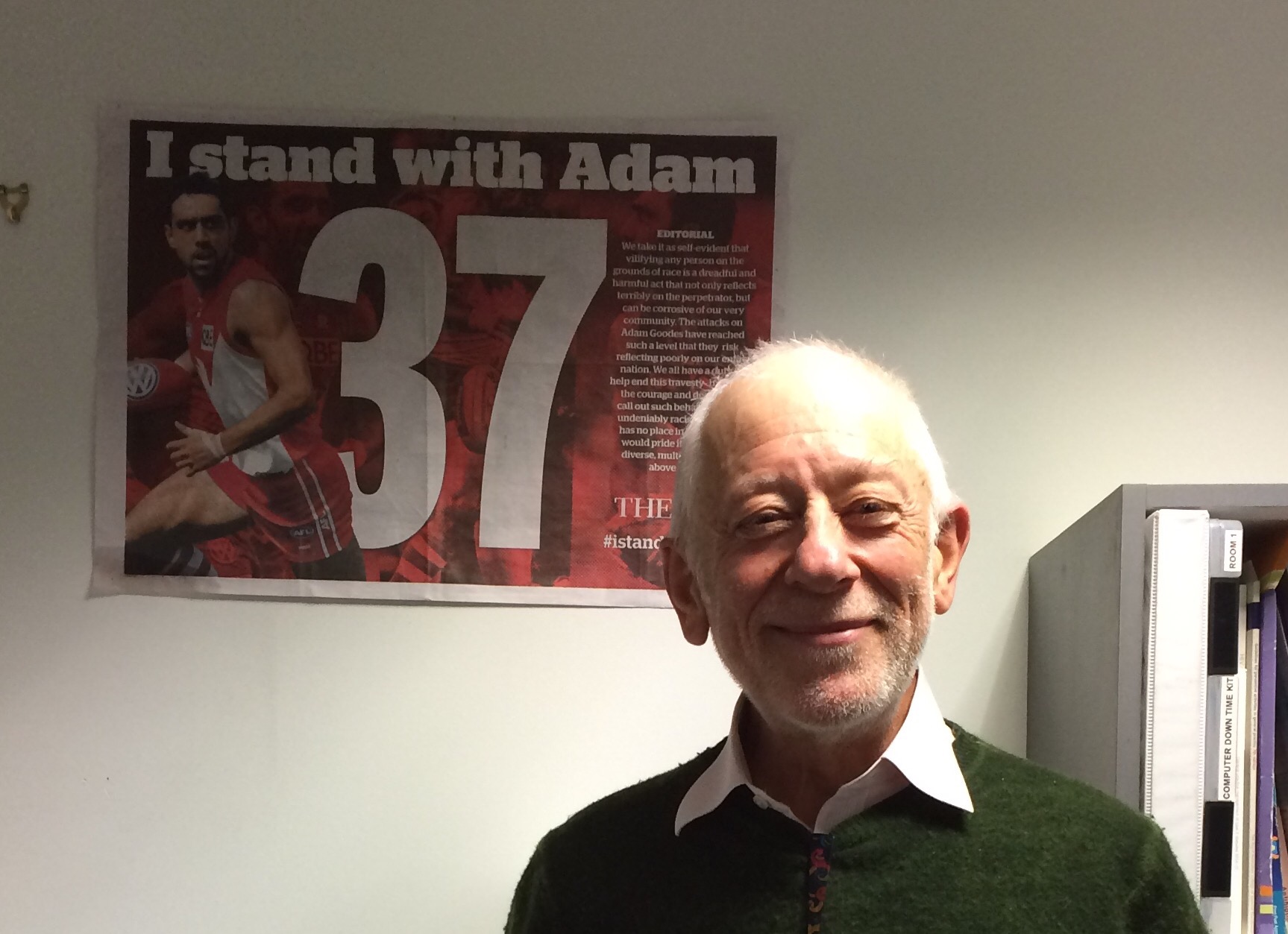
What can be his problem? Sure, he’s black. That couldn’t be his problem, surely. Not here, not in Australia. We aren’t racists. Ask Adam Goodes.
Postcript:

If you happen to be or to know a colour blind employer who needs a person skilled in multimedia, please write urgently to Hilary at quincetree@gmail.com. Time is very short.
Previous post on Hilary’s story http://wp.me/p2QU0B-Mg

Flannelled Fools at the Wicket

We live in historic times. Australia humiliated! Slaughtered! Ten batsmen dismissed in the shortest space of time, surviving the fewest balls in all Test Match history! It happened overnight against the English whom we expected to slaughter, to humiliate, to crush. We had announced those intentions, declared them as good as facts.

 
The Test Cricket contests between Australia and England – termed reverently, ‘The Ashes’, for reasons as fatuous as they are imperishable – excite citizens and journalists of both countries inordinately. Five test matches, each of up to five days’ duration, hold the attention and the hopes of tens of millions at opposite ends of the globe. A strange set of phenomena, these, phenomena that speak seriously to the human condition.
 
What is the human condition? Broadly speaking we human animals are born and we die. In the interval between our beginning and end we live. Our animality drives us to compete, to form packs, while our humanity creates consciousness of self and pursuit of transcendence.
 
Like other animals we play. Alone and in groups, dolphins play, both with fellow dolphins and with humans. Lambs plashing on their dewy grasses play, gamboling and skipping. Foals and adult horses alike gallop and canter in groups for no other reason than they can. 
Humans play too.
 
Watch children as they proceed from A to B. Unconsciously, automatically, universally, they wander, they saunter, they skip, stride, jump and run. They do so because they can. Apparently they must.
 
In respect of play, adults remain children. Play rehearses animal needs: hence running races, wrestling, jumping and leaping contests, swimming contests. Primates learn the use of implements. Fencing as sport exemplifies the primitive contest with the evolved use of an implement, in this case an implement for slaughter, modified for play. At some early time in our story humans invented or discovered the ball. Arguably the ball surpasses the wheel as the singular development in this story.
 
Early in the story of warfare, which closely corresponds to the story of humans, the idea emerged of the champion, the representative best skilled in slaughter. The champion went out to battle on behalf of the tribe; if your champion slew the opposing champion, your tribe enslaved the opponent tribe.
 
Test Cricket survives as the recognisable fusion of these elements. When English persons wearing white flannels, and using sticks and a ball, compete for five days in fierce opposition to eleven Australian persons in similar attire, all twenty-two play out ancient animal and human impulses.
Preserved in the game are ancient rituals: fierce facial expressions, face painting, taunts and challenges, insults and oaths; violence in the flinging of the ball, in the plying of the willow; elegance, in batting poetry, in fielding as in batting the highest graces of dance; among players exhibitions of courage, hubris, cunning, strength, nimbleness, speed and deception; among the supporters, transcendence, transports of joy, of grief, of shame, of pride.
 
With the unbearable recent exception of Phillip Hughes, no-one dies. As in chess, the highly comparable very slow game of transmuted murder, cricket fulfills our animal need for mayhem, without shedding blood. It was Wellington (‘the Battle of Waterloo was won on the playing fields of Eton’) who pointed, albeit from a different angle, to the relation between games and war.
 
In the present Ashes series, we have SLAUGHTER! HUMILIATION! TRIUMPH! We have the march of the superlatives, but nothing new. Nothing at all.

Adam the Original

 
Years ago I had the privilege of working in partnership with a Brownlow Medallist. Dr Donald Cordner was the scion of a family as distinguished for Medicine as for football. I learned many things from Donald: it was he who transformed me from a sluggard to a mechanism for perpetual motion. Like my father he personified a thirst for a meaningful life both within and without medicine. 

Donald captained the Melbourne Football Club in its fertile years of recurring premierships. Of the Medal he spoke seldom and little. I remember one datum: the Charles Brownlow Medal is awarded to the player voted by the umpires as the FAIREST and the best. Over the twenty years we worked together that described Donald Cordner: he was the best at everything he put hand or foot to; and he personified honour.


Like Donald, Adam Goodes captained his club. Like Donald he saw a role for himself in community service. Like Donald, Adam Goodes is a leader, a man of vision, of substance.


In 2003 we saw Adam receiving the first of his two Brownlow Medals. Although he shared the distinction that year with two other champions – one of whom captained the club of my own allegiance – it is the image of Goodes that lingers. More particularly the choice of his companion. Alone among the great young men, Adam brought his mother along, the sole parent who raised him and his siblings. Goodes’ mother contrasted with the other companions, generally blondes, frequently trophy females with cleavage.

Mrs Goodes looked what she is, an Aboriginal matron. Nothing fashionable – read, ‘mutable, evanescent’ – just his Mum, the woman Adam Goodes chose to raise to public honour.


When I looked at this man, this original, I saw one who stands for family, for loyalty,  one who knows his roots and is proud. Like his ethnically distinctive medallist forebears, Robert Dipierdimenico and Jim Stynes, Adam is Australia incarnate. He reminds us of our inextinguishably diverse makeup. That diversity, for most Australians, is our glory; for some an intolerable truth. When those persons boo Adam Goodes, they boo their community, they boo themselves.


The Rubaiyat of Zoltan Klein

A Book of Verses beneath the Bough,
A Flask of Wine, a Loaf of Bread – and thou Beside me singing in the Wilderness –        And, Wilderness were Paradise enow!

I accepted the invitation to the launch event of ‘Bread, Wine & Thou’ without curiosity. But as the series of emails from the Event Manager mounted I sensed I should look a bit spiffy for the launch. So I wore my English Schoolboy Blazer. The addition of my backpack subtracted from the elegance of my outfit and together with my skullcap ensured I would look quite as odd as usual.

At the last moment I invited a friend, an art impresario held by all to be ineffably elegant.

The security man at the door, a gym giant in Armani, consulted a guest list longer than the Pentateuch. A show of expensive teeth: “Your names, gentlemen?”

“We are both Howard Goldenberg”, I said.

“Thank you sirs. Please take the elevator to the Second Floor.”

A disembodied voice from the rear of the elevator was heard: “Hi Howard”. It took a while to identify our host Yossi (also Zoltan Vinegar) Klein, obscured as he was by a cluster of tall, expensively draped women, mounted on very steep heels. Taller than all others in the lift a wide man with an interesting face stood next to Yossi. He did not speak.

The lift released us into the highly geometric womb of Cox Architecture, a space as inventive and unexpected in its proportions and planes and shapes as Federation Square. I had not previously heard of Cox, but I was given to understand its iconic condition.

Filling the space, throngs of elegant females and stylish males kissed a lot of air as they greeted each other with little shrieks and harmless hugs. I noted my companion and I were not the most expensively dressed persons present. Wine was sipped, quite exquisite looking entrees were served and everyone accepted a copy of ‘Bread, Wine and Thou.’

Eventually Zoltan took a microphone and spoke. For a time no-one noticed, for Yossi is, as his surname suggests, not tall. After a bit all fell silent. He spoke informally, disarmingly, unpretentiously. He said, “I wanted to create a literary magazine on the themes of food, wine and culture.” Those were precisely the words he used when he spoke to me a year earlier in ‘Batch’, the Kiwi coffee shop where he and I had sighted each other without speech over years. On that occasion Yossi said: “I’ve read your writing on Aboriginal Australia. I want you to write a piece on Aboriginal Cuisine for the first Number of ‘Bread, Wine & Thou.’ I can’t pay you.”

I accepted the commission and wrote something and turned up in my blazer and kippah and backpack. It must be clear from the harsh tone of my introductory remarks that I felt uncool, unfamous, outranked by the figures of beauty. But as Yossi spoke all that fell away. This man in his forties spoke of his dream and its fulfilment, the magazine – really a handsome book – that we held in our hands. Yossi opened with a joke about his Jewish mother. It was a good joke and we all laughed and Yossi relaxed. He thanked a legion of first names, burnishing each name with his deep appreciation. As Yossi spoke one hundred and fifty smart people from the uppermost echelons of food and wine stood, arrested. Cynicism and self-consciousness fell away. We were human together as Yossi stood, naked in his feeling. He said he was overcome. His voice cracked with emotion.

Later a Very Great Man accepted the microphone. He sat down and whispered, exercising the powers of greatness and of near-inaudibility over his audience. Just as Howard Goldenberg alone had never heard of Cox Architecture, neither had I recognised the Greatest Chef in the World, the tall wide man of the interesting features who rode the rising elevator at Yossi’s side.

  
The room worshipped. Upon completing his remarks the man folded Yossi in an embrace that hoisted him from the floor. Evading believers*, he strode from the room, disappearing into the night.

That this personage should have descended to Melbourne for Yossi was felt to be an enormous compliment to our host. As I listened to the chef speak of his career at length and in breadth I felt increasingly the greatness of Yossi. And when you read Yossi’s magazine I think you will feel the same.

Although ‘Bread, Wine & Thou’ is accessible on-line, I urge you, do not go for the virtual book; for modest moneys you can acquire the real volume. Collectors will treasure this, the first edition, a thing of truth and beauty.

IMG_6132

* I stole this lovely phrase whole from Les Murray’s ‘ A Perfectly Ordinary Rainbow’.

Writing as Healing

The mother of identical twin boys sent me this story by Ranjava Srivastava.


“Losing my twin baby boys for ever changed the way I treat my patients.

I will never know the kind of doctor I would have become without the searing experience of being a patient, but I like to think my loss wasn’t in vain.

‘My obstetrician’s tears stunned me but also provided immediate comfort. They normalised the mad grief that had begun to set inside me.’
Around this time 10 years ago, I was poised to start my first job as an oncologist when personal tragedy visited in a way that would forever change the way I would practice medicine.

I had returned from my Fulbright year at the University of Chicago, blessed with only the joys and none of the irritations of being pregnant with twins. Landing in Melbourne, I went for a routine ultrasound as a beaming, expectant parent. I came out a grieving patient. The twins were dying in utero, unsuspectedly and unobtrusively, from some rare condition that I had never heard of. Two days later, I was induced into labour to deliver the two little boys whom we would never see grow. Then I went home.

If all this sounds a little detached it is because 10 years later I still have no words to describe the total bewilderment, the depth of sorrow and the intensity of loss that I experienced during those days. Some days, I really thought my heart would break into pieces. Ten years later, the din of happy children fills our house. But what I have found myself frequently reflecting on is how the behaviour of my doctors in those days profoundly altered the way in which I would treat my patients.

An experienced obstetrician was performing my ultrasound that morning. Everything was going well and we chatted away about my new job until he frowned. Then he grimaced, pushed and prodded with the probe, and rushed out before I could utter a word. He then took me into his office and offered me his comfortable seat. Not too many pregnant women need a consultation at a routine ultrasound.

“I am afraid I have bad news,” he said before sketching a picture to describe the extent of the trouble. I thought for a fleeting moment that my medical brain would kick in and I would present him with sophisticated questions to test his assertion that the twins were gravely ill. But of course, I was like every other patient, simultaneously bursting with questions while rendered mute by shock.

I was well aware that doctors sometimes sidestepped the truth, usually with the intent of protecting the patient. I knew he could easily get away with not telling me any more until he had more information but I also knew that he knew. I read it in his face and I desperately wanted him to tell me.

I asked the only question that mattered.

“Will they die?” 

“Yes,” he said, simply holding my gaze until his tears started.

As I took in the framed photos of children around his office he probably wished he could hide them all away.

“I don’t know what to say,” he murmured, his eyes still wet. 

Until then, in 13 years of medical training, I had never seen a doctor cry. I had participated in every drama that life in bustling public hospitals offers but never once had I seen a doctor cry.

My obstetrician’s tears stunned me but also provided immediate comfort. They normalised the mad grief that had begun to set inside me. Yes, the doctor’s expression said, this is truly awful and I feel sad too.

“You are sure?”

“There is a faint chance that one lives but if you ask me, things look bad. You know I will do everything I can to confirm this,” he said.

The obstetrician had told the unflinching truth and in doing so almost surgically displaced uncertainty with the knowledge that I needed to prepare myself for what lay ahead. I had test after test that day, each specialist confirming the worst. I think I coped better because the first doctor had told the truth.

Two other notable things happened that week. Among the wishes that flowed, another doctor wrote me an atypical condolence note. His letter began with the various tragedies that had taken place that week, some on home soil and others involving complete strangers. “I ask myself why,” he wrote, “and of course there is no answer to why anyone must suffer.”

Until then, everyone had commiserated only at my loss – and I was enormously grateful – but here was someone gently reminding me that in life we are all visited by tragedy. All the support and love in the world won’t make you immune to misfortune, he was saying, but it will help ease the pain.

Finally, there was the grieving. I lost count of the pamphlets that were left at our door to attend support groups, counselling sessions and bereavement seminars but we were resolutely having none of it. My midwife called me out of the blue – it was a moving exchange that taught me how deeply nurses are affected too. But I didn’t need counselling, I needed time. I valued the offers but I knew that my catharsis lay in writing. I wrote myself out of suffocating grief, which eventually turned to deep sadness and then a hollow pain, which eventually receded enough to allow me to take up my job as a brand new oncologist. How I would interpret the needs of my patients was fundamentally altered now that I had been one myself.

Cancer patients are very particular about how much truth they want to know and when. I don’t decide for them but if they ask me I always tell the truth. A wife brings in her husband and his horrendous scans trigger a gasp of astonishment among even the non-oncologists.

“Doctor, will he die from this?” she asks me.

“I am afraid so,” I answer gently, “but I will do everything in my power to keep him well for as long as I can.” 

It is the only truthful promise I can make and although she is distressed she returns to thank me for giving her clarity. Sometimes honesty backfires, when the patient or family later say they wanted to talk but not really hear bad news. I find these encounters particularly upsetting but they are rare and I don’t let them sway me from telling the truth.

Oncology is emotionally charged and I have never been afraid of admitting this to the very people who imbue my work with emotion. I don’t cry easily in front of patients but I have had my share of tears and tissues in clinic and contrary to my fears, this has been an odd source of comfort to patients. In his Christmas card, a widower wrote that when my voice broke at the news that his wife had died he felt consoled that the world shared his heartbreak.

It can be tricky but I try to put my patients’ grief into perspective without being insensitive. It’s extraordinary how many of them really appreciate knowing that I, and others, have seen thousands of people who are frightened, sad, philosophical, resigned, angry, brave and puzzled, sometimes all together, just like them. It doesn’t diminish their own suffering but helps them peek into the library of human experiences that are catalogued by oncologists. It prompts many patients to say that they are lucky to feel as well as they do despite a life-threatening illness, which is a positive and helpful way of viewing the world.

I will never know what kind of a doctor I might have become without the searing experience of being a patient. The twins would have been 10 soon. As I usher the next patient into my room to deliver bad news, I like to think that my loss was not entirely in vain.” 

……… 

I read this story with alarm. It made me feel anxious because I have and love a pair of identical twin boys. I felt involved because, like the writer’s doctor, I am a doctor who cries; and like the writer, Dr Srivastava, I am a doctor who writes. Finally we two are products of the same medical school (Monash) – Dr Srivastava graduated at the top of her class, in the present century, I graduated at the opposite end of my class, in antiquity (1969).

A final point of commonality was her reassuring remark that ten years after her doctor wept her home is full of the noise of happy living children.

I found the piece helpful. Dr Srivastava identifies and untangles the strands of her experiences with surgical deftness. Her doctor weeps, her colleagues show support and care and empathy and she heals. As a trained observer, the writer dissects her experience of grief, lays out its anatomy and reflects upon its organs and parts.

Like the writer, I find relief and understanding in the act of writing. I suspect that a part of this relief results from word search. The writer is obliged to seek the precise word for the experience. In my case this forces me to test and taste a number of words. Perhaps a dozen words might work more or less passably, but the acts of searching, of choosing, of trialling, help me to clarify what my feelings were not quite like. I mean I discover what I mean. Perhaps this functions as a working through, a self-conversation, something between analysis of an experience and re-imagining it. In my case too, the pleasure of words is an aesthetic joy that comforts me.

Medicine is a pursuit conducted with the living in the shadow of death. It is a pursuit packed with anxious questions: what is wrong with me, will I die, what can be done, will it hurt, how much, how will I know the answers, when will I know? This crying doctor feels the patient’s fear and his own and has to know the border that divides the two. My fears are for the patient, of the patient, of failure, of failing a person of flesh and feeling. My fears include the terror that strikes me when I see my patient slipping away, the knowledge of my mortal inadequacy.

The writer who lost her twins precisely names the elements in her emotional experience. With remarkable poise she traces the costs and the benefits of the loss. So coherent are her reflections I could feel myself learning as I read. I learned about her life and her work, how the two are not the same but never severable. I learned more of how a doctor feels, who she is, who I am.