You Can’t Beat a Butter Batter

Fruit cake, rich, heavy, moist, in childhood the natural partner of a glass of icy-cold-milk-not-boiled-please-Mum, an entire fruit cake became my own every January eighth – my birthday cake, dating from around the time of my maybe fifteenth birthday, as I recall – Mum baked it, back in the butter days when doctors hadn’t discovered her soaring cholesterol, (we had our good times, we had our butter times), and Mum, always a superlative baker (who never essayed a sponge cake – ‘I can’t bake a sponge cake’) who kept two tins endlessly plenished with biscuits, biscuits Anzac, biscuits corn-flake, jam biscuits, biscuits nameless now in my aged forgettings; and cakes, always one waiting and ready for the nourishing of children, four of us, four who each secretly knew that he or she was the most loved of all by this mother who would say, in her much later years, “I never achieved much in my life, but I have four children who love me and that is enough”, and enough it was, especially as fruit cake, moist, heavy, from the deep delved earth, was never even my favourite, so many, so various and numberless and so rich and so high, light, soft, moist and sweet and buttery were all of them, but somehow, early one January, Mum must have asked, “What cake would you like for your birthday, darling?”, and I must have replied – thinking of how that uncooked cake batter, all floury and viscous with brown sugar and fruits in Rhine Castle kosher muscat wine, how much better raw in the mixing bowl than after baking three hours in the slow not-too-hot oven, how this batter beat all other raw cake batters by a rich mile – “Fruit cake, please Mum”, and Mum would have decided it was my favourite, and every eighth of January thereafter she presented me with a whole one, until that year, freshly married, freshly graduated, doing my first locum in a small town in Tasmania in January, I knew this would be the first year I’d go cakeless, that I’d graduated from that child nurturing, and my darling bride, a neophyte cook who would go on to surpass all before her as a chef, had the wisdom and the discretion not to venture into the cuisine where the mother-in-law shone and the cakes of breastmilk affection preceded her, so Annette forebore and the pampered young groom understood an end had come, but a day or two before the eighth, a parcel arrived in the post among all the letters from drug companies, the parcel wrapped in brown paper – my parents never threw out brown paper or string, they never forgot the Great Depression when, as I imagined it, there came to pass the World Crisis of No String and no Brown Paper – that parcel heavy, and under the brown paper a container unyielding to my fingers, and on the brown paper and addressed in Mum’s singular and elegantly jerky hand to “Dr. Howard Goldenberg, The Surgery, Deloraine, Tasmania,” and the address incomplete, the sort of address that destined your mail for the Dead Letter Office, but in the margin Mum’s plea:
“Mr Postie, It’s his birthday cake, please try to get it to him by the eighth: This Way Up”, and inside the paper was a cake tin and inside the cake tin was the birthday cake, fruit cake, still so good with a glass-of-icy-cold-milk-not-boiled, a single slice a gobstopper, but who ever stopped at a single slice?, not me, and so the January cakes came and came, butterless now in the puritanical regime imposed by philistine doctors, the cakes still came, until the strokes came, Mum’s left hand forgetting its cunning and the birthday cakes would surely stop now, but they didn’t, because Dad, himself a cook of meat and fish who never baked a cake in his life, saying ‘I can’t bake,” Dad stepped forward and made the annual fruit cake to Mum’s recipe, under Mum’s direction, and she presented it to a son expecting nothing this year or ever again, just grateful that Mum was still alive and loving and playful, and she not the least interested in the facts of disability, and so the cakes came and came until Dad went, and here I was, a boy of fifty-seven-and-a-half years who knew his fruitcake days were over; but no they were not, for there existed Mum’s firstborn, Dennis, born with butter in his mouth, a cook who believed in fat and cream and sugar and starch and no self control and no moderation especially in helping our Mum and never more than in celebrating his younger brother, the brother whom he might reasonably have seen as his supplanter, his usurper, but no, Dennis never felt those things, writing one January eighth, “Howard, I think God must be proud of you”, and now the cakes kept coming, butter reinstated, for there were never thoughts of tomorrow with Dennis, only of the abundant now and now was Howard’s birthday and it was his joy to help Mum make cake for her boy, and then, at the age of sixty-three Dennis underwent surgery and died and the cakes finally stopped…but no they didn’t, because Mum recruited her east-european carers, masters of the cuisine of heavy stodge, as her new sous chefs and she directed as they baked my fruit cakes – until the time Mum died and that would have been the end of the fruitcakes… except Mum left one granddaughter who loves baking as much as she loves her father; and that person is my youngest daughter Naomi, a devotee of the Creed of Cholesterol; devoutly does she mix bright-yolk eggs with buttery batter for a father whose januation ever is blessed with food-as-love, and so may it continue until I come to my Full Stop.

IMG_4032.JPG

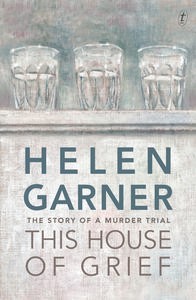
This House of Grief – by Helen Garner, A Review.

Helen Garner saw it on the TV news. Night. Low Foliage. Water, misty and black. Blurred lights, a chopper. Men in high-vis and helmets. Something very bad here. Something frightful.

It was truly very bad. A man had driven his car into a dam. He escaped from the car but his three small sons drowned. The man was charged with their murder and over the following eight years Garner attended the man’s exhaustive legal trials. She exhausted herself in the process of moral exploration of territory that is indeed, ‘dark, misty, black and blurred.’ Reading Garner’s ‘This House of Grief’ can exhaust a reader in turn.

Three hundred pages of scrupulous enquiry end with the author reflecting: ‘When I let myself think of Jai, Tyler and Bailey lying in their quiet cemetery…I imagine the possessive rage of their families: You never knew them. You never even saw them. How dare you talk about your “grief?”
But no other word will do. Every stranger grieves for them. Every stranger’s heart is broken. The children’s fate is our legitimate concern. They are ours to mourn. They belong to all of us now.’

Garner takes the deaths of the three children personally as if she were herself involved. She seeks to know whether they died by grievous mischance or by human intent. She needs to understand. She begs of fate, of the universe, ‘Oh Lord, let this be an accident.’ For us her readers – we who elect to follow her into this frightful something – Helen Garner attends the hearings as our emissary to that house of grief. We too need to know, we too seek to understand; the three lost boys are ‘our’ lost children.

Garner quotes three epigrams, each a succinct cry from a previous emissary, each a pair of hands flung upward in despair over the futility of the quest to comprehend.

He can’t possibly have done it. But there’s no other explanation.

There is no explanation of the death of children that is acceptable.

…life is lived on two levels: one in our awareness and the other only inferable…from inexplicable behavior.

On what account are Garner’s thoughts and reactions, naked here on page after page, a matter for a reader’s interest or a reviewer’s remark? What access has the reader to her deeps, her angst? Garner, the person on the page, our emissary, attends a day of ravaging evidence; afterwards she makes her way, blindly, solitary, to a bar for a vodka. On other occasions she resorts to magical thinking: If only Farquharson could be found not guilty, then the boys would not be dead…Garner pictures them in their domestic vitality, playing footy, watching cartoons, running with arms open for a cuddle. The only way I could bear it was to picture the boys as water creatures: three silvery naked little sprites,…who slithered through a crack and …sped away together.
Then, haunted by the chill of reality, she races homeward in her mind, to haul my grandsons …from their Lego and their light sabres, to squeeze them …until they squirmed. Young boys! How can such wild vital creatures die? How can this hilarious sweetness …be snuffed out?

And again, this longer account of the observer’s migratory flight of feeling: When I got home I sat on the back verandah mumbling to myself, sick at heart. My third grandchild came wandering around the house. He approached me without speaking, turned his back, and stood waiting to be picked up. I lifted him onto my lap. He was only a few months younger than Bailey Farquharson had been when he drowned. For a while the little boy sat on my knee. He relaxed his spine against my chest. Together we listened to the clatter of the high palm fronds, the wail of a distant siren. He glanced up sharply when a flight of lorikeets swerved chattering across the garden. Then he spread his right hand like fan, inserted a delicate thumb into his mouth, and tucked his head under my chin.

And yet only two hours later when he and his four-year-old brother disobeyed me… and went crashing and yelling down the hall to the kitchen like maniacs, rage blinded me. I ran after them, grabbed the nearest arm, and yanked its owner round in a curve. Before I could land a blow I got a grip on myself. The boys stood frozen in attitudes of flight. Nobody spoke. In a cold sweat I leaned against the cupboard door and took some trembling breaths.

Here Garner gives us her brittleness, her sense of near disintegration, her proximity in extremis to harming loved ones in her care; and subtly too, the boys’ “attitudes of frozen flight” recall the postures of failed flight of the boys in the drowned car.

There is a reticence, a holding back at certain points, a refusal to comment that shouts, no, screams, in unexpressed horror. Thus: The men from Major Collision looked into the car before they opened it to drain the water. Ten-year-old Jai was lying face down across the front seats with his head towards the driver’s door…
Seven-year-old Tyler lay on his right side behind the driver’s seat. His head was near the door and his legs were between the two front seats. Two-year-old Bailey was lying across the top of the baby seat, facing rearwards and still tangled in his safety harness.

It is not until the following page that Garner reveals the killer datum: all three seatbelts were unbuckled. It is this crushing fact that tells us that a child – or two children – struggled. It is this, delayed, that a writer striving for dramatic effect might have juxtaposed earlier and quite unbearably with those postures. As it is, the bodies lie diagonally, piercing my composure. I too need recourse to slithering fishes or to vodka or to clutching hard my own brood of near ten-year-old grandboys.

***

Writing to a friend some weeks following release of the book – a year or more I guess after the trial and the appeal and the retrial and the application to the High Court – after all had ended, Helen Garner said: “This is what I’ve learned from the last seven or eight years: ‘We are small. We are weak. We are mortal’… but I think I knew that already.”

After all had ended it had not ended at all.This House of Grief

Manny the Marathon Man

Manny Karageorgiou ran 42.2 kilometres yesterday, racing his oldest foe. At 58 years, Manny is the youngest of the Glorious Ten who have competed in and completed every single Melbourne Marathon. ‘Forty two kilometres’ – it rolls off the eye easily, but it’s a long way to travel on foot. My car gets tired over that distance.

Manny ran with the most reluctant consent of his oncologist. He delayed his stem cell transplant so he could keep faith with the Ten. This GP consented more readily despite the rib that fractured as it filled with tumour, despite the remaining bones waiting for fracture in the merest trip, bones brittle and chalky from the medicines and radiation. The GP consented; who could say ‘no’ to that beautiful face, a child’s face, appealing, smiling through the pain and fear, gentle, mild even before the cancer, tenderer than ever since the rib broke, as Manny sought to comfort his fearful wife and his children.

They came around, the family. They ran the late kilometres with him, the bitter second half of the marathon, they ran, a caravanserai of love and hope and tearful joy, along the endless steppes of St Kilda Road. Manny’s son ran the whole distance at his side. Pana, as Manny calls him is a strapping footballer, vigorous and fearless. Afterwards he would say, ‘I don’t know how anyone could run another marathon after experiencing the pain of the first.’ But Manny has run the Melbourne Marathons thirty seven times. He has outrun the Reaper. So far.

Why does he run?

He runs for faith, he runs for pride, he runs to be humbled, he runs for the self-glory of mortifying his flesh. He runs because he lives. He runs for all of us.

IMG_3865.JPG

Mending the Broken Runner

Spring months are the cruelest, mixing memory and desire. And I have felt the sun soft on my skin, have woken with birds that called me, watched the young and the not young but not broken, all at their running, running, running. And I have felt self-sorrow, sincerest of emotions, and I have felt the creeping entry of a green stranger. And I have resented and I have envied those runners, their unforgivably beautiful limbs, their light and loping tread. In short I became that miserable creature, the broken runner.

Yesterday I drove with daughter and grandboys to Wilson’s Promontory National Park. All was as ever it was; emu browsing, shy wallaby, slow wombat, delicate birds, hills, hills, hills, bouldered beaches and the odd ‘mountain’. Only in Australia, and perhaps the Netherlands, would you grace Bishop and Oberon as mountains. But when you run them your legs cry out and the mind, the mind has mountains.

There was Mt Bishop. We drove past and I told the kids, I used to run up there, all the way to the top. Unable to see the top, too small, too low in the car, the kids made no response.

This morning I awoke and the cabin slept. My knee felt OK. There were the car keys, here were running clothes unrun-in for five months, no family duty called, no excuse. Five minutes’ drive to the track saved me twenty minutes’ running dull bitumen. Here was the track, sandy, scattered with leafmeal, meandering into bush. My legs smiled and snuffed the battle with delight.

And I was running. And nothing hurt. And my lungs kept up with my legs. I ran carefully, judiciously. I avoided rocky footfalls, I paced myself, I spared the left leg and I climbed.

I climbed the twisting turning tilting track, gently, gently, enquiring ever of the knee, feeling no angry response.

The track was mine, mine alone, mine this domain, this splendour, these rugged crags, that ribbon of silver of tidal river, the dull green of bushland, the sweeter green of spring growth, the dead trees white, trees blackened by the fires but shooting green, greening too the great denuded gorges scoured by the floods.

All this juice and all this joy, all for me, a message, a consolation, hope in dried tubers.

The track softened beneath my gladding feet, the gradient gentled, the summit sighted.

There at the summit, the track ended at that same old tumble of broken shapes and abrasive surface: Snack Rock. Slowly I climbed those last metres, transferring weight, o so cautiously, sparing the knee, old man’s knee, unwelcome stranger’s knee, imperious ruler for five months of my youngering spirit.

I offered a line of thanks and ate my apple. I took my first selfie. I photographed the terrain.

And down I ran.

Now, descending, pain pounced and grabbed the rear of the injured knee. Small pain this, the same as I feel on the bike, pain of no portent. And as on the bike, brief of tenure.

Down, down, down, through avenues of wattle unnoticed earlier by the runner with head bent on the ascent. The wattles arching over me, an avenue of honour, reminding me, reminding me of the day I ran into a bunch of hockey players blocking the path ahead of me. This was a serious run, a timed solo marathon to qualify for entry to the hundredth running of the Boston Marathon. A cry from their leader, “Guard of Honour, Guard of Honour!”; and the hockey guys fell into two lines, raising sticks above my head, applauding me as I ploughed on.

There is honour in the long run, a tearful thankful joy, a discovering of the self. I felt all those, all that old knowing, all those strong sensations. And something else, something new – signs of life.

The Eve of the Eve of Yom Kippur

The house, emptied now of the insurrection that is a bunch of grandboys on school holidays, is quiet. These are the peaceful moments when the house exhales, the pulses slow and thought recovers.

Tonight is the night before the eve of Yom Kippur, the Jewish Day of Atonement, our Sorry Day. What am I sorry for? For what need I atone? Almost all my sins are those committed in words: I am sorry for the words shouted in anger at my grandrats, sorry for careless slights and unkind witticisms, sorry for speaking faster than my thinking.
And as this blog consists of words, I should search them.

I wrote (in How we Killed Leo) unkindly of Mister Scott Morrison. Elsewhere I have written uncharitably of Mr Shorten and Mr Abbott. All of these public people have private families who would feel wounded when writers such as I play the man instead of attacking the issue. I referred – wittily I felt – to our homegrown press baron as Murd. I should wash my mouth out. I am sorry for the hurt I have done those men and their families.

I remain sorry – and ashamed – that we Australians choose representatives who follow our baser instincts instead of those who might lead us and inspire our finer selves.

In the person of the successor in Sydney to Cardinal Pell, we might have found such a leader. On the morning after his accession the new archbishop spoke like one repentant for wrongs, transparent in confession, compassionate towards those hurt, and creative and courageous in his declared resolve to seek out his brother clerics in the Muslim community, ‘to find ways we can work together to heal our community’. This on the very morning we all read of the arrest of one Australian suspected of plotting to kidnap and behead another – any other – Australian.

A few weeks ago a Jewish democrat, tirelessly active in the struggle to improve our policies towards refugees, shared with me a bright new idea. “Howard,” he said, “Instead of attacking politicians I want to mobilise members and leaders of all of Australia’s faith communities to work together with government to create some softer policies that will be less cruel in their effects on those already here and kept in limbo.” Many, many are the Australians who wish our practices were not so harsh. Many are ashamed. Many have raised voices – as I have – in rancour. What I heard now was the echo of the quiet wisdom of Petro Georgiou, former Member for Kooyong, the man who spoke softly to a hard-faced Prime Minister and brought some humanity into policy.

As the prophet said, “Come, let us reason together.”

Phone Calls from my Dead Brother

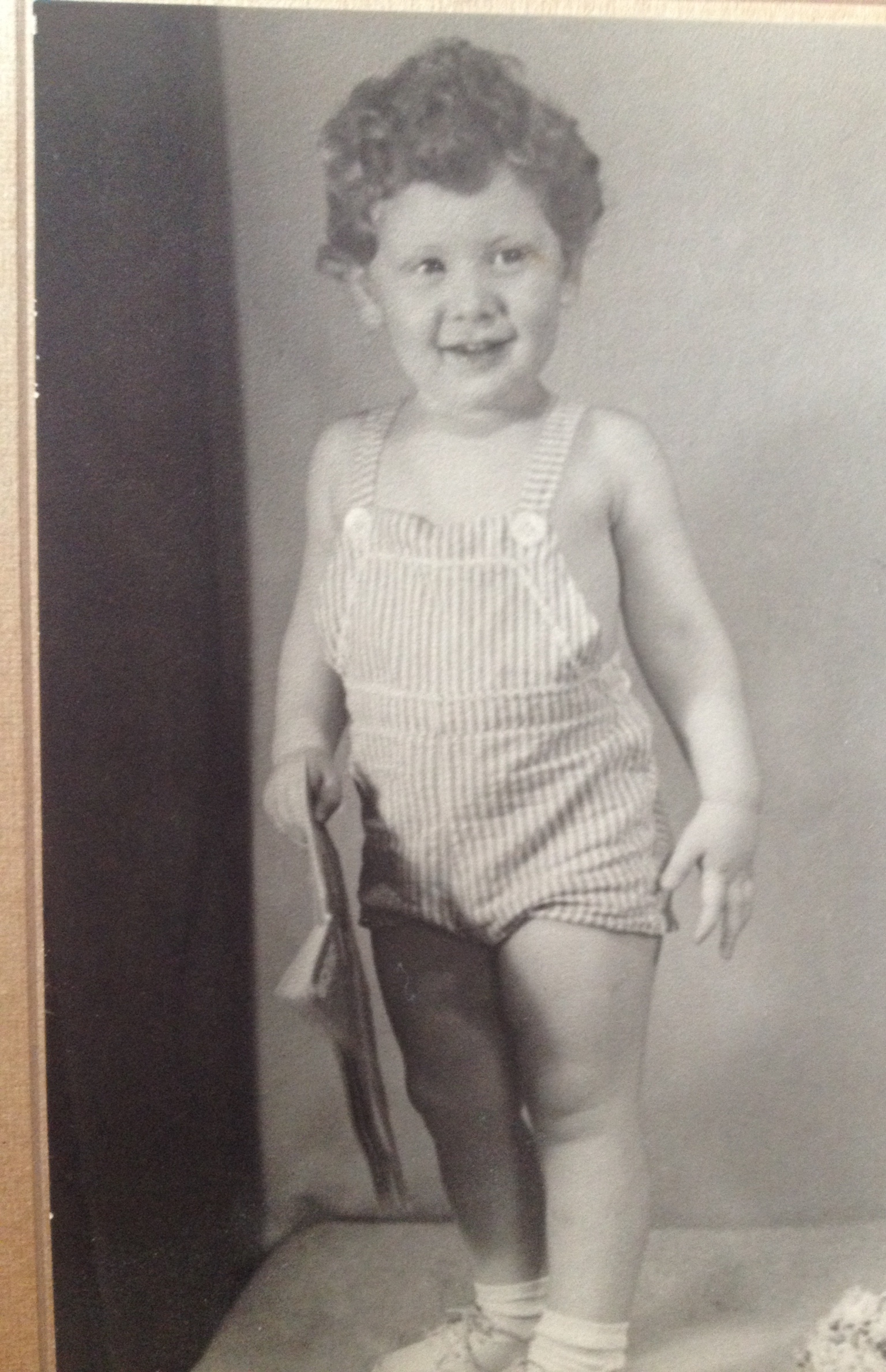
My brother Dennis

My brother Dennis

This evening and tomorrow the family will mark the seventh anniversary of the dying of my firstborn brother Dennis. We’ll light candles and congregations will join us in remembering him.

Two weeks before he died Dennis underwent elective surgery. I wondered if the surgery was wise. Dennis, whose life’s creed was hope, assured me: ”Doff, this operation can eventually cure diabetes. It will transform my life.”
We spoke daily on the phone – he from his hospital bed, I from a hellhole town in the deep Kimberley. Day by day Dennis seemed to be doing well. But on day four he told me: ”I’m OK but my belly hurts”. A belly ache bad enough for stoical Dennis to mention was bad enough to alarm me.

Day five, no phone call. That day the pain was worse. Dennis collapsed, his circulation failing as his abdomen filled with blood and stomach acid leaking from his wounds.
At his bedside in Intensive Care the following day we counted the tubes entering and departing Dennis’ comatose form. One into his windpipe to make him breathe; a second into a great vessel to deliver information; a third to bypass his kidneys which had failed; a fourth to drain his bladder; a fifth and sixth into peripheral vessels to deliver fluids and the hero molecules that just might save him.
The greater the number of tubes in a patient’s body, they told us, the lower the chance he would leave ICU alive.
I sat at his bedside and I watched my brother. Behind the clicks and gusts of his life machines swelled the sounds of classical music. Annette, his loving sister-in-law, thought to play that music, those patterned sounds that ever soothed his troubled breast.
I sat there and watched as nurses, tender or tough, kept my brother alive. The tough ones, resentful of something – were we too many, was this medical brother too medical, that sister too exacting, that aged mother too accepting? – made me feel small, in need again of a big brother.

Dennis turned the corner: blood pressure held firm, sleeping kidneys awoke, fewer molecules were needed. The doctors conferred and announced: “We’ll let him wake up now and breathe on his own.”

Dennis breathed and slept on. We all breathed, went home and slept.
At four in the morning my phone rang. A crepitous, rustling sound, a broken voice in windy gusts: it was Dennis: “Doff, they want to njjhrnnujicxvclbkvn”
“Den, I can’t hear you. Say it again.”
Gales and crackles and Dennis’ voice in fragments: “Doff… inaudible… they…unintelligible…the tube back in.”
“Den, are you saying they advise you to go on the respirator again?”
More gasping, a desparate heaving of voice: “Yes!” More gasping. “Is it a good idea?”
“Den, it’s your best hope. Say yes.”
“Alright Doff.”

That was the final phone call. Dennis and I never spoke again. By the time I reached the hospital Dennis’ coma was renewed, the respirator breathing for him. Soon his circulation collapsed again, the doctors tried heart-lung bypass (“It’s only ever been shown to work in children. It’s your brother’s last hope..”) and on the eve of Shabbat Dennis died.

***

I can speak or write of Dennis dying with a composure that surprises me. Even my fatal advice does not trouble me. Perhaps it was not the dying of my big brother, but his living, that calls to me and troubles my dreams.

Dog Days

Fidel at the beach on his last day.

Fidel at the beach on his last day.

Patchett opens her story with, “Two days before my dog Rose died…”* Who of us who has ever loved a dog can resist the urge to read on? Flung into foreknowledge of a death – knowledge humans share, but which animals might be – who knows? – spared, we realise this death is imminent. While many of us imagine we’d welcome such foreknowing of our own end, few could bear it. Patchett, it is clear, feels that burden of knowing.

Then there’s the dog’s name, Rose: this dog is particular. She has an owner, a name giver. Giving a name is an act of appropriation, literally a claim of belonging. Rose belongs to Ann. Sahara belonged to my brother Dennis; and Fidel belonged to my son-in-law Pablo. And, to our surprise, a widening circle of others.

My firstborn brother spent most of his last decade as the sole resident in a family sized dwelling. A gregarious, family-minded man, his loneliness would have been bleak without Sahara. To those who did not love her, Sahara, was completely unlovable, too small, too low slung, raucous and aggressive; she was in addition a sneaking, nasty, opportunistic biter. To Dennis alone was she cherished; blind to her antisocial nature, her repellent effect on all creatures on two legs or four, Dennis pampered her. He loved Sahara. She was his housemate, his friend, his nearest relative.

Happily for Dennis he never saw Sahara’s last days. After he died, one of his friends materialised in our house of mourning and volunteered to take her in. Relieved of a most undesired heirloom, we seldom speak of her. She lives on, however, under her own name, between the covers of my novel ”Carrots and Jaffas”, in which she functions as an unexpected redeemer. My fear is she might be alive somewhere in the flesh. A roar, a blur, a quick bite, sudden blood, quicker flight, you’ll recognise Sahara by her toothmarks.

***

By any standard Fidel was a Border Collie gentleman of refined habits. He growled only when a stranger ventured too close to the latest newborn of his household; he barked only at the one great hound to invade his territory outside Alma Espresso; he was quite useless as a watchdog. Fidel’s sole lapse of etiquette was his habitual piddling on my mother’s loungeroom carpet, but we excused that as the imperative of territory.

Fidel loved to run. I loved to run. Long after my running companions fell away to ruined knees or rescued marriages, Fidel kept me company on long lonely early morning runs. Young women smiled at me, my maleness forgiven in the company of Fidel.
Fidel was first dog across the line in the Traralgon Marathon of 1998. He was photographed smiling at my side with his medal around his neck. The officials were not to know he’d travelled some of those 42.185 kilometres – unwillingly and under protest – in my daughter’s car.

Fidel parted with his testes without complaint, he raised three small boys and won the hearts of widening circles of kin with his never ending grin and his always sweet breath. Like all his bottom sniffing kind Fidel seemed immune to odour. He’d keep me company when I was seated on the loo. Once in that small room he ventured forward, making mistaken fellatious overtures. Fidel and I were close but I drew the line here.

One day Fidel seemed tired, the next day apathetic; the third day he was rescued by surgery and transfusion (at the hands of his loving vet-in-law) from death by catastrophic internal haemorrhage. The vet-in-law confided he had had incurable cancer. Six weeks later my wife and I said our goodbyes to Fidel – my jowls quiver and my lower lip trembles as I recall it – at the seaside, his happiest hunting grounds where he was wont ever to chase seagulls into mocking flight. We embraced him and whispered last words. We knew what we knew; we wondered what Fidel knew? Not for the first time I kissed him.

***

Ann Patchett won the Orange Prize and a Pulitzer for ‘Bel Canto’. She won me first with a small booklet titled ‘The Bookshop Strikes Back’ (Bloomsbury, 2013), a safe enough speculative buy at $2.50, handsomely rewarding.

In her remarkable book, “This is the Story of a Happy Marriage”, Ann Patchett describes the passing of Rose. Rose was small, lap-sized, not a real dog to love and run a marathon with. From her opening phrase Patchett won me.

After Rose dies, Patchett writes: “I came to realize…there was between me and every person I had ever loved some element of separation…arguments and disappointments…over time people break apart, no matter how enormous the love…and it is through the breaking and the reconciliation, the love and the doubting of love, the judgment and then the coming together again, that we find our own identity and define our relationships.
Except…I had never broken from Rose…”

Patchett recruited me into her love, convinced me, changed me, enlarged my understanding.
What more can we ask of a writer?

*This must be the most arresting start since Annie Proulx’ “Postcards”, which opens with the protagonist’s realisation that the person with whom he has – one breath past – shared an unspecified se xual act has died in that act.

She Died with a Smart Phone in Her Hand

She approaches the kerb, this young woman, walking diagonally across the footpath towards the verge. As she walks her regard is upon the screen of the phone in her palm. Nimble fingers dance across the small keyboard as she composes her message.

The face is intent, neither unhappy nor animated, as she drifts in her fugue onto the roadway. Dancing fingers pause, poised above the screen while she searches for the word that eludes her. Her feet walk slowly. She has no regard to the now quickening flow of feet before her.

The message, the letter, these occupy her.

The red light tells her nothing.

My car moves forward with the greening of the lights, as others do on either side of me and from the opposite direction.

What does she write? To whom does she compose these thoughtful words?

Is there a beloved for whom she writes? Inching closer I imagine her words: ”Dear one,

Last night was so…”

The last dashers against the red light have made shore. But the drifting lover faces her palm. Her fingers busy again, she writes her closing words…

***

When one tonne of plastic-clad metal encounters sixty kilograms of human flesh at 50 kilometres an hour the tender flesh gives way. The body leaves the surface, rising briefly above the roadway before landing in an attitude determined not by volition but by physics. A gust of sound as air is forced from the chest. The head makes forcible contact, soft brain and delicate vessels slam against the hard vault of bone. Slender cervical vertebrae are wrenched violently, internal viscera suffer shearing forces.

I have seen these changes, seen them all, attended them at post-mortems and at roadside.

***

And then there was Barry, my younger brother. Barry was five when the phone call came. I was home sick, genuinely sick – we couldn’t put anything over my doctor father – and I watched Mum take the call. Barry had gone off to school that morning, unescorted by a bigger brother.

Mum stood with the phone in her hand, her face urgently attentive. “Yes, I am Barry’s mother.”

Frowning, silent, burning with inquiry, Mum finally cut in: ”Sir, I can’t understand you. Please compose yourself.”

Then, “Oh hello Mr Zizzis, yes, yes I do know you… from the milk bar. Please tell me…”

Mum listened for a moment or two.

“I’ll come now. I’ll be there in a few minutes.”

As she headed for the back door Mum said, “Barry’s been hit by a car…crossing Warrigal Road. Mr Zizzis says he’s alright. No, you stay here. You’re sick, remember.”

When Mum returned Barry was alright. He had an egg on his forehead and a guilty, relieved look on his beautiful face. Perhaps he was just pale, but his tight dark curls never looked so black.

Mum explained: “Barry ran in front of a car. The driver couldn’t stop in time. He was an old man, he said he’d never had an accident in all his life of driving… I couldn’t understand him on the phone, he was crying so much. Mr Zizzis saw it all through his window. He said the fender caught Barry and threw him up into the air. Barry just floated up from the roadway, floated and Mr Zizzis saw him going up, then landing on the bonnet. The driver wasn’t going fast. He just brought his car to a stop.

And Mr Zizzis knew Barry. He brought them in and gave the old man his phone. Poor man. Poor, poor old man.”

***

The daydreaming letter writer is safely beyond the eastbound lanes. Will she claim sanctuary on the double lines? The nearest westbound fender catches her. Her body rises, floats – I will her to follow Barry’s gentle parabola – she is young, too young to die. I am old, too old and too young – to bear witness again to the sudden extinction of breath, of life.

My Mother’s Amygdala

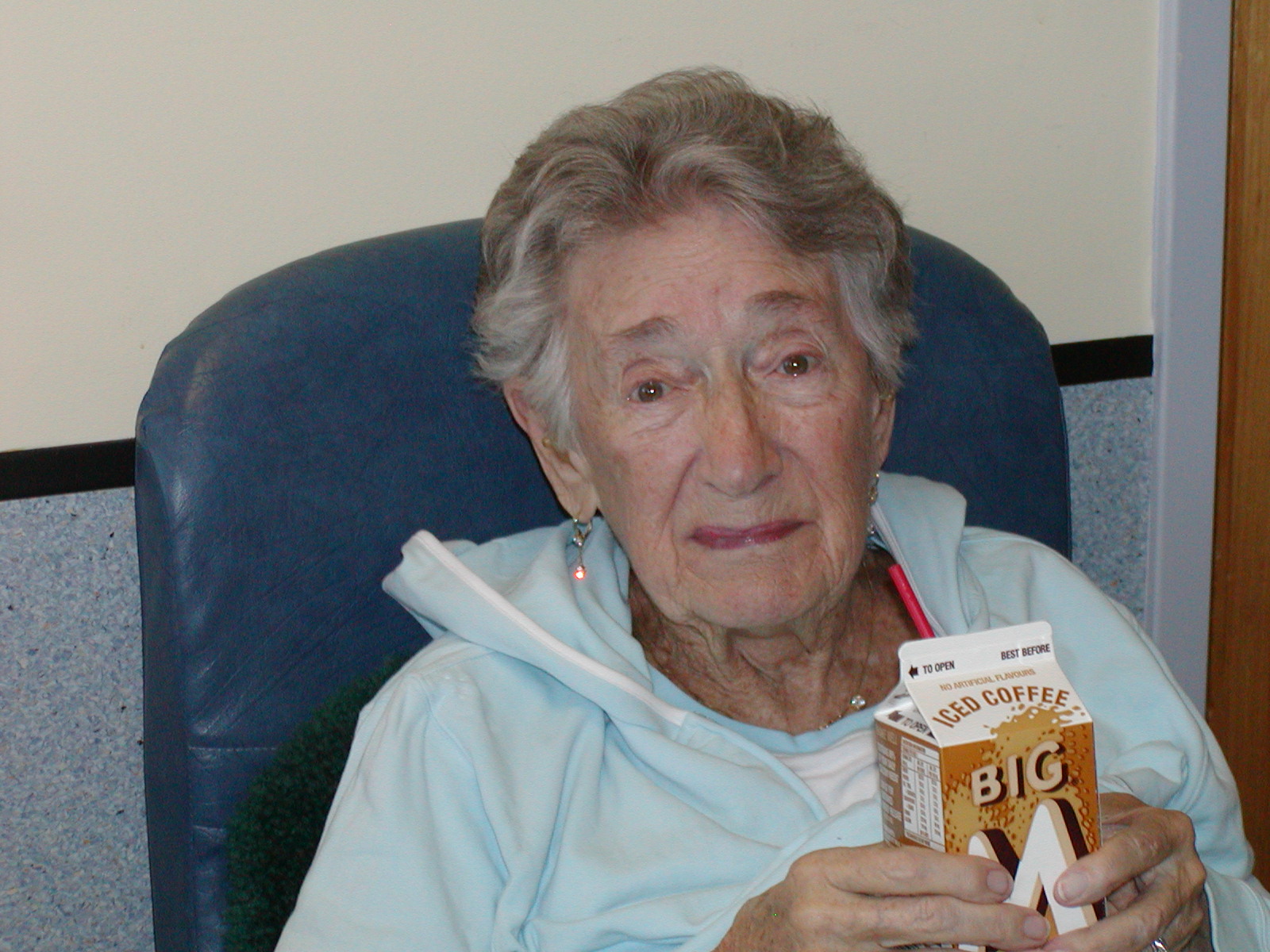
MumI am pretty sure my mother had an amygdala; every one of us does. If my friend Joe, who seems to know his amygdalas, is correct, Mum’s must have been smaller than most. He tells me the amygdala is the seat of fear in the brain.
Joe is a barrister. I remind him I am a doctor. “It’s fifty years since I last had need of any knowledge of the amygdala. How come you know about it?”
Joe says: “In my business it helps to keep up to date with neuroscience. Such things as the organ of fear can be important in court”. Which all makes sense for a criminal lawyer; but Joe does compensation cases only.

For a while I consider my mother. Then I describe her to Joe. Joe smiles. The more I speak of my mother the wider Joe’s smile.
“Mum lost her father to cancer when she was twelve. Then three years and one day later her mother died – “Mummy had rheumatic fever in her childhood. After Daddy went, she died of a broken heart.”
From the age of fifteen Mum and with her younger sister Doreen were raised by her widowed grandmother, “Gar”, a tender and enlightened and emancipated lady who taught her granddaughters to feel inferior to no-one on this earth. Nor superior, for that matter.

Mum failed her Intermediate Certificate, Year Ten in today’s language. She concluded she was a dunce (making no allowance for the effect on learning of the abrupt loss of a pair of parents) and left school. She attended secretarial college, worked as a bookkeeper, saved her salary and at the age of twenty set sail alone for Europe. The year was 1939. Her correspondence through that blithe passage via the Dutch East Indies into Western Europe is punctuated by increasingly urgent letters from Gar to hurry home: “There is going to be a war.”
Mum prepared for the war by sleeping on deck – “in case we were torpedoed” – on the last night at sea. Her ship made port in Fremantle on the day war was declared.

My parents raised us children in the country town of Leeton. Once a year we visited the great city of Melbourne where there were trams. Mum took me on a tram ride along Hawthorn Road, past the cemetery. “Mummy and Daddy are in there”, she remarked affably, indicating a long red brick wall. Behind the wall I glimpsed stone statues and crosses. Mum’s remark made no sense to me. ‘Mummy’ was on the tram with me and ‘Daddy’ was back home in Leeton. Mum explained: “It’s a cemetery. People who have died are buried there. That’s where my parents are.” Mum’s voice, warm with affection and remembered pleasure, sounded as it always did when she spoke of her mother and father. I heard no note of sadness. At seven years old I could only imagine losing parents as the absolute of perdition, of aloneness. A thought like the abyss. Mum seemed to think dying was a natural part of living; it happened but death didn’t spoil life. Not for Mum.

Mum told me once of a tram ride she took one night from Fitzroy Street to the home of her uncle (and co-guardian) in Beaconsfield Parade. “I was visiting a friend in St Kilda. I stayed later than I intended and I almost missed the last tram. I just caught it. In the morning I read in the paper that a young woman was murdered overnight at that same tram stop. She was killed some time soon after the last tram – my tram – left… Ever since I was fifteen I’ve known that people die. Last night just wasn’t my time.”

When we children were teenagers, now living in Melbourne, Mum sailed to Britain or Europe. She always stayed in the cheapest hotel, choosing the cheapest room that had private bathroom facilities. Invariably her accommodation was in some seedy district. One time she discovered she was staying in a brothel.”I was safely locked in my bedroom, when I heard a sound from the door. I looked up and I saw the door handle turning. Then the door that I’d locked opened. I sat quietly. No-one came in. The door closed and I heard footsteps walking away. Next day a man I didn’t know asked me to sleep with him. He couldn’t speak English but he showed quite clearly what he wanted in sign language. I couldn’t speak his language – which might have been Kurdish. But I showed him in sign language the answer was no.”
“How did you ‘show’ him?”
“I took out my photos of you four children. I told him your names and your ages. Your faces must have changed his mind.” I picture Mum recounting with delight details of her brood, regaling a puzzled predator with biography, smiling and brimming with goodwill in her natural belief that blood was thicker than semen. I think Mum’s sunny innocence would dent anyone’s carnal ardour.

Another trip, this one around the time of the Cuban missile crisis: mum decided to travel to Yugoslavia. Friends tried to talk her out of it, reminding her of the Cold War. Mum said, “I know it’s an Iron Curtain country, but I don’t think it’s very iron.” People in Tito’s concentration camp in the mountains probably felt both the iron and the cold. Mum, blessed in her innocence, did not sense the chill.

One week before her 92nd birthday, Mum lay in her bed in Cabrini Hospital and breathed. Breathing was a labour as Mum’s heart was failing. Between small gulps of oxygen Mum chatted cheerfully with me and Miriam, a neighbour. Suddenly she coughed. And coughed again and again. Wordless now, Mum at up straight and took great desperate gasps, one after another. Quickly Miriam excused herself and left. I turned up the oxygen flow and called a nurse, who raced in and injected some diuretic into Mum’s drip. Minutes later Mum was gulping comfortably again. She pulled off her oxygen mask and grinned: “Miriam and the nurse both thought I was going to croak, didn’t they?” – huge crooked grin now, now laughing – “Well, I didn’t!”
After that Mum and I talked seriously: I asked her if she had any late – possibly last – wishes. Day and night in the hospital she had her two living sons and her daughter and a tribe of grandchildren with her. Mum never wished for more than that.

Even the smallest amygdala will not save you when your heart is shot. Mum lived a few more days before falling asleep and dying without fear.

Toby’s Fingers Stuck in the Bath Hole

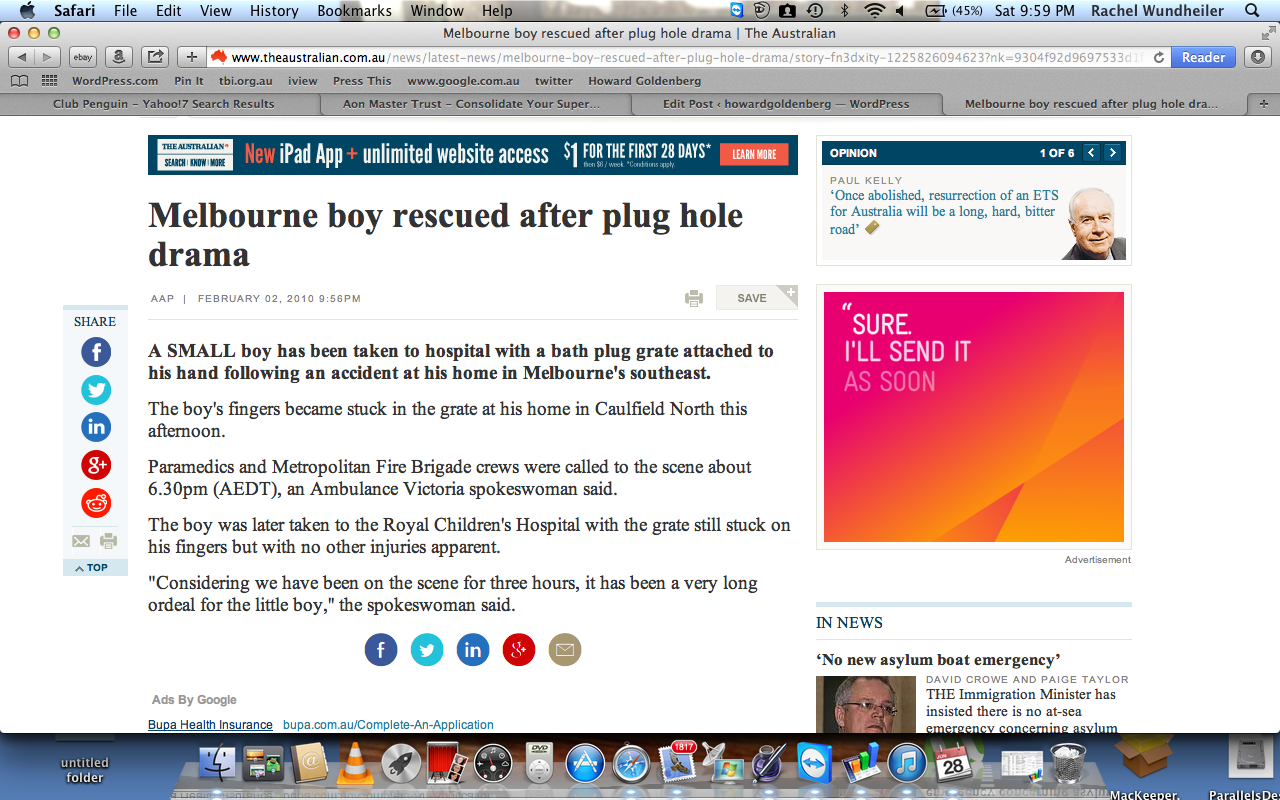
My wife Annette and I are having an early dinner when my phone rings. It is Rachel, our elder daughter: “No-one is hurt, everyone is OK, but I’ve called an ambulance: Toby’s fingers are stuck in the bath hole.”

I reckon I’m equal to this little challenge: ”Darling, just soap his fingers liberally then they’ll become slippery and he can just slip them out.”
“I’ve done that, Dad, and it didn’t work. I’m attending to Toby, but I need help with the other kids. Can you come over?”
“We’re on our way. We’ll be 15 minutes.”

In the car, Annette looks at her watch and calculates that Rachel’s brother, Raphael, will be driving home about now. He might get to Rachel’s before we do. She calls Raph and indeed he is only a minute away from Rachel’s house. He isn’t driving; he’s on his bike.

We drive into Rachel’s street which is blocked by two large fire trucks, a smaller fire car, two ambulances and a police car. There is no smoke and there are no signs of a motor accident.
We park at a distance and make our way on foot to Rachel’s house. Flung to one side on the grass is Raphael’s bicycle. Ahead of us the large torso and bum of a fire officer protrude from the bathroom window. The head and shoulders are out of view, presumably inside.
We make our way to the interior. A large man walks purposefully ahead of us, lugging a heavy timber box of plumber’s tools. From the narrow hallway an ambulance officer carries a plastic drink bottle into the bathroom. The bathroom itself is small. What with the toilet, the shower recess and the old-fashioned claw-foot bath, two is a crowd here. This evening the crowd is larger: the ambulance officer, a young lady, is leaning forward, passing the drink bottle to a male colleague who sits on the edge of the bath. The missing fireman’s face and shoulders are framed in the window, as he leans inward, observing and giving advice and instructions to another fire officer lying on the floor. This is another partial fireman, his face and arms invisible beneath the curve of the steel bathtub.
What he lacks in extremities and face he makes up for in length: this is a very tall fireman.
In the tub, drained of its bathwater, sits Rachel, her back to the door. On her lap is the skinny white body of Toby, aged five, a runt, a set of bones with a piping voice. One of his arms extends to the bath hole. His fingers are not seen.
The mother is reading a story to her child.

From the family room, children’s voices are calling: Toby’s twin, Miles, and their older brother, Jesse, have sighted us: “Saba! Savta! Toby is stuck. His fingers are stuck in the bath!
Look! Lollies! Raph is giving us a special treat.
The boys peel themselves from the arms of their uncle Raphael, who stands with his bare chest, wet with the sweat of his bike ride on this hot evening of 30 plus degrees.
Miles and Jesse pull at our clothing, dragging us to the bathroom, to see Toby and his missing fingers. They squeeze past the ambos, step onto the prostrate fireman and clamber into the bath. We follow them, secreting ourselves along the far wall and we greet Rachel. Raph stands behind us in the doorway.
Rachel smiles the smile that we’ve seen before, the smile that welcomes mere chaos that unseats tragedy.
Pasted over her fear, and threat and alarm, Rachel’s smile invites us to see and share the joke.
It is hot in the bathroom. Toby’s free hand wields a lollypop that disappears and reappears in and out of the recesses of his mouth. He cries out his greetings, his words emerging through a slop of saliva and lolly juice. He is having a pretty good time.

Rachel gives us a synopsis: “I called the ambulance and told them that Toby’s finger was stuck. These guys came and called the fire brigade. While I was on the phone, Toby’s free fingers were curled up and cramped, so he made them more comfortable by poking another couple into the plughole. Now there are three fingers that are stuck.
“The fire guys have all the right tools and equipment. They get fingers out of plug holes all the time. I didn’t know that bathplugs are a fireman’s specialty.”
The fire chief in the window frame elaborates: “Normally, a plughole is a ten-minute job. They’re all plastic nowadays. But this bath is a genuine antique, made of genuine steel. The plughole itself is probably made of toughened steel: it’s usually a disc about half an inch thick, with half a dozen circular holes, all of them just about the width of a toddler’s finger.
“The plan is to cut away the drain pipe. This will allow us to raise the bath from the floor, so that Steve can get right underneath and free Toby’s fingers from below. He’ll push up on Toby’s fingertips with his own finger.
If that fails, we’ll have to saw away the steel drain and free Toby from the tub, and then tackle the fingers.

“You and your family won’t be taking baths for a while, Rachel. This bath will be in pieces once we’ve finished here.”
I take a look at my watch. 7.45 pm. Toby has been in the bath for an hour and a half.
While we’ve been talking, the home phone has rung and rung out. My own mobile has rung unattended. Now Annette’s phone rings and it is Toby’s Aunty Naomi, calling from Sydney. She had called earlier, just when Rachel was racing between the stuck child and the other children and her urgent phone calls for help. Since that time, Naomi has learned sufficient to frighten, and nothing to comfort an aunt who has visions of fingers lost by strangulation or by nightmare surgery. Naomi has no children of her own yet and she loves her Melbourne nephews and niece with an intensity which increases with the distance.

Naomi asks to speak to Toby. “Toby, would you like me to sing Rainbow?”
Toby nods, his mouth occupied by his lollypop.
Rachel switches the phone to Speaker and says:
” Toby is busy with a lolly. He does want you to sing.”
Naomi’s voice floats into the bathroom.
“Somewhere, over the rainbow,
Way up high…”
The phrases float, spacious, into the bathroom, the words a familiar caress for the boys at their bedtime. Naomi’s singing voice is a sweet soprano, usually crystalline. Tonight the voice is thickened with an unfamiliar tremolo.
“ there’s a land that I heard of
Once, in a lullaby…”
Toby is transfixed. His brothers are still. Three lollypops are held, suspended, while Naomi sings.
All conversations stops. The lengthy plumber pulls his face out from under the steel belly of the tub. His face is wet with sweat. Bathroom lint clings to his chin and brow. He lifts his head and listens. The ambos and the fire chief stand, arrested. The voice rises, crests a high note and falls. The singing undoes us, soft family and hardy professionals alike.

A skinny woman appears. She is Laura, Rachel’s best friend. Alarmed by the emergency vehicles congregating outside, she races in: “What’s wrong? Is everyone alright? Can I bring food?”
She listens, looks, offers cuddles, kisses the air with her famous loud smacking sounds and leaves, disappointed not to be catering. Laura makes me laugh, always has.

The tall man pulls his head in again. The Chief hands us a hacksaw. We pass it to the tall man. We hear sounds of sawing, long metal screams.
Alarmed, Rachel wonders aloud about Toby’s fingers: are they safely out of the way of the singing blade? The Chief says: “Don’t worry. Steve knows just where to cut. He leaves a margin of pipe just shorter than his own index finger.”

At length the drainpipe is sawn through. Everyone gets out of the bath excepting for Toby and Rachel. Annette, Raphael and I make room so the bath can be lifted. Eight adult hands hoist the tub aloft. Toby squeals with delight as he levitates.
Steve’s voice comes from the floor: “Toby, can you wriggle your fingers?”
Rachel and the ambos relay the request. Toby says, explaining the obvious to the unintelligent, “I can’t. They are stuck.”
The voice from the floor warns Rachel that he is about to push Toby’s fingertips upwards from below. Steve pushes, Toby says “Ow! You are hurting me!”
Apologising, Steve has another try and Toby cries:”Stop it, you bumhead!”
Steve stops.
The Chief retires to the fire truck, returning with some new cutting equipment which he passes to Steve. Steve now sets about cutting free the metal disc with its six perforations and its three child fingers.
The Chief invites Jesse and Miles to come and inspect the fire truck. He shows them the hoses and the heavy brass fittings, then hoists them high into the cabin and places them onto the driver’s seat, beneath the steering wheel. In the massive truck they are very small.
The Chief points out the siren, the two-way radio, the switches that elevate the ladders and all the usual automotive controls. Two boys are in paradise. I remove them before they drive off in search of a fire.

Back in the bathroom, Toby is pacific once more. He sits in the tub in his mother’s arms watching a DVD. The ambos take turns holding the portable screen at the right distance for Toby’s comfort. The DVD is in a language foreign to the ambos and fire crew. It is “Bob Esponja”, Sponge Bob in Spanish.
Now his brothers clamour to watch too. Raphael and I take them outside and hoist them onto the window sill recently vacated by the fire chief.
All of this takes place well past the bedtime of such small boys as maintain a normal, detached relationship with their bathtubs.
The boys watch and translate for the ambulance man and lady, Ross and Joelle (‘call me Jodie’) respectively. It is a cultural treat for Ross and Joelle, who have only previously enjoyed Sponge Bob in English with respective nephews.

It is about 9.00PM when the plughole with its nubbin of pipe and its heavy perforate disc is freed from the tub. Sponge Bob has finished. Toby looks at his naked self and the empty tub. He says mildly: “I am ready to get out now.”
Rachel rises, her bum and thighs numb after three hours, cradling Toby and his massive steel bracelet as she does so.
Escorted by Joelle and Ross, they make their way to the kitchen. Here Annette has covered the kitchen table with towels and a pillow for Toby’s head.
Annette takes Miles and Jesse to their bedrooms. Their protests are audible from the kitchen.
Jesse appears in the kitchen. He says,”I can’t sleep. I’m too worried.”
Somehow Annette persuades him to come back to his room. She lies down alongside him and tries to help him relax.

Now the Chief produces a narrow strip of steel blade, about a foot long and an eighth of an inch wide. Its surface is roughened and irregular; it looks like steel with acne. The Chief explains: “Diamond saw. It’s the only thing that will cut through that steel.”

The Chief threads the stiff blade between Toby’s index finger and the inner edge of the steel annulus. The sharp edge of the blade is applied to the steel and moved up and down. It seeks a niche or crack to bite at hard, but the steel is obdurate and the blade bounces off it. The Chief tries again and again. He is relentless. Steel against steel, the Chief versus the disc.
An exquisite Argentine proverb of Toby’s father, Pablo, runs: con paciencia y con saliva, el elefante se cogio a la hormiga.*
Over the next long time, the Chief will need all the patience and saliva he can muster. He sneaks the blade between the hard steel and the soft boy. The blade makes glancing contact with the disc, leaving a fine scratch in the steel. Now the blade comes again, finds the line of scratching and attacks. The linear scratch deepens minutely. It is nothing like a fissure. Many more passes of blade, many minutes in which Rachel braces Toby’s hand against movement. Rachel searches the face of the Chief. Is he discouraged? He is not. He is the elephant seducing the ant. He presses on.
The room heats up, the disc heats up and Toby protests. Now Jodie produces a green gadget and shows Toby. It looks like a fat whistle. “You put this in your mouth, Toby, and you breathe in. Then your hand will feel good again.”
Toby takes the toy, breathes in and out, relaxes and smiles. He likes his inhaled narcotic.
More laborious sawing, more minutes pass, many single tedious minutes, dragging themselves into hours. The disc is hot, the Chief is resolute, the ambos take turns positioning Toby’s wrist and the Toby rescue industry hums on. Eventually – it is around 10.00pm – Toby becomes fractious. He addresses Jody, the wrist-bearer of the moment. “Put my hand down.”
Jody explains: ”We have to hold it up high to get your fingers out, Toby. It won’t take long.”
Toby is not placated: “Stop it, bumhead!”
Bumhead’s offsider, Ross, gives Toby another suck of narcotic and he subsides.

A further half an hour passes, half an hour of sawing, story reading, perspiring and concentrating. The cluster around Toby and his still buoyant mother falls eventually into speechless reverie. Each person in her own thoughts, each concentrating on three thin fingers that remain pink and on a small boy’s face, pale now with medication and fatigue.

There is a bloke at the front gate who wants to talk to any member of the family. I am greeted by a shortish man with a warm smile and a huge camera. He’s from one of the TV stations. He apologises for his intrusion, he hopes he is not causing distress, would any member of the family be prepared to describe what is happening? I answer, “No.” The man accepts this gracefully and walks away.
I retrieve a phone call. It is Pablo, Toby’s aphoristic father. “Howardo, what’s happening? Is Toby OK? Should I come home?”
Pablo is up country, the indispensable leader of his team’s annual residential seminar. He is out of town but painfully in touch. It tears him in two.
“No, Pablo, Toby is safe and cheerful, his mum is cheerful and the house is full of fire people, ambulance people, family, friends and kibitzers. There’s no physical space for a mere father. OK?”
Pablo is OK, just. I am to ring back later with more news.
Back inside, Toby stirs, complains: “My hand feels uncomterful.” Jody confers with Ross, then turns to Rachel: ”We can’t give Toby any more of the painkiller in case it depresses his breathing. Any further doses need to be given in the Children’s Hospital, with anaesthetic and operating facilities.”

Rachel flows into action. She kisses her other boys goodnight, tells them that Toby will go to the hospital to get his fingers out and he’ll come home soon. She grabs Toby’s teddy bear, a couple of books and another DVD.
Toby says a warm goodnight to all the emergency people, not excluding bumheads.
Rachel wraps Toby in a rug, marches from the house into the open ambulance, concealing her son from the TV camera, and in a moment they are away.

I follow in my car. I work odd night shifts in the Emergency Department of that hospital. I might be useful in some way; I know people there.
By the time I arrive in Triage, Rachel and Toby are nowhere to be seen. The nurse in Triage seems to expect me. “Go into the Minor Procedures Room, Howard. They’re all in there.”

Indeed they “all” are. There are Jodie and Ross and a new fire team. Steve and the Chief and our previous team only do outpatients, it seems. The new bunch comes from another fire station and they do the inpatient jobs. There is a firelady and a fireman, both selected, surely, for their tenderness towards children. The fireman is as tall as Toby is minute. He looks at me, I look at him, Rachel looks at him. He says, “Hello Doctor Goldenberg. We met at your clinic. I married your patient, Robyn. Do you remember?” Indeed I do remember. He is Nick. Rachel is looking at him hard and long because he is so good looking.

Nick has no hand for me to shake because his are occupied with an intriguing apparatus, whose principles he at length will explain. The principles are alarming.
Meanwhile I meet Lucy, who is operating a portable DVD player for Toby, who sits in his mother’s embrace on an operating table. Toby grips his pale blue teddy bear as he always does – with one of its arms in his mouth. Every night that bear develops a soggy upper limb. The bear keeps Toby company through his hospital stay and then disappears, forever lost. Bearnapped, we suppose.
There is a nurse who is helping a doctor administer intravenous pain killers to Toby. The doctor smiles and greets me. We know each other. A quarter of a century ago, when he was a boy, I used to be his family doctor. Then he became my medical student. Nowadays, when I work at the Royal Children’s, I operate under his direction. He is the paediatric consultant on duty tonight. His name is Dominic.

Nick explains his gadget. It is a miniature example of the famed ‘Jaws of Life’ that road emergency crews use to disimpact a crushed motor vehicle from its trapped occupant. Nick’s gadget is a menacing midget of frightening power. It looks like a pair of dark steel pincers emerging from a cylindrical contrivance connected by strong piping to a device that couches like sin on the floor of the O.R. That floor dweller is a pump that forces air under enormous pressure to the pincers, coercing them apart.
Nick introduces the fine pincers into one of the unoccupied annuluses of Toby’s steel ring. He allows the pressure to build and build. The steel of the annulus resists the steel of the jaws. All our jaws are clamped hard, as we watch in dread the application of irresistible force to an object not amenable to persuasion. I close my eyes briefly against a vision of a sudden sundering of the steel bracelet or else an explosion underfoot of the compressor. The latter would destroy the fourteen limbs standing nearby on the floor; the former could shatter my daughter and my grandson.
I adopt the business-as-usual expression that one always deploys when one’s gamble with a patient’s health hangs upon the coin that one has set spinning, spinning, as it falls to earth.
With a discrete metallic sigh the annulus cracks and gapes. Firelady Lucy hands Nick a diamond–blade saw, which he wields now with a free-swinging action well away from Toby’s flesh. As the saw makes its remorseless way through the steel disc, Dominic inserts a shield for Toby’s finger.
Millimetre by millimetre the blade divides the inviolate steel. Sixteen eyes follow the progress of the blade, a remorseless icebreaker freeing the trapped one. The saw falls still, a fraction short of the shield. Now Nick applies a wrench to the opposing shores of the bay where Toby’s finger is marooned. Another steel sigh and the disc surrenders. Toby’s finger is free. Watching Aladdin and his magic, he pays no heed to our drama.
Two more fingers to go. Pincers, saw, wrench – all are deployed in unhurried speed. Nick frees Toby’s digits, tears gather at the edges of my eyes as Rachel kisses those finger tips.

Dominic examines the fingers minutely. He is checking for tissue damage. There is the small skin indentation one sees when a ring has been a little tight. The skin is pink.
Dominic tells Toby to wriggle his fingers. Toby does so, his expression of scornful surprise registering wonder at the obtuseness of the adult world.
Dominic wants to be certain that there has been no damage to nerves and blood vessels. After x-rays he will keep Toby and Rachel here, in an annexe, until the morning, “just to be sure”.
The morning is not many hours away. I kiss my grandson and I hold my daughter’s face in my hands and squeeze her beloved flesh. Then I drive home.
On the way to the car, I phone Annette and share the news. And I forget all about phoning Pablo and Naomi.
***

In the bath a few weeks later 7 year old Jesse has an idea: “Why don’t you see if you can get your fingers into the bath hole, Toby?”.


* Pablo translates: With patience and with saliva, the elephant fucked the ant.

Melbourne Boy Rescued After Plug Hole Drama
Melbourne Boy Rescued After Plug Hole Drama