Walking with my Father*, after all this Time

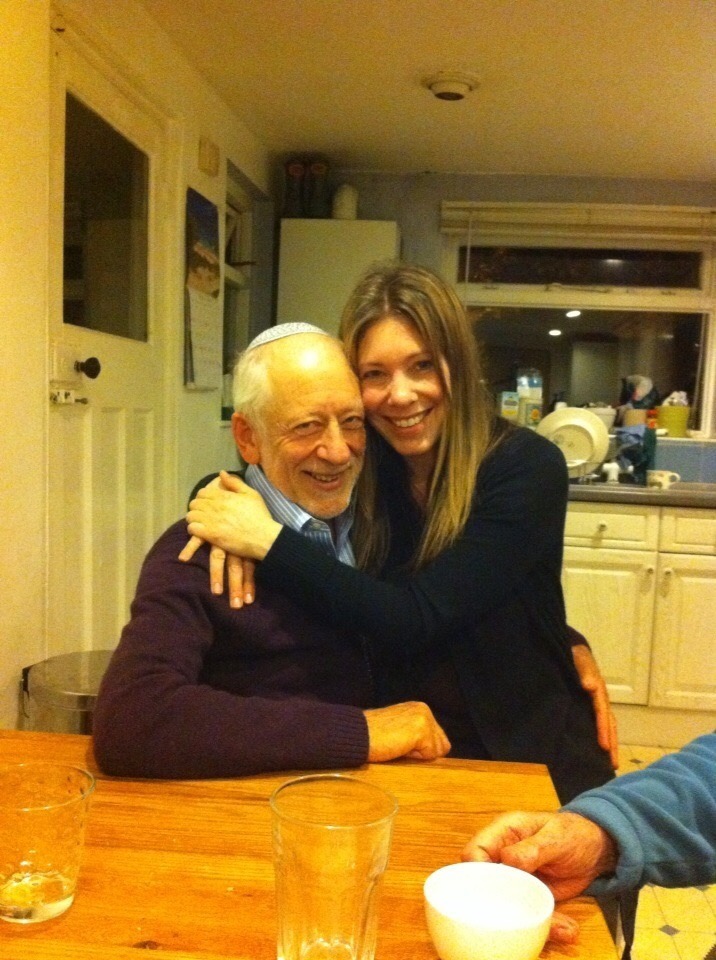
Most Saturdays I walk with my father. Saturday is shabbat, when I go to shule (synagogue) in the morning and walk home alone afterwards. It is this walk that I take with Dad. It works like this: services at the shule of my choice finish around noon-thirty – precisely the time my family will be gathering at home. No-one wants to risk coming between a Goldenberg and her food at meal time; too dangerous. So just a few moments before the congregation sings the concluding hymn, Adon Olam, I duck out of shule and hurry homeward.

 
When it comes to a prayer or a song a Goldenberg is not one to short-change his Maker. So, striding like my father before me, I sing that song as I walk, feeling anew the melody I sang with my father through our decades of shule-going together. In fact, Dad and I shared two different melodies to Adon Olam, one of them quite beautiful, the other even lovelier – or should I say – slower, sweeter, more expressive of longing. We loved them both, I love them still, and so I sing – first one of the two, then the second.
 
When I was a timid child I attached myself devoutly to the final lines of this song:
Into His hand, I entrust my soul
While I sleep and when I awaken;
And while ever my soul remains with me –
The Lord is with me – I will not fear.
 
But of course I did fear. First I feared the wolves and the bears that would come for me in my bedroom from the grim tales of Europe; later I felt afraid of snakes, of adults who shouted at me, of the world. I felt safe with Mum and with my dreadnought father, and – more perilously – with my risk-taking brother Dennis. I did a lot of fearing and I seized needily at the comforting closing line of Adon Olam. I’d sing it to myself when I walked alone in the dark.
 
***
 
Dad sang sweetly, his light tenor voice rising high above the circumambient baritone drone of fellow worshippers. He’d look intent as he sang, for music spoke to Dad more truly than words. Dad always claimed he didn’t like poetry, but he loved song. Music reached Dad in his secret places of abiding anxiety, it inspired him and carried his hopes, his love of life, his belief in beauty.
 
It was late in Dad’s life that he surprised me, speaking once of Adon Olam: Whenever in my life I’ve felt afraid, that last line has come to me. As a child I’d sing it to myself when I was walking alone in the dark.
 
Now a man walks home alone. Approaching threescore and ten he walks, still vigorously, as his father walked. He sings softly as he walks. Adon Olam swells in his throat. His voice slows to climb the penultimate arc of old melody, he holds that high note, then allows his voice to fall, to slide peacefully, into peace.

The man walks home alone but never alone.
 
· *’Walking with my Father’ was a chapter title in my first book, ‘My Father’s Compass’ (Hybrid, 2007). That memoir recorded my life with my father that had ended with death at a great age, a few years earlier. It was that book in which I first went public with my (possibly regressive) ancestor worship.

Of Chillis and Medicine

It was early in my medical career when I first encountered the diabolical burn of the chilli pepper.
A Greek man ferried, carried, hurried his screaming child down the driveway of our home to the side door that admitted patients to Dad’s consulting room. The child’s round cheeks were red, his eyes streamed, his left upper and lower eyelids were scarlet. The father’s distress equalled the child’s: grief and fear contended in his broken speech: Is doctor house? Too much paining! My son, he burn… Terrified – I was fourteen, and although self-apprenticed to Dad, I knew I was out of my depth – I opened the door and stammered over my retreating shoulder, Doctor will come soon, I’ll tell Mum. The man wept, rocked his child, rocked himself, his tears fell, mixing with his son’s.

Mum hurried and said kind, calming things. She fetched damp cloths and wiped the boy’s eyelids and his lips, swollen like plums. Afterwards Doctor did come, gave an injection and peace returned.
Mum explained, The boy thought the red chilli pepper was some sort of lolly. When it burned his lips he cried. Then he wiped his left eye with his chilli hand. He must have rubbed the right eye with the other.

All that happened a long time ago. I was reminded of it today as I peeled and chopped mango for a lime and mango fruit salad. I sucked a lot of mango pips, I slurped the juicy flesh from mango peelings. And my fingers and palms began to tingle. My lips tingled too. Soon tingle turned to burn. I looked at my fingers, all red and juicy and I remembered the day I prepared mango mousse for twelve. That day a dozen mangoes bled onto my lips and hands; and today my skin remembered. I had disregarded the warning at the end of the recipe to protect my skin with rubber gloves. The recipe closed with the words, both the mango and the chilli originate in Latin America. They are botanically close.
The word recipe is one a doctor uses with every prescription: the large R stands for the instruction to the compounding pharmacist, Recipe – please make up the following recipe. I did some doctoring today as well as some cooking. I claim to be a bold cook, not a good one. My family are bold eaters and candid critics of my cooking, just as they are of my healing. They will tell me after dinner what they think of my recipe.

The Seventh Day of Spring 

She slipped out of her mother into my palms on the seventh day of spring almost two score years ago. Small and slippery and vernix-spattered, with opalescent pink skin, she lay in my hands and opened her eyes and astonished me. Shortly afterwards her nine-month co-tenant peeked out, hesitated, retreated then plopped into a steel dish. The placenta lay in the dish, mute. The baby cried. She had fingers and toes and a belly and limbs and a face and girl bits and a mouth.

We took the baby home.
Seven is a mystical number, springtime a magical season. In a story I wrote about her I called her Pleasant Spring Goldenmountain. That name will serve for this story too.
Born of midget parents, she was tiny. The Pleasant One, being pocket sized and portable, was perfect for carrying and cuddling and tickling and flinging into the air and (generally) catching on the way down. She’d laugh and scream and I’d chuck her towards the ceiling time and again until once, gasping, she cried: ‘Stop! I’m not a toy, Dad.’ Chastened, I stopped.

  
The little one loved her father, attaching herself to him as if to a placenta. While she was still far too young to appreciate it the dad read ‘Great Expectations’ to little Springtime. She listened to the connection between Joe Gargery and Pip. She would say to her dad, ‘Ever the best of friends old chap. Ever the best of friends.’

  
Around the age of twelve her classmates shot up so much she had to crane her neck to talk with them. When her neck tired she’d address her friends’ belly buttons. A doctor friend recommended growth hormone injections. By this stage the Pleasant One knew her life’s mission: to mother early and often. She knew too that a short person’s small skeleton often had a small pelvis too narrow to allow a baby through. Some short mothers couldn’t give birth naturally. 
Every day for three years the Pleasant One injected her belly with the hormone and she grew. Her mandible grew wide enough to accommodate her teeth and her long bones flung her up to a towering five feet, two and a half inches, plenty big enough for babies. ‘I’m tall, Dad’, she said. And she stopped injecting.
Growing up in a family that lacked nothing other than fiscal discipline, Springtime would hear her parents groaning over the bills they had to pay. On weekends the child worked as a medical receptionist and saved her earnings. When she wanted new clothes she chose and paid for her own. Aged fifteen she decided she’d like a holiday in North Queensland. She worked and saved and paid for it herself. Aged sixteen she wanted to improve her French. She worked and saved and travelled to Paris where a man exposed himself to her outside the produce market. To improve her Hebrew she enrolled in a girls’ boarding school in Jerusalem for her summer holidays. Soon she could speak like the prophet Isaiah.

 
One day Springtime said something that made her older sister and her brother laugh. Her parents laughed too. ‘That’s funny, darling’, said her father. ‘I know Dad. I’m funny.’ ‘I’m funny too, darling’, said her dad. Springtime rolled her eyes like an epileptic. And laughed.
When she entered her early twenties Pleasant Springtime determined her father was not perfect. She told him so. From time to time, lest this slip her father’s imperfect mind, she repeated this information, adducing evidence. Her mother shared this surprising opinion and voiced it aloud. The two made a chorus and seemed to enjoy it.
Pleasant Springtime collected a couple of degrees, became a psychologist, gathering a bouquet of diplomas, coing to leadership of a large team of professional peers, some a good deal older than she. A number of fruitless connections came and passed before she met the good man I will call Running Bear. She married the bear and she bore him two infants, a Minor Prophet and a red gem.

  
And her Gargery father lived happily ever after.

Postscript: Twenty years after injecting herself full of Birth Canal Enlarging Hormone, Springtime elected to deliver her children by caesarean section.

Dinner with Some Old Teenagers

Word reached me, and when it came, it came obliquely. My writer friend in England, Hilary Custance Green, forwarded a letter that had reached her by way of one or another of the virtual media. ‘I wasn’t certain what to do with this,’ she wrote, ‘I thought it might be spam, but I decided to forward it, just in case.’ The writer of the letter asked Hilary if she could forward it to her old doctor. The letter bore strong feelings that had brewed and bubbled within the writer over years.
‘Dear Dr Goldenberg, I don’t know if you remember me but I remember you and I have wanted to contact you for a long time.’ There followed the remarkable declaration that my actions had saved the writer, now aged fifty-five, when she was a girl of seventeen. She owed her present happy life, she wrote, to my intervention, as well as the help of some others around that time. 

The letter, and the memories it evoked, thudded, jolted within me. Yes I did remember the girl, firstborn of three, trapped in a hell where her violent alcoholic father abused all in the home. I remember the face, fair skinned, the coronet of fair hair. And her brave, fugitive smile. 

I read on, and as I read the girl’s name came to me, a diminutive in the Australian way, never Anna but ‘Annie.’ Annie’s father was a helpless, hopeless drunk, and when drunk prone to unpredictable extremity. Annie would await his return from the pub with dread, hoping he’d keep away, hoping helplessly her mother and sisters would be safe. She’d have fled the family home long before but father had screamed and waved his gun at her. His words – ‘If you try to leave I’ll shoot you and the others and myself’ – shocked me. Uselessly, helplessly, I trembled for the child. The child confided she never brought a friend into that house, for fear of the shame. She told me these things, forty years ago, and I recognised a further shame, even deeper, Annie’s self-disgrace to be ashamed of her own father.    

In her letter Annie reminded me of the Saturday night she finally escaped. Father had drunk all that day and into the night. Annie sheltered in her bedroom but when father burst in she ran from him, wearing only her nightclothes. Father screamed behind her, ‘You’ll never come back into this house, girl!’ The girl walked through the early hours, avoiding exposed places. She found herself in the deep dark of a railway culvert and, terrified in that blackness she decided, ‘This is where I’ll have to sleep from now on.’
Annie wrote, ‘I walked to the clinic and laid down and waited there for you to arrive. You’d always been kind and understanding. I knew you worked the Sunday mornings. I didn’t have anywhere else. You took me in when you arrived and after work you drove me home so I could safely collect some clothes. Then you drove me to a refuge.’

Annie’s account of that last-first morning was only dimly familiar. I felt small stirrings of pride, and a tenderness for the girl in the nightdress. Much stronger was my shock as I realised I had not thought of her since the ‘rescue.’ Annie had disappeared from the days of those busy years. She had lived, thrived, suffered reverses, sought salvation, recovered, blossomed, become the assertive woman her mother could never be, married happily and raised children, good citizens, and now saw grandchildren. Forty years and no thought by her wonderful caring doctor. That child had come into her own and that doctor had reached his prime and passed it.
Perturbed, I wrote to Hilary to thank her for sending word, for her gift.
The word found me in the outback. I wrote to Annie, giving my phone number and told her I was anxious to speak to her. My phone rang as I rode my bike across the railway line. I dismounted and answered and the voice said it was Annie and for twenty minutes I listened to her narration of the events of a turbulent life. We agreed we’d meet after my return from the outback.
In the exchange of emails that followed a second voice entered, followed by a third, then a fourth. Later a fifth and a sixth made contact. The writers, all roughly contemporaries, had been my patients in their teenage years. Each bore a burden of recollection which pressed now to be discharged.

Three women, matrons now, waited for me at the restaurant. I opened the door to faces that shone. I saw three faces of girls in their teens. I stepped forward and found myself clasped. Lined faces kissed mine, ample bodies held me close.

We sat. The women said how young I looked, I said how good they looked. The past was with us, the past with its beauty and its horror. The past, reverberating with friendships I had forgotten and the three had remembered. 
How had I forgotten?
The waitress came, hovered, departed. Again she came and we promised we’d soon choose and order. It was not soon. Forty years here, twenty there, so much event, so much life. Babies – it turned out I had delivered them – were now adults, some even parents.  
The waitress returned. Jerked into the present we ordered.

Girls Numbers Two and Three are sisters. I asked after their parents, immigrants, older than me by ten years, proud people, beavers in the general community and within their own. Mum was alive, still vibrant – ‘and fat, like all of us!’ Shrieks of laughter. And Dad?

‘Dad’s fat too, and dementing. The grog; it’s Korsakov’s.’ The speaker is Number Two, now a nurse. In the care of their aging parents she’s the officer commanding Number Three and their brothers. 

Both Three and Two were married when I last knew them. They’d married matching buffoons, agreeable blokes when sober, not often sober, not often enough agreeable. Three spoke: ‘Even before we married I saw how my father in law treated his wife. He’d tell her she was stupid, shout at her to shut up when she spoke. One time I saw him belting into her – he was full as usual. I froze. We never saw that. Mum and Dad would drink a couple of gins after work but they never got nasty. Not like that.’ 

Memories returned to me of the mother in law. A tall trembling lady, her face pink and scarred, she’d address me in a soft trembly voice, describing symptoms I could never fathom, never cure. Now I understood.

‘It wasn’t too long before Robbie was getting aggressive like his Dad. He’d go to the pub after work, get full, drive home drunk. I had my first girl, then the second. I thought, “No. This isn’t what I want for them, not what I want them to see.“ I rang Robbie and I said, “Don’t hurry home you drunken bum. Your wife and your kids have split.”’ Peals of laughter from Three, far the widest at our table. ‘Did he ever hit you?’ – I wondered. ‘Lot’s of times, but I’d belt him too!’ More jolly mirth. Three sits opposite me, her great arms a gallery of art in brilliant reds. Finer tattoos crawl upward from her bodice, another spiders around her neck.

‘Weren’t you scared, leaving him?’

‘No.’ The thought is a stranger to Three. She stares at my unexpected question. ‘There was no future there. I got up, took my girls and went.’

Did I raise an eyebrow? I certainly wondered at her resolve, her clarity. Her fearlessness. ‘Yeah, money was tight. I got a job and I worked and I looked after my girls. They’re good. Their blokes are lovely. And the three of us, we’re very close. Like me and sis here.’ The two women looked at each other and smiled.

Two reminded me: ‘I was a mother at nineteen. Got married. You delivered my babies, Howard. I was in labour, terrified, not knowing anything. You got up on the bed beside me and stroked my back.’ Did I? Nowadays the Medical Board would caution me for this sort of thing. They’d require me to undergo Education.

Two continued: ’You know everything about us. You’ve seen all our vaginas!’ Careless in their merriment the girls showed none of the self-consciousness that saw me look down and blush. ‘I’m diabetic now,’ continued Two. ‘But I’m good. After I left my husband I worked as a nurse, you know, State Enrolled. When my kids were adult and near-adult my partner encouraged me. He said, “You’ve always wanted to study. Do it.” So I did. I studied nursing at Melbourne University. Boy that’s a gap – from Victoria Uni to Melbourne. But I did well…’

‘Got Distinctions’, Three’s voice was proud.

‘I did all of it on scholarships. I had to perform. They can take the scholarship away if you get bare passes. Now I’m specializing in Mental Health, in charge of the ward. I love it.’

Three told me how she too had always worked in health, in administration. She described without bitterness how, after eighteen years, her institution had managed her out of her job and into retirement. ‘Now I write poetry. I go to Creative Writing classes. And every Wednesday I post a poem on Facebook. Wednesday is the hump of the week. I call my readers, my “humpies.” Here’s this week’s poem’. Three handed me her phone where I read her tidy quatrains. The verses spoke in anticipation of this gathering, in praise of the poet’s doctor, his kindness, his understanding. Blushing again I came across a ‘Like’ in response. The author of the Like was Four, another ex-teenager whose family I’d been close to. Four wrote, ‘I remember how Dr Howard comforted me when Karen died.’ Another thump. 

I remembered Four, a striking girl with olive skin, tight black curls, a smile that made you feel like singing. I remembered Karen, Karen who was lost, that sparkling child. Karen was in the car that drove to the pub in the bush hamlet twenty kilometres distant from my country practice. The pub filled the young driver up with grog and watched him drive the carful of friends home. How many died when the car missed the bend? Four? Five? Karen was extinguished in that crash. I remember speaking afterwards with Four. Was she the only one I was trying to comfort? I think I was trying to comfort myself too. A year or so later another young driver killed himself driving home from the same pub. His passenger suffered a fractured neck, became quadriplegic. From that time until left I doctored the human wreckage. And my rage burned against that pub. I nursed a futile wish to close it down.
*** 
The girls spoke of the men in their present lives. Annie had formed a lasting union with Ian that prospers still. She showed me the album her family made for her fiftieth birthday. Here were Annie’s mum, Annie at fifteen, Annie’s own grown children, Annie with Ian. I saw a tall man, angular and strong-looking, with a craggy face. Two and Three spoke warmly of their own blokes. All three had known some duds but the ‘girls’ bore no hostility to the male race. When, at the conclusion of the evening, Ian turned up to drive Annie home he towered over me. My not-small hand was lost in his handclasp. Instantly likable, solid as a wall, he smiled and I felt gladdened for Annie.

Two asked Annie: ‘Have you ever seen your father again?’ Quietly came the reply: ‘I always vowed I never would. Then four years ago he wrote to me, to all of us, Mum, my sisters. He said he was dying, in Mallacoota. His heart was failing, from the grog. He wanted to see us. Mum wouldn’t come, neither would my sisters. But I thought, “He can’t hurt me now.” So I went. He talked and he talked, poured out his side of our lives. He lay on the bed and asked me to lay by him and cuddle him.’ 
I looked at Annie, my eyes wide. 

‘I thought, “He can’t hurt me now. He’s old and he’s dying alone.” He’s got a partner but she’s not his blood. It’s not the same. I climbed up beside him and I held him. We laid there together for a good while. After a couple of days I went home. He died two weeks later.’

Adam the Original

 
Years ago I had the privilege of working in partnership with a Brownlow Medallist. Dr Donald Cordner was the scion of a family as distinguished for Medicine as for football. I learned many things from Donald: it was he who transformed me from a sluggard to a mechanism for perpetual motion. Like my father he personified a thirst for a meaningful life both within and without medicine. 

Donald captained the Melbourne Football Club in its fertile years of recurring premierships. Of the Medal he spoke seldom and little. I remember one datum: the Charles Brownlow Medal is awarded to the player voted by the umpires as the FAIREST and the best. Over the twenty years we worked together that described Donald Cordner: he was the best at everything he put hand or foot to; and he personified honour.


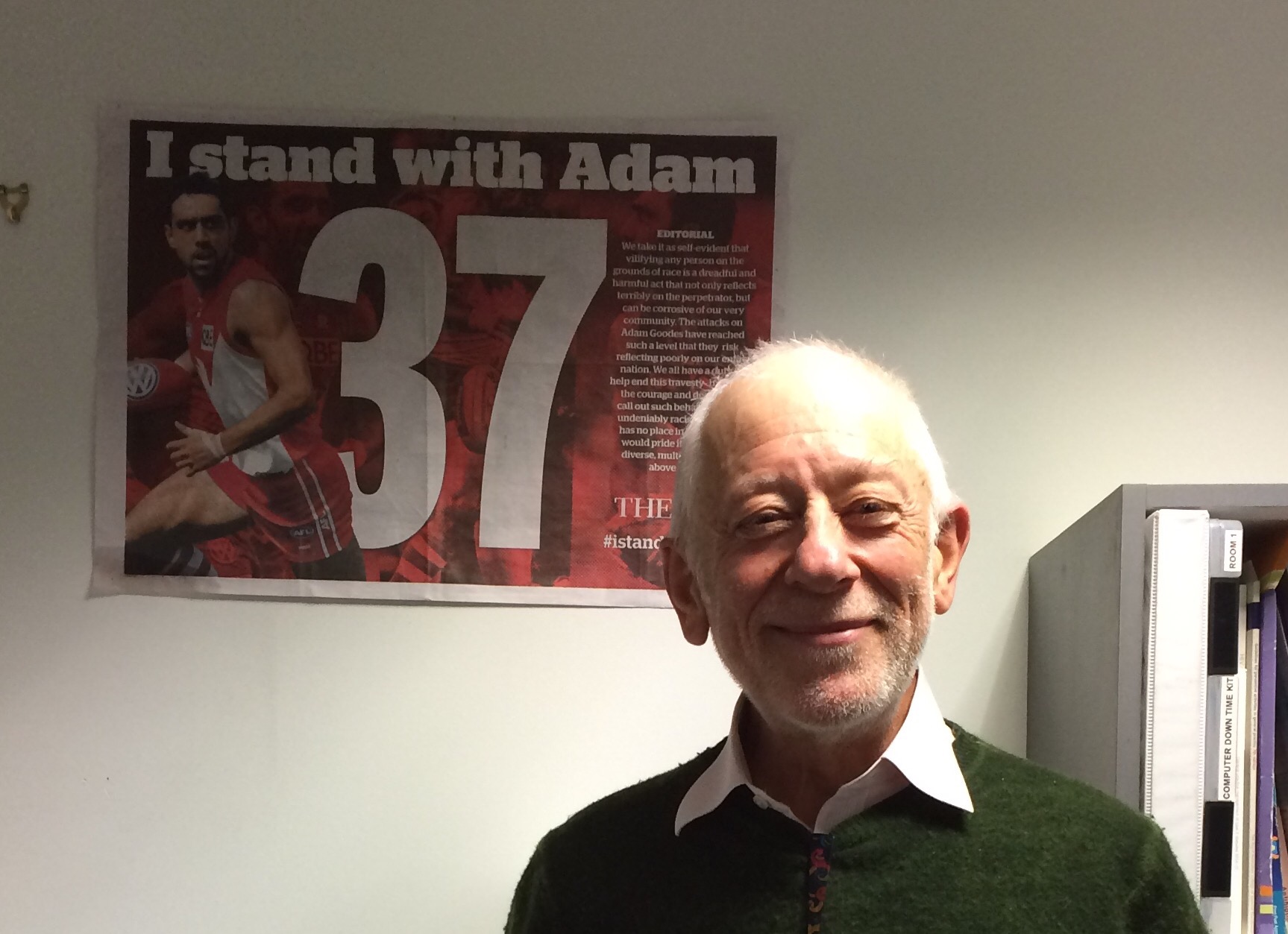
Like Donald, Adam Goodes captained his club. Like Donald he saw a role for himself in community service. Like Donald, Adam Goodes is a leader, a man of vision, of substance.


In 2003 we saw Adam receiving the first of his two Brownlow Medals. Although he shared the distinction that year with two other champions – one of whom captained the club of my own allegiance – it is the image of Goodes that lingers. More particularly the choice of his companion. Alone among the great young men, Adam brought his mother along, the sole parent who raised him and his siblings. Goodes’ mother contrasted with the other companions, generally blondes, frequently trophy females with cleavage.

Mrs Goodes looked what she is, an Aboriginal matron. Nothing fashionable – read, ‘mutable, evanescent’ – just his Mum, the woman Adam Goodes chose to raise to public honour.


When I looked at this man, this original, I saw one who stands for family, for loyalty,  one who knows his roots and is proud. Like his ethnically distinctive medallist forebears, Robert Dipierdimenico and Jim Stynes, Adam is Australia incarnate. He reminds us of our inextinguishably diverse makeup. That diversity, for most Australians, is our glory; for some an intolerable truth. When those persons boo Adam Goodes, they boo their community, they boo themselves.


Do You Have Children? 

She was the first patient in my day.
She was sent to this city in North Queensland by the foreign mining giant that employs her. 
I had never met her before. We introduced ourselves.
 She said: ‘I was woken by awful pain in my bladder. It’s an infection, I’ve had them before. I couldn’t sleep for the pain. It was four in the morning, but I got up and went out and walked the streets until I found a 7- eleven. I bought some Nurofen tablets for the pain.’
‘Did they help?’
‘A little.’
Her urinalysis was positive.
‘I think you’ll need an antibiotic. Antibiotics famously render the oral contraceptive pill inoperative. Maybe. So during this cycle you shouldn’t trust the pill… unless you want a baby.’
A smile and a shake of the head. The smile is not that smile that says, ‘Tread with care.’ She is a mature woman at peace with herself. Excepting for her hostile bladder. The smile licensed me:
‘Do you have children?’
‘No.’
Another smile as she sat and formulated a response to my silence.
‘I never thought I would. Now I realise I really have to decide – this month in fact. You see I’ll turn thirty-nine next month. I wouldn’t want to have a baby after forty.’
‘Why the late uncertainty?’
‘It hit me I might come to regret never experiencing that.’
 

She talked about childbearing and childraising, describing the contrasting experiences of her sisters. I agreed it was a momentous question. We talked about bladders and we parted.

 At home I asked myself how I’d describe my own experiences. I’d be unable to resist describing – at clear risk of malicious misinterpretation – the intense pleasures of bathing or changing soft bodies, the satiny skin, the small weightiness in arms or lap.
I thought about my feelings and the word that came was ‘intensity.’ Had she asked I might have said, ‘Becoming a parent deepened me. I believed I was tender towards children, but my firstborn taught me how I had tiptoed through mere shallows.’
I recalled an early piece of Martin Flanagan in the Melbourne ‘Age’. He described nursing his small daughter through a night of torrid fevers. From memory, I recall him writing, ‘I know I will never feel closer to this child than I have this night.’
I might have quoted an early patient who became an enduring friend. Her asthmatic sons struggled night after night for breath. She told me how she’d walked the floors, holding them, counting breaths, weighing ambulance against a dash in her own car.
Inevitably I was visited by verse.
I have walked and prayed for this young child an hour
And heard the sea-wind scream upon the tower,
And under the arches of the bridge, and scream
In the elms above the flooded stream….

(W B Yeats, ‘A Prayer for My Daughter’)

I might have described the common and uncommon thrill of feeling a newborn curling her fingers – by reflex – around the finger that I rest on her palm. I might have said, ‘The unearned trust of my child makes me know – as I have never known before – I am significant.
 

I might have said, ‘My children gave me a clarity that was visceral: I knew through them my task, the meaning of my being alive. I knew I would give my labour without question or measure or thought of recompense.

I could never have dreamed the reward that would follow – grandchildren. And of course, with grandchildren comes the renewal of mission, of labour, of redemption of my aging. Feeling anew that deep significance I stride towards my latter end with head high.’


Had she asked, that’s what I might have said. But of course we will not see each other again.
Postscript: But we did see each other again – the next morning. With her consent I read aloud the words you just read. I looked up. Her face was suffused, on her lips the widest smile, from her eyes a flow of tears.
She thanked me and in answer to my question she said, ‘Sure, you can publish that.’

Two Recipes for a Long Life

Recipe One
(Yvonne Mayer Goldenberg, 8 June, 1917- 7 June, 2009)

  
Eat only foods rich in butter and cream. Avoid any food that requires chewing, especially vegetables. (My mother was frightened by a vegetable as a child and never came near one again.)

Relax. Do not rush. Shun punctuality.

A lady who possesses the skill of changing a flat tyre should conceal such knowledge. ‘Why deprive some gentleman of the opportunity to behave chivalrously?’
(Mum believed in chivalry. As a child when instructed by her teacher to use the word ‘frugal’ in a sentence, Mum understood ‘frugal’ to mean one who saves. She wrote: ‘A lady was walking by the sea. A strong wind lifted her up and flung her into the waves. She could not swim. She saw a man on a white horse: “Frugal me! Frugal me!”, she cried. So the man leapt into the waves and frugalled her. And they lived happily ever after.’)

Rejoice in your kin; they are life’s benison to you. You will not have them forever. (Mum’s parents died in her childhood. Left with her younger sister in the care of her beloved grandmother, Mum cherished all her descendants with promiscuous undiscrimination.)

Smile. Nothing is so serious that it should furrow your brow – unless it hurt your little ones.

Talk to strangers, visit their countries. Walk the earth without fear. People are good.

Forgive your children their naughtiness. Indulge your adolescent children in their self-absorbtion. They owe you nothing; they give you all.

What you cannot cure you must endure – with a smile. (Mum’s hip was shattered in her twenties. For forty years she walked in pain, with a marked limp. She did not think to complain. Pain did not interest her. Likewise the disabling strokes she suffered in her last decades. ‘A stroke is boring’, she said.)

Decorate your life. Eat every day from your best china; use the good cutlery. (Which day will be better than today? Who better than the family to enjoy these things?)

Raise your boys to help. (‘Why should I be your kitchen slave? There is no pride in being a parasite.’)

Sex is good, sexual pleasure very good. Never boast of your conquests. Use a condom. (These last two dicta were delivered to her sons before the age of nine.)

Feminism is a mistaken impulse. (It arises from the absurd notion held by some that a woman could possibly be inferior to a man in any particular.)

Never open someone else’s mail.

Read. Meet new words. Look up every one in the dictionary. Read everything – the classics, the junk mail, the cornflakes packet.

Don’t fear death. Speak of it freely. (‘Death is a part of life, darling.’)

Do not fear harm. Fate is kind. Clothe your young in love but do not over-wrap them. Harm probably won’t befall them. Entrust them to the care of the universe.

Do not fear at all.

Recipe Two
(Myer Goldenberg, 5 December, 1909 – 10 September, 2003)

  
Fear everything. (Dad witnessed his friend die of electrocution when the stays of his yacht struck power lines. He operated on trauma patients without number. These events made him warn his children of the injuries that result from inattention or lack of care. One warning would never suffice. No number of warnings could suffice.)

Do everything. But take care. Sail, drive, use power tools. Never wave a knife around. Safety first. Safety last.

Fear nothing and no-one. No task is beyond you, no skill too hard to master, no knowledge beyond your reach, no person to be feared.

Eat vegetables. Overboil them first.

Be firm with children. Demand they meet your own high standards. Don’t coddle them in their minor ills. But if real harm come near, cross the country to protect or repair them.

Don’t let your children off lightly. But protect them ferociously from attack by an outsider.

Cherish your kin. Honour your parents. Honour your ancestry.

Honour your work.

Work hard. Keep going. Do not weaken.

Do not run marathons.

Be worthy. (Dad idolised his parents, particularly his father. Through his long life Dad wished always ‘to be worthy’. He meant worthy of his own father. Even in his eighties Dad fretted he was not worthy. I ached when I heard him speak so.)

Forgive. Never hold a grudge. Speak your anger then reconcile.

Never forget or forgive one who hurts your young.

Keep your words clean. Do not say ‘bum’, never say ‘bloody’. Forget ‘dick’. When you belt your thumb with a hammer, allow yourself ‘YOU BITCH!’

Exercise. Where you could drive, choose to walk. Walk fast. Your children can run to keep pace.

People are good. Life is good, health a blessing. Protect it with injections.

Do not fret about germs. They build resistance.

Breast feed. (‘They’re not just there to fill jumpers’).

Cuddle your children. Kiss them – the boys too. And not just in private.

Pass on your faith. Drill your young in ancient ritual and practice.

Tell the children Bible stories. Read those stories with passion and conviction. Pass on your heritage with love and pride.

Be proud. You are as good as anyone else. And no better.

Be authentic. Do not fear being different. Respect yourself and others will respect you.

Love your children. Succour them in your old age as you did lifelong when the need was real.

Show tenderness. A man can be soft and still be strong.

Tell the truth. Demand the truth. Nothing is more sacred than your word. Nothing nourishes better than trust.

Don’t arrive on time. Arrive early.

Never open someone else’s mail.

Work hard. Save for a rainy day. (Dad worked very hard. He practised medicine to the age for ninety-two and a half. To the end of his life he saved for a rainy day, never feeling the heavy rain upon him, never knowing the time had come to take shelter.)

Sing. Sing loudly. Sing with your children. Sing table hymns with your children on Shabbat; sing loudly in synagogue; sing sea shanties, sing nonsense songs. Opera is grand but Gilbert and Sullivan are brighter, more fun.

The compass needle on your boat flickers; at the poles the compass fails. Know your own True North. Follow it.

Embrace the sea. Sail, fish, and sing. Travel by boat at night, navigating by stars, chart and compass. Do not fear the sea. Never take it for granted.

Be vigilant. Experience the rapture of your mastery of an alien element.

Do not fear. Relax. Never relax your vigilance.

See the beauty, smell the ozone, relish this given world.

Thrill to the cresting wave, the heeling sailboat.

Surrender to the windless calm. Experience tranquillity.
Feel the caress of the sun, the bracing breeze. Both are good.

Give thanks. Be thankful.

Love your kin. Nourish them, work for them protect them, nurture them. Demand resilience.

Be brave. Be true.

When all is said remember the love.

And the Two Walked Together

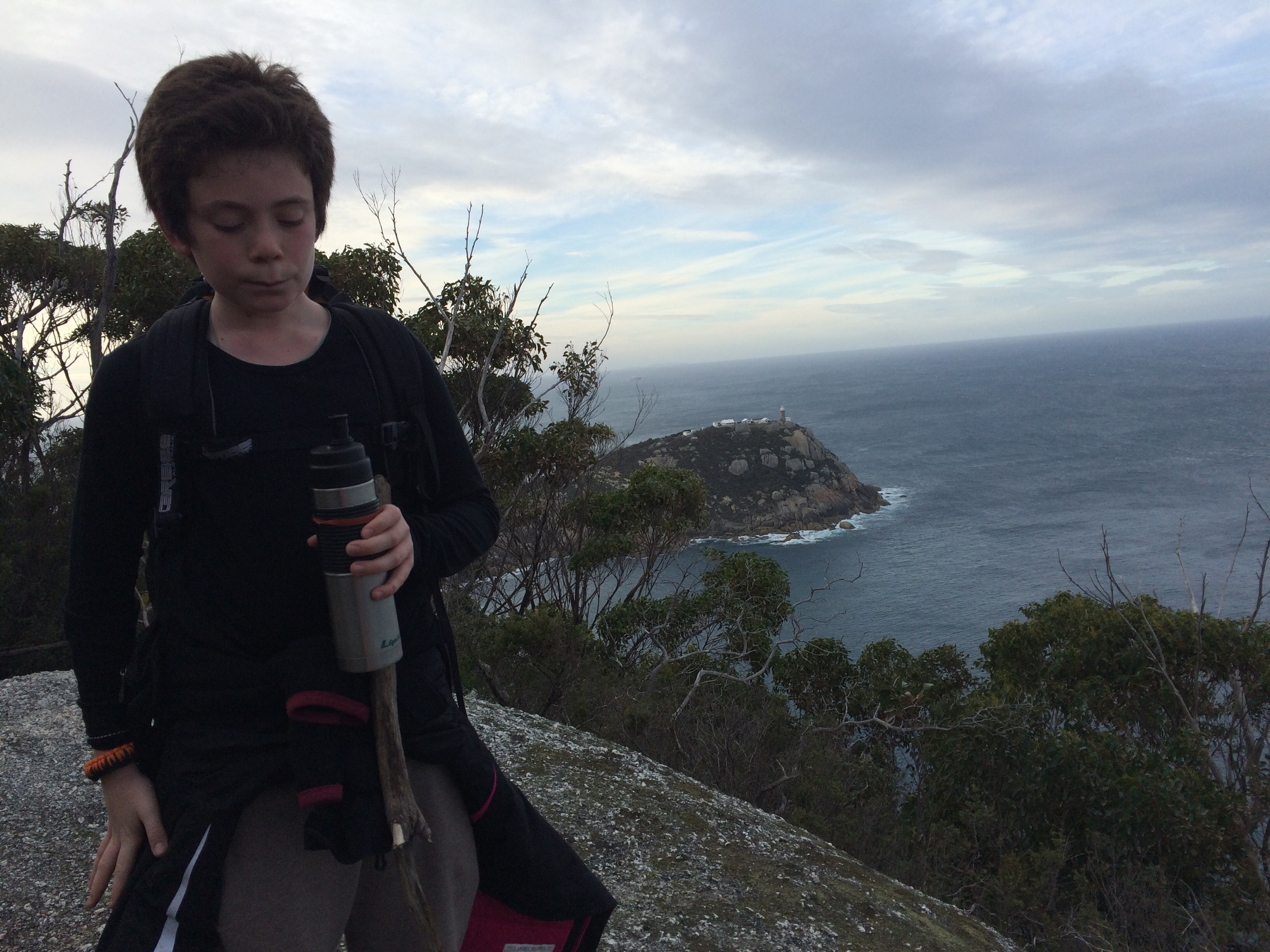
The boy emerged from the car and read the sign: LIGHTHOUSE 19 KILOMETRES. Beneath the sign were the words: Six Hours. The boy spoke, his voice small: ‘I’m nervous, Saba.’
The old man reassured the boy. They pulled on their weighty daypacks and started to walk from the turntable on the mountain. The dirt track was wide enough for a small truck. It sloped away beneath their feet and, despite the lowering sky and the fine wind-whipped rain, the two made good speed in good humour.

The old man said: ‘This is a long, long downhill slope; it will be uphill on the way back. Just when we are really tired we’ll have to fight these hills.’

They looked ahead into immensity. As the path led them lower the slopes towered green and steep before them. The old man saw they’d soon be climbing. The rain stopped and the two felt hot. They peeled off parkas and jumpers and mopped rain and sweat from their faces.

Rounding a sharp bend the boy exclaimed, ‘Look Saba! Look – how beautiful!’ The old man looked and what was beautiful for him was the joy on the boy’s face. ‘Surprised by joy’ – the words floated into the old man’s mind from some half-read snatch of old verse – ‘surprised’ – overcome – as in a surprise attack.‘ The boy’s face, red with exertion, glowed. The old man looked again; he saw no sign of care.


The descent ended in a strange plain of long grasses and thick green ferns between which the pale trunks of gums rose, twisted and charred, like writhing skeletons, reaching for the sky. ‘The bushfires must have raced through here’, said the old man, ‘See how there’s not a single living eucalypt. Just ghosts. And everything else so green.’ To himself, he added, ‘They look like humans whose prayers were not heard.’ The old man had dwelled much in suffering of late. All nature spoke to him of the pain of others.

The boy’s expression was opaque.

Not an hour into the walk the boy’s voice asked: ‘Would we be a quarter of the way there yet?’ The old man doubted it. He couldn’t really say. Mostly the boy walked beside him, now and then slipping behind. At these moments the old man slowed, he hoped, inconspicuously.

The boy’s breaths were loud. The old man announced: ‘Morning tea time’, and they stopped to drink. The old man asked, ‘Apricots?’ The boy took the dried fruits and ate appreciatively. They hoisted their packs again, the boy staggering a little before steadying. The old man took the drink bottle. It felt lighter in his hand. They walked. Between the sounds of footfalls a voice spoke: ’I love you Saba.’

The old man, for all his years, for all his words, could find no words better in reply. ‘I love you too, darling.’


After a time the flat road began to rise and twist. Ahead of them they saw stately ranks of black tree trunks, erect and slim, towering upward, their branches richly green. ‘Look’, said the old man, ‘Every tree has been burned but every one of them here has survived.’ Their eyes drank in the green life, the dense underburden. Walking between the giants the two felt the silence and it did not oppress them. Rather, wonder swept their eyes upward. In quietness they laboured up long hills, around bends that led to yet more hills, working hard but not feeling it as work.

A scream broke the silence. The boy hobbling, whimpered, ‘My foot! It kills!’ The old man took the boy’s pack. ‘Here’, he said, ‘Sit down.’ ‘I can’t Saba, my arse will get muddy.’ The old man saw a tear at the corner of the boy’s eye. He spread his waterproof on a bank, pulled the boy’s haunches backward and sat him down. ‘Saba, my foot doesn’t hurt when I’m just sitting here. But it killed before.’

The old man opened lunch, bagels he’d bought from Glicks at five that morning. The previous evening the boy ordered peanut butter and honey for his: ‘Fifty percent of each please Saba.’The old man made short work of his own bagel but the boy played with his, peanut butter and honey notwithstanding. Reckoning the child needed relief the old man removed the heavy items from the boy’s pack. Bookish like his grandfather, he’d packed a small library.

‘Do you think you can test that foot?’

The boy rose, hoisted his pack and stepped forward. He winced but said nothing. And the two walked together. At first the boy’s gait was diffident, but quickly he established a fluent step-wince-step rhythm. Rounding a sharp bend the boy cried out, once again in delight. A small wooden footbridge led them across a shallow stream. Green ferns dwarfed the boy, the water chattered and rippled, the air was still and cold. The boy glowed. He turned and spoke: ‘Thank you so much for taking me here Saba.’ In the richness of his feeling the old man felt again the poverty of his own words.


They climbed. The old man, remembering walking as a child with his father, described how hard it had been to keep pace. He said, ‘Every few paces I’d fall behind. I’d have to run to catch up. I think that’s what started my life as a runner. It’s what prepared me for running marathons.’ The boy replied, ‘That happens to me too, Saba.’

The old man, a package of memories, told the boy about the time he ran a marathon in Melbourne. ‘It was springtime, quite warm. The sun shone and warmed the asphalt. I could feel the heat through my shoe every time my foot hit the road. I realised I had worn the soles too thin. Actually I had trained hard here, at Wilson’s Promontory, on tracks like this. I had run fourteen kilometres, only one-third of the marathon distance. I anticipated feeling pain with every step of the remaining 28 kilometres. I felt full of gloom. Then I did something really brilliant: I talked to myself. I said, “Every time your foot hits the ground remember you have one les step to run. Every time your foot hurts it’s a reminder – you’re getting closer to the finish.” Guess what – after about ten metres I stopped noticing my foot altogether.’

They passed a sign that read: HALFWAY HUT. Unfortunately whatever ’halfway’ meant it did not refer to the lighthouse walk. They walked on a good while and the boy asked, ‘How much further do you reckon we have to walk, Saba?’

‘Maybe ten kilometres, perhaps a bit less.’

The boy absorbed this. He picked up a straightish stick, about 1.3 metres long and tested it. A few minutes later he discarded the stick, saying his foot wasn’t too bad now. He added, ‘I love you Saba.’ ‘I love you too, Mister Pie.’ (When he was a baby family members called him ‘Sweetie Pie.’ After twelve years the remnant was ‘Mister Pie’).


The two came to a fork and another sign. To the left, the sign read: VEHICLE TRACK 9.5KM.

To the right the sign read, WALKING TRACK 8.5KM. The old man recalled the briefing from the Ranger Staff, warning them off the walking track ’because it rained last night – could be soft underfoot.’ He chose the walking track, being the shorter and possibly the softer. ‘Maybe too soft, perhaps marshy or boggy.’ He misgave but he did not reveal his uncertainties to the child. The decision proved decisive. Time and again as they clambered over steeps, scrabbled on uneven footing, wound around sharp turns and twists, the boy exclaimed in delight and wonder. At every corner a vista, at every peak breathtaking verdure. And at every pause the song of falling waters. They panted and sweated and never stopped smiling.


The old man, marathon man, always prided himself on his doggedness on hills. But these slopes, so steep, so long, so numerous, for these he needed to dig deep. Head down, bending forward to bring the pack over his centre of gravity, the old man, ploughed dourly on; while the boy sailed ahead, never slowing, never weakening, not ever quailing at the next hill and the next that unfolded in unfeeling succession at summit after summit. The old man marvelled and rejoiced.


The walking track was no bog, simply a way up and into a southern Himalaya. Abruptly the climb ended in a series of steep declines. ‘I’m scared I’ll fall’, said the boy. The old man held the back of the boy’s pack and pulled gently backward at every descent, the traction a felt message that the old man would not allow a fall.


Around a bend and suddenly the dense bush ended at a wide cleared space. The walking track had rejoined the vehicular. A short walk brought them to a further sign announcing: NO THROUGH ROAD. Rising from their left a walking track led into bush. Leaning on some rocks three men in their late thirties sat eating dried fruit. One asked, ‘You heading for the lighthouse? It’s up that way.’ A thumb pointed backward over the speaker’s shoulder indicated the walking track. The three might have been planted in that spot, so comfortable was their seat on earth, so fixed and settled their attitude.


The old man asked, ‘Have you ever walked to the lighthouse?’ Heads nodded. The man with the thumb looked at his bag of currants and said, ‘It’s mainly downhill from here. All except the final three hundred metres, which are the steepest in the entire National Park.’ The boy pointed out a smaller notice behind the men: LIGHTHOUSE 3.2 KMS. He and the old man had been walking for four hours. With a relatively short descent ahead of them both understood they’d arrive in good time for the sunset and the start of the Sabbath. That knowing, not spoken aloud, relieved the worry, also unspoken, of walking in darkness and arriving to cold and dark.


 After a short climb the track truly did descend. Underfoot, leafmeal and twigfall covered the soft sand. ‘This sort of footing is my favourite’, said the old man, ‘It comforts your soles. My feet love it.’ At every bend gaps in the bush gave way to glimpses of sea. One gap, wider than others, gave onto a view to the east of a long climbing pathway of exposed rock. At the far end of the path the two saw a white structure, phallic in shape – the lighthouse! It looked beguilingly close.


The two pressed on, half racing now. They tumbled around a bend almost falling into the arms of a human who stood on a granite elevation, tall and slim, a statue. The statue had a young woman’s face, a woman’s voice: ‘Look there: Orca.’ She pointed over a shoulder at the sea. ‘Look carefully, you’ll see the water break as they near the surface. When you arrive at the lighthouse would you please tell the lodgekeeper; there’s a pod of four playing here.’

The water broke and mended itself, broke and settled. Was this whale action? The same small disturbances were seen in every direction the man and the boy looked. Hopeful then doubting, then self-doubting, they fixed eyes, solemn and reverent, upon the sea. The old man had seen whale in these waters in years past but this time he saw no purple-black bruising the surface. After a decent interval the two hastened on. They’d seen no Orca yet they tingled with the closeness of greatness.


A voice rose from the bustling shape of the boy. He spoke of self-doubt, of fears, of haunting thoughts of his own grave unworth. The old man, filled with quite opposite thoughts of the boy, listened. He ached for the boy. He wanted to say something useful. ‘I know those feelings, Mister Pie’, was all he managed. He wished he had some infusing strength such that if he but held the boy close, the child would grow and know his worth. The urge to seize the child, to crush doubt from him bodily, was strong. But the old man knew such truth is the daughter of time. A daughter not yet ready to be born.


 Meanwhile, simple exertion, the actions of fast walking seemed to make the child lighter as he gathered momentum. The words spoken, the hard thoughts disappeared in air, leaving a small body busy and complete in its plunging passage through bushland.

The old man followed behind, carrying his pack, the boy’s books and the boy’s discharged cares.


A rock lay in their path, its northerly aspect coated in delicate mosses of brilliant green. The boy stopped to explain, ‘In the bush you can use mossy rocks as a guide, like a compass. The moss grows on the sunniest side. In our hemisphere that’s north.’


At one bend the lighthouse would appear only to disappear at the next as they corkscrewed their way down to sea level.  

Now a right angle turn marked the last of the bush. They emerged to an exposed path of surpassing ugliness. Blocks of weathered and stained cement set end to end formed a series of plaques that rose and rose, ending three hundred metres further on at the Light. This, the old man recognised, must be the ‘worst climb’ mentioned by the currant muncher. He looked up. The boy had not paused. He’d opened a lead of twenty metres as he attacked the awful slope. The old man hurried after him but the gap did not close. Half way up the boy approached a welcoming bench, set at the path’s edge to relieve exhausted climbers. The boy ignored the bench and steamed past and the old man, shaking his head, followed. When he reached the top the boy was grinning, his face a fairground of many pleasures.


Before they set out the Ranger had estimated the walking time from carpark to lighthouse at six hours. The man and boy finished in under five and in plenty of time for sunset and the Sabbath.


The lodgekeeper welcomed them. He said, ‘We’re expecting eleven in your cottage tonight. You two are the first to arrive. We expected an old – pardon me, I mean older – man and a child. Amazing that you beat all those grownups, young feller. Congratulations! Your reward for arriving early is the room with the best view. See – there’s the Light just outside your window. You’re overlooking the ocean. You’ll see any whales without leaving your room.’


The room had high ceilings, bunk beds, large windows and plenty of room for two and their possessions. The ‘cottage’ was formerly a lightkeeper’s dwelling, large enough for his wife and their eight children. Outside the wintry gale blew up a four metre swell. Inside the cottage was snug and the showers were hot. Both man and boy stank of sweat. They peeled off their steaming clothes and showered. The boy headed off to the reading room where he met the incoming walkers, adults all, and held court. The first to arrive was the trio of dried-fruit eaters, blokes in their thirties, friends since their schooldays in the Blue Mountains, revisiting old haunts and shared pleasures. After them came a family of four, rich in geography and history, which encompassed Scotland, Southern Africa, Denmark and a touch of Jewishness. The sole female was the Dane. The boy introduced himself and she replied, ‘I’m Astrid.’ This name was new to the boy who remembered her as Asteroid. Following the arrival of that heavenly body from Denmark a lean schoolteacher in his early thirties turned up. He’d sighted the boy in the carpark before setting out. Admiringly he said, ‘You walked quicker than I did’.


Darkness fell, the windy world outside moaned and window frames rattled, while inside their room the man and the boy had lit the candles. The old man placed his hands on the boy’s head and slowly, as in a fugue, recited the old words of blessing of the child. Then the two sang the Sabbath Dedication before breaking bread and feasting on packeted food brought to piping in the microwave.


Afterwards the boy beat the old man at Scrabble, much to the admiration of the last two to arrive, a bushy-faced pair who materialised from the darkness, unfussed by their final hour of moonlit hiking.


The man and the boy slept eleven hours that night.


The next day – Saturday – was a true Sabbath, a day of rest. The boy accumulated a series of hurts – his back ached, his right sole was bruised, his left knee seized in spasm. When the lodgekeeper invited all guests into the lighthouse museum for a tour, all pains were put to the side, and soon – or sooner – forgotten. The boy asked most of the questions, good adult questions, as the lodgekeeper later confided. They spent the rest of the day and the evening in the heated common rooms, reading, playing Scrabble, chatting. It is fair to say the nine adult males found the sole female and the sole child the most memorable of the company.


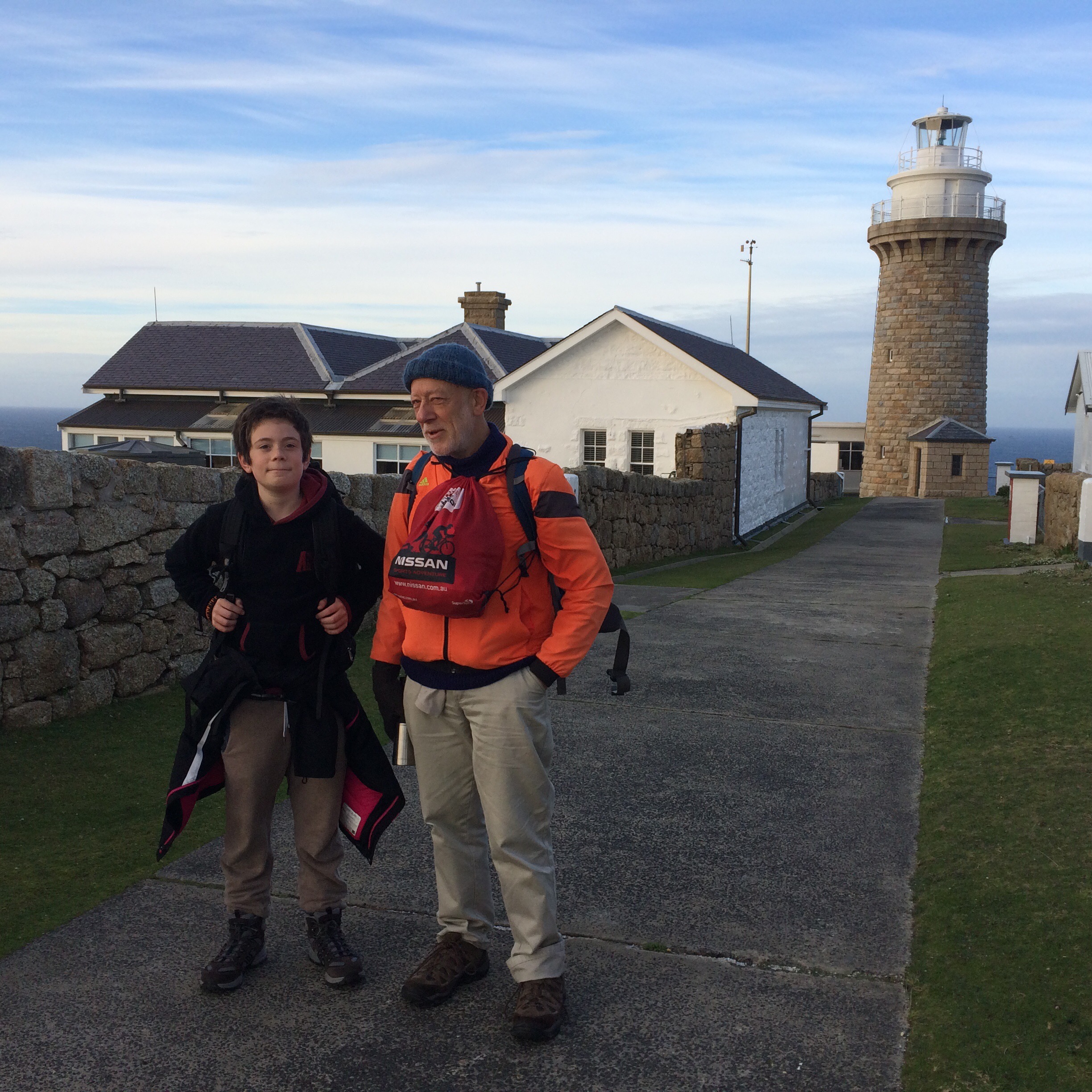
Early Sunday the boy revisited his wounds: his bruises padded with multiple bandaids, his knee now moving without pain, his stiff back tolerating a (lighter) pack, he said, ‘I should be able to walk.’ The old man said, ‘The stiffness and soreness will probably disappear once you warm up a bit.’ Before they left the lodgekeeper insisted on taking photos of child and man standing with the lighthouse in the background. ‘To prove to everyone you actually made it’, he said.


 The walk back was just as beautiful, just as long, just as tough as the walk out. After an hour the old man asked, ‘How’s your back, Mister Pie?’ ‘I haven’t been noticing, Saba.’ The boy greeted every new vista with delighted recognition. The top of every rise, each mossy stone, every leafy dell, every rugged prospect, he claimed them all as new old friends. He owned the track, his by conquest. Every so often the boy would turn to the old man in his train and repeat, ‘Isn’t this wonderful, Saba? Thank you so much for bringing me here!’

Over the hours of the return hike the boy never asked, ‘How far have we walked?’ Pressing hard on the hills, the boy asserted a sort of mastery: he had done this walk before, he’d do it again now. There was no doubting his ability.

Ahead of them rose the final four kilometres of unrelenting hills. Between the two and the hills a pair of colourful shapes moved in and out of focus. The boy said, ‘Asteroids. There’s a couple of asteroids ahead of us.’ Neither spoke it aloud but both decided they’d overtake the colourful figures ahead. It took them seventy minutes but they did so. The boy declined the old man’s suggestion of a break for lunch. A quick stop for drinks and fruit and upward and onward they went, again tacitly resolving they’d beat the asteroids to the carpark. As on the outward walk the boy attacked the closing uphills. Cruelly illusory, every late bend offered promise of an end. Time and again a tough slope led the eye upwards towards a seeming opening, as one would see at trail’s end. But time and again the boy ploughed on, leaving disappointment behind, his head down, breathing hard, with the old man following in his wake.


The sun found its way out of cloud, the greenery took on a lighter shade, the day gleamed. Sweat beaded the boy’s small face, the pink of his cheeks overlying a strange circumambient pallor. ‘Take a break, Mister Pie. Let’s drink.’ The boy took the bottle without words, sucked, passed it back and climbed wordlessly on.


One of the illusions of an end turned out to be the fact of the end. The boy strode into the clearing, staggering a little now on the flat asphalt. His grandfather went to take a snap to record the moment of triumph, but the boy, sickly pale, waved him away, gasping: ‘No photos, Saba.’


A little later, in the car, the boy said, ‘I’ll take my son on this walk one day – or my grandson.’

  

Concussed

The phone call comes at 3.30 on the last afternoon of term. An unfamiliar voice speaks: ‘I have your boy here. He came into the shop and collapsed.’
The woman’s voice is concerned, competent: ‘He wants to get back onto his bike and ride home but I won’t let him.’ The woman gives the address, a shop on busy Centre road, Bentleigh.
 
The mother of the child calls the boy’s father, cannot contact him, drives towards the place in Centre Road. The heavy Friday afternoon traffic races, stops, starts, unpredictably. The mother suppresses her urge to speed, shakes her head: ‘What if he’d collapsed in this traffic!’ Alone with her fear, she calls her father, doctor to the injured boy. She gives her father the bones of the story, adding: ‘He told the lady in the shop he was hit in the head earlier today. She says he’s talking but he’s not making sense. He couldn’t remember my number. Didn’t know the password to his phone. She rang the school and they put us in touch… I’ve nearly arrived. I’ll call again once I’m with him. ‘Bye.’
 
At 3.50 the doctor’s phone rings. His daughter’s voice, the boy’s, an unfamiliar woman’s voice, traffic sounds, snatches of conversation – ‘Dad, I’m with him now. He’s awake. He’s seeing double… Yes, thanks, in the back here. Sorry Dad, the lady who’s been looking after him is helping me get the bike into the car. He lost consciousness a couple of times. What does it mean that he’s seeing double? And he wants to vomit?’
 
Forty-eight hours earlier the doctor saw a boy in Resuscitation at the Royal Children’s Hospital. The boy had been hit by a car. He lay on a trolley, his body a gangle of bones, on his face a large bruise and the dopey smile of a child with no memory of the car that hit his head. The doctor-grandfather spends a lot of time with injured children in Emergency Departments. The doctor knows what double vision means, he knows what vomiting means. The grandfather in the doctor avoids the question, asking some of his own: ’Has he had a head injury?’
‘Yes Dad. A kid at school swung his locker door open and belted him in the head. He went to sick bay for an ice pack. After school he rode to the shops.’
The boy’s voice pipes, indistinctly, the phone set on speaker. ‘Saba, when I look at anything I see two of everything.’ The child slurs the words.
‘What part of your head did the locker hit, darling?’
‘What do you mean, Saba?’
‘Was it the front or the back or the side?’
‘Are you joking, Saba?’
‘No darling. What part of your head was it?’
‘Above my ear, a bit in front of it.’
 
Just in front of the ear, in the temporal region, runs a vulnerable artery which shelters behind skull bone thinner than elsewhere.
The doctor instructs his daughter to drive directly to Monash Medical Centre which is not far distant.
‘I don’t know the way, Dad.’ The father-grandfather-doctor is notorious for his lack of sense of direction. He directs the daughter, hoping. ‘I’ll call Emergency at Monash, darling, so they’ll expect you… Take a book with you. You’ll be there for hours.’
‘Dad, he’s just vomited. Now he’s falling asleep. Does that matter? Do I need to keep him wake?’
‘Try to keep him talking, darling.’
The grandfather speaks to the child: ‘Darling you’ll go into the hospital and they’ll look after you until you’re better. Then they’ll let you go home. You probably won’t be staying in the hospital.’
‘Saba, what will happen to me?’ The voice quavering:’ Will I be alright?’
‘Dad, where will I park?’
‘Drive straight to “Ambulances Only”. At the moment you are an ambulance.’
 
At 4.10 the doctor calls Monash, asks to be connected to the Consultant in Emergency. A young voice, informal: ‘Emergency, Preeti speaking.’
‘Hello Preeti, I’m sending you a child with concussion. I’m his GP. Are you the consultant?’
‘Yes.’
The doctor briefs the young voice. She listens, asks a couple of questions, says, ‘Thank you. We’ll be expecting him.’
‘Thank you, Preeti. I’m quite concerned… He’s my grandson.’
 
When the doctor’s phone rings the time is 4.40. It rings as he’s hurrying to the toilet to pee, the third time in twenty minutes. He stands still, commands his bladder to wait.
‘Dad, I dropped him and they took him straight in. Doctor Preeti was waiting. I’ve just come back, I had to move the car. My phone’s about to die.’
‘Darling, Shabbat is about to start. But I’ll answer the phone if you ring. Someone will lend you a phone. If you need me, call me, even though it’s Shabbat.’
‘’Bye, Daddy. I love you.’
 
The old man puts the finishing touches to his Shabbat table. His wife is away, visiting their Sydney daughter and Joel and Ruby.
He covers the loaves of challah, races to the bathroom, showers, dresses, recites the Afternoon Prayer, racing the setting sun. He finishes, checks the time, realises he’s just too late to light the Shabbat candles: he won’t make fire on the Sabbath. Ordinarily he won’t use the phone. During Shabbat he’ll allow the phone to ring, enjoying freedom from the i-tyrant, celebrating the sample of paradise that is the Sabbath. But tonight he’ll answer it.
 
Darkness falls. The old man recites his Evening Prayers, rich with poetry from the mystics of Safed and the Golden Period in Spain. The dying of the day, the passing of the workaday week, the beauty of the sung hymns, all these have always found him susceptible; since childhood the eve of Sabbath makes him prey to tender feeling.
 
He looks across at the table, set for two. He recites the She’ma Yisrael prayer, inserting, by old family custom, an improvised prayer. He prays: ‘ Heal the boy and all who love him.’
 
The old man sings the hymns, he welcomes the Ministering Angels, he praises his wife – “A woman of Valour, who can Find? Her Price is above Rubies” – then he sings the Kiddush dedication, drinks his grape juice, washes his hands and sits to break bread. Before him, chicken soup with noodles and kreplach, four salads, slow cooked lamb shanks, potatoes. He eats alone, wolfing the feast he prepared for two. His elder daughter won’t be finished at the hospital until very late.
 
The food is good. He’d made a great effort for this meal with his daughter. He eats and gives thanks. Afterwards he reads. He reads three newspapers then opens the political biography a friend gave him. Deprived of sleep as he always is by Friday, he doesn’t expect sleep will come quickly tonight.
 
At 8.00 the front door opens. His daughter enters and they embrace. The boy is well. He’s back home with his brothers and his father. Surprised by her early arrival, the doctor listens to his daughter: ‘Dad, they asked him questions, they checked his eyes and his pulse and his blood pressure again and again. They tested his balance. He improved and they let us go. They said once four hours had passed the danger was much less. They timed it from when he collapsed in the shop.’
 
While the mother speaks the father prepares a salad to replace the four he wolfed. The child-mother eats with relish. ‘I’m sorry I spoiled our meal, Dad.’
She toys with the lamb shanks that come cold to the table. ‘Dad, I can’t eat any more. It’s been a big day.’
Father and daughter look at each other. No words are spoken, none needed; each knows the content of the other’s mind. The father looks away, knowing without looking how his child’s lip trembles and her eyes fill.
 
A minute or two of quietness, then the daughter smiles: ‘By the time we were leaving ED his speech was perfectly clear. He was saying he wanted junk food. Then he said, “Let’s ring the kind lady in the shop and thank her.”’

A Message of Love Smuggled into a Suitcase

We live in a world in pain. In that world dark deeds, harsh words, inhumane policies are normal. God is conscripted and deformed in every form of violence. Truth is lost, our planet poisoned.
Seeing all this, hearing it, feeling it,a person might surrender and despair.
Then life sends a message.
This is the message that came to me today.

  
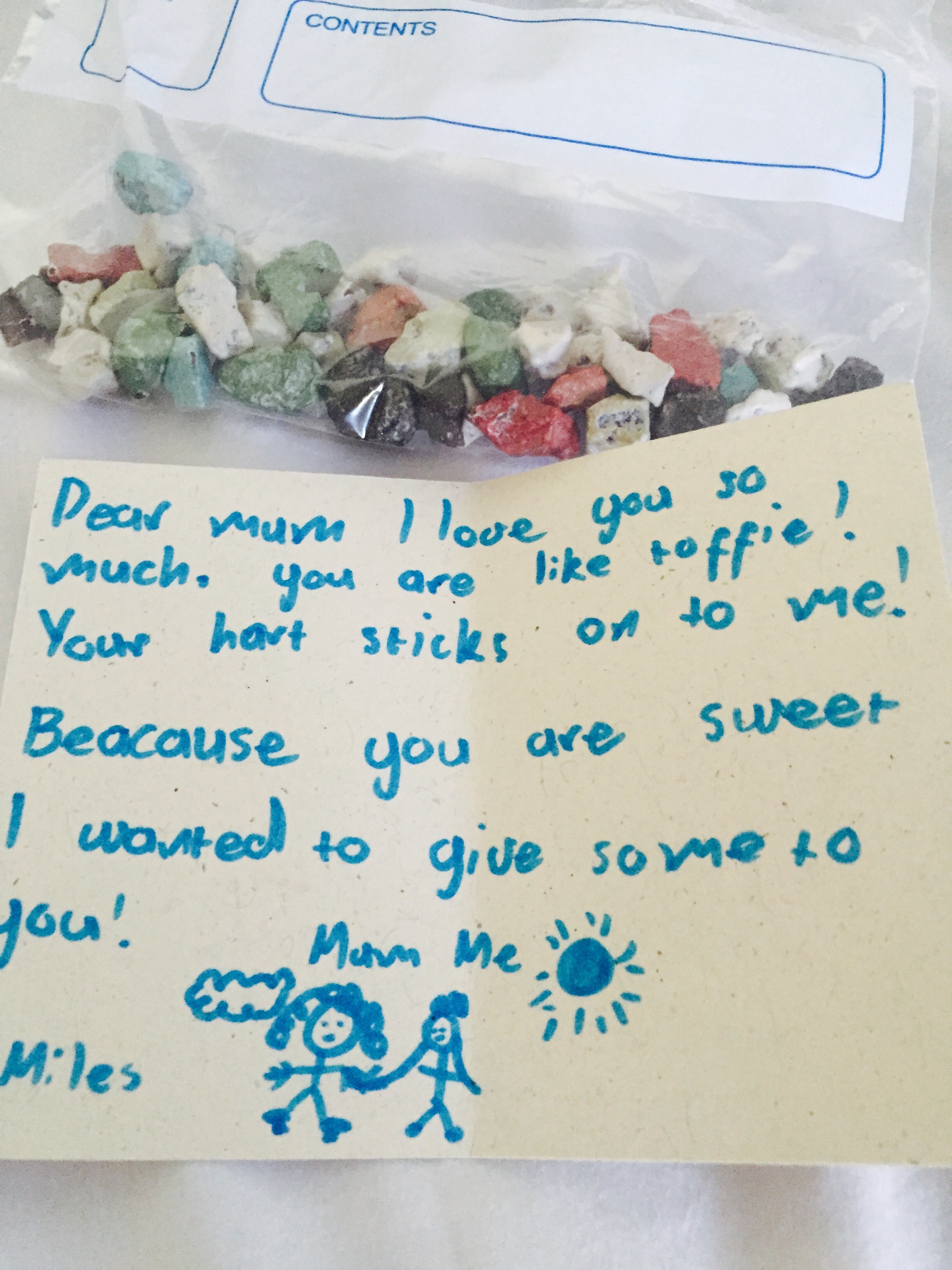
Miles spent two weeks pocket money on this gift for his mother.