Scavengers at Woolworths in a Remote Mining Town

By the time we disembark in the town we have travelled most of the day. The streets are a desert in the empty way of a Sunday afternoon in the country. We need to buy food supplies but all is quiet. Nothing moves. The air tastes hot. Breathing becomes an effort.

Up and down slow wide streets we prowl, looking for a supermarket. Hello! This is Woolworths. A cluster of cars baking in the carpark. Signs of life. Or recent life.
We tumble out, one grizzled grandfather, two ratty ten-year-old twins. Woolies is open! In the course of the following twenty minutes I load a trolley with fruit, vegetables, cheese, pasta, milk, yoghurt, confectionary bribes, cans of tuna, smoked salmon for the sybaritic grandsons.
The boys have disappeared. All other customers have disappeared. Someone turns off a lot of lights. I wrestle the trolley to the check-out where the twins lie face down, arms outstretched, fingers groping in the narrow cracks beneath the checkout counters, Their long curly hair wears a diadem of dust. Their once-clean shirts from long ago – this morning – are grimy. Their faces are coated in dirt. They wear expressions of intense concentration. When I call their names they do not respond. They pay no heed. Business as usual.
I pay a distracted-looking checkout person who asks me whether the boys are mine.

Technically they are not. But I admit to the connection. 

Checkout person says: ‘That money doesn’t belong to them.’

‘What money, I wonder?’
I call the boys and advise them I am about to leave, the store is about to close, and I will collect them at opening time tomorrow. If I remember.

The boys surface, faces aglow with dirt and triumph, their hands full of coins. ‘Look Saba! We found all this money under the checkouts.’

‘That money doesn’t belong to you’ – checkout person again.  

‘It doesn’t belong to you either’, says one cheeky voice.

‘Who does it belong to?’ – challenges another.

‘Woolworths!’

‘No it doesn’t.’ – two voices in chorus.

‘It can’t belong to the shop, Saba. The people paid the shop. The people dropped the coins. It’s not the shop’s money.’

‘Whose is it, do you think?’ – asks the grizzled grandfather, who isn’t really too clear on the legalities or the morals here.
The boys have an answer: they’ve spied a tin chained to the checkout counter. The tin has a slot for coins in its top.

The boys are busily feeding the coins into the tin, counting as they go. ‘Twenty two dollars and thirty-three cents, Saba! All for charity.’
The boys were unerring in their reading of the moral landscape: the label on the tin reads: HELP DISADVANTAGED CHILDREN.
 

Gap Years 

The friendly young man in the bookshop approves of my reading choice*: ‘Good book, I really enjoyed it. It was prescribed in my literature course last year.’He looks young, too young to be a uni graduate: ‘What was your course?’

‘School. I finished last year.’

‘What are you doing this year?’

‘Working here. Saving. I’m going to travel; I’m taking a gap year.’


Everyone takes a gap year nowadays. I never thought of it. No-one did back in 1963. I was keen to get on with becoming a doctor. I couldn’t see a gap and I would not have walked through it if I found one. Tempus was fugit, vita was brevis, gluteus was maximus, so I sat myself down and flogged my humanities brain over the sciences that were the stepping stones to doctoring. I never gave thought to my already clear history of stumbling through the sciences. I entered medical school, I studied the sciences and I stumbled on. If in later years I referred to my undistinguished undergraduate days, patients refused to believe it. They’d look at their trusted doctor and smile, knowing he must be joking; their peace of mind required he have no gaps.


I became a husband, I became a father, once, twice, thrice. I had four new people in my life to love, four more to work for. And I did work. A joyful and fulfilling part of my work was caring for women in pregnancy and childbirth. I became the intimate stranger, the guest at the birth of families. I’d be called to the hospital in the middle of the night, during dinner, at the kids’ bedtime, at quiet times alone with my wife. I’d leave home early in the mornings to visit the mother and her newborn in hospital. I’d leave before the children were awake. I left lacunae in our family, gaps where the dad was elsewhere when a daughter was sick, when our son had asthma, when our youngest cried at bedtime because a classmate at kinder teased her about the warts on her fingers. After twenty years I bade farewell, a long farewell to obstetrics, and hoped I’d mend the gaps.


The children grew, graduated, went to work, married, became parents. Became busy. Their time cramps them, crowds them in. The gaps that open in our children’s lives allow my wife and me in and enrich us.


The friendly young bookseller-bookreader will head off into his gap. He’ll travel towards his Ithaka and become rich with all he learns.


The truth is, life is full of gaps. As Leonard Cohen teaches us, that’s how the light gets in.


*Brenda Walker’s ‘Reading by Moonlight’. A gift for a friend with a couple of cancers.


The Tooth

In his last decade Dad and I drove every year to the Gippsland Lakes for a few days of sailing. Those lakes are plenished by rivers that flow down from the Great Dividing Range on their way to the sea. In the course of the drive of four hours we had time enough to evoke time remembered. Passing through the township of Trafalgar we’d sight the turnoff to Bruthen, a small town nestled high in those hills. Dad and I remembered Bruthen for our separate reasons, I for the Snowy River – mighty in verse, a miserable trickle in its reduced reality when I found it in 1968. Dad remembered Bruthen for the tooth.
 
‘I did a locum in Bruthen. It would have been 1935. I was a year or so out of medical school, wandering around the country, working in little towns – like you do, Howard.
I remember the drive up into the hills. I was driving a Sunderland. I remember that car for its unusual transmission: in those days manual transmission was all we had, but the Sunderland had something unique: you pre-selected a gear manually and it would change itself. Strange at first, unfamiliar, but just the thing as I wound up those hills and around those bends.’
 
Dad smiled as he remembered: ‘Bruthen was a one-doctor town. On my first day there a man came in with a toothache. His face was swollen and he pointed to his upper jaw on the right side. This was the 1930’s; we had no antibiotics the: the man needed a dentist. “Doc,” he said, “I’ve got a tooth for you to pull.”

(I pictured my Dad as I was at that stage – green, keen, torn between the need to be a proper locum tenens, literally, ‘holding the place’ of his absent Principal, while untrained for the task. Where I was timorous and trepid, Dad was fearless as an aspiring surgeon, aware of his solitary state – no colleague to consult, no training beyond seeking and accepting responsibility – and rising to the challenge. Dad would believe he could do the job and he must do so.)

Dad continued: ‘“I’m not a dentist. I can’t do that.”
“Why not, Doc? The regular doctor always pulls teeth.”
“I don’t have any instruments…”
“Yes you do, Doc. In the cupboard, up there.”

He pointed. Hoping he was incorrect I went to the cupboard. He was quite right. I found two pairs of steel dental forceps, half-familiar instruments, a bit sinister-looking.
“See, Doc? You use this pair for lower teeth, and this one for uppers. Mine’s an upper.”
The handles felt alright in my palm. Usable, not impossible…
“Doc, you know the trick to this tooth-pulling business? You have to push downwards to pull a lower tooth and you push upwards for an upper.”’
Dad said: ‘I didn’t know the trick.
The man pointed to the tooth. I applied the forceps, closed my palm, gripping the tooth hard, then I pushed up as the man advised. Nothing happened. I squeezed harder and pushed harder. A crunching sound then all resistance fell away. I looked down at the forceps: the tooth, a molar, sat beneath its roots, which were long and stout, like antlers on a stag.
“See, Doc? Nothing to it.”
The man fingered the cavity where his molar used to sit. He withdrew his finger, bloody and slippery with spit: “Wrong tooth, Doc. It’s this one.” He pointed again.
I said I was sorry: “You really need a dentist”, I said.
“No dentist in Bruthen, Doc. You do it.”
“Are you sure?”
“Yeah. You’re good at it. Go ahead.”
It was easier the second time. I looked down at the tooth feeling satisfied with myself.
“Good work, Doc!…but… it’s the wrong tooth.”
Feeling miserable I washed the forceps and placed them in the sterilizer.
The man said: ‘What are you doing, Doc? You haven’t finished.” He pointed to the next tooth along. 
“Are you sure this is the one?”
He was sure.
I removed that tooth like its predecessors. Like its predecessors it too was the “wrong one.”

‘We continued, tooth following tooth, until I had cleared all the upper teeth on the right side. Then we agreed to call a halt.’

On Turning Seventy


At some time on January 8, 1946, at St Andrews Hospital in East Melbourne, Yvonne Mayer Goldenberg (nee Coleman) gave birth to her second child, a son. The precise hour of the child’s birth is no longer known. St Andrews Hospital no longer exists and, sadly for this son, neither does Yvonne. Since the moment (unspecified) of his birth, that child has enjoyed an ambivalent relationship with Time. 

  
The temporal relationship was subjected to distorting stress even before the child was born. Although Myer Goldenberg delivered hundreds of other people’s babies every year in the Leeton District Hospital he determined his own children would be delivered by obstetric specialists in Melbourne. Two weeks before the second babe was due Myer drove Yvonne to Melbourne, dropped her at his parents’ house and returned to his patients in Leeton. Once Nature had taken its course he would return to meet the baby. Yvonne came into labour at night. Her father-in-law, Joseph Hyman Goldenberg, an excitable man and an erratic driver, bundled Yvonne into the car and raced towards East Melbourne. Joseph Hyman had no obstetric ambitions of his own: emphatically he did not wish to get down and bloody with Yvonne. He drove anxiously. In those days doctors erected a red light outside their medical premises to inform the passing trade. At every red light Joseph Hyman slowed to ask Yvonne, Should we stop here? Are you sure the baby is not coming? The pair passed from East St Kilda to Fitzroy Street, where red lights abounded: doctors were not the only practitioners with red lights. In this manner, slowing and accelerating by turns, the two proceeded to St Andrews where the child was born.


The parents named the child Adrian*. 


The baby was blessed with two distinct exemplars in the matter of Time. Myer Goldenberg was a stickler for punctuality. He tried to stickle his wife, but Mum wasn’t sticklish. So unpunctual was Mum, so indifferent to Time’s pursuit, Dad claimed:  Yvonne can’t tell the time. Mum’s riposte became famous: I can tell the time, I just don’t approve of it.


I took after Mum.


When I was nine years old I decided to become wealthy. Mum offered to pay me to shine shoes at one penny a shoe. Dad had about four pairs, Mum twice that number. I polished and I banked the proceeds. After shining two thousand, four hundred shoes I had accumulated ten pounds in my Commonwealth Bank account. I withdrew that sum and I bought a wristwatch. With that purchase I won my chance for mastery over Time.

I won it and I blew it.


School and life offered challenges, adult tasks, endless opportunity for a dysnumerate adolescent to strain his brain with numbers. Tomorrow always appealed. Later was better than now. Soon, Dad, soon.


After taking up middle distance running in my ‘teens I became interested in my pulse rate. I discovered my heart beat precisely sixty times a minute. I spent many lessons with my right index finger pulp resting over my left radial artery, counting the wrist minutes to the end of class.


My father had the impressive ability to awaken from sleep at a designated hour. He’d pack the boat at nine in the evening, we’d all climb into our bunks, and we’d sleep until the roar and throb of the marine engine told us Dad had awakened, as he’d planned, with the turn of the tide.  Such a skill seemed to me mystical. I know it now to be physiological, supported by a time-swollen prostate, the older man’s alarm clock.


Dad was always awake. I’d awaken and wonder why I had; or, more precisely, why now? And go back to sleep. I came to realise I could estimate the passing of time with remarkable accuracy. Let us say I heard the News on the ABC at seven AM and then went about my business through the day until mid-afternoon. I found I could stand still, rehearse the movements and actions of the intervening time, and calculate the hour. I’d say, I reckon it must be about four, or maybe a bit after. We’d hail someone wearing a watch who’d confirm it was five minutes after Four.


Curiously Time stalked me. I never chased it; it wasn’t particularly interesting to me. Now, at threescore years and ten I have discovered a new skill, equally unexpected: ask me when someone died, when someone else married or divorced or when she published her second-last book, I’ll declare, five or six years ago. Or, the Easter before last – and I’ll be right. Time has slipped through my hands. I never gripped it firmly but I have felt its mass, I can weigh it in my mind and give you the quantum of time that has passed.


Of course my time with Time is limited. The psalm I recite every shabbat reminds me: the days of our years are threescore and ten…I’ve had my threescore and ten. I’ve spent them and enjoyed them. I have seen much, I have loved many. Many are the books I have read, many the teachers who showed me their light. But what of my books unread, my books unwritten? What of the cracks in my world I was going to fix? What of the love I owe and never paid? Happily my psalm offers an extension: but with heroic effort, eighty years… 
At medical school I came across a novel and striking notion: senescence proceeds from birth, hand in hand with growth. The processes continue. Like a plucked fruit I ripen and I decay. In the house at night you can hear me snoring. In a coffee shop the other day I sipped my cappuccino while peeking at the attractive barrista. My thigh felt suddenly hot. I turned from the young woman and saw my cup held on its side, coffee streaming onto my flesh. I realised I have come to a stage where I can no longer perve and drink coffee at the same time. On the anniversary of my birth the grandchildren celebrated me. One wrote: Saba, I love you more than mangoes. Another, We will put you in a Home.
In Time there will be time ample for sleep. For now I sleep less, as if to waste no moment of the light. I hear less but I appear to miss little. Deafness is my censor, filtering out much noise, admitting much signal. I taste Time and it remains fresh and sweet. It passes, slipping away, slipping, like a breath. New times will follow and, like all times, they will pass into memory, after that into a memory of memory, and finally into forgetting. 
I can feel Time passing by weightlessly. Time as quantum wields no heft, bears no moment: somewhere I have a wristwatch, capable of measuring time. I have set it aside: I just don’t approve of it. 


*The parents named their new baby Adrian. Years later my mother showed me the notice she and my father placed in ‘The Murrumbidgee Irrigator’: Myer and Yvonne Goldenberg are pleased to announce the birth in Melbourne of their second son, Adrian.

Over the following ten days of her confinement, Yvonne received a stream of visitors, all of whom asked the name of the newborn, and all of whom vomited. Presently their friends Ben and Ethel visited, bringing with them their son, Howard. After the vomiting my father looked at my mother, my mother looked at my father, they both turned to Ben and Ethel, asked did they mind, and Adrian became Howard. Baby Adrian was not consulted.

Eat Your Weeties

‘Hello Toby, I’m Howard.’

‘Hi. I’m Toby’. A laugh: ‘I guess you knew that…’

Doctor and patient shake hands. The doctor takes in the young man with the ready self-laugh. Tall, thin, Ned Kelly beard. Laughing eyes, a vital face and something serious, a gravity lurking between the smiles.

‘I’ve got a Toby’, says the doctor, ‘Every family needs one. And one might be just about the limit – to judge by mine.’

The smiling eyes crinkle: ‘Well my family had two of us, in a manner of speaking. I got my name from my grandfather. That wasn’t his true name but everyone called him Toby on account of the mobile he had above his bed when he was small. He loved Weeties you see…’

The doctor doesn’t see.

‘My Grandpa loved the breakfast cereal so much they hung a mobile made from Uncle Toby’s* Weeties packets over his bed; and everyone always called him Toby. They named me after him. Or at least in memory of him.’

The Ned Kelly beard rises and falls, dances with Toby’s face, mobile, in the telling of his story.

The doctor: ‘Nice beard Toby.’

‘Glad you like it, Doctor, but today’s it’s last day. Tomorrow I shave it off – to raise money – for cancer. And that’s really why I’ve come: I need you to check my wound.’

The man pulls up his shirt, exposing a circle of blood in the centre of a depression just to the right and below his belly button. The doctor indicates the couch. Toby lies down as he explains: ‘They’ve just closed off my colostomy, about six weeks ago. They said I wouldn’t need dressings after six weeks, but I should have the GP check on it. What do you think?’

The doctor thinks it looks like a fresh bullet wound, this dimpled circle of bright dried blood. He has a gentle poke around Toby’s belly: nothing inflamed, healing progressing well…so far as the doctor can tell. He doesn’t deal often with colostomies freshly closed. He looks up, his face a question.

‘Eleven month ago I had rectal cancer. They took out the lower bowel and I passed waste through that hole in my belly.’

‘And now you have the standard plumbing, you use the opening at the back and it all works again?’

‘Like a champion, Doctor.’

‘How does a man of…’ the doctor checks Toby’s date of birth, does some sums: ’How does a twenty-five year old get cancer of the rectum?’

‘Eating bacon… so they reckon.’ A smile as Toby, standing again now, looks down at the doctor’s yarmulka: ‘You’d be pretty safe, Doc.’

‘What was the treatment, Toby? How was it?’

‘Chemo. Radiation.’ A grin. ‘The first chemo wasn’t too bad. Later it was rugged. They’d run it in through a drip over a week.’

The doctor pictures a man of twenty-five enduring that protracted chemical poisoning. For himself he’s always believed he’d accept death rather than the vomiting, the weekly cycles of wretchedness, the titration of benefit – the death of cancer cells – against the loss of weight, the loss of immunity, the vomiting, the vomiting, the vomiting. But as he looks at Toby he sees vitality, faith in living. He sees a man who’d embrace suffering and try to chase death away. The man would believe he’d be cured, like all of them.

‘And it worked. You’re cured?’

‘That’s what they reckon.’ Toby’s whiskers cannot hide his triumph, his delight.

Deeply the doctor too feels delight. And relief, like a cloud lifting, the cloud of many defeats.

‘Will you be able to have children, Toby? After the radiation.’

‘We’ll see. Every chance I will. Might make a new Toby.’

‘Anyway, Doc, the beard goes tomorrow. For charity. I don’t want to boast but I’ve raised seven thousand dollars in less than a week.’

The doctor has an idea, a question: ‘Toby, I write a blog. Would you like me to write your story? And publish it on the net?’

‘Terrific idea, doc.’ Serious now, the face contracts: ‘Tell my story. Use my name. Tell everyone. The address for donations is: gofundme.com/tobyshaveforcancer.’


That’s: http://gofundme.com/tobyshaveforcancer


* Uncle Tobys

From Wikipedia, the free encyclopedia

Uncle Tobys is an Australian brand of breakfast cereals and other breakfast food products. The brand has a lot of history and is mentioned in an 1892 newspaper. Their main manufacturing base is located in the small town of Wahgunyah, on the NSW / Victorian Border.

A Perfectly Routine Call

Woman injured, perhaps a fall,
A fracas? Who knows –
Perhaps a brawl?

Over the phone the nurse tells all:
Neck injuries…
She’s in a collar:
I call Flying Doctors: 
Eight thousand dollar.
 

I take notes: a punch to the mouth
And she fell;
Got a kicking to the head
And the belly as well
 

Her neck is tender
C2-3, where the cord is slender
She can feel, can move…
That doesn’t prove
We’ll mend her.
 

I take it all down, arrange the flight.
In afterthought,
I ought
Ask ‘Who? How?’ – at least:
It was a male. I called the police.
 

I take notes, recording in full
The news that’s not news,
That minds like mine 
Refuse
To take it in at all
 
Nurse gives name:
Like a punch to my mouth
Then a kicking,
Shame like flame
To burn my aorta –
 
The name – that ordinary name –
Is the same 
That we gave
Our newborn 
Daughter.

Long in the Tooth

To celebrate our wedding anniversary (tantrum warning; see footnote) my wife and I arranged to spend an intimate weekend in a sleepy coastal village an hour or two from Sydney. At our advanced stage of life our offspring seek to protect us from any reckless or imprudent intimacy, and so it was our Sydney family joined us in the seaside cottage.
Annette and I married forty-six years ago, when she was twenty years of age and I was twenty three. We were children, who did not know each other; in fact we did not know ourselves. 
I did some arithmetic recently and realised we have been married for 66.66*% of my life. Annette’s percentage is even higher. We thought the marriage a good idea at the time and I think it a good idea still.
After so many years it is delightful to make fresh discoveries of one’s bride. On Day One of our anniversary weekend I disturbed Annette in the bathroom after lunch. I saw she was brushing her teeth. I said, ‘I didn’t know you brushed your teeth after lunch. I thought I was the only person in the world who did that. If I had known I’d have spread toothpaste on your brush when I did mine.’

With her sweet mouth foaming dentrifice attractively , Annette replied, ‘I always brush after lunch.’

On Day Two I went to the bathroom to perform my midday oral toilet and found my toothbrush, freshly spread with toothpaste. 
From brusher, with love.   
FOOTNOTE: TANTRUM.
THIS IS OUR FORTY SIXTH ANNIVERSARY. IT IS NOT NOT NOT OUR ‘FORTY SIX YEAR ANNIVERSARY’. THERE IS NO SUCH THING. THERE CAN NEVER BE SUCH A THING AS A ‘ONE YEAR ANNIVERSARY’ OR (HEAVEN FORBID) A ‘HALF-YEAR ANNIVERSARY’ OR (SAINTS AND REBBES PRESERVE US) A THREE MONTH ANNIVERSARY’. WHY NOT?

BECAUSE ‘ANNIVERSARY’ MEANS ‘TURNING OF A YEAR’; HENCE FORTY SIX YEAR ANNIVERSARY IS A TAUTOLOGY AND AN OFFENCE AGAINST LOGIC AND MEANING.
END OF TANTRUM.

The Man said to the Woman

The man said to the woman, look how beautiful is the wide blue sea. The woman looked at the sea and saw what the man saw. She saw how the sea sparkled in the light of beginning. She saw its beauty and she knew this was what she wanted. She wanted to share it with the man. She felt something in her hand and when she looked she saw the man’s hand was holding hers. The two hands looked comfortable and strong together.
 

The woman said, yes, it’s very beautiful. It looks like it has no end.


The man said, we’ll need to build a boat. The man and the woman looked down and both saw how each hand held the other; how the hands were comfortable and strong together. The woman said, we can build this boat together and we can sail it together on this sea that has no end. And the man said, we’ll build our boat and we’ll care for it together and we’ll sail on the endless sea together and we’ll never stop.


The woman and the man understood it would take a long time to build a boat. They had long dreamed of the beautiful voyage that had no end. In their dreams their longing moved to their lips, and one murmured about the beautiful sea, and the other murmured about the voyage that has no ending, and the murmurs entered their sleeping ears and when they awoke they both knew they would build and sail together.


They knew too a boat must be safe and strong. They both knew that the beautiful sea could become fierce and dark and stormy. Their boat would have to be strong enough for great storms, for hot weather and for cold, for rain and for long dry times. Their boat would need high walls to keep out the sea, especially if children might come aboard.


The man and the woman worked hard and patiently. In childhood they had floated sticks in the rain that ran down the gutters into the great drains and they had pretended their sticks were sailing ships. But neither had never built a real boat before. They chose the good stout timbers of the kauri tree. They weathered the timbers and after one year the timbers were ready for shipbuilding. The man and the woman measured and sawed and glued and soon their timbers took the form of a boat. Then the man and the woman caulked the gaps between the timbers, and they daubed the inside with tar. Finally they painted the hull with marine varnish, and below the waterline they applied anti-fouling to stop barnacles from spoiling the stout kauri timbers.


The boat was ready to float. The man built a cabin to keep the sun and the rain and the wind from his crew; and the woman built bunks inside the cabin and a galley where food would be made for the crew.

The man and the woman slipped their boat into the water and they saw it floating and their faces shone like the sun that blazed upon the bright blue sea.


The final task was to create a crew. This took time and care. The crew arrived one at a time. They were very, very small. The woman placed each one gently onto a bunk that she had made. After a good many years the man and the woman had a full crew of small children, and the children knew no home other than their good safe boat and they grew there and became strong on the face of that shining sea. The woman looked at the crew, all hale and bronzed from the sun, and she said to the man, let’s set sail on our journey of no end.

The journey took them years. The children grew bigger and stronger. All of the children suffered falls and cuts and bruises and burned in the strong sun, but all of them healed. The man and the woman steered their boat away from storms and pirates, away from icebergs and reefs that might crash or tear their boat apart. Together the man and the woman and their crew visited islands and ports, from Mombasa to Saskatchewan. They saw volcanoes from Vesuvius to the great extinct Mount Erebus. They saw the great leviathan that leaped and blew, they loved the merry dolphins that escorted them, they knew the flying fishes and the jelly fishes, the octopus, the inky squid, the dinified seahorse. Their strong boat housed them and moved them and kept them afloat and the crew and the woman and the man knew their planet as they knew their boat, which was their world.


Sometimes a sudden tempest would arise. The children would cling to their bunks as the waves threw the craft high upon crests then plunged it deep into troughs, and the winds shrieked in the sheets and the rain fell in torrents that ran down the decking and into the sea. The children looked at the great waves of dark green and the foaming crests of white and their world was angry and unkind. Deep inside themselves they feared their boat would break and they’d all be lost. And they felt a mighty fear for the man and the woman who made their world and kept it afloat. The children wept but their cries could not be heard over the scream of the wind and the thunder of the skies. And the woman did not come and the man did not come and each child feared and cried and shivered alone.  


And as suddenly as the squall arose it would subside. The sun shone upon a gleaming world and the terrified crew came up from below and joined the man and the woman who commanded their boat. And in that sunshine the world was at peace, the craft sailed on and the crew recovered.


In every storm the children knew those fears. And in every storm they understood the man and the woman could not comfort them. But luckily, after a few frightening storms the children found their own way to feel safe. The biggest child opened his eyes just as the boat climbed up, up, up a mighty wave then down, down, down the far side, and he saw the smaller crew weeping through closed eyes, and he sang to them. And as he sang the smaller ones heard snatches of sweet sound, a lullaby, and they opened their eyes and saw the singer was their big brother and they managed to smile. From that time, when storms came the crew would all climb onto the big bunk where the man and the woman slept, and they would hold each other and sing or hum and all knew they were not alone.


After every storm the children came out and looked anxiously at their boat, but the boat looked sound and the children mostly lost their fears. But the eldest child worried: how much violence, how many storms could the boat sustain and survive?


The storms came more often and they went on longer. The howling winds and the crashing seas were slower to make peace, and the children clung to each other and sang and hummed as they trembled and tried not to show their fear.


From time to time the man and the woman would steer the craft to a port and put in for repairs. And the boat’s invisible tears and strains and cracks and leaks were glued and tarred and caulked, the barnacles were sanded off the kauri and the hull repainted as before. And the boat seemed safe and strong. And the crew and the man and the woman continued their voyage.


One day the crew awoke to a frightful storm. They heard roaring and screaming. It was the voice of the wind that screamed and the voice of the sea and the thunder that roared. And the boat shook and the small crew members saw cracks opening between the timbers and water pouring in. The biggest little crew man grabbed a bucket and the smaller crew grabbed cups and bowls from the galley and all the small people filled their cups and bowls and bucket with the sea water and threw it over the side. Each of the crew filled and bailed and threw the waters away, each of them sensing they had to be the one who would save the boat. But it was no use: the waters came up through the floor boards and up to their ankles, then their knees. Now the woman came below and the man came with her and they told the crew what they already feared. Perhaps they already knew. Perhaps the sea waters had told the young crew that their beloved boat could no longer take them on their journey safely.


The woman spoke kindly and the man spoke gently. The man said, we will always protect you and you will sail again in peaceful waters. The woman said, you will always be our crew even when we no longer sail this boat that was so beautiful. And as the two spoke gently and kindly, the children realised the screaming and the roaring had stopped. And the small ones thought, no, that’s not going to happen; this beautiful boat will be made better and we will all sail in it again. But the biggest crew child looked at the boards, all swollen and splintering, and he knew the boat would not sail again.


The boat did not sink straight away. The brave man and the sad woman steered it and sailed it to a safe place. The bow of the boat rested on dry land, and the man jumped ashore and the woman lifted the children from the broken boat and passed the crew, one by one, to the man who set them down on the shore. The smallest crew person wasn’t used to the feel of sand and grass underfoot, and started to cry. The other crew tried to comfort the smallest one, but they could not speak; their throats were full of a great ball of sadness, and when the man and the woman tried to cheer the sobbing child their throats blocked too. Suddenly all found voice and the voice they found was the voice of sadness and they wept together. And when at last they all finished weeping they looked one last time towards the boat they loved. But the boat had gone. Only a swirl on the surface of the sea marked where it had been.

The Delinquent Chromosome and the Marathon Runner 

Most of us have no intercourse with our forty-six chromosomes. They perform their work honourably in intracellular obscurity and we leave them alone. Not so for my friend Manny Karageorgiou: his Chromosomes Numbers 13 and 14 have conspired to mutate. This mutiny came to light late in 2013 when he broke a rib without trying. He simply breathed or coughed or heaved a carton and the rib quietly cracked.
 

What Manny has tried to do – what he has managed to do every year for 37 years – is to run the 42.195 kilometres of the Melbourne Marathon. Manny is one of a tiny and diminishing band of brothers to achieve this feat. This, their 38th year, they number only eight.


When Manny’s rib cracked he consulted his doctor. In their shared innocence, patient and doctor initially believed they were dealing with a painful area in Manny’s chest, a mere nuisance, an impediment to running: and Manny had a marathon to run. The Marathon would call him. Come October Manny would obey the call and run. Always the Melbourne Marathon, always and only Melbourne. Athens too, has called Manny. Deep in his Greek heart’s core he hears that call. He feels aeonic tremors, he hears echoes across time of Pheidipides at Marathon field. Manny feels, he hears and he yearns to join the runners in Athens; but year after year that marathon clashes with Melbourne’s.


Manny could not run both. Melbourne held him: captive of his love for the Melbourne, of his obligation to its history, of his loyalty to his old comrades, Manny stopped his ears to Athens in October, he turned his back on the Aegean and, busted rib and all, he ran Melbourne. That was last year. For a period of time between the fracturing of the rib and that Sunday in October, my colleagues filled Manny’s body with poisons – thalidomide, dexamethasone, bortezomib – in their attempts to put down the chromosomal mutiny. The short term for that poisoning is high-dose chemotherapy. 


When I wrote of Manny’s marathon in 2014, runners from around the world responded in awed respect of the man who’d run thirty-seven Melbournes, and who’d prepared and run it this time with a diseased rib and a poisoned body.


All that was in 2014. Since then Manny has undergone autologous haemopoietic stem-cell transplantation. The chemical savagery of this procedure – doctors have to poison every blood-producing cell in his body – can cure or kill. It did not kill Manny. But the mutiny grumbles on, bones everywhere are eroded, they await their moment of innocent impact or small tumble. One crack and a marathon runner will have run his last.


Manny’s haemato-oncologist, a compassionate and scholarly man, forbids running. He knows too well Manny’s disease. My guess is he has never run a marathon, is innocent of the joy, has never known the intensity of that blood-filled, tear-filled passage through space and time to self-realisation. For his part, Manny knows little about his proliferating mast cells, rogue daughters of his body’s revolution; he knows less of the osteoclasts punching holes in his bones; and nothing of the dysregulation of an oncogene translocated to his perfidious chromosome 14. But Manny knows enough. He understands the doctors do not speak of cure, he accepts the unending medication, he understands the risks of running. But he takes the occasional light run.


I haven’t asked Manny, ‘Do you run to live?’ I sense that the occasional light run is the answer that Manny’s mind or body drives him to. When Manny asks this family doctor, ‘Do you think I can run the marathon again this year?’ – the question I hear is: ‘Am I permitted to live before I die?’ And who am I – captive of my own marathon dreaming – to deny Manny? I decide I will run Melbourne at Manny’s side.


***


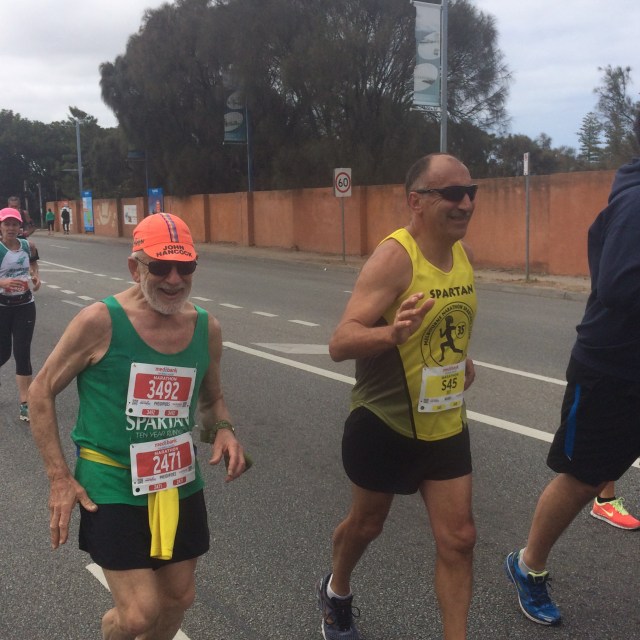
Lining up at the rear of the field of seven thousand dreamers before the Start, Manny implores me for the seven thousandth time: ‘Promise you’ll leave me behind once I’m too slow for you, Howard. I don’t want you to sacrifice your time for me.’ Manny never dreams he’s honouring me. But even before the gun sounds, runners reading the rear of Manny’s shirt salute him: ‘Legend!’ – they cry – ’Thirty-five Melbourne Marathons! Amazing!’ They clap him on the back, not realising Manny’s shirt sells him short by two marathons. Manny does not correct them. The same people spill glory and goodwill onto me in my Spartan’s shirt: ‘Go Spartan!’


A beautiful morning for running. Beneath low cloud a light breeze cheers and cools us as we snake along boulevards and run spirals through Melbourne’s parklands. Manny’s prudent pace suits me. I search for bodily pains to fret about. Nothing: silence from the supposed stress fracture in my left foot, nothing from the torn right calf muscle that I have rested from four weeks. The opposite calf sends alarms, but these are false. Pheidipides Goldenberg has no complaints.


Running half a pace behind Manny I take him in, not as the indoor person I have known, but Manny as runner. His build is not classic Kenyan: Manny is constructed of old materials, a series of chunks assembled one on top of the second. Impressive that he has lugged this unpromising torso through thirty-seven marathons. Projecting below that torso are the legs which are Manny’s secret. Beautifully muscled, elegantly defined beneath skin shining with vitality and sweat, Manny’s legs look decades younger than he as they pump smoothly, rising, descending, devouring distance.


Approaching the thirteen kilometre mark, Manny grinds on steadily, shouting out greetings to figures who come into view and earshot, his comrades, these, fellow members of the hallowed eight. To a man they look old. And calm. The marathon is their familiar foe. It holds no terrors, no surprises for them. Not for the first time, I recall Tennyson’s Ulysses as he looks upon his comrades:


Souls that have toil’d, and wrought, and thought with me –

That ever with a frolic welcome took

The thunder and the sunshine…

You and I are old;

Old age hath yet his honour and his toil;

Death closes all; but something ere the end,

Some work of noble note, may yet be done…   


With a cry of a different temper, Manny swerves, his voice joyous. He mounts the kerb, sweeps a good-looking woman into his arms, kisses her face, her hair. She pushes him away a little, looks at him searchingly. Satisfied, she smiles: ‘You look good, darling, you look wonderful. You’re running smoothly.’ The good-looking woman is Manny’s wife Demetra. She plenishes us both with cola and kisses, promising to find us again ten kilometres down the route. Manny releases his wife, takes a step, turns back, grabs Demetra again, crying into her hair, ‘I love you, darling’, and sets off again. I look down and try to deal with a lump that has risen in my throat.


Heading out toward the beach now we are bathed by sun and cooled by the breeze. Aaah, blessed day. The first Kenyan, having turned and now heading homeward, glides past us on air. Shouts of wonder rise from all throats as runners and spectators alike react to this shock of the beautiful. 


‘That’s my street there, Howard, Number 141. Please join me and my family at any time from 3.00. Bring your wife. Please.’ I want to join Manny and his family. If I finish in time I’ll certainly be there. Until now, Manny has spoken little while I have spoken more. A quieter person, he places one foot before another, repeatedly, steadily, and runs inwardly. I ask from time to time, ‘How are you going, Manny?’ ‘Not great. Not as good as last year.’ Not feeling great but not complaining either. As we swing out along the beach road and past Café Racer, a bunch of bystanders suddenly flows onto the road in our path and Manny’s face relaxes and falls into a wide smile. Hugs, handshakes, claps on Manny’s back, kisses on Manny’s face from two toothsome young women, and Manny keeps smiling and keeps on running. The interlopers pump sunshine up Manny’s arse and run alongside him. For the best part of an hour we run with the posse and through all that time Manny is smiling.
We come to the turn and the posse whoops and cheers as Manny turns for home. Manny is brother to one, uncle to a couple, second cousin to a few more, godfather to another. The kissing females are godson’s girlfriend and her girlfriend. The brother is shorter than Manny, genial, younger, rounder and pretty fit. He stays the distance for the full hour as do godson and one of the kissers. Others, out of shape or out of condition, fade away and re-join us later. Finally, with farewells, more clasps and shakes and blessings the mob falls away. ‘See you at my place, darling!’ ‘See you after three, Manny!’ The mob loves Manny and he them. Afterwards he tells me, ‘They’re here to meet me every year. Every year at the same spot. They never fail.’ A little later Manny says, ‘Dem and I are taking the whole family to Athens next year…it won’t be at marathon time of course.’

Increasingly I relish Manny’s invitation to join him and the family. These people run to the beat of a familiar drum.

  Back on the road, unescorted by Manny’s family, I have a question: ‘Manny, are you Manuel or Emmanuel?’

‘Manuel. They call me Manny. Also Manoli.’ 

Manny, Manoli – these affectionate diminutives are the aural furnishings of a life. Cushioned at every mention of his name, the man lives his life in relation, in connection, not alone, never – so long as these names are heard – alone. Back on the road, the solid road, returning from my abstractions, back with Manny-the-person I notice him struggling wordlessly. What silent erosion within his skeleton, what deposition of para-proteins in his kidneys, what mischief in his marrow, hampers this champion? Conversely (and most striking), how remarkable the redemptive effect of the loving presence of Manny’s family!


Around the corner and into Fitzroy Street where the crowds thicken and the cheering is a roaring without end, we allow ourselves a fifty-metre walk up the ugly little hillock placed here for the torment of the tiring runner. I reckon we’ve run better than two thirds of our 42.195 kilometres. Manny bursts into joyous shouting: ‘My baby! My baby!’ Emerging from the midst of the thronging cheerers is the adoring Demetra, bearing encouragement and affection and more Coke. And a baby! – their first grandchild. Manny cradles the pink bundle, adores her like a Magus. To me Demetra passes chocolate! I’m dubious about this; I’ve never eaten chocolate in the middle of a run. Will I like it? Will it like me? Too late – it’s melting in my sweaty paw. Now it’s inside me, followed by a bottle of Coke. Supercharged with caffeine and sugar and fluid I am invincible. In Demetra’s arms, holding his pink grandbaby, Manny looks the same, but once around the corner and out of sight, he looks and feels utterly vincible.


Around the corner now and into St Kilda Road, the broad thoroughfare closed to traffic in honour of us marathoners. The sun shines, the day has warmed, everyone who is not running enjoys the balm. Runners enjoy the painful raising of knees, the heavy hurt in the thighs, the weight of weary, weary bodies that started running almost four hours ago. The 32 – kilometre sign tells us there are only ten kilometres to go. Only ten kilometres to go feels to a runner as welcome as only ten more years might sound to a prisoner serving life. The experienced runner knows the second half of a marathon starts at 32K.


We plod in the sunshine. The field has thinned as faster runners leave us behind and others – the broken, the breaking, the bleeding, those limping – fall behind us. Here to one side of us, runs Eeyore, a young woman from England. She runs smoothly ahead then stops, bends forward in apparent pain, and breaks into a slow walk, and soon she is at our side again. Eeyore replies to my clinical enquiries morosely. I encourage her, I pump sunbeams, I tell her she should be proud. I should shut up and allow her to enjoy her misery. Eeyore and Manny and Pheidipides keep company intermittently until the final few hundred metres. Just ahead and to our left runs an aged, arcuate Japanese runner. His age might be anywhere from fifty to seventy. He clings to a line, a crack visible in the road’s surface where one layer of tarmac meets its neighbour. Dourly, silently, mute to my greetings, his spine twisted into a boomerang convex to the left, Japan runs the lines. His speed is no better than ours but I bet he could run all the way to Hokkaido without stopping.


A soft sound issues from the female who runs half a pace ahead on our right. The slight sound recurs – the grunt of a person in pain? – pulls me close. No not a grunt, it’s a moaning, the woman’s lament for her suffering self, her threnody sung for self-comfort. She’s about forty, shapeless, pale, a moving emblem of tortured humanity. The moment brings me back to the Olympic Marathon (I think it was at Barcelona) where a Swiss or French runner, whose name I seem to recall was Dominique Something approached the Finish. No-one who witnessed the sight of this tall, thin woman, faltering and staggering in her final lap of the stadium will forget her in her extremity. The brutally hot day, the merciless steeps of Monjuic in the approach to the stadium, the criminal timing of the event in such heat had all but undone her. She lumbered into view, slowed, stooped, seemed to recover herself and advanced. Time and again she seemed at the point of falling. Officials were seen to move toward her, then to retreat. Appalled viewers on screen and in flesh begged wordlessly for it to end, but Dominique stumbled on. Twenty, thirty metres from the Finish she fell. Officials came to her aid and in so doing ended her chance of completing the Olympic Marathon. It is Dominique whom I hear now as this woman moans.


It is no disrespect to acknowledge that we belong to the dregs of the marathon world: among the select who run marathons, possibly the most resolute and vigorous of people, our sub-group group is the most enfeebled. And all the more honour to us who persist. On we go, pausing for drink every three kilometres, enjoying the excuse to walk twenty, thirty metres. Then up again with weary legs, up and back into the slow steady tread that our heartbeats allow us, that is all our breaths and our body salts and our fluid reserves and our moral reserves can support. We walk, we pause to walk thirty guilt-free walking paces, then on again we run, and on. Manny and I negotiate small contracts: we’ll run without stop to the top of this short rise, then we can coast down the farther side; we’ll run and not stop until we reach the next drink stop, then we’ll reward ourselves with cool fluids and a splash of water; we’ll run now and will not stop until we reach the MCG, and then…


We enter the great stadium side by side. The huge grandstands tower about and above. We insects crawl the margins below. At my left Manny says, ‘It’s magnificent, isn’t it?’ It is, it is indeed. We swing our arms, pumping our reluctant thighs into action, we raise our heads, then hoist ourselves onto our toes for the final 150 metres. Two aging men, one with an intact skeleton, the second much ravaged, swing around the bend. We pass the bent man from Japan: his face, transmogrified, is a rising sun; and Manny and I are sprinting, and sprinting we fall across the Line.
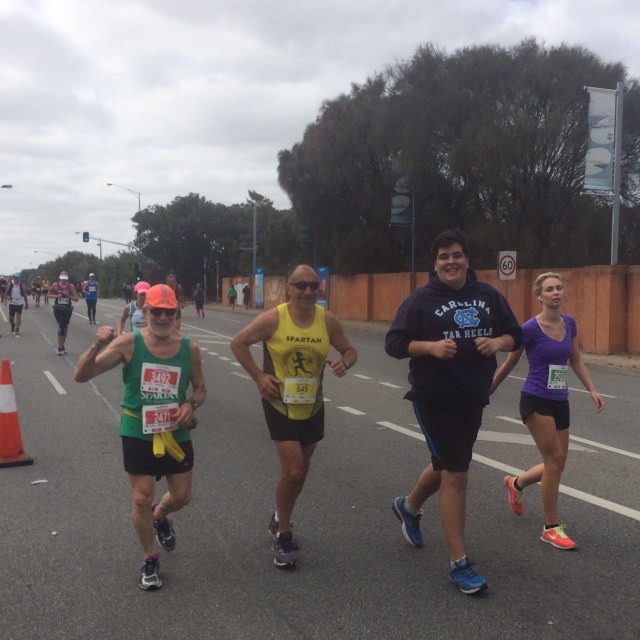


POSTSCRIPT: I have written elsewhere of my inadvertent double entry (and double payment) in this year’s Melbourne Marathon. I duly wore two bibs – each with its distinct number – and with them, both electronic timing chips. I had speculated that Pheidipides Goldenberg might record a finish in both last and second-last places. If you google Melbourne Marathon Results 2015 you will see how closely I anticipated the result. And you’ll find, ahead of me by one second, Manny, Manuel, Manoli Karageorgiou. 


Yizkor

 
I found the photograph I had been missing. It was found, as most of my misplaced objects are, precisely where I had placed it; in this case it was safely at the bottom of my backpack. I wanted it for remembrance. 

The photo sits in its small oval frame. It shows two small boys sitting side by side. Their cheeks have been pinked by some process of photographic enhancement common to photos from the ‘fifties. One boy sits cradling a large teddy bear. The boy’s face is a narrow oval, his expression unsmiling, alert, guarded, attentive to the photographer who is an adult in a frightening world controlled by adults. The second boy, taller, wider, rounder, has a fuller face, topped with wavy titian hair. He has the daughter of a smile on his face. His is the image I have sought, this the face of the person I wish to hold in remembrance.


The portrait conveys much of what I wish to hold: the elder boy is Dennis, his parents’ firstborn, my brother. His destiny is here to be read. It’s all here – firstborn, male, cherished; good-natured, close to his younger brother – and fat. In this photograph Dennis must be about four. In less than sixty years he will be dead.


***


Literally translated, the Hebrew word yizkor means ‘he will remember’. Over the recent Festival period I recited the yizkor prayer for my father, my mother, my wife’s father; and for Adrian, my consuegro; and I remembered them all tenderly. It was only when I prayed for Dennis that I cried. I cried for the protective brother I could not protect, for the always-advising brother I could not advise, for the firstborn who worshipped this usurper as a hero. 

Dennis did not ask to be born fat. He did not ask to be born first. He loved his father as his father loved him – not wisely but too well.

Immoderate in all he did Dennis loved his younger brother immoderately. I miss him, I pray for his rest as I pray for my own.