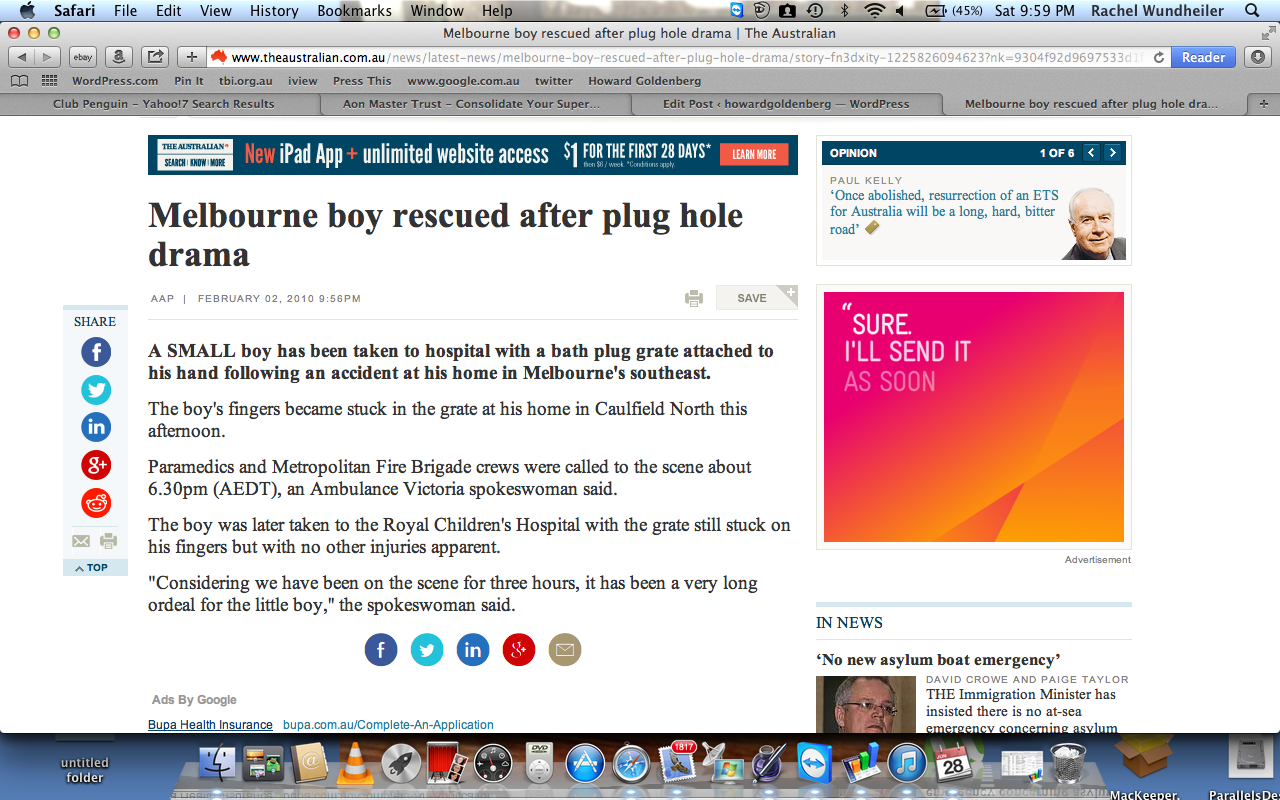
Another Toby Emergency

A scream from the back of the boat, the scream of amazed pain. Now follow loud cries as Toby’s face rises above the transom. Tears stream down his face, uncharacteristically pale. At the point of his chin a gleaming carbuncle of deepest red rises to a meniscus, then overflows. Brilliant red drops appear on the white deck, tracking Toby’s path to adult rescue.

I apply my nearly clean handkerchief to the wound. Toby darling, press this hard against the cut. Very hard.
I’m sorry, Saba. I’m sorry.
No need to be sorry, Toby – just press.
I’m sorry. I’m very sorry…

My bottle-green hanky is turning red. A quick peek underneath shows a deep and gaping gash. The wound is irregular; it will need meticulous suturing to minimize the inevitable scarring.

Before we arrived in Metung I commanded the kids: NO RUNNING ON THE BOAT, NO JUMPING ON THE BOAT.
I’m sorry, Saba, I won’t do it again.

Pablo scoops his son into his arms and we run to the car. The patient, cocooned in his father, is stowed in the back. We drive into the little town to look for the doctor’s premises: the Village Store, a hardware and fishing tackle shop, the pub, a real estate office, a few coffee shops – these account for one half of the Central Business District; a u-turn brings us to the post office, a laundromat and a petite pharmacy. The pharmacist, a lady of my years, petite like her shop, is sympathetic. She advises, Yes, there is a doctor in town… every Tuesday morning.
Hmmm. Do you have surgical glue?
I don’t think so. I’ll look…
The search doesn’t take long. No glue. We settle for some stout Steri-strips, a gross of sterile gauze squares and a gallon of Savlon.
Across the road the door to Hardware and Fishhooks is locked. It’s only four PM, Friday. The sign reads, Open 9.00-5.00, M-Thurs. Fri 9.00-1.00.
The Village Store stocks food, suncream, the dailies, the Metung Meteor. Unless it’s a condom or a painkiller I seek, no pharmaceuticals. Do you have Super-glue? (Super-Glue is identical to Surgical glue; it’s packaged in crushable phials for single use, to discourage germs.) The helpful young cashier leads me to her hardware shelf. No Super-glue but we do have Araldite.
Araldite. I’ve never glued human tissues with this product. Will I try it on my grandson? I call the Emergency Physician in Alice Springs, where ED is full of my workmates. Yeah, Araldite will hold it, same as Super-glue. But it’s thermogenic. In an emergency, better than nothing, better than Steri-strips alone. Translated, ‘Thermogenic’ means the glue will heat the skin.

Back to the car. No doctor in Metung: we’ll have to go to Lakes Entrance. Toby lies quietly, eyes widening as I approach his wound. A wince, a gasp as I peel away my hanky of dark green and dark red, exposing a valley of flesh. Briefly bloodless, the wound fills quickly. Clean white gauze is applied. Toby darling, press again, hard. Here.
The child’s eyes follow me anxiously as he anticipates the uppance that surely will come: I’m sorry, Saba. I won’t do it again.

Driving back through town I wonder about the boatyard. They repair boats there, they must glue things. The Boatwright is helpful: Sure, Howard, we should have Super-glue somewhere.
The tube is not new. They have no other but needs must…

Pablo and I remove the patient and lie him on a picnic table, Pablo cradling the child’s head. Darling, we are going to put some glue on your cut to close it up. First I’ll wash the cut with this yellow stuff. It will be quite quick.
A splash, a yelp, a bit of quick mopping and a flow of fresh blood. It is quite quick – and quite hurty.

Now I’m going to squirt some glue onto your cut, Toby. It will be quite quick.
Pablo, pinch the skin edges closed… like this.
Pablo pinches – which hurts – as I peel away the gauze – which hurts. Toby’s eyes widen in fresh surprise, he releases a single gasp, half rises, then subsides. He takes deep breaths, slow breaths, as I squirt the glue – which hurts – and Toby breathes on. Through the following three minutes, Pablo pinches the skin edges – which hurts – and Toby, calm in his self-mastery, gazes trustingly into our close faces.
A few Steristrips bridge the narrow ridge of pink that was a cleft moments before. The wound is closed, and dry, more or less regular, messy in its scatterings of dried blood. It will heal and eventually scar.
Toby kisses his torturers and thanks us: You’re the best father, Papi. I love you, Sabi…I am sorry.

Postscript that might have been a Prescript: readers of this blog might recall an earlier, very lengthy post, titled ‘Toby’s Fingers in the Bath Hole’. A year after the Fingers in the Bathplug Story, we had the Batteries in the Ears story. Toby spent an afternoon in hospital for removal of hearing aid batteries trapped in his ear canals. Once in-situ, batteries create an enveloping oedema of the canal walls, a watery swelling of the flesh that neatly encloses the little discs. Toby is not deaf (not yet) and has no need of hearing aids or their batteries. But the batteries he found were just the right size, so…

Additional Postscript: Toby’s cousin Noah described the accident: Toby tried to get from the back of the boat onto the pier but his life vest caught on this wire and he fell when he jumped.
“When he jumped”: that must have been what Toby’s “sorries” were for. Not a forbidden jump at all, this was a jump from the boat, not on it.

IMG_3333.JPG

<a

This House of Grief – by Helen Garner, A Review.

Helen Garner saw it on the TV news. Night. Low Foliage. Water, misty and black. Blurred lights, a chopper. Men in high-vis and helmets. Something very bad here. Something frightful.

It was truly very bad. A man had driven his car into a dam. He escaped from the car but his three small sons drowned. The man was charged with their murder and over the following eight years Garner attended the man’s exhaustive legal trials. She exhausted herself in the process of moral exploration of territory that is indeed, ‘dark, misty, black and blurred.’ Reading Garner’s ‘This House of Grief’ can exhaust a reader in turn.

Three hundred pages of scrupulous enquiry end with the author reflecting: ‘When I let myself think of Jai, Tyler and Bailey lying in their quiet cemetery…I imagine the possessive rage of their families: You never knew them. You never even saw them. How dare you talk about your “grief?”
But no other word will do. Every stranger grieves for them. Every stranger’s heart is broken. The children’s fate is our legitimate concern. They are ours to mourn. They belong to all of us now.’

Garner takes the deaths of the three children personally as if she were herself involved. She seeks to know whether they died by grievous mischance or by human intent. She needs to understand. She begs of fate, of the universe, ‘Oh Lord, let this be an accident.’ For us her readers – we who elect to follow her into this frightful something – Helen Garner attends the hearings as our emissary to that house of grief. We too need to know, we too seek to understand; the three lost boys are ‘our’ lost children.

Garner quotes three epigrams, each a succinct cry from a previous emissary, each a pair of hands flung upward in despair over the futility of the quest to comprehend.

He can’t possibly have done it. But there’s no other explanation.

There is no explanation of the death of children that is acceptable.

…life is lived on two levels: one in our awareness and the other only inferable…from inexplicable behavior.

On what account are Garner’s thoughts and reactions, naked here on page after page, a matter for a reader’s interest or a reviewer’s remark? What access has the reader to her deeps, her angst? Garner, the person on the page, our emissary, attends a day of ravaging evidence; afterwards she makes her way, blindly, solitary, to a bar for a vodka. On other occasions she resorts to magical thinking: If only Farquharson could be found not guilty, then the boys would not be dead…Garner pictures them in their domestic vitality, playing footy, watching cartoons, running with arms open for a cuddle. The only way I could bear it was to picture the boys as water creatures: three silvery naked little sprites,…who slithered through a crack and …sped away together.
Then, haunted by the chill of reality, she races homeward in her mind, to haul my grandsons …from their Lego and their light sabres, to squeeze them …until they squirmed. Young boys! How can such wild vital creatures die? How can this hilarious sweetness …be snuffed out?

And again, this longer account of the observer’s migratory flight of feeling: When I got home I sat on the back verandah mumbling to myself, sick at heart. My third grandchild came wandering around the house. He approached me without speaking, turned his back, and stood waiting to be picked up. I lifted him onto my lap. He was only a few months younger than Bailey Farquharson had been when he drowned. For a while the little boy sat on my knee. He relaxed his spine against my chest. Together we listened to the clatter of the high palm fronds, the wail of a distant siren. He glanced up sharply when a flight of lorikeets swerved chattering across the garden. Then he spread his right hand like fan, inserted a delicate thumb into his mouth, and tucked his head under my chin.

And yet only two hours later when he and his four-year-old brother disobeyed me… and went crashing and yelling down the hall to the kitchen like maniacs, rage blinded me. I ran after them, grabbed the nearest arm, and yanked its owner round in a curve. Before I could land a blow I got a grip on myself. The boys stood frozen in attitudes of flight. Nobody spoke. In a cold sweat I leaned against the cupboard door and took some trembling breaths.

Here Garner gives us her brittleness, her sense of near disintegration, her proximity in extremis to harming loved ones in her care; and subtly too, the boys’ “attitudes of frozen flight” recall the postures of failed flight of the boys in the drowned car.

There is a reticence, a holding back at certain points, a refusal to comment that shouts, no, screams, in unexpressed horror. Thus: The men from Major Collision looked into the car before they opened it to drain the water. Ten-year-old Jai was lying face down across the front seats with his head towards the driver’s door…
Seven-year-old Tyler lay on his right side behind the driver’s seat. His head was near the door and his legs were between the two front seats. Two-year-old Bailey was lying across the top of the baby seat, facing rearwards and still tangled in his safety harness.

It is not until the following page that Garner reveals the killer datum: all three seatbelts were unbuckled. It is this crushing fact that tells us that a child – or two children – struggled. It is this, delayed, that a writer striving for dramatic effect might have juxtaposed earlier and quite unbearably with those postures. As it is, the bodies lie diagonally, piercing my composure. I too need recourse to slithering fishes or to vodka or to clutching hard my own brood of near ten-year-old grandboys.

***

Writing to a friend some weeks following release of the book – a year or more I guess after the trial and the appeal and the retrial and the application to the High Court – after all had ended, Helen Garner said: “This is what I’ve learned from the last seven or eight years: ‘We are small. We are weak. We are mortal’… but I think I knew that already.”

After all had ended it had not ended at all.This House of Grief

Toby’s Fingers Stuck in the Bath Hole

My wife Annette and I are having an early dinner when my phone rings. It is Rachel, our elder daughter: “No-one is hurt, everyone is OK, but I’ve called an ambulance: Toby’s fingers are stuck in the bath hole.”

I reckon I’m equal to this little challenge: ”Darling, just soap his fingers liberally then they’ll become slippery and he can just slip them out.”
“I’ve done that, Dad, and it didn’t work. I’m attending to Toby, but I need help with the other kids. Can you come over?”
“We’re on our way. We’ll be 15 minutes.”

In the car, Annette looks at her watch and calculates that Rachel’s brother, Raphael, will be driving home about now. He might get to Rachel’s before we do. She calls Raph and indeed he is only a minute away from Rachel’s house. He isn’t driving; he’s on his bike.

We drive into Rachel’s street which is blocked by two large fire trucks, a smaller fire car, two ambulances and a police car. There is no smoke and there are no signs of a motor accident.
We park at a distance and make our way on foot to Rachel’s house. Flung to one side on the grass is Raphael’s bicycle. Ahead of us the large torso and bum of a fire officer protrude from the bathroom window. The head and shoulders are out of view, presumably inside.
We make our way to the interior. A large man walks purposefully ahead of us, lugging a heavy timber box of plumber’s tools. From the narrow hallway an ambulance officer carries a plastic drink bottle into the bathroom. The bathroom itself is small. What with the toilet, the shower recess and the old-fashioned claw-foot bath, two is a crowd here. This evening the crowd is larger: the ambulance officer, a young lady, is leaning forward, passing the drink bottle to a male colleague who sits on the edge of the bath. The missing fireman’s face and shoulders are framed in the window, as he leans inward, observing and giving advice and instructions to another fire officer lying on the floor. This is another partial fireman, his face and arms invisible beneath the curve of the steel bathtub.
What he lacks in extremities and face he makes up for in length: this is a very tall fireman.
In the tub, drained of its bathwater, sits Rachel, her back to the door. On her lap is the skinny white body of Toby, aged five, a runt, a set of bones with a piping voice. One of his arms extends to the bath hole. His fingers are not seen.
The mother is reading a story to her child.

From the family room, children’s voices are calling: Toby’s twin, Miles, and their older brother, Jesse, have sighted us: “Saba! Savta! Toby is stuck. His fingers are stuck in the bath!
Look! Lollies! Raph is giving us a special treat.
The boys peel themselves from the arms of their uncle Raphael, who stands with his bare chest, wet with the sweat of his bike ride on this hot evening of 30 plus degrees.
Miles and Jesse pull at our clothing, dragging us to the bathroom, to see Toby and his missing fingers. They squeeze past the ambos, step onto the prostrate fireman and clamber into the bath. We follow them, secreting ourselves along the far wall and we greet Rachel. Raph stands behind us in the doorway.
Rachel smiles the smile that we’ve seen before, the smile that welcomes mere chaos that unseats tragedy.
Pasted over her fear, and threat and alarm, Rachel’s smile invites us to see and share the joke.
It is hot in the bathroom. Toby’s free hand wields a lollypop that disappears and reappears in and out of the recesses of his mouth. He cries out his greetings, his words emerging through a slop of saliva and lolly juice. He is having a pretty good time.

Rachel gives us a synopsis: “I called the ambulance and told them that Toby’s finger was stuck. These guys came and called the fire brigade. While I was on the phone, Toby’s free fingers were curled up and cramped, so he made them more comfortable by poking another couple into the plughole. Now there are three fingers that are stuck.
“The fire guys have all the right tools and equipment. They get fingers out of plug holes all the time. I didn’t know that bathplugs are a fireman’s specialty.”
The fire chief in the window frame elaborates: “Normally, a plughole is a ten-minute job. They’re all plastic nowadays. But this bath is a genuine antique, made of genuine steel. The plughole itself is probably made of toughened steel: it’s usually a disc about half an inch thick, with half a dozen circular holes, all of them just about the width of a toddler’s finger.
“The plan is to cut away the drain pipe. This will allow us to raise the bath from the floor, so that Steve can get right underneath and free Toby’s fingers from below. He’ll push up on Toby’s fingertips with his own finger.
If that fails, we’ll have to saw away the steel drain and free Toby from the tub, and then tackle the fingers.

“You and your family won’t be taking baths for a while, Rachel. This bath will be in pieces once we’ve finished here.”
I take a look at my watch. 7.45 pm. Toby has been in the bath for an hour and a half.
While we’ve been talking, the home phone has rung and rung out. My own mobile has rung unattended. Now Annette’s phone rings and it is Toby’s Aunty Naomi, calling from Sydney. She had called earlier, just when Rachel was racing between the stuck child and the other children and her urgent phone calls for help. Since that time, Naomi has learned sufficient to frighten, and nothing to comfort an aunt who has visions of fingers lost by strangulation or by nightmare surgery. Naomi has no children of her own yet and she loves her Melbourne nephews and niece with an intensity which increases with the distance.

Naomi asks to speak to Toby. “Toby, would you like me to sing Rainbow?”
Toby nods, his mouth occupied by his lollypop.
Rachel switches the phone to Speaker and says:
” Toby is busy with a lolly. He does want you to sing.”
Naomi’s voice floats into the bathroom.
“Somewhere, over the rainbow,
Way up high…”
The phrases float, spacious, into the bathroom, the words a familiar caress for the boys at their bedtime. Naomi’s singing voice is a sweet soprano, usually crystalline. Tonight the voice is thickened with an unfamiliar tremolo.
“ there’s a land that I heard of
Once, in a lullaby…”
Toby is transfixed. His brothers are still. Three lollypops are held, suspended, while Naomi sings.
All conversations stops. The lengthy plumber pulls his face out from under the steel belly of the tub. His face is wet with sweat. Bathroom lint clings to his chin and brow. He lifts his head and listens. The ambos and the fire chief stand, arrested. The voice rises, crests a high note and falls. The singing undoes us, soft family and hardy professionals alike.

A skinny woman appears. She is Laura, Rachel’s best friend. Alarmed by the emergency vehicles congregating outside, she races in: “What’s wrong? Is everyone alright? Can I bring food?”
She listens, looks, offers cuddles, kisses the air with her famous loud smacking sounds and leaves, disappointed not to be catering. Laura makes me laugh, always has.

The tall man pulls his head in again. The Chief hands us a hacksaw. We pass it to the tall man. We hear sounds of sawing, long metal screams.
Alarmed, Rachel wonders aloud about Toby’s fingers: are they safely out of the way of the singing blade? The Chief says: “Don’t worry. Steve knows just where to cut. He leaves a margin of pipe just shorter than his own index finger.”

At length the drainpipe is sawn through. Everyone gets out of the bath excepting for Toby and Rachel. Annette, Raphael and I make room so the bath can be lifted. Eight adult hands hoist the tub aloft. Toby squeals with delight as he levitates.
Steve’s voice comes from the floor: “Toby, can you wriggle your fingers?”
Rachel and the ambos relay the request. Toby says, explaining the obvious to the unintelligent, “I can’t. They are stuck.”
The voice from the floor warns Rachel that he is about to push Toby’s fingertips upwards from below. Steve pushes, Toby says “Ow! You are hurting me!”
Apologising, Steve has another try and Toby cries:”Stop it, you bumhead!”
Steve stops.
The Chief retires to the fire truck, returning with some new cutting equipment which he passes to Steve. Steve now sets about cutting free the metal disc with its six perforations and its three child fingers.
The Chief invites Jesse and Miles to come and inspect the fire truck. He shows them the hoses and the heavy brass fittings, then hoists them high into the cabin and places them onto the driver’s seat, beneath the steering wheel. In the massive truck they are very small.
The Chief points out the siren, the two-way radio, the switches that elevate the ladders and all the usual automotive controls. Two boys are in paradise. I remove them before they drive off in search of a fire.

Back in the bathroom, Toby is pacific once more. He sits in the tub in his mother’s arms watching a DVD. The ambos take turns holding the portable screen at the right distance for Toby’s comfort. The DVD is in a language foreign to the ambos and fire crew. It is “Bob Esponja”, Sponge Bob in Spanish.
Now his brothers clamour to watch too. Raphael and I take them outside and hoist them onto the window sill recently vacated by the fire chief.
All of this takes place well past the bedtime of such small boys as maintain a normal, detached relationship with their bathtubs.
The boys watch and translate for the ambulance man and lady, Ross and Joelle (‘call me Jodie’) respectively. It is a cultural treat for Ross and Joelle, who have only previously enjoyed Sponge Bob in English with respective nephews.

It is about 9.00PM when the plughole with its nubbin of pipe and its heavy perforate disc is freed from the tub. Sponge Bob has finished. Toby looks at his naked self and the empty tub. He says mildly: “I am ready to get out now.”
Rachel rises, her bum and thighs numb after three hours, cradling Toby and his massive steel bracelet as she does so.
Escorted by Joelle and Ross, they make their way to the kitchen. Here Annette has covered the kitchen table with towels and a pillow for Toby’s head.
Annette takes Miles and Jesse to their bedrooms. Their protests are audible from the kitchen.
Jesse appears in the kitchen. He says,”I can’t sleep. I’m too worried.”
Somehow Annette persuades him to come back to his room. She lies down alongside him and tries to help him relax.

Now the Chief produces a narrow strip of steel blade, about a foot long and an eighth of an inch wide. Its surface is roughened and irregular; it looks like steel with acne. The Chief explains: “Diamond saw. It’s the only thing that will cut through that steel.”

The Chief threads the stiff blade between Toby’s index finger and the inner edge of the steel annulus. The sharp edge of the blade is applied to the steel and moved up and down. It seeks a niche or crack to bite at hard, but the steel is obdurate and the blade bounces off it. The Chief tries again and again. He is relentless. Steel against steel, the Chief versus the disc.
An exquisite Argentine proverb of Toby’s father, Pablo, runs: con paciencia y con saliva, el elefante se cogio a la hormiga.*
Over the next long time, the Chief will need all the patience and saliva he can muster. He sneaks the blade between the hard steel and the soft boy. The blade makes glancing contact with the disc, leaving a fine scratch in the steel. Now the blade comes again, finds the line of scratching and attacks. The linear scratch deepens minutely. It is nothing like a fissure. Many more passes of blade, many minutes in which Rachel braces Toby’s hand against movement. Rachel searches the face of the Chief. Is he discouraged? He is not. He is the elephant seducing the ant. He presses on.
The room heats up, the disc heats up and Toby protests. Now Jodie produces a green gadget and shows Toby. It looks like a fat whistle. “You put this in your mouth, Toby, and you breathe in. Then your hand will feel good again.”
Toby takes the toy, breathes in and out, relaxes and smiles. He likes his inhaled narcotic.
More laborious sawing, more minutes pass, many single tedious minutes, dragging themselves into hours. The disc is hot, the Chief is resolute, the ambos take turns positioning Toby’s wrist and the Toby rescue industry hums on. Eventually – it is around 10.00pm – Toby becomes fractious. He addresses Jody, the wrist-bearer of the moment. “Put my hand down.”
Jody explains: ”We have to hold it up high to get your fingers out, Toby. It won’t take long.”
Toby is not placated: “Stop it, bumhead!”
Bumhead’s offsider, Ross, gives Toby another suck of narcotic and he subsides.

A further half an hour passes, half an hour of sawing, story reading, perspiring and concentrating. The cluster around Toby and his still buoyant mother falls eventually into speechless reverie. Each person in her own thoughts, each concentrating on three thin fingers that remain pink and on a small boy’s face, pale now with medication and fatigue.

There is a bloke at the front gate who wants to talk to any member of the family. I am greeted by a shortish man with a warm smile and a huge camera. He’s from one of the TV stations. He apologises for his intrusion, he hopes he is not causing distress, would any member of the family be prepared to describe what is happening? I answer, “No.” The man accepts this gracefully and walks away.
I retrieve a phone call. It is Pablo, Toby’s aphoristic father. “Howardo, what’s happening? Is Toby OK? Should I come home?”
Pablo is up country, the indispensable leader of his team’s annual residential seminar. He is out of town but painfully in touch. It tears him in two.
“No, Pablo, Toby is safe and cheerful, his mum is cheerful and the house is full of fire people, ambulance people, family, friends and kibitzers. There’s no physical space for a mere father. OK?”
Pablo is OK, just. I am to ring back later with more news.
Back inside, Toby stirs, complains: “My hand feels uncomterful.” Jody confers with Ross, then turns to Rachel: ”We can’t give Toby any more of the painkiller in case it depresses his breathing. Any further doses need to be given in the Children’s Hospital, with anaesthetic and operating facilities.”

Rachel flows into action. She kisses her other boys goodnight, tells them that Toby will go to the hospital to get his fingers out and he’ll come home soon. She grabs Toby’s teddy bear, a couple of books and another DVD.
Toby says a warm goodnight to all the emergency people, not excluding bumheads.
Rachel wraps Toby in a rug, marches from the house into the open ambulance, concealing her son from the TV camera, and in a moment they are away.

I follow in my car. I work odd night shifts in the Emergency Department of that hospital. I might be useful in some way; I know people there.
By the time I arrive in Triage, Rachel and Toby are nowhere to be seen. The nurse in Triage seems to expect me. “Go into the Minor Procedures Room, Howard. They’re all in there.”

Indeed they “all” are. There are Jodie and Ross and a new fire team. Steve and the Chief and our previous team only do outpatients, it seems. The new bunch comes from another fire station and they do the inpatient jobs. There is a firelady and a fireman, both selected, surely, for their tenderness towards children. The fireman is as tall as Toby is minute. He looks at me, I look at him, Rachel looks at him. He says, “Hello Doctor Goldenberg. We met at your clinic. I married your patient, Robyn. Do you remember?” Indeed I do remember. He is Nick. Rachel is looking at him hard and long because he is so good looking.

Nick has no hand for me to shake because his are occupied with an intriguing apparatus, whose principles he at length will explain. The principles are alarming.
Meanwhile I meet Lucy, who is operating a portable DVD player for Toby, who sits in his mother’s embrace on an operating table. Toby grips his pale blue teddy bear as he always does – with one of its arms in his mouth. Every night that bear develops a soggy upper limb. The bear keeps Toby company through his hospital stay and then disappears, forever lost. Bearnapped, we suppose.
There is a nurse who is helping a doctor administer intravenous pain killers to Toby. The doctor smiles and greets me. We know each other. A quarter of a century ago, when he was a boy, I used to be his family doctor. Then he became my medical student. Nowadays, when I work at the Royal Children’s, I operate under his direction. He is the paediatric consultant on duty tonight. His name is Dominic.

Nick explains his gadget. It is a miniature example of the famed ‘Jaws of Life’ that road emergency crews use to disimpact a crushed motor vehicle from its trapped occupant. Nick’s gadget is a menacing midget of frightening power. It looks like a pair of dark steel pincers emerging from a cylindrical contrivance connected by strong piping to a device that couches like sin on the floor of the O.R. That floor dweller is a pump that forces air under enormous pressure to the pincers, coercing them apart.
Nick introduces the fine pincers into one of the unoccupied annuluses of Toby’s steel ring. He allows the pressure to build and build. The steel of the annulus resists the steel of the jaws. All our jaws are clamped hard, as we watch in dread the application of irresistible force to an object not amenable to persuasion. I close my eyes briefly against a vision of a sudden sundering of the steel bracelet or else an explosion underfoot of the compressor. The latter would destroy the fourteen limbs standing nearby on the floor; the former could shatter my daughter and my grandson.
I adopt the business-as-usual expression that one always deploys when one’s gamble with a patient’s health hangs upon the coin that one has set spinning, spinning, as it falls to earth.
With a discrete metallic sigh the annulus cracks and gapes. Firelady Lucy hands Nick a diamond–blade saw, which he wields now with a free-swinging action well away from Toby’s flesh. As the saw makes its remorseless way through the steel disc, Dominic inserts a shield for Toby’s finger.
Millimetre by millimetre the blade divides the inviolate steel. Sixteen eyes follow the progress of the blade, a remorseless icebreaker freeing the trapped one. The saw falls still, a fraction short of the shield. Now Nick applies a wrench to the opposing shores of the bay where Toby’s finger is marooned. Another steel sigh and the disc surrenders. Toby’s finger is free. Watching Aladdin and his magic, he pays no heed to our drama.
Two more fingers to go. Pincers, saw, wrench – all are deployed in unhurried speed. Nick frees Toby’s digits, tears gather at the edges of my eyes as Rachel kisses those finger tips.

Dominic examines the fingers minutely. He is checking for tissue damage. There is the small skin indentation one sees when a ring has been a little tight. The skin is pink.
Dominic tells Toby to wriggle his fingers. Toby does so, his expression of scornful surprise registering wonder at the obtuseness of the adult world.
Dominic wants to be certain that there has been no damage to nerves and blood vessels. After x-rays he will keep Toby and Rachel here, in an annexe, until the morning, “just to be sure”.
The morning is not many hours away. I kiss my grandson and I hold my daughter’s face in my hands and squeeze her beloved flesh. Then I drive home.
On the way to the car, I phone Annette and share the news. And I forget all about phoning Pablo and Naomi.
***

In the bath a few weeks later 7 year old Jesse has an idea: “Why don’t you see if you can get your fingers into the bath hole, Toby?”.


* Pablo translates: With patience and with saliva, the elephant fucked the ant.

Melbourne Boy Rescued After Plug Hole Drama
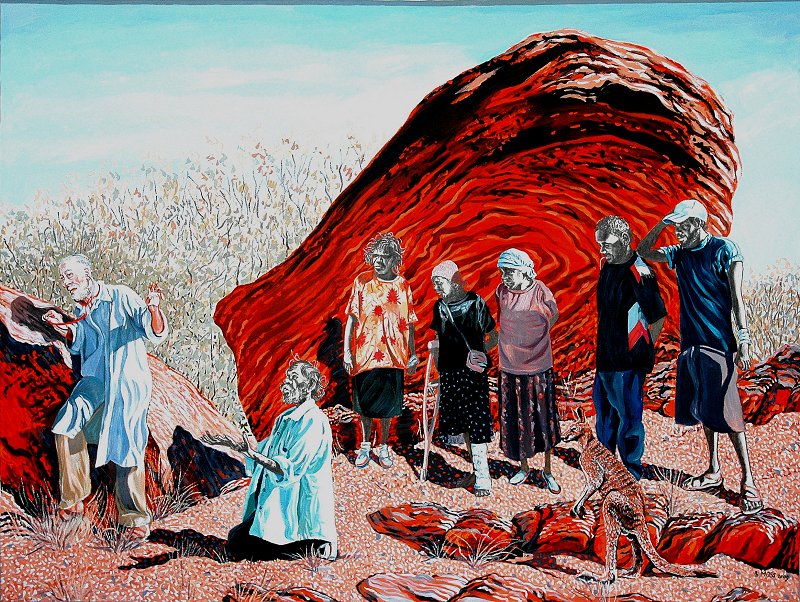
Melbourne Boy Rescued After Plug Hole Drama
 

What Would You Do? – Part 3


 This was one of Dad’s stories that made me when I was small – probably made my brothers and my sister too:

Dad said: “We lived in North Carlton, where all the Jews lived. We were all poor. Even after the Depression, when we weren’t so poor we never forgot the poor times.

“My Father – your Papa – told us a story about King and Godfree. Papa went there once in, the hard times, to buy food.

The grocer said: What can I get you, Mr. Goldenberg?

Three pounds of potatoes, please Mr. King.

What else?

A pound of flour.

The grocer weighed the spuds and the flour.

What else, Mr. Goldenberg?

That’s all. Nothing else thanks.

That’s not enough, Mr.Goldenberg.

What do you mean?

You’ve got three sons, growing boys. They need milk, eggs.

No thanks Mr. King.

The grocer left the counter for a moment. He came back and placed a dozen eggs and a quart of milk on the counter.

Papa shook his head. No Mr. King, I won’t take those. I’ll take what I can pay for.

You take them now Mr. Goldenberg. You’ll pay for them when you can.

Papa never forgot that. From that day he always shopped at King and Godfree.”

Notice of the Death of a Son

A thin, linear lady, stringy, bounces in to my consulting room, sits down, beams at me from her lean oblong face. And waits. She has the grin of a six-year old.

We haven’t met before. Welcome. My name’s Howard.

A bony hand on a long arm grips mine vigorously and softly. The grin widens, shifting dentures. Hello Howard. I’m Lucy.

In general Lucy looks her age, which is seventy two years; but her skin looks a lot older. She might be a chicken, so scaly and irregular are her surfaces. The thicket of hair atop her bony head is fair. The skin is fair too, excepting for the plaques of pink, great blotches of healing. She is an old gum tree, her bark new, old, peeling, revealing, irresistibly alive.


She looks me over genially, taking my measure. She decides I will do and embarks on a story.

I had a son. He died last year. Lucy looks up, waits a bit, resumes: Your children are supposed to bury you, not the other way around.

Lucy bears her loss lightly. She hasn’t come here to shed grief. She looks at me, unbowed, light in her being.

I look back hard. There must be a wound.

How did your son die?

A heart attack, massive. He was forty-four.

Lucy has taken my measure. I am old enough. I will know the verities, the facts of death.

You know the smell of death.

A statement, not a question.

How does death smell, Lucy?

Indescribable. And unmistakeable. As you’d know.

I smelt death first the night Dad died. I was staying with him and I smelt that smell. When I found Dad he’d been dead a couple of hours. He was cooling. The smell started around the time he died…

I started smelling death again a year ago. I smelled it four nights in a row. My bed smelled of it, my pyjamas too. It was really strong. I wouldn’t let myself fall asleep: I thought I was the one dying. I was at my daughter’s place and I didn’t want her to have to find me.

After the fourth night they rang to tell me my son had passed. He died four nights before.

That smell starts ten minutes after they die. And it stops once you know.

Lucy looks at me, grins a smile of reality, of truth. Ultimate truth, the factuality of death.

I’ve lost both my boys; the first one died at birth.

But I’ve got my girls. They’re both good. And seven grandchildren and – a huge bright smile, a lightning strike in the summer of Lucy’s face – a little great granddaughter!

A pause. Lucy is a good pauser, unfrightened of the silences that flow, clear as her sentences. And in the pauses, Lucy smiles her knowings that I must share: the freshness of new life. How the fact of a baby redeems all.

You know I bounce back. Just about exactly a year come round since my boy passed, I lost a dear friend. Like sisters we were. That was tough… for a while.

This is a pause unlit by smiling. Lucy looks at me steadily.

But I bounce back.


On the Night Train to Jerusalem

Saturday night. The late train from Tel Aviv to Jerusalem is sparsely filled and comfortable. Passengers sit and read and stare out at the darkness. They travel in private cocoons of quiet. The small world of the carriage snuggles into the bedtime dark. Children, slumped against parent bodies, rocked and clickclacked, fall asleep.

Tel Aviv, Lod, Ramle. The train climbs, winds, climbs again. Stations materialize in the unsuspecting dark. Doors open, passengers melt away, doors close and the dark swallows all.

A brief stop at Ramle, now the train resumes its smooth motion. A sudden hubbub. Fast footfalls tripping along the corridor, a young woman, fair, slight, twentyish, races, crying, protesting, her voice shrill. She comes to a stop before the closed carriage door. Indignantly, she demands the train go back to Ramle. She missed her stop.
Others follow her – mothers with children, one pushing a pram. All protest, all join in the demand that the train retrace its path. Remorselessly the train picks up speed.

A new arrival, a tall young woman, dark haired, wearing black, makes her voice heard. It is an impressive voice, strong, pitched a little lower than the others’, a voice that rings. Like the others, this woman is unhappy, like them indignant. The younger blonde lady is eclipsed, she and her group are anaemic in comparison; they lack her force, her intensity, her perseverance.

The collector arrives, a small man in a grey jacket, slight, inoffensive. The women batter him with their clamour, their remonstrances. He explains that it is impossible to return, unsafe.
The young woman in black assumes leadership. Decibelling her anger, she details the group’s grievances: the doors in their compartment failed to open; the women and their children were unable to disembark. It was not their fault but the railways’; they had paid for their tickets, there were small children who needed their beds, the night was cold, the train would dump them at Beth Shemesh, leaving them stranded.
The collector offers no defence. He melts away.

The train climbs towards Beth Shemesh where it will arrive in fourteen minutes. The leading lady performs through the fullness of this time. Her face is strong, passionate, her dark lipstick an exclamation mark, her muscular features mobile with the pulse and rhythm of her thundering.

She maintains her rage, augmenting it minute by minute, until it reaches a pitch where violence can be its only resolution. Roaring now, she silences her party members. Nessun dorma: all in the train attend or pretend not to attend to the woman and await a climax that must immediately follow.

The train slows. Women corral their young, hoist their luggage, prepare their escape. The train stops, the carriage door duly opens and the unwilling visitors to Beth Shemesh debouch into the dark.

Their leader makes her final address to the invisible collector, to the entire railway system. Continuing travellers brace themselves for her final explosion. With withering sarcasm she delivers her line: Thank you for kindly opening the door –
Last of all to exit, she stops in the doorway, turns back to face the interior and screams – Darling!

Copyright, Howard Goldenberg, 29 March, 2013.

In Israel

Parable: A frog is swimming in the River Nile. A scorpion hails him from the bank: will you please give me a ride on 

on your back across the river?

The Frog replies: no, you’ll sting me and I’ll die.

Scorpion: no, I wouldn’t do that.

Frog: word of honour?

Scorpion: word of honour.

Frog, swimming over to the bank: alright, climb onto my back.

All is well until they are halfway across, when the scorpion suddenly stings the frog.

Frog, dying: why did you do that? Now I’ll die and you’ll drown.

Scorpion, drowning: this is the middle east – what did you expect?


I understand President Obama is visiting Israel at precisely the time as the visit of my family. I believe this to be a coincidence: neither party knew the other was coming.

However it seems their agenda might be the same.

At the play centre today, a bigger boy, perhaps 4 years old, pushed grandson Joel, aged one year and 358 days. Joel fell over. He arose and pushed the other child.

Joel’s mother said: Don’t push, darling. 

Another who mother had witnessed the exchange of shoves, interceded on Joel’s behalf: Really your boy was simply defending himself. The bigger boy started it.

Joel’s mother thought for a moment: Yes, but it doesn’t solve anything does it?

Joel’s defender, smiling: You can’t have lived here very long. Of course, you are right, it is not a solution. But tell me, tell us all – everyone here needs to know – what do you suggest?


Copyright, Howard Goldenberg, 19 March, 2013

A Unique Offer

I write to invite the reader to participate in a remarkable opportunity. It all starts in the village of Hopkinton, 26 miles from Copley Square in Boston, Massachusetts. It is the Boston Marathon, which I will run on 15 April, 2013. My purpose – apart from winning the race and driving the Mercedes home to Australia – is to raise funds for the Michael Lisnow Respite Centre. The who?.
The Michael Lisnow Centre is, briefly put, a place of joy. As you will see.

I have written on a previous occasion along similar lines to these. That was in 2004 when I decided to bring about a cure for haemophilia. I resolved to achieve this by running 42.185 kilometres (about 26 miles) from Hopkinton to downtown Boston. I would race against the 12000 select runners in the Boston Marathon and I would cure haemophilia.

I wrote to all my friends and begged for donations for research at Boston Children’s Hospital. This very great institution treats my great nephew for his severe haemophilia.

Everyone donated, I bled my friends, and, running as Pheidipides Goldenberg I completed the marathon – and, blow me down, haemophilia wasn’t entirely cured. But treatments improved and the quality of my great-nephew’s life improved. The boy – his name is Elisha – is absolutely blooming. All because I ran the Boston Marathon.

All told I have run the Boston Marathon three times and I have never won: a clear case of home town favouritism.
I am coming out of retirement to give it another crack this year because the Michael Lisnow Centre has captured my cold old heart. Haven’t heard of them? Neither had I until someone sent me this short short youtube. Have a look at it: http://www.youtube.com/hopkintonrespitetv

This program, both modest and magnificent, is located in little Hopkinton, the world’s most famous village on this one day of the year. On the remaining 364 days, in perfect obscurity, the miracles continue.

The deal is this: I do the running, you make the cash investment. I am instructed to raise US$5000.00 by exploiting my friends.

Now I expect many of you are reaching for cheque books and credit cards as you read this, wishing to provide the entire $5000.00 yourselves. At the risk of disappointing you, I advise that this is not my plan. Rather I invite everyone who feels a pang of delight at the youtube above to make a modest investment.

Although I lack a Securities Advisor License, I believe I am qualified to comment on this opportunity. This is a BLACK CHIP INVESTMENT, something unique, a guaranteed, dead set, one hundred percent secure opportunity. Unlike other funds, shares, projects and speculations, the fate of your contribution is beyond doubt: you will never see a cent of your money again. Neither will the Tax Office get a share of the funds. Nor will inflation chew away at them.
Every penny goes for the care of these kids. Donors in Australia will not receive a tax deduction in return for their goodness.
I stake my reputation on these undertakings – not very high stakes, you might say – but I remind you I am also committing a lot of perspiration and shoe leather. Finally, I undertake to provide donors with an Investment Report after my return from Boston.

All you need to do to say goodbye to your money is to sponsor me in the Boston Marathon.

Time is short: the marathon will be run – as always – on Patriots Day, falling this year on15 April, 2013. Please send your donations directly through this link– http://www.razoo.com/Pheidipides-Foolproof-Investment-Opportunity

I might not win the race but together we will certainly improve the life of some lovely children.

Help me to help them, please.

Sincerely

Howard (Pheidipides) Goldenberg

Book Alert

a long time ago i tutored a group of medical students at melbourne university

one of these was dominic wilkinson

dominic was an unusual student, interested in ethics, coffee, dumb animals and conversation

he was built like a greyhound*, played violin in an orchestra, created, directed and acted in commercial theatre, pedalled a bike everywhere, ran marathons, ate no food that had a mother and eschewed leather shoes

he read widely, had a quirky sense of humour and was far too bright to be a doctor.

straight away i recognized dominic as a fellow dilettant

i knew he would find no time to study for exams and that he would fail

and go on to some more creative field

i was nearly correct: dominic passed his exams, graduating at the head 9780199669431of his elite class

he trained in paediatrics (too easy), ethics (too simple), philosophy

( that gives makes my brain ache)

he won a rare and prized scholarship to oxford where he conquered,

returning to oz with more degrees than a thermometer

five minutes later he is a professor in adelaide and has written this book

i was right: i KNEW he’d turn his mind to something creative

if you have a a baby, plan to make one or ever were one, buy dominic’s book

or even if you just enjoy sex, because you never know…

howard goldenberg

*an expression of one of my patients: “like a greyhound – all dick and ribs”

Now for the official blurb:

In ancient Rome parents would consult the priestess Carmentis shortly after birth to obtain prophecies of the future of their newborn infant. Today, parents and doctors of critically ill children consult a different oracle. Neuroimaging provides a vision of the child’s future, particularly of the nature and severity of any disability. Based on the results of brain scans and other tests doctors and parents face heart-breaking decisions about whether or not to continue intensive treatment or to allow the child to die.

Paediatrician and ethicist Dominic Wilkinson looks at the profound and contentious ethical issues facing those who work in intensive care caring for critically ill children and infants. When should infants or children be allowed to die? How accurate are predictions of future quality of life? How much say should parents have in these decisions? How should they deal with uncertainty about the future? He combines philosophy, medicine and science to shed light on current and future dilemmas.”

Death or Disability? The Carmentis Machine and decision-making for critically ill children is published by Oxford University Press. It is now available via the OUP website on the link above, or via Amazon UKFranceCanadaUS (released in March) or Book Depository (free postage)


Twenty Swear Words

I celebrated my 67th birthday recently. By the age of 67 my vocabulary should be just about complete: now that I’ve reached the age of forgetting, I’m not likely to remember new words.

But my eldest grandson believes otherwise. His present to me was a list of words that Shakespeare coined. He thought I’d appreciate them. He tells me they are swear words.

I drove that 10-year old and his seven-year old twin brothers to school today. In a chorus of loving name calling that began with the familiar “Captain Big Nose” they quickly turned literary.

“You Huge Hill of Flesh!” was something to contemplate.

“You Huge Bombard of Sack!” had me looking down to my lap.

“You Swollen Parcel of Dropsies!” was pleasingly clinical and accurate. My calcium channel blocker does in fact cause me some fluid retention.

“You Prince of Wales!” puzzled me. Surely no insult, unless we are supposed to hear Prince of Whales – the prince being the Sperm Whale – and the ejaculation some sort of perverse tribute. As I frowned in contemplation of the words of the Bard, the three kids were helpless with hilarity. This epithet somehow became me. The more they chanted “Prince of Wales” the funnier it became and the more we all four enjoyed it.

Eventually the ten-year old Shakespeare scholar moved on to “You Bull’s Pizzle!” He realized from my facial expression that this was a winner. Once they learned that the pizzle was the phallus of a farmyard animal (famous as the projectile with which Jude woos Arabella in the Hardy novel) they wouldn’t let it go.

I was a Bull’s Pizzle all the way to school.

As they dismounted from the car in high good spirits, they added “You Foot-Licker!”

I farewelled each with a kiss and “You Vile Standing Tuck!” – the last word from Captain Big Nose.

20130214-215901.jpg