Remembering at the Wall

Jerusalem in high summer. We awaken at 4.30, depart the apartment at 5.00 and already the sky is blue, cobalt blue.

Jerusalem is quiet. The roads are quiet. Quiet is rare in this city that teems with the pious, the fervent, the urgent.

Wondering whether we’ll find people enough at the Wall for a minyan (quorum), we walk with fast steps along twisting ways. We need a quorum in order to recite Kaddish, the mourner’s prayer. Erupting from an alley into the broad square we sight the Wall. Before it, in their many hundreds, the devout, already at prayer.
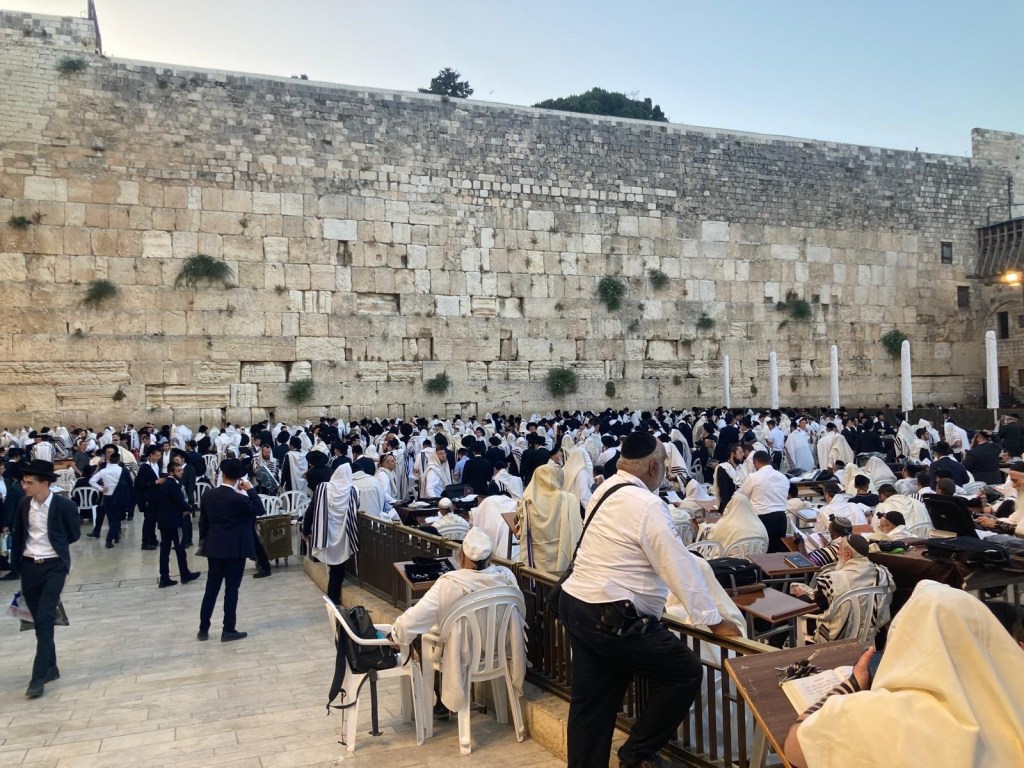
We three are not in mourning, we are here to remember. We are our mother’s surviving children. An indispensable fourth is her son-in-law John, devoted to Mum now as in life. The remembering starts with the first sighting of the Old City’s perimeter wall. How ancient, these creamy stones, mutely dramatic, forever contended. So many conquerors, so many defeats, such passions, stones soaked in blood.


From the plaza, we sight many minyans of minyans, male bodies cloaked in tallithot (prayer shawls). Some wave and sway, others shake metronomically, all moving to intensify intention. One youth in front of me flings his arms to the heavens, his hands clench and unclench in his entreating to God. May his prayers be answered for the good.

Past the beggars, past worshippers of all stripes, past Haredim Caucasian, and Haredim North African, past modern orthodox, past the odd Ethiope, past a pair of the pious deeply asleep, my brother and I wind and wend to the far side where, separated by less than one metre, our sister will hear us recite kaddish.
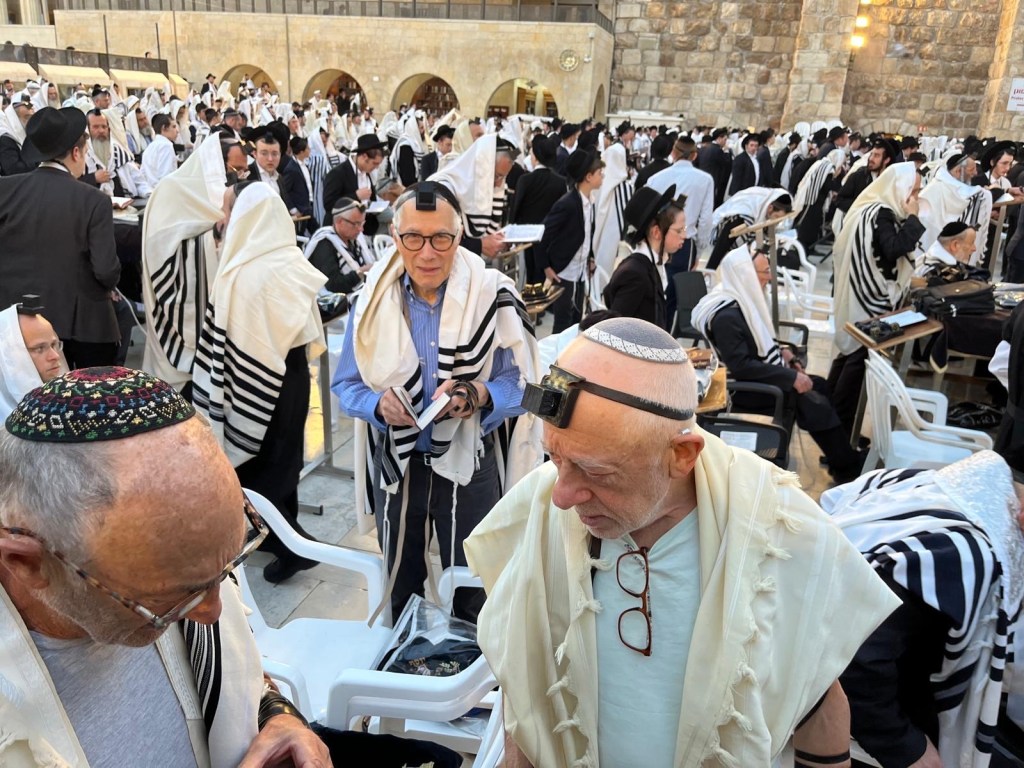
A memory of my first visit. November 1967. It’s afternoon in early winter, the air crystalline, the skies blue. An impromptu service is in progress. I attach myself to a congregation that is the chance aggregation of the moment. Those elect who are of the line of Aharon the High Priest offer their hands for a Levite to wash, prior to giving the priestly blessing. I raise my washed hands and intone: May the Lord bless you and keep you…

An afterthought lands: here I am, delivering this blessing at the Temple. This my forebears did for centuries until the Temple was destroyed, almost precisely nineteen hundred years ago. My people went into exile. At some stage in the 1800’s my grandfather’s grandparents returned to the land, settling in Petakh Tikvah, the Gateway of Hope, far to the north of here.

Is it possible that I am now, in 1967, the first lineal priest in my family to officiate here since the year 70 C.E.? 

Today, together with my brother I will offer that same blessing. The blessing concludes: May the Lord lift up His face unto you, and give you peace.

Peace!

Our mother was a serene soul. She lived a long life of love, somehow happy through all of life’s losses and afflictions. Today, I remember her and honour her, without sorrow or pain. Late in her life, Mum said to me, You know I never did anything remarkable or distinguished. I never was famous or exceptional. But I did give birth to four children and I raised them and they all love me. So I suppose I was successful.

Mum, you don’t know the half of it: so well did you love us four, that every single one of us felt sure that we were your favourite.

Mum lived her life of peace. I can imagine her in no other state than peace. She went with heart at ease. My tears today are not for Mum. I shed a few sweet tears for this son who misses her. But many are my tears for my people, detested today, deserted by fair weather friends, threatened today, abroad and at home. There is tension in the air, fear too, appalled pain and grief. And mighty resolve.

But here, at this hour of pure air and quiet, Jerusalem is at peace. Have I ever attended prayers so quiet, so ruly? We hundreds recite the words, a soft hum rises from many lips. Until the Amidah (the silent devotion). Quietnessnow, perfect and complete. Torsi swing, sway and shake, hands clench and unclench. 

Prayers completed, kaddish recited, Mum honoured, I make my way to my sister Margot. We fall into a fierce hug that does not quickly end. My body heaves with sobs. I’m a good sobber. There’s much to shed tears about. Tears for the present pain, tears of hope for the future good.
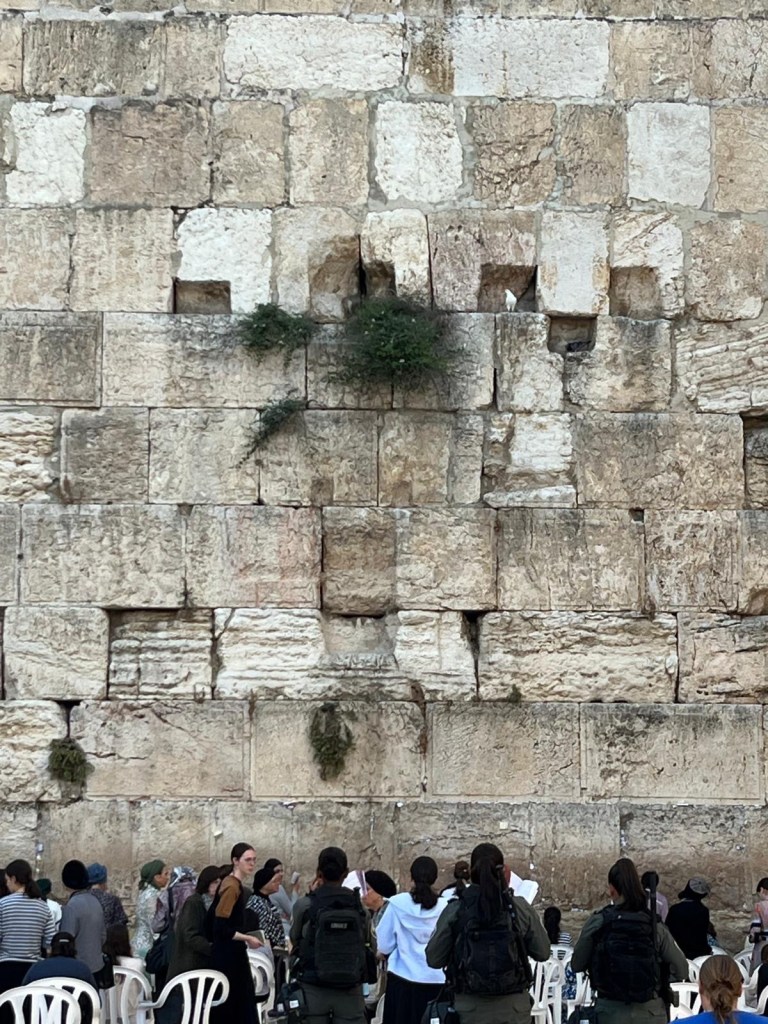
White dove high in the cleft of the Wall

On a Hillside in Jerusalem

Walking up a hill at Yad Vashem about twenty years ago, I overtake an elderly man and his somewhat younger female companion. The man, overweight, is breathing hard. I pause by a cattle car to read the words: this cattle car was one of thousands that ferried Jews to Auschwitz where they died, al kiddush Hashem, in sanctification of the name of God. I stand there for a while, looking at the loathsome vehicle.

The elderly couple have caught up with me. The man reads the words and snorts angrily. 

There was no kiddush Hashem. I was there! It was the opposite, all desecration – all of it!

The accent is Polish.

The woman, considerably younger, tries to calm him. Her accent is American. Perhaps an earlier wife perished. Turning to me, a little embarrassed, she explains, We arrived just today. Always, on the first day in Israel, he has to come here, and to the Kotel.

The man has fallen silent. 

After a time he speaks.

Once, one time only, was kiddush Hashem.

His voice intense.

The Nazis take all the men of the village. We stand, gathered around our Rebbe, we want to protect him. The Nazis see him, this holy man. The commander screams, Take off your clothes, old man!

A Chillul Hashem, a desecration, this humiliation.

We cannot look.

The commander screams, Anyone who looks away, wewill shoot him.  

Our Rebbe stands there, naked. In the square, in front of his people.

That commander takes out his pistol.

The Rebbe asks, Will you grant me one minute to bless my people?

Take two minutes, old man. 

Mocking him.

Our Rebbe turns to face us. He lifts his hands up over us and he looks at us, his hundreds. We would follow him anywhere.

The Rebbe speaks his last words. He quotes the heathen prophet, Balaam, who came to curse the Children of Israel, but found himself forced instead to bless them.

Ma tovu ohalecha, Yaakov, mishkenotecha Yisrael. (How goodly are your tents, O Jacob, your dwelling places, Israel!)

An Inlet, a Lagoon


In a tsunami of reports about health, that arrive in an age of anxiety,

in a rising ocean of uncertainty

that’s inundating our islands of calm, while families driven from Idlib watch their babies freezing to death for want of shelter,

as oil becomes cheap,

as savings are savaged,

as panic feeds on panic,

as the old lack all words to comfort,

as the young tremble for the future,

as the future overtakes the moment –
some thing good,

some moment of balm, some relief, an inlet, a lagoon of quiet joy:
this baby this entire new person this changer of lives
three kilograms and a handful of grams – of life

make her great-grandmother squeal

and squeal again, and again

with astonishment

Nana, surely you know by now, babies are born!

Nana, you had two of your own,

They each had three of their own, The day came when those six

Brought forth babies of their own.

Nana, why do you squeal,

what’s to astonish an old lady of ninety-three?

A baby, that’s to astonish

That’s to amaze, to heal, to comfort, to inspire,to thank God –

and to love.

Going to the Wall

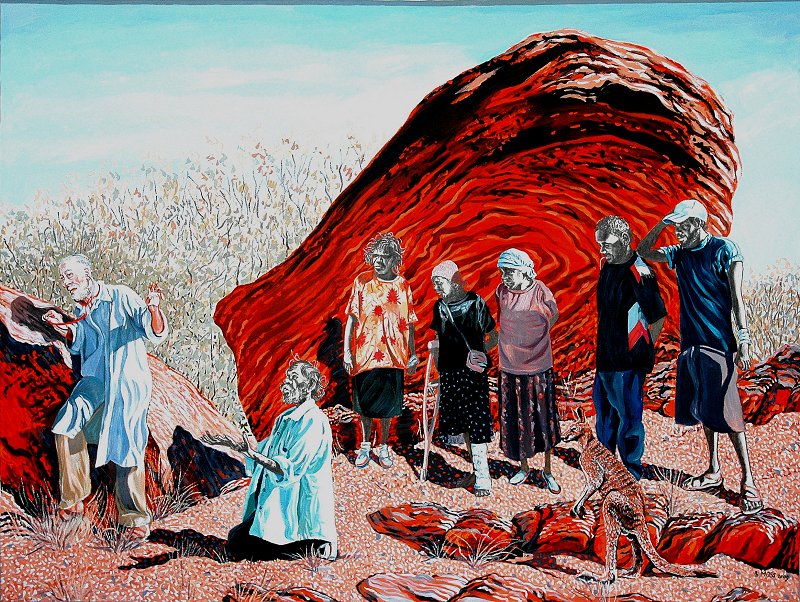
My family used to be employed in Jerusalem. Unfortunately our family business was disrupted for a time by conflict and conflagration. In what appeared to be arson, on the ninth day of the month of Av in the year 70 of the Current Era, our office was burned down. 
The office I refer to was the Holy Temple where my forebears would officiate in rituals of sacrifice, in mediating and arbitrating disputes, in quarantining suspected carriers of contagious disease and in blessing the people. As the reader will realise we worked as lawyers and doctors and priests. After the burning my family was unable to go to our office for nineteen centuries. Then in 1967 we returned. The other day I went back to the office where I resumed working in the family business. 
It happened like this.
My two eldest grandchildren, both aged thirteen, accompanied my wife and me on our current visit to Israel.
The boy, a pretty secular fellow whom we’ll call Jesse, walked down to the Wall with me. He understood the antiquity of the Wall and something of its sanctity. Praying is not his specialty. ‘What will I do, Saba?’
‘I pray there, Jesse. Some people write their prayer on a slip of paper and insert it into a crack between stones.‘
‘What should I pray for, Saba?’
‘Think of the thing that you most want in the world, Jesse. Ask for that. It could be some deep and secret thing, something you wish for yourself or for someone else.’
Jesse has seen suffering. Earlier he saw a man begging. Well made, about the age of Jesse’s father, the man requested small change, blessing anyone who donated. The man walked on a distance from Jesse, turned away and covered his face with his hands. His shoulders shook.
At the Wall, Jesse pressed his lips against the glowing stone. He leaned his forehead against the Wall for some time, his lips moving. Then he posted his slip of paper into a tiny eye socket in the stone.
As we walked away backwards, Jesse stopped me and threw his arms around me. He said, ‘That was a really important experience, Saba. Thank you for taking me here…I love you, Saba.’
We rejoined my wife and Jesse’s cousin, whom we’ll call Ellie. They too had prayed at the Wall. Ellie’s fair features glowed: ‘Saba and Savta, that was wonderful.’ My hands twitched, a spasm in unemployed muscles. I recalled I was a Cohen, a lineal priest: I was in the blessing trade. I rested my palms on Ellie’s head. My fingers splayed and I searched for some voice. The voice shook as I recited the ancient words: ‘May God bless you and keep you…’ Here I was back at the old workplace, here was Ellie, flesh of my flesh.
I had waited 2000 years to get back to work. I annointed her fair head with my salt tears. 

Giving Thanks

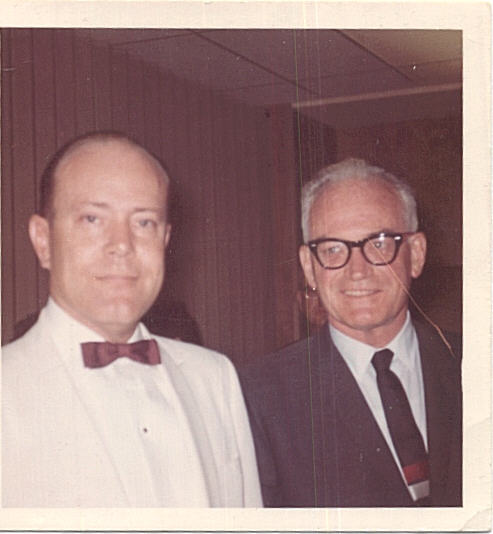
Barry and Paul (in the tux)

Barry and Paul (in the tux)


Howard and Paul

Howard and Paul

My old and cherished friend, Paul Jarrett, writes from Phoenix Arizona:

 
“Thanksgiving is the day we reserve for giving thanks.
When I was small, every meal was preceded by “returning thanks” which was “Grace” before meals.  It was “returned” by my father if present, or mother if not.
This brief prayer was to express gratitude for God’s many blessings and to ask for His continuing guidance.  We did not eat before the “Blessing” was asked.
While it is true that when small I was impatient to get this ritual over so that I could scarf down my meal, it is also true that I can hear Dad today in my mind’s ear reciting the blessing and realize how important it was to him, no mere gesture or formality.
Once in awhile in a restaurant I see a person asking God’s blessing on the food they are about to eat, but very seldom.  I must admit that I do not do it myself so as not to attract attention.  For that matter I do not “return thanks” when I am by myself at home, a matter that I shall correct.
God doesn’t need these rituals, we do.”
 
Paul is exceedingly old and exceedingly wise. In his time he has been a military surgeon, an aviator, a morbid anatomist.  This means he could fly you to hospital, operate on you, and should you be ungrateful enough to die, Paul would, without hard feelings, carry out your autopsy. 
 
Paul describes himself as conservative. He claims to be to the right of Barry Goldwater. He shows a photo to prove it.
Nowadays, Paul cuts neither the living nor the dead. He contents himself with wise and sometimes splenetic observations about a world and a nation going to the dogs.
 
Paul’s reminiscences are always evocative. His recollections of Grace evoked this memory of my own:
Dear Paul
I recall growing up in a country town in new south wales where our family were the only Jews.
my closest friend’s family were Presbyterian.
like my friends the jarretts, the wanklyns provided kosher meals so i could eat with them.
dulcie wanklyn prefaced each meal with: FOR WHAT WE ARE ABOUT TO RECEIVE THE LORD MAKE US TRULY GRATEFUL.
i recall sitting through this small ritual, head down, in quiet uncharacteristic decorum.
i’d gaze at the linen napery, each napkin held furled inside its collar of china or silver or pewter.
it all seemed holy.
no-one ate, no-one spoke, until AMEN was heard.
it never occurred to me that the benedictions  my father taught me and which we recited before and after every meal, were likewise, Grace, and likewise holy
the problem with an everyday ritual is ritualisation, the normalisation of the quite audacious idea of finite man reaching with words towards infinte God
mrs wanklyn never made Grace feel mundane
love,
Howard