A Dream

In early 2018, fourteen of Clan Goldenberg descend on a vast villa in the Dominican republic. We have not been long in DR before we start to feel its bite. While we reside in a vast house of huge rooms and lush grounds the world outside is very different. Simply put, the people are poor. While the sun-and rain-drenched soil feeds most of its 13 million people more-or-less adequately, measures of relative poverty place DR 19th-poorest on the planet. Schooling is free but generally brief and standards are deplorable. We read of teenage pregnancy – 28 percent of girls aged eleven to fifteen have undergone termination of pregnancy. Unemployment and sub-employment drive a cycle of generational poverty. The poor attend poorer schools for a shorter period. They leave, they marry too young, and it all starts again.

There is, it appears, something of a solution. For every additional year that a girl stays at primary school there accrues a 3% rise in her employability. But for every additional year of high schooling, employability rises 26%.


So far, so regrettably common. But there’s something uncommon about this particular half-island. In 1938 two of the worst humans of modern history found themselves at cross purposes. While Hitler worked to persecute, and finally to exterminate Jews, Trujillo, the Dominican butcher-dictator, strove to save them.

At the ill-fated Evian Conference, convened by Roosevelt to find countries of shelter for Jews, thirty-two nations gathered. The setting was elegant, the food sublime, the sentiments uniformly noble. The outcome was disastrous: America remained obdurately closed; Britain accepted children but kept Palestine closed to Jewish immigration; vast, empty Australia piously declared: we are a young nation without a racial problem (really?) and we have no wish to import one…


Nation number 32, the Dominican Republic, vowed to take 100,000 Jews.  Why did Trujillo make his offer? While opinion is divided about his motivation it seems he was anxious to improve his image following his recent massacre of 20,000 of his countrymen. Trujillo, himself partly black, was a racist who used to powder his face white for public appearances. He stated he sought Jewish immigration to raise the standards of Dominican agriculture and industry. He added openly his wish that by intermarrying with locals, European Jews would whiten his citizenry.

It is this mixed package of information that bites us. In Sosua, in the neglected north, we find a remnant Jewish community, proudly Dominican, proudly Jewish, unashamedly religiously ‘impure’. Sosua speaks to the grateful heart. A friend from New York helped to endow a school here for the children of the poorest, dedicating it to the memory of his mother Flora, herself an early childhood educator.

Sosua bit our friend and it bit my family too. We are accommodated between Sosua and Cabarete in a gated community of vast villas with yawning ceilings, timbered walls and picture windows opening onto lush grounds. Cheerful Dominicans bearing weapons protect us (from cheerless Dominicans?), patrolling the grounds day and night. Their guns have the look of the blunderbuss, somehow horrific and laughable at the same time. It is all very comfortable – just a little too comfortable for comfort. A comfort from which our New York friend relieves himself by working relentlessly for the people of DR, both Gentile and Jewish.

Two days ago we visited the school named for Flora, a part of the DREAM Project. The drive from Sosua to Cabarete was punctuated by the now-raining, now-sunny weather and the familiar dicing with death of the weaving motocyclistas along the perpetually slippery roads.

When we reached Cabarete’s sole traffic light we turned right, as directed, along Callejon de Talloga. This little ribbon of road twists and turns though the Dominican village, a place vivid for its street life and stark for its street life. People here abide in evident vivacity and in evident want.

We become lost repeatedly in side streets too narrow for a U-turn. Few of the villagers speak English but everyone knows the two words, DREAM Project. Faces light up, people point, someone materializes as designated interpreter and directions are given.

The roads are narrow, footpaths are lacking, and soft human bodies share the roadway with battered cars, bikes, motorcycles and hungry dogs. Dwellings are tiny and insubstantial. They will not survive the next hurricane season. Eateries are very numerous, generally someone’s front room. Bright colours, lounging youths, slim-hipped schoolgirls, their bodies advancing to a ripeness far beyond their years, smiles everywhere, people moving with the grace of dancers; life is pinched but never mean.

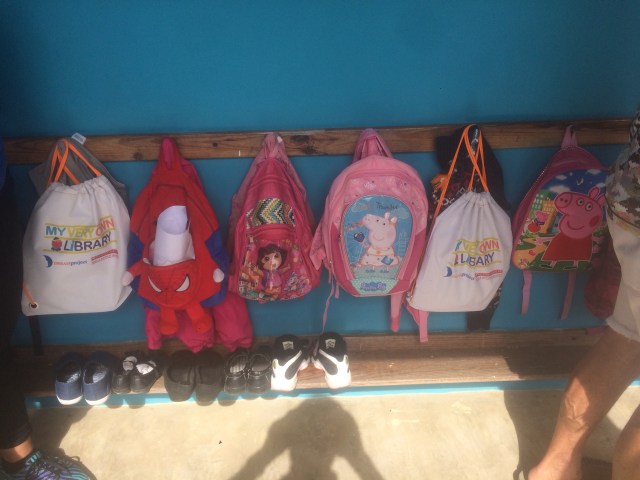
We turn a corner and here are the DREAM Project’s Flora Rabinovitch premises. By chance our visit coincides with the inauguration of something. The fundraiser, a charming American called John, shepherds a small herd of pink visitors to an outdoor shelter where he explains the DREAM in fluent and quite accessible Spanish and in English.  Seated on the ground before us is a class of three-to five-year olds, the pupils of the beginners’ grade. The children observe deep decorum, their bodies unmoving, their grave faces a mute challenge to all: behold my irresistible humanity.


The fundraising man is handsome, utterly charming, and he is paid to charm us. He certainly charmed me. If he told me he was going to campaign for the re-election of the incumbent President of the United States I would probably follow him and drink at his Tea Party.

But charm is needless. Outside on the street the need is visible and unpretty. Here in the bricks and flesh of the school is a serious gesture towards cure. John-the-Charming reels off figures and facts: We now have ten regional and rural schools, we have 750 students, we teach by the Montessori System…


Montessori! My own children attended a Montessori school. It stands for a learning which is neither rigid nor structured; rather the child chooses what to task to learn, and having once learned it, moves onto another. The teacher explains: The child learns tasks of living. We prepare the child for life at each child’s pace. The pace can be quick: many of our four-year olds are reading.

In the USA Montessori means private; private means money. These kids of the DREAM receive schooling that most Yanquis can only dream of.


We sweat for a while in the blaze of day then follow John and the teacher to the classroom of Beginners. The flesh and curls teacher closely resembles the young woman of the billboard, at work among her charges. We stand, towering above children who are impossibly small, impossibly beautiful and so, so solemn.

The children will invite you to come and sit. They will teach you what they have mastered.


One child takes my hand in hers and sits me down at a tiny table. She turns, walks a little distance to some shelves where she selects a tray, which she carries studiously to our table. She sits. Upon the tray I see small sheets of coloured paper and a small bucket filled with sharpened pencils. I ask her name. Facing downward she makes a small sound which I cannot make out. Rather than disturb her composure by asking again, I hold my peace.  My nameless little teacher takes a yellow pencil and traces a fairly straight line on the bottle-green page. At the termination of the line she draws a roughly circular shape. Gravely she looks up. I nod. Once again Anonymous Child draws something linear which runs to and joins something circular. I might be looking at a balloon on a string, an olive on a twig, or a circle and a line. I nod again. Little teacher hands me a pencil and I do my best to emulate the task she has mastered and taught me.

My lesson is over. I thank the small teacher and approach the adult teacher. I describe an outback school in Australia’s Top End where I saw undernourished children, and where the school feeds them. The pupils eat two hot meals a day on every school day, their sole reliable nutrition. Does the DREAM in Cabarete feed these kids? At mid-morning we have Snack. The government supplies milk and bread. The school supplies cookies. At lunchtime some children have no food and we teachers feed them from the lunches we bring from home. At the end of the day we give leftover bread and milk to children of hungry families to take home.

It’s time to go. A quiet word to John Charming. Yes, the school does accept donationsOne hundred percent of donated money goes to work in the classrooms.

I trust the DREAM. I donate more than I imagined I might at http://www.dominicandream.org/ and so can you.
Running to a Dream

After the Malta Marathon I took a break from long runs. The physical recovery took about one week, two at most, moral recovery much longer. I feared long runs. The thought evoked moral nausea.

Perhaps that’s why I managed to acquire my first real injury in forty years of running. Perhaps that’s why rest brought no cure; why physiotherapy didn’t fix me; why eventually it hurt too much walk. Surgery followed, together with the instruction, ‘No running for 6-8 weeks.’  Disability became my comfort, surgery my excuse, prohibition my refuge.

***

Almost one year pass without a single further marathon. Finally my legs speak up and today, fifty weeks post-Malta, those legs mandate a long run. I decide I’ll try to run to Cabarete and back, a distance of 23 kilometres. We visited the poor Dominican village of Cabarete a couple of days ago, and we know it a little. Cabarete is the home of a Dream.

Here in the Dominican Republic the air perpetually feels thick and today it is a mantle, heavy on the skin. Very soon a fine rain falls about and upon me, a rain too fine to soak my thin singlet. The horizon disappears in the grey, and with the light Sunday morning traffic noises quelled it is a softer world that welcomes me back to the long run.

In this northern part of the country but a single road runs from Puerto Plata to my turning point, Cabarete, and beyond. Some dreamer designated this road a highway, but the reality is simply one lane of traffic twisting in one direction and a second stream struggling back. Potholes large enough for caving lie concealed beneath pooled rainwater. Three vehicles in four are motorcycles, underpowered and overloaded. The bikes carry a load of soft flesh. Usually two ride but sometimes I sight a third body, even occasionally a fourth – generally children – squeezed between driver and pillioned passenger; and my first-world heart misses a beat.

These frail conveyances seek safety on the verge, where I – likewise a frail conveyance – seek safety as I run. I run facing and dodging  the oncoming traffic.

Traffic regulations are observed in DR in the breach. Red lights appear to be advisory only. In one full week of daily runs, I never see a motorcyclist in a helmet. Life expectancy is low here, human life guarded less closely than in my fretful homeland. However today, ‘Domingo, the Lord’s Day,’ I actually sight in the gloom what looks like a helmeted rider. Is this possible, I wonder? A large roadside sign answers: Con Dios Todos es Possible.


The rain has thickened but it does not dampen my spirits. Luke-warm, it falls vertically in fat drops, cooling me sweetly. Legs free of self-doubt propel me forward, the kilometres turn into miles, nothing hurts. I breathe fresh air fortified by hydrocarbons and the smell of cow manure.

When I asked my friend Edith, ‘are there snakes here in DR?’, she answered: ‘No. No snakes, unless you count the little green ones. They’re harmless.’

Running beneath a pedestrian overpass my shoe strikes the tarmac just beside a serpent lying in the warm wetness. This reptile is about a metre long, striped in the pattern of Australia’s decidedly unharmless Tiger Snake.  This particular serpent would be a baby tiger in Australia; his thickness a little less than one inch. At present this snake has no volume, he is a planar serpent, compressed flat by some overrunning heavy vehicle. My legs cease their running and I study the deceased. His small mouth gapes venomously, as if to frighten Death himself. He looks neither particularly little, not at all green, and absolutely not friendly. But he is extremely dead.

I run on.

Tottering along on its four circular feet an ancient motorized cart passes me, headed for the tourist district. Loaded chaotically with watermelons the cart conveys undefeated optimism. In the family of a watermelon seller life and sustenance, hang by a filament. I recall my Papa, a professional watermelon seller operating in the waters offshore from the fishing port of Yaffo (Jaffa) in the 1890’s. Hunger drove Papa from school before he’d finished Third Grade. He’d buy watermelons in the market and swim them far out to sea in the hope of making a sale to thirsty fishermen in their boats offshore.

Eventually I arrive at Cabarete’s sole traffic light, my turning point. Nothing hurts, breathing is easy, I’m feeling strong, nothing daunts me. I turn and run for home. Is it raining still? Strangely, I’ve stopped noticing; it seems to make no difference in this damp-never-wet-for-long-never-very-dry place.

Back to snake overpass and here, on the opposite side of the ‘highway’ lies another serpent, his dead brother’s twin. Something unexpected happens: I feel sorrow for the poor dead creature, crushed, spine broken and wrenched into a violent right angle that is, anatomically, all wrong angle.  D H Lawrence’s ‘Snake’ comes to mind:

Was it humility, to feel so honoured?

I felt so honoured.

Reading the roadside hoardings as I run, pretty soon I crack the code: if the language is English the signboard addresses pink people, Gringos, especially Yanquis. The pink have the money for this spiffy resort, that shmick kitesurf school, these elegant condominiums.

As in Australia, the person in DR who cleans your room, or cooks for you is not pink. He or she is pigmented and poor.

An eatery describes its fare in emphatic upper case:

BURRITO’S


TACO’S


BOWL’S

It is to puke. The feral apostrophe has invaded the hispanosphere.

Grammar-appalled, I run on.


Here’s another roadside notice: an attractive female face beams down at the traffic. On her fitted t-shirt one reads:DREAM PROJECT, Dominican Republic Education And Mentoring. Surrounding her, small dark faces bend over books, desks, small trays; little fingers grip pencils in a rainbow of colours. The scene of infant industry carries a powerful message. Along the lower margin a reminder: WWW.DREAMPROJECTDOMINICA.ORG

I recognise those pleasing features. Together with my Australian-American family I visited the Dream Project a couple of days ago.

The Lady in Seat 22 F  

Somehow the airline separates me from my wife. They allocate Annette seat number 21 C and they give me 22 B. Arriving at Row 22 I find seat B occupied by a young mum with a baby on her lap. The baby is asleep. The young woman explains: ‘The cabin attendant switched me so my Mom and I can sit together. Do you mind?’

I don’t mind at all.

The cabin attendant appears at my elbow. ‘Seat 22 E is free. Do you mind sitting there?’

I don’t mind at all.

I take my seat between a youngish man and a younger woman. He’s a muscular nugget. His fair facial bristles catch the morning sun and glow gold; she’s slim, no whiskers, café au lait skin. The man busies himself with his keyboard. I open my paperback. The lady smiles, says, ‘Hello’. I catch an accent, try to place it. Guessing she’s a Latina I prepare some Spanish. ‘De donde estais?’

‘Not from Espain. Not from any espanish speaking country. Try to guess.’

‘Slovenia?’

The smile widens. She shakes a lot of wavy hair: ‘No.’

‘Turkey?’

More hairshaking. She’s laughing now.

‘One more try.’

Guessing wildly I try Portugal. She laughs a merry laugh. ‘No. Saudi Arabia.’

Golly. No head covering, light brown hair, pretty conventional western dress.

‘She proffers a child’s hand: ‘My name’s Amy.’

Golly.

‘Hello, Amy. I’m Howard.’

‘What is your country, Howard?’

‘Australia.’

I give her time to absorb the incredible. Then, ‘You are Muslim?’

‘Yes, of course.’

I remove my cap, lean forward, reveal my yarmulke: ‘I’m your cousin.’

The smile widens. She’s delighted: ‘You are a religious man. I pray every day five times. I am estudent.’ She names her university in Los Angeles, a name not known to me.’ When in Saudi Amy wears her head covered, ‘only my face you can see.’

Amy tells me of her two brothers and her sister who are back in Saudi Arabia, with mother and father. A second sister is studying in LA with Amy. She points to a rich head of darker hair that crowns a quite ravishing face in a nearby row,

I spend some time pondering the life of a young Saudi woman on a US campus. A woman who dresses western and prays every day five times. Pretty brave, I suspect. And incidentally, pretty easy on the eye.

‘Amy, why do you take the risk of speaking candidly like this to a strange man?’

The head lifts and she regards me, smiling a little as to one who is naive: ‘Instinct.’

Back to my paperback. The young bloke types something about a baseball match. The young woman takes out some study sheets. I sight some highlighted terms familiar to me – homeostasis, perception, adrenergic flight/fight response. The head of wavy hair bends over the notes, a child-size finger traces the lines, her lips frame the foreign words.

‘What are you studying?’

‘Clinical Psychology. And what is your profession?’

‘I’m a doctor.’

‘That’s good. Maybe you can tell me what is homeostasis.’

I tell her what I understand by that term, the neologism I encountered first in 1965, a word that widened my mind.

Amy nods gravely and thanks me.

After a while Amy sets Clinical Psychology aside. She looks at my book and asks:’ Is that a good book?’

‘I think so, yes.’

‘But you do not know?’

The book won a Pulitzer. A close friend pressed it on me, saying: ‘Read it if you want to know DR.’

Do I like it? Not much. At least not yet. The plot, yes; the characters, yes yes yes. The style, not much.

Homeostasis is simpler to explain than ‘I think it’s a good book, but I do not know if I like it.’ A deep breath and I essay some literary criticism: ‘This book won America’s top award for literature. I think it gained attention for its unusual style of writing and for telling the modern history of the Dominican Republic in the story of one unfortunate family. The writing is bright, the story is dark. The language is lively, plenty of street talk. Every third word is nigger, every fourth word is fuck.’

I pause. No shock registers on the estudent’s face.

‘The characters are vivid and their story is dramatic. So, yes, I think it is a good book, an important book. Even ‘though I do not enjoy it much. Yet.’

‘You read many books?’

‘Yes, I do.’

‘Tell me please what books are good for me to read. Books you do like.’

She couldn’t give me a pleasanter task. The flight from Los Angeles to New York takes four hours. That might suffice. I speak of my favourite of all books written in the twentieth century. This is the book I read at Amy’s age ( I’m guessing here she’s as old today as I was fifty years ago): ‘The Leopard, an Italian novel of an aging aristocrat – you know? (Amy nods) – he sees the life he has known and loved, a life of privilege, passing. He knows that life will be lost.’

Amy remarks, ‘Life in my country is also changing… Slowly.’

Next I speak of Anna Karenina. ‘This is also an old book, more than one hundred years, written by another aristocrat, Leo Tolstoy. It tells the life of a woman who disobeys the rules of her society and obeys only her passion. She loves a man who is not her husband. I like this book very much; I respect Anna’s courage but I am angry at her too. I am angry because she turns her back on her son, a small boy.

‘It is an important book, one of the earliest books to give a woman strength, courage to make choices and to follow her own path.’

I watch Amy for signs of disapproval or discomfort. No sign of either.

‘Although I don’t entirely like Anna, the character, I like the book. The author shows us life. Like Shakespeare, he knows the good and the bad, the strong and the weak. He knows them and he shows them. He is not the judge, he gives us the life.’

‘And one more. This is maybe America’s most beloved book of the Twentieth Century. I love it very much. It is called, To Kill a Mockingbird. It is written by a woman, Harper Lee. The story is told in the voice of a small girl who lives in a town in America’s south at a time when many white people showed no respect for black people. The girl’s father is a lawyer who tries to save a black man who is accused of raping a white woman. You read this book and you love the father and you love the child.’

Amy asks me to write the names of the books she should read. It dawns on me I’ve recommended three books that challenge old norms. The books subvert male dominance, they chart the passing of feudalism and ancient authority, they show the rule of equal law.

I have lots of questions. Amy answers them readily. No she doesn’t go out with men (‘I am a good Muslim’), but she had been engaged to marry a man whom she chose. That was back in her home country. Later the engagement ended, the free decision of both. No hard feelings, no honour issues. It occurs to me Amy has found in Seat 22E a Father Confessor. I wonder about her vocation: I don’t know anyone who works in mental health who enjoyed an easy childhood.

The aircraft’s engines keep up a steady hum. Conversation is hushed and most passengers sleep. As Amy sits at the side of one of my deaf ears, there’s no lip-reading and I miss some of her speech. When I ask, ‘What work does your father do?’, I miss her reply. She repeats : ‘He’s a general in the Air Force.’

Golly.

She adds, ‘My mother is a school teacher.’

‘When you finish your studies will you return to your country?’

‘I will visit. My older sister has two babies. I must see them. But my life, I think maybe here in America. And my sister Sara, she is here.’

My mind races from question to question: Is Amy the right sort of Muslim – by the lights of the current President – to be admitted to the USA? What does Daddy the General think of Amy’s choices – dress, spouse, profession, place of residence? All her choices bespeak independence but in reality she must be completely dependent on Daddy. Amy has none of the bearing of the rebel – there’s nothing defiant in her speech – yet her Americanness must challenge Saudi norms. I think too of the engagement of the Saudi’s military – especially the Air Force – in the nasty war in Yemen. A Saudi general would be a serious man.

These are questions this old man does not ask. Meanwhile the estudent has put away her study notes, buried her head in a blanket, tucked her legs beneath her and, by some miracle of youthful calisthenics, made herself comfortable enough to sleep. For the next two hours the Princess of Araby slumbers in Seat 22F. She awakens as we descend, smiles, shakes my hand and asks, ‘When will I meet you again, Howard?’

Summer Stories: Just Dirt

Before arriving in Coober Pedy I read of The Breakaways, an accessible scenic spot of some sacred significance. Once in town I asked directions. These were simple enough to alarm me: ‘Turn right at the Stuart Highway, turn right at the signposted track and drive to the end of the road.’  And – ‘You  best get there in time for sunset or sunrise, when the colours are stronger. Other times it’s bleached by the sun.’

The Stuart bisects our continent. I’ve never found myself alone on the Stuart before. The road roars with lorries and road trains that hug the tail of your smaller vehicle at their permitted 110 kilometres an hour. But this early morning my car alone moved through the dark along the Stuart. Cloud covered the stars. The car radio was silent. A velvet cloak sat upon the earth. I knew I was alone.

The kilometres slipped behind me as I raced to catch a doubtful sunrise. A tiny signpost flashed into sight and out. Had I missed the turnoff? I laughed aloud at my famed ability to get lost. But no – a few minutes on a large sign read: THE BREAKAWAYS. So-named, I read, because chunks of the planet appear broken off from the surrounding scarp.  One or two locals, indigenous people, shrugged when I mentioned The Breakaways: ‘Never been’, said one. ‘Just dirt’, said a second.

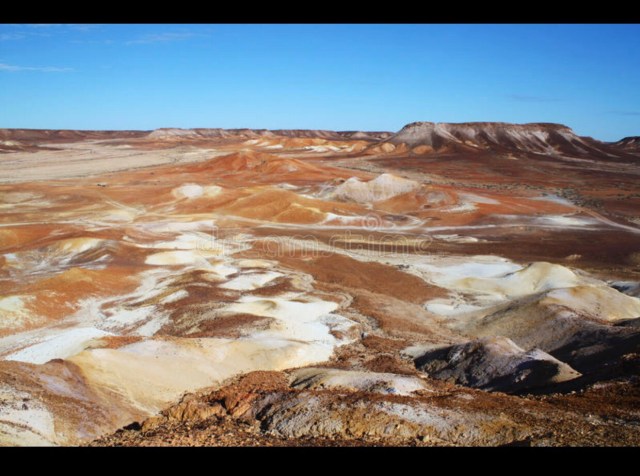
The velvet was breaking up. Teal blues split the clouds, a lightening over my shoulder from the east, the dark surface now reddening, the black grasses greening. Earth awakening, but everywhere, silence, stillness. The dirt track shifted beneath my tyres, the car, tipsy, slid from side to side, my passage never quite controlled, not fully skidding. Up a rise, the end of the road. Once out the car the first sensation a blast of wind, night-cooled, but warming towards today’s 46 maximum.  A wooden barrier separated me from a sudden void. The earth fell away at my feet, a vast valley, roughchopped, opened before me. The wind tore up the slopes and away. Nothing else moved. No sound. No life. Stepping forward felt like sacrilege.

I stood still and gazed, astonished. Unprepared for an encounter none could prepare for, I simply stood. My eyes flew up the slopes of table-topped massifs and followed the fall of abrupt clefts. Hills of caramel pink and nude rocks of white ochre in a repeating pattern of rise and fall, fall and rise. And no sound at all. Was this the birthplace of the world? Would that scrubby shrub at the valley floor burst into unconsuming flame?

I stood for some time as one at prayer. I knew an aloneness and a silence and a stillness that must have spoken to my soul. In time I returned to time and I took up the elements of my ritual dawn prayers and I prayed and I gave thanks. I felt kin to others who have stood here over the millennia and contemplated creation. I made my poor homage.

At length a living thing came to me in the stillness, a blowfly. The fly sniffed and sipped, and finding my skin dry, it went its ways. The wind whipped my tallith which made to join the insect in flight. Alone again, no human on earth today had better access to his Creator. If a voice had called, ‘Howard, Howard’, I believe I’d have answered, Hineni.

My prayers done I walked to the display that detailed the nearby salients. The text, authorized by a local elder, hinted opaquely at their sacred significance. The place has its true name, Kangu. Behind me at a short remove was the bearded dragon, Cadney, over there was Pupa, two dogs lying down.  And in front was Kalayu, the emu, father caring for his chicks. The area is an initiation site for young boys. Its elaborated meanings are secret, forbidden. This is meet. Sufficient to be here in mystery.

A side track to Pupa beckoned and I ran. Ochreous powder cushioned my feet. The track took me down and around. Soon I was at the valley floor and the mighty forms rose up, thronging about me. This was ‘just dirt’ and I human clay, a small thing in all the greatness. I thought of the miracle of being, I thought of annihilation. So easy here, to slip, to fall, to break an ankle. In a day or two the heat would finish a crippled runner. The thoughts carried no drama, little colour. Death in this valley would be ordinary; it was living and moving that were out of the order of things.

I was alive and moving. I turned and I ran back up the hills.

Summer Stories: A Small Town in the Bush

This blog has just now awoken from a long nap. While asleep the blog saw or visited or dreamed a number of summer stories. Here’s the first.

You might have heard of Avoca’s rushes. The gold rush, the coal rush, the bull rush.

You drive in on the main street and the first thing you notice is nothing. I mean the main street is wide, country town wide. And nothing moves.

You know you’ve arrived in an Australian country town when nothing happens. Unlike the classic barroom scene in the Westerns, where the arrival of the newcomer throws the crowded bar into silent, menacing scrutiny of the arrival, you arrive in Avoca unremarked.

People reside in Avoca but no-one rushes here. The rushes are over. The bull rushes persist, but they persist in a gentle way. The bulls graze, they browse, they produce their climate-malignant methane and they do their business and they leave their calling cards. Only when serving a cow does the Avoca bull rush. Avoca is no Pamplona.

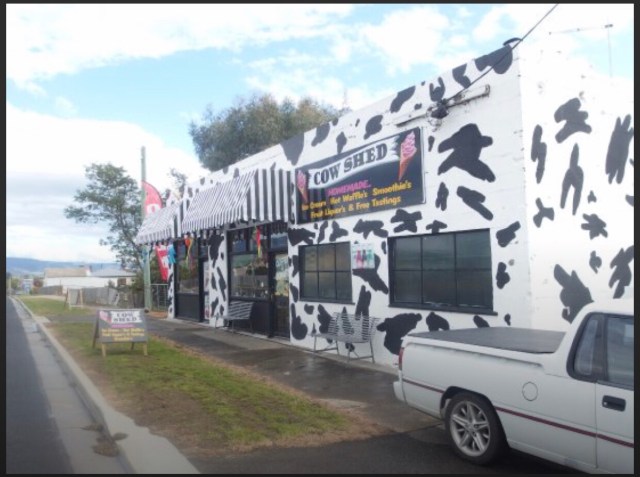
In the main street the structural element of the bovine persists in the shape of the Cow Shed Café. I saw the cafe and, metropolitan coffee snob that I am, I drove past. On a later visit the Cow Shed Café was still there. So I stopped. I found the shop is wider than it is deep. Within the narrow oblong between the shop’s front and the high counter you stand closely surrounded, indeed compressed, by handicrafts. You can buy doilies and crocheted items that are rich in colour and of no function that I could divine. They look like something your granny might make for charity or for therapy. But these are for commerce. You can buy them. Postcards that show the Cow Shed Café sit on the counter awaiting your purchase. Next to the postcards an array of jams and sauces and syrups and chutneys gleams at you. These are Avoca’s café’s crown jewels. Behind the counter a man as tall and narrow as his shop stands and awaits your pleasure. He’d be fifty, perhaps a decade more, the skin of his brown face hangs in deep furrows, his voice is deep, resonant and very pleasing. You hear the voice and you know you want to have a conversation with this jam and doily man.

‘Who makes these jams and sauces?’

‘Mother. Mother makes them all.’ A sweep of a long arm encompasses all the handicrafts and the comestible preserves. ‘Mother picked these raspberries this morning.’ I hadn’t noticed the berries. Bright like the doilies they call, Buy me! Buy me!

‘Lived here long?’

‘All my life. Mother too. We’ll all leave one day, feet first.’ The man smiles and the smile and the voice merge, a single harmonious entity.

I buy some bright things and I leave.

The historic records evoke old Avoca: “In 1827 Roderic O’Connor wrote in his journal – ‘There is a vacant space immediately at the junction of the South Esk and St Paul’s River. We beg to recommend reserving it’. In 1832 military troops, formerly at ‘St Paul’s Plains’, were recorded as garrisoned at Avoca.”

By 1834 Avoca was a town.

Apparently old Avoca was always a place of drama and event, as today. The record goes on: “Bona Vista’ (circa 1842) is a magnificent Georgian homestead built by Simeon Lord and doubtless the centre of society at the time. Martin Cash is said to have worked there as a groom before becoming a notorious bushranger. In 1853 bushrangers Dalton and Kelly made a raid on the house, committed a murder and robbed the house. Blood stains remain on the steps. In 1890 a young man named Beckitt was murdered at the homestead woodheap, his body dumped in the South Esk River to be discovered by Tom Badkin Jr.”

The stone building calls to me and I approach and mooch around, here and at the church. A country quiet enfolds all. The afternoon wind softly sighs and soughs. The sun shines upon the green and the old convict stones speak mutely of endurance, modestly of grandeur. So fine these stone walls, their patterning and proportions so pleasing to the eye that sees not the aching backs and the cruel sufferings of the convicts who were the unwilling labourers.

A Post Office opened at Avoca on 1st Jan 1838. It stands still on the main road. I slow and read a sign outside offering the fine stone structure for sale. I stop and mooch. Naturally I want to buy it. I could do with a Post Office. But I’ll stand aside for you if you want it too.

Avoca lies in the Fingal Valley. Forty kilometres distant, Fingal is a town similar to Avoca. A nurse I work with tells me: ‘I grew up in Fingal. But I left. I realized single in Fingal might be my epitaph so I left.’

Starfish Flingers

Running along Cable Beach very early this morning I passed a couple who carried small plastic bags of a primrose colour. The two peered and bent repeatedly, picking up small items unseen and popping them into their yellow bags. I’d seen people at this before, collecting pippis, also known as cockles. Some collect them for bait (whiting love them) while others eat them cooked in garlic and herbs and wine. I sang to myself as I ran one of the old songs Dad used to sing with us kids as we travelled by boat or by car:


She was a fishmonger

And sure ’twas no wonder

For so were her mother

And father before


She wheeled her wheel barrow

Through streets broad and narrow  

Crying, ‘Cockles and muscles

Alive, alive O…’


I ran a long way before retracing my steps. On the return I passed the cockle collectors. I changed course to inspect their catch. ‘Are these to feed you or to feed the fish?’

‘They would have fed the fish, but not now,’ said the woman, a person in her early sixties, her skin fair beneath her tan. ‘Take a look.’ I looked into the bulging bag she held: no pippis, just sandy cigarette butts, scores of them. Her husband held his bag open. More butts, many more.


‘He collected 160 of them today,’ said the woman, ‘Same number yesterday.’ I stood and mused for a bit. The woman explained: ‘People sit on the beach and smoke and drop their butts on the sand. Later the incoming tide washes the butts out to sea where fishes see them and take them for food. After a fish swallows a butt it swells up in the belly of the fish and the fish suffers and dies.’


‘Look at this, and this’ – her husband pointed out filter tips – ‘These filters catch all the poisons and toxins, and if the fish happens to survive you might catch it and eat it.’


I looked at the man, his build compact, his face a scrotum. The white hat he wore had seen better days and even the best of those days wouldn’t have been much good. I liked the cut of his jib.

‘Are you locals?’

‘No. Bunbury’s home for us.’

I pictured the couple walking the beaches from the south of the state all the way north to Broome, collecting cigarette butts. One hundred and sixty butts a day.


And I recalled Jonathan Sacks, the immediate past Chief Rabbi of the English-speaking world (by which term I mean to exclude the USA), who quoted a vignette of two men strolling along the seashore which was littered with starfish washed up and freshly stranded on the sand. One of the two bent repeatedly to pick up the starfish and to throw them as far as he could out to sea. His companion watched and mused and finally spoke: ‘There are so many, hundreds, probably thousands. You can’t possibly save them all; even if you labour all morning, your effort won’t make any appreciable difference…’


The first man paused, starfish in hand. He regarded the creature, still alive, then threw with all his might. He said, ‘To this one it makes a difference.’

Johann Appleseed

He stands in the mall, an oddly striking figure. His right foot perches before the left, the heel resting on pavement, the sole raised at angle of forty-five degrees to the horizontal. The man looks as if captured in the act of tapping a foot to music. But the foot does not stray from its perch; and where is the music? Listen carefully and you hear a sighing, a musical sound in time with his breathing. Look closely: held between fine fingers that protrude from fingerless grey woollen gloves is a silver harmonica. The man is playing. Or is he merely respiring – breathing in, breathing out through the instrument?  My friend Rod is a local. He traverses the mall every day.  ‘I don’t think he’s playing music’, says Rod. ‘Or if he is, it’s one single note.’
 
 
The man’s appearance is unusual. His hat is of classic design, early American Puritan I guess. Johnny Appleseed's name that comes unaccountably to mind. That old apple-planting, godbothering American pioneer, an early conservationist, a beloved and mythic figure in his own lifetime and since. Doubtless it's the headgear: the high peak of the hat is a tall cone, the brim a wide downsloping verandah . The colours of the felt shift subtly from mouse-grey to a junior navy blue to a peacock green. The effect strikes me as quite beautiful. The man himself is slim and he stands a full head taller than I. The hair of his head and his beard is turning from jet to silver. He looks as if he might command a fleet or conduct an orchestra.
 
 
The man stands singularly alone. I mean not simply that he is unaccompanied, nor that he neither receives nor seems to need notice: I mean there is in his solitude a seeming self-sufficiency that contradicts his act of his busking. For surely he is busking, this man who stands and plays music in a public place. But if he is busking, where is a receptacle for coins or notes? No cup or box or instrument case on the pavement before him, no hat either. That rainbow remains on his head. I stand at a distance, observing, wondering. I approach and wait for a hiatus in the sounds that emerge from his instrument. There is no pause. Neither is there a meeting of eyes. I step a little closer, not close enough to offend, but too close to ignore. I stand in silence while the musician plays on in near silence. I have time sufficient to study the sounds he makes. I hear more than Rod’s single note, at least three. The sounds flow and merge like the hues of his hat. While I wait I admire the close-fitting leather vest that clings to his lean frame. At length, a pause. I ask, ‘Do you mind if I speak to you?’
The man looks down towards me, an expression without a smile. He speaks: ‘For what purpose?’
‘I am puzzled. I see you standing in this public place, you play your instrument as one might who is busking. Yet you provide no container for a passer-by to show appreciation…’
‘Yes. ‘
‘Would the offer of money offend?’
‘No.’
‘But you do not encourage it.’
‘Nor discourage. If a person wishes to show appreciation, a conversation must first take place. As is occurring at present.’
The man’s old-fashioned formality has seduced me into unconscious imitation.
‘Would you object to telling me your name?’
‘Possibly not. What is yours?’
“Howard.’
‘Good morning, Howard. My name is Johann.’

He pronounces it unexpectedly as Jo-Han.
‘Isn’t it really Yo-hahn.’
‘Yo-hahn, yes.
‘Dutch?’
‘Yes.’ A smile, good teeth, (a little yellowed) emerge from the shrubbery of his upper lip. It’s a nice smile. ‘My parents, from the Netherlands.’
‘Do you live in Alice, Johann?’
‘Yes. For five winters now.’
‘And before that?’
‘I wandered. I carried my swag from place to place, I slept where I chose, under the stars. I came to Alice Springs and it was good place and I stayed. I do not expect to find a better. I do not need a better.’  
‘Do you play here every day, Johann?’
‘It provides my breakfast. I meet here interesting people from many places. I enjoy conversation. As is occurring at present.’
 
 
Johann accepts some money gravely. And no, he has no objection to being photographed or filmed.

From Laurenzo Marques to Nyngan on Bogan

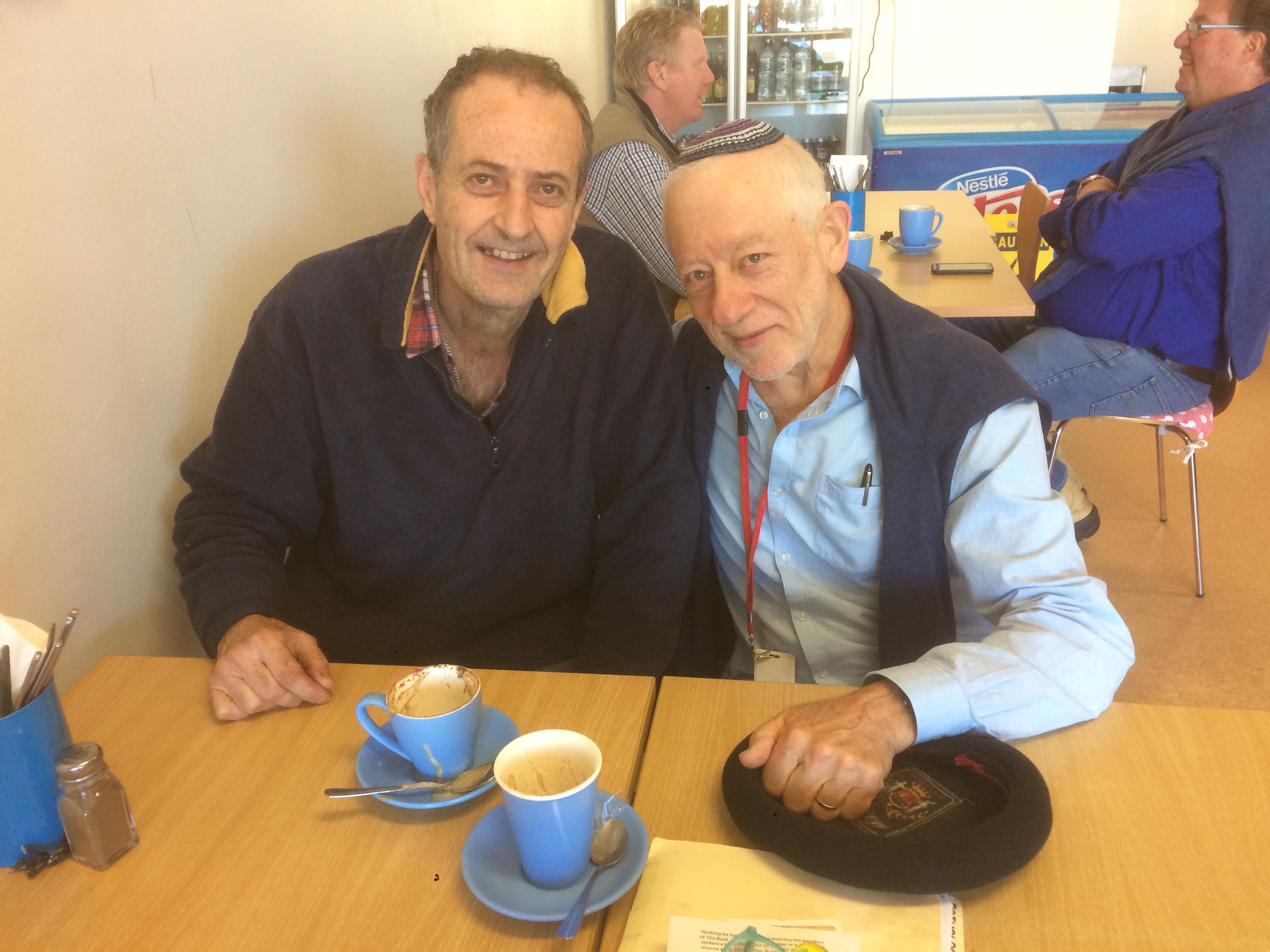
A man accosts me in the darkened lobby of the hospital in the small town where I’m working. ‘Shalom’, he says.
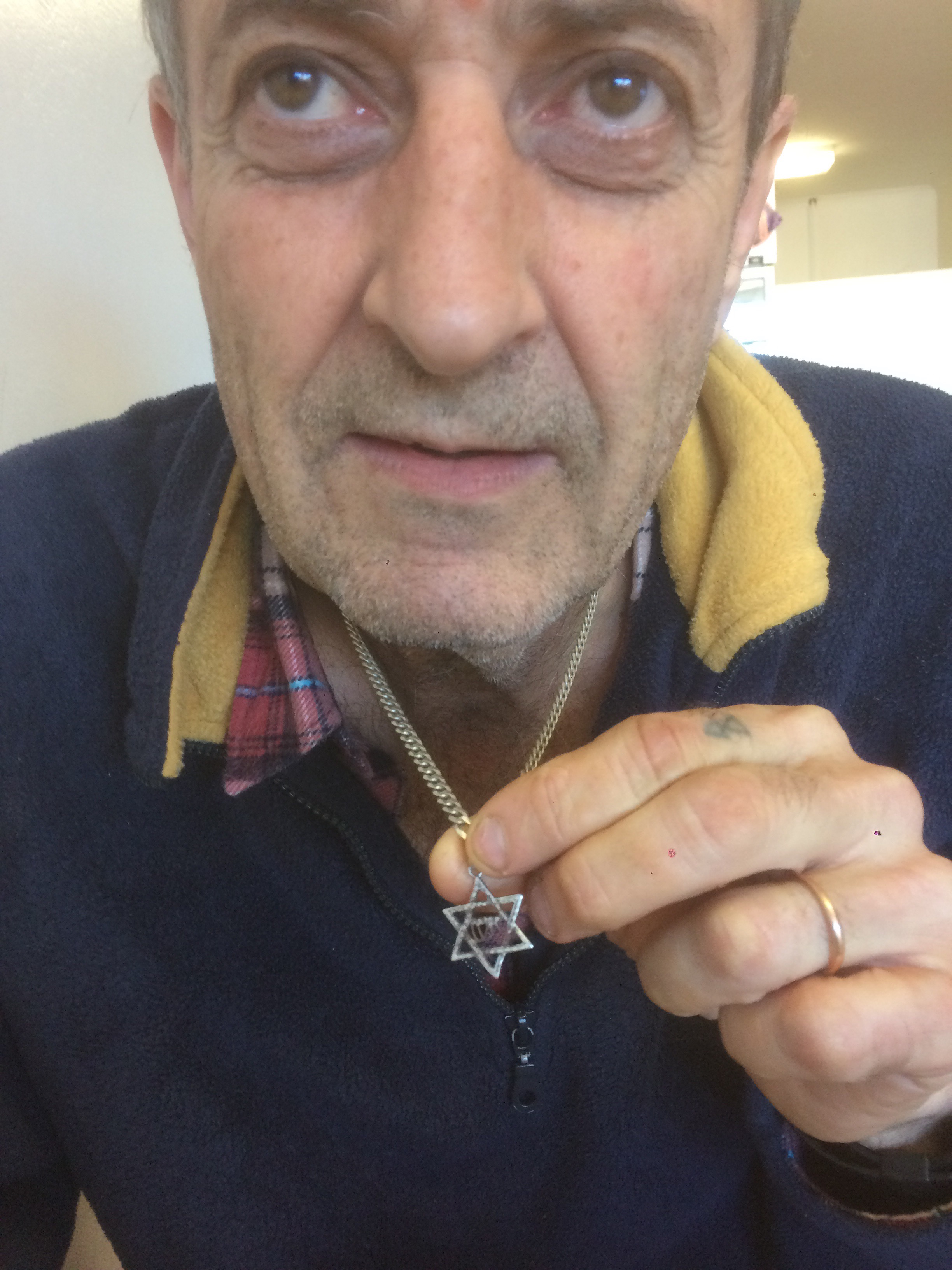
He gropes inside the front of his shirt and pulls out a silver magen david.
‘Shalom aleichem’, says I.
We swap names. For the purposes of this story, his name is Federico.
Federico looks not ancient, not brand new. He’s tall, compact, has an olive complexion and he bends forward as he speaks. His accent is not Australian-made. His English is arrhythmic.


‘What are you doing In Nyngan, Federico?’
‘I live here. Thirteen years now.’
‘Will you tell me your story?’
He does so.
 
 Before I repeat Federico’s story, allow me orient you to the remote, obscure town of Nyngan by referring you to my recent blog post (Nyngan on the Bogan).
 
Back to Federico: ‘I come from Mozambique. You know, was colony of Portugal. In 1976 Salazar dies. A bastard, Salazar. Like Franco, not a Jew-lover. Both of them, friends of Mussolini. Salazar dies, the blacks start to revolt and Portugal says, OK, we leave. They just run away, no negotiation, no transition. Then starts the war. A civil war. Massacres, the usual thing. First the Portuguese come to the coast in sixteenth century, they set up the port, Lorenzo Marques, a stopping place to their bits of empire in India. They go to India for the spices. They build their African colony by sending all their criminals, convicts. Like Australia. Like Australia, the same, those convicts become successful and they are comfortable. Portugal comes, butchers the blacks, in 1977 they go, then more massacres. Africa.
 
A nice place actually, Mozambique – for a Portuguese. But not now, not in ’77. In ’77, I know if I stay I will die. I leave my birthplace. My barmitzvah was there. In the synagogue, in Lorenzo Marques. Now I am in Portugal, a refugee, among all the refugees – from Mozambique, from Timor, from all places that Portugal runs away from. I cannot go back to Lorenzo Marques. Another Jewish refugee. History’s old story.
 
 
No-one can go to LM now. It does not exist: now the town is Maputo. And the big statue of that old colonist, Lorenzo Marques, they tear it down. Now in that square is a sculpture of a bird.   
 
 
My grand-grandfather comes from Portugal to Mozambique. Now my family, all gone, all scattered. Six brothers and sisters, some in London, some in South Africa, one sister in Norway. She was the last one of the six I have seen. She used to visit me here in Nyngan, every winter of Norway. Last time I visited her was before five years. That last time, in Norway. Family all scattered. The Jewish story. Always the same. You know.
 
 
You want to hear how I come to Australia? Things happen for a reason. There is a meaning. I study history, I research. There is a reason. I believe that. So in Portugal I am safe. My grand-grandfather was Portuguese so I have citizenship. But no future, a refugee. The Jewish story. Always the same. So I wander. I work in Vancouver, I leave, my visa has finished. I work in South Africa. Many Jewish there. I work In London, in Finchley Road. Again many Jewish. I work in Norway. In between visas I work on cruise ships. Eight years on cruise ships; you don’t need a visa. On cruise ships there are Jewish. Also Barbados, every one old, everyone rich. Some Jews there too. I work In Korea. That’s where the miracle happens that brings me to Australia.
 
 
One year before Korea in Vancouver I apply for Australia. A Mozambiquean friend in Australia advises me: be careful what you tell them when you apply in the Embassy. Don’t say the wrong thing. So the embassy woman, she asks me what I will do – she means work – in Australia. I say I have qualification. I tell her I am chef. I don’t know what answer is the right answer. I know from my friend they don’t tell you what they want and what they do not want, but if you say wrong, they close the door. I answer, I pay the application. It will take a few months, the application, she tells me. Another cruise. And another. A letter arrives from Ottawa. The letter is from Australian High Commission in Ottawa. I have immigration visa. But no money. To come to Australia I must pay. So I wander on cruises and I work and I save. And I know I will leave the ships one day and I will settle and all my friends on the ship, always they will be slaves. I pay for a flight from Korea to Australia. Maybe three hundred American dollars, I go to the airline office to pick up ticket, the day before my flight. But it is a public holiday in Korea. Office is closed. I have paid, I have visa, I have no ticket. My flight is tomorrow. Here happens the miracle. I put my face against the window. I see people inside, cleaning. I make with fingers – come here please – come to window, I must ask. They come, but no-one speak English. They find someone. I tell him I need my ticket, I point to the office where the woman sold me the ticket, they go in, bring the woman out. A miracle. A public holiday, in Korea, the office is closed but I have my ticket. Things happen for a reason, I believe it.


In Australia, in Sydney, I work in Bondi Junction. Again many Jewish. I am there some years. I marry there, my wife have lymphoma before we meet. Then she is cured and we marry. Have children. Since thirteen years I am in Nyngan. I come here, I come here for the peace. I work at the pub as chef. Then the manager closes the kitchen, leaves Nyngan, manages from the city. I have no job, but things happen for a reason. I believe that. I sit in this coffee shop and the manager of the biggest hotel comes in, says, Hello Federico. Come work for me.
 
 
Small town, you know, everyone knows everyone. Good people here. My wife gets a second cancer. We drive to Dubbo, we drive to Sydney, we drive, drive. Always long drives, costs hundreds of dollars petrol. And the people of Nyngan collect money for our travel. Good people in Nyngan. Nothing happens without a reason. But my son, he’s grown up, I tell him – get out of Nyngan, no future for you here, go see the world, go build your future. You know I believe.
 
 
Will you do me a favour, Howard? I want for my doorpost the Jewish sign, for the doorpost, you know. I google but I don’t just buy. Has to be real, you. Needs the writing inside, not just the box .   

Nyngan on the Bogan

 
 The term bogan (/ˈboʊɡən/[1]) is a derogatory Australian and New Zealand slang word used to describe a person whose speech, clothing, attitude and behaviour exemplify values and behaviour considered unrefined or unsophisticated. Depending on the context, the term can be pejorative or self-deprecating.[2]

  – Wikipedia
 
 
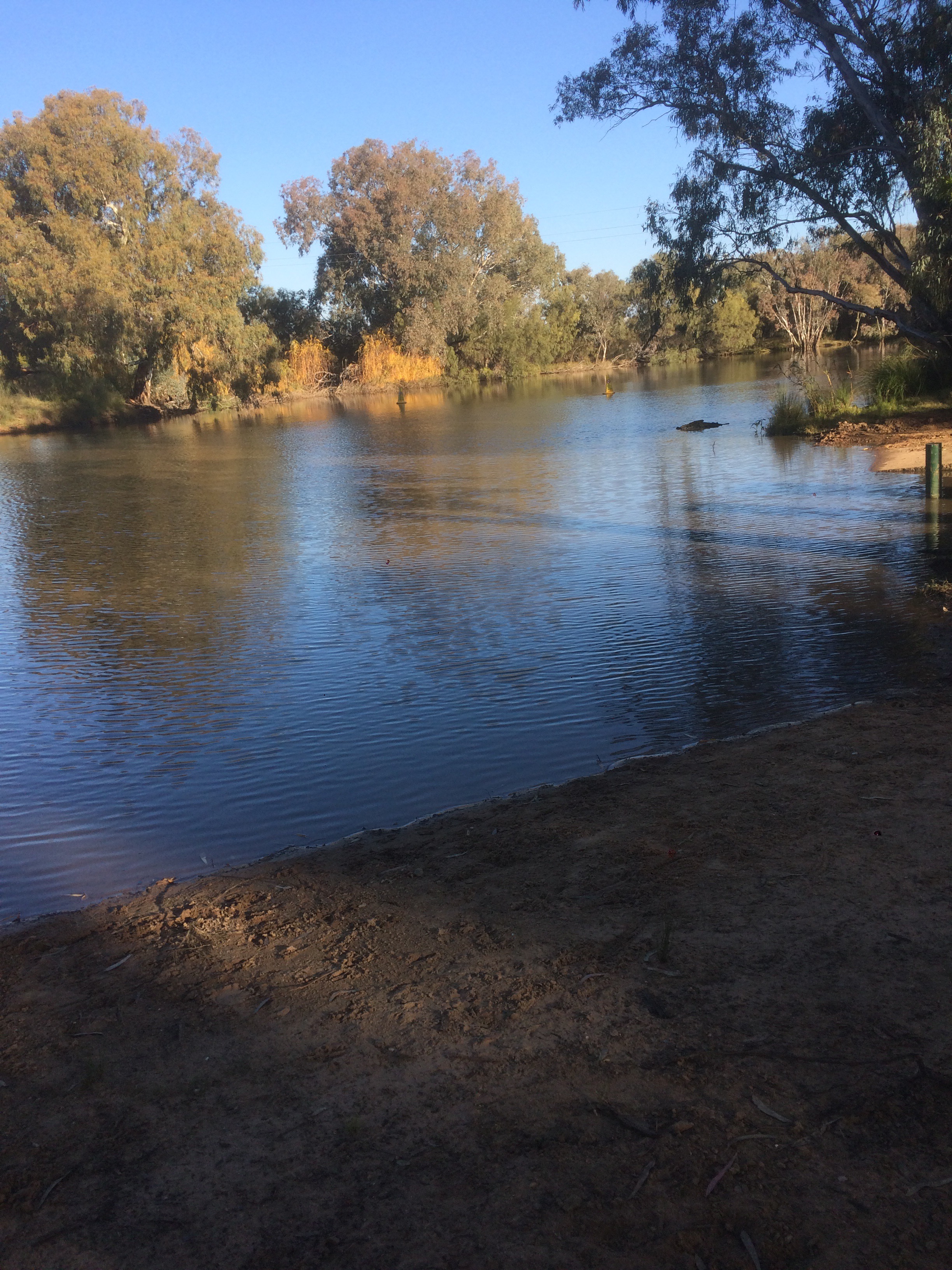
I never dreamed the river would give its name to the shire. I knew only that Nyngan was built on the eastern bank of the Bogan. A friend who knows his outback towns said, ‘You’ll like Nyngan. Nyngan’s doing well.’ My friend was right. I do like Nyngan. And I like the river. But I never imagined ‘Bogan Shire.’ You drive along the main street through the shopping centre, and you come to a small rise. At its top a sign reads: GIVE WAY TO HORSES IF ON BRIDGE. And there, stretching away to your left and your right are the tranquil waters of the river. Quiet flows the Bogan; you might say it’s a river with decorum.


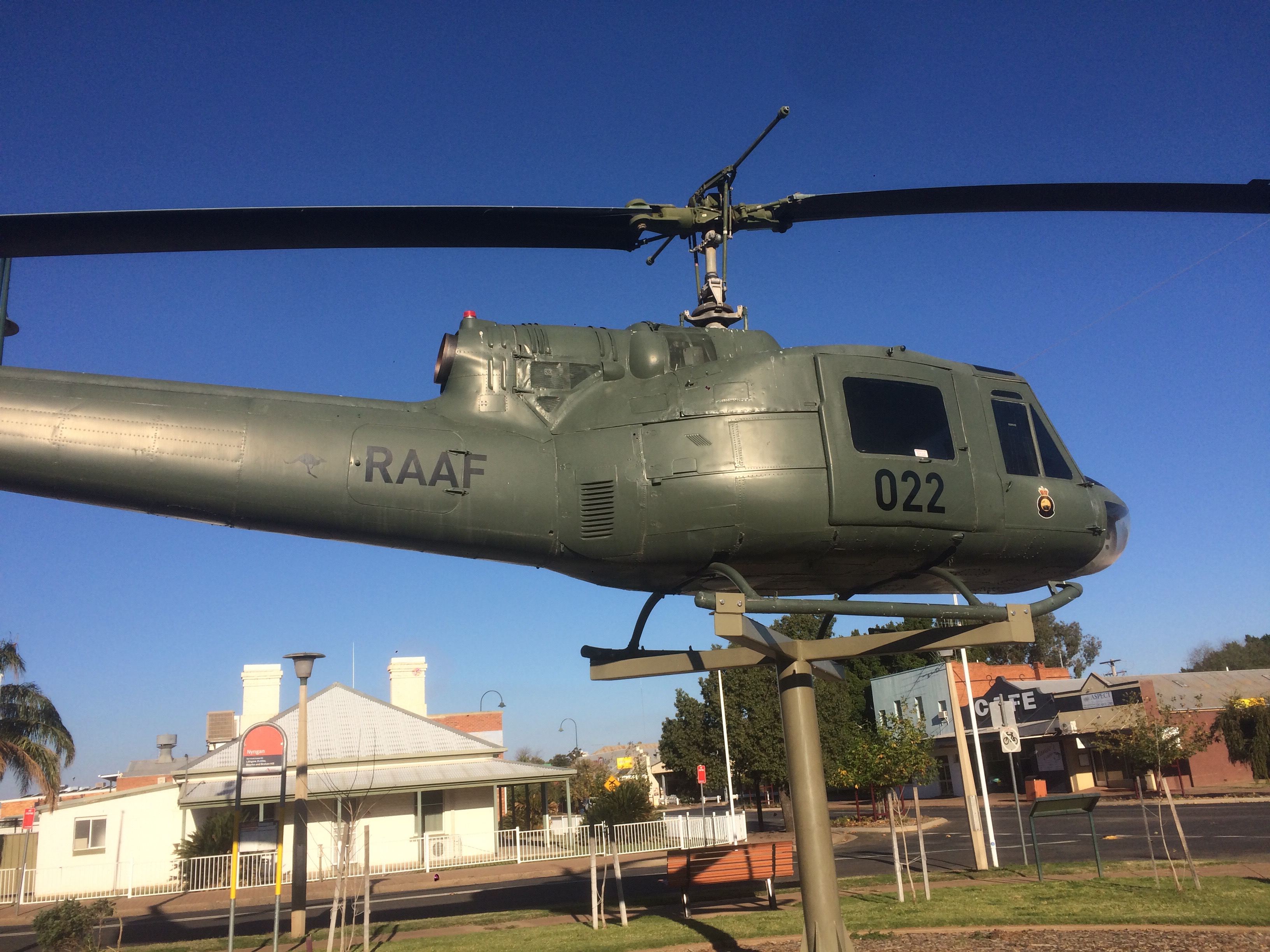
It was not always thus. In April 1990 unusually heavy rains fell in the catchment areas upstream. The Bogan rose and threatened the town’s modest levee banks. The local populace built a frenzied barrier of sandbags but the levee was breached and the town was flooded. The townspeople had to be airlifted out. The airfield being under water the only effective aircraft were helicopters. Everyone was helicoptered out, some on army choppers, on others owned by private individuals, and aboard yet others belonging to TV stations. The populace of an entire town was hoisted away into the air. One of the military choppers, a veteran of the Vietnam conflict, returned and stayed. It stands just off the main road as a reminder. Meanwhile the levee bank is now a full two metres higher than the 1990 level.


You must not think there’s been no news in Nyngan since 1990. On the contrary, the town supports a number of newspapers; just how many is hard to work out. I paid my one dollar and eighty cents for The Nyngan Observer and read it from cover to … well no, not to the opposite cover, because on the way I found a second newspaper, The Daily Liberal. And I was ploughing through the Liberal when I found myself engrossed in the pages of The Western. And all three papers, locked in amorous embrace, are chockers with news. Through The Observer I learned that students from the tiny school in Hermidale starred at the Dubbo Eisteddfod. (I’ve never previously had to actually write ‘eisteddfod’. Once you’ve written it down, you scratch your head. The written word looks too short. The word feels longer. But there it is. Life in Nyngan is like that – a thrill a minute.)
 
 
The editorial in the Daily Liberal pulls no punches. Beneath a photograph of the (Liberal) premier and a headline: PREMIER STANDS UP TO POLITICAL CORRUPTION, the editor boldly asks: Do ‘you think the convicted criminal and former NSW government minister Eddie Obeid should receive a generous parliamentary pension on the taxpayer’s dime?’ On the facing page Senator Derryn Hinch has no time for pedophiles. I mean he does not award them the right to privacy. The headline reads: RENEWED PUSH TO KNOW WHERE SEX OFFENDERS LIVE. The following pages are drenched with culture. Photo after photo of little girls in tutus, all younger than six, participating in the Dubbo Eisteddfod. The pictures were taken by the wonderfully named Orlander Ruming. They show innocence in sequins and scarlet lipstick. (I hope Derryn’s bad people live far, far away. And they don’t take the Liberal.) The Liberal believes in small business. On page 16 three female businesswomen, Haley, Jacqueline and Georgia are listed under ‘Adult Services’. So adult in fact that one of the three is described as ‘mature.’


Nyngan Observer


Encouraging fact: FIGURES FOR SEX ASSAULT REDUCE. Incidents of malicious damage, fraud and sexual assault have all fallen dramatically in the Bogan Shire (Nyngan Observer). It was only this weekend that ‘The Australian’ smacked its lips, announcing the RISE in crime in Victoria. Wouldn’t you know it – those soft-on-crime socialists? Back at The Liberal we read how Dubbo is a mecca for dole bludgers, ‘ranking eighth for people who fail to attend job interviews, miss appointments and turn down employment offers.’ That’s Dubbo, two hours drive to the east. Dubbo, Bogan City.


But back to the Bogan. The Bogan arises near Parkes from whence it flows 617 kilometres downhill into the Little Bogan River to form the Darling River, near Bourke. The term Bogan is Aboriginal. It refers to ‘the birthplace of a notable person, a headman of a local tribe.’ The local tribe happens to be the Wiradjuri. I’m a Wiradjuri boy; that is I hail from Leeton, which is a long, long way downstream of the Bogan, but it’s still Wiradjuri country. We – Nyngan, the Bogan and I – happen to be in the centre of New South Wales, a state larger than most countries in Europe. From the bridge over the Bogan the road stretches far west to Broken Hill. That’s the Barrier Highway. To the north lies Bourke. I have to confess to a boyish feeling of excitement. Here in Nyngan, in Bogan Shire, I’m surrounded by places and streams of legend: I’m front of Bourke, upstream from the Darling, staring at Broken Hill. Only an hour or two from Parkes (Parkes! You know Parkes? The Dish? Never mind…)


I find myself here in Nyngan, on the Bogan and I find myself happy.
 
 
CULTURAL FOOTNOTES:
 
1. Fifty kilometres south of Nyngan you’ll find a sculpture of Thurman The Dog. I have been unable to learn more than the name and the location. If you find out please let me know.
2. This Tuesday June 20 a visiting author will read from ’A Threefold Cord’, the exciting, hilarious, suspenseful, uplifting and all-around good novel by Howard Goldenberg. Howard will read to the grades four, five and six of the Nyngan Public School. Don’t miss it!

Men, Today we Die a Little

Emil Zatopek spoke those words to his rivals at the starting line of the Olympic Marathon, in Melbourne in 1956. Throughout his career Zatopek regarded every other runner as a comrade. He talked to everyone everywhere he went. He befriended everyone, including his opponents, chatting with them as they raced. In this respect Emil and I are brothers.

On that marathon day, a Saturday in early December 1956, I was nearly twelve. I had worshipped Zatopek for some time. Later generations do not recognise that name but aficionados – among them Australia’s Ron Clark – remember Emil Zatopek as the greatest Olympic distance runner of all. (What? You don’t know who Ron Clark was?) The marathon course took runners from the stadium, out along Dandenong Road to Dandenong, where they turned for the run back to the MCG. Standing with my mother at the foot of my street in suburban Oakleigh, I picked out Zatopek as he approached, short, balding, a ball of muscular effort. He was not among the first three or so. I ran alongside my hero, racing him from the nature strip. I beat Zatopek over one hundred metres then left him to his devices. Long past his best, injured, unwell, he completed the marathon, finishing in sixth place. 

Sixty years later, in Malta, I was prepared to die a little. Malta was hilly, the roads uneven and hard, the weather brutally clement. Add to that my very late decision to run, and my token training, and I deserved to die more than a little.

I set my alarm for 0445 hours. I booked my cab for 0545. I lay down and sweet sleep enfolded me. My alarm never rang; sleep abruptly forsook me at 0300, leaving me to wrestle with a now hostile pillow and futility. At 0330 I gave up, got up and switched off the redundant alarm. I contemplated the coming day sourly. If you run a marathon with a sleep debt the late miles will claim settlement; effectively you fall asleep on your feet, concentration falters and resolution slumbers.

So I did what any drug addict does. I brewed and drank a thunderbolt coffee. Then I recited my dawn prayers. Then I did what any drug cheat does. I drank some more strong coffee. It was a thoughtful cheat who drained that second cup. There would be no more caffeine until after the race. In every other marathon runners deposit their personalized drinks before the start. These drinks are marked with the runner’s name and the relevant kilometer mark. As we approach every 5K mark we know our drinks await us. My drinks always contain Coca Cola, which, so the label informs me, contains only natural ingredients. The natural ingredients that interest me in a marathon are water (check) sugar (double check) and caffeine (check, check, check). Malta has no provision for personalised drinks – water and a sports drink only – and as I was to learn, even these might fail. So there’d be no further euphoriant chemicals to carry me through Zatopek’s valley of the shadow.

Being awake so early I bolted a slug of sustaining bircher muesli I had prepared a couple of days earlier. Over the couple of days my bircher had set into the consistency of drying cement. The cement sat in my gullet, a solid and present companion that would keep me company well after the coffee stopped working.

The cab dropped me at the ferry terminal in Sliema. From there our prepaid buses would take us to the start in Mdina. (Have you been to Mdina? You must. Around the Mediterranean, ‘mdina’ – derived from the semitic word ‘medina’ – signifies the old city. This particular old city sits atop hills, a fortress from its inception, its honeyed stone walls shining in the sun. I have visited and loved and gone mad time and time again in Jerusalem’s old city, a city most particular to me; and yet I have to declare, by narrow aesthetic criteria, I find Malta’s Mdina Jerusalem’s equal. And in both cases, the city’s geography is its history. Situated at strategic geopolitical crossroads, both have been loved, contended, changed hands again and again, and remain beautiful, beloved and blood drenched.)

Before the Marathon


The bus slid through the dying night. Runners from everywhere chatted in the dimness. I heard African accents, Asian, singsong Italian, German, and Eastern European tongues heavy in consonant and intensity. Regional British accents all around, French too, somehow always a whispering music. Four thousand would run, but only 900 of these would run the full 42.195 kilometre event. Of these Maltans are a small proportion. I suspected Pheidipides Goldenberg constituted the entire Australian contingent. 

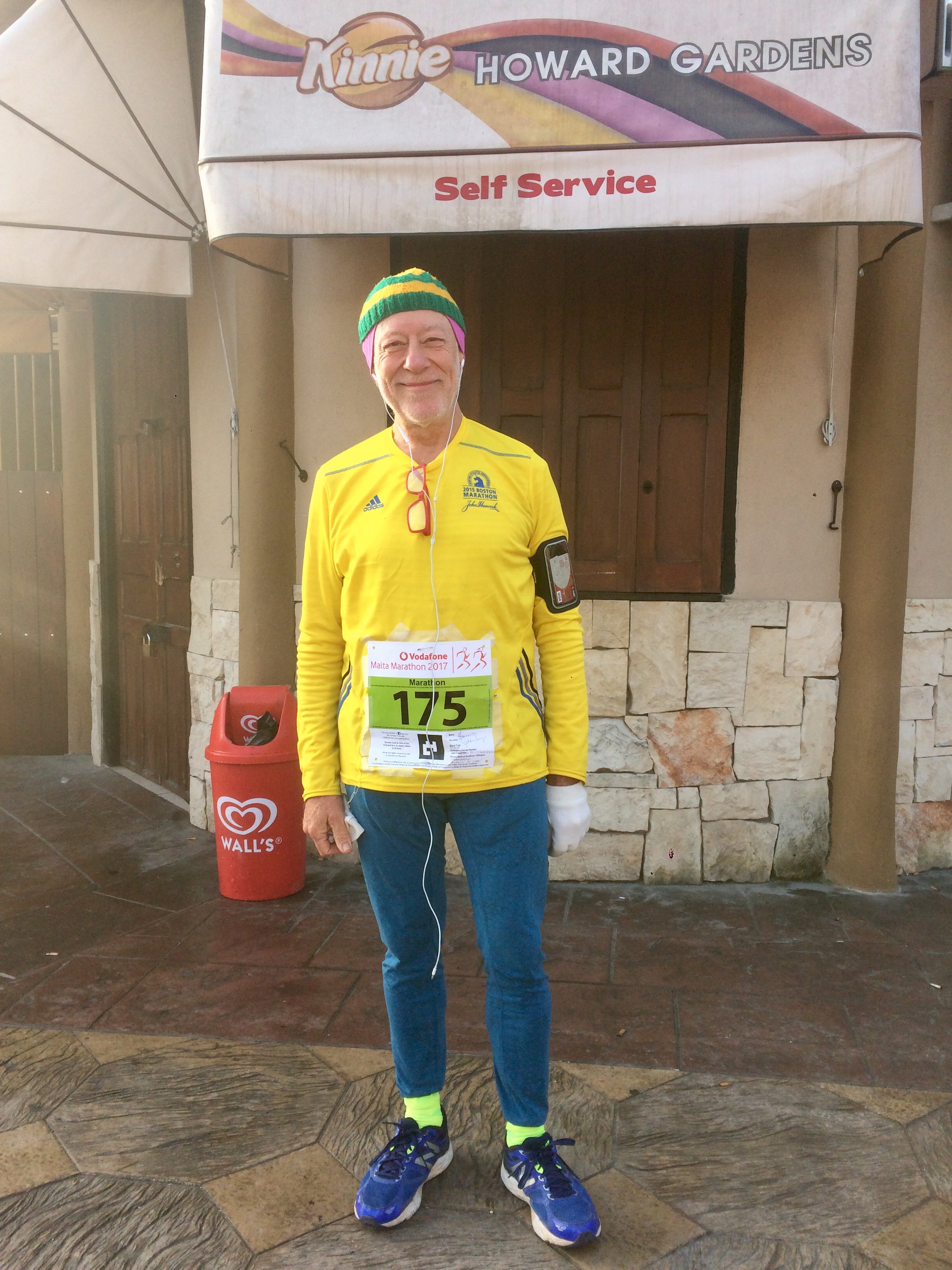
The race information booklet advised the oldest male in the full marathon was one Giuseppe Balzarini. At 78 this fellow would be seven years my senior. A skeleton in a bright yellow shirt stood suddenly before me. His face of olive skin hung in deep stubbled folds. He had some teeth, not many, but all of them flashed me a brilliant grin. His right forefinger extended, nearly touching my own yellow shirt: You. How many?

Seventy one. My own index finger came into play: Which country?

The face showed incomprehension. His palms opened interrogatively: How much?

I showed the man seven fingers, then a single digit.

Ahh! Huge smile. The man indicated himself: Me…he showed me seven fingers then eight. His teeth were overjoyed. Then the man – the name on his shirt read not Giuseppe but Edouardo – did something unexpected. He extended his right hand once again, and brought it close to my cheek. Once, twice, Edouardo soft palm patted my cheek. An uncle could not have touched me more tenderly. Of course, my own hand rose to Edouardo’s face and did the same. Chest to chest, smile to crooked smile, we were two Zatopeks. We stood for a moment, then he was gone. I hoped I’d see him again.
Naturally we had arrived at the Start an hour before starting time. Naturally we all used the Portapotties. Mildly grotesque and richly comic are these lines of runners waiting to discharge some of the surplus we have so purposefully taken in. We stand or jiggle or dance, all of us declaring publicly a quite private intention. We wait and we wait, none of us knowing in what condition we will find the accommodation. (Beyond silently thanking my obsessive precursor I forbear here to report.)

But I can tell you on emerging I found it pretty cold up there on that hilltop, the wind rising from the Valetta plain, coaxing gooseflesh from my limbs. I found the numbered van corresponding to my race number and deposited my bag of possessions in the back. Then, sneaking around the front I let myself into the driver’s cabin, tried to make myself invisible, and let my flesh thaw.

The race was to start at 0730 hours. At 0710 my solitude was disturbed: You alright?

It was the driver. Yes I was alright, thanks.

Is OK. Next time you ask?

Yes. Next time. Thank you.

At 0720 my bladder had an afterthought. Back at the Portapotty queues a fair-haired runner named Michelle provided entertainment for us latecomers. A stocky young person, Michelle did not look African lean. I doubted she’d last the distance. (I was wrong.) But as a sprinter she was quite good. As soon as a Portapotty door swung open Michelle would race forward, only to find opportunity snatched from her. This open door was for males only, that open door was the same, this other one opened all right – exposing the buttocks of an occupant who wasn’t expecting company. Michelle danced on the spot, whether to warm up or to maintain continence, the effect was to divert us from our private concerns.

At 0725 the Public Address summoned us to the Start. At 0729 and fifty seconds the PA voice said ten seconds to go. Let’s all count down! Nine hundred voices complied. Zero! – cried the nine hundred. Go! – cried the PA. And we did. Tragically the first kilometres downhill from the citadel of Mdina were downhill. Utterly seduced, my legs flew. For the time being my body, cement bircher included, was weightless. Of course I could not catch my breath. And my sanity fled far away, not to be overtaken for twenty kilometres.


What followed in the next five hours will not hold your interest. I recall it all, of course, but wish to forget it. The marathon organisers warned runners the event would conclude at 1300 hours – fully five and a half hours after the start. After that, runners would receive no medal, their finishing times would go unrecorded and unreported. I thought five-and-a-half hours long enough to have a birthday: surely I’d beat the deadline. I had drawn up my plans, dividing the 42.195 kilometres into hopeful ‘quarters’ of 11 kms, 11 kms, 10 and 10.195 kms. I allowed these splits 70, 75, 80 and 90 minutes respectively, totalling five hours and fifteen minutes. A finishing time that would rank with my Personal Blushful Worst.

Of course everything transpired otherwise. Too fast in the first stanza, too undigesting in the second, too beaten up in the legs by Malta’s rocky roadways in the third, too thirsty in the fourth. Thus reads my list of excuses. 

It is true that the shabby mobile kiosk at 28 kms was emblazoned with the sacred words: Coca Cola. But the bewhiskered vendor had no change of my twenty Euro note. He offered me the drink gratis, but I waved his offer away. Even an addict would not rob the poor. It is true too that the water stations at 30 and 35 kilometres ran dry before my arrival at the tail of the field. I felt grumpy for a bit, a new sensation in a marathon. My uncharitable feelings quickly evaporated in the glorious sunshine – unseasonable, given Malta’s weather patterns for late winter. From the five kilometer mark onward I ran bare-chested, bare-bulging-bellied too – not a flattering look but a practical one.

The 30km mark


The final stanza of the course passed through a light industrial estate, a place barren of cheer or cheering crowds. There were none of the uplifting musicians of the first stanza. Thirty-two bands were named in the race brochure. Of these most of the final sixteen were packing up by the time we of the tail reached them. The brochure promised clashing drums, blasting brass, oompahing tubae, and so there were initially. But I could see the matter from the viewpoint of the musicians. By the final kilometres individual runners were spread out, separated by up to 200 metres. A band numbering eight musos might feel a bit absurd playing to one struggling runner.

How different, how soul nourishing was the raven-haired beauty who sang to me at the thirty-seven kilometer mark. (Yes, I appreciate your scepticism here – had it been a veritable Gorgon playing a guitar and singing I’d have felt an uplift. But truly she was beautiful.) The young woman might have been about twenty. Seated alone in a wilderness of concrete, on an ordinary kitchen chair, long black hair falling heavy behind her, guitar on her knee and a mike in front, she gave voice. Sounds issued from her throat that soared upward to the heavens whence they surely came. A moment of joy. When I think of it now – sober, rested, replenished of fluids and foods, and yes – of caffeine, that joy returns. It remains, a treasure to which I can return, long after my week of days in Malta.

38 Kms, read the sign at the roadside. At sea level now, tracing the shoreline of the bay I could not wait for the finish. I shuffled past that sign alone. In the near distance ahead a stocky form and a fall of fair hair told me how wrong I had been in underestimating Michelle. Yet I knew I would overtake her. Surely. Light footsteps behind, a flash of bright yellow far to my left, and this was Edouardo, plowing on, on, looking neither right nor left. I decided I would sneak past Edouardo. I would be the first septuagenarian to cross the line. I moved to the far right of the course, where my rival might not notice my challenge. I drew ahead. Then I looked at my watch – I had 28 minutes for less than four kilometres. I could do that comfortably. Then comfort undid me. I stopped that loathesome running and I walked.

Now Edouardo drew abreast of me, now inching past, he left me behind, a moral ruin. I resumed running, without conviction, without really trying. Michelle receded. Edouardo flowed on. I plodded, I walked, I ran. I lacerated myself with self censure. Around a bend, I looked in vain for the finish. Around another bend, two bright figures, walking in the opposite direction, waved and cheered me on. I recognised the tall woman in her thirties and her male companion, she from Sweden, her husband British. Both wore Finisher’s Medals. I had made their acquaintance at the seven kilometre mark. This was their first marathon, their training had been nugatory. We’d exchanged hoped-for finishing times, we wished each other luck. And now the tyros had shown the veteran how it was done. The encounter lifted my spirits. From that point on – perhaps the 41Km mark – I mainly ran.

Around one more bend, I lacked the courage to look up for the Finish Line. But the crowd noises told me I was close. And the Public Address blaring: and here comes another runner, Ladies and Gentlemen. Cheer him on, help him beat the cut-off time.

I lifted my feet, raised my head, pumped my arms, achieving an ugly sprint. The crowd roared, quite deceived into thinking I had been trying my best. The numbers on the clock astonished me: five hours, 28 minutes. I plunged across the Line.

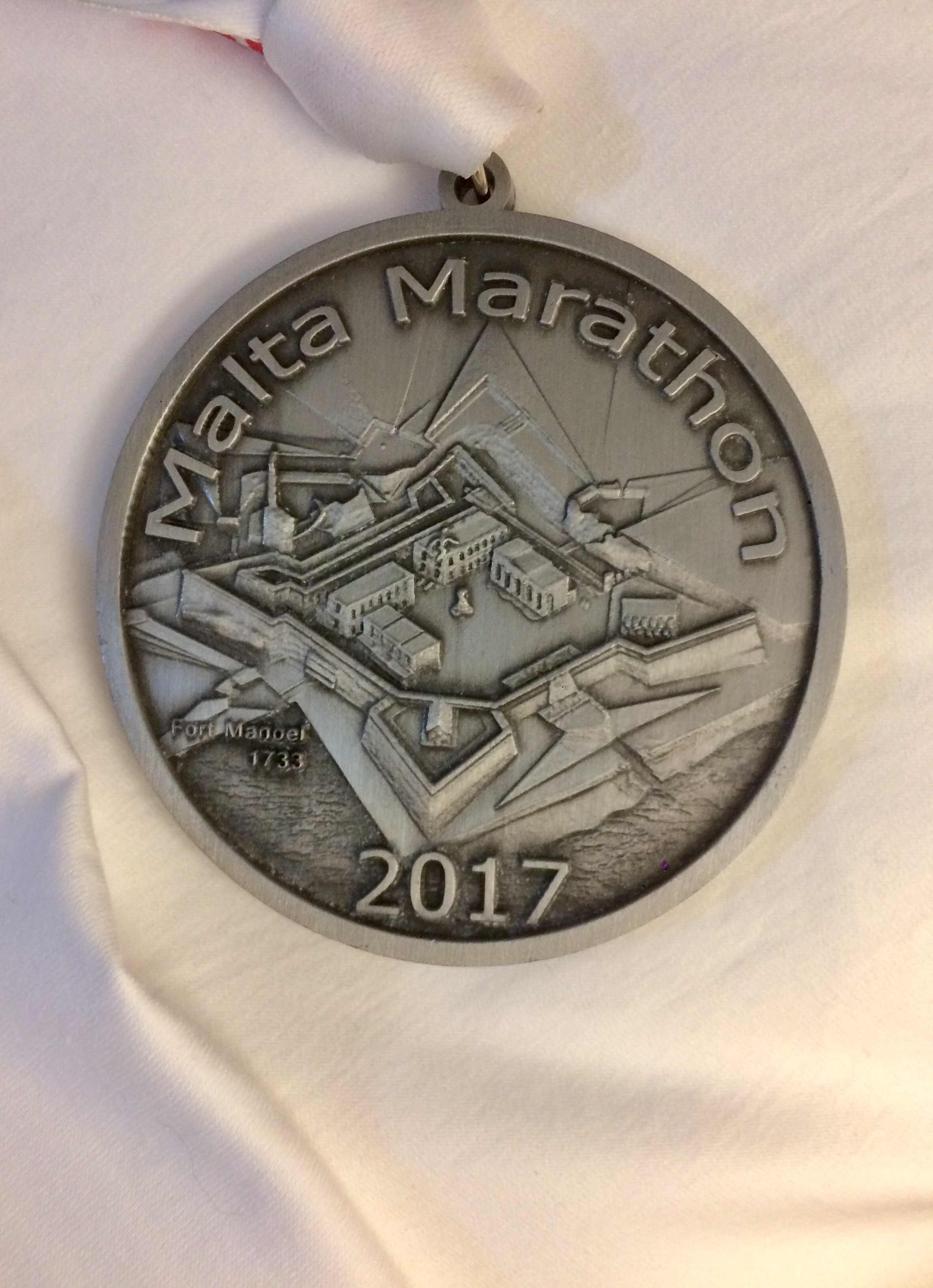
A banana and a bottle of water materialized in my hands, a foil blanket covered my too hot shoulders, and a medal – the medal – hung heavy from my neck. I shambled forward a hundred metres or so then settled down on a concrete kerb to negotiate nausea. A pair of brown legs approached, stopped within a metre. It was Edouardo. With all my heart I congratulated him. Once again I asked, From what country do you come?

Italia! – and that smile again. We shook hands. The better man had won and I loved him.             

And that was number fifty.