Blog On?

Like every wise man I operate in thrall to my womenfolk. One of those womenfolk helps me manage this blog. Readers might have observed the blog stuttering in its cantering gait recently. I have slipped from my regular Monday and Friday postings, to no-one’s great regret. Noting this delinquency the Blogmeistress has commanded me to address my readers with some questions. She says I need to ask you what you want me to write about. The conversation went like this:

BLOGMEISTRESS: Ask your readers what they want.

HG: Why?

BLOGMEISTRESS: Why what?

HG: Why bother them? They’re enjoying the rest.

B/MEISTRESS: You need to blog, so you’ll reach new readers…

HG: Why?

B/MEISTRESS: Why what?

HG: Why do I need readers – old or new – of my blog?

B/MEISTRESS: You need blog followers so they’ll become readers of your books: your writing is OK; it’s just your attitude to technology that stinks. You write passably but all three of your books have been worstsellers. You need to get known.

HG: Look, no-one, not a single person has written begging me for a new post. No-one misses them. A blog that appears on your screen twice a week is an imposition. I’m giving them a break.

B/MEISTRESS: Blog – or fail as a writer!

HG: When I blog I fail because I take time and energy away from serious writing.

BM: Blogging is serious. You’re an appalling snob. You’re going to fail.

So, dear reader, dear slumbering follower, here are the questions a wise man must ask:

What would you like me to write about?

The news – all miserable – that I whinge about already?

My moral quandaries, in which I flail and thrash in a mighty masturbation of the conscience?

Oddities, trivial observations, exercises in whimsy and gentle self-mockery? Or would you prefer brutal self-mockery?

Family stories? Isn’t your own family is just as lunatic as mine?

***

Here is the question I am forbidden to ask: Could you care less?

Sorry to disturb your hard-earned respite.

Do Not Vote – It Only Encourages Them

We had an election last year and I warned all – especially myself – to consider casting a donkey vote.
This coming weekend I will be fined if I don’t vote and angry with myself if I do. On the other hand I do believe it’s every citizen’s duty to help to choose a government. In practice I think this means my choice must encompass one of the two major parties somewhere on my ballot paper.

I consider the present government has made many inequitable decisions which are either corrupt or woefully incompetent. I have always voted for the other team, but Labor has worked assiduously to convince me of its own venality and hopeless thrall to factions.

I look about me and wonder, where is the Labor candidate or the Liberal who rises to cry ‘whoa!’ about our cruelty towards people seeking refuge on our shores?

You might think me absurd to consider a national issue in what is ‘only’ a state election in which the issues should be local.

But the refugee is neither local nor national. Literally, she is non-national. Morally she is universal. She is us, she is me.

Who, among the incompetents and the self-seekers and the factionistas and the corrupt – who will stand for the person on the boat?

I do know that many Aussies in the neighbourhoods stand alongside the newcomer and brotherhood and help. Which is the party – or the nonparty candidate – who will stand against Party and for ‘mon semblable, mon frere’ – the newcomer?

We’re Better Than This

The Refugee people sent me a young mother today with her four-year-old child who had a cough.
She said: “Interrupter, please.”
I looked at her, not understanding.
“Needing interrupter. Not English.”
I preferred to have a go without an interpreter.
“You tell me, I listen” – I said.
“My child much coughing.”
I listened to the chest of the vivacious child whose smile would melt an official from Immigration and Border Protection. I looked at her throat, I felt her glands. She was well, simply suffering from a snot attack. I ordered an anti-snotic.
I addressed Mum: “From what country.”
“Iran.”
“Salaam.”
A look of surprise. A brilliant smile.
I hadn’t picked her nationality. Her peasant blouse, embroidered with edging of magenta and primrose, somehow made me expect she’d be Hazara. That and her creamy skin. Wrong.

“Are you a Permanent Resident?”
A shake of the head. “Commentary Detention.”
“Are you on a Bridging Visa?”
“No. Commentary. Not visa. Commentary Detention.”

“Ahh… community detention?”
Nodding, a smile, we two are doing well despite the lack of an interrupter. But the smile empty of joy.

“My husband, the police, make shee – you know, shee?” The young woman waves her hand in a whipping movement. “Shee. Sixty times, they make shee.”
The woman pulls out her phone, shows me a photo: an adult lies face down on a narrow bed. The creamy skin of a broad back, fine scarlet streaks, the skin must have been lashed with wires.

“They do this before five years. We are not marry, he is boyfriend. I have baby” – she points to her belly – “They tell, ‘You wait, you come after baby, you also sixty shee.’”

The young woman’s pregnancy approached its end, she was summoned to the police station, but fled here, arriving four years ago – pre-Rudd solution.
“My mother, police tell her ‘where is your daughter?’ Mother tell, ‘daughter in Australia.’
They say, ‘No is hiding. Is in Iran. Must come to police station, have shee.’ They call mother many times. She very scare.”

The daughter appears to believe full well the police intend to keep their promise.
So, the boat. Detention at Curtin, then in South Australia. ‘My baby, not Iran.” The smile, this one half-charged: “Born Darwin.”
 
Her visa is not permanent resident.
Her visa is not bridging.
Her visa is not.
She is community detention.
 
What are we that we might send her back?
 
Whom are we bombing in Syria and Iraq?
Why?
 
I believe it likely the tide of opinion will swing in Australia because we – not our leaders – are better than that.

http://wbttaus.org

Blog Wail

A week or so ago this blog wailed about the darkness of the news, the darkness at the heart of man. Two readers responded.
One referred to my wailing as my de profundis, an expression I’d seen bobbing along on the high cultural current over my decades, passing by unpassed. Now it came to me: from the depths. That rang a bell: David, warrior poet, king of ancient Israel, wrote a psalm,
min ha’ma’amakim, From the depths I called…’

Well, two answered my call.

From England, author, bloggish fruitcake maker and novelist Hilary Custance Green is writing her account of her father, a POW in the same camp as Weary Dunlop. He was
one of many untrained medical orderlies who worked in the camp under Canadian surgeon Jacob Markovitz. She writes: “I used to weep continuously as I read these accounts, but I found a dreadful tendency to habituate to the misery and cruelty…”

Robert Hillman, Australian novelist and ghostwriter of lives in ghastly times and climes, sent an antidote:

“Dear Howard – I’ve read your De Frofundis, and your blog about the Richard Flanagan book. I’ll get that book, most certainly, after all you had to say about it. The De Profundis was wonderful in its sincerity, Howard. It’s what all of (us) want to say. But you actually said it. And yet, you know, thank God that there are people of courage and grace in the world who also have a say. I’ve just finished writing a book (‘The Wailing Song’) for a guy who served – most reluctantly – in the Iranian armed forces in the last two years of the Iran-Iraq war. A situation arose when his most senior officer made a mistake, failing to issue an order to 2500 men under his command to withdraw to a ceasefire position in the face of an Iraqi advance. My guy knew of the mistake, and after awful soul-searching, decided to issue the order himself. If he had not, those 2500 men would have been massacred by the vastly superior Iraqi force. Usurping the authority of a Colonel when you are no more than a humble corporal will almost certainly get you court-martialed and hanged in the Iranian army. My guy accepted that he would be hanged, but went ahead and issued the order anyway – he was circumstantially in a position to do so, without having his authority questioned. The men were saved, my guy wasn’t hanged, due to the difficulty the Colonel would have had in explaining his blunder. Its one of those existential situations, a moment of truth, when all that you hope about yourself and believe about yourself is suddenly up for testing: do you have the courage to die at the end of noose in order to save others? Will your life have any meaning if you find a way to duck out? It must be like being thrust into an arena, a bright light directed at you. Here’s your chance. Yes or no?”

I know that moment of moral choice. I know it from reading with growing dread Conrad’s Lord Jim. I read it in the dread of self-knowledge that I would not rise to that challenge. However, since the start of my sixth decade I have imagined that I might.
(Free advice: read ‘Joyful’, which I enthused over in this blog half a year ago. Hillman writes in his own and in many voices of those who struggle in these depths and of some who rise in them).

Intersections, Signposts, Byways along the Road to the Deep North

I read a book yesterday. Started early, finished late. At intervals I had to break off reading to gasp, get to my feet, pace around. Then I sat down and resumed reading. Again I had to stop: I couldn’t read.:
my eyes were streaming and I was sobbing. Because I am a man and men do not give into tears I composed myself, went back to the book and finished it. Unusually for me, I was reading a novel I had read before.
My fortunate path through life is paved with storybooks, so many good books, a few even demanding the accolade of greatness. This is one of the great books.

The novel fictionalises the adult life of Edward (‘Weary’) Dunlop, an Australian surgeon and ‘war hero’, that shopworn term which perplexes and burdens the novel’s central figure for the decades
that remain to him after the War. Ï met ‘Weary’ late one Saturday night after he’d launched a friend’s book. I reminded him that my father and he had been classmates at Melbourne University
Medical School sixty years earlier. I mentioned Dad’s name. The old face looked down and away from me. There was no flicker of recognition: ‘Good man…very good man,’ he said, through the
whiskey of a long night and through the passing of too many years.

The novel which gives us the life and times and war of ‘Weary’ is decidedly unromantic. He is not a hero to himself, he’s simply perplexed, reluctantly drawn to greatness which he can never fathom.
The novel is a telling of one of Australia’s important stories. Like all the great stories the epic of the Burma Railroad (‘The Line’) carries the clout of magic and the endurance of myth.
We have read the tale before in an earlier triumph of storytelling, David Malouf’s ‘The Great World’.

One of Australia’s most original literary stylists is Nicolas Rothwell, the Áustralian’ newspaper’s northern correspondent. Rothwell delivered an oration recently in memory of Eric Rolls,
which was excerpted and published in the Oz a week or so ago. In the acutely elegaic piece Rothwell noted the death of the novel, lamenting exquisitely and I think romantically
on the passing of the genre into effete late middle age and irrelevance. As a keen reader of novels and of Rothwell, I read the essay in perplexity: here was a heartfelt requiem to the literary form of which Rothwell himself is a sublime practitioner. His novel ‘Belomor’ is a convincing rebuttal of his own thesis. If this were not enough to confuse and comfort me,
then ‘The Narrow Road to the Deep North”, Richard Flanagan’s Man Booker Prize winner, the cause of my gasping, crying, pacing, would demolish all doubt.

If I read Rothwell right it is not the novel that is dead but our capacity to hear a long story, to enter and journey and stay the distance in a world, to experience lives in their amplitude. We have become nerve-deaf, casualties of the quickening tempo of life, in particular of the crazed acceleration of information technology. I think this is what Rothwell means. I hope so. Because I travelled the Narrow Road to the Deep North, travelling to an extremity of feeling, going far out to sea into an enlargement, an expansion of my being. Mister Richard Flanagan told me a story that penetrated whatever is the deafness
of the age. He spoke to the same organs of wonder and imagination and belief that my mother and my father spoke to or read to when I was small. The same organs are alive and quivering in my grandchildren
when I tell them a story. We are, as Najaf Mazari – the Rug Maker of Mazr a Sharif – points out in ‘The Honey Thief’, ‘made of stories’. Stories are part of the protoplasm of the human. Rothwell knows this,
his writings show it.

Rothwell makes an important point, subtly and allusively as ever, but convincingly. In this continent the long story between covers is in its youth. There yet remains a task for literature to fulfill that is specific to this
country. The Australian novel is a necessary vehicle for the defining and redefining of our place here. If we are whitefella or blackfella we have a task ahead – to come to terms with our each otherness, to relate authentically to a landscape and to its stories, to Australia.

Between the covers of the Narrow Road Flanagan’s Dorrigo Evans and Darky Gardner take us a long way on that needed path. Novels such as this have the power to create new minds with new organs of knowing.

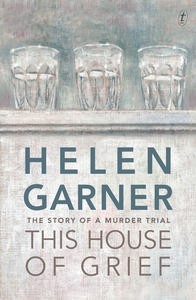
This House of Grief – by Helen Garner, A Review.

Helen Garner saw it on the TV news. Night. Low Foliage. Water, misty and black. Blurred lights, a chopper. Men in high-vis and helmets. Something very bad here. Something frightful.

It was truly very bad. A man had driven his car into a dam. He escaped from the car but his three small sons drowned. The man was charged with their murder and over the following eight years Garner attended the man’s exhaustive legal trials. She exhausted herself in the process of moral exploration of territory that is indeed, ‘dark, misty, black and blurred.’ Reading Garner’s ‘This House of Grief’ can exhaust a reader in turn.

Three hundred pages of scrupulous enquiry end with the author reflecting: ‘When I let myself think of Jai, Tyler and Bailey lying in their quiet cemetery…I imagine the possessive rage of their families: You never knew them. You never even saw them. How dare you talk about your “grief?”
But no other word will do. Every stranger grieves for them. Every stranger’s heart is broken. The children’s fate is our legitimate concern. They are ours to mourn. They belong to all of us now.’

Garner takes the deaths of the three children personally as if she were herself involved. She seeks to know whether they died by grievous mischance or by human intent. She needs to understand. She begs of fate, of the universe, ‘Oh Lord, let this be an accident.’ For us her readers – we who elect to follow her into this frightful something – Helen Garner attends the hearings as our emissary to that house of grief. We too need to know, we too seek to understand; the three lost boys are ‘our’ lost children.

Garner quotes three epigrams, each a succinct cry from a previous emissary, each a pair of hands flung upward in despair over the futility of the quest to comprehend.

He can’t possibly have done it. But there’s no other explanation.

There is no explanation of the death of children that is acceptable.

…life is lived on two levels: one in our awareness and the other only inferable…from inexplicable behavior.

On what account are Garner’s thoughts and reactions, naked here on page after page, a matter for a reader’s interest or a reviewer’s remark? What access has the reader to her deeps, her angst? Garner, the person on the page, our emissary, attends a day of ravaging evidence; afterwards she makes her way, blindly, solitary, to a bar for a vodka. On other occasions she resorts to magical thinking: If only Farquharson could be found not guilty, then the boys would not be dead…Garner pictures them in their domestic vitality, playing footy, watching cartoons, running with arms open for a cuddle. The only way I could bear it was to picture the boys as water creatures: three silvery naked little sprites,…who slithered through a crack and …sped away together.
Then, haunted by the chill of reality, she races homeward in her mind, to haul my grandsons …from their Lego and their light sabres, to squeeze them …until they squirmed. Young boys! How can such wild vital creatures die? How can this hilarious sweetness …be snuffed out?

And again, this longer account of the observer’s migratory flight of feeling: When I got home I sat on the back verandah mumbling to myself, sick at heart. My third grandchild came wandering around the house. He approached me without speaking, turned his back, and stood waiting to be picked up. I lifted him onto my lap. He was only a few months younger than Bailey Farquharson had been when he drowned. For a while the little boy sat on my knee. He relaxed his spine against my chest. Together we listened to the clatter of the high palm fronds, the wail of a distant siren. He glanced up sharply when a flight of lorikeets swerved chattering across the garden. Then he spread his right hand like fan, inserted a delicate thumb into his mouth, and tucked his head under my chin.

And yet only two hours later when he and his four-year-old brother disobeyed me… and went crashing and yelling down the hall to the kitchen like maniacs, rage blinded me. I ran after them, grabbed the nearest arm, and yanked its owner round in a curve. Before I could land a blow I got a grip on myself. The boys stood frozen in attitudes of flight. Nobody spoke. In a cold sweat I leaned against the cupboard door and took some trembling breaths.

Here Garner gives us her brittleness, her sense of near disintegration, her proximity in extremis to harming loved ones in her care; and subtly too, the boys’ “attitudes of frozen flight” recall the postures of failed flight of the boys in the drowned car.

There is a reticence, a holding back at certain points, a refusal to comment that shouts, no, screams, in unexpressed horror. Thus: The men from Major Collision looked into the car before they opened it to drain the water. Ten-year-old Jai was lying face down across the front seats with his head towards the driver’s door…
Seven-year-old Tyler lay on his right side behind the driver’s seat. His head was near the door and his legs were between the two front seats. Two-year-old Bailey was lying across the top of the baby seat, facing rearwards and still tangled in his safety harness.

It is not until the following page that Garner reveals the killer datum: all three seatbelts were unbuckled. It is this crushing fact that tells us that a child – or two children – struggled. It is this, delayed, that a writer striving for dramatic effect might have juxtaposed earlier and quite unbearably with those postures. As it is, the bodies lie diagonally, piercing my composure. I too need recourse to slithering fishes or to vodka or to clutching hard my own brood of near ten-year-old grandboys.

***

Writing to a friend some weeks following release of the book – a year or more I guess after the trial and the appeal and the retrial and the application to the High Court – after all had ended, Helen Garner said: “This is what I’ve learned from the last seven or eight years: ‘We are small. We are weak. We are mortal’… but I think I knew that already.”

After all had ended it had not ended at all.This House of Grief
What Can We Do Once We Lose Our Freedom?

We started gmail and we surrendered the final shred of privacy. We used the net and opened ourselves to every hacker, most of them those we elected. We read of the twin towers and were alarmed; we saw the beheadings and were rattled. Those we elected rattle us often and hard and by reflex and in all sincerity and – as in the case of asylum seekers – in the sincere anxiety that we might unelect them. Once thoroughly rattled we allowed our governments to suspend habeas corpus. We are each of us now, all citizens, all merely Mohammad Hanifs, awaiting the knock on the door of our terror police.

Terror has triumphed. As it usually does. Terror wins when we pay heed – as we need to; it wins when we panic – as we need not.

So what can we do once we lose our freedoms?

I saw an odd movie a score or more years ago in which an Orwellian change had occurred and citizens were forbidden to own books. Books were collected and burned. Publishers were taken away for re-education. The Good Book says: ‘Of making books there is no end.’ But this was an end.

A few resisted, silently abandoning the cities, coming together to meet in the forest. Here each escapee became a talking book. One became ‘War and Peace’, another recited ‘Animal Farm’. Those whose mental muscles were less hypertrophied recited ‘Ozymandias’, or ‘Waiting for the Barbarians’, or the Twenty-third Psalm. All these texts threatened the regime that murdered thought. All reciters risked death but inherited life.

Back here in my real life. I resolve to read poetry every day. I’ll rescue myself and succour others.

The Eve of the Eve of Yom Kippur

The house, emptied now of the insurrection that is a bunch of grandboys on school holidays, is quiet. These are the peaceful moments when the house exhales, the pulses slow and thought recovers.

Tonight is the night before the eve of Yom Kippur, the Jewish Day of Atonement, our Sorry Day. What am I sorry for? For what need I atone? Almost all my sins are those committed in words: I am sorry for the words shouted in anger at my grandrats, sorry for careless slights and unkind witticisms, sorry for speaking faster than my thinking.
And as this blog consists of words, I should search them.

I wrote (in How we Killed Leo) unkindly of Mister Scott Morrison. Elsewhere I have written uncharitably of Mr Shorten and Mr Abbott. All of these public people have private families who would feel wounded when writers such as I play the man instead of attacking the issue. I referred – wittily I felt – to our homegrown press baron as Murd. I should wash my mouth out. I am sorry for the hurt I have done those men and their families.

I remain sorry – and ashamed – that we Australians choose representatives who follow our baser instincts instead of those who might lead us and inspire our finer selves.

In the person of the successor in Sydney to Cardinal Pell, we might have found such a leader. On the morning after his accession the new archbishop spoke like one repentant for wrongs, transparent in confession, compassionate towards those hurt, and creative and courageous in his declared resolve to seek out his brother clerics in the Muslim community, ‘to find ways we can work together to heal our community’. This on the very morning we all read of the arrest of one Australian suspected of plotting to kidnap and behead another – any other – Australian.

A few weeks ago a Jewish democrat, tirelessly active in the struggle to improve our policies towards refugees, shared with me a bright new idea. “Howard,” he said, “Instead of attacking politicians I want to mobilise members and leaders of all of Australia’s faith communities to work together with government to create some softer policies that will be less cruel in their effects on those already here and kept in limbo.” Many, many are the Australians who wish our practices were not so harsh. Many are ashamed. Many have raised voices – as I have – in rancour. What I heard now was the echo of the quiet wisdom of Petro Georgiou, former Member for Kooyong, the man who spoke softly to a hard-faced Prime Minister and brought some humanity into policy.

As the prophet said, “Come, let us reason together.”

Outrage at Whitegate

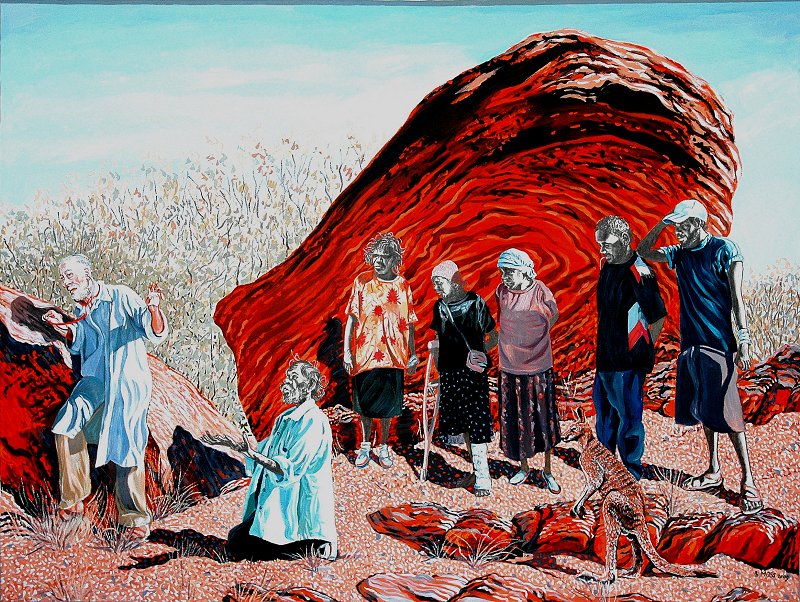
A few weeks ago someone cut the water supply to a town camp on the outskirts of Alice Springs. The ‘camp’ belongs, by ancient practice and by government fiat, to a local clan of Aboriginal people, heirs to a tradition of tenure that goes back beyond white settlement, beyond the dawn of written history. Whitegate is far from how we might imagine a camp, being neither an attractive resort nor a place of refugees. Whitegate Town Camp is not in any sense a place of temporary habitation. It is habitat, it is country. It belongs to the Hayes clan as the clan belongs to Whitegate.

Governments wish to take over the camp, ostensibly to modernise and improve it. They seek to unseat tenure and replace this with long leases. The longest paper lease imaginable would be but momentary in the context and the conception of the Hayes family. Such paper devalues and threatens a connection which is inalienable in nature and beyond secular legal conception.

So someone cut the water supply. Just possibly the government is not responsible. Responsible or not, government could quickly supply water but this has not happened. Nor has repair of the camp’s long defunct solar generation. Whitegate, long a garden of neglect is now a wilderness, occupied by human Australians. Other Australians, notably whitefella writer-artist Rod Moss, supply water and burnable fuel for heating and cooking.

In the present historic moment of human barbarity it is noteworthy that none of the parties to the conflict in the Middle East – not even Assad’s Syria – has ever cut water supplies to its foe. Such an act seems to be beyond human imagining. Except in Alice Springs.

Actions to protest this barbarism will take place in coming days and weeks, actions that are notably harmonious in nature and intent, ‘Aboriginal way.’

How have we fallen so low?

IMG_4041.JPG

Worst of Times, Best of Times

Ours is a world in agony. The holy is awash in profanation. Men hear the voice of a ravening god that sends them to cut off heads. Others kidnap children in the name of a god. Again the toxic cohabitation of religion with violence, the foul marriage that brought us the Crusades, the Spanish Inquisition and Bushido on the Burma Railroad.

In the centre of our own country the Hayes clan lives at Whitegate, a ‘town camp’ in Alice Springs. The site is ancestral land going back to a time before the counting. Last week local government cut the water supply to Whitegate. The power died there some time ago. The cold desert nights are bitter.

How to breathe? Where to find hope? Why believe in our species at all? What light can we show our small children?

Last week the International Council of Christians and Jews honoured Debbie Weissman, a veteran worker across the tribes and creeds, building frail bridges of peace. Peace has broken out in Gaza-Israel. Rod Moss, artist and writer, chops wood and hauls water to Whitegate.

The peacemakers, the hewers of wood and drawers of water: these small signs. I clutch at such as these.