Gap Years 

The friendly young man in the bookshop approves of my reading choice*: ‘Good book, I really enjoyed it. It was prescribed in my literature course last year.’He looks young, too young to be a uni graduate: ‘What was your course?’

‘School. I finished last year.’

‘What are you doing this year?’

‘Working here. Saving. I’m going to travel; I’m taking a gap year.’


Everyone takes a gap year nowadays. I never thought of it. No-one did back in 1963. I was keen to get on with becoming a doctor. I couldn’t see a gap and I would not have walked through it if I found one. Tempus was fugit, vita was brevis, gluteus was maximus, so I sat myself down and flogged my humanities brain over the sciences that were the stepping stones to doctoring. I never gave thought to my already clear history of stumbling through the sciences. I entered medical school, I studied the sciences and I stumbled on. If in later years I referred to my undistinguished undergraduate days, patients refused to believe it. They’d look at their trusted doctor and smile, knowing he must be joking; their peace of mind required he have no gaps.


I became a husband, I became a father, once, twice, thrice. I had four new people in my life to love, four more to work for. And I did work. A joyful and fulfilling part of my work was caring for women in pregnancy and childbirth. I became the intimate stranger, the guest at the birth of families. I’d be called to the hospital in the middle of the night, during dinner, at the kids’ bedtime, at quiet times alone with my wife. I’d leave home early in the mornings to visit the mother and her newborn in hospital. I’d leave before the children were awake. I left lacunae in our family, gaps where the dad was elsewhere when a daughter was sick, when our son had asthma, when our youngest cried at bedtime because a classmate at kinder teased her about the warts on her fingers. After twenty years I bade farewell, a long farewell to obstetrics, and hoped I’d mend the gaps.


The children grew, graduated, went to work, married, became parents. Became busy. Their time cramps them, crowds them in. The gaps that open in our children’s lives allow my wife and me in and enrich us.


The friendly young bookseller-bookreader will head off into his gap. He’ll travel towards his Ithaka and become rich with all he learns.


The truth is, life is full of gaps. As Leonard Cohen teaches us, that’s how the light gets in.


*Brenda Walker’s ‘Reading by Moonlight’. A gift for a friend with a couple of cancers.


The Tooth

In his last decade Dad and I drove every year to the Gippsland Lakes for a few days of sailing. Those lakes are plenished by rivers that flow down from the Great Dividing Range on their way to the sea. In the course of the drive of four hours we had time enough to evoke time remembered. Passing through the township of Trafalgar we’d sight the turnoff to Bruthen, a small town nestled high in those hills. Dad and I remembered Bruthen for our separate reasons, I for the Snowy River – mighty in verse, a miserable trickle in its reduced reality when I found it in 1968. Dad remembered Bruthen for the tooth.
 
‘I did a locum in Bruthen. It would have been 1935. I was a year or so out of medical school, wandering around the country, working in little towns – like you do, Howard.
I remember the drive up into the hills. I was driving a Sunderland. I remember that car for its unusual transmission: in those days manual transmission was all we had, but the Sunderland had something unique: you pre-selected a gear manually and it would change itself. Strange at first, unfamiliar, but just the thing as I wound up those hills and around those bends.’
 
Dad smiled as he remembered: ‘Bruthen was a one-doctor town. On my first day there a man came in with a toothache. His face was swollen and he pointed to his upper jaw on the right side. This was the 1930’s; we had no antibiotics the: the man needed a dentist. “Doc,” he said, “I’ve got a tooth for you to pull.”

(I pictured my Dad as I was at that stage – green, keen, torn between the need to be a proper locum tenens, literally, ‘holding the place’ of his absent Principal, while untrained for the task. Where I was timorous and trepid, Dad was fearless as an aspiring surgeon, aware of his solitary state – no colleague to consult, no training beyond seeking and accepting responsibility – and rising to the challenge. Dad would believe he could do the job and he must do so.)

Dad continued: ‘“I’m not a dentist. I can’t do that.”
“Why not, Doc? The regular doctor always pulls teeth.”
“I don’t have any instruments…”
“Yes you do, Doc. In the cupboard, up there.”

He pointed. Hoping he was incorrect I went to the cupboard. He was quite right. I found two pairs of steel dental forceps, half-familiar instruments, a bit sinister-looking.
“See, Doc? You use this pair for lower teeth, and this one for uppers. Mine’s an upper.”
The handles felt alright in my palm. Usable, not impossible…
“Doc, you know the trick to this tooth-pulling business? You have to push downwards to pull a lower tooth and you push upwards for an upper.”’
Dad said: ‘I didn’t know the trick.
The man pointed to the tooth. I applied the forceps, closed my palm, gripping the tooth hard, then I pushed up as the man advised. Nothing happened. I squeezed harder and pushed harder. A crunching sound then all resistance fell away. I looked down at the forceps: the tooth, a molar, sat beneath its roots, which were long and stout, like antlers on a stag.
“See, Doc? Nothing to it.”
The man fingered the cavity where his molar used to sit. He withdrew his finger, bloody and slippery with spit: “Wrong tooth, Doc. It’s this one.” He pointed again.
I said I was sorry: “You really need a dentist”, I said.
“No dentist in Bruthen, Doc. You do it.”
“Are you sure?”
“Yeah. You’re good at it. Go ahead.”
It was easier the second time. I looked down at the tooth feeling satisfied with myself.
“Good work, Doc!…but… it’s the wrong tooth.”
Feeling miserable I washed the forceps and placed them in the sterilizer.
The man said: ‘What are you doing, Doc? You haven’t finished.” He pointed to the next tooth along. 
“Are you sure this is the one?”
He was sure.
I removed that tooth like its predecessors. Like its predecessors it too was the “wrong one.”

‘We continued, tooth following tooth, until I had cleared all the upper teeth on the right side. Then we agreed to call a halt.’

The Clinician and Detention

Recently Dr David Isaacs, a courageous Australian paediatrician, returned from a working visit to one of Australia’s offshore immigration centres with distressing reports of the suffering and what he considered to be torture of the detained asylum seekers. He called publicly for doctors and nurses to question whether it is ethically permissible for them to accept employment in such settings. Since Dr Isaacs spoke out doctiors and nurses at Melbourne’s Royal Children’s Hospital have refused to discharge asylum seeker p[atients to island detention where they believe the children would be unsafe.
Dr Isaacs risked imprisonment for speaking out and he donated his earnings to asylum seeker relief. He then published an essay in The Journal of Medical Ethics, whose editor – an Australian medical graduate – asked me to respond. This is what I wrote. It is published here with the kind consent of the editor of the Journal of Medical Ethics, British Medical Journal.
ABSTRACT: An examination of ethical issues encountered in the author’s clinical work with detained patients. The author seeks to clarify in which ways, if any, the detained patient might differ from the generality of patients, and hence to identify any distinct ethical duty of the clinician. Also addressed is the broader question: how – if at all – do medical ethics vary from universal ethics? The author reflects on the distinctive duties of a free human towards a detained one. And finally addresses the topical suggestion that a doctor or a nurse should positively refuse to serve in an immigration detention facility on the grounds that to do so would be to condone or facilitate torture.

BY WAY OF INTRODUCTION

The author is a general practitioner of wide experience, having worked in Australian urban, suburban and country practices over greater than four decades; and having spent about eight weeks a year for the past twenty years working in remote clinics. These ‘outback’ postings have been predominantly in Aboriginal communities, while (in 2009) the writer worked for a time In Alice Springs Correctional Centre, and (in 2010) in an Australian Government Immigration Detention Centre offshore.
 
 
DECLARATION OF INTEREST
 
1. I worked in Alice Gaol for lower than average wages; I worked offshore for inflated wages; I banked all proceeds and I paid tax on them.
2. I tutored the editor of this journal in general practice. Our conversations ran particularly to ethics. I became your editor’s friend, his referee, his failed marathon running mentor.
3. As a result of the foregoing I must accept partial responsibility for any ethical errors in your editor’s writing and in his clinical work.
4. I have written and published elsewhere on these themes and continue to do so. They constitute a substantial element in my forthcoming book, ‘Burned Man’ (in press, Hybrid Publishers, for release in August 2016), to be marketed with mercenary intent (and with the opposite expectation).
5. I signed a confidentiality agreement with my employer prior to working in the island Detention Centre. 
6. I worked in Torres Strait (2008) on behalf of the Department of Customs, charged with medical assessment and initial treatment of illegal fisherman captured in Australian waters.
 
 
MEDICAL ETHICS VS ‘UNIVERSAL ETHICS’
 
I read with interest and admiration ‘Are health professionals working in Australia’s immigration detention centres condoning torture?’ The paper addresses a number of important issues explicitly as well as raising equally significant questions implicitly. As I read that valuable paper I found myself wondering whether any distinction actually exists between medical ethics and human ethics generally. An alternative way of formulating my question runs something like this: Why, and in what ways, should a nurse or a doctor – or any clinician – be answerable differently from any other moral agent?
At first blush there would seem to be no difference: in the encounter between any two humans who find themselves respectively in need of help and in a position to help, their inequality mandates a response. That one is sick and the other is skilled in healing is an accident, a detail. This is the bedrock ethic of the Good Samaritan.
However, if among a number of willing passers-by there be one who is a nurse or a doctor, the twin facts of clinical training and of vocation, demand that person in particular step forward and help.
Similarly, the training of the Surf Life Saver selects her to rescue one washed out to sea; and the paramedic is the one who should commence CPR in case of roadside cardiac arrest; and the infectious diseases physician respond to the Ebola outbreak.
 
Common to all these is a degree of risk to the rescuer; the life saver risks drowning, the paramedic risks injury from passing vehicles or hostile lawyers, the physician risks contracting infection and the asylum-seeker’s clinician risks criminal penalties should she reveal official wrongdoing. Traditionally society expects its ‘rescuer class’ to accept those personal risks. In entering our professions we who are clinicians have implicitly accepted – indeed embraced – those risks. So much so that it was with shock that I first heard the suggestion – made in 1969 – that a doctor should not stop to help a road victim, lest the doctor be sued for an adverse outcome. (That advice was given to doctors in litigious America. The advice was ethically wrong, and in many jurisdictions laws have been passed that protect a clinician who responds ethically.)
 
 
ARE DETAINED PATIENTS DIFFERENT?
 
 
My detained refuge-seeking patients resembled all patients in that they were variously unhappy and anxious; their understanding of their condition was inadequate; and they were sometimes unwell, although not in the way they understood themselves to be.
These were patients (although my employers insisted they were ‘clients’); their complaint, their pathos, was the detained condition, to which more familiar clinical entities were superadded.
 
To a man – and the great majority in my care happened to be adult and male – patients in immigration detention suffered from a spiritual malaise, an affliction I have not seen described and which I struggle to categorise. Its features include an inversion of belief such that the detained person replaced trust in fellow humans with mistrust, an expectation of mendacity and malignity of purpose. Thus the clinician, ostensibly present to help, was felt to be the adversary, present only to frustrate and harm the detained one. Our method of harm was supposed to destroy sanity, literally to drive mad the supplicant for our help. The two protagonists became respectively the anti-patient and the anti-doctor. The inversion of belief was pervasive. Hope, the constitutional belief in life and its goodness, were alien, felt to be elements of the fabulous, not congruent with life as it was now known. In a community of almost one thousand believers the mosque was largely unattended.
 
This inversion of the spiritual substrata of life reminded me of Primo Levi’s descriptions of that distinctive moral universe, the Nazi concentration camp, where the SS intentionally destroyed a world of hope, faith, kindness. I do not suspect any such intent on my island. But the outcomes here are as certain as they are unintended. 
 
An unanticipated hazard was experienced by carers, both among the guards and the clinicians. The hazard was moral in nature. Quickly many came to sense wrongness in the system. The wrongs included treating as criminals persons who had broken no law; imprisoning persons who had shown every desperation to be free; humiliating our patients with a dehumanizing system of identification by boat number rather than by name. All who worked in the Centre understood we were functioning parts of an unkind system: while we were to do no harm we were to delimit our own capacity to do good.
Evidence of the moral hazard, the sense of our violence against our own values, emerged in the behavior of the captors. Doctors drank every night, smoked heavily, suffered nightmares. More than one guard attempted suicide, one successfully.
 
In one more than one instance my medical superior refused my referrals for imaging, apparently on the unspoken grounds such would have to take place outside the Detention Centre. In one case, evidence of acute lumbar disc herniation indicated urgent CT scanning. This would require transfer to the mainland. My boss said: ’No. That can’t be done.’ Knowing that it could be done and it should be done, I asked, ‘Why can’t it be done?’
Displeased by my insubordination she stepped forward, stopped half a pace from me and shouted, ‘You can’t ask that question!’
 
For months following my return to the mainland, my reunion with friends and family, my resumption of normal medical work, I experienced nightmares. In those dreams I was a member of a tribunal, sitting in judgement on refugees’ pleas for asylum. In those dreams no voice was heard; supplicants argued mutely; mutely, we judges refused their pleas. The whole was an accusation against my implicated self, against my silent self.
 
 
CRIMINAL DETENTION VS IMMIGRATION DETENTION VS CUSTOMS DETENTION
 
 
The author of ‘Condoning Torture?’ refers to both criminal detention and immigration detention. I have worked in both categories as well as in compulsory detention for Customs. In all three cases detained persons are held inside locked areas behind high fencing in locations beyond view of the public. These arrangements serve to ensure ‘security’, an idea with more than one understanding: ‘security’ has evolved from the safety of the detained person and of the community to security of secrets. Briefly put, locked behind a series of heavy steel doors, detained persons remain invisible to outsiders and hence vulnerable to abuse. These are the settings which some refer to as Black Sites.
 
In the case of my island Detention Centre, the detained resided in their quarters, out of reach and sight of clinicians, who saw and treated them only when they were admitted to the Clinic located in a second secured area. The communicating door between the broader compound and the clinic was manned by the bulkiest of the male guards, charged with selecting and admitting our patients according to acuity of need. In practice these selections were opaque; we clinicians could never know who was excluded from our view and on what basis.
 
Offshore detainees manifest a critical and unique pattern of behaviour which distinguishes them from the great majority of patients of my clinical experience in other settings: they see it in their interest to achieve, demonstrate and maintain the worst health possible. The purpose – or the function – of this ‘poor health’ is to qualify for urgent transfer to ‘the mainland’, a location endowed with a mythic access to liberty in Australia proper. Thus the asylum seeker will exaggerate or fabulate to save himself. The clinician is mistrusted (like all in authority, for all have ‘lied’, and lied maliciously to drive the poor patient mad); in turn the clinician is unable to take symptoms at face value. Trust, the substrate of every decent clinical encounter, is shattered. For the clinician and the imprisoned person have opposite objectives.
 
Quite different are the assumptions in Alice Springs Correction Centre where eighty percent of prisoners are Aboriginal. Here transparency is a cardinal virtue. Prompted by blackfella outrage and whitefella shame, and by the political hazard of failing to care well for imprisoned indigenous people, authorities hasten to identify risk of harm to their charges and to act upon it. Often warders and clinicians over react, such are the anxiety and the dread of misreading need through the clinician’s cultural subliteracy.  
 
 
SHOULD A DOCTOR ACCEPT WORK WITH DETAINED PERSONS OFFSHORE?
 
 
This question arises because of the apprehended possibility that a doctor will participate in or facilitate wrongdoing; and having witnessed harm to patients will be constrained from ‘whistleblowing’ against that wrong. The apprehended risks are real. Under new Australian legislation a clinician who speaks out is open to prosecution and if convicted, to imprisonment for up to two years, for revealing secret information. An additional constraint is the Confidentiality Agreement employees are required to sign as a condition of employment.
 
The author of “Condoning Torture” suggests Australia’s treatment offshore of detained refugees constitutes torture. The writer adduces evidence for that suggestion but stops short of declaring categorically that such treatment is torture. At the same time he acknowledges the clinical needs for care of the refugees. He writes: Australian health professional thus face a major ethical dilemmas. Individual health professionals need to decide whether or not to work in immigration centres. If they do so, they need to decide for how long and to what extent restrictive contracts and gagging laws will constrain them from advocating for closing detention centres.
 
I find the author’s formulation of those questions helpful in pointing a clear ethical path. He authorizes each individual to forge a personal response. This seems to recognize the moral autonomy of the individual practitioner, as well as the individual responsibility of the individual. As the Mishnaic sage Hillel taught: if not me, then who? If not now, then when?
The author breaks the decision into two or three parts:
1. Will I work there? (Do I have the right to do so? Do I have the right to decline?)
2. If I do accept that work, I must do so provisionally, ceasing when I form a judgement that to continue more offends ethically than to desist.
3. In answering the second question I must consider how much my gags prevent me from doing needed good?

The argument allows me to approach the questions as follows: Here, in the offshore ‘facility’ – a black site or a blackish site or at the very least a grey site – we have sick human beings. Our government, their custodians, seeks to employ doctors, nurses, psychologists, mental health nurses, to attend to clinical need. The employer presents the qualified clinical professional with a contract to perform professional duties and to treat the conditions of the workplace confidentially. The government does not stipulate, ‘You must agree to torture your patient’.
 
On the basis of my own experiences, where I was not required to do positive harm but I was constrained from doing some needed good, I could sign the contract and enter upon my employment in good faith and in the assumption of my employer’s good faith. After all, I was employed a medical professional. That profession implies first and foremost a refusal to do no harm. If and when I form the belief my employment required me to do harm, I must refuse and make clear my reasons for doing so, both to my superiors and to my peers. Where possible I must make this clear also to the detained person. Should my employer dismiss me I must make public my employer’s wrongful instruction and my actions and the circumstances of my dismissal. I run a risk in doing this, the risk of incarceration. That is my lifesaver, my paramedic, my infectious disease specialist moment, my moment of familiar medical hazard. A hazard, yes, but in our relatively non-totalitarian system, a hazard without risk of death. Safer far than the ebola risk. Safer than the choices of a psychiatrist in the Soviet Union, safer than those of doctors under the Third Reich. A hazard but not a mortal hazard. 
 
On the other hand if no objectionable command requires me to take a self-sacrificial stand I remain free to work, to watch, to listen and to consider. And upon making my judgement I should speak out. If all is kosher, if detained persons are treated with full human dignity and compassion, then I must cry it from the rooftops. And conversely, if I find my hypothetical centres to be objectionable I must call for their improvement or their closure.
 
Those are equally clear ethical imperatives – not matters of narrow medical judgement but the call of every citizen. In the end the doctor, the nurse, the guard, the journalist, the therapist, the pharmacist, the interpreter, the public servant all answer to an ethic which is universal. Medical ethics represents but one corner of that wide universe.

Eat Your Weeties

‘Hello Toby, I’m Howard.’

‘Hi. I’m Toby’. A laugh: ‘I guess you knew that…’

Doctor and patient shake hands. The doctor takes in the young man with the ready self-laugh. Tall, thin, Ned Kelly beard. Laughing eyes, a vital face and something serious, a gravity lurking between the smiles.

‘I’ve got a Toby’, says the doctor, ‘Every family needs one. And one might be just about the limit – to judge by mine.’

The smiling eyes crinkle: ‘Well my family had two of us, in a manner of speaking. I got my name from my grandfather. That wasn’t his true name but everyone called him Toby on account of the mobile he had above his bed when he was small. He loved Weeties you see…’

The doctor doesn’t see.

‘My Grandpa loved the breakfast cereal so much they hung a mobile made from Uncle Toby’s* Weeties packets over his bed; and everyone always called him Toby. They named me after him. Or at least in memory of him.’

The Ned Kelly beard rises and falls, dances with Toby’s face, mobile, in the telling of his story.

The doctor: ‘Nice beard Toby.’

‘Glad you like it, Doctor, but today’s it’s last day. Tomorrow I shave it off – to raise money – for cancer. And that’s really why I’ve come: I need you to check my wound.’

The man pulls up his shirt, exposing a circle of blood in the centre of a depression just to the right and below his belly button. The doctor indicates the couch. Toby lies down as he explains: ‘They’ve just closed off my colostomy, about six weeks ago. They said I wouldn’t need dressings after six weeks, but I should have the GP check on it. What do you think?’

The doctor thinks it looks like a fresh bullet wound, this dimpled circle of bright dried blood. He has a gentle poke around Toby’s belly: nothing inflamed, healing progressing well…so far as the doctor can tell. He doesn’t deal often with colostomies freshly closed. He looks up, his face a question.

‘Eleven month ago I had rectal cancer. They took out the lower bowel and I passed waste through that hole in my belly.’

‘And now you have the standard plumbing, you use the opening at the back and it all works again?’

‘Like a champion, Doctor.’

‘How does a man of…’ the doctor checks Toby’s date of birth, does some sums: ’How does a twenty-five year old get cancer of the rectum?’

‘Eating bacon… so they reckon.’ A smile as Toby, standing again now, looks down at the doctor’s yarmulka: ‘You’d be pretty safe, Doc.’

‘What was the treatment, Toby? How was it?’

‘Chemo. Radiation.’ A grin. ‘The first chemo wasn’t too bad. Later it was rugged. They’d run it in through a drip over a week.’

The doctor pictures a man of twenty-five enduring that protracted chemical poisoning. For himself he’s always believed he’d accept death rather than the vomiting, the weekly cycles of wretchedness, the titration of benefit – the death of cancer cells – against the loss of weight, the loss of immunity, the vomiting, the vomiting, the vomiting. But as he looks at Toby he sees vitality, faith in living. He sees a man who’d embrace suffering and try to chase death away. The man would believe he’d be cured, like all of them.

‘And it worked. You’re cured?’

‘That’s what they reckon.’ Toby’s whiskers cannot hide his triumph, his delight.

Deeply the doctor too feels delight. And relief, like a cloud lifting, the cloud of many defeats.

‘Will you be able to have children, Toby? After the radiation.’

‘We’ll see. Every chance I will. Might make a new Toby.’

‘Anyway, Doc, the beard goes tomorrow. For charity. I don’t want to boast but I’ve raised seven thousand dollars in less than a week.’

The doctor has an idea, a question: ‘Toby, I write a blog. Would you like me to write your story? And publish it on the net?’

‘Terrific idea, doc.’ Serious now, the face contracts: ‘Tell my story. Use my name. Tell everyone. The address for donations is: gofundme.com/tobyshaveforcancer.’


That’s: http://gofundme.com/tobyshaveforcancer


* Uncle Tobys

From Wikipedia, the free encyclopedia

Uncle Tobys is an Australian brand of breakfast cereals and other breakfast food products. The brand has a lot of history and is mentioned in an 1892 newspaper. Their main manufacturing base is located in the small town of Wahgunyah, on the NSW / Victorian Border.

A Perfectly Routine Call

Woman injured, perhaps a fall,
A fracas? Who knows –
Perhaps a brawl?

Over the phone the nurse tells all:
Neck injuries…
She’s in a collar:
I call Flying Doctors: 
Eight thousand dollar.
 

I take notes: a punch to the mouth
And she fell;
Got a kicking to the head
And the belly as well
 

Her neck is tender
C2-3, where the cord is slender
She can feel, can move…
That doesn’t prove
We’ll mend her.
 

I take it all down, arrange the flight.
In afterthought,
I ought
Ask ‘Who? How?’ – at least:
It was a male. I called the police.
 

I take notes, recording in full
The news that’s not news,
That minds like mine 
Refuse
To take it in at all
 
Nurse gives name:
Like a punch to my mouth
Then a kicking,
Shame like flame
To burn my aorta –
 
The name – that ordinary name –
Is the same 
That we gave
Our newborn 
Daughter.

The Delinquent Chromosome and the Marathon Runner 

Most of us have no intercourse with our forty-six chromosomes. They perform their work honourably in intracellular obscurity and we leave them alone. Not so for my friend Manny Karageorgiou: his Chromosomes Numbers 13 and 14 have conspired to mutate. This mutiny came to light late in 2013 when he broke a rib without trying. He simply breathed or coughed or heaved a carton and the rib quietly cracked.
 

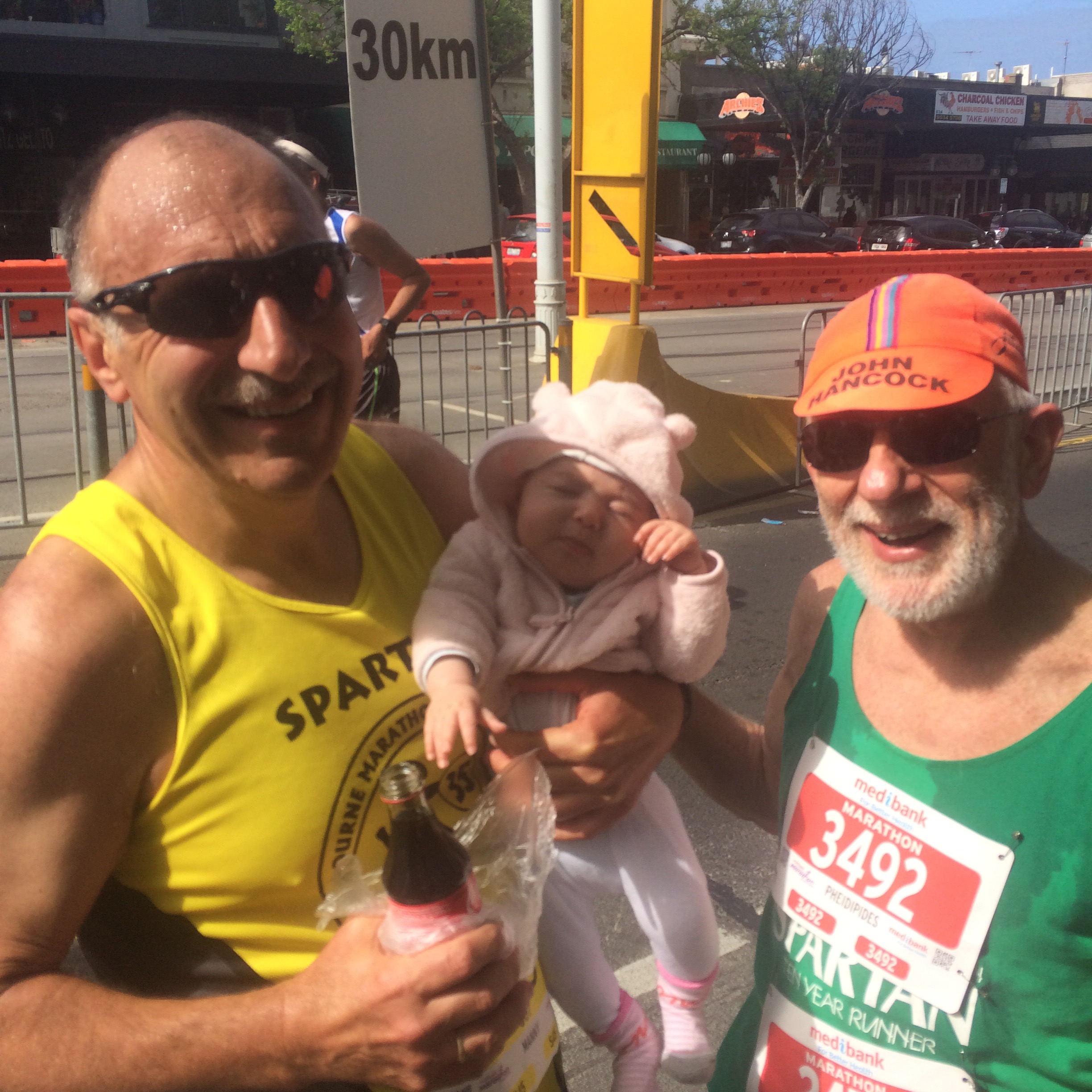
What Manny has tried to do – what he has managed to do every year for 37 years – is to run the 42.195 kilometres of the Melbourne Marathon. Manny is one of a tiny and diminishing band of brothers to achieve this feat. This, their 38th year, they number only eight.


When Manny’s rib cracked he consulted his doctor. In their shared innocence, patient and doctor initially believed they were dealing with a painful area in Manny’s chest, a mere nuisance, an impediment to running: and Manny had a marathon to run. The Marathon would call him. Come October Manny would obey the call and run. Always the Melbourne Marathon, always and only Melbourne. Athens too, has called Manny. Deep in his Greek heart’s core he hears that call. He feels aeonic tremors, he hears echoes across time of Pheidipides at Marathon field. Manny feels, he hears and he yearns to join the runners in Athens; but year after year that marathon clashes with Melbourne’s.


Manny could not run both. Melbourne held him: captive of his love for the Melbourne, of his obligation to its history, of his loyalty to his old comrades, Manny stopped his ears to Athens in October, he turned his back on the Aegean and, busted rib and all, he ran Melbourne. That was last year. For a period of time between the fracturing of the rib and that Sunday in October, my colleagues filled Manny’s body with poisons – thalidomide, dexamethasone, bortezomib – in their attempts to put down the chromosomal mutiny. The short term for that poisoning is high-dose chemotherapy. 


When I wrote of Manny’s marathon in 2014, runners from around the world responded in awed respect of the man who’d run thirty-seven Melbournes, and who’d prepared and run it this time with a diseased rib and a poisoned body.


All that was in 2014. Since then Manny has undergone autologous haemopoietic stem-cell transplantation. The chemical savagery of this procedure – doctors have to poison every blood-producing cell in his body – can cure or kill. It did not kill Manny. But the mutiny grumbles on, bones everywhere are eroded, they await their moment of innocent impact or small tumble. One crack and a marathon runner will have run his last.


Manny’s haemato-oncologist, a compassionate and scholarly man, forbids running. He knows too well Manny’s disease. My guess is he has never run a marathon, is innocent of the joy, has never known the intensity of that blood-filled, tear-filled passage through space and time to self-realisation. For his part, Manny knows little about his proliferating mast cells, rogue daughters of his body’s revolution; he knows less of the osteoclasts punching holes in his bones; and nothing of the dysregulation of an oncogene translocated to his perfidious chromosome 14. But Manny knows enough. He understands the doctors do not speak of cure, he accepts the unending medication, he understands the risks of running. But he takes the occasional light run.


I haven’t asked Manny, ‘Do you run to live?’ I sense that the occasional light run is the answer that Manny’s mind or body drives him to. When Manny asks this family doctor, ‘Do you think I can run the marathon again this year?’ – the question I hear is: ‘Am I permitted to live before I die?’ And who am I – captive of my own marathon dreaming – to deny Manny? I decide I will run Melbourne at Manny’s side.


***


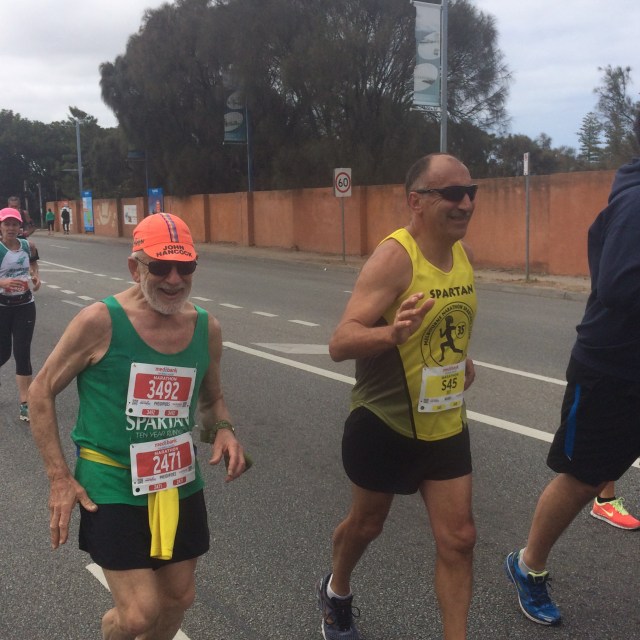
Lining up at the rear of the field of seven thousand dreamers before the Start, Manny implores me for the seven thousandth time: ‘Promise you’ll leave me behind once I’m too slow for you, Howard. I don’t want you to sacrifice your time for me.’ Manny never dreams he’s honouring me. But even before the gun sounds, runners reading the rear of Manny’s shirt salute him: ‘Legend!’ – they cry – ’Thirty-five Melbourne Marathons! Amazing!’ They clap him on the back, not realising Manny’s shirt sells him short by two marathons. Manny does not correct them. The same people spill glory and goodwill onto me in my Spartan’s shirt: ‘Go Spartan!’


A beautiful morning for running. Beneath low cloud a light breeze cheers and cools us as we snake along boulevards and run spirals through Melbourne’s parklands. Manny’s prudent pace suits me. I search for bodily pains to fret about. Nothing: silence from the supposed stress fracture in my left foot, nothing from the torn right calf muscle that I have rested from four weeks. The opposite calf sends alarms, but these are false. Pheidipides Goldenberg has no complaints.


Running half a pace behind Manny I take him in, not as the indoor person I have known, but Manny as runner. His build is not classic Kenyan: Manny is constructed of old materials, a series of chunks assembled one on top of the second. Impressive that he has lugged this unpromising torso through thirty-seven marathons. Projecting below that torso are the legs which are Manny’s secret. Beautifully muscled, elegantly defined beneath skin shining with vitality and sweat, Manny’s legs look decades younger than he as they pump smoothly, rising, descending, devouring distance.


Approaching the thirteen kilometre mark, Manny grinds on steadily, shouting out greetings to figures who come into view and earshot, his comrades, these, fellow members of the hallowed eight. To a man they look old. And calm. The marathon is their familiar foe. It holds no terrors, no surprises for them. Not for the first time, I recall Tennyson’s Ulysses as he looks upon his comrades:


Souls that have toil’d, and wrought, and thought with me –

That ever with a frolic welcome took

The thunder and the sunshine…

You and I are old;

Old age hath yet his honour and his toil;

Death closes all; but something ere the end,

Some work of noble note, may yet be done…   


With a cry of a different temper, Manny swerves, his voice joyous. He mounts the kerb, sweeps a good-looking woman into his arms, kisses her face, her hair. She pushes him away a little, looks at him searchingly. Satisfied, she smiles: ‘You look good, darling, you look wonderful. You’re running smoothly.’ The good-looking woman is Manny’s wife Demetra. She plenishes us both with cola and kisses, promising to find us again ten kilometres down the route. Manny releases his wife, takes a step, turns back, grabs Demetra again, crying into her hair, ‘I love you, darling’, and sets off again. I look down and try to deal with a lump that has risen in my throat.


Heading out toward the beach now we are bathed by sun and cooled by the breeze. Aaah, blessed day. The first Kenyan, having turned and now heading homeward, glides past us on air. Shouts of wonder rise from all throats as runners and spectators alike react to this shock of the beautiful. 


‘That’s my street there, Howard, Number 141. Please join me and my family at any time from 3.00. Bring your wife. Please.’ I want to join Manny and his family. If I finish in time I’ll certainly be there. Until now, Manny has spoken little while I have spoken more. A quieter person, he places one foot before another, repeatedly, steadily, and runs inwardly. I ask from time to time, ‘How are you going, Manny?’ ‘Not great. Not as good as last year.’ Not feeling great but not complaining either. As we swing out along the beach road and past Café Racer, a bunch of bystanders suddenly flows onto the road in our path and Manny’s face relaxes and falls into a wide smile. Hugs, handshakes, claps on Manny’s back, kisses on Manny’s face from two toothsome young women, and Manny keeps smiling and keeps on running. The interlopers pump sunshine up Manny’s arse and run alongside him. For the best part of an hour we run with the posse and through all that time Manny is smiling.
We come to the turn and the posse whoops and cheers as Manny turns for home. Manny is brother to one, uncle to a couple, second cousin to a few more, godfather to another. The kissing females are godson’s girlfriend and her girlfriend. The brother is shorter than Manny, genial, younger, rounder and pretty fit. He stays the distance for the full hour as do godson and one of the kissers. Others, out of shape or out of condition, fade away and re-join us later. Finally, with farewells, more clasps and shakes and blessings the mob falls away. ‘See you at my place, darling!’ ‘See you after three, Manny!’ The mob loves Manny and he them. Afterwards he tells me, ‘They’re here to meet me every year. Every year at the same spot. They never fail.’ A little later Manny says, ‘Dem and I are taking the whole family to Athens next year…it won’t be at marathon time of course.’

Increasingly I relish Manny’s invitation to join him and the family. These people run to the beat of a familiar drum.

  Back on the road, unescorted by Manny’s family, I have a question: ‘Manny, are you Manuel or Emmanuel?’

‘Manuel. They call me Manny. Also Manoli.’ 

Manny, Manoli – these affectionate diminutives are the aural furnishings of a life. Cushioned at every mention of his name, the man lives his life in relation, in connection, not alone, never – so long as these names are heard – alone. Back on the road, the solid road, returning from my abstractions, back with Manny-the-person I notice him struggling wordlessly. What silent erosion within his skeleton, what deposition of para-proteins in his kidneys, what mischief in his marrow, hampers this champion? Conversely (and most striking), how remarkable the redemptive effect of the loving presence of Manny’s family!


Around the corner and into Fitzroy Street where the crowds thicken and the cheering is a roaring without end, we allow ourselves a fifty-metre walk up the ugly little hillock placed here for the torment of the tiring runner. I reckon we’ve run better than two thirds of our 42.195 kilometres. Manny bursts into joyous shouting: ‘My baby! My baby!’ Emerging from the midst of the thronging cheerers is the adoring Demetra, bearing encouragement and affection and more Coke. And a baby! – their first grandchild. Manny cradles the pink bundle, adores her like a Magus. To me Demetra passes chocolate! I’m dubious about this; I’ve never eaten chocolate in the middle of a run. Will I like it? Will it like me? Too late – it’s melting in my sweaty paw. Now it’s inside me, followed by a bottle of Coke. Supercharged with caffeine and sugar and fluid I am invincible. In Demetra’s arms, holding his pink grandbaby, Manny looks the same, but once around the corner and out of sight, he looks and feels utterly vincible.


Around the corner now and into St Kilda Road, the broad thoroughfare closed to traffic in honour of us marathoners. The sun shines, the day has warmed, everyone who is not running enjoys the balm. Runners enjoy the painful raising of knees, the heavy hurt in the thighs, the weight of weary, weary bodies that started running almost four hours ago. The 32 – kilometre sign tells us there are only ten kilometres to go. Only ten kilometres to go feels to a runner as welcome as only ten more years might sound to a prisoner serving life. The experienced runner knows the second half of a marathon starts at 32K.


We plod in the sunshine. The field has thinned as faster runners leave us behind and others – the broken, the breaking, the bleeding, those limping – fall behind us. Here to one side of us, runs Eeyore, a young woman from England. She runs smoothly ahead then stops, bends forward in apparent pain, and breaks into a slow walk, and soon she is at our side again. Eeyore replies to my clinical enquiries morosely. I encourage her, I pump sunbeams, I tell her she should be proud. I should shut up and allow her to enjoy her misery. Eeyore and Manny and Pheidipides keep company intermittently until the final few hundred metres. Just ahead and to our left runs an aged, arcuate Japanese runner. His age might be anywhere from fifty to seventy. He clings to a line, a crack visible in the road’s surface where one layer of tarmac meets its neighbour. Dourly, silently, mute to my greetings, his spine twisted into a boomerang convex to the left, Japan runs the lines. His speed is no better than ours but I bet he could run all the way to Hokkaido without stopping.


A soft sound issues from the female who runs half a pace ahead on our right. The slight sound recurs – the grunt of a person in pain? – pulls me close. No not a grunt, it’s a moaning, the woman’s lament for her suffering self, her threnody sung for self-comfort. She’s about forty, shapeless, pale, a moving emblem of tortured humanity. The moment brings me back to the Olympic Marathon (I think it was at Barcelona) where a Swiss or French runner, whose name I seem to recall was Dominique Something approached the Finish. No-one who witnessed the sight of this tall, thin woman, faltering and staggering in her final lap of the stadium will forget her in her extremity. The brutally hot day, the merciless steeps of Monjuic in the approach to the stadium, the criminal timing of the event in such heat had all but undone her. She lumbered into view, slowed, stooped, seemed to recover herself and advanced. Time and again she seemed at the point of falling. Officials were seen to move toward her, then to retreat. Appalled viewers on screen and in flesh begged wordlessly for it to end, but Dominique stumbled on. Twenty, thirty metres from the Finish she fell. Officials came to her aid and in so doing ended her chance of completing the Olympic Marathon. It is Dominique whom I hear now as this woman moans.


It is no disrespect to acknowledge that we belong to the dregs of the marathon world: among the select who run marathons, possibly the most resolute and vigorous of people, our sub-group group is the most enfeebled. And all the more honour to us who persist. On we go, pausing for drink every three kilometres, enjoying the excuse to walk twenty, thirty metres. Then up again with weary legs, up and back into the slow steady tread that our heartbeats allow us, that is all our breaths and our body salts and our fluid reserves and our moral reserves can support. We walk, we pause to walk thirty guilt-free walking paces, then on again we run, and on. Manny and I negotiate small contracts: we’ll run without stop to the top of this short rise, then we can coast down the farther side; we’ll run and not stop until we reach the next drink stop, then we’ll reward ourselves with cool fluids and a splash of water; we’ll run now and will not stop until we reach the MCG, and then…


We enter the great stadium side by side. The huge grandstands tower about and above. We insects crawl the margins below. At my left Manny says, ‘It’s magnificent, isn’t it?’ It is, it is indeed. We swing our arms, pumping our reluctant thighs into action, we raise our heads, then hoist ourselves onto our toes for the final 150 metres. Two aging men, one with an intact skeleton, the second much ravaged, swing around the bend. We pass the bent man from Japan: his face, transmogrified, is a rising sun; and Manny and I are sprinting, and sprinting we fall across the Line.
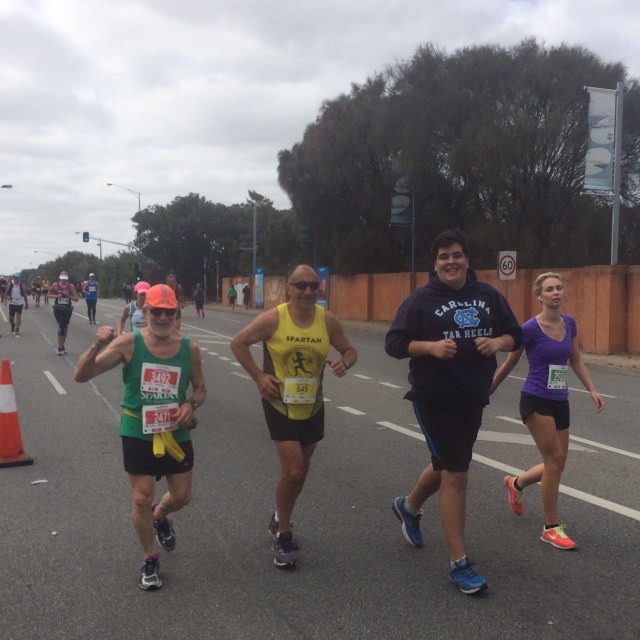


POSTSCRIPT: I have written elsewhere of my inadvertent double entry (and double payment) in this year’s Melbourne Marathon. I duly wore two bibs – each with its distinct number – and with them, both electronic timing chips. I had speculated that Pheidipides Goldenberg might record a finish in both last and second-last places. If you google Melbourne Marathon Results 2015 you will see how closely I anticipated the result. And you’ll find, ahead of me by one second, Manny, Manuel, Manoli Karageorgiou. 


Of Chillis and Medicine

It was early in my medical career when I first encountered the diabolical burn of the chilli pepper.
A Greek man ferried, carried, hurried his screaming child down the driveway of our home to the side door that admitted patients to Dad’s consulting room. The child’s round cheeks were red, his eyes streamed, his left upper and lower eyelids were scarlet. The father’s distress equalled the child’s: grief and fear contended in his broken speech: Is doctor house? Too much paining! My son, he burn… Terrified – I was fourteen, and although self-apprenticed to Dad, I knew I was out of my depth – I opened the door and stammered over my retreating shoulder, Doctor will come soon, I’ll tell Mum. The man wept, rocked his child, rocked himself, his tears fell, mixing with his son’s.

Mum hurried and said kind, calming things. She fetched damp cloths and wiped the boy’s eyelids and his lips, swollen like plums. Afterwards Doctor did come, gave an injection and peace returned.
Mum explained, The boy thought the red chilli pepper was some sort of lolly. When it burned his lips he cried. Then he wiped his left eye with his chilli hand. He must have rubbed the right eye with the other.

All that happened a long time ago. I was reminded of it today as I peeled and chopped mango for a lime and mango fruit salad. I sucked a lot of mango pips, I slurped the juicy flesh from mango peelings. And my fingers and palms began to tingle. My lips tingled too. Soon tingle turned to burn. I looked at my fingers, all red and juicy and I remembered the day I prepared mango mousse for twelve. That day a dozen mangoes bled onto my lips and hands; and today my skin remembered. I had disregarded the warning at the end of the recipe to protect my skin with rubber gloves. The recipe closed with the words, both the mango and the chilli originate in Latin America. They are botanically close.
The word recipe is one a doctor uses with every prescription: the large R stands for the instruction to the compounding pharmacist, Recipe – please make up the following recipe. I did some doctoring today as well as some cooking. I claim to be a bold cook, not a good one. My family are bold eaters and candid critics of my cooking, just as they are of my healing. They will tell me after dinner what they think of my recipe.

Should Nurses and Doctors Accept Work in Australia’s Detention Centres?

In 2010 I worked in an Australian detention centre for short time that felt like a long time. The experience was the worst in my fifty years in Medicine. I signed a confidentiality agreement, sewing my own lips in the process. I saw no atrocity, no wrongdoing, other than torture by impersonal and meandering bureaucracy. Yet the suffering was general; it saw inmates, guards, nurses and doctors all resorting to self-harmful acts. I saw honourable people treating the detained with skill and humanity. I saw them constrained by employers and distrusted and insulted by patients, who felt sure that we too were liars. Yet we did some good. People, whether sick in body or in spirit, were treated with kindness and respect.

For six months after I returned to the mainland I was visited by dreams in which I sat on Tribunals without name, determining the fate of nameless individuals doomed by history and by Australian laws. Captive in these dreams, I doled unequal laws to defeated supplicants. I’d awaken and ask myself, did I really do that? But, inescapably, I knew I was implicated.

My island was a paradise of procedural propriety compared to today’s islands of Nauru and Manus. Doctors and nurses have returned from these places with distressing reports. Some have argued that, knowing what is now known, it is in unethical to work in these places; that the system tortures inmates; that participating is to become complicit in torture. More moderately, all clinicians and observers who return seem to agree that incarceration harms the inmate. The first law of medical ethics being, first do no harm, is not an ethical practitioner obliged to refuse to share in that harmdoing?

A new element affecting the work of a detention clinician is the outlawing of reporting wrongs seen in that work. Offenders face the threat of two years gaol. Nice systematic irony: to protect the liberty of Australians we incarcerate boat people; to protect the integrity of the system we incarcerate truthtellers. Interestingly, the flood of job offers to work in Detention that recruiters used to send to remote doctors such as myself has dried up. Someone, somewhere must have decided Australian clinicians are unreliable.

What then must a nurse or a doctor or a psychologist or a psychiatric nurse do? If offered, may we accept this work? Even if we are forbidden to speak of what we see?

I compare the situation to working with patients in places of dangerous epidemic disease. The first such case I read of was the cholera that broke out in eighteenth century Naples, where a young Swedish doctor left his fashionable private practice in Paris to work with the afflicted. He found himself working alongside a young nurse who was both beautiful and a nun. At any moment the disease might take them. The two work steadily on, afflicted by the losses and by the erotic fever that seizes them both. The drama of the two who risk all for strangers has never left me. The doctor, Axel Munthe, wrote of this in his memoir, The Story of San Michele.

We saw just such heroism played out by Australian nurses and doctors who went to Africa recently to save people from Ebola. We saw it, and -as a nation, as individuals – we prayed for our heroes and we applauded them.

Nothing new here: nurses and doctors work with AIDS, with multi-drug-resistant TB, with Lassa Fever. It is natural to the species to measure the need before the personal risk.

The second precedent is an unhappy one; during the twentieth century doctors working under dictatorships accepted orders, accepted payment, enjoyed promotion and protection, and participated in abuses ranging from imprisoning sane dissenters in psychiatric institutions, to ‘eugenic’ murder, to torture. And being bought, they shut up about it. If clinical ethics learned anything from these abuses it was the imperative to speak out.

In the light of history I see the duty of free citizens, clear and uncomplicated. It is to go to the camps, to do such good work as might be done, and to speak out.

Dinner with Some Old Teenagers

Word reached me, and when it came, it came obliquely. My writer friend in England, Hilary Custance Green, forwarded a letter that had reached her by way of one or another of the virtual media. ‘I wasn’t certain what to do with this,’ she wrote, ‘I thought it might be spam, but I decided to forward it, just in case.’ The writer of the letter asked Hilary if she could forward it to her old doctor. The letter bore strong feelings that had brewed and bubbled within the writer over years.
‘Dear Dr Goldenberg, I don’t know if you remember me but I remember you and I have wanted to contact you for a long time.’ There followed the remarkable declaration that my actions had saved the writer, now aged fifty-five, when she was a girl of seventeen. She owed her present happy life, she wrote, to my intervention, as well as the help of some others around that time. 

The letter, and the memories it evoked, thudded, jolted within me. Yes I did remember the girl, firstborn of three, trapped in a hell where her violent alcoholic father abused all in the home. I remember the face, fair skinned, the coronet of fair hair. And her brave, fugitive smile. 

I read on, and as I read the girl’s name came to me, a diminutive in the Australian way, never Anna but ‘Annie.’ Annie’s father was a helpless, hopeless drunk, and when drunk prone to unpredictable extremity. Annie would await his return from the pub with dread, hoping he’d keep away, hoping helplessly her mother and sisters would be safe. She’d have fled the family home long before but father had screamed and waved his gun at her. His words – ‘If you try to leave I’ll shoot you and the others and myself’ – shocked me. Uselessly, helplessly, I trembled for the child. The child confided she never brought a friend into that house, for fear of the shame. She told me these things, forty years ago, and I recognised a further shame, even deeper, Annie’s self-disgrace to be ashamed of her own father.    

In her letter Annie reminded me of the Saturday night she finally escaped. Father had drunk all that day and into the night. Annie sheltered in her bedroom but when father burst in she ran from him, wearing only her nightclothes. Father screamed behind her, ‘You’ll never come back into this house, girl!’ The girl walked through the early hours, avoiding exposed places. She found herself in the deep dark of a railway culvert and, terrified in that blackness she decided, ‘This is where I’ll have to sleep from now on.’
Annie wrote, ‘I walked to the clinic and laid down and waited there for you to arrive. You’d always been kind and understanding. I knew you worked the Sunday mornings. I didn’t have anywhere else. You took me in when you arrived and after work you drove me home so I could safely collect some clothes. Then you drove me to a refuge.’

Annie’s account of that last-first morning was only dimly familiar. I felt small stirrings of pride, and a tenderness for the girl in the nightdress. Much stronger was my shock as I realised I had not thought of her since the ‘rescue.’ Annie had disappeared from the days of those busy years. She had lived, thrived, suffered reverses, sought salvation, recovered, blossomed, become the assertive woman her mother could never be, married happily and raised children, good citizens, and now saw grandchildren. Forty years and no thought by her wonderful caring doctor. That child had come into her own and that doctor had reached his prime and passed it.
Perturbed, I wrote to Hilary to thank her for sending word, for her gift.
The word found me in the outback. I wrote to Annie, giving my phone number and told her I was anxious to speak to her. My phone rang as I rode my bike across the railway line. I dismounted and answered and the voice said it was Annie and for twenty minutes I listened to her narration of the events of a turbulent life. We agreed we’d meet after my return from the outback.
In the exchange of emails that followed a second voice entered, followed by a third, then a fourth. Later a fifth and a sixth made contact. The writers, all roughly contemporaries, had been my patients in their teenage years. Each bore a burden of recollection which pressed now to be discharged.

Three women, matrons now, waited for me at the restaurant. I opened the door to faces that shone. I saw three faces of girls in their teens. I stepped forward and found myself clasped. Lined faces kissed mine, ample bodies held me close.

We sat. The women said how young I looked, I said how good they looked. The past was with us, the past with its beauty and its horror. The past, reverberating with friendships I had forgotten and the three had remembered. 
How had I forgotten?
The waitress came, hovered, departed. Again she came and we promised we’d soon choose and order. It was not soon. Forty years here, twenty there, so much event, so much life. Babies – it turned out I had delivered them – were now adults, some even parents.  
The waitress returned. Jerked into the present we ordered.

Girls Numbers Two and Three are sisters. I asked after their parents, immigrants, older than me by ten years, proud people, beavers in the general community and within their own. Mum was alive, still vibrant – ‘and fat, like all of us!’ Shrieks of laughter. And Dad?

‘Dad’s fat too, and dementing. The grog; it’s Korsakov’s.’ The speaker is Number Two, now a nurse. In the care of their aging parents she’s the officer commanding Number Three and their brothers. 

Both Three and Two were married when I last knew them. They’d married matching buffoons, agreeable blokes when sober, not often sober, not often enough agreeable. Three spoke: ‘Even before we married I saw how my father in law treated his wife. He’d tell her she was stupid, shout at her to shut up when she spoke. One time I saw him belting into her – he was full as usual. I froze. We never saw that. Mum and Dad would drink a couple of gins after work but they never got nasty. Not like that.’ 

Memories returned to me of the mother in law. A tall trembling lady, her face pink and scarred, she’d address me in a soft trembly voice, describing symptoms I could never fathom, never cure. Now I understood.

‘It wasn’t too long before Robbie was getting aggressive like his Dad. He’d go to the pub after work, get full, drive home drunk. I had my first girl, then the second. I thought, “No. This isn’t what I want for them, not what I want them to see.“ I rang Robbie and I said, “Don’t hurry home you drunken bum. Your wife and your kids have split.”’ Peals of laughter from Three, far the widest at our table. ‘Did he ever hit you?’ – I wondered. ‘Lot’s of times, but I’d belt him too!’ More jolly mirth. Three sits opposite me, her great arms a gallery of art in brilliant reds. Finer tattoos crawl upward from her bodice, another spiders around her neck.

‘Weren’t you scared, leaving him?’

‘No.’ The thought is a stranger to Three. She stares at my unexpected question. ‘There was no future there. I got up, took my girls and went.’

Did I raise an eyebrow? I certainly wondered at her resolve, her clarity. Her fearlessness. ‘Yeah, money was tight. I got a job and I worked and I looked after my girls. They’re good. Their blokes are lovely. And the three of us, we’re very close. Like me and sis here.’ The two women looked at each other and smiled.

Two reminded me: ‘I was a mother at nineteen. Got married. You delivered my babies, Howard. I was in labour, terrified, not knowing anything. You got up on the bed beside me and stroked my back.’ Did I? Nowadays the Medical Board would caution me for this sort of thing. They’d require me to undergo Education.

Two continued: ’You know everything about us. You’ve seen all our vaginas!’ Careless in their merriment the girls showed none of the self-consciousness that saw me look down and blush. ‘I’m diabetic now,’ continued Two. ‘But I’m good. After I left my husband I worked as a nurse, you know, State Enrolled. When my kids were adult and near-adult my partner encouraged me. He said, “You’ve always wanted to study. Do it.” So I did. I studied nursing at Melbourne University. Boy that’s a gap – from Victoria Uni to Melbourne. But I did well…’

‘Got Distinctions’, Three’s voice was proud.

‘I did all of it on scholarships. I had to perform. They can take the scholarship away if you get bare passes. Now I’m specializing in Mental Health, in charge of the ward. I love it.’

Three told me how she too had always worked in health, in administration. She described without bitterness how, after eighteen years, her institution had managed her out of her job and into retirement. ‘Now I write poetry. I go to Creative Writing classes. And every Wednesday I post a poem on Facebook. Wednesday is the hump of the week. I call my readers, my “humpies.” Here’s this week’s poem’. Three handed me her phone where I read her tidy quatrains. The verses spoke in anticipation of this gathering, in praise of the poet’s doctor, his kindness, his understanding. Blushing again I came across a ‘Like’ in response. The author of the Like was Four, another ex-teenager whose family I’d been close to. Four wrote, ‘I remember how Dr Howard comforted me when Karen died.’ Another thump. 

I remembered Four, a striking girl with olive skin, tight black curls, a smile that made you feel like singing. I remembered Karen, Karen who was lost, that sparkling child. Karen was in the car that drove to the pub in the bush hamlet twenty kilometres distant from my country practice. The pub filled the young driver up with grog and watched him drive the carful of friends home. How many died when the car missed the bend? Four? Five? Karen was extinguished in that crash. I remember speaking afterwards with Four. Was she the only one I was trying to comfort? I think I was trying to comfort myself too. A year or so later another young driver killed himself driving home from the same pub. His passenger suffered a fractured neck, became quadriplegic. From that time until left I doctored the human wreckage. And my rage burned against that pub. I nursed a futile wish to close it down.
*** 
The girls spoke of the men in their present lives. Annie had formed a lasting union with Ian that prospers still. She showed me the album her family made for her fiftieth birthday. Here were Annie’s mum, Annie at fifteen, Annie’s own grown children, Annie with Ian. I saw a tall man, angular and strong-looking, with a craggy face. Two and Three spoke warmly of their own blokes. All three had known some duds but the ‘girls’ bore no hostility to the male race. When, at the conclusion of the evening, Ian turned up to drive Annie home he towered over me. My not-small hand was lost in his handclasp. Instantly likable, solid as a wall, he smiled and I felt gladdened for Annie.

Two asked Annie: ‘Have you ever seen your father again?’ Quietly came the reply: ‘I always vowed I never would. Then four years ago he wrote to me, to all of us, Mum, my sisters. He said he was dying, in Mallacoota. His heart was failing, from the grog. He wanted to see us. Mum wouldn’t come, neither would my sisters. But I thought, “He can’t hurt me now.” So I went. He talked and he talked, poured out his side of our lives. He lay on the bed and asked me to lay by him and cuddle him.’ 
I looked at Annie, my eyes wide. 

‘I thought, “He can’t hurt me now. He’s old and he’s dying alone.” He’s got a partner but she’s not his blood. It’s not the same. I climbed up beside him and I held him. We laid there together for a good while. After a couple of days I went home. He died two weeks later.’

Adam the Original

 
Years ago I had the privilege of working in partnership with a Brownlow Medallist. Dr Donald Cordner was the scion of a family as distinguished for Medicine as for football. I learned many things from Donald: it was he who transformed me from a sluggard to a mechanism for perpetual motion. Like my father he personified a thirst for a meaningful life both within and without medicine. 

Donald captained the Melbourne Football Club in its fertile years of recurring premierships. Of the Medal he spoke seldom and little. I remember one datum: the Charles Brownlow Medal is awarded to the player voted by the umpires as the FAIREST and the best. Over the twenty years we worked together that described Donald Cordner: he was the best at everything he put hand or foot to; and he personified honour.


Like Donald, Adam Goodes captained his club. Like Donald he saw a role for himself in community service. Like Donald, Adam Goodes is a leader, a man of vision, of substance.


In 2003 we saw Adam receiving the first of his two Brownlow Medals. Although he shared the distinction that year with two other champions – one of whom captained the club of my own allegiance – it is the image of Goodes that lingers. More particularly the choice of his companion. Alone among the great young men, Adam brought his mother along, the sole parent who raised him and his siblings. Goodes’ mother contrasted with the other companions, generally blondes, frequently trophy females with cleavage.

Mrs Goodes looked what she is, an Aboriginal matron. Nothing fashionable – read, ‘mutable, evanescent’ – just his Mum, the woman Adam Goodes chose to raise to public honour.


When I looked at this man, this original, I saw one who stands for family, for loyalty,  one who knows his roots and is proud. Like his ethnically distinctive medallist forebears, Robert Dipierdimenico and Jim Stynes, Adam is Australia incarnate. He reminds us of our inextinguishably diverse makeup. That diversity, for most Australians, is our glory; for some an intolerable truth. When those persons boo Adam Goodes, they boo their community, they boo themselves.