Long in the Tooth

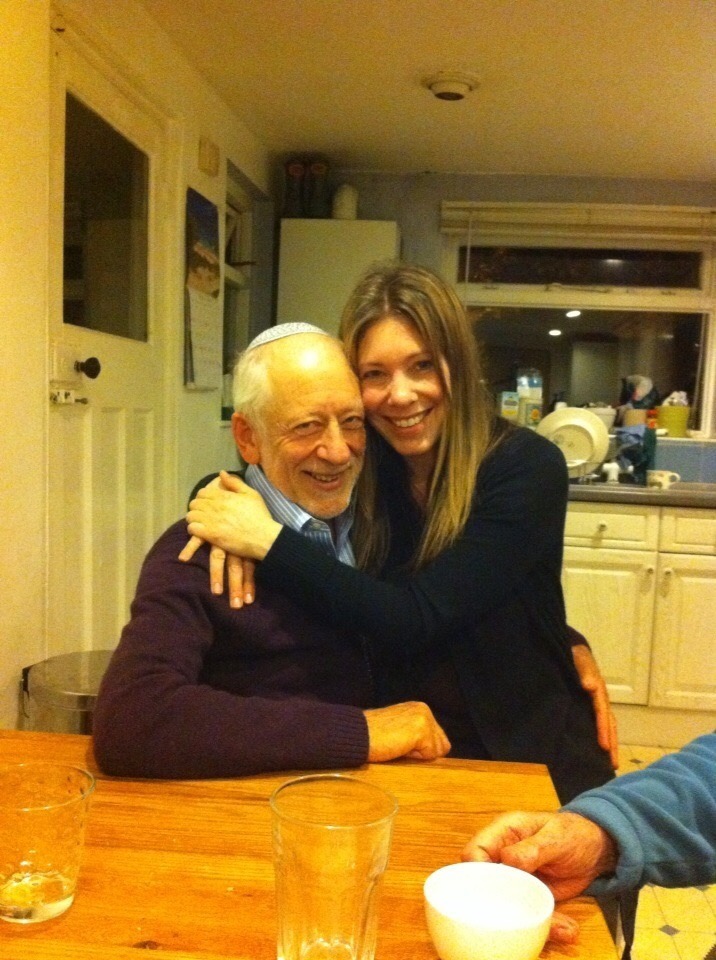
To celebrate our wedding anniversary (tantrum warning; see footnote) my wife and I arranged to spend an intimate weekend in a sleepy coastal village an hour or two from Sydney. At our advanced stage of life our offspring seek to protect us from any reckless or imprudent intimacy, and so it was our Sydney family joined us in the seaside cottage.
Annette and I married forty-six years ago, when she was twenty years of age and I was twenty three. We were children, who did not know each other; in fact we did not know ourselves. 
I did some arithmetic recently and realised we have been married for 66.66*% of my life. Annette’s percentage is even higher. We thought the marriage a good idea at the time and I think it a good idea still.
After so many years it is delightful to make fresh discoveries of one’s bride. On Day One of our anniversary weekend I disturbed Annette in the bathroom after lunch. I saw she was brushing her teeth. I said, ‘I didn’t know you brushed your teeth after lunch. I thought I was the only person in the world who did that. If I had known I’d have spread toothpaste on your brush when I did mine.’

With her sweet mouth foaming dentrifice attractively , Annette replied, ‘I always brush after lunch.’

On Day Two I went to the bathroom to perform my midday oral toilet and found my toothbrush, freshly spread with toothpaste. 
From brusher, with love.   
FOOTNOTE: TANTRUM.
THIS IS OUR FORTY SIXTH ANNIVERSARY. IT IS NOT NOT NOT OUR ‘FORTY SIX YEAR ANNIVERSARY’. THERE IS NO SUCH THING. THERE CAN NEVER BE SUCH A THING AS A ‘ONE YEAR ANNIVERSARY’ OR (HEAVEN FORBID) A ‘HALF-YEAR ANNIVERSARY’ OR (SAINTS AND REBBES PRESERVE US) A THREE MONTH ANNIVERSARY’. WHY NOT?

BECAUSE ‘ANNIVERSARY’ MEANS ‘TURNING OF A YEAR’; HENCE FORTY SIX YEAR ANNIVERSARY IS A TAUTOLOGY AND AN OFFENCE AGAINST LOGIC AND MEANING.
END OF TANTRUM.

The Delinquent Chromosome and the Marathon Runner 

Most of us have no intercourse with our forty-six chromosomes. They perform their work honourably in intracellular obscurity and we leave them alone. Not so for my friend Manny Karageorgiou: his Chromosomes Numbers 13 and 14 have conspired to mutate. This mutiny came to light late in 2013 when he broke a rib without trying. He simply breathed or coughed or heaved a carton and the rib quietly cracked.
 

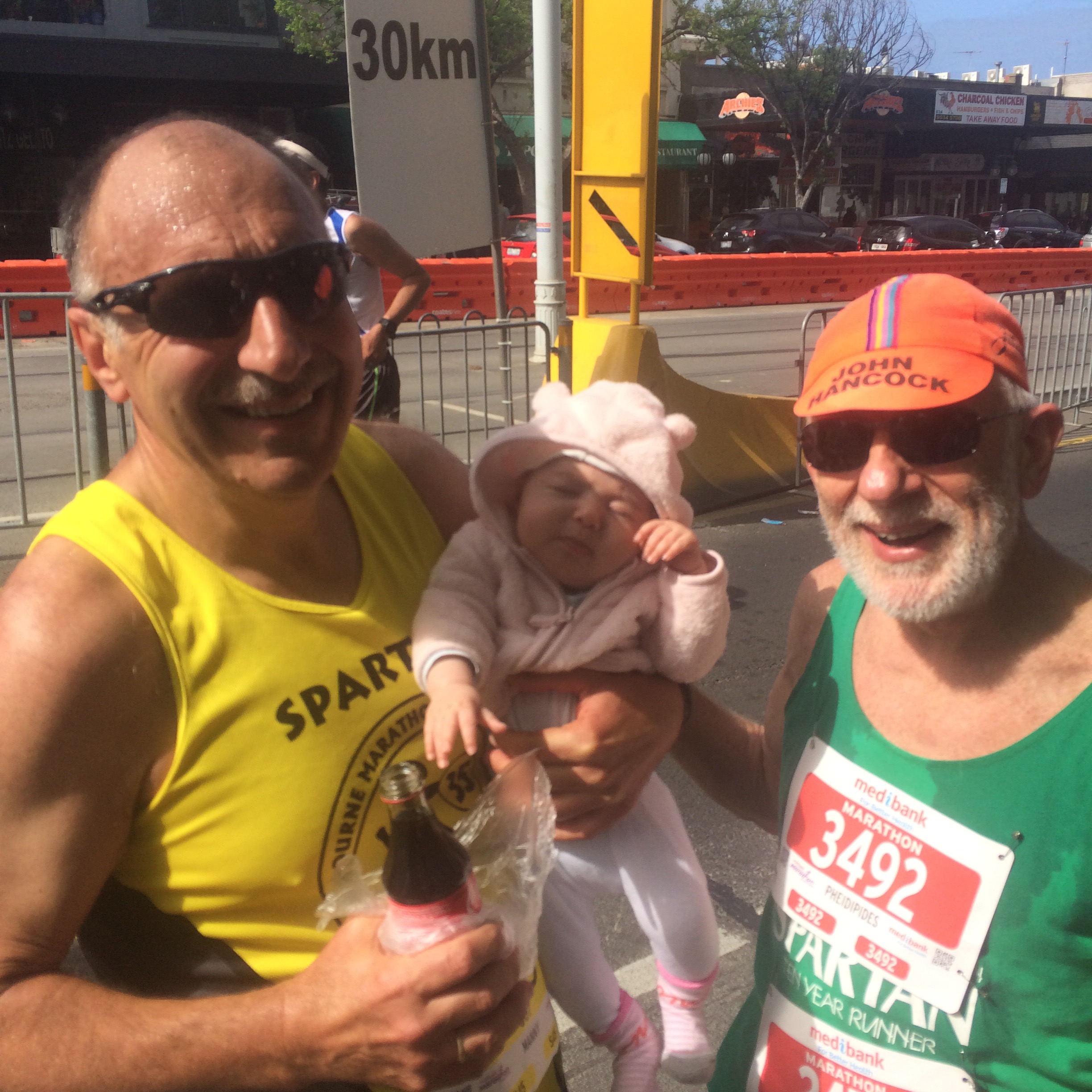
What Manny has tried to do – what he has managed to do every year for 37 years – is to run the 42.195 kilometres of the Melbourne Marathon. Manny is one of a tiny and diminishing band of brothers to achieve this feat. This, their 38th year, they number only eight.


When Manny’s rib cracked he consulted his doctor. In their shared innocence, patient and doctor initially believed they were dealing with a painful area in Manny’s chest, a mere nuisance, an impediment to running: and Manny had a marathon to run. The Marathon would call him. Come October Manny would obey the call and run. Always the Melbourne Marathon, always and only Melbourne. Athens too, has called Manny. Deep in his Greek heart’s core he hears that call. He feels aeonic tremors, he hears echoes across time of Pheidipides at Marathon field. Manny feels, he hears and he yearns to join the runners in Athens; but year after year that marathon clashes with Melbourne’s.


Manny could not run both. Melbourne held him: captive of his love for the Melbourne, of his obligation to its history, of his loyalty to his old comrades, Manny stopped his ears to Athens in October, he turned his back on the Aegean and, busted rib and all, he ran Melbourne. That was last year. For a period of time between the fracturing of the rib and that Sunday in October, my colleagues filled Manny’s body with poisons – thalidomide, dexamethasone, bortezomib – in their attempts to put down the chromosomal mutiny. The short term for that poisoning is high-dose chemotherapy. 


When I wrote of Manny’s marathon in 2014, runners from around the world responded in awed respect of the man who’d run thirty-seven Melbournes, and who’d prepared and run it this time with a diseased rib and a poisoned body.


All that was in 2014. Since then Manny has undergone autologous haemopoietic stem-cell transplantation. The chemical savagery of this procedure – doctors have to poison every blood-producing cell in his body – can cure or kill. It did not kill Manny. But the mutiny grumbles on, bones everywhere are eroded, they await their moment of innocent impact or small tumble. One crack and a marathon runner will have run his last.


Manny’s haemato-oncologist, a compassionate and scholarly man, forbids running. He knows too well Manny’s disease. My guess is he has never run a marathon, is innocent of the joy, has never known the intensity of that blood-filled, tear-filled passage through space and time to self-realisation. For his part, Manny knows little about his proliferating mast cells, rogue daughters of his body’s revolution; he knows less of the osteoclasts punching holes in his bones; and nothing of the dysregulation of an oncogene translocated to his perfidious chromosome 14. But Manny knows enough. He understands the doctors do not speak of cure, he accepts the unending medication, he understands the risks of running. But he takes the occasional light run.


I haven’t asked Manny, ‘Do you run to live?’ I sense that the occasional light run is the answer that Manny’s mind or body drives him to. When Manny asks this family doctor, ‘Do you think I can run the marathon again this year?’ – the question I hear is: ‘Am I permitted to live before I die?’ And who am I – captive of my own marathon dreaming – to deny Manny? I decide I will run Melbourne at Manny’s side.


***


Lining up at the rear of the field of seven thousand dreamers before the Start, Manny implores me for the seven thousandth time: ‘Promise you’ll leave me behind once I’m too slow for you, Howard. I don’t want you to sacrifice your time for me.’ Manny never dreams he’s honouring me. But even before the gun sounds, runners reading the rear of Manny’s shirt salute him: ‘Legend!’ – they cry – ’Thirty-five Melbourne Marathons! Amazing!’ They clap him on the back, not realising Manny’s shirt sells him short by two marathons. Manny does not correct them. The same people spill glory and goodwill onto me in my Spartan’s shirt: ‘Go Spartan!’


A beautiful morning for running. Beneath low cloud a light breeze cheers and cools us as we snake along boulevards and run spirals through Melbourne’s parklands. Manny’s prudent pace suits me. I search for bodily pains to fret about. Nothing: silence from the supposed stress fracture in my left foot, nothing from the torn right calf muscle that I have rested from four weeks. The opposite calf sends alarms, but these are false. Pheidipides Goldenberg has no complaints.


Running half a pace behind Manny I take him in, not as the indoor person I have known, but Manny as runner. His build is not classic Kenyan: Manny is constructed of old materials, a series of chunks assembled one on top of the second. Impressive that he has lugged this unpromising torso through thirty-seven marathons. Projecting below that torso are the legs which are Manny’s secret. Beautifully muscled, elegantly defined beneath skin shining with vitality and sweat, Manny’s legs look decades younger than he as they pump smoothly, rising, descending, devouring distance.


Approaching the thirteen kilometre mark, Manny grinds on steadily, shouting out greetings to figures who come into view and earshot, his comrades, these, fellow members of the hallowed eight. To a man they look old. And calm. The marathon is their familiar foe. It holds no terrors, no surprises for them. Not for the first time, I recall Tennyson’s Ulysses as he looks upon his comrades:


Souls that have toil’d, and wrought, and thought with me –

That ever with a frolic welcome took

The thunder and the sunshine…

You and I are old;

Old age hath yet his honour and his toil;

Death closes all; but something ere the end,

Some work of noble note, may yet be done…   


With a cry of a different temper, Manny swerves, his voice joyous. He mounts the kerb, sweeps a good-looking woman into his arms, kisses her face, her hair. She pushes him away a little, looks at him searchingly. Satisfied, she smiles: ‘You look good, darling, you look wonderful. You’re running smoothly.’ The good-looking woman is Manny’s wife Demetra. She plenishes us both with cola and kisses, promising to find us again ten kilometres down the route. Manny releases his wife, takes a step, turns back, grabs Demetra again, crying into her hair, ‘I love you, darling’, and sets off again. I look down and try to deal with a lump that has risen in my throat.


Heading out toward the beach now we are bathed by sun and cooled by the breeze. Aaah, blessed day. The first Kenyan, having turned and now heading homeward, glides past us on air. Shouts of wonder rise from all throats as runners and spectators alike react to this shock of the beautiful. 


‘That’s my street there, Howard, Number 141. Please join me and my family at any time from 3.00. Bring your wife. Please.’ I want to join Manny and his family. If I finish in time I’ll certainly be there. Until now, Manny has spoken little while I have spoken more. A quieter person, he places one foot before another, repeatedly, steadily, and runs inwardly. I ask from time to time, ‘How are you going, Manny?’ ‘Not great. Not as good as last year.’ Not feeling great but not complaining either. As we swing out along the beach road and past Café Racer, a bunch of bystanders suddenly flows onto the road in our path and Manny’s face relaxes and falls into a wide smile. Hugs, handshakes, claps on Manny’s back, kisses on Manny’s face from two toothsome young women, and Manny keeps smiling and keeps on running. The interlopers pump sunshine up Manny’s arse and run alongside him. For the best part of an hour we run with the posse and through all that time Manny is smiling.
We come to the turn and the posse whoops and cheers as Manny turns for home. Manny is brother to one, uncle to a couple, second cousin to a few more, godfather to another. The kissing females are godson’s girlfriend and her girlfriend. The brother is shorter than Manny, genial, younger, rounder and pretty fit. He stays the distance for the full hour as do godson and one of the kissers. Others, out of shape or out of condition, fade away and re-join us later. Finally, with farewells, more clasps and shakes and blessings the mob falls away. ‘See you at my place, darling!’ ‘See you after three, Manny!’ The mob loves Manny and he them. Afterwards he tells me, ‘They’re here to meet me every year. Every year at the same spot. They never fail.’ A little later Manny says, ‘Dem and I are taking the whole family to Athens next year…it won’t be at marathon time of course.’

Increasingly I relish Manny’s invitation to join him and the family. These people run to the beat of a familiar drum.

  Back on the road, unescorted by Manny’s family, I have a question: ‘Manny, are you Manuel or Emmanuel?’

‘Manuel. They call me Manny. Also Manoli.’ 

Manny, Manoli – these affectionate diminutives are the aural furnishings of a life. Cushioned at every mention of his name, the man lives his life in relation, in connection, not alone, never – so long as these names are heard – alone. Back on the road, the solid road, returning from my abstractions, back with Manny-the-person I notice him struggling wordlessly. What silent erosion within his skeleton, what deposition of para-proteins in his kidneys, what mischief in his marrow, hampers this champion? Conversely (and most striking), how remarkable the redemptive effect of the loving presence of Manny’s family!


Around the corner and into Fitzroy Street where the crowds thicken and the cheering is a roaring without end, we allow ourselves a fifty-metre walk up the ugly little hillock placed here for the torment of the tiring runner. I reckon we’ve run better than two thirds of our 42.195 kilometres. Manny bursts into joyous shouting: ‘My baby! My baby!’ Emerging from the midst of the thronging cheerers is the adoring Demetra, bearing encouragement and affection and more Coke. And a baby! – their first grandchild. Manny cradles the pink bundle, adores her like a Magus. To me Demetra passes chocolate! I’m dubious about this; I’ve never eaten chocolate in the middle of a run. Will I like it? Will it like me? Too late – it’s melting in my sweaty paw. Now it’s inside me, followed by a bottle of Coke. Supercharged with caffeine and sugar and fluid I am invincible. In Demetra’s arms, holding his pink grandbaby, Manny looks the same, but once around the corner and out of sight, he looks and feels utterly vincible.


Around the corner now and into St Kilda Road, the broad thoroughfare closed to traffic in honour of us marathoners. The sun shines, the day has warmed, everyone who is not running enjoys the balm. Runners enjoy the painful raising of knees, the heavy hurt in the thighs, the weight of weary, weary bodies that started running almost four hours ago. The 32 – kilometre sign tells us there are only ten kilometres to go. Only ten kilometres to go feels to a runner as welcome as only ten more years might sound to a prisoner serving life. The experienced runner knows the second half of a marathon starts at 32K.


We plod in the sunshine. The field has thinned as faster runners leave us behind and others – the broken, the breaking, the bleeding, those limping – fall behind us. Here to one side of us, runs Eeyore, a young woman from England. She runs smoothly ahead then stops, bends forward in apparent pain, and breaks into a slow walk, and soon she is at our side again. Eeyore replies to my clinical enquiries morosely. I encourage her, I pump sunbeams, I tell her she should be proud. I should shut up and allow her to enjoy her misery. Eeyore and Manny and Pheidipides keep company intermittently until the final few hundred metres. Just ahead and to our left runs an aged, arcuate Japanese runner. His age might be anywhere from fifty to seventy. He clings to a line, a crack visible in the road’s surface where one layer of tarmac meets its neighbour. Dourly, silently, mute to my greetings, his spine twisted into a boomerang convex to the left, Japan runs the lines. His speed is no better than ours but I bet he could run all the way to Hokkaido without stopping.


A soft sound issues from the female who runs half a pace ahead on our right. The slight sound recurs – the grunt of a person in pain? – pulls me close. No not a grunt, it’s a moaning, the woman’s lament for her suffering self, her threnody sung for self-comfort. She’s about forty, shapeless, pale, a moving emblem of tortured humanity. The moment brings me back to the Olympic Marathon (I think it was at Barcelona) where a Swiss or French runner, whose name I seem to recall was Dominique Something approached the Finish. No-one who witnessed the sight of this tall, thin woman, faltering and staggering in her final lap of the stadium will forget her in her extremity. The brutally hot day, the merciless steeps of Monjuic in the approach to the stadium, the criminal timing of the event in such heat had all but undone her. She lumbered into view, slowed, stooped, seemed to recover herself and advanced. Time and again she seemed at the point of falling. Officials were seen to move toward her, then to retreat. Appalled viewers on screen and in flesh begged wordlessly for it to end, but Dominique stumbled on. Twenty, thirty metres from the Finish she fell. Officials came to her aid and in so doing ended her chance of completing the Olympic Marathon. It is Dominique whom I hear now as this woman moans.


It is no disrespect to acknowledge that we belong to the dregs of the marathon world: among the select who run marathons, possibly the most resolute and vigorous of people, our sub-group group is the most enfeebled. And all the more honour to us who persist. On we go, pausing for drink every three kilometres, enjoying the excuse to walk twenty, thirty metres. Then up again with weary legs, up and back into the slow steady tread that our heartbeats allow us, that is all our breaths and our body salts and our fluid reserves and our moral reserves can support. We walk, we pause to walk thirty guilt-free walking paces, then on again we run, and on. Manny and I negotiate small contracts: we’ll run without stop to the top of this short rise, then we can coast down the farther side; we’ll run and not stop until we reach the next drink stop, then we’ll reward ourselves with cool fluids and a splash of water; we’ll run now and will not stop until we reach the MCG, and then…


We enter the great stadium side by side. The huge grandstands tower about and above. We insects crawl the margins below. At my left Manny says, ‘It’s magnificent, isn’t it?’ It is, it is indeed. We swing our arms, pumping our reluctant thighs into action, we raise our heads, then hoist ourselves onto our toes for the final 150 metres. Two aging men, one with an intact skeleton, the second much ravaged, swing around the bend. We pass the bent man from Japan: his face, transmogrified, is a rising sun; and Manny and I are sprinting, and sprinting we fall across the Line.


POSTSCRIPT: I have written elsewhere of my inadvertent double entry (and double payment) in this year’s Melbourne Marathon. I duly wore two bibs – each with its distinct number – and with them, both electronic timing chips. I had speculated that Pheidipides Goldenberg might record a finish in both last and second-last places. If you google Melbourne Marathon Results 2015 you will see how closely I anticipated the result. And you’ll find, ahead of me by one second, Manny, Manuel, Manoli Karageorgiou. 


Yizkor

 
I found the photograph I had been missing. It was found, as most of my misplaced objects are, precisely where I had placed it; in this case it was safely at the bottom of my backpack. I wanted it for remembrance. 

The photo sits in its small oval frame. It shows two small boys sitting side by side. Their cheeks have been pinked by some process of photographic enhancement common to photos from the ‘fifties. One boy sits cradling a large teddy bear. The boy’s face is a narrow oval, his expression unsmiling, alert, guarded, attentive to the photographer who is an adult in a frightening world controlled by adults. The second boy, taller, wider, rounder, has a fuller face, topped with wavy titian hair. He has the daughter of a smile on his face. His is the image I have sought, this the face of the person I wish to hold in remembrance.


The portrait conveys much of what I wish to hold: the elder boy is Dennis, his parents’ firstborn, my brother. His destiny is here to be read. It’s all here – firstborn, male, cherished; good-natured, close to his younger brother – and fat. In this photograph Dennis must be about four. In less than sixty years he will be dead.


***


Literally translated, the Hebrew word yizkor means ‘he will remember’. Over the recent Festival period I recited the yizkor prayer for my father, my mother, my wife’s father; and for Adrian, my consuegro; and I remembered them all tenderly. It was only when I prayed for Dennis that I cried. I cried for the protective brother I could not protect, for the always-advising brother I could not advise, for the firstborn who worshipped this usurper as a hero. 

Dennis did not ask to be born fat. He did not ask to be born first. He loved his father as his father loved him – not wisely but too well.

Immoderate in all he did Dennis loved his younger brother immoderately. I miss him, I pray for his rest as I pray for my own.


The Seventh Day of Spring 

She slipped out of her mother into my palms on the seventh day of spring almost two score years ago. Small and slippery and vernix-spattered, with opalescent pink skin, she lay in my hands and opened her eyes and astonished me. Shortly afterwards her nine-month co-tenant peeked out, hesitated, retreated then plopped into a steel dish. The placenta lay in the dish, mute. The baby cried. She had fingers and toes and a belly and limbs and a face and girl bits and a mouth.

We took the baby home.
Seven is a mystical number, springtime a magical season. In a story I wrote about her I called her Pleasant Spring Goldenmountain. That name will serve for this story too.
Born of midget parents, she was tiny. The Pleasant One, being pocket sized and portable, was perfect for carrying and cuddling and tickling and flinging into the air and (generally) catching on the way down. She’d laugh and scream and I’d chuck her towards the ceiling time and again until once, gasping, she cried: ‘Stop! I’m not a toy, Dad.’ Chastened, I stopped.

  
The little one loved her father, attaching herself to him as if to a placenta. While she was still far too young to appreciate it the dad read ‘Great Expectations’ to little Springtime. She listened to the connection between Joe Gargery and Pip. She would say to her dad, ‘Ever the best of friends old chap. Ever the best of friends.’

  
Around the age of twelve her classmates shot up so much she had to crane her neck to talk with them. When her neck tired she’d address her friends’ belly buttons. A doctor friend recommended growth hormone injections. By this stage the Pleasant One knew her life’s mission: to mother early and often. She knew too that a short person’s small skeleton often had a small pelvis too narrow to allow a baby through. Some short mothers couldn’t give birth naturally. 
Every day for three years the Pleasant One injected her belly with the hormone and she grew. Her mandible grew wide enough to accommodate her teeth and her long bones flung her up to a towering five feet, two and a half inches, plenty big enough for babies. ‘I’m tall, Dad’, she said. And she stopped injecting.
Growing up in a family that lacked nothing other than fiscal discipline, Springtime would hear her parents groaning over the bills they had to pay. On weekends the child worked as a medical receptionist and saved her earnings. When she wanted new clothes she chose and paid for her own. Aged fifteen she decided she’d like a holiday in North Queensland. She worked and saved and paid for it herself. Aged sixteen she wanted to improve her French. She worked and saved and travelled to Paris where a man exposed himself to her outside the produce market. To improve her Hebrew she enrolled in a girls’ boarding school in Jerusalem for her summer holidays. Soon she could speak like the prophet Isaiah.

 
One day Springtime said something that made her older sister and her brother laugh. Her parents laughed too. ‘That’s funny, darling’, said her father. ‘I know Dad. I’m funny.’ ‘I’m funny too, darling’, said her dad. Springtime rolled her eyes like an epileptic. And laughed.
When she entered her early twenties Pleasant Springtime determined her father was not perfect. She told him so. From time to time, lest this slip her father’s imperfect mind, she repeated this information, adducing evidence. Her mother shared this surprising opinion and voiced it aloud. The two made a chorus and seemed to enjoy it.
Pleasant Springtime collected a couple of degrees, became a psychologist, gathering a bouquet of diplomas, coing to leadership of a large team of professional peers, some a good deal older than she. A number of fruitless connections came and passed before she met the good man I will call Running Bear. She married the bear and she bore him two infants, a Minor Prophet and a red gem.

  
And her Gargery father lived happily ever after.

Postscript: Twenty years after injecting herself full of Birth Canal Enlarging Hormone, Springtime elected to deliver her children by caesarean section.

Dinner with Some Old Teenagers

Word reached me, and when it came, it came obliquely. My writer friend in England, Hilary Custance Green, forwarded a letter that had reached her by way of one or another of the virtual media. ‘I wasn’t certain what to do with this,’ she wrote, ‘I thought it might be spam, but I decided to forward it, just in case.’ The writer of the letter asked Hilary if she could forward it to her old doctor. The letter bore strong feelings that had brewed and bubbled within the writer over years.
‘Dear Dr Goldenberg, I don’t know if you remember me but I remember you and I have wanted to contact you for a long time.’ There followed the remarkable declaration that my actions had saved the writer, now aged fifty-five, when she was a girl of seventeen. She owed her present happy life, she wrote, to my intervention, as well as the help of some others around that time. 

The letter, and the memories it evoked, thudded, jolted within me. Yes I did remember the girl, firstborn of three, trapped in a hell where her violent alcoholic father abused all in the home. I remember the face, fair skinned, the coronet of fair hair. And her brave, fugitive smile. 

I read on, and as I read the girl’s name came to me, a diminutive in the Australian way, never Anna but ‘Annie.’ Annie’s father was a helpless, hopeless drunk, and when drunk prone to unpredictable extremity. Annie would await his return from the pub with dread, hoping he’d keep away, hoping helplessly her mother and sisters would be safe. She’d have fled the family home long before but father had screamed and waved his gun at her. His words – ‘If you try to leave I’ll shoot you and the others and myself’ – shocked me. Uselessly, helplessly, I trembled for the child. The child confided she never brought a friend into that house, for fear of the shame. She told me these things, forty years ago, and I recognised a further shame, even deeper, Annie’s self-disgrace to be ashamed of her own father.    

In her letter Annie reminded me of the Saturday night she finally escaped. Father had drunk all that day and into the night. Annie sheltered in her bedroom but when father burst in she ran from him, wearing only her nightclothes. Father screamed behind her, ‘You’ll never come back into this house, girl!’ The girl walked through the early hours, avoiding exposed places. She found herself in the deep dark of a railway culvert and, terrified in that blackness she decided, ‘This is where I’ll have to sleep from now on.’
Annie wrote, ‘I walked to the clinic and laid down and waited there for you to arrive. You’d always been kind and understanding. I knew you worked the Sunday mornings. I didn’t have anywhere else. You took me in when you arrived and after work you drove me home so I could safely collect some clothes. Then you drove me to a refuge.’

Annie’s account of that last-first morning was only dimly familiar. I felt small stirrings of pride, and a tenderness for the girl in the nightdress. Much stronger was my shock as I realised I had not thought of her since the ‘rescue.’ Annie had disappeared from the days of those busy years. She had lived, thrived, suffered reverses, sought salvation, recovered, blossomed, become the assertive woman her mother could never be, married happily and raised children, good citizens, and now saw grandchildren. Forty years and no thought by her wonderful caring doctor. That child had come into her own and that doctor had reached his prime and passed it.
Perturbed, I wrote to Hilary to thank her for sending word, for her gift.
The word found me in the outback. I wrote to Annie, giving my phone number and told her I was anxious to speak to her. My phone rang as I rode my bike across the railway line. I dismounted and answered and the voice said it was Annie and for twenty minutes I listened to her narration of the events of a turbulent life. We agreed we’d meet after my return from the outback.
In the exchange of emails that followed a second voice entered, followed by a third, then a fourth. Later a fifth and a sixth made contact. The writers, all roughly contemporaries, had been my patients in their teenage years. Each bore a burden of recollection which pressed now to be discharged.

Three women, matrons now, waited for me at the restaurant. I opened the door to faces that shone. I saw three faces of girls in their teens. I stepped forward and found myself clasped. Lined faces kissed mine, ample bodies held me close.

We sat. The women said how young I looked, I said how good they looked. The past was with us, the past with its beauty and its horror. The past, reverberating with friendships I had forgotten and the three had remembered. 
How had I forgotten?
The waitress came, hovered, departed. Again she came and we promised we’d soon choose and order. It was not soon. Forty years here, twenty there, so much event, so much life. Babies – it turned out I had delivered them – were now adults, some even parents.  
The waitress returned. Jerked into the present we ordered.

Girls Numbers Two and Three are sisters. I asked after their parents, immigrants, older than me by ten years, proud people, beavers in the general community and within their own. Mum was alive, still vibrant – ‘and fat, like all of us!’ Shrieks of laughter. And Dad?

‘Dad’s fat too, and dementing. The grog; it’s Korsakov’s.’ The speaker is Number Two, now a nurse. In the care of their aging parents she’s the officer commanding Number Three and their brothers. 

Both Three and Two were married when I last knew them. They’d married matching buffoons, agreeable blokes when sober, not often sober, not often enough agreeable. Three spoke: ‘Even before we married I saw how my father in law treated his wife. He’d tell her she was stupid, shout at her to shut up when she spoke. One time I saw him belting into her – he was full as usual. I froze. We never saw that. Mum and Dad would drink a couple of gins after work but they never got nasty. Not like that.’ 

Memories returned to me of the mother in law. A tall trembling lady, her face pink and scarred, she’d address me in a soft trembly voice, describing symptoms I could never fathom, never cure. Now I understood.

‘It wasn’t too long before Robbie was getting aggressive like his Dad. He’d go to the pub after work, get full, drive home drunk. I had my first girl, then the second. I thought, “No. This isn’t what I want for them, not what I want them to see.“ I rang Robbie and I said, “Don’t hurry home you drunken bum. Your wife and your kids have split.”’ Peals of laughter from Three, far the widest at our table. ‘Did he ever hit you?’ – I wondered. ‘Lot’s of times, but I’d belt him too!’ More jolly mirth. Three sits opposite me, her great arms a gallery of art in brilliant reds. Finer tattoos crawl upward from her bodice, another spiders around her neck.

‘Weren’t you scared, leaving him?’

‘No.’ The thought is a stranger to Three. She stares at my unexpected question. ‘There was no future there. I got up, took my girls and went.’

Did I raise an eyebrow? I certainly wondered at her resolve, her clarity. Her fearlessness. ‘Yeah, money was tight. I got a job and I worked and I looked after my girls. They’re good. Their blokes are lovely. And the three of us, we’re very close. Like me and sis here.’ The two women looked at each other and smiled.

Two reminded me: ‘I was a mother at nineteen. Got married. You delivered my babies, Howard. I was in labour, terrified, not knowing anything. You got up on the bed beside me and stroked my back.’ Did I? Nowadays the Medical Board would caution me for this sort of thing. They’d require me to undergo Education.

Two continued: ’You know everything about us. You’ve seen all our vaginas!’ Careless in their merriment the girls showed none of the self-consciousness that saw me look down and blush. ‘I’m diabetic now,’ continued Two. ‘But I’m good. After I left my husband I worked as a nurse, you know, State Enrolled. When my kids were adult and near-adult my partner encouraged me. He said, “You’ve always wanted to study. Do it.” So I did. I studied nursing at Melbourne University. Boy that’s a gap – from Victoria Uni to Melbourne. But I did well…’

‘Got Distinctions’, Three’s voice was proud.

‘I did all of it on scholarships. I had to perform. They can take the scholarship away if you get bare passes. Now I’m specializing in Mental Health, in charge of the ward. I love it.’

Three told me how she too had always worked in health, in administration. She described without bitterness how, after eighteen years, her institution had managed her out of her job and into retirement. ‘Now I write poetry. I go to Creative Writing classes. And every Wednesday I post a poem on Facebook. Wednesday is the hump of the week. I call my readers, my “humpies.” Here’s this week’s poem’. Three handed me her phone where I read her tidy quatrains. The verses spoke in anticipation of this gathering, in praise of the poet’s doctor, his kindness, his understanding. Blushing again I came across a ‘Like’ in response. The author of the Like was Four, another ex-teenager whose family I’d been close to. Four wrote, ‘I remember how Dr Howard comforted me when Karen died.’ Another thump. 

I remembered Four, a striking girl with olive skin, tight black curls, a smile that made you feel like singing. I remembered Karen, Karen who was lost, that sparkling child. Karen was in the car that drove to the pub in the bush hamlet twenty kilometres distant from my country practice. The pub filled the young driver up with grog and watched him drive the carful of friends home. How many died when the car missed the bend? Four? Five? Karen was extinguished in that crash. I remember speaking afterwards with Four. Was she the only one I was trying to comfort? I think I was trying to comfort myself too. A year or so later another young driver killed himself driving home from the same pub. His passenger suffered a fractured neck, became quadriplegic. From that time until left I doctored the human wreckage. And my rage burned against that pub. I nursed a futile wish to close it down.
*** 
The girls spoke of the men in their present lives. Annie had formed a lasting union with Ian that prospers still. She showed me the album her family made for her fiftieth birthday. Here were Annie’s mum, Annie at fifteen, Annie’s own grown children, Annie with Ian. I saw a tall man, angular and strong-looking, with a craggy face. Two and Three spoke warmly of their own blokes. All three had known some duds but the ‘girls’ bore no hostility to the male race. When, at the conclusion of the evening, Ian turned up to drive Annie home he towered over me. My not-small hand was lost in his handclasp. Instantly likable, solid as a wall, he smiled and I felt gladdened for Annie.

Two asked Annie: ‘Have you ever seen your father again?’ Quietly came the reply: ‘I always vowed I never would. Then four years ago he wrote to me, to all of us, Mum, my sisters. He said he was dying, in Mallacoota. His heart was failing, from the grog. He wanted to see us. Mum wouldn’t come, neither would my sisters. But I thought, “He can’t hurt me now.” So I went. He talked and he talked, poured out his side of our lives. He lay on the bed and asked me to lay by him and cuddle him.’ 
I looked at Annie, my eyes wide. 

‘I thought, “He can’t hurt me now. He’s old and he’s dying alone.” He’s got a partner but she’s not his blood. It’s not the same. I climbed up beside him and I held him. We laid there together for a good while. After a couple of days I went home. He died two weeks later.’

Do You Have Children? 

She was the first patient in my day.
She was sent to this city in North Queensland by the foreign mining giant that employs her. 
I had never met her before. We introduced ourselves.
 She said: ‘I was woken by awful pain in my bladder. It’s an infection, I’ve had them before. I couldn’t sleep for the pain. It was four in the morning, but I got up and went out and walked the streets until I found a 7- eleven. I bought some Nurofen tablets for the pain.’
‘Did they help?’
‘A little.’
Her urinalysis was positive.
‘I think you’ll need an antibiotic. Antibiotics famously render the oral contraceptive pill inoperative. Maybe. So during this cycle you shouldn’t trust the pill… unless you want a baby.’
A smile and a shake of the head. The smile is not that smile that says, ‘Tread with care.’ She is a mature woman at peace with herself. Excepting for her hostile bladder. The smile licensed me:
‘Do you have children?’
‘No.’
Another smile as she sat and formulated a response to my silence.
‘I never thought I would. Now I realise I really have to decide – this month in fact. You see I’ll turn thirty-nine next month. I wouldn’t want to have a baby after forty.’
‘Why the late uncertainty?’
‘It hit me I might come to regret never experiencing that.’
 

She talked about childbearing and childraising, describing the contrasting experiences of her sisters. I agreed it was a momentous question. We talked about bladders and we parted.

 At home I asked myself how I’d describe my own experiences. I’d be unable to resist describing – at clear risk of malicious misinterpretation – the intense pleasures of bathing or changing soft bodies, the satiny skin, the small weightiness in arms or lap.
I thought about my feelings and the word that came was ‘intensity.’ Had she asked I might have said, ‘Becoming a parent deepened me. I believed I was tender towards children, but my firstborn taught me how I had tiptoed through mere shallows.’
I recalled an early piece of Martin Flanagan in the Melbourne ‘Age’. He described nursing his small daughter through a night of torrid fevers. From memory, I recall him writing, ‘I know I will never feel closer to this child than I have this night.’
I might have quoted an early patient who became an enduring friend. Her asthmatic sons struggled night after night for breath. She told me how she’d walked the floors, holding them, counting breaths, weighing ambulance against a dash in her own car.
Inevitably I was visited by verse.
I have walked and prayed for this young child an hour
And heard the sea-wind scream upon the tower,
And under the arches of the bridge, and scream
In the elms above the flooded stream….

(W B Yeats, ‘A Prayer for My Daughter’)

I might have described the common and uncommon thrill of feeling a newborn curling her fingers – by reflex – around the finger that I rest on her palm. I might have said, ‘The unearned trust of my child makes me know – as I have never known before – I am significant.
 

I might have said, ‘My children gave me a clarity that was visceral: I knew through them my task, the meaning of my being alive. I knew I would give my labour without question or measure or thought of recompense.

I could never have dreamed the reward that would follow – grandchildren. And of course, with grandchildren comes the renewal of mission, of labour, of redemption of my aging. Feeling anew that deep significance I stride towards my latter end with head high.’


Had she asked, that’s what I might have said. But of course we will not see each other again.
Postscript: But we did see each other again – the next morning. With her consent I read aloud the words you just read. I looked up. Her face was suffused, on her lips the widest smile, from her eyes a flow of tears.
She thanked me and in answer to my question she said, ‘Sure, you can publish that.’

And the Two Walked Together

The boy emerged from the car and read the sign: LIGHTHOUSE 19 KILOMETRES. Beneath the sign were the words: Six Hours. The boy spoke, his voice small: ‘I’m nervous, Saba.’
The old man reassured the boy. They pulled on their weighty daypacks and started to walk from the turntable on the mountain. The dirt track was wide enough for a small truck. It sloped away beneath their feet and, despite the lowering sky and the fine wind-whipped rain, the two made good speed in good humour.

The old man said: ‘This is a long, long downhill slope; it will be uphill on the way back. Just when we are really tired we’ll have to fight these hills.’

They looked ahead into immensity. As the path led them lower the slopes towered green and steep before them. The old man saw they’d soon be climbing. The rain stopped and the two felt hot. They peeled off parkas and jumpers and mopped rain and sweat from their faces.

Rounding a sharp bend the boy exclaimed, ‘Look Saba! Look – how beautiful!’ The old man looked and what was beautiful for him was the joy on the boy’s face. ‘Surprised by joy’ – the words floated into the old man’s mind from some half-read snatch of old verse – ‘surprised’ – overcome – as in a surprise attack.‘ The boy’s face, red with exertion, glowed. The old man looked again; he saw no sign of care.


The descent ended in a strange plain of long grasses and thick green ferns between which the pale trunks of gums rose, twisted and charred, like writhing skeletons, reaching for the sky. ‘The bushfires must have raced through here’, said the old man, ‘See how there’s not a single living eucalypt. Just ghosts. And everything else so green.’ To himself, he added, ‘They look like humans whose prayers were not heard.’ The old man had dwelled much in suffering of late. All nature spoke to him of the pain of others.

The boy’s expression was opaque.

Not an hour into the walk the boy’s voice asked: ‘Would we be a quarter of the way there yet?’ The old man doubted it. He couldn’t really say. Mostly the boy walked beside him, now and then slipping behind. At these moments the old man slowed, he hoped, inconspicuously.

The boy’s breaths were loud. The old man announced: ‘Morning tea time’, and they stopped to drink. The old man asked, ‘Apricots?’ The boy took the dried fruits and ate appreciatively. They hoisted their packs again, the boy staggering a little before steadying. The old man took the drink bottle. It felt lighter in his hand. They walked. Between the sounds of footfalls a voice spoke: ’I love you Saba.’

The old man, for all his years, for all his words, could find no words better in reply. ‘I love you too, darling.’


After a time the flat road began to rise and twist. Ahead of them they saw stately ranks of black tree trunks, erect and slim, towering upward, their branches richly green. ‘Look’, said the old man, ‘Every tree has been burned but every one of them here has survived.’ Their eyes drank in the green life, the dense underburden. Walking between the giants the two felt the silence and it did not oppress them. Rather, wonder swept their eyes upward. In quietness they laboured up long hills, around bends that led to yet more hills, working hard but not feeling it as work.

A scream broke the silence. The boy hobbling, whimpered, ‘My foot! It kills!’ The old man took the boy’s pack. ‘Here’, he said, ‘Sit down.’ ‘I can’t Saba, my arse will get muddy.’ The old man saw a tear at the corner of the boy’s eye. He spread his waterproof on a bank, pulled the boy’s haunches backward and sat him down. ‘Saba, my foot doesn’t hurt when I’m just sitting here. But it killed before.’

The old man opened lunch, bagels he’d bought from Glicks at five that morning. The previous evening the boy ordered peanut butter and honey for his: ‘Fifty percent of each please Saba.’The old man made short work of his own bagel but the boy played with his, peanut butter and honey notwithstanding. Reckoning the child needed relief the old man removed the heavy items from the boy’s pack. Bookish like his grandfather, he’d packed a small library.

‘Do you think you can test that foot?’

The boy rose, hoisted his pack and stepped forward. He winced but said nothing. And the two walked together. At first the boy’s gait was diffident, but quickly he established a fluent step-wince-step rhythm. Rounding a sharp bend the boy cried out, once again in delight. A small wooden footbridge led them across a shallow stream. Green ferns dwarfed the boy, the water chattered and rippled, the air was still and cold. The boy glowed. He turned and spoke: ‘Thank you so much for taking me here Saba.’ In the richness of his feeling the old man felt again the poverty of his own words.


They climbed. The old man, remembering walking as a child with his father, described how hard it had been to keep pace. He said, ‘Every few paces I’d fall behind. I’d have to run to catch up. I think that’s what started my life as a runner. It’s what prepared me for running marathons.’ The boy replied, ‘That happens to me too, Saba.’

The old man, a package of memories, told the boy about the time he ran a marathon in Melbourne. ‘It was springtime, quite warm. The sun shone and warmed the asphalt. I could feel the heat through my shoe every time my foot hit the road. I realised I had worn the soles too thin. Actually I had trained hard here, at Wilson’s Promontory, on tracks like this. I had run fourteen kilometres, only one-third of the marathon distance. I anticipated feeling pain with every step of the remaining 28 kilometres. I felt full of gloom. Then I did something really brilliant: I talked to myself. I said, “Every time your foot hits the ground remember you have one les step to run. Every time your foot hurts it’s a reminder – you’re getting closer to the finish.” Guess what – after about ten metres I stopped noticing my foot altogether.’

They passed a sign that read: HALFWAY HUT. Unfortunately whatever ’halfway’ meant it did not refer to the lighthouse walk. They walked on a good while and the boy asked, ‘How much further do you reckon we have to walk, Saba?’

‘Maybe ten kilometres, perhaps a bit less.’

The boy absorbed this. He picked up a straightish stick, about 1.3 metres long and tested it. A few minutes later he discarded the stick, saying his foot wasn’t too bad now. He added, ‘I love you Saba.’ ‘I love you too, Mister Pie.’ (When he was a baby family members called him ‘Sweetie Pie.’ After twelve years the remnant was ‘Mister Pie’).


The two came to a fork and another sign. To the left, the sign read: VEHICLE TRACK 9.5KM.

To the right the sign read, WALKING TRACK 8.5KM. The old man recalled the briefing from the Ranger Staff, warning them off the walking track ’because it rained last night – could be soft underfoot.’ He chose the walking track, being the shorter and possibly the softer. ‘Maybe too soft, perhaps marshy or boggy.’ He misgave but he did not reveal his uncertainties to the child. The decision proved decisive. Time and again as they clambered over steeps, scrabbled on uneven footing, wound around sharp turns and twists, the boy exclaimed in delight and wonder. At every corner a vista, at every peak breathtaking verdure. And at every pause the song of falling waters. They panted and sweated and never stopped smiling.


The old man, marathon man, always prided himself on his doggedness on hills. But these slopes, so steep, so long, so numerous, for these he needed to dig deep. Head down, bending forward to bring the pack over his centre of gravity, the old man, ploughed dourly on; while the boy sailed ahead, never slowing, never weakening, not ever quailing at the next hill and the next that unfolded in unfeeling succession at summit after summit. The old man marvelled and rejoiced.


The walking track was no bog, simply a way up and into a southern Himalaya. Abruptly the climb ended in a series of steep declines. ‘I’m scared I’ll fall’, said the boy. The old man held the back of the boy’s pack and pulled gently backward at every descent, the traction a felt message that the old man would not allow a fall.


Around a bend and suddenly the dense bush ended at a wide cleared space. The walking track had rejoined the vehicular. A short walk brought them to a further sign announcing: NO THROUGH ROAD. Rising from their left a walking track led into bush. Leaning on some rocks three men in their late thirties sat eating dried fruit. One asked, ‘You heading for the lighthouse? It’s up that way.’ A thumb pointed backward over the speaker’s shoulder indicated the walking track. The three might have been planted in that spot, so comfortable was their seat on earth, so fixed and settled their attitude.


The old man asked, ‘Have you ever walked to the lighthouse?’ Heads nodded. The man with the thumb looked at his bag of currants and said, ‘It’s mainly downhill from here. All except the final three hundred metres, which are the steepest in the entire National Park.’ The boy pointed out a smaller notice behind the men: LIGHTHOUSE 3.2 KMS. He and the old man had been walking for four hours. With a relatively short descent ahead of them both understood they’d arrive in good time for the sunset and the start of the Sabbath. That knowing, not spoken aloud, relieved the worry, also unspoken, of walking in darkness and arriving to cold and dark.


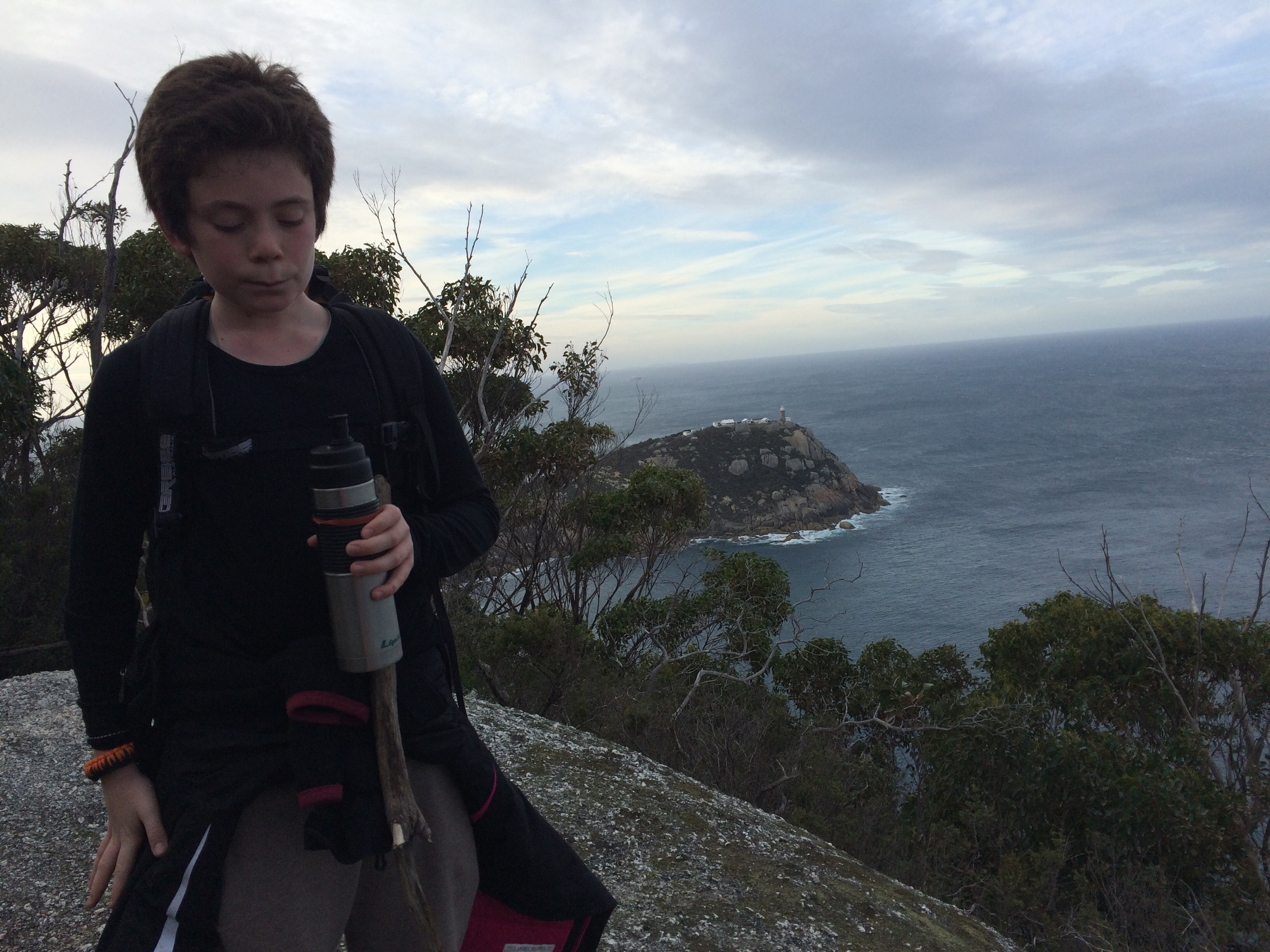
 After a short climb the track truly did descend. Underfoot, leafmeal and twigfall covered the soft sand. ‘This sort of footing is my favourite’, said the old man, ‘It comforts your soles. My feet love it.’ At every bend gaps in the bush gave way to glimpses of sea. One gap, wider than others, gave onto a view to the east of a long climbing pathway of exposed rock. At the far end of the path the two saw a white structure, phallic in shape – the lighthouse! It looked beguilingly close.


The two pressed on, half racing now. They tumbled around a bend almost falling into the arms of a human who stood on a granite elevation, tall and slim, a statue. The statue had a young woman’s face, a woman’s voice: ‘Look there: Orca.’ She pointed over a shoulder at the sea. ‘Look carefully, you’ll see the water break as they near the surface. When you arrive at the lighthouse would you please tell the lodgekeeper; there’s a pod of four playing here.’

The water broke and mended itself, broke and settled. Was this whale action? The same small disturbances were seen in every direction the man and the boy looked. Hopeful then doubting, then self-doubting, they fixed eyes, solemn and reverent, upon the sea. The old man had seen whale in these waters in years past but this time he saw no purple-black bruising the surface. After a decent interval the two hastened on. They’d seen no Orca yet they tingled with the closeness of greatness.


A voice rose from the bustling shape of the boy. He spoke of self-doubt, of fears, of haunting thoughts of his own grave unworth. The old man, filled with quite opposite thoughts of the boy, listened. He ached for the boy. He wanted to say something useful. ‘I know those feelings, Mister Pie’, was all he managed. He wished he had some infusing strength such that if he but held the boy close, the child would grow and know his worth. The urge to seize the child, to crush doubt from him bodily, was strong. But the old man knew such truth is the daughter of time. A daughter not yet ready to be born.


 Meanwhile, simple exertion, the actions of fast walking seemed to make the child lighter as he gathered momentum. The words spoken, the hard thoughts disappeared in air, leaving a small body busy and complete in its plunging passage through bushland.

The old man followed behind, carrying his pack, the boy’s books and the boy’s discharged cares.


A rock lay in their path, its northerly aspect coated in delicate mosses of brilliant green. The boy stopped to explain, ‘In the bush you can use mossy rocks as a guide, like a compass. The moss grows on the sunniest side. In our hemisphere that’s north.’


At one bend the lighthouse would appear only to disappear at the next as they corkscrewed their way down to sea level.  

Now a right angle turn marked the last of the bush. They emerged to an exposed path of surpassing ugliness. Blocks of weathered and stained cement set end to end formed a series of plaques that rose and rose, ending three hundred metres further on at the Light. This, the old man recognised, must be the ‘worst climb’ mentioned by the currant muncher. He looked up. The boy had not paused. He’d opened a lead of twenty metres as he attacked the awful slope. The old man hurried after him but the gap did not close. Half way up the boy approached a welcoming bench, set at the path’s edge to relieve exhausted climbers. The boy ignored the bench and steamed past and the old man, shaking his head, followed. When he reached the top the boy was grinning, his face a fairground of many pleasures.


Before they set out the Ranger had estimated the walking time from carpark to lighthouse at six hours. The man and boy finished in under five and in plenty of time for sunset and the Sabbath.


The lodgekeeper welcomed them. He said, ‘We’re expecting eleven in your cottage tonight. You two are the first to arrive. We expected an old – pardon me, I mean older – man and a child. Amazing that you beat all those grownups, young feller. Congratulations! Your reward for arriving early is the room with the best view. See – there’s the Light just outside your window. You’re overlooking the ocean. You’ll see any whales without leaving your room.’


The room had high ceilings, bunk beds, large windows and plenty of room for two and their possessions. The ‘cottage’ was formerly a lightkeeper’s dwelling, large enough for his wife and their eight children. Outside the wintry gale blew up a four metre swell. Inside the cottage was snug and the showers were hot. Both man and boy stank of sweat. They peeled off their steaming clothes and showered. The boy headed off to the reading room where he met the incoming walkers, adults all, and held court. The first to arrive was the trio of dried-fruit eaters, blokes in their thirties, friends since their schooldays in the Blue Mountains, revisiting old haunts and shared pleasures. After them came a family of four, rich in geography and history, which encompassed Scotland, Southern Africa, Denmark and a touch of Jewishness. The sole female was the Dane. The boy introduced himself and she replied, ‘I’m Astrid.’ This name was new to the boy who remembered her as Asteroid. Following the arrival of that heavenly body from Denmark a lean schoolteacher in his early thirties turned up. He’d sighted the boy in the carpark before setting out. Admiringly he said, ‘You walked quicker than I did’.


Darkness fell, the windy world outside moaned and window frames rattled, while inside their room the man and the boy had lit the candles. The old man placed his hands on the boy’s head and slowly, as in a fugue, recited the old words of blessing of the child. Then the two sang the Sabbath Dedication before breaking bread and feasting on packeted food brought to piping in the microwave.


Afterwards the boy beat the old man at Scrabble, much to the admiration of the last two to arrive, a bushy-faced pair who materialised from the darkness, unfussed by their final hour of moonlit hiking.


The man and the boy slept eleven hours that night.


The next day – Saturday – was a true Sabbath, a day of rest. The boy accumulated a series of hurts – his back ached, his right sole was bruised, his left knee seized in spasm. When the lodgekeeper invited all guests into the lighthouse museum for a tour, all pains were put to the side, and soon – or sooner – forgotten. The boy asked most of the questions, good adult questions, as the lodgekeeper later confided. They spent the rest of the day and the evening in the heated common rooms, reading, playing Scrabble, chatting. It is fair to say the nine adult males found the sole female and the sole child the most memorable of the company.


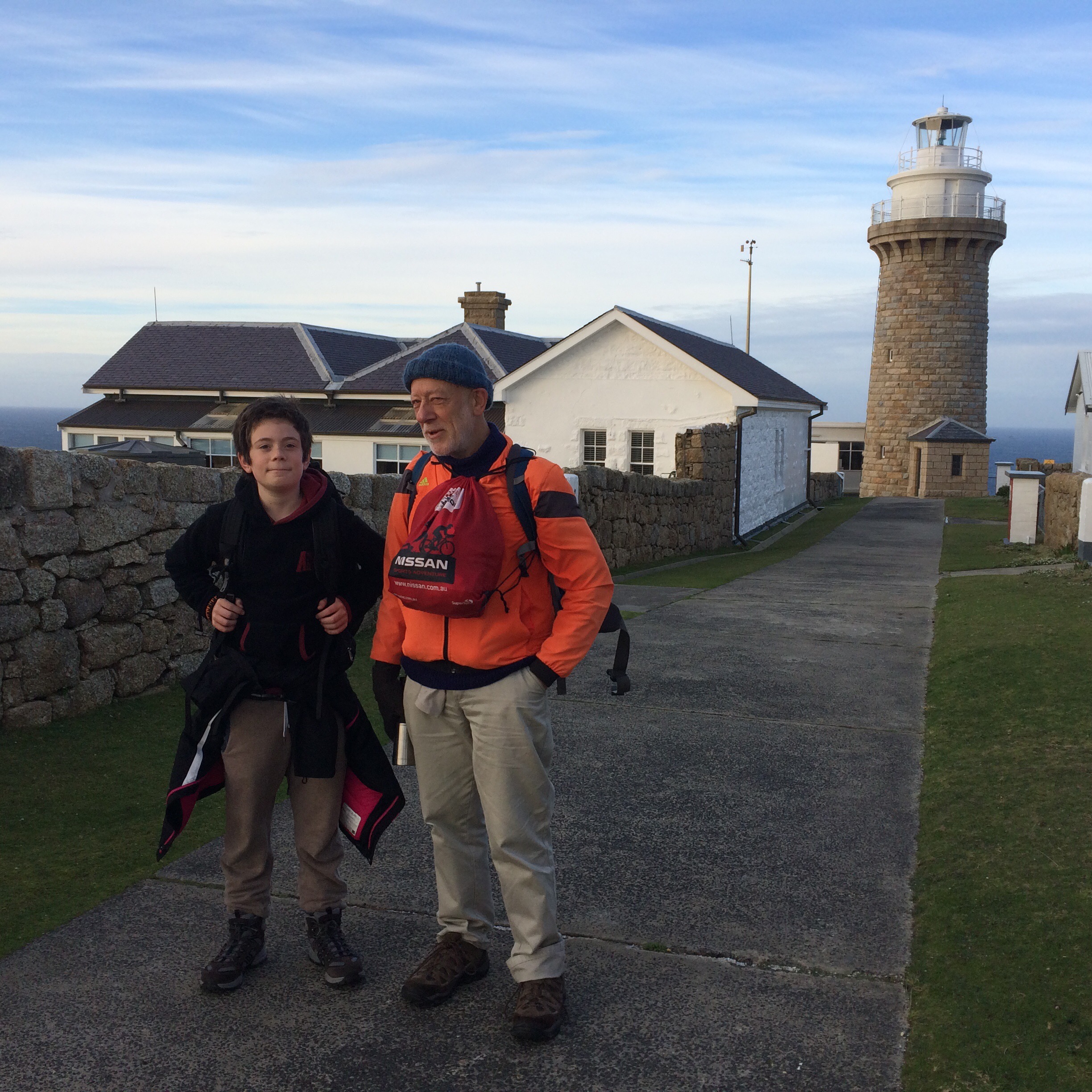
Early Sunday the boy revisited his wounds: his bruises padded with multiple bandaids, his knee now moving without pain, his stiff back tolerating a (lighter) pack, he said, ‘I should be able to walk.’ The old man said, ‘The stiffness and soreness will probably disappear once you warm up a bit.’ Before they left the lodgekeeper insisted on taking photos of child and man standing with the lighthouse in the background. ‘To prove to everyone you actually made it’, he said.


 The walk back was just as beautiful, just as long, just as tough as the walk out. After an hour the old man asked, ‘How’s your back, Mister Pie?’ ‘I haven’t been noticing, Saba.’ The boy greeted every new vista with delighted recognition. The top of every rise, each mossy stone, every leafy dell, every rugged prospect, he claimed them all as new old friends. He owned the track, his by conquest. Every so often the boy would turn to the old man in his train and repeat, ‘Isn’t this wonderful, Saba? Thank you so much for bringing me here!’

Over the hours of the return hike the boy never asked, ‘How far have we walked?’ Pressing hard on the hills, the boy asserted a sort of mastery: he had done this walk before, he’d do it again now. There was no doubting his ability.

Ahead of them rose the final four kilometres of unrelenting hills. Between the two and the hills a pair of colourful shapes moved in and out of focus. The boy said, ‘Asteroids. There’s a couple of asteroids ahead of us.’ Neither spoke it aloud but both decided they’d overtake the colourful figures ahead. It took them seventy minutes but they did so. The boy declined the old man’s suggestion of a break for lunch. A quick stop for drinks and fruit and upward and onward they went, again tacitly resolving they’d beat the asteroids to the carpark. As on the outward walk the boy attacked the closing uphills. Cruelly illusory, every late bend offered promise of an end. Time and again a tough slope led the eye upwards towards a seeming opening, as one would see at trail’s end. But time and again the boy ploughed on, leaving disappointment behind, his head down, breathing hard, with the old man following in his wake.


The sun found its way out of cloud, the greenery took on a lighter shade, the day gleamed. Sweat beaded the boy’s small face, the pink of his cheeks overlying a strange circumambient pallor. ‘Take a break, Mister Pie. Let’s drink.’ The boy took the bottle without words, sucked, passed it back and climbed wordlessly on.


One of the illusions of an end turned out to be the fact of the end. The boy strode into the clearing, staggering a little now on the flat asphalt. His grandfather went to take a snap to record the moment of triumph, but the boy, sickly pale, waved him away, gasping: ‘No photos, Saba.’


A little later, in the car, the boy said, ‘I’ll take my son on this walk one day – or my grandson.’

  

Concussed

The phone call comes at 3.30 on the last afternoon of term. An unfamiliar voice speaks: ‘I have your boy here. He came into the shop and collapsed.’
The woman’s voice is concerned, competent: ‘He wants to get back onto his bike and ride home but I won’t let him.’ The woman gives the address, a shop on busy Centre road, Bentleigh.
 
The mother of the child calls the boy’s father, cannot contact him, drives towards the place in Centre Road. The heavy Friday afternoon traffic races, stops, starts, unpredictably. The mother suppresses her urge to speed, shakes her head: ‘What if he’d collapsed in this traffic!’ Alone with her fear, she calls her father, doctor to the injured boy. She gives her father the bones of the story, adding: ‘He told the lady in the shop he was hit in the head earlier today. She says he’s talking but he’s not making sense. He couldn’t remember my number. Didn’t know the password to his phone. She rang the school and they put us in touch… I’ve nearly arrived. I’ll call again once I’m with him. ‘Bye.’
 
At 3.50 the doctor’s phone rings. His daughter’s voice, the boy’s, an unfamiliar woman’s voice, traffic sounds, snatches of conversation – ‘Dad, I’m with him now. He’s awake. He’s seeing double… Yes, thanks, in the back here. Sorry Dad, the lady who’s been looking after him is helping me get the bike into the car. He lost consciousness a couple of times. What does it mean that he’s seeing double? And he wants to vomit?’
 
Forty-eight hours earlier the doctor saw a boy in Resuscitation at the Royal Children’s Hospital. The boy had been hit by a car. He lay on a trolley, his body a gangle of bones, on his face a large bruise and the dopey smile of a child with no memory of the car that hit his head. The doctor-grandfather spends a lot of time with injured children in Emergency Departments. The doctor knows what double vision means, he knows what vomiting means. The grandfather in the doctor avoids the question, asking some of his own: ’Has he had a head injury?’
‘Yes Dad. A kid at school swung his locker door open and belted him in the head. He went to sick bay for an ice pack. After school he rode to the shops.’
The boy’s voice pipes, indistinctly, the phone set on speaker. ‘Saba, when I look at anything I see two of everything.’ The child slurs the words.
‘What part of your head did the locker hit, darling?’
‘What do you mean, Saba?’
‘Was it the front or the back or the side?’
‘Are you joking, Saba?’
‘No darling. What part of your head was it?’
‘Above my ear, a bit in front of it.’
 
Just in front of the ear, in the temporal region, runs a vulnerable artery which shelters behind skull bone thinner than elsewhere.
The doctor instructs his daughter to drive directly to Monash Medical Centre which is not far distant.
‘I don’t know the way, Dad.’ The father-grandfather-doctor is notorious for his lack of sense of direction. He directs the daughter, hoping. ‘I’ll call Emergency at Monash, darling, so they’ll expect you… Take a book with you. You’ll be there for hours.’
‘Dad, he’s just vomited. Now he’s falling asleep. Does that matter? Do I need to keep him wake?’
‘Try to keep him talking, darling.’
The grandfather speaks to the child: ‘Darling you’ll go into the hospital and they’ll look after you until you’re better. Then they’ll let you go home. You probably won’t be staying in the hospital.’
‘Saba, what will happen to me?’ The voice quavering:’ Will I be alright?’
‘Dad, where will I park?’
‘Drive straight to “Ambulances Only”. At the moment you are an ambulance.’
 
At 4.10 the doctor calls Monash, asks to be connected to the Consultant in Emergency. A young voice, informal: ‘Emergency, Preeti speaking.’
‘Hello Preeti, I’m sending you a child with concussion. I’m his GP. Are you the consultant?’
‘Yes.’
The doctor briefs the young voice. She listens, asks a couple of questions, says, ‘Thank you. We’ll be expecting him.’
‘Thank you, Preeti. I’m quite concerned… He’s my grandson.’
 
When the doctor’s phone rings the time is 4.40. It rings as he’s hurrying to the toilet to pee, the third time in twenty minutes. He stands still, commands his bladder to wait.
‘Dad, I dropped him and they took him straight in. Doctor Preeti was waiting. I’ve just come back, I had to move the car. My phone’s about to die.’
‘Darling, Shabbat is about to start. But I’ll answer the phone if you ring. Someone will lend you a phone. If you need me, call me, even though it’s Shabbat.’
‘’Bye, Daddy. I love you.’
 
The old man puts the finishing touches to his Shabbat table. His wife is away, visiting their Sydney daughter and Joel and Ruby.
He covers the loaves of challah, races to the bathroom, showers, dresses, recites the Afternoon Prayer, racing the setting sun. He finishes, checks the time, realises he’s just too late to light the Shabbat candles: he won’t make fire on the Sabbath. Ordinarily he won’t use the phone. During Shabbat he’ll allow the phone to ring, enjoying freedom from the i-tyrant, celebrating the sample of paradise that is the Sabbath. But tonight he’ll answer it.
 
Darkness falls. The old man recites his Evening Prayers, rich with poetry from the mystics of Safed and the Golden Period in Spain. The dying of the day, the passing of the workaday week, the beauty of the sung hymns, all these have always found him susceptible; since childhood the eve of Sabbath makes him prey to tender feeling.
 
He looks across at the table, set for two. He recites the She’ma Yisrael prayer, inserting, by old family custom, an improvised prayer. He prays: ‘ Heal the boy and all who love him.’
 
The old man sings the hymns, he welcomes the Ministering Angels, he praises his wife – “A woman of Valour, who can Find? Her Price is above Rubies” – then he sings the Kiddush dedication, drinks his grape juice, washes his hands and sits to break bread. Before him, chicken soup with noodles and kreplach, four salads, slow cooked lamb shanks, potatoes. He eats alone, wolfing the feast he prepared for two. His elder daughter won’t be finished at the hospital until very late.
 
The food is good. He’d made a great effort for this meal with his daughter. He eats and gives thanks. Afterwards he reads. He reads three newspapers then opens the political biography a friend gave him. Deprived of sleep as he always is by Friday, he doesn’t expect sleep will come quickly tonight.
 
At 8.00 the front door opens. His daughter enters and they embrace. The boy is well. He’s back home with his brothers and his father. Surprised by her early arrival, the doctor listens to his daughter: ‘Dad, they asked him questions, they checked his eyes and his pulse and his blood pressure again and again. They tested his balance. He improved and they let us go. They said once four hours had passed the danger was much less. They timed it from when he collapsed in the shop.’
 
While the mother speaks the father prepares a salad to replace the four he wolfed. The child-mother eats with relish. ‘I’m sorry I spoiled our meal, Dad.’
She toys with the lamb shanks that come cold to the table. ‘Dad, I can’t eat any more. It’s been a big day.’
Father and daughter look at each other. No words are spoken, none needed; each knows the content of the other’s mind. The father looks away, knowing without looking how his child’s lip trembles and her eyes fill.
 
A minute or two of quietness, then the daughter smiles: ‘By the time we were leaving ED his speech was perfectly clear. He was saying he wanted junk food. Then he said, “Let’s ring the kind lady in the shop and thank her.”’

Writing as Healing

The mother of identical twin boys sent me this story by Ranjava Srivastava.


“Losing my twin baby boys for ever changed the way I treat my patients.

I will never know the kind of doctor I would have become without the searing experience of being a patient, but I like to think my loss wasn’t in vain.

‘My obstetrician’s tears stunned me but also provided immediate comfort. They normalised the mad grief that had begun to set inside me.’
Around this time 10 years ago, I was poised to start my first job as an oncologist when personal tragedy visited in a way that would forever change the way I would practice medicine.

I had returned from my Fulbright year at the University of Chicago, blessed with only the joys and none of the irritations of being pregnant with twins. Landing in Melbourne, I went for a routine ultrasound as a beaming, expectant parent. I came out a grieving patient. The twins were dying in utero, unsuspectedly and unobtrusively, from some rare condition that I had never heard of. Two days later, I was induced into labour to deliver the two little boys whom we would never see grow. Then I went home.

If all this sounds a little detached it is because 10 years later I still have no words to describe the total bewilderment, the depth of sorrow and the intensity of loss that I experienced during those days. Some days, I really thought my heart would break into pieces. Ten years later, the din of happy children fills our house. But what I have found myself frequently reflecting on is how the behaviour of my doctors in those days profoundly altered the way in which I would treat my patients.

An experienced obstetrician was performing my ultrasound that morning. Everything was going well and we chatted away about my new job until he frowned. Then he grimaced, pushed and prodded with the probe, and rushed out before I could utter a word. He then took me into his office and offered me his comfortable seat. Not too many pregnant women need a consultation at a routine ultrasound.

“I am afraid I have bad news,” he said before sketching a picture to describe the extent of the trouble. I thought for a fleeting moment that my medical brain would kick in and I would present him with sophisticated questions to test his assertion that the twins were gravely ill. But of course, I was like every other patient, simultaneously bursting with questions while rendered mute by shock.

I was well aware that doctors sometimes sidestepped the truth, usually with the intent of protecting the patient. I knew he could easily get away with not telling me any more until he had more information but I also knew that he knew. I read it in his face and I desperately wanted him to tell me.

I asked the only question that mattered.

“Will they die?” 

“Yes,” he said, simply holding my gaze until his tears started.

As I took in the framed photos of children around his office he probably wished he could hide them all away.

“I don’t know what to say,” he murmured, his eyes still wet. 

Until then, in 13 years of medical training, I had never seen a doctor cry. I had participated in every drama that life in bustling public hospitals offers but never once had I seen a doctor cry.

My obstetrician’s tears stunned me but also provided immediate comfort. They normalised the mad grief that had begun to set inside me. Yes, the doctor’s expression said, this is truly awful and I feel sad too.

“You are sure?”

“There is a faint chance that one lives but if you ask me, things look bad. You know I will do everything I can to confirm this,” he said.

The obstetrician had told the unflinching truth and in doing so almost surgically displaced uncertainty with the knowledge that I needed to prepare myself for what lay ahead. I had test after test that day, each specialist confirming the worst. I think I coped better because the first doctor had told the truth.

Two other notable things happened that week. Among the wishes that flowed, another doctor wrote me an atypical condolence note. His letter began with the various tragedies that had taken place that week, some on home soil and others involving complete strangers. “I ask myself why,” he wrote, “and of course there is no answer to why anyone must suffer.”

Until then, everyone had commiserated only at my loss – and I was enormously grateful – but here was someone gently reminding me that in life we are all visited by tragedy. All the support and love in the world won’t make you immune to misfortune, he was saying, but it will help ease the pain.

Finally, there was the grieving. I lost count of the pamphlets that were left at our door to attend support groups, counselling sessions and bereavement seminars but we were resolutely having none of it. My midwife called me out of the blue – it was a moving exchange that taught me how deeply nurses are affected too. But I didn’t need counselling, I needed time. I valued the offers but I knew that my catharsis lay in writing. I wrote myself out of suffocating grief, which eventually turned to deep sadness and then a hollow pain, which eventually receded enough to allow me to take up my job as a brand new oncologist. How I would interpret the needs of my patients was fundamentally altered now that I had been one myself.

Cancer patients are very particular about how much truth they want to know and when. I don’t decide for them but if they ask me I always tell the truth. A wife brings in her husband and his horrendous scans trigger a gasp of astonishment among even the non-oncologists.

“Doctor, will he die from this?” she asks me.

“I am afraid so,” I answer gently, “but I will do everything in my power to keep him well for as long as I can.” 

It is the only truthful promise I can make and although she is distressed she returns to thank me for giving her clarity. Sometimes honesty backfires, when the patient or family later say they wanted to talk but not really hear bad news. I find these encounters particularly upsetting but they are rare and I don’t let them sway me from telling the truth.

Oncology is emotionally charged and I have never been afraid of admitting this to the very people who imbue my work with emotion. I don’t cry easily in front of patients but I have had my share of tears and tissues in clinic and contrary to my fears, this has been an odd source of comfort to patients. In his Christmas card, a widower wrote that when my voice broke at the news that his wife had died he felt consoled that the world shared his heartbreak.

It can be tricky but I try to put my patients’ grief into perspective without being insensitive. It’s extraordinary how many of them really appreciate knowing that I, and others, have seen thousands of people who are frightened, sad, philosophical, resigned, angry, brave and puzzled, sometimes all together, just like them. It doesn’t diminish their own suffering but helps them peek into the library of human experiences that are catalogued by oncologists. It prompts many patients to say that they are lucky to feel as well as they do despite a life-threatening illness, which is a positive and helpful way of viewing the world.

I will never know what kind of a doctor I might have become without the searing experience of being a patient. The twins would have been 10 soon. As I usher the next patient into my room to deliver bad news, I like to think that my loss was not entirely in vain.” 

……… 

I read this story with alarm. It made me feel anxious because I have and love a pair of identical twin boys. I felt involved because, like the writer’s doctor, I am a doctor who cries; and like the writer, Dr Srivastava, I am a doctor who writes. Finally we two are products of the same medical school (Monash) – Dr Srivastava graduated at the top of her class, in the present century, I graduated at the opposite end of my class, in antiquity (1969).

A final point of commonality was her reassuring remark that ten years after her doctor wept her home is full of the noise of happy living children.

I found the piece helpful. Dr Srivastava identifies and untangles the strands of her experiences with surgical deftness. Her doctor weeps, her colleagues show support and care and empathy and she heals. As a trained observer, the writer dissects her experience of grief, lays out its anatomy and reflects upon its organs and parts.

Like the writer, I find relief and understanding in the act of writing. I suspect that a part of this relief results from word search. The writer is obliged to seek the precise word for the experience. In my case this forces me to test and taste a number of words. Perhaps a dozen words might work more or less passably, but the acts of searching, of choosing, of trialling, help me to clarify what my feelings were not quite like. I mean I discover what I mean. Perhaps this functions as a working through, a self-conversation, something between analysis of an experience and re-imagining it. In my case too, the pleasure of words is an aesthetic joy that comforts me.

Medicine is a pursuit conducted with the living in the shadow of death. It is a pursuit packed with anxious questions: what is wrong with me, will I die, what can be done, will it hurt, how much, how will I know the answers, when will I know? This crying doctor feels the patient’s fear and his own and has to know the border that divides the two. My fears are for the patient, of the patient, of failure, of failing a person of flesh and feeling. My fears include the terror that strikes me when I see my patient slipping away, the knowledge of my mortal inadequacy.

The writer who lost her twins precisely names the elements in her emotional experience. With remarkable poise she traces the costs and the benefits of the loss. So coherent are her reflections I could feel myself learning as I read. I learned about her life and her work, how the two are not the same but never severable. I learned more of how a doctor feels, who she is, who I am.

A Message of Love Smuggled into a Suitcase

We live in a world in pain. In that world dark deeds, harsh words, inhumane policies are normal. God is conscripted and deformed in every form of violence. Truth is lost, our planet poisoned.
Seeing all this, hearing it, feeling it,a person might surrender and despair.
Then life sends a message.
This is the message that came to me today.

  
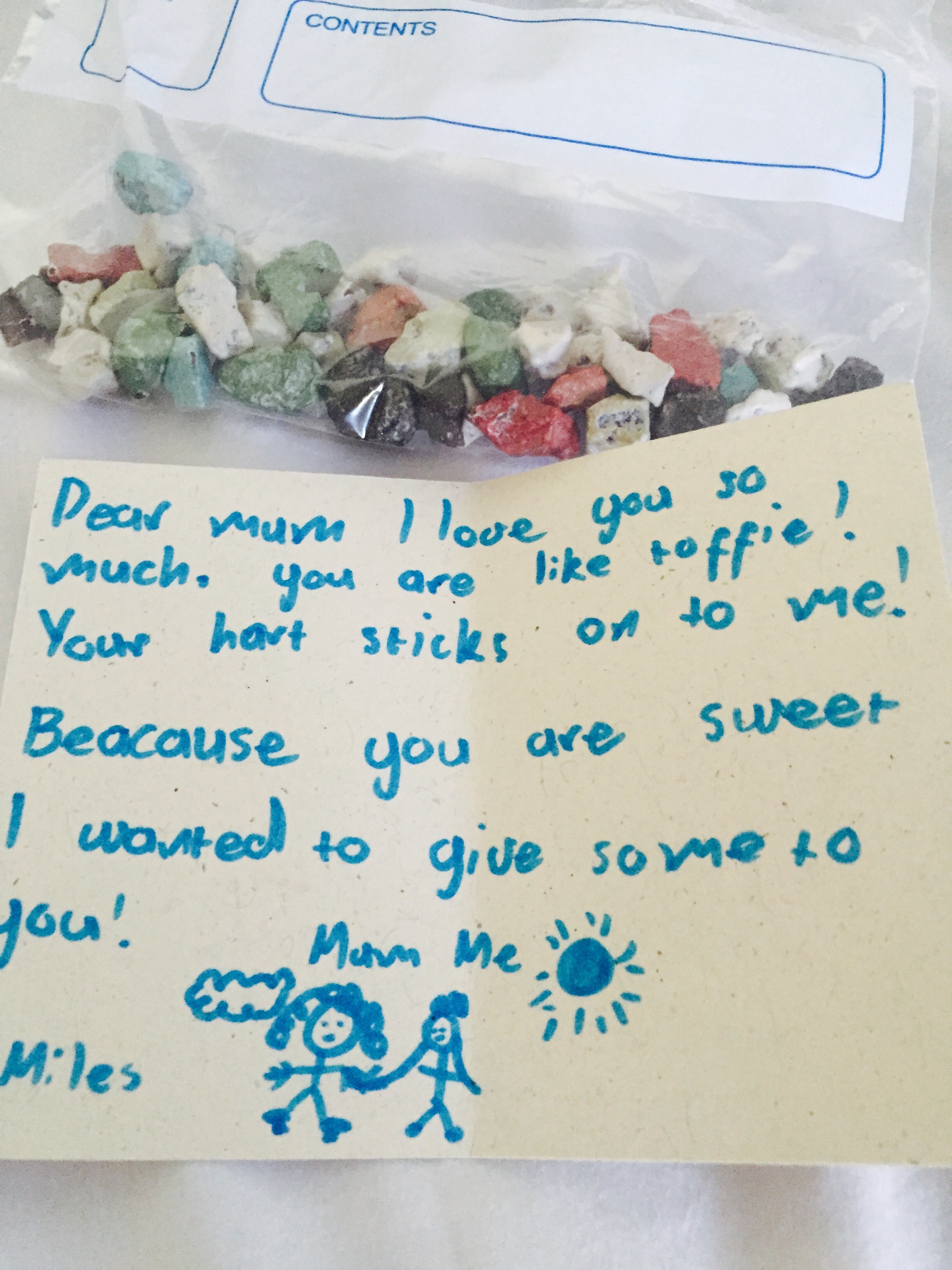
Miles spent two weeks pocket money on this gift for his mother.