Hilary’s Seventh Cervical Vertebra and our Minister for Immigration

Please prepare to write a letter. Gather your wits. Gather pen, paper, envelope and a stamp. Or prepare your keyboard. Now read on:
 

Around 1985 my former classmate Hilary rolled her car and fractured her seventh cervical vertebra. The damage to Hilary’s spinal cord resulted in her quadriplegia: for the past thirty-odd years – half of her lifetime to date – Hilary has ridden a wheelchair.

When your legs don’t work, when your hands are too weak to crack an egg, when your bladder and bowel are deaf to the commands of the brain, you need a lot of help. Hilary receives a lot of help. Good help is proverbially hard to find. And easy to lose. Hilary is about to lose Ilaisaane, one of her two good helpers.

I visited Hilary a couple of days ago and I met Ilaisaane. I hadn’t seen Hilary since we left school. That was half a century ago. It’s not as if Hilary lives far from me. It is not as if I had not heard of her situation. I felt a horror, the primitive horror of looking misfortune in full gaze and I kept a coward’s distance, a guilty silence.


***


 I walked through the door and there was Hilary and there was the schoolgirl grin. As a child Hilary grinned at life; nothing and no-one seemed able to cow her. Plenty of us tried. And here was Hilary, offering me a hand, thin as a wafer, the fingers fine and delicate and very white. Her handclasp light as fairy floss. And that grin, so vital, so charged with – there! I can’t avoid it – charged with hilarity. Hilary introduced me to her carer.

The name is Tongan. With her ready smile and her winning manner Ilaiasaane may be hard on the tongue but she is easy on the eye. The two ladies gave me some Tongan elocution training. You pronounce the name, ‘ill-eye-saah–neh’. Hilary calls her, ‘my beloved Saane’.

I asked Saane, ‘What do you do for Hilary?’ Uncertain how candidly she should respond, Saane looked towards Hilary. Hilary said, ‘Everything.’ ‘Everything’ includes cooking, preparing, serving, clearing of meals. It includes showering, dressing, undressing. It includes the most intimate elements of personal hygiene and toilet. The needs of a human body arise by day and by night. The carer needs stamina and a sense of humour. The person cared for depends utterly upon the carer; she must surrender autonomy. Dignity hangs in the balance: either party can fracture it. Rage must be the natural state of a person whose body will not obey her, but grace is the quality she needs. Few would possess that quality. I wondered that this person, known until now only as that unformed being, the schoolchild, might.

As Ilaisaane and I talked, I wondered who’d want to deport this charming, mild, good humoured person. She didn’t strike me as a danger to Australia. The opposite seems to be the fact: while here she has become a State Enrolled Nurse, studying in her Hilary-free days. She plans to become a Registered Nurse. Meanwhile she works, Hilary pays for her help, and Ilaiasaane pays taxes. Hilary herself works from home, spares the government costs of institutional care and pays taxes.


I asked Hilary how she earns her living. ‘I’m a social worker. I see and counsel clients here, at my home. I specialise in working with male family violence. I also run reflective supervision groups for other therapists.’

I nodded. Numerous psychologists of my acquaintance are her paying clients. I had a further question: ‘So, all three of you – Iliasaane, you and O.G. – all pay taxes. And losing your carer could tip you into institutional care? In that case, the Commonwealth of Australia foots endless bills for your care while losing three sources of income tax?

‘If those are questions they are three not one. And the answers are “yes”, “yes” and “yes.”’


So what is the problem here? The problem is the man smiling in the photo. His name is Ogolotse. ‘You say the ‘G’ as ‘H’, Ilaisaane informs. Hilary refers to him as O.G.


O.G. comes from Botswana. Years ago he studied Multimedia at RMIT. After graduating he returned to Botswana and worked in television before returning here, completing a Masters degree at RMIT, then working in his professional field on a skilled worker’s visa. That employment has evaporated in a mist of obfuscation. As a result O.G.’s visa lapses. And we will shortly evict him.  


Why should we care?

Hilary explains: ‘It takes a long time to find a good carer, a longer time to train her. She needs to be able to work around the clock. Saane works 38 hours over three days, plus 3 sleepovers. She’s been with me five years…’ Unspoken is the bond, the intimacy and the trust between the two women. I feel it flow as I sit between them, like a warming current of regard. Hilary continues: ‘We have a hearing at the Administrative Appeals Tribunal on August 28. That’s a favourable sign; we have a chance. On the other hand our lawyer has sacked O.G. because he can’t pay the legal fees. We’ve been advised we need one thousand physical letters of support to appeal for ministerial discretion to produce at the hearing.’


I WOULD NOT NORMALLY ASK A READER OF THIS BLOG TO FORWARD ANY POST OF MINE TO EVERYONE SHE KNOWS, BUT I DO SO IN THIS CASE. 

HILARY ADVISES WRITING A LETTER TO THE MINISTER THEN EMAILING IT TO HER SO SHE CAN PRINT AND PRESENT A LARGE BUNDLE AT THE HEARING. AND IF THE TRIBUNAL RULES AGAINST THEM, ALL LETTERS WILL BE FORWARDED TO THE MINISTER TO BOLSTER A MINISTERIAL REVIEW.

1. Address letter to:

The Hon Peter Dutton

Minister of Immigration
Parliament House

Canberra 2600

2. Copy letter to Hilary at quincetree@gmail.com

3. Draft letter (sample follows)

Dear Minister Dutton

IN SUPPORT OF OGOLOTSE NTWAAGAE AND ILAISAANE POPUA KALAVI
I, the undersigned, wish to express my alarm that this couple, named above, could be dismissed from Australia. I believe them to be excellent, honest, hardworking people.

I have heard about Ms Kalavi’s employment as a carer for a social worker who has quadriplegia. Ms Kalavi shares this job with one other person, so her work there is vital to the woman’s wellbeing and continuing to be a productive member of society. I have no doubt that if Ms Kalavi had to leave suddenly it would cause a damaging crisis in this woman’s life.

Ms Kalavi works as the woman’s carer for 38 hours a week plus sleepovers. She has been with her a long time, for 5 years. That level of training and familiarity would be extremely hard to replace, especially given how hard it is to find compatible staff for such a close relationship.

I urge you to grant residency to this couple as soon as possible.

SIGNATURE​​​​

Name
Address

IDENTIFICATION:

(Passport No. – OR – Driver’s Licence No. – OR – Medicare No.) 

Email: minister@immi.gov.au
And/or

Email: peter.dutton.mp@aph.gov.au

 4. Hold your breath, say your prayers, hope that your ordinary goodness will pierce a minister’s heart.

And accept my heartfelt thanks,


Howard


And the Two Walked Together

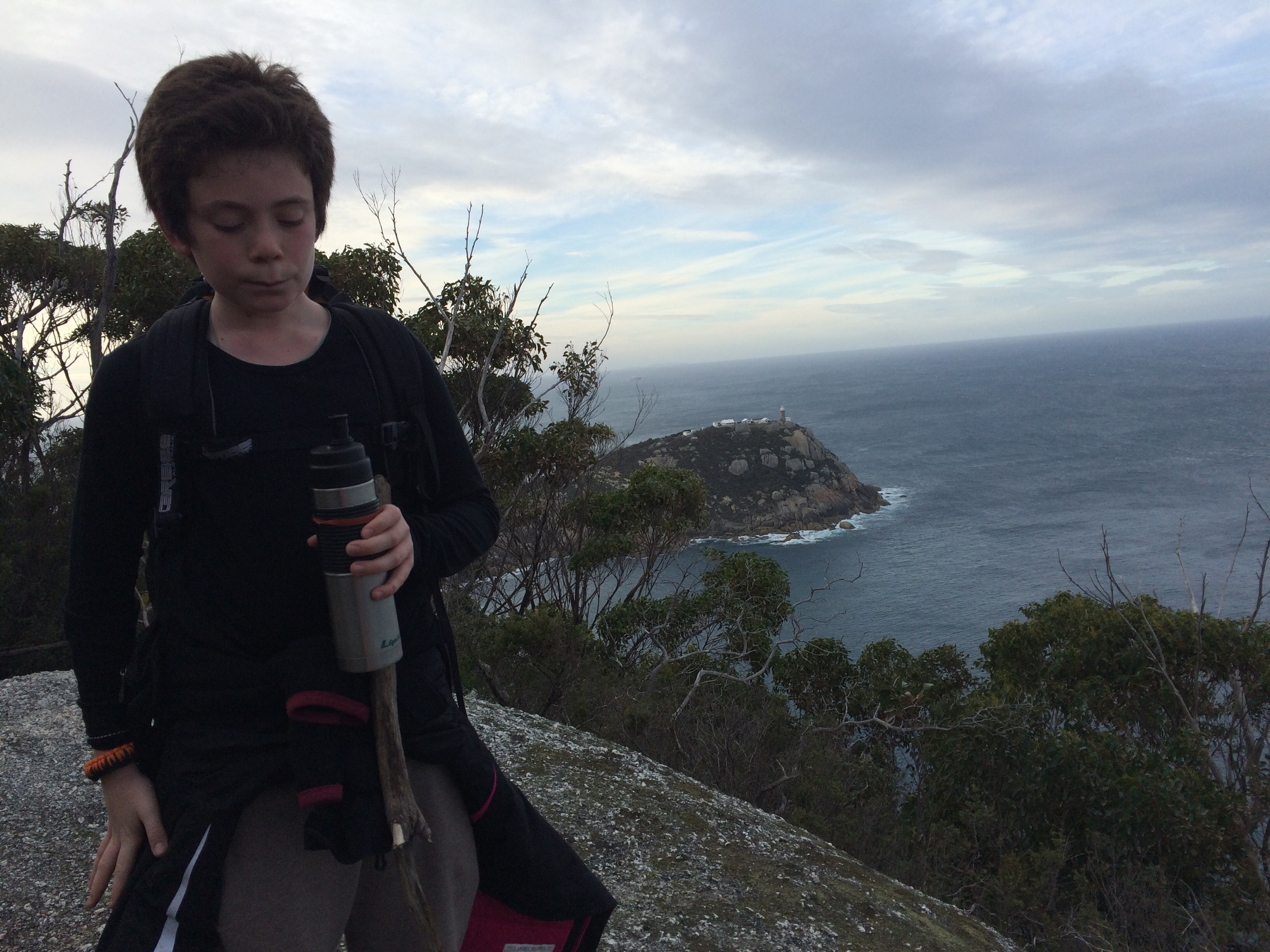
The boy emerged from the car and read the sign: LIGHTHOUSE 19 KILOMETRES. Beneath the sign were the words: Six Hours. The boy spoke, his voice small: ‘I’m nervous, Saba.’
The old man reassured the boy. They pulled on their weighty daypacks and started to walk from the turntable on the mountain. The dirt track was wide enough for a small truck. It sloped away beneath their feet and, despite the lowering sky and the fine wind-whipped rain, the two made good speed in good humour.

The old man said: ‘This is a long, long downhill slope; it will be uphill on the way back. Just when we are really tired we’ll have to fight these hills.’

They looked ahead into immensity. As the path led them lower the slopes towered green and steep before them. The old man saw they’d soon be climbing. The rain stopped and the two felt hot. They peeled off parkas and jumpers and mopped rain and sweat from their faces.

Rounding a sharp bend the boy exclaimed, ‘Look Saba! Look – how beautiful!’ The old man looked and what was beautiful for him was the joy on the boy’s face. ‘Surprised by joy’ – the words floated into the old man’s mind from some half-read snatch of old verse – ‘surprised’ – overcome – as in a surprise attack.‘ The boy’s face, red with exertion, glowed. The old man looked again; he saw no sign of care.


The descent ended in a strange plain of long grasses and thick green ferns between which the pale trunks of gums rose, twisted and charred, like writhing skeletons, reaching for the sky. ‘The bushfires must have raced through here’, said the old man, ‘See how there’s not a single living eucalypt. Just ghosts. And everything else so green.’ To himself, he added, ‘They look like humans whose prayers were not heard.’ The old man had dwelled much in suffering of late. All nature spoke to him of the pain of others.

The boy’s expression was opaque.

Not an hour into the walk the boy’s voice asked: ‘Would we be a quarter of the way there yet?’ The old man doubted it. He couldn’t really say. Mostly the boy walked beside him, now and then slipping behind. At these moments the old man slowed, he hoped, inconspicuously.

The boy’s breaths were loud. The old man announced: ‘Morning tea time’, and they stopped to drink. The old man asked, ‘Apricots?’ The boy took the dried fruits and ate appreciatively. They hoisted their packs again, the boy staggering a little before steadying. The old man took the drink bottle. It felt lighter in his hand. They walked. Between the sounds of footfalls a voice spoke: ’I love you Saba.’

The old man, for all his years, for all his words, could find no words better in reply. ‘I love you too, darling.’


After a time the flat road began to rise and twist. Ahead of them they saw stately ranks of black tree trunks, erect and slim, towering upward, their branches richly green. ‘Look’, said the old man, ‘Every tree has been burned but every one of them here has survived.’ Their eyes drank in the green life, the dense underburden. Walking between the giants the two felt the silence and it did not oppress them. Rather, wonder swept their eyes upward. In quietness they laboured up long hills, around bends that led to yet more hills, working hard but not feeling it as work.

A scream broke the silence. The boy hobbling, whimpered, ‘My foot! It kills!’ The old man took the boy’s pack. ‘Here’, he said, ‘Sit down.’ ‘I can’t Saba, my arse will get muddy.’ The old man saw a tear at the corner of the boy’s eye. He spread his waterproof on a bank, pulled the boy’s haunches backward and sat him down. ‘Saba, my foot doesn’t hurt when I’m just sitting here. But it killed before.’

The old man opened lunch, bagels he’d bought from Glicks at five that morning. The previous evening the boy ordered peanut butter and honey for his: ‘Fifty percent of each please Saba.’The old man made short work of his own bagel but the boy played with his, peanut butter and honey notwithstanding. Reckoning the child needed relief the old man removed the heavy items from the boy’s pack. Bookish like his grandfather, he’d packed a small library.

‘Do you think you can test that foot?’

The boy rose, hoisted his pack and stepped forward. He winced but said nothing. And the two walked together. At first the boy’s gait was diffident, but quickly he established a fluent step-wince-step rhythm. Rounding a sharp bend the boy cried out, once again in delight. A small wooden footbridge led them across a shallow stream. Green ferns dwarfed the boy, the water chattered and rippled, the air was still and cold. The boy glowed. He turned and spoke: ‘Thank you so much for taking me here Saba.’ In the richness of his feeling the old man felt again the poverty of his own words.


They climbed. The old man, remembering walking as a child with his father, described how hard it had been to keep pace. He said, ‘Every few paces I’d fall behind. I’d have to run to catch up. I think that’s what started my life as a runner. It’s what prepared me for running marathons.’ The boy replied, ‘That happens to me too, Saba.’

The old man, a package of memories, told the boy about the time he ran a marathon in Melbourne. ‘It was springtime, quite warm. The sun shone and warmed the asphalt. I could feel the heat through my shoe every time my foot hit the road. I realised I had worn the soles too thin. Actually I had trained hard here, at Wilson’s Promontory, on tracks like this. I had run fourteen kilometres, only one-third of the marathon distance. I anticipated feeling pain with every step of the remaining 28 kilometres. I felt full of gloom. Then I did something really brilliant: I talked to myself. I said, “Every time your foot hits the ground remember you have one les step to run. Every time your foot hurts it’s a reminder – you’re getting closer to the finish.” Guess what – after about ten metres I stopped noticing my foot altogether.’

They passed a sign that read: HALFWAY HUT. Unfortunately whatever ’halfway’ meant it did not refer to the lighthouse walk. They walked on a good while and the boy asked, ‘How much further do you reckon we have to walk, Saba?’

‘Maybe ten kilometres, perhaps a bit less.’

The boy absorbed this. He picked up a straightish stick, about 1.3 metres long and tested it. A few minutes later he discarded the stick, saying his foot wasn’t too bad now. He added, ‘I love you Saba.’ ‘I love you too, Mister Pie.’ (When he was a baby family members called him ‘Sweetie Pie.’ After twelve years the remnant was ‘Mister Pie’).


The two came to a fork and another sign. To the left, the sign read: VEHICLE TRACK 9.5KM.

To the right the sign read, WALKING TRACK 8.5KM. The old man recalled the briefing from the Ranger Staff, warning them off the walking track ’because it rained last night – could be soft underfoot.’ He chose the walking track, being the shorter and possibly the softer. ‘Maybe too soft, perhaps marshy or boggy.’ He misgave but he did not reveal his uncertainties to the child. The decision proved decisive. Time and again as they clambered over steeps, scrabbled on uneven footing, wound around sharp turns and twists, the boy exclaimed in delight and wonder. At every corner a vista, at every peak breathtaking verdure. And at every pause the song of falling waters. They panted and sweated and never stopped smiling.


The old man, marathon man, always prided himself on his doggedness on hills. But these slopes, so steep, so long, so numerous, for these he needed to dig deep. Head down, bending forward to bring the pack over his centre of gravity, the old man, ploughed dourly on; while the boy sailed ahead, never slowing, never weakening, not ever quailing at the next hill and the next that unfolded in unfeeling succession at summit after summit. The old man marvelled and rejoiced.


The walking track was no bog, simply a way up and into a southern Himalaya. Abruptly the climb ended in a series of steep declines. ‘I’m scared I’ll fall’, said the boy. The old man held the back of the boy’s pack and pulled gently backward at every descent, the traction a felt message that the old man would not allow a fall.


Around a bend and suddenly the dense bush ended at a wide cleared space. The walking track had rejoined the vehicular. A short walk brought them to a further sign announcing: NO THROUGH ROAD. Rising from their left a walking track led into bush. Leaning on some rocks three men in their late thirties sat eating dried fruit. One asked, ‘You heading for the lighthouse? It’s up that way.’ A thumb pointed backward over the speaker’s shoulder indicated the walking track. The three might have been planted in that spot, so comfortable was their seat on earth, so fixed and settled their attitude.


The old man asked, ‘Have you ever walked to the lighthouse?’ Heads nodded. The man with the thumb looked at his bag of currants and said, ‘It’s mainly downhill from here. All except the final three hundred metres, which are the steepest in the entire National Park.’ The boy pointed out a smaller notice behind the men: LIGHTHOUSE 3.2 KMS. He and the old man had been walking for four hours. With a relatively short descent ahead of them both understood they’d arrive in good time for the sunset and the start of the Sabbath. That knowing, not spoken aloud, relieved the worry, also unspoken, of walking in darkness and arriving to cold and dark.


 After a short climb the track truly did descend. Underfoot, leafmeal and twigfall covered the soft sand. ‘This sort of footing is my favourite’, said the old man, ‘It comforts your soles. My feet love it.’ At every bend gaps in the bush gave way to glimpses of sea. One gap, wider than others, gave onto a view to the east of a long climbing pathway of exposed rock. At the far end of the path the two saw a white structure, phallic in shape – the lighthouse! It looked beguilingly close.


The two pressed on, half racing now. They tumbled around a bend almost falling into the arms of a human who stood on a granite elevation, tall and slim, a statue. The statue had a young woman’s face, a woman’s voice: ‘Look there: Orca.’ She pointed over a shoulder at the sea. ‘Look carefully, you’ll see the water break as they near the surface. When you arrive at the lighthouse would you please tell the lodgekeeper; there’s a pod of four playing here.’

The water broke and mended itself, broke and settled. Was this whale action? The same small disturbances were seen in every direction the man and the boy looked. Hopeful then doubting, then self-doubting, they fixed eyes, solemn and reverent, upon the sea. The old man had seen whale in these waters in years past but this time he saw no purple-black bruising the surface. After a decent interval the two hastened on. They’d seen no Orca yet they tingled with the closeness of greatness.


A voice rose from the bustling shape of the boy. He spoke of self-doubt, of fears, of haunting thoughts of his own grave unworth. The old man, filled with quite opposite thoughts of the boy, listened. He ached for the boy. He wanted to say something useful. ‘I know those feelings, Mister Pie’, was all he managed. He wished he had some infusing strength such that if he but held the boy close, the child would grow and know his worth. The urge to seize the child, to crush doubt from him bodily, was strong. But the old man knew such truth is the daughter of time. A daughter not yet ready to be born.


 Meanwhile, simple exertion, the actions of fast walking seemed to make the child lighter as he gathered momentum. The words spoken, the hard thoughts disappeared in air, leaving a small body busy and complete in its plunging passage through bushland.

The old man followed behind, carrying his pack, the boy’s books and the boy’s discharged cares.


A rock lay in their path, its northerly aspect coated in delicate mosses of brilliant green. The boy stopped to explain, ‘In the bush you can use mossy rocks as a guide, like a compass. The moss grows on the sunniest side. In our hemisphere that’s north.’


At one bend the lighthouse would appear only to disappear at the next as they corkscrewed their way down to sea level.  

Now a right angle turn marked the last of the bush. They emerged to an exposed path of surpassing ugliness. Blocks of weathered and stained cement set end to end formed a series of plaques that rose and rose, ending three hundred metres further on at the Light. This, the old man recognised, must be the ‘worst climb’ mentioned by the currant muncher. He looked up. The boy had not paused. He’d opened a lead of twenty metres as he attacked the awful slope. The old man hurried after him but the gap did not close. Half way up the boy approached a welcoming bench, set at the path’s edge to relieve exhausted climbers. The boy ignored the bench and steamed past and the old man, shaking his head, followed. When he reached the top the boy was grinning, his face a fairground of many pleasures.


Before they set out the Ranger had estimated the walking time from carpark to lighthouse at six hours. The man and boy finished in under five and in plenty of time for sunset and the Sabbath.


The lodgekeeper welcomed them. He said, ‘We’re expecting eleven in your cottage tonight. You two are the first to arrive. We expected an old – pardon me, I mean older – man and a child. Amazing that you beat all those grownups, young feller. Congratulations! Your reward for arriving early is the room with the best view. See – there’s the Light just outside your window. You’re overlooking the ocean. You’ll see any whales without leaving your room.’


The room had high ceilings, bunk beds, large windows and plenty of room for two and their possessions. The ‘cottage’ was formerly a lightkeeper’s dwelling, large enough for his wife and their eight children. Outside the wintry gale blew up a four metre swell. Inside the cottage was snug and the showers were hot. Both man and boy stank of sweat. They peeled off their steaming clothes and showered. The boy headed off to the reading room where he met the incoming walkers, adults all, and held court. The first to arrive was the trio of dried-fruit eaters, blokes in their thirties, friends since their schooldays in the Blue Mountains, revisiting old haunts and shared pleasures. After them came a family of four, rich in geography and history, which encompassed Scotland, Southern Africa, Denmark and a touch of Jewishness. The sole female was the Dane. The boy introduced himself and she replied, ‘I’m Astrid.’ This name was new to the boy who remembered her as Asteroid. Following the arrival of that heavenly body from Denmark a lean schoolteacher in his early thirties turned up. He’d sighted the boy in the carpark before setting out. Admiringly he said, ‘You walked quicker than I did’.


Darkness fell, the windy world outside moaned and window frames rattled, while inside their room the man and the boy had lit the candles. The old man placed his hands on the boy’s head and slowly, as in a fugue, recited the old words of blessing of the child. Then the two sang the Sabbath Dedication before breaking bread and feasting on packeted food brought to piping in the microwave.


Afterwards the boy beat the old man at Scrabble, much to the admiration of the last two to arrive, a bushy-faced pair who materialised from the darkness, unfussed by their final hour of moonlit hiking.


The man and the boy slept eleven hours that night.


The next day – Saturday – was a true Sabbath, a day of rest. The boy accumulated a series of hurts – his back ached, his right sole was bruised, his left knee seized in spasm. When the lodgekeeper invited all guests into the lighthouse museum for a tour, all pains were put to the side, and soon – or sooner – forgotten. The boy asked most of the questions, good adult questions, as the lodgekeeper later confided. They spent the rest of the day and the evening in the heated common rooms, reading, playing Scrabble, chatting. It is fair to say the nine adult males found the sole female and the sole child the most memorable of the company.


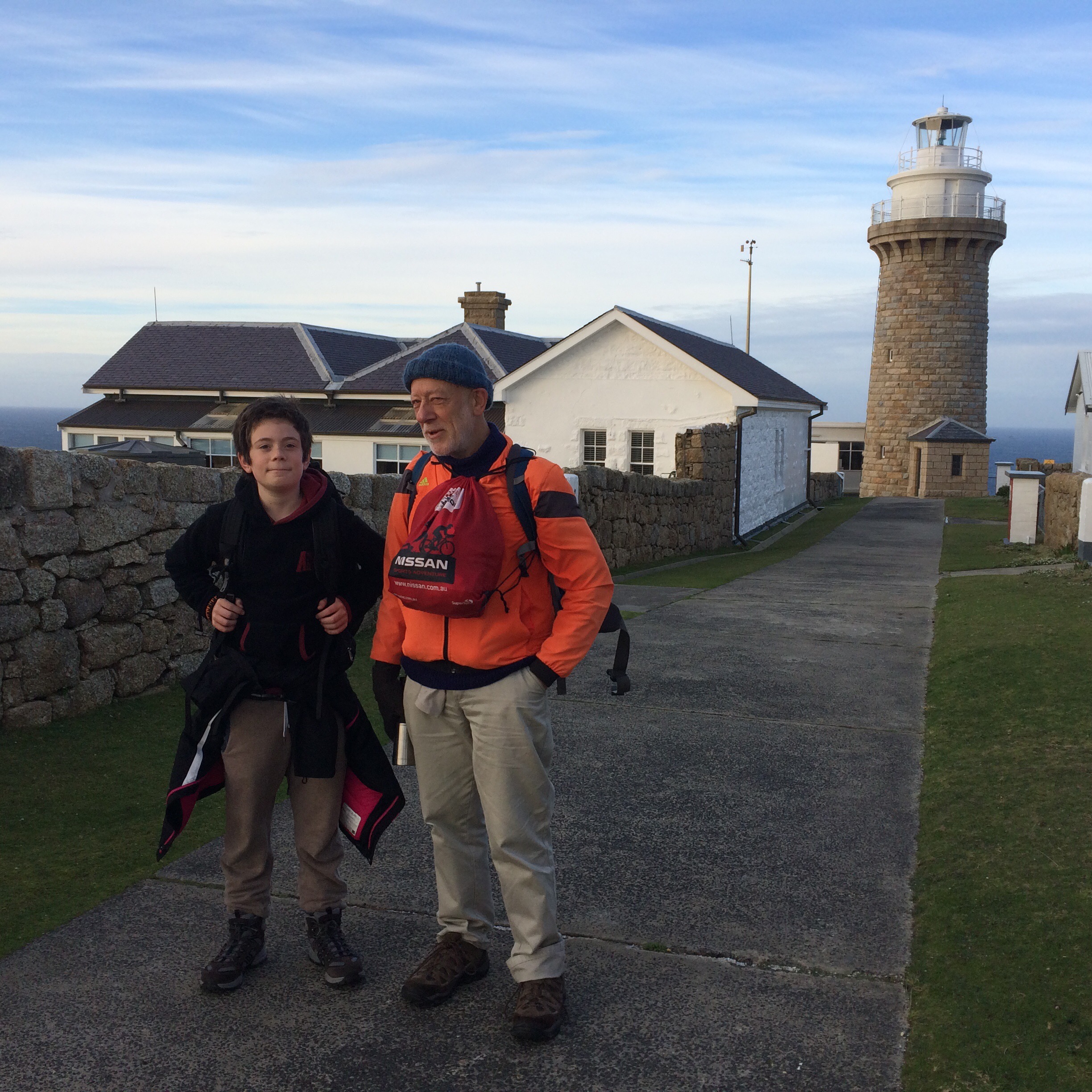
Early Sunday the boy revisited his wounds: his bruises padded with multiple bandaids, his knee now moving without pain, his stiff back tolerating a (lighter) pack, he said, ‘I should be able to walk.’ The old man said, ‘The stiffness and soreness will probably disappear once you warm up a bit.’ Before they left the lodgekeeper insisted on taking photos of child and man standing with the lighthouse in the background. ‘To prove to everyone you actually made it’, he said.


 The walk back was just as beautiful, just as long, just as tough as the walk out. After an hour the old man asked, ‘How’s your back, Mister Pie?’ ‘I haven’t been noticing, Saba.’ The boy greeted every new vista with delighted recognition. The top of every rise, each mossy stone, every leafy dell, every rugged prospect, he claimed them all as new old friends. He owned the track, his by conquest. Every so often the boy would turn to the old man in his train and repeat, ‘Isn’t this wonderful, Saba? Thank you so much for bringing me here!’

Over the hours of the return hike the boy never asked, ‘How far have we walked?’ Pressing hard on the hills, the boy asserted a sort of mastery: he had done this walk before, he’d do it again now. There was no doubting his ability.

Ahead of them rose the final four kilometres of unrelenting hills. Between the two and the hills a pair of colourful shapes moved in and out of focus. The boy said, ‘Asteroids. There’s a couple of asteroids ahead of us.’ Neither spoke it aloud but both decided they’d overtake the colourful figures ahead. It took them seventy minutes but they did so. The boy declined the old man’s suggestion of a break for lunch. A quick stop for drinks and fruit and upward and onward they went, again tacitly resolving they’d beat the asteroids to the carpark. As on the outward walk the boy attacked the closing uphills. Cruelly illusory, every late bend offered promise of an end. Time and again a tough slope led the eye upwards towards a seeming opening, as one would see at trail’s end. But time and again the boy ploughed on, leaving disappointment behind, his head down, breathing hard, with the old man following in his wake.


The sun found its way out of cloud, the greenery took on a lighter shade, the day gleamed. Sweat beaded the boy’s small face, the pink of his cheeks overlying a strange circumambient pallor. ‘Take a break, Mister Pie. Let’s drink.’ The boy took the bottle without words, sucked, passed it back and climbed wordlessly on.


One of the illusions of an end turned out to be the fact of the end. The boy strode into the clearing, staggering a little now on the flat asphalt. His grandfather went to take a snap to record the moment of triumph, but the boy, sickly pale, waved him away, gasping: ‘No photos, Saba.’


A little later, in the car, the boy said, ‘I’ll take my son on this walk one day – or my grandson.’


Not Running with the Devil

The longest night in the southern calendar, June 21, gave birth to a splendid and frigid morning in Traralgon. By the time we started running the temperature was four degrees celsius, a good deal cooler than Boston where, a couple of months earlier, self-pity and hypothermia had congealed within me. Wiser this time, I enclosed myself in layers. A Michelin Man, I set off, discarding layers as I warmed. The layers were, I realised, like geological striae, those stripes in a rockface that are time’s memorial. First to go at twenty five metres in was the remarkably ugly tangerine rain jacket (discarded in Boston by another runner who decided wetness and cold were preferable to Adidas’ ugliest.) Next to go were the elegant little white gloves that cocooned my fingers during winters in the eighties when we’d run the alps of the Diamond Valley. (Ahh, my friends, my friends…) At the twenty kilometre mark I left my stripy thermal top (Kathmandu, 2014) and the Stepping Strong top that honours Gillian Reny, the young dancer whose legs were shattered by a Tsarnaev bomb (Boston, 2013). At 35 kilometres I divested the Miles for Michael shirt (Boston 2013). This left a salted wreck whose overheated genitals must abide within undies (Leigh Creek supermarket, c. 1999), olive green tights (Kathmandu, 2000) and New Balance running shorts, veterans of seventeen marathons (Leigh Creek, 2008). 

In the dawn no wind blew. Silent and shapely, six plumes rose pink against the indigo sky. Delicate and pretty the smoke of Loy Yang poisoned my world. 


I ran the first half hard with legs confident from last weekend’s fast training run from Babinda to the Boulders and back, a distance of fifteen kilometres, longer than one third of a marathon. My wristwatch read 74 minutes. This absurdly quick time suggested I’d regained some speed. I reckoned in Traralgon I’d take a full hour off the Personal Worst that was Boston. I ran first with Leanne, a shrivelled fifty-year old, light of step, a lean machine. I kept up with her, keeping myself honest. Leaving her behind I chased a rounder matron who took a bit of catching. She said, I just want to finish. We swapped names; the matron’s name was Marlene. Keeping pace with Marlene did me good – in the moral sense. I had to reach deep for Nobility and Courage. After Marlene left me behind with benediction, I ran alone for a while, this time on a stony dirt track. Mother earth beneath my feet, hard but fair, took me back to childhood in the country. My reverie – have I been dreaming, have I slowed? – was interrupted by busy footfalls pattering behind. Light of foot my pursuer spurred my own feet and I worked to stay ahead. Three kilometres later the pattering feet drew alongside and they belonged, not as I expected, to a female but to a bloke named Duc. We exchanged the lead a few times before I sent Duc on ahead with my blessings.


Next came Sam. Short like me, bearded like me, his fleshy face a crop of smiling peaches, Sam didn’t look like he was made for distance running, his well-fed body the antithesis of the ascetic distance runner’s. But Sam too left me behind. I would see him again as I approached the turn and once again, much later, as I staggered past the 41 kilometre mark; Sam, smiling still, had finished a full hour earlier.


At the halfway mark I met the Devil. In fact he’d run with me all the way, quietly waiting his moment. (In Judaism the Devil is not personified much; if anything he is The Adversary. He lives, not in hell but within us as desire, ‘the evil inclination’, which is ordinary, domestic, human weakness. As such the Devil doesn’t really earn his capital letter.) The devil was up and about early in Traralgon.


With my friend Nick and his febrile son Darcy waiting for me with love and drinks at the Half, I paused. The sun shone in a windless sky as the devil murmured in my ear, congratulating me on my time, which, while not the blinding brevity of Babinda, was quickish, respectable even. The devil suggested I needn’t knock myself about so much. He counselled me, drink slowly, recharge your energies. It might be wise, he insinuated, to hold something in reserve. He whispered something to my bones, to my thighs, something I didn’t catch. He reminded me the turn wasn’t really halfway; the second half doesn’t start until 32 kilometres, when you’ve got ten more to go. The sun was soft now on my face. It felt good. And so I jogged. 


Jogging isn’t running. When you run you leave the devil behind. Jogging along past kilometre marks that came and went agreeably, time did not count. I looked at the sky and followed the flight of ducks. I looked long at the smoke stacks of Loy Yang, pondering my own complicity. I smelled the cows. Runners passed me and we’d exchange congratulation and encouragement. A large vehicle came up behind, slowed and swerved close. Two female faces shone with enthusiasm and screamed you are awesome! Never mind these words have been bled white of meaning in a million million facebook ‘likes’, these girls transfused the words back to life. I felt wonderful. Just ahead the girls called the same to a much speedier runner who just grunted. Wonderful girls, aren’t they, I said. He grunted again, his face a mask.


I jogged on. When I turned into Black But Road the devil slouched over to me with some advice: the stones underfoot here on this unmade track can hurt your feet. Best to walk here. A little walk can’t hurt… Over the remaining fourteen kilometres I enjoyed a number of little walks. They didn’t hurt at all.


I turned back onto the Traralgon-Maffra Road where busy cars sped past at their full entitlement of one hundred kilometres per hour. I crossed the Latrobe River, where, in all twelve of my previous Traralgon Marathons, my skyscanning eyes have sighted a sailing pelican, my white bird of hope. Always, gazing across to the chimneys, I’ve thought of the Ancient Mariner:


Nor dim nor red, like God’s own head,

The glorious Sun uprist:

Then all averred, I had killed the bird

That brought the fog and mist.

‘Twas right, said they, such birds to slay,

That bring the fog and mist.


Today, for the first time, I saw no white bird.


At thirty five kilometres I sighted the white car of Good Friend Nick. He accepted my sweat-laden shirts in exchange for my drink of Coca-Cola-and-orange-juice. This dysenteric-looking concoction contains sugar, potassium salt, sodium chloride and caffeine. And water. Ever since the turn my dry lips had been telling me I forgot to load up with water before the race. Now I loaded up with every molecule known to aid a depleted body.

Darcy, no longer feverish, looking at me, wanted to know, is it hard? His Dad looked at me and laughed. I said, yes Darcy it is. That’s why we do it.

Running slowly ahead of me, his aged body skew-wiff, his pace dogged, we sighted a Spartan as he pressed steadily onward. Over the next seven kilometres of straight road I saw his singlet of emerald green, a flag of courage that reminded me of my own lack of that quality.


Nick drove off to hide my final bottle of dysenteric elixir for me at the 40 km mark before hurrying back to Melbourne to watch his elder son play footy .


Now walking, now shuffling, now jogging, I pressed on. I knew a full-bodied run would hurt intolerably. I knew this because the devil told me so. Runners continued to pass me, every one of them urging on this bent wreck. Voices said, looking good. And, great effort. Not long now…


A small parcel of sinew and strings drew alongside. I recognised the woman’s face, full of years and resolve. I recognised the voice that hectored me for ten kilometres in 2013, before its owner hurried away to assist others with her wisdom. Now the voice said, I know you. I ran with you here once before. Today she didn’t not linger to advise, or assist, or direct or instruct me. Perhaps it was something I said.


I felt the caress of fingers dancing lightly on my left shoulder. I looked up to see an able body, young, upright, light of foot. I saw a face buried in a forest of auburn beard. In the depths of the forest I saw a smile and from them a voice blessing me, extolling me, praising my effort. The dancing fingers left a sensation that abides still, twenty-four hours later.


Here and there the Traralgon-Maffra Road undulates. From the 38 kilometre mark to 39 kms in a flat marathon course the road rises steadily. As I sailed downhill early in the outward half I marked this well, resolving I would not stop, nor even slow, during my return. Brave promises those, the promises of legs that feel fresh, of resolve not yet tested. Walking now I saw the road rise ahead of me. I stopped and took a deep breath and cranked my limbs into a shuffle. And then a slow run. Putting the devil behind me I ploughed uphill. I reached the top and turned and started the downhill run home. Now my legs started cramping. Earlier, when they’d have excused me from trying to run at all, I’d have welcomed these cramps, but not now. I decided to ignore them.

I ran studiously down the hill attempting a judicious balance between speed and cramp. Footsteps behind me, soft voices, closing on my left shoulder. The runners drew alongside, a bloke in his fifties, and a much younger female. Her face had the puppy fat of childhood. They saluted me and passed. I saw the child wore a pair of floral shorts. The freshness of her being, the stream of approval and encouragement flowing from her father, the sweet amity and unity of the two, these lifted my spirits and distracted me from pathetic thoughts and tremors.


Approaching the 40km mark I decided I wouldn’t stop for my drink. Here I was, maintaining a precarious run; if I stopped I mightn’t start again. So it was with mild puzzlement but no regret that I sighted no bottle at the 40 km marker. Ahead a marshall smiled and directed me to the second last turn, calling, you’re doing well, Howie. “Howie”. How did she know me? Now her little boy approached me, near to blocking my path. His outstretched hand held a small bottle of brown fluid.

Small kindnesses, these, potent with grace. I recalled other moments, over my previous forty five marathons. Crossing the Line at the finish of the New York Marathon in 1988 I heard a sweet voice singing. It came from a fellow runner, a student of opera at the famed Julliard School. He asked my name: Pheidipides.

Ah, Pheidipides. Reverting now to Greek he recited that runner’s dying words: ‘Rejoice my brothers, ours is the victory’.


On Patriots Day in Boston, Athens of the New World, a river of grace flows during its Marathon. Of three million Boston citizens fully one million come out – and stay out – to cheer on the runners, both the fleet of foot and the unfleet. They cheer us, they feed us – everything from bananas, to segments of orange, to candies to barbecued sausages dripping fat – they love us. When two explosions destroyed the ceremony of innocence that is a marathon, overwrought Bostonians overflowed with tender concern for their thwarted guests.


Together with every runner in the world I watched the telecast of the Olympic Marathon in Barcelona. In the final brutal kilometres as the runners raced up the slope of Monjuic, one of the lead bunch of five missed his drink at the drink stop. With a medal in sight and no time to be lost, he ran on without it. A rival passed his bottle and the two shared it.


I was one of a generation inspired by John Landy’s act in the 1956 National 1500 Metres Championship. A young Ron Clark fell at Landy’s feet. The champion stopped to assist him than ran on and won.


I ran my first marathon in Traralgon. On that occasion achilles tendonitis and unremitting cramps forced me to walk from the 30km mark to 40kms. I contrived a pathetic run for the last stanza, hobbling into view of the football club where all the other 140 finishers were enjoying refreshments. One caught sight of Pheidipides approaching in the gloom. To a man, my fellow runners abandoned their scones and passionfruit sponge cakes and sausage rolls to applaud the runner who ran on an hour after they’d finished.


After my mother-in-law-in-law survived Auschwitz she dedicated her life to fighting racism. A tiny woman of immense will, she was never scared to take me to task. She challenged me once with the folly of the ‘disordered’ (her term) pursuit of marathon running. Shortly afterwards I ran the New York Marathon and found my answer: my life is a marathon, an undistinguished passage through time and space; it is a passage made rich and significant by the people who run their race at my side.


Postscript: Yesterday in Traralgon I set a new PW of five hours nineteen minutes. My time of 5.13, Boston was a sprint in comparison.


The Princeling and the Premier

Mum has a brand new car. It’s not the Rover of Leeton days, it’s a Holden Premier. But it’s pretty fancy for a Holden – green duco with a metallic sparkle, luxurious bucket seats in rich tan leather.

Dennis’s close friend at Swinburne is Aly Ong, direct descendant of a line of Malay princes. One day Aly tells Dennis he has a date. Instantly Dennis offers Mum’s new car to Ali. Aly is amazed: ‘I can’t take your mother’s car!’
‘Yes you can.’
‘No I can’t. It’s brand new.’
Uncharacteristically, Dennis asks Mum’s permission.
‘Of course, Darling. With pleasure. Tell Aly to have a lovely evening.’

Is Aly a cautious driver? Has he a license to drive? Mum doesn’t think to ask.

At midnight Aly returns, knocks on our door looking desolated. ‘I need to speak to your mother. It’s terribly late, I hate to disturb her, but something terrible has happened.’
Night and day are one to Mum. She comes down the stairs, delighted to see Dennis’ friend: ‘Hello Aly. Did you have a nice time?’
‘No, Mrs Goldenberg… I ,mean yes. But something terrible has happened…’
Mum, concerned, her face softer than ever: ‘What, Aly? Are you alright?’
‘Yes, Mrs Goldenberg, I’m quite alright. But your car is not. I crashed your car!’
‘But you’re not hurt, Aly?’
‘No, not at all, but I’ve spoiled your lovely car.’
‘Thank goodness you’re not hurt, Aly. Come and sit down and I’ll make you some supper.’

188861_large

“I’m just a boy whose intentions are good; Please don’t let me be misunderstood.”

Picture: Ray Strange Source: News Corp Australia

Picture: Ray Strange Source: News Corp Australia

A photo in the current issue of The Monthly shows Bob Hawke and John Howard seated together at a public event to honour the memory of a deceased Prime Minister. Their old faces deeply creased, their bodies close, Hawke’s right arm entwined with Howard’s left, the picture of two old men united in deep sympathy – and in Hawke’s case at least – showing characteristic demonstrativeness, as his hand gently grasps Howard’s thigh. The image arrested me. I thought of Yeats’ Lapis Lazuli:

‘There, on the mountain and the sky,
On all the tragic scene they stare.
One asks for mournful melodies…
Their eyes mid many wrinkles, their eyes,
Their ancient glittering eyes…’

In the same issue of the magazine I was arrested by an equally unexpected image: Noel Pearson the leading Aboriginal intellectual seated close to Tony Abbott, our Prime Minister. Pearson looks past the PM, gazing severely into the distance; Tony Abbott, smiling tightly, looks upward to Pearson’s face. I spent some time interrogating their expressions. In Pearson I found depth, a sober realism. In Tony I saw yearning. I wondered how it was the PM appeared to be the supplicant, the client, while the man from disadvantage wore such self-assurance.

Tony Abbott is co-author (along with predecessor PM’s and a succession of underlings) of our World’s Worst Practice towards human beings who arrive in Australia by boat and seek asylum. That policy is cruel by calculation; it is calibrated torture. Our practice is a precise antithesis of the parable of the Good Samaritan. Now, would-be-good Tony knows this and only by a sustained effort of moral contortion and will can he manage to unknow it.

Along with Morrison, Ruddock, Howard, Beasley and Rudd, Tony Abbott is an avowed believer. He belongs to a claque of believers who perpetrate this unchristian – indeed antichristian – policy. How do they all do it? What do the believers believe?

In Tony’s case the face I see is an innocent face. He gazes towards his grownup interlocutor, his expression seeking approval: he seeks a word or a sign: “Good boy, Tony, you’ve done well.” Like a small boy Tony seeks affirmation. By means of sustained effort he has gained this, successively from the ghost of Bob Santamaria and from Cardinal George Pell. From such firmly formed personages Tony learned notions of goodness. He would be good and thereby be approved.
The child looked for affirmation from John Howard and the Liberal Party. He sought our approbation too and, in opinion polls and at the last federal election we gave it. We became complicit in sustaining the ego structure of this needy child. Patently we no longer show approval to this immature person. He locks himself inside a tightening circle of insecurity, looking to spouse, offspring and advisors, some of them women, to whom he seeks mothering.

On Mother’s day I will muster all the compassion I am capable of and try to think kindly of Tony Abbott, the child leader who just wants to be good (just so long as we’ll approve).

Five Hours to Run, Fourteen Hours to Write, One hour to Read

“Rain, Snow, Winds of Storm –

Nought shall make me afraid.”

Flying east from the West Coast every third person seems to be a slim female heading for Boston. All of them blonde, all appear younger than their years, all wear the BAA jacket from a previous Boston Marathon. They bring their own health foods which they chew with religious solemnity; they have no truck with airline pap. Heading east with the same purpose I feel those Boston stirrings. We pilgrims know our Mecca.

I recall my previous Bostons. Amazingly, for a runner of no real distinction, I’ve managed to run four of them. Amazing because you have to qualify for Boston, a feat I’ve never quite managed. In1987 I completed the Application Forms and addressed a begging letter to the Race Director:

Dear Mr Morse,

You might not be aware that Australia celebrates its two-hundredth birthday this year. You might also be unaware that Melbourne – where I live and run, and Boston – where you live and run, are sister cities. As you will see from my application my ‘qualifying’ time of three hours and thirty-one minutes is not quite fast enough. I believe I can run a qualifying time but Melbourne has no recognised marathon for me to run before the cutoff date.

I write to appeal to you: here is your chance to cement the Australian-American alliance. If we wait until Australia’s three-hundredth anniversary, I’ll probably be too old. Please consider.

Yours,

Pheidipides* Goldenberg.

Weeks passed. Months passed and no word. I needed to know, so I rang the Boston Athletic association and asked to be connected to Mister Morse. A voice came through the phone: Who is this?

I’m an Australian runner, running as Pheidip…

Are you the guy who wrote that crazy letter?

You’re all set. You’re good to go!

So I went.

That was a day like they’re forecasting for Monday – cold, wet, miserable. And triumphant.

Some time after the event I began to wonder whether Melbourne and Boston are indeed

sisters.

My brother-in-much-more-than-law, John, planned to run the one hundredth Boston with me. A member and regular runner with the New York Road Runners Club, he qualified easily. I planned to run Melbourne to qualify but the event clashed with the Festival of Shavuoth. I sure as shit don’t run on Shavuoth.

I approached the Melbourne people with a plan. I’d run the course one week early and they agreed to provide me with a certified time on presentation of a statutary declaration of my finishing time. They told me they’d mark the course one week early, and I couldn’t possibly get lost. I ran, I found no marks, and I did get lost – repeatedly. I ran with witnesses, doubling back whenever I took a wrong turning. We subtracted the time expended on

extra distance and came up with a net time of three hours and twenty-six minutes, comfortably inside the qualifying time. Boston honoured the Melbourne Marathon certificate and John and I ran together.

Although the arithmetic was scrupulous, it had to be wrong. In 1998 I wasn’t beating 3:30 by that margin. This time it was Boston’s birthday I honoured.

The third time I ran as a charity runner. I wrote to everyone I know, promising them an investment opportunity like no other. I offered an absolute no-risk guarantee: donor-investors would never get their money back. We raised over five thousand dollars to aid research at Boston Childrens Hospital, the great institution that saved the lives of my two nephews, and so many others. As usual in Boston, I ran poorly and felt fulfilled.

The fourth Boston I raised money for the Michael Lisnow Respite Center, yet another local institution where tragedy is transmuted.

That was in 2013, the year of the bombs. I was not permitted to finish.

Now once again I am a fundrunner, this time for ‘Stepping Strong’, the inspiring initiative of the parents of a lovely young woman whose horrific injuries almost took her life in 2013.

Five Bostons without a single dinkum qualifying time. The story of a fortunate man.

In Boston on race day I consult the weather forecast. Yesterday they predicted eleven degrees Celsius. Today they revise it down to eight.

American weather prophets express themselves in percentage probability. Today’s prophecy: one hundred percent likelihood of rain.

While I wait in the meagre shelter of the light rail station my body confirms the forecast. Hugging myself, clapping hands for warmth I wait glumly. The light rail ride is warm but all too brief.

I descend and hike to the bus that will take me to the Start at Hopkinton. Waiting in the line I shiver.

Once aboard the bus the old bloke next to me announces he comes from Nova Scotia. Stick thin, too tall to sit straight in the bus, he wears five layers including a windbreaker. Although he ran his last marathon in Dubai his body remembers the cold.

We introduce ourselves. He’s Robert. I extend a hand, he offers a collection of long bones: Glad to meet you, Howard.

Good to meet you, Robert.

We shake.

Robert aims to finish under four and a half hours. What about you, Howard?

What about me? Unusually, I haven’t identified a target for myself. I know I want to finish, something they wouldn’t let me do in the year of the bombs. That DNF leaves a scar in a runner whose sole boast is persistence. More than pride suffered wounds that day: belief was harmed as little Martin Richard, Krystle Campbell and Lingzi Lu died at the Finish in Boylston Street.

Before that day ‘The Finish’ never carried a double meaning. After Boston 2013, every ‘Finish’ carries a doubt.

I jolt myself from reverie. Forced to consider times, I know I want at least to beat my last effort, a painful four and a half hours on an Arctic day in Melbourne.

Boston usually lifts my spirits. Even with the bombings two years ago the mood abroad of unity and amity redeemed the day.

But the clothes I wear this day are not equal to the cold. Near me another veteran grumbles: there are only three things I hate at a marathon – rain, cold and wind. And today we’re gonna get them all.

Only minutes after leaving the bus I start to shiver as drizzle fulfills the prophet’s one hundred percent confidence. Memories of bone chill in my last marathon in Melbourne gloom me up thoroughly.

But Boston, being Boston, doesn’t allow a stranger to shiver: Take this jacket, sir. The volunteer has collected the jacket from a runner, one of the fleet of foot whose race has already started. Volunteer lady, twenty years younger than I, mothers me into the jacket, pulls the hood over my ears. There you go sir. Wear it until it gets too hot for comfort, then hand it to any volunteer and we’ll make sure it goes to the homeless. I begin to defrost and Boston brightens within me.

The announcer introduces our Starter. Wave Four, the slowest and the last to start, includes the bent, the broken and us ten thousand fundrunners who’ve raised funds for various charities. The Boston Athletic Association honours our Starter in recognition of her service to this village where she has conducted her family grocery since 1943. Big it up for the Hopkinton family grocer, folks. Usually too insubordinate – too Australian – to big it up when ordered, somehow I join the clapping for the grocer lady.

At some signal that I cannot hear nor see, Wave Four is released for the 26.2 miles. Now I shuffle, then trot, now tread a wary path between speeding legs that weave about my prudent hypotenuse. After one kilometre we start to run. This running is too easy; the steep declines murder muscles.

Before a marathon most runners prepare their ‘splits’, calculated times for each section of the race. My calculation is simple: never run a mile faster than ten minutes: any faster than this, I’ll burn up and be forced to walk the route into the early evening.

For ten miles I stick to my splits. After that time carries no meaning as I interrogate slowing thighs that have thudded down hill after hill. This strange sensation in my quadriceps muscles must betoken something, something portentous. A marathoner is a practised hypochondriac, fuelled by fears, searching ever for signs of doom, teasing meaning from meaningless sensations. Faced with the alternatives of hope and fear I elect to hope: let this thick feeling, this heaviness in the thighs reflect muscles bursting with all that pasta I took on board last night.

In this time without time I run inwardly, communing with my constant companions, doubt and fear. A voice penetrates, the public address: The leading runners just passed Heartbreak Hill. They’ll finish in a half hour.

The fundrunners on every side run for cures. My group seeks to cure trauma. Named for Gillian Reny, a nineteen-year old whose training to become a professional dancer was shattered with her leg, the ‘Gillian Stepping Strong’ team is as inspiring as that young woman, who dances her life yet.

Around me run the Liver runners, the Dana Farbers (cancer), the Cystic Fibrosis team, the Melanomas, the Multiple Sclerotics, Boston Childrens, Miles for Miracles, MR8 (for Martin Richard, aged eight). MR8 – a statement, a protest. Who can forget the carefree image of Martin with his wide toothy grin? The child wrote: No more hurting. Peace.

I recall another image. Standing with his back to the wall, his backpack at his feet, Dzhokhar Tsarnaev gazes impassively at the scene near the Line. Only a few feet in front of him he must see Martin and his seven-year old sister. He sees, he walks away, leaving his bomb behind the children.

Boston is healing but a fresh agony tears at this liberal community – the question of the death sentence for the bomber. Survivors and their families are painfully divided on the question. The voices I hear are Boston voices, measured, sober, heavy with unmediated pain.

Boston the town whose largest hoarding tolls the dead. The text reads in part, AMERICANS KILLED BY ASSAULT WEAPONS SINCE SANDY HOOK: 73,835.

Every runner’s singlet seems to memorialise someone. For Dad. Nigel and Luke. Barbara. Nanna and Nick. So many names, so many stories. The rain falls thickly now, drawing a heavy grey curtain and I do not venture to ask.

But the crowds refuse all gloom. Small children reach out and up from beneath umbrellas, high-fiving us grownups. Women whoop, men roar, the air screams benediction. Gloom begone!

We’ve passed through Ashland, running now between dark woods that line both sides of the road. Men dart from the track, turn their backs and drain overstretched bladders. An enterprising woman chases the men from the road. Does she plan to join them? No, instead she pees discreetly in the lee of a conveniently parked car.

Descending alarmingly still we pass through Natick. A lot of big beards here, tattoos, big stomachs. Harleys line the road. Music booms, the air rocks to Born in the USA and we ascetic creatures lift our feet, energized, at one with all them good old boys.

Uphill at last, then down, we’ve reached the Wellesley Hills. Here sing the sirens, the students of Wellesley College. The young women scream and carry placards, some subtle, some nearly subtle:

Kiss me, I’m from China.

Kiss me, I’m size D.

Kiss me, I’m French.

Kiss me, I do tongue.

A very married man, I blush and turn away, suddenly shy. But my legs respond. Lighter now, they want to bolt up the hills until I rein them in, reminding them of my ten-minute rule.

Around the halfway mark my legs declare themselves: they are just tired. This makes sense as my training has been limited to the half distance. Doubts bellow now, in chorus: Will you keep running? Will your resolve evaporate? Do you have the ticker? When will you give up and walk?

A huddle in black moving slowly to my right distracts me. I read the name “Achilles Club” on the black jackets of a group of four people who surround a racing wheelchair. Seated – no not seated – he’s half recumbent, in the chair is a black man, tall, not young. Two helpers drag the chair backwards up the hill, two others push from the front. The man has one operating limb, a leg that extends to the asphalt and pushes against it, helping to propel the chair backwards. I know the Achilles people, named for Homer’s wounded hero; they help people with disabilities to participate as athletes.

The hero in the chair silences my chorus. Abruptly I know myself again. I’ll finish this, and finish it running. This is only fatigue. That, and an exaggerated belief in my own frailty. A life lesson learned: I need to learn to give Father Time his due, but not to pay him in advance.

This certain knowing doesn’t buoy me much. There’s a bloody long way to go, it’s bloody unpleasant in this cold and wet, every step is hard, and there are no excuses.

Labouring onward I am visited by a thought, a sparkling discovery: This is stupid. I am too old for this. This will be the last. And just to confirm the resolution I add, No more! This sort of thinking is not new. I have thought this way during every one of my forty-five marathons. This time the decision feels compelling.

At every milepost I pause and drink a cordial composed of sugars, electrolyte and urine. Or something. I wash it down with a splash of water. These respites of thirty seconds allow muscles to recharge. I pick up my legs and for a time the going feels easier. Perhaps I was hasty. Maybe I needn’t stop doing this. I just need to train properly instead.

We start to climb what must be the outliers of Heartbreak, a hill whose start is undefined and whose finish is a coronary. These undulations have defeated greats: in the 1970’s Bill Rodgers won Boston four times; but on two other occasions he had to stop around here and withdraw.

HG Running Boston 2015

Refusing to look up, running now in my dour element, I know the drill. Steady and slow, plod, plod, up, up. Refusing to be lulled by the odd small decline, I remember and respect these hills. My wise legs, hardened on the granite grades of Wilsons Promontory, follow each other slowly, soberly, up, up.

My brain melts. Arithmetic fuddles me. Here’s the nineteen mile mark. The marathon is 26.2 miles. How many miles to go? Too hard!

Snatches of verse swim into my head: here in Emily Dickenson’s territory I seize upon:

I like a look of Agony

Because I know it’s true…

Shakespeare follows:

Blow, blow, thou winter wind

Thou art not so unkind

As man’s ingratitude…

Tennyson speaks to my remnant resolve:

Tho’ much is taken, much abides; and tho’

We are not now that strength which in old days

Moved earth and heaven, that which we are, we are…

Scraps from the Song of Solomon:

My beloved skips over the mountains

He leaps the hills.

This last fragment runs and runs, spooling endlessly, following the rhythm and tempo of my footfalls. I spend a long time – is it a long time? – I cannot be sure – with Solomon.

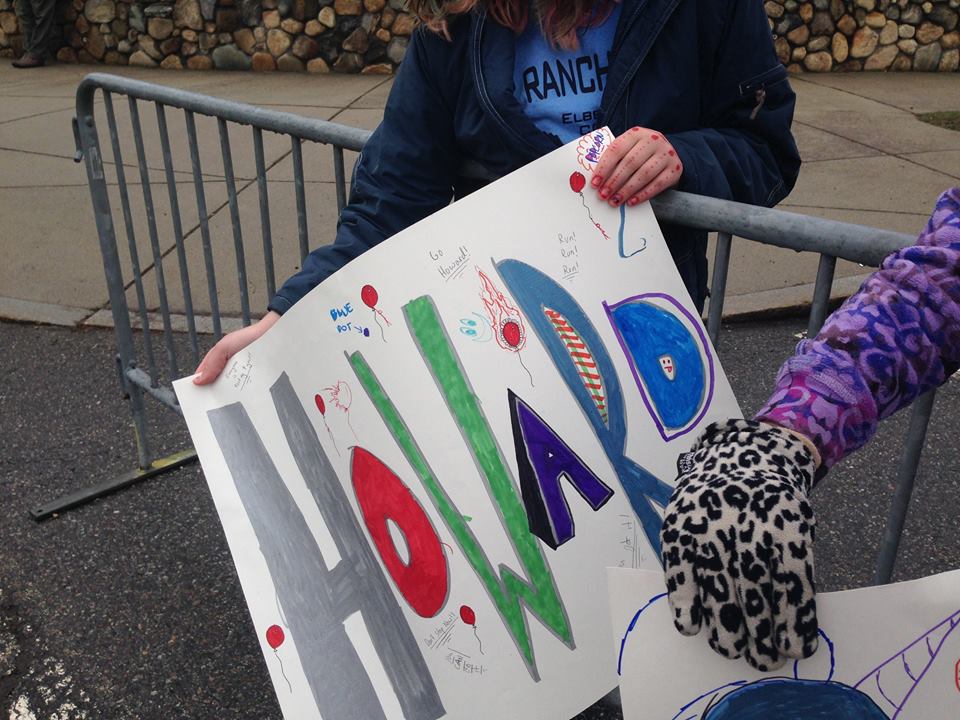
A cry from across the road: Uncle Howard! Uncle Howard! The crier is Ziva, my sister’s firstborn. At her side, sucking an enviably warm-looking thumb, stands her younger son Akiva, holding a placard in primary colours. The placard informs the field of thirty-two thousand that Uncle Howard is a champion.
Howard sign

Akiva’s elder brother Elisha is not with us. He’s in hospital, recovering from a kick in the eye.

Shai black eye

The injured brother is represented by Grade Seven classmates, showing solidarity with Elisha. Some neighbours of Ziva have been gathered to watch her grateful old wreck of an uncle gobble a banana, reject a waterproof (too late), ignore the Coke Zero he requested, instead bolting and slurping electrolyte gels.

The uncle says sentimental things, kisses the niece, tries to kiss the great-nephew (who ducks adroitly) and runs off greatly cheered. Ringing in his ears are Ziva’s fatuous words – You’re running great, Uncle! – words he finds entirely convincing.

It is a still cheerful uncle who looks ahead and sights the stiffest and last of the uphills. Today marks the new moon of the month of Iyar in the Jewish calendar. Psalms from the day’s liturgy visit me:

This is the day the Lord has made –

Let us rejoice in it and be happy!

And that’s what happens. The way is long, the body is tired, but the mind is reconciled. I run on rejoicing.

Time to boast. Throughout the race I’ve been working the downhills. Instead of coasting, I’ve lengthened my stride – it hurts when I do this now – grabbing what acceleration I can. I tell myself I’m running an honest race, the best I can run. Steadfastly ignoring my stopwatch, I am yet aware my marathon pace is funereal. But some dumb pride glows as I run on, relishing the minute achievement of my imperceptible accelerations. I will run a Personal Worst today, which will yet be my absolute best.

Another boast: I recall a conversation between a champion marathoner and a commoner.

Slowcoach: I cannot believe your speed – running that entire distance in half the time it takes me.

Champion: And I cannot believe your endurance – running your hardest for twice as long as I can.

Today I will run nearly two-and–a–half times as long as the winner.

Ahead of me runs a solitary figure in pink, a youngish woman, quite tall, strong looking. Powerful shoulders emerge from her singlet; is she a triathlete? Whatever she is or does – this island – she piques my curiosity. Her independence wins my respect.

I recognise another woman, running like a draft horse half a pace ahead of me, the same Dana Farber runner I saw earlier wearing ‘Barbara’ on her singlet. She’s another island, plodding, oblivious of spectators and runners alike who are now jiving and singing along to a pounding ‘Sweet Caroline.’

I’d like to hear about Barbara. I pull alongside, am about to ask, then pause. I don’t want to hurt or shock the lady by referring to Barbara in an inappropriate tense, whether present or past. Please excuse me. Would you like to tell me the story of Barbara?

Briefly startled, the woman smiles: Yes, yes, I’d like that very much.

She tells me Barbara had cancer, but hers is a happier story. Thirteen years ago Barbara received a diagnosis of an aggressive, inoperable brain tumour. She might hope to live six months. At the time her children were three and one. She underwent treatment and was free of cancer for eleven years before the disease returned. This time it was six months.

I am so glad you asked me. I want people to know.

Moved by the telling, I murmur, It’s a sacred remembering her, speaking her name…

Yes, yes, I feel that too.

A young woman runner darts across our path from the far left to the barriers on our right. Crying words I cannot make out she throws her arms around two young women who stand together at the barrier. Three heads clinch in close embrace. The women exchange fierce kisses, then hold each others’ faces for a long moment in searching silence. Something has happened. Perhaps here, at this precise spot. Something tells me they arranged to rendezvous at this point. Was it here they heard the news two years ago, of a fourth – a friend? – when the bombs went off.

Running along Commonwealth Avenue now, only four miles to go. Only. Here’s a smallish lady, female, whose raincoat reads, Baby on Board. I pull alongside and cast an obstetric eye over her belly. Yes, she is.

How many weeks are you?

She smiles: Thirty-one. The doctors say it’s quite OK so long as I don’t overdo it.

Running a marathon is overdoing it – by definition. That’s the point of running the event.

She runs slowly, steadily on, looking quite comfortable. Slow as I am I outpace her. I leave her behind and ruminate happily on a new baby, a new life, some sort of consolation. If they call for a doctor, I’ll be ready.

Another familiar Dana Farber, this the one who wore ‘Nigel’ and ‘Luke’. Emboldened I ask, Those names you wear – cancer?

Yes.

Were Nigel and Nick twins?

Yes, identical.

Thud. No further questions asked, none required. The woman’s soft look must mirror my own; a sorrow shared.

Past the Citgo sign we turn. Soon we’ll see Boylston Street and journey’s end. But the 25 milepost forbids excitement. This is one subtraction I am equal to. The one mile that remains feels like a long sentence to serve. But the sentence is not solitary. I share it with the lame, the very elderly, the damaged runners, as well as quite a few who appear young and fit. We leave behind the tall pink girl, now walking, stolid still, and solitary.

From either side of the street the crowds hurl waves of noise, calling, cheering, praising us all in an ecstasy of joy. They love us. They love me. Our effort is theirs, our success their own.

Boston claims us, lives through us. Amazed, uplifted, I burn. And run steadily on. Down Hereford Street now, it’s roses, roses all the way. Here’s where they turned me back in 2013. I look around me. Police again are everywhere, but calm, calming, part of the Boston polity, our protectors.

The final turn. Three hundred metres to go. I can race this. I raise rusted knees, swing mechanical arms, rise up onto blistered toes and chase. No chance I’ll catch that young bloke five metres ahead and to my left; he’s racing too. That young woman just ahead has picked up speed as well. Bugger it: let’s go for gold! I sweep past the racing girl. I chase that young buck, knowing it’s futile, joyous in full-blooded pursuit. The feet beneath me fly over the wet roadway towards the Line, a royal blue slash just ahead. Ten metres out, I find a bit more. I lunge and vanquish Young Buck. We shake hands and I stagger a bit.

Medals, drinks, foods, fruit, Medical – all straight ahead! Keep going straight!

One hundred long metres further on a woman wraps me in an insulating foil robe. Ahh, that’s better. Another lady garlands me with the familiar Boston medallion, the weightiest trophy marathoners know. They are not young, not glamorous, just kindly, just volunteers – Bostonians. And we runners love every one of them, all nine thousands of them.

I turn around and sight Ms Pink, striding slowly across the Line. Her gaze nowhere, she’s mindless of completion. Her face is distorted and drenched. This is not rain, she is crying.

*For quite understandable reasons of security BAA requires a runner’s name to match that of the photo ID. Farewell, Pheidipides the brave, my hero since third grade!

I post this long report so a reader can feel the long slog of the marathon.

Additionally I offer and dedicate this post to the generous blog followers who donated to Stepping Strong.

If you missed out on the privilege of giving, please be aware the fund accepts donations until June 30. You can give soon and give often. https://www.crowdrise.com/brighamwomensboston2015/fundraiser/pheidipidesgoldenber
Back to Boston

Running a marathon is an undertaking of but a single dimension. At least that is how it appears to the non-marathoner: the runner places one foot in front of another and repeats that act 42,184 times. Inexplicable to many, perverse in fact. And in the course of the event the runner herself might feel the same: there is but one dimension which is distance. In physics we call this Space and it implies a further dimension which is Time. But we runners can quite forget time, becoming oblivious, entering a kind of fugue state. The corresponding sole dimension in the body is fatigue, a fatigue singularly profound in the lives of the modern first-worlder. And the moral or spiritual correlate is courage or the pursuit of courage.


In the course of the career of the continuing marathoner that analysis undergoes change. The change occurs by evolution or by revolution.

For some that revolution, that turning over, occurred at Boston in 2013. I ran Boston that day. I was among the thirty thousand on the course whose lives changed. We were outnumbered by the three million, the people of Boston who take us into their homes, who take us to their hearts, whose day of days is the third Monday in April, Patriots’ Day. Those people, acted like a polity wounded. The wound was psychic and social, a wound that was the denial of the hospitable self of Boston. On Patriots’ Day one million of the citizens of that small big city come out and stay out to watch their home event. They come out early and they stay late, cheering on not only the swift Kenyan but the aged Melbourne schlepper. To all they offer oranges, bananas, jelly snakes, beer, sausages, and Vaseline as groin balm.

The bombs went off and Boston exploded in grief and contrition. The world had come to celebrate the folly and the freedom of running too far; the world was their guest and abruptly the ceremony of innocence came to an end.

Too slow, too tardy, I missed the Finish Line explosions. Turned away by police at the top of Boylston Street I walked away through stunned and grieving Boston. Evening came on, the chill came down and Boston offered me the use of its i-phone, the gift of a jacket, the shelter of warm shops, the gentle pat on the shoulder. Bostonians wanted to drive me wherever I needed to go, then walked miles out of their way to conduct me to my family meeting place.


I flew home the next day.


Ever since Boston has sent me reports on its healing and rehabilitation. Most telling have been testimonies of the injured. One wrote of her amputation, her new prosthesis, her learning to walk and her completing the marathon the following year.


The research community of Boston has wasted no time in applying its collective brain to research into trauma and recovery. You can read some testimonies by clicking on this link.


http://www.nytimes.com/interactive/2014/04/13/us/100000002820641.mobile.html


In October last year Boston wrote and invited me to run as a guest in the 2015 marathon. Having just recovered from injuries (self-inflicted!) I leapt into training. And I decided to support the Stepping Strong Team that raises money for research into trauma such as Boston experienced. My wife and my daughter are psychologists, both practising in the field of trauma. Between them they have nearly fifty years’ experience in a field that is as endless as human cruelty. I see the work they do and the need. I wrote on the subject in yesterday’s Age:

http://m.theage.com.au/national/when-a-helper-needs-help-20150328-1m646f.html


I want to raise $1000.00 for the Boston research. I’ve kicked it off with $180.00 of my own. Please read and consider: if you want to make a contribution you can do so at https://www.crowdrise.com/brighamwomensboston2015/fundraiser/pheidipidesgoldenber


The Sweet Taste of Revenge

The oldest friend of our married life is a parson. After inspiring and marrying hundreds of young believers and unbelievers and halfbelievers; and after watching their marriages fragment – fast or slow – and die, John concluded he was not a success in bringing people’s lives together. He left the parsonage and took up God’s work in a new business: in his own words, ‘I spent a year in gaol.’ The parson became a chaplain.
‘Long Bay Gaol was just like other congregations I’d worked in – lots of sinners, lots of righteous people (“I never did it… it was someone else’s fault…I was framed…”), and lots of people who couldn’t care less about religion. I didn’t mind the unreligious and they didn’t mind me. The convicted were just people, by and large. I found most of them likeable enough.
‘But a few of them were hard to like. There was one man who’d been convicted for trying to incinerate his girlfriend. She survived, horribly burned, but in the process he killed the masseuse who was treating her at the time. He was quite unrepentant, quite without conscience, but nevertheless he became one of my most frequent parishioners. He’d visit my office frequently, ostensibly for spiritual guidance. All he really wanted was the luxury of private conversation. I did not like him, but I couldn’t let on.
‘There were others in the gaol who were just as unlikeable. One was a warder, one of the ‘’screws’’, as the prisoners called them. This fellow treated the prisoners brutally. He was feared and hated. He used to visit me often and he was just as persistent, just as falsely pious and just as unwelcome as the murderer.
‘The murderer confided once how “cons” had their ways of getting back at the screws they hated most. He said, “Father, we piss in their tea.”
‘I understood how that might be. The best-behaved prisoners enjoyed the privilege of waiting on tables in the Officers’ Dining Room. That was where I ate. The prisoners prepared and serve beverages. One day I went to that Dining Room for lunch. I loaded my tray and sat at a table out of the way to enjoy some privacy. Out of the blue, bearing his own tray, that brutal fellow was at my shoulder, declaring, “Father, you don’t mind if I join you.”
I did mind of course, but I said the opposite, of course.
A prisoner turned up and asked us for our beverage order.
“Tea, white, two sugars,” said my guest.
I asked for the same. That waiter, my religious friend the incinerator, said, “Certainly, gentlemen, I’ll bring them presently.”
The con returned carrying two mugs. ‘This is yours, Father”, he said, as he laid my drink on the table. Then he walked to the other side of the table, placed the mug before the screw and said, “And this is yours, sir.” As he spoke he shot a huge wink in my direction.
‘What did you do, John?’
‘It was a moral emergency. If I remained silent I would be party to a wrong. If I spoke I would breach a confidence. I drank my tea. I watched the screw drink his.’

John’s story brought to mind my cousin’s account of certain events In Israel during the first Intifada. She wrote: ‘Consumers of a particular brand of hummus remarked on a change in the product. It didn’t taste bad, just subtly different. Closed circuit TV in the factory caught Palestinian workers wanking into the vats.’

***

Neither the hummus masturbators nor the prison micturators could have read the more recent American novel, The Help, in which a white racist woman consumes chocolate cake containing the ordure of the ‘help’ – an unfairly dismissed African-American woman.
I recount these stories to offer succour to a friend, a novelist, Margaret.
Now Margaret enjoys the attentions of a literary assassin, a relative by inheritance, a sort of outlaw-in-law. That person claims a critical authority and a mission to improve HCG by means of brutal dismissal.

The critic and the writer are destined to meet from time to time; what can Margaret do to fight back?

All the examples quoted have their appeal. The cake is of course, irresistible but time-consuming. The hummous is nourishing but beyond the resources of an unaided female. I suggest Margaret make her nemesis a cuppa tea – white, of course, with two sugars.

Once Upon A Writer

Once upon a time I was a writer… No, not once – thrice upon a time.

First time: in second or third class the teacher directed us to write a composition. We did as we were told. I enjoyed writing. My composition was chosen and read to the class. I was a writer and one year later, when the Melbourne ‘Age’ published a little piece, I was a published writer.

Second time: at medical school, achieving mediocrity in exams, I found relief editing and writing for a paper. I published what I wrote.

Third time: with a family now grown up and my own parents failing, I was a writer heavily charged with material. I wrote and my friends and family responded. Among the responders one friend in particular responded decisively. Often enough she responded derisively; and not just often enough but more often than enough.

I had good reason to pay attention to my critic friend. She had been an adult reader for many more years than I had been an adult writer. Further my critic was trained in criticism while I was untrained in writing.

Curiously my early vulgarity didn’t trouble her much. My sentimentality (an abiding tendency) excited little reproof. And even the structural shambles, the way narrative fell upon narrative by accident into a happy enough heap, provoked no rebuke.

The problem with my writing was the writer. Contrary to my critic’s command I did not write of Howard the way Howard should write of Howard. In truth this was not willful delinquency (another abiding tendency) but incomprehension. So stratospheric is my critic’s sophistication, her principles eluded me.

The pages of my first two books are Howard-haunted. Howard Bloody Goldenberg is to be found in the middle of every page or in its margin or inescapably behind every page, pages that can never be thick enough to disguise Howard. This drove my critic mad. It was not that Howard was full of himself (he is that) but that Howard was represented without precisely the ‘self-reflexivity’ (my critic’s term) that she demanded. ‘Howard’, she wagged her finger imperiously, ‘Howard, you are refusing to become the writer Howard should be. Your subject, your great subject, is Howard…’

This criticism, emphatic and oft-repeated, merely increased my self-consciousness. Eventually it would drive Howard from the page. Thus, in book number three (‘Carrots and Jaffas’) there exists a character who resembles Howard but is not Howard. Although that character is a male in his sixties, a compulsive storyteller, an outback doctor with a large nose and lavatorial obsessions, he is not Jewish, not Howard per se. In truth I no longer trusted Howard to create Howard. My critic had achieved something worthwhile; she had demolished a formerly impregnable exhibitionist. This was surely to the good, for Howard the person showed an objectionable and retrograde refusal to adopt my critic’s view of the world. (The critic started adult life as a social activist, becoming a member of a commune, a welfare worker, resolutely a conscious and conscientious proletarian. In time she learned the profound error of her ways and unlearned her early amused tolerance of Howard’s political softheadedness.)

Meanwhile Howard had become a blogger and my critic became my bloggee. I would write, my daughter would post and my critic would criticise. More and more my critic criticised Howard for not being my critic’s faithful disciple. At one stage, in outraged surprise, she accused me of being ‘green’.

Given this blog’s unrepentant diarising of Howard’s life, his thought, his memories and stories – in short this blog being Howard on the virtual page – my critic found the entire exercise personally provoking. Possibly intentionally so. Her criticisms of Howard were now unrelenting, and of course, public.

It is timely here to remind my reader that my critic is a friend, that she certainly wishes for nothing more than my improvement. She has in mind my ascension into a literary realm which exists clearly in her sight and quite outside my powers of vision. In her private love of Howard this friend is staunch. In public she is an attack dog. At first puzzled, later a little hurt, eventually wryly amused that such a thing might be, I accepted her blank rebuttal of my private objection to her tone. ‘Howard’, she wrote (publicly of course), ‘Once your writing emerges into the public sphere you cannot expect criticism to remain private.’ Fair enough. Perfectly logical, fully consistent with literary purity. And perfectly blind to the imperatives of friendship.

I came to accept a painful reality:

The moving finger writes,

And having writ, moves on;

Nor all thy piety nor wit

Can lure it back

Nor cancel half a word of it

(From the Rubaiyyat of Omar Khayyam)

Eventually the moderator of this blog published guidelines of the limits to decent blogly conduct; and the critic, declaring herself to be my ‘troll’ (to me a new concept), banished herself from these pages.

My critic helped me immensely. She forced me to examine every self-syllable I wrote. She required of me an intensification of my self-consciousness. To this day she shadows every line I write, shaping my writing to conceal my thought, as she peers through the ether for Howard malignancy, stimulating me to a meticulous attention to some standard I never grasped but for which I blindly reach. Of course the cost is a friend who, in the name of friendship, has shat upon friendship.