A Man Died Today

Kylie says Ernie died.

Her face is tight, closed. She was Ernie’s only friend.


Ernie

Ernie was a sad person. He saw doctors and they prescribed tablets for his sadness. He said he felt a bit better on the tablets, and then said he was worse. He stopped the tablets.


Ernie lived alone. I visited him once in his rented house. His dogs greeted me. I found Ernie in his dark bedroom, in bed, blinds drawn, in mid-afternoon. He said he wasn’t crook. Nothing to get up for, he said. Only the dogs.


Kylie said he was paying $350 a week in rent for the mean little house on a back road in the country. She reckoned Ernie was past caring.


One time Ernie spoke a little of his childhood. Dad abused him violently. Mum didn’t care. After a couple of short sentences, his old face hanged from his neck, wordless, wrought with injury remembered. 


Doctors encouraged him to join Men’s Shed. He wasn’t interested. The visiting nurse was worried. He didn’t answer calls, he’d be grouchy. Then he became confused. No, he wouldn’t go into the local hospital. His dogs would pine.


The day came when he couldn’t speak. His mouth couldn’t make words. He found himself on the ground in his yard, with no memory of going outside. The dogs licked him into awareness.


He was taken to the big hospital two hours distant, where doctors found him recovered from a mini-stroke. They told him to go home. Unable to drive, alone, at night in winter, he lay down on the floor of the hospital’s unheated waiting room. Kylie called to check on him, then drove to the big town and brought him home.


From time to time I’d sight Ernie talking with Kylie. She’d sit quietly, leaning forward, allowing Ernie’s words to find their way out of him. The words would stop and start, like a streamlet wending around rocks, hard obstacles of pain interrupting the flow. In their cave of trustI’d see Ernie smiling.


Kylie

Three days ago Kylie said, Ernie’s in hospital. He’s got pneumonia. The old man’s friend. Kylie visited him that day and again two days later.

Today Kylie said, Ernie died.

My Friend from Rwanda

My friend from Rwanda has been a teacher to me. I listen to his beautiful voice: his words, exquisitely chosen, percolate unto my being. In those moments I am in harmony with my friend and with my essential self.

My friend from Rwanda lived through war in his homeland. He lost a brother in war. He watches TV images from Gaza. Children climb through the rubble.

I was one of those children, he says.

My friend from Rwanda watches TV and he sees children dying.

He cannot see Hamas putting the children in the way of harm. 

My friend does not see self-defense. He does not see intent. He only sees genocide, where I am convinced of the opposite intent.

When my friend from Rwanda sends us footage that uses language of ethnic cleansing, of colonialism, he hurls me into a distance that neither of us wants. He cannot hear my words. Drenched in blood memories, clad hard in his own pain, he cannot know mine.

Distance, silence, alienation.

And yet we love each other.

Standing on the Shoulders of a Cliché

Many years ago when my friend the great children’s doctor, Lionel Lubitz was still good-looking, I witnessed a Moment in the History of Ideas.


Lionel Lubitz

Lionel placed toast in the toaster and took raspberry jam from the pantry. He spread the jam on his toast and stopped. He said, I’ve just had an idea. He rose, returned to the pantry, coming back to his toast holding a jar of chilli powders. Lionel sprinkled the jam with chilli powder. I urged him to get help.


Lionel bit rashly into his toast. He said, beaming, Try a bit, Howard. Humouring the lunatic, I took a taste. It was a sensation. This was a moment of invention, a breakthrough in human alimentation, and I was there as a witness. As I remarked above, this was history. Human thought had moved forward.


The United Staes of America has been the birthplace of another such stride forward. In 1901, Julia Davis Chandler wrote a recipe in the Magazine of the Boston Cooking School of Culinary Science and Domestic Economics. In her article she described a sandwich recipe with crab apple jam and peanut butter. Peanut butter had become a popular spread in New York tea rooms of the period. One tea room, anticipating the latter-day Lubitz, offered a peanut butter and pimento sandwich.


If I am to be truthful, I am unable to describe the latest Moment in the History of Gustation with any modesty at all. In a thunderbolt moment of mentation, I thought, What about a peanut butter, raspberry jam and chilli sandwich?


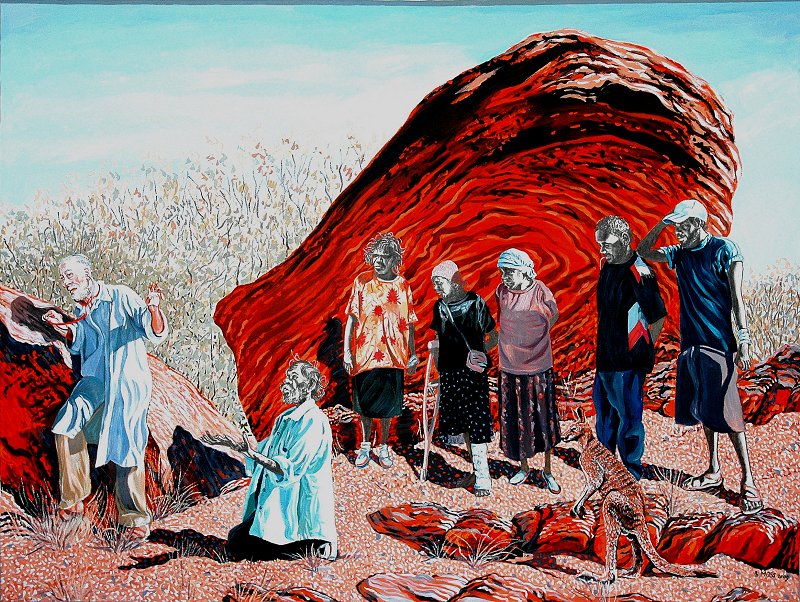
I made one. Sitting in an unpromising kitchenette in my Alice Springs accommodation, I applied raspberry jam to a Corn Thin. I covered this in smooth peanut butter, then sprinkled chilli powder on top. Once again, sensation! I was silent for a moment, like Stout Cortez and his men when they stared out at the Pacific, silent on a peak in Darien. I found my voice and offered a bite – just a small bite, it was too good to share generously – to my friend, Rod Moss, the famous artist. (Yes I do have famous friends: with this invention, Rod and Lionel now have one of their own, to wit, this writer). Rod shook his head. No thanks, Howie. Like eating polystyrene. 


Rod Moss

How little, how very, very little, does Rod know.


Yes, the invention is truly a leap of the human toward high heaven. I must have recourse to cliché: like Sir Isaac Newton before me, if I have seen further, it is because I have stood on the shoulders of giants.


While awaiting my Nobel, I will share the recipe with humankind.


Raspberry Jam, Peanut Butter and Chilli Toast*


INGREDIENTS

Raspberry Jam (must be bright red, a bit runny and have seeds).

Peanut Butter (smooth or bumpy, salted or unsalted, all are good).

Toast or *Corn Thins (I have not tried polystyrene, but you could give it a go).


METHOD

Combine the above in any order and apply to the farinaceous.

Eat, roll eyes, swallow. Be prepared to swoon.  

Prayers

Not long ago a man holidaying with his family falls suddenly to the floor, crying to his little boy as he falls, Call an ambulance! The man does not speak again. He lies in a coma in the Intensive Care Unit of a little hospital in Bali, with injuries to his brain that can’t be measured or treated properly there.


Around the bedside of the man his mother and his 10 year-old son and his elder sister stand and try to understand. A mother looks at her only son; a sister, burdened by her knowledge of the brain, gazes at her wounded brother.  The sister’s husband grips her hand. The boy who gave the man his chance of life sees his father, inert, intubated, silent. The child has no language, no words, in his world overturned.


The mother, the sister, the child speak – when they can bring forth words from their grief – soft, urgent  murmurs of love. The brother in law breathes his prayers.


The man is surrounded by love and tears. Does he hear the murmured prayers of his loved ones? Will he learn one day of the care and the grief of his many, many friends?


An aircraft is sent from Australia to retrieve the man, to bring him home, to get the most advanced care. The plane is an airborne ICU with the super-nurse and the intensivist doctor who can keep the injured man safe as he crosses half a world.


All of this will be hideously expensive. The insurer pauses, ponders, plays for time as time races. How much time does the  wounded man have? The wounded man lies outside time, while his loved ones, their desperation growing, plan to fund the costs privately. 


The man flies home and is admitted to the excellent hospital. The family scrambles for flights, eventually rejoining the man who does not speak.


After all their frantic haste the family falls now into a world of no haste, a world of deliberate care. No idle speech. Words of yearning love whispered into the ears of the stricken. The words spoken aloud are the necessary words of critical work, as gauges flash, tubes drip, drip, drip and respirators observe their slow rhythm of rise and fall.


All wait.


Many come, the aunt, the man’s friends from today, and from all his yesterdays, stretching back to early boyhood. Solemnity sits heavily upon them.


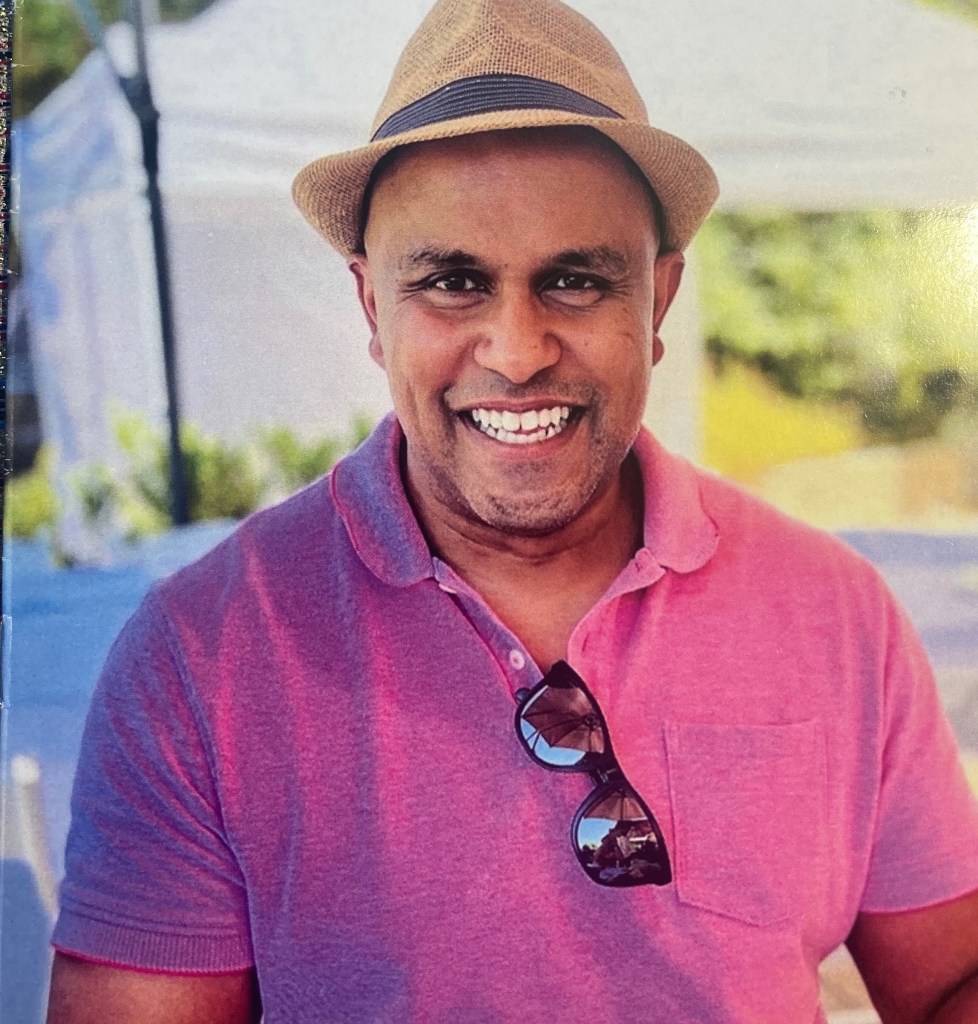
The man Raj, has a wide, wide smile. He has innumerable anguished friends and a family – to which I belong: Raj is my daughter-in-law’s brother, her younger brother who, from earliest times, she lived to protect. Sister and brother planned this holiday time together, with their spouses and children.

The sister landed in Bali only to learn that Raj had fallen, and had undergone emergency surgery that same morning.


In all the deliberating silence doctors search the damage. An early image unveils the haemorrhage-surge that tore through the delicate brain. Later tests answer the question we dread to ask: when stimulated, the unliving brain shows no response.

No flicker, no spark.


The brain subsists in its inscrutable dark. We in our world of talk and think and act, exist utterly separated from Raj. We are exiles from Raj’s new world.


Raj has known this world before. Before his birth, before his conception, Raj existed as thought, as hope, as desire. This world lacked Raj. When he came into being, Raj was answer to prayer, he completed a world.


Now Raj and we inhabit worlds distinct, we with memory, with yearning, and with lack.


Raj’s world is eternal, ours ephemeral. Confined here for our instant of being, we know nothing of eternity. From that place where Raj now abides for all time, time itself is exiled, together with pain.


Who knows, but perhaps prayer lingers there, together with love?


Sometimes the Sun

June 4, the sun shines on Traralgon and it shines on me. At 6.30m when I head out, the temperature is 4 degrees C (“feels like 2 degrees C”). A heavy fog lies upon the earth.

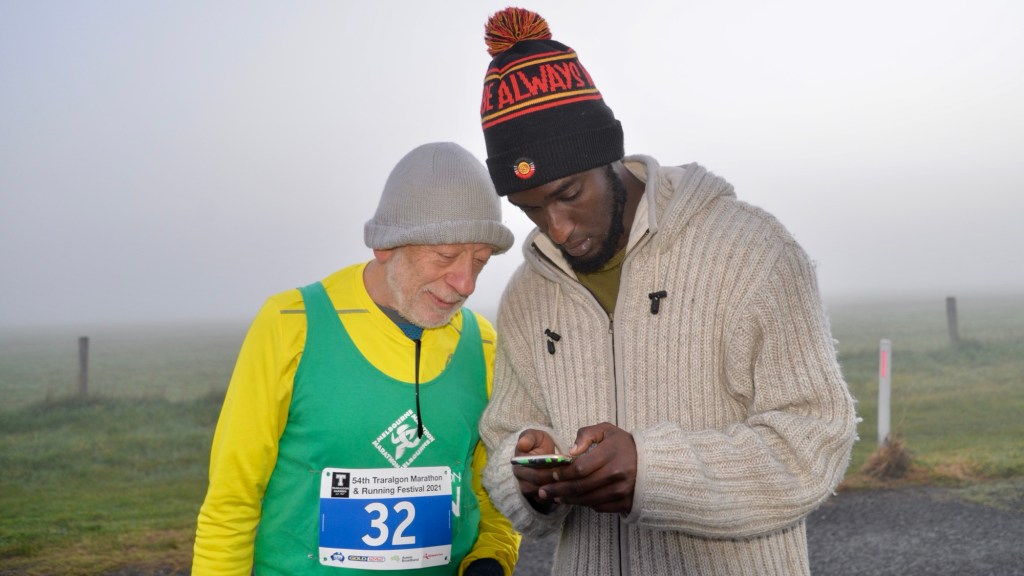
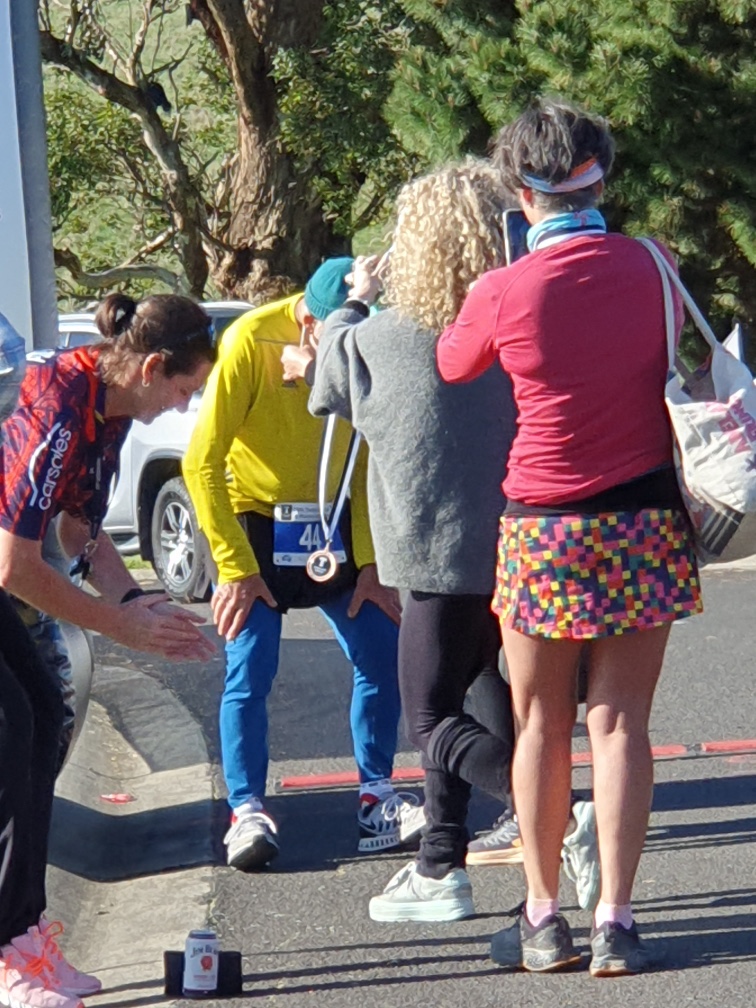
A mystic silence reigns as I set out on the 42.195 kilometres of the Traralgon Marathon. Although I’m starting my run one hour before the remaining 61 runners, I am not alone; my eldest grandchild drives his electric skateboard at my side.

The sun comes up at 7.30, warming my body and my spirit. The track, a rail trail, gleams as we move along towards that rising sun. Cobwebs, suspended from grasses and bushes, each of them a so-delicate necklace, that sparkles with sunkissed dew.Cows graze nearby, leaving generous splats for us to dodge. (I succeed, my grandson not quite.)

On his back the grandson wears a pack, ferrying supplies to replenish my body: planets*, reptiles** and salt tablets, and a flagon of water, as urged by Emily, the endurance sports dietitian and triathlete. My own project looks modest in comparison to Emily’s. As the weeks before Traralgon shrank to days, I rationalised: It’s not that far. I’ll run as far as I can, perhaps halfway, and when I can’t run anymore, I’ll walk… I’ll discover whether my legs remain capable of 42,000 steps.

As often as I daydreamed thus in hope, came that voice of dull prudence, Don’t be silly. You’ve never been so undertrained,you’ve never been so old…

Where lies wisdom? Where hubris, where cowardice? Thoughts alternate. Yes I am old, yes, I’ve had a stroke and, yes, the end approaches. I could sit and wait, retire from life and all risk and hope; and wait gracefully to die. An aged man is but a paltry thing/A tattered coat upon a stick/Unless…Unless soul clap its hands and sing. A decision makes itself. I’ll run!

This lovely marathon course winds and bends its ways between tall trees and low bushes and no trees at all. In nearby fields of pasture, tall grey gumtrees stand, gaunt, without foliage. What killed these survivors of fire and flood? They stand, each alone, each a memorial statue of its own demise.

At 8.00 o’clock, we pause for salts and serpents*, of which Emily commanded me to consume three every hour. This pause refreshes legs and lungs. Plenished now, those organs respond eagerly to the delights and sights on all sides. We cross little bridges over small waters and large, each bridge individual, this one of wood, this of metal, this one grassed, the next gravelled, the next paved of wood.

This being a rail trail, we reach the former rail station at Glengarry. Here, Jesse the skateboarding grandson, helps me to flout fairness in sport. He procures my performance enhancing substance, astrong latte, please Jesse, with sugar! This encourages lungs and legs already high on endorphin.

Everything smiles as we plod without pain towards Toongabbie Siding, where we sight a dark figure that moves ahead of us across the landscape. We close on this shifting shape and recognise Nick, close friend and ever-generous chauffeur. He and Jesse leave now, for their return to commitments in Melbourne.

I come to the turn, which is the half-way mark, all smiles. Ah, happy runner, happy, happy foolish, self-fooled runner, strong in the legs but too weak in the head to read a map properly. Utterly unaware that this out-and-back marathon course is not symmetrical, I discover the Toongabbie Loop, which now adds five kilometres of running. Why do I smile? What cheers me in my benighted state? It is my own laughable absurdity that cheers me so.

Forty minutes pass in happy solitude. More cows of course, more trees, more sun, and, the occasional fast marathoner, who now overtakes me, overcoming my one-hour start. Back at Toongabbie siding I’m overtaken by Kirsty, my marathon friend from Boston and the South Australian bush. Where is Sally, the third of our Boston threesome? She follows, in better time than mine. We swap stories of our morning so far, we sip salted drinks, then ahead sweepsKirsty, a real runner, on her way to finish in four- and a-half hours.

Alone again in the sunshine, recalling my first Traralgon Marathon, the first of fifty-seven. Another sunny day in winter.

Traralgon is Victoria’s Country Marathon Championship and Victoria’s first. All in all a pretty lustrous affair. Running under his nomme de jamb of Pheidipides, Howard Goldenberg completed his maiden marathon at Traralgon thirty-nine years ago. That year 181 runners started and 141 finished. I still have the official printout of the results. At the foot of the second of two roneoed sheets of paper (this report antedated the internet), you’d read: In 141st place, PheidipidesGoldenberg; time: 4 hours, 31 minutes, 31 seconds.

Every time I run a marathon I write one. That simple passage through time and space, so simple, so elemental, you mightn’t credit it worthy of remark. But every running feels remarkable to the runner. In the marathon the runner encounters his sole self, discovering some things about herself she’d prefer not to know and others that make him feel a little proud. In a marathon, as Zatopek remarked, we all die a little. The event is charged with significance for this runner because an often-solitary passage through time and space always involves encounters with others. It is the comradeship, the fellow feeling, the respect that elevate our experience. In that sense the marathon is a metaphor for our lives.

A watcher of the Barcelona Olympic Marathon might have caught images of the leading bunch of five as they passed their drink stop with seven kilometres to go. They had, running in intense humidity and heat, slowly outpaced a score of household names from Kenya and Tanzania and Korea and Japan and Australia. These five were the bravest of the brave on that particular day. One of these five, one only, would go on to become immortal. Four of the five grabbed their special drinks at the 35 KM mark. The fifth grabbed and missed. And ran on. Turning back was out of the question. The four drank and ran and drank again. One of the four passed his unfinished drink to the fifth. I do not recall whether the drink-giver won the event – I fancy he did not – but in that moment he joined the Immortals. Such small moments are the glory of the marathon.

All this reads a bit portentously. Most running – and all of mine – is more comedic or shambolic than deep. In the field of my third Traralgon I sighted at the Start the famed and cherished Cliff Young, Australia’s most famous potato farmer, a previous winner of the Westfield Sydney to Melbourne Ultramarathon. Cliffy used to train in his hobnail work boots. If he needed a haircut he’d trot the thirty kilometres from his farm to Colac, then run back home again. That day in Traralgon I wondered if I’d get close to him. Around the three Kilometre mark my legs became over-excited and accelerated and I hauled him in. Running a couple of paces behind Cliff I admired the light lacework of his tracksuit material. I drew closer. The lacework was in fact the work of a legion of hungry moths. Through the moth holes I could see and admire the pale skin of those spindly old legs…

A cry in the wilderness brings me back to now. Another cry, shrill and repeated. A flash of impossibly curly fair hair, and a form on the track ahead. The hair and the form,and now the face, I recognise as belonging to Rachel, my firstborn. A long embrace and on we race, one full kilometre, after which Rachel gasps, I’ve just done a full marathon, and retires to her car to drive to Glengarry for a stop, a planet or two and more coffee.

Phil Kayumba, Rachel’s partner, now materialises, tall, lean, young, the swift spirit of hope. Phil sings but one song:

Howard goldenberg/looking good/running well

Howard goldenberg/looking good/running strong…

and today he’ll sing it often as he pumps me full of sunshine, breathing it into my ear as he spirits me to the Finish.

A long pause at Glengarry, more coffee, more chocolate planets, more gummy serpents. After a12-minute pause, we are off and ‘running’, really just plodding. Somehow nothing hurts. The sun smiles on me, Traralgon Harriers smile on me as thy run past. They cry, Go, Mister Goldberg!

Keep going Mister Goldberg!

Who are these strangers? Whomever they be, they are in league with the elements, with my kin, with my friends, with the volunteers who bless my path.

Phil is in my ear: Only 13 kilometres to go, you can do this Howie.

No Phil, it’s eighteen.

No Howie, just thirteen.

Phil is correct. In my masterful map-reading failure, I’ve undercounted the kilometres run. Phil’s news comes as a gift. Phil’s simple song sings itself to the rhythm of our falling feet:

Howard goldenberg/looking good/running well 

Howard goldenberg/looking good/running strong…

One foot strikes the grassy path, the opposite foot follows. A stranger to volition, to strain, to suffering, I float above, with love at my side, love all around, love and joy awaiting and greeting me as I puff and plod absurdly the final thirty, hilly metres to the Finish. Cheers, a medal, drinks for the hero.

In all my scores of years’ ruminating about the meaning of a marathon, time and again recurs this deep and bright truth: my life is like the marathon, an effortful passage through space and time, made rich by love and companionship. Meaning congeals within me. As Malamud wrote, I am a man, which is not very much. But it is a great deal more than nothing.

*The planets that sustained me were Mars.

**The serpents were jelly snakes.

The Fatal Canal


I returned today to the canal where John died. He must died around 1951, when I would have been five. I looked at the low bridge over the canal that I always looked at with fear. I’d stand a hundred yards upstream and I’d regard the swift current. I knew that if I fell in the current would sweep me downstream and under the bridge and beyond.Dad’s words would ring in my ear: The canal flows ninety miles, all the way to Hay. I’d stand upstream of the bridge and I’d terrify myself with thought of my helpless passage to Hay.

When I was five that bridge was larger and higher. The canal was wider: the entire scene dwarfed me. In that canal I learned the power of trust. Dad stood in the canal, and urged me to jump in and swim to him. He was three yards distant. He said, Jump in Howard. I’m here; you can trust me. I looked at that too-strong stream, I looked at the separation from Dad, I looked downstream in the direction of Hay. I said, Dad, how do I know I can trust you? Dad looked at me. He said, I gave you my word. I jumped in and I learned that trust is stronger even than the current in the Hay Canal.

This evening images came to me of Dad and his friend Jack diving into the canal, emerging gasping, diving again and again. Then Jack surfaced and cried, I found him! The two men dived once again and brought John to the surface. They placed his inert body onto the tray of Jack’s truck, which roared off towards the hospital. A final picture remains of my Dad working on John on the tray, as the track rounded a bend and disappeared.

Only minutes before that frantic scene, John was a young man in his prime, sailing on the little yacht that belonged to Dad and Jack. He’d served in the War and survived. That day the boat’s mast touched overhead power lines just as John pushed the boat off the bank. Current flowed through John, electrocuting him.

Years later his niece sent me a photo of John. The face that looked at me was young, handsome, dashing in his uniform. His face was smiling. As I looked at the picture I thought of the wreckage that would ravage his family.

As he fell, John cried, Electric!

A Nice Night for a Picnic in the Rain

When the premier set us free

To foregather in the park 

With undiminished glee

We picnicked in the dark.

Why not, said we

Though it be wet,

Who knows where or when

We’ll next be met?

Friends we’ve been 

Friends remained, 

Friends long unseen

Joyful though it rained.

Weeks, months, more than a year,

And the plague still it rages

All tremble, all fear,

Every one of us ages –

Greyer now, more wrinkled,

But green still in feeling

We cared not it sprinkled

Rain-dancing, reeling

The rain that falls as well 

On sinner as on saint,

Washed us nice and clean

As a bright new coat of paint.

Raindrops in the soup

Rainfall on the spud

It dampened not our group

Seated in the flood.

As if beneath a roof

We dined through the night

Wine-warmed in spite –

In friendship waterproof.

Jesse at Eighteen

The mother whom you are about to bring into being feels a pain in her belly. Your birth was due a couple of days ago but it doesn’t occur to the woman that she might be in labour. She phones her father, a doctor, soon to become a grandfather.

Dad, my tummy hurts. It’s been hurting all day. Could it be gastro?

Darling, you are pregnant. You have reached full term. Unless you have diarrhoea you’re probably in labour. Go to hospital.

The date is November 11, a date already doubly and indelibly significant for Australians. It’s the date you create a mother, a father, three grandparents, a great-grandmother, uncles, aunts, great-uncles, great-aunts. It’s the date you change our world.

All day you knock at life’s door. Day becomes night. In the Delivery Suite your mum-to-be squats and strains. In an adjacent waiting area, dimly lit, your yogi great-grandmother-designate squats and bears down, trying to birth you at a remove. The soon-to-be grandfather consults his wristwatch. This climactic second stage of labour has become prolonged. He knows a lengthy second stage imperils a baby. He sends a message to the obstetrician: Would you like an extra pair of hands in case the baby needs resuscitation?

The specialist says yes.

I enter and not long after, the door of life opens to you. You and I meet. You need no resuscitation. I hold you and I introduce you to the mother whom you have brought into being.

Thirty-six hours later I’m gazing at you, just a baby. You lie inside my pink cap. I’ve seen hundreds of babies, I’ve delivered hundreds, every one of them a miracle, every one of them scrutinised for irregularities by a clinical eye. You are no less imperfect than those hundreds. You are skinny, you look like an empty sock, your face isn’t quite symmetrical.

But some event or process, something visceral, something cosmic perhaps, is taking place and I am transmogrified: I am a grandfather; I love you. What is this joy? Your fingers curl and close around my finger and you grip me. 

On the eighth day of your life you rest on the lap of your great-grandfather, I remove some skin and bring you into a Covenant. A drop of wine pacifies you. Your tribe jubilates. We know our long back story. Behold you! We see you and we behold our futurity.

Years pass, your parents send you to this grandfather to learn rituals, traditional melodies, ancient texts. At thirteen you are barmitzvah. Once again your clan rejoices and this time you can share it. You sense the power, the force field of love that is your extended family, the depth of our feeling. Profoundly you know belonging.

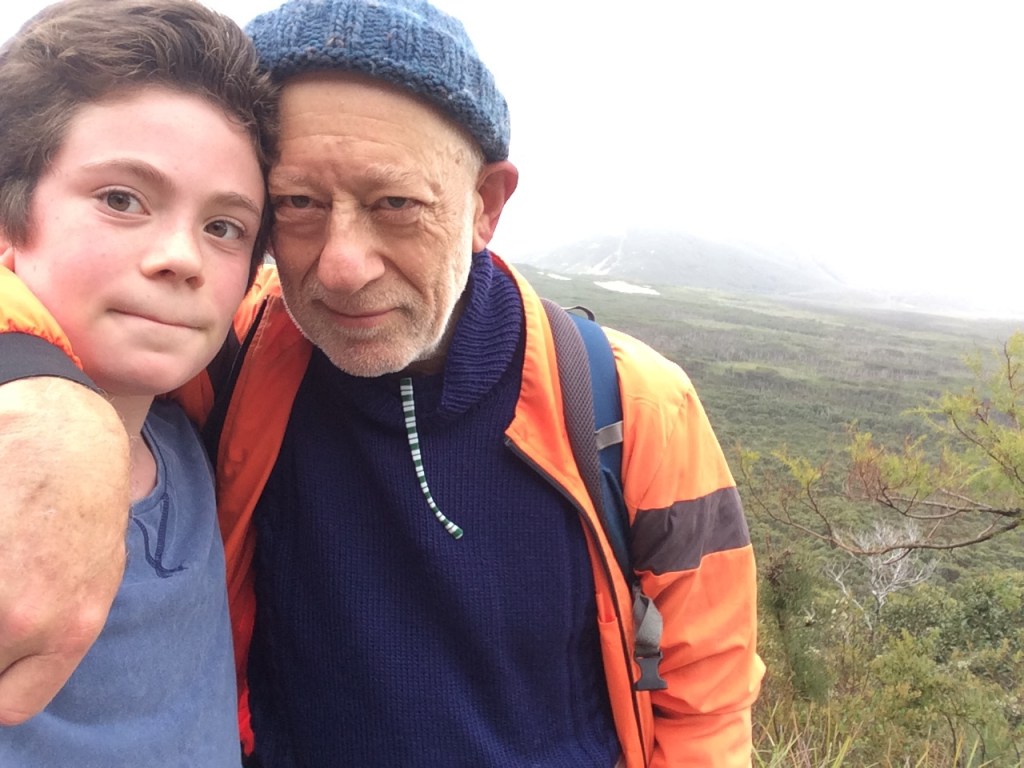
Life takes you through ups and downs. At eleven you walk with me, up, down, up and again down, to a distant lighthouse. A boy who buries strong feelings, you struggle and you achieve. You declare, I love you Saba. Later you say, I’ll bring my kids on this walk. And you add, I love you Saba.

Six years later, life is still up and down. We do that same walk again. This time it is the boy who stops and waits, and allows an aging Saba to catch up. Your words are few but they have not changed. The miles, the steeps, the struggle weld us once again.

This week you sit your last school examination. Your schooldays are behind you. We behold you, the first of your generation. Eighteen years have passed, enriched and intensified by your being. Eighteen years ago you gripped me, never to let me go.

A River Flows Through

A river flows through my childhood. I dwelt in that particular suburb of heaven which is a country boyhood. When I was nine-and-a-half years of age I was kidnapped by my parents and brought to a city where I have sojourned for 65 years. Very quickly I learned to embrace my new home. Over time I have learned to forgive Melbourne for not being Leeton.
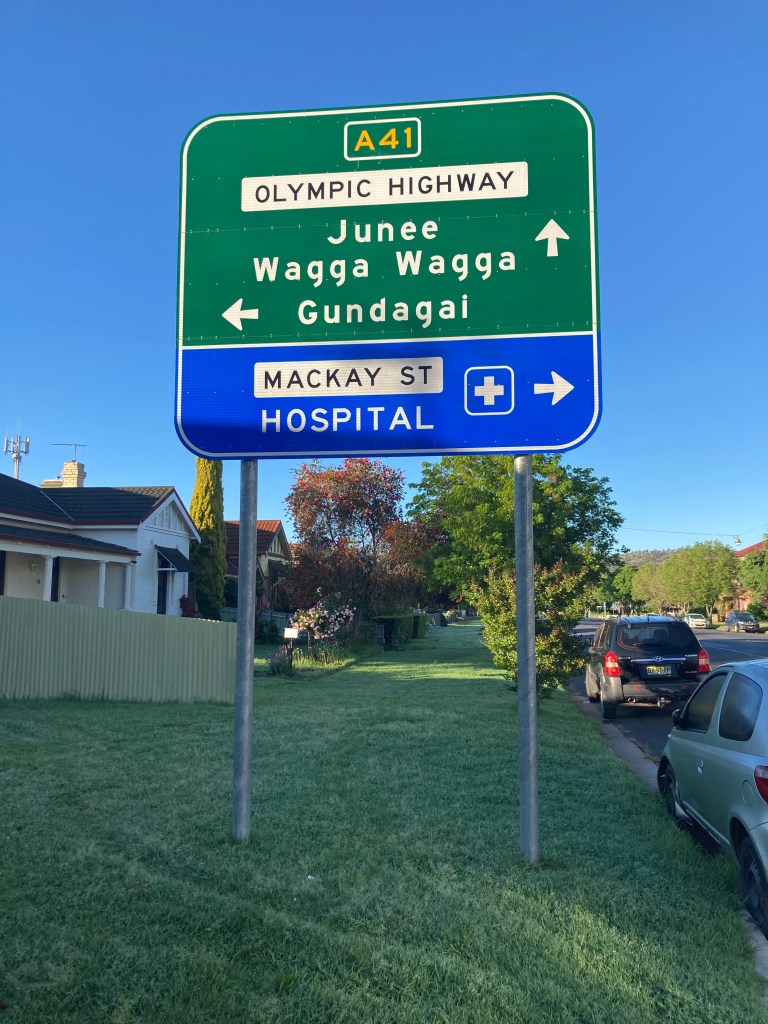
Every so seldom work calls me back to that riverine land. For the past three weeks I’ve been working in the blessed town of Cootamundra. Wide streets, unhurried citizens, verdant gardens, wide skies, a community without traffic lights, have nourished and refreshed me these three weeks. Road signs direct the motorist to nearby downs: this way to Tumut; close by is the drowned township of Talbingo; only two and a bit hours to Albury, where abides my oldest friend; down the road is Gundagai; turn right for Junee, railway junction to the entire state. Leeton (Leeton!) is not far; and down that road lies Wagga Wagga Wagga, so great they named it thrice.

The river flows through these parts. Its strong current could seize a body and drown it. It seizes me still and flings me backwards. Nostalgia is the practice of rejoicing in grief. It’s probably a malignant habit. But it reflects a truth, the truth of country, of homeland, a truth known to every territorial animal, including the human.

Sitting in my surgery I meet old farmers of a third or fourth generation on this land. Their attachment to country runs deeply, deep in struggle, deep in memory of drought and flood, in struggle to sustain family and to flourish. Their love runs deeper than mine, which is of the surface. Theirs is rooted in the earth. In Malaya they have a word for it:  bumi putra – sons of the soil.   

Wars have been fought here over territory. The professor of law who sits in my surgery tells me the local Wiradjuri fought the tribe that gave Canberra its name. The same professor declares, of course epidemics killed most Aboriginal people. The settlers spread them intentionally. They gave blankets to the indigenous, smearing them first with smallpox.Incredulous, I ask for proof.I can’t prove it. It’s part of Aboriginal narrative. Marcia Langton quotes it. Other historians too.


Drinking my morning coffee at Dusty Road Coffee Roasters I fall into conversation with a tall, pear-shaped woman of about fifty. She tells me she teaches in schools for the Red Cross.Do you teach the kids First Aid?No, cultural diversity. In particular, to accept and welcome migrants of all colours, from all places.Can you teach kids not to be racist?Yes, that’s not too hard. You can’t teach adults, though.I digest this for a while. The woman speaks again: Cootamundra Girls’ School was created to train stolen girls to be domestic servants. They were stealing girls as late as 1970. None of the girls came from this district. They were brought here as aliens. The old girls held a reunion here recently.The occasion brought together old friends, survivors together of loneliness, of seizure from country. On pain of physical punishment those girls were forbidden to speak in language. Coming together with old friends was somehow joyous.I ask our informant how long she’s lived in Cootamundra. This isn’t my country. My father’s people are Gunditjmara from near Warrnambool. My mother’s mother came from the Netherlands.The woman leaves us to go to her work, making non-racists.

The professor takes me to see the old girls’ school. It sits near the middle of town, a vast nondescript brick edifice on spacious grounds. Insignia on a placard inform us that a Cadet Corps uses the property. No sign of indigenous occupancy, no word or name to be seen , no-one would dream this is Wiradjuri country. The professor speaks: Many Indigenous people stay away from Cootamundra. Folk memory of this school is unbearable to them.I look around for signs of First People. Nothing here, nothing anywhere I’ve been these past seventeen days. I’ve run main roads and side roads, run to the cemetery, past the churches, past the handsome two-story buildings that house the banks, past the hospital, past the imposing old railway station, past the Council Chambers. I’ve lived across the street from the old Masonic TempIe. This is a town which honours its pioneer past. It honours the birthplace of Donald Bradman and preserves the little house that was his natal hospital. I haven’t noticed an Aboriginal Medical Centre, nor a Cultural Centre.

Until now I didn’t even notice the silence or the absence. So easy, so very easy, not to see, not to know, not to look or ask.

And this is Naidoc Week. 

The river that flows through my childhood flows also through the entire time of European settlement. Those times are the recent shallows. The river we all claim, the river that claims us flows through all time and song and dance and story.

Curfew Tales: The Story of Mister Jones Chapter IV

Winter in Melbourne. The sun observes the curfew longer than we humans do. It stays in bed and rises late if it rises at all. Today the sun sleeps in. The wind blows, the rain falls and two figures run through the dark and the wet, down to the wet and dark of the Bay. As we run, Toby sings his morning song:

Nice and freezing

Nice and freezing 

Nice and freezing

He sings these lyrics to the initial bars of ‘Shortening Bread’.

Toby sings the lyrics with the sincerity of one who is underdressed for the weather. It falls to me to state the obvious: ‘It’s raining, Toby.’

‘Nice and freezing

Nice and freez…

The rain reminds me: ‘In Papua it rains every day, Toby. I hope Mr Jones is keeping dry. I hope he’s well… I hope he’s alive.’

‘Saba, that newspaper report from Leeton about Mr Jones’ daughter Amelia Bodelia – do you think it’s true? I mean can a person’s heart really burst with love? Can they die of it?’

‘Toby, doctors now know that grief or shock can kill. There are cases where a person who never had heart disease before received sad news then suffered a heart attack and died. Maybe something like that killed Amelia B.’

‘Saba, when Amelia Nee died, our chances of contacting Noel Henry Jones died with her.’ 

‘I’ve been hoping that newspaper message was mistake, hoping she might be moribund, or just stunned. I’ve been checking my emails. Nothing. Poor Ameila must be really truly dead.

Toby speeds up and leaves me behind. For a while he runs alone. It’s hard to tell in the rain and the dark, but I think I heard tears in Toby’s voice when he said our chances died with her. After a while Toby slows down and allows me to catch up. Together we shiver home companionably. Once inside I find myself at the computer. Where is Mister Jones? How will I find him? I open my emails. There’s lots of SPAM but there is no information.

The snail mail arrives. Lots of letters, addressed to me by machines. Toby envies me for the many letters I receive daily: ‘In a whole year I hardly get any. What’s that letter you’re reading Saba?’

‘The lost dogs’ home wants a donation, Toby.’

‘Saba, if the dogs are lost, the home doesn’t need donations!’

‘Good point, Toby.’

There’s a letter advertising pizza and a flyer for a new gym.

The next letter is the Gas Bill.

‘Saba, can I open one and read it to you?’

‘OK, Toby. Golly, what do you think of my gas bill, Toby?’

Toby does not reply. He’s engrossed in a letter. I glance at the envelope, addressed not by a machine but by a human with shaky handwriting. The address reads:

dR hOWARD jONATHAN gOLDENBERG

formerly of Leeton

now in Melbourne

The handwriting is really hard to read, but there’s something familiar about the ink. My memory stirs. Long ago, when I was just a kid, younger than Toby, I once used a pen with ink like that. I’m pretty sure I know that ink. I do recognise it. It’s Parker Pen ink. 

I look at the back of the envelope. I read: Sender’s Address: MANUS ISLAND. Isn’t that in Papua New Guinea? What does all this mean – familiar ink, familiar address?

Meanwhile Toby holds the scrap of paper in the air, he’s squinting, concentrating hard, his forehead wrinkly as a dartos muscle in winter. He mutters, ‘I can hardly read any of this writing, just a few words: Leeton, carrot…Amelia.

Saba! – he exclaims.

I hand the envelope to Toby and he passes me the letter. We speak simultaneously: look at that! I hold the scrap of notepaper and I read.

At that same moment I recalled the true owner of the Parker pen. I jump to my feet and shout, Toby!

‘Toby, we’ve found him. ‘He found us actually. But I don’t think we’ll ever see him. He says all his cannibal tribesmen have died.’ 

‘How come, Saba?’

‘Old age, perhaps. Maybe COVID 19.’

‘Saba, I saw on the National Geographic Channel there’s an etiquette among cannibals. At times of famine – that means there’s no humans to eat – the elders offer themselves to be eaten by the youngers. Until there are only two left.’

‘Well, Toby, Mister Jones wrote he thinks he’ll die soon.’

Toby grabs the letter and peers at it hard. He shakes his head. ‘I can’t read this spidery writing, Saba. Mister Jones can’t die! We have to contact him.’

‘Toby, darling. Everyone dies. Old people understand they can die at any time. Old people reach an age when they know they have lived their life and their time is near to leave it. Often the person who dies is not sad; as death comes closer it’s the people who love the old person who feel frightened. And afterwards they feel sadness and emptiness.’

‘But Saba, not Mister Jones. Not yet. What about grace?’

The boy throws his arms around me and holds me hard. Who is he comforting – me, or himself?

‘Toby, you’ve put your finger on my question. Grace is my problem, not Mr Jones’. He’s at peace. I’m the one with unfinished business. Somehow Noel Henry Jones, that kind and gentle man, seems to remember me kindly. He says he had a daughter, Amelia Bodelia; he never had a boy, but I was like a son! He doesn’t even mention my pen pinching. I don’t know whether he ever forgave that. And now I’m afraid I’ll never know.’

Time passes. COVID crowds our days, curfew squeezes our nights, danger lurks, darkness reigns. In my dreams I walk from Number 10 Wade Avenue in Leeton, past the Fire Brigade, past the Library, past Major Dooley Park. My legs take me around a corner and there, before me is Leeton Public Primary School. Night after night the streets of Leeton open before me, I walk towards the school but before I arrive, I awaken. The school is there, waiting. Time after time Mr Jones’ classroom stands open before me, but I never enter.

Weeks later, the sun appears. One morning Toby and I return in sunlight from an early morning run. I open my emails, hoping for news. Nothing. Just a message from Australia Post to expect some delivery. Probably the masks that I ordered.

A knock at the door. Toby answers and brings in a very small package, too small for the masks we’re waiting for. I’m curious. Toby says he wants to open the package. I let him. This is what we see:

I take the pen in my hand. Through tears I read the words engraved there: Noel Henry Jones.