Aunty Pearly’s Sorry Business

I think many families have an aunty who is not really an aunt. That sort of aunt, usually a contemporary of a parent, is a person treasured across generations. You inherit that sort of aunty.

For many of my Jewish school friends in the fifties and sixties that was the only sort of aunt and uncle they knew: their parents’ blood siblings had perished in the gas chambers. Afterwards, close contemporaries were clutched and held closer, people who shared the stories and the memories.

The auntness of Pearly wasn’t woven of that tragic weft. Pearly was the sister of the wife of my father’s brother Abe. The earliest encounter I recall with Aunty Pearly occurred on a winter’s evening at the start of half a year of exile from my home and family. My older brother Dennis and I were to board with Aunty Clare and Uncle Abe in Melbourne, while Dad sold his medical practice in Leeton, our hometown. Transactions of that type take a long time.

The evening was erev shabbat, Sabbath eve, that fulcrum in the week that still finds me emotionally suggestible. The sun set and sank, and with it my mood.

While I enjoyed a period of self-pity – always the sincerest of emotions – our cousins Ruth and Carmel spoke elatedly: “Aunty Pearly’s coming for Shabbat. She always gives us a whole Vanilla Nougat or a Cherry Ripe. Each!

I didn’t know Aunty Pearly. She wouldn’t know me. Vanilla and Cherry and Pearly would be strangers to me. My sincerity deepened.


A knock at the door, a scamper of cousins, gleeful ‘thank you’s, and a deepish womanly voice called: “Where’s Dennis? Where’s Howard?”

Down the short hallway the voice approached, a bulky figure loomed, a smell of perfume, a slash of lipstick, and we were hoisted, one after the other, up into the soft valley between two mountainous breasts. Pearly handed me a Violet Crumble Bar. To Dennis she gave a Vanilla Nougat.

Somehow this stranger knew me, liked me, perhaps even loved me. In that instant I loved Aunty Pearly and the feeling never changed.


When Pearly’s real nephew – a blood nephew – called me early on a Sunday morning sixty years later, his slow agricultural voice had slowed further. “Aunty Pearly just passed away. The funeral will be tomorrow.” The day of Pearly’s passing was filled with celebrations at far ends of a widening clan: there was a Barmitzvah to attend of the grandson of my wife’s cousin and the wedding of the son of my first cousin. Such mixing of significant life moments!


Next day a wintry afternoon found us in a garden burial ground. In this light the grass took on a deeper shade. Black clothing against the green brought a sombre richness.

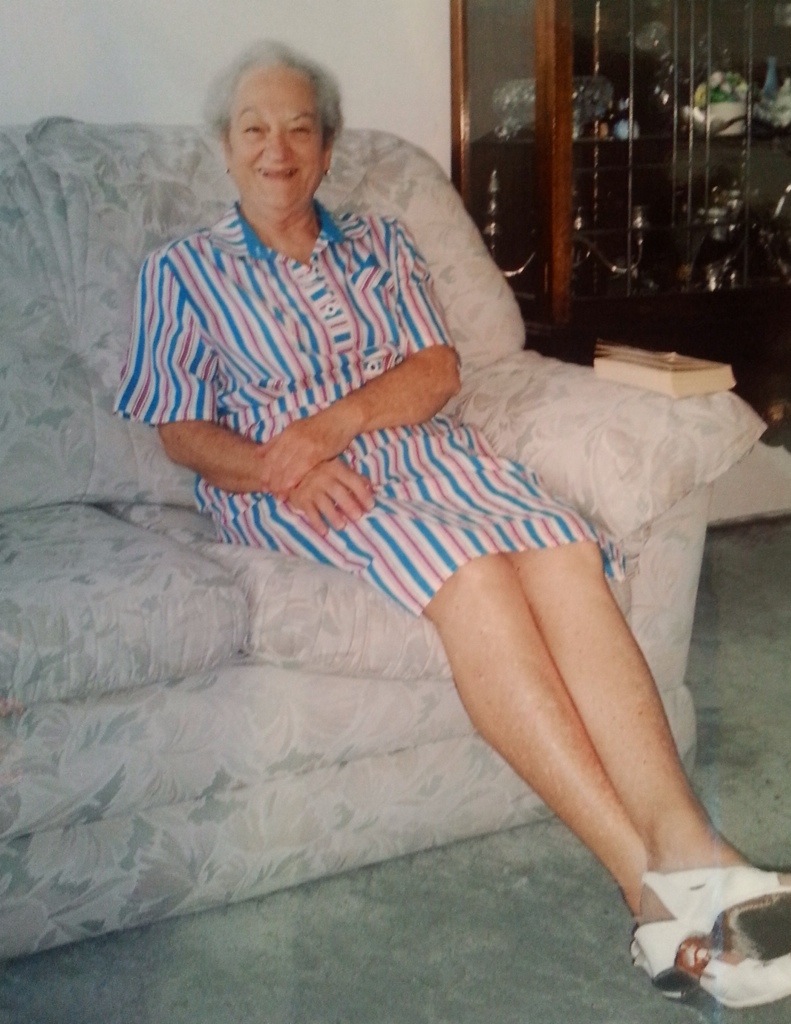
A crowd, many, many scores of people, gathered. Although some of the names eluded us we all knew each other’s faces from generations of family events. This was a gathering of the many from the fringes of a number of intermarrying clans. Pearlie was one of seven siblings. All of her siblings married and multiplied. Pearlie alone never married: she’d smile and call herself an unclaimed treasure. She treasured her siblings’ children and grandchildren, and their spouses, a growing multitude. But there were non-bloods there as well, numerous as her true kin. Pearlie gathered the young in her wake and we followed her, long after our own youth had gone, to her end. Everywhere eyes shone while mouths smiled, people cradled each other, faces looked serious but not in grief; for aunty Pearly died at the right time – before her dementia could ruin her, her slow cancer suddenly accelerated and she was gone.


Aunty Pearlie led a religious life. Her sacred places were the MCG and the Melbourne Synagogue. She never wavered from the worship of her idols at the Melbourne Football Club. But today it was the curate from her synagogue who led the ceremonies. It was a sweet moment when the young man – no relation to Pearlie or to anyone present – called her “Aunty Pearlie” as we all had. He was another honorary nephew, full of affectionate personal reminiscence. Pearlie’s life of faith ensured she would not be buried by a stranger.


In Aboriginal communities a burial takes place after indeterminate delay long enough for families to scrape the money together for a funeral. Then follows a further chapter of mourning where people gather from across a life history, from across a continent, for the Sorry Business.

Jews are buried with all decent haste. Then our own Sorry Business follows, the precisely calibrated period of shiva when first degree relatives sit low to the floor and receive condolence from their community. But Aunty Pearlie had neither spouse nor children to sit in her honour. Instead we gathered the next two evenings for successive memorial services at her synagogue. Same crowd as at the garden funeral, swollen now, and at a different venue. The Melbourne Synagogue is grand, cavernous, dripping with history, but too often attended by too few. A beautiful shell, the Shule waited for throngs that rarely came. But Aunty Pearlie came, Shabbat after Shabbat, at festival times, at all seasons. Over nearly seven decades she befriended each new rabbi, kept him company in his inevitable disillusion, saw him leave and welcomed and supported his highhoping successor. In this manner Aunty Pearlie outlasted seven Rabbis.


In the course of the Sorry Business I learned more of Pearlie’s growing up in Brisbane, of her service in WWII, of her friendships there with many women and men including a young Zelman Cowen. Pearlie seems to have won and kept many devoted friends.


Poignantly, one who resided so deeply in so many affectionate bosoms left no son to recite the mourning prayer Kaddish for her. Anxiously, I waited to see who might step forward and assume the mantle of the sons who never were. An aged brother in law, still erect, together with his not young son, and a couple of his not young cousins, all recited it together. One or two, more fluent in the Aramaic, led the others as they hobbled and stumbled in and out of time with each other. The four men freighted the feeling and the yearning of us hundreds, all of Aunty Pearly’s “young ones”, all of us wanting hard for her to be sung and storied, lamented and remembered, celebrated in this her holy place. Hundreds of us, all with our personal memories of some moment like mine with a Violet Crumble Bar when I was a child missing a mother’s love.
 

20140616-064031-24031367.jpg

Budget 2014

As a family doctor I’ve been thinking about the co-payment to be made for bulk-billed visits to the GP. It has taken me weeks to come to some sort of appreciation of what is going on. A surprisingly long time, really given that I have average intelligence and a keen direct interest. Let me tell you what I have discovered – three things.

The first is no-one has a very clear idea of how the system will work. Will it work like the GST where the provider of the service acts as the government’s tax collector? Will the literally penniless who attend a GP be seen and treated, or must the GP send that person to a public hospital? Or will we be permitted (thanks Messrs Abbott and Hockey) to treat that person gratis? WHAT IS CLEAR HERE IS OBSCURITY. OBSCURITY FATHERS CONFUSION, WHOSE OFFSPRING IS ANXIETY. THE POOR WILL GET SICKER.

I work both in middle class clinics where we bill patients privately and in outback Aboriginal communities where bulkbilling is universal and absolutely and literally lifesaving. Privately billed patients will hardly blink. Aboriginal patients will revert to the traditional healer. If you aren’t appalled at this thought please consider the case of your own child, 500 kilometres from a hospital, feverish, endangered, and effectively unattended. Dickens wrote of this plight in the London of his day. Messrs Hockley, Abbott – go bush, sit down, listen and reconsider!

Finally, I gather the bulkbilled will enjoy a safety net. After ten co-payments, the system bulk-bills them again, free of charge. Ten times seven equals seventy, equals 1 and a smidgeon dollars a week, equals less the cost of one icy pole every five days. Where’s the gain? The gain is derisory: that means BUGGER ALL help to the bottom line. The gain comes at the cost of derision. Messrs A and H hold us in derision. Where’s the pain? The pain is in the deterrence. Don’t go the doctor if you are poor. It’s not government policy. Where’s your mateship? Your citizenship? Your sense of responsibility? The age of entitlement is over. Get real. Get rational. Harden the f-up.

I know how hard hard can get. That condition is called rigor mortis.

The Elephant not in the Room

A roomful of people in the dusk of the inaugural Melbourne Jewish Writers Festival, expectant, keen to hear and discuss “Carrots and Jaffas”. I anticipated we’d be fewer. I should have known Emily Lubitz (from Tin Pan Orange) and Martin Flanagan (journalist) would attract people. But Emily sent a series of text messages.

2300 last night: “Howie, we might need a rain check. My waters just broke. I’ll see the doc before tomorrow’s gig. Am keeping my legs crossed.”

1100 today: “Howie, I’m in hospital but not contracting. I asked the doc can I duck out for a couple of hours. She looked at me as if I was crazy. Still hoping I’ll be the elephant in the room.”

1300 today: “I’m contracting. If it’s a redheaded boy we’ll call him Jaffas or Carrots.”

So, no Emily.

Martin Flanagan, journalist, novelist, anthropophile, led a conversation about the book, about my choice to turn from serious non-fiction to the novel, about stolen children – the ultimate wound, about twinness, about the problems and pitfalls of the whitefella writing about blackfellas.

An audience of committed, highly informed and compassionate people engaged us in a conversation about the interfaces between Australia’s first peoples and later comers. They explored the curious and recurrent engagement of blackfellas in Jewish affairs that started with William Cooper, and the reciprocal engagement by Jews in Aboriginal advancement.

Martin and our audience created an atmosphere of the most distinctive quality. Humans and their stories, people and their dreams, the mystery and the sanctity of the Dreaming, the heritage that is memory, the sacrament that is storytelling – all these were raised up and seen at their height.

We went home fulfilled.

20140602-210544-75944388.jpg

Wilson’s Promontory

Wilson’s Promontory – where the Australian mainland gropes south towards Tasmania and the Pole.
Wilson’s Promontory – in whitefella parlance, “The Prom”; to blackfellas, “Wamoom” – a place too special to live in, reserved for ceremony.
The Prom – a place sacred to whitefellas who do not reside there, vacation nomads.
Wilson’s Prom – where generations come and keep coming, where they need ballots to winnow the applicants; we who apply – we are the grass.
Wilson’s Prom – where four generations of my family have wintered and summered, most of them beyond remembering.

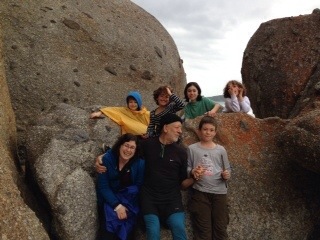
Some of my family spent this (prolonged) weekend at the Prom, both saplings and old growths, across the generations and down: two grandparents, their niece from Boston, her two children, the three children of our firstborn – all of us in that heightened state of aesthetic rapture as rugged mountains meet a moody sea.

We hiked and climbed great rocks, we jumped from them onto sand that squeaked, fell from them and upon them. We collected water from a mountain spring, we crossed small rivers and we peed into them, we ate and we ate, we read stories from the Jungle Book, we played chess and Scrabble and board games.
Screens were eclipsed.

Five young children from two different continents, different lives, met and blent, and were Australian in the special way that occurs ‘in country.’

Ten years ago, I wrote a poem here, memorialising a whale and my father, then one year gone.

WHALE MOURNING AT WAMOOM.

My father walked these hills and steeps;
Woke early ever, walked rugged rock-strewn track
To the lookout and back. Now he sleeps
Forever; and I rise with the sun
On this second day of this last new moon
Of the dying year,
And sound the shofar, the ram’s horn warning,
Then go for a run on a crystal morning.

My father walked till his dying year; I follow his track
Across the bridge,
Then up the hill and over a ridge –
Then back; pausing to view a sapphire sea.

High here, on air, at Wamoom, this southern
End of a continent,
Comes remembrance, a fifth element.
Midst earth and water I stand, content,
Basking in the gentle fire of an early sun,
Then turn
To start the slog and gasp and sweat – up hills
And tracks on the ridge of the returning run.

‘Stop!’ – cries the voice of my companion –
‘And turn!
And look out to sea, and see – there’s a whale!’
I stop and turn and look – and sight the sail-
Shaped fin, the hump of back, the mammalian
Brown-black, a bruise
On the blue face of the sea. Now it sinks again
And as I smile, give thanks and muse
It surfaces and plays, and sprays its spume
At the end of the dying year.

Another whale was here, beached, dead; while with my father
A decade ago, I saw it. We paid homage at its sandy tomb.

(from ‘My Father’s Compass’, Howard Goldenberg, Hybrid, 2007.)

20140525-185107-67867946.jpg

20140525-185655-68215464.jpg

Tracks

Tracks

Tracks

Tiny cinema. Although the tickets are numbered, you can sit where you like, the audience is so sparse.
Opening images of a waif, a child in a yellow dress, walking. You see her from behind as she walks before you. The camera – and your eyes – follow her tracks.
The remainder of the slow movie is much the same: the waif, now of adult years, walks and the watcher follows her tracks. “Tracks” is the name of the movie and the name of Robyn Davidson’s book that preceded it by some decades.

The adult waif informs unbelieving Centralians, “I am going to walk to the ocean.” She speaks with an affect of subdued dourness. There is a tinge of defiance in anticipation of skepticism. The character is defensive, often enough sour. A person alone, she imagines she is independent of approval, of fellowship. Halfway from Alice to the WA coast she discovers, suddenly, violently, her human need. She practically rapes her astonished companion, the awkward photographer whose incursions into her aloneness she resents and finally accepts. Clumsy in his American optimism and belief and cheer, he saves her life by dropping jerry cans of water ahead on her route.

The movie has little dialogue. The silence speaks, the emptiness of the continent speaks. Motifs recur – sand as the tabula rasa of existence, fire as companion, water as vivifier. And the land, “country” in the language of her Aboriginal friends ( she makes a few friends, all of whom exist on the uttermost edges of Australian society. In the unexpected sweetness of the waif’s friends the movie approaches caricature. The traces of sentimentality are forgiven, offset as they are by the central character’s acerbity.)
The land, on the other hand, is eloquent and true. No matter how dramatic the image of hill, of shimmering emptiness, of spinifex, of purpling distant ridges, those images are true. The land – tracked in this way only by Davidson, the lost Leichhardt and Aborigines – is immutably itself.

This viewer, watching Davidson’s traverse, felt the flood of deep knowing, of coming home.
This land is the home of us whitefellas, a home known uniquely to relatively few, characters like Davidson, like Rod Moss, (artist and author of “The Hard Light of Day” and “One Thousand Cuts”). Their knowing is informed by the blackfellas who have shown them their home.

If you’ve missed this movie, don’t worry. Here for five minutes, gone tomorrow, I think it will never disappear. Like Davidson’s book the movie will be sought and valued so long as whitefellas are curious about the land, so long as we ponder our human aloneness.

Reconsider Phillip

The morning finds Phillip’s bed empty. No-one has discharged him, no-one has removed the intravenous bung from his arm. The plastic bottle of saline hangs from its pole, its tubing droops into air. Phillip’s just gone.


At mid-morning a call comes from the nearby general practice: “One of your patients turned up here with a bandaged arm; would we change his dressing? We found an IV bung. We figured he came from the hospital.”


Two days later a young woman wanders into the hospital. She shows the back of her right hand, swollen and deformed.

“What happened?”

A full-cheeked face, a crooked smile. A palm-upwards gesture from the opposite hand: You know how these things are. Just a swollen hand…

She offers no words.

“When did it happen?”

A shrug.

We won’t have X-ray until Monday. She turns to go, her walk crooked like her smile. A fruity aroma hangs in the air.


On Monday the X-ray shows a fractured metacarpal, classic fracture of the biff.  We ask again: “How did it happen?”

Her shrug, her smile convey confession and self–forgiveness.

She points in the direction of her companion, who volunteers: I made her wild.

She is so young, at least in years. Her face, even younger in its innocence, looks older in damage.

A pang of regret for that damage prompts a candid question. “Do you think your drinking is doing you harm?”

Her companion is a slim young man with a meandering black beard. He replies before she finishes the familiar smiling that she substitutes for words: It’s doing both of us harm!

That face, that beard, I know them: the man’s sobriety and his gaiety confused me. The speaker is Phillip.

Consider Phillip

Consider Phillip. He lies in his hospital bed, a person unknown. Deep in the stupefaction of alcohol he lies as one asleep. Possibly he is asleep.

I stand silently and watch Phillip and I consider him.

The police were alarmed when he vomited violently in their lockup. They called the ambulance that brought him to my one-doctor hospital. The nurses, veterans in the management of all forms of intoxication, called me, troubled by his scatterings of impulse, his wildly fluctuating state of mind and mindlessness.


I arrive to find a thin man of twenty-five lying on his side, inert. His body has curled into the position of a foetus in a textbook. Phillip’s narrow face, tapering downwards to a thin chin and a Ho Chi Minh beard, buries itself in a pillow. His eyes are closed.

I address him: “Phillip.”

No answer.

“Phillip. Phillip!”

Not a flicker.

“Phillip, I’m the doctor. I’ve come to help you…Phillip!”


Only minutes before my arrival the nurses found Phillip conscious and verbal. One moment he was weeping for the death earlier in the day of an aunty in his hometown on a nearby island; the next he was wolfing the sardine sandwiches the nurses prepared for him.

Now he is immobile, unhearing, a narrow form, a closed face, a straggle of black beard.


In these parts the death of “an aunty” can signify unbearable loss. And the access to alcohol can trigger irresistible impulse to harm.

I stand and consider Phillip.

Do I leave him lie – the chicken option? Or stir him up, revisit loss, possibly unleash the grog-drugged demons?

“Phillip, show me your tongue.”

Eyelids flicker, the eyes open. A mute question on a busy face: What – show my tongue?

“Phillip, I am the doctor. Please show me your tongue.”

Lips part, a pink lizard shows itself and retreats. Now it crawls from its dark cave and rests, clean, a healthy pink. But dry.

Phillip’s chart records a low blood pressure reading. Less than 100/60, it might betoken the relaxant action of alcohol on blood vessels. Equally such a reading might simply reflect his norm, his youthful good health. He’s a stranger here. We don’t know his normal BP. And it matters.

Abruptly Phillip sits up in bed. A pillow goes flying, bedclothes are flung aside. Phillip’s scrawny arm reaches behind his back, deep into his undies. He scratches furiously. He looks around. A wildness in his movements. He lies down and begins to whimper. He buries his head in the crook of an arm and weeps now, regular little bleating sounds, a child giving way to grief. Before I arrived, the nurses tell me, Phillip squatted on the floor, folded his head in to his torso, his body a concertina; at the same time he drew his arms against his chest and his fingers into the attitude of prayer – the nurses were taken by the strange gracefulness of his fingers – and he began to cry.

This second weeping exhausts itself. Quietness falls in the darkened room.

Without warning Phillip’s fingers race around his belly, scratching in a frenzy. Now they plunge to his undies and pull them down, exposing a circumcised member. Meanwhile my own hands yank bedclothes upwards to restore what? – dignity? – modesty? For the exhibition is so insistent, so obscure, so confusing, I feel alarmed and I am sure my alarm is for the women around me, anxiety occasioned by the actions of the thin man in the bed, actions quicker than thought, movements without reason or purpose. As the bedclothes jump and subside before me I am reminded of the inscrutable movements of the unborn. And indeed there is much that is infantine about Phillip, his way of looking at and into the attending nurse or at me, his helplessness, his mute, unknowing enquiry, his submission to tenderness.


I decide on an intravenous saline infusion to rehydrate Phillip, to wash out the grog and to lift his BP. And not incidentally, to provide immediate access to a vein in case of urgent need. I am thinking of sedation that might short-circuit a fatal impulse. On the other hand, sedation can further lower a low pressure and depress grogged breathing.

First I have to sell the deal. Phillip is (still) a voluntary patient of whom involuntary treatment would be assault.

“Phillip, we’re going to give your body a drink. We’re going to put a needle in your vein so we can make you feel better.”

The busy face, thinking what?

“We’ll put a needle in here.”
Phillip looks at the finger I have placed on his arm vein as at  something mystic.

Nurses bring the gear for a drip. The nurses who are due to go off duty do not go. Every able bodied person in the hospital gathers around Phillip. No-one has expressed it but all of us feel anything might happen.

The sharp trochar pricks Phillip’s cubital skin. Beneath my sentinel palm that rests gently on his shoulder I feel his muscles bunch. Now his hand flies up towards the face of the cannulating nurse. Her face tightens and darkens, her voice finds steel: Don’t. You. Think. Of It.

A moment that freezes. Ten eyes stare, Phillip subsides, we breathe out.

“Midazolam, 2.5 milligrams, now!” My command is a whispered shout. Moments later Phillip is sedated, leaving nurses and doctor unsedately measuring blood pressure and monitoring respirations.


Two hours later the nurse in command calls me, apologising needlessly: “Phillip is agitated again, should we repeat the sedation?”

“Should we? We have to!”

Incidentally the nurse’s midnight enquiries to the clinic on Phillip’s island confirm that his BP is always low. The pressure of a healthy child.


Sleep will not come. The eye in memory sees a teenager, crazed, sad, helpless, feeling everything, understanding nothing, terrified of the feelings that clamour and hammer in his head.

At length a question crystallizes and brings me back to Phillip’s bedside. We two are alone in his dark room. His eyes are open, his body at rest. Before I can pose my question Phillip has one of his own. He gazes at the inside of his elbow. He fingers the bandage that holds his cannula inside the vein. The white bandage is bright in the gloom. “What if I pull all this out?” His finger explores dangerously, his voice asks innocently. I beg Phillip not to touch the tubes, not to disturb the bandage. “We want to help you Phillip.”

Now for my question: “Phillip, what else have you had today – apart from the beer?” There has to be something else. I don’t see this behavior with grog alone. And more than that, Phillip stays beneath the roof a special house in this community. It is the house of an older white man. A white man with many younger black visitors and residents. A nurse at the hospital says: “We treat a great deal of sexually transmitted disease among the young residents of that house, and too many drug-taking people.”


Artlessly Phillip gives answer: “I smoked ganja today doctor. You know, dope.” He looks to me, that look he has, free and clear of adult care, of consequence. He looks to me, the grownup. Aunty has passed: it is for me to know, for me to be a parent.


Copyright, Howard Goldenberg, 27 February, 2014.


Mouth to mouth

Once a year your accredited family doctor undergoes retraining in CPR. Commanded to forget previous models she learns the latest tweak, he meets the newest gadget.

It’s pleasant, collegial, unreal.  They practise on a manikin. The plastic model lacks the saliva the pinking agonal froth. There are no dentures to yank out in a fret of haste, no sweat on the body that foretasted its death, no lips of purple grey in a face of grey.

My phone rang. It was a nurse in an outback hamlet no-one ever hears of. I know the nurse. I know her clinic.

“Howard? Thank goodness!”

A great indraft of air.

“There’s been a death. I have to report it.”

“What happened?”

“There was a fight. They’ve been rioting and fighting all week…” The nurse’s voice thinned and rose an octave. She gulped air.

“Someone raced into the clinic and called me out into the street. They said there was a man who was hit and fell and wouldn’t wake up. I looked down the street and I could see him, lying there. I ran and I asked what happened: a witness said he copped a glancing blow to the chin.  He said it wasn’t forceful.

I did CPR. I worked on him for a long while. I’m alone here. The only nurse. A copper helped me.

“Howard, I know him. It was Billy. He’s a lovely old man, gentle, you know. He was an old stockman. He always wore his old cowboy hat and his stockman’s boots. And now he’s dead!.

“Howard, we don’t have a morgue here. What do I do?”

I ran through the formalities, the bureaucracy of sudden death. There was a noise in the background, a moaning, wailing. Behind that, angry voices, shouting.

The nurse listened and took notes. Our conversation neared its end. Her work demanded and pressed but she didn’t seem ready to finish. She would be busy through the day with phone calls to the coroner, to the bush undertaker, and to the director of regional and remote nurses. There’d be the paperwork. And then she’d go home: home to her donger, the bedsitter that is really a shipping container; home to the memory of cold lips and the gentle fellow she liked and she couldn’t bring back.

“Howard, he’s lying here in the clinic. I checked him again in case I was wrong. But there’s no chest movement and I can’t hear a heartbeat. His pupils are dilated and they don’t react to the light. Is there anything else?”

There wasn’t anything else.

“Howard, Billy’s gone and now there’ll be Payback. He’s still wearing his hat and his boots.”

The Price of Life in Doomadgee

Just before noon the phone called me from the river to the hospital. The hospital held me until long past midnight.

A man with his jawbone fractured, pushed right out of alignment, said: “There was a fight. I was watching it and a man came up from behind, on my right side, and king-hit me.”

I called a plane to take Sampson to Mt Isa.

Eight thousand dollars.


A man came in and showed me his hand, puffed up, a boxing glove of soggy blood under the skin. Beneath the blood, the head of the metacarpal bone had snapped. I said: “You’ll need an operation. We’ll fly you to Mt. Isa.”

Eight thousand dollars.


On the TV Rafael Nadal struggled into night with back muscles in spasm. A chubby baby, feverish and short of breath, took me from the tennis. Over the previous day or two I had seen this baby at peace. He filled all who saw him with delight. Such abundant flesh, so well at home in grandmother’s embrace.

This was their third night visit in 48 hours. Grandma brought him in this time as previously. She nursed the weeping Buddha and comforted him. The rule in Aboriginal health says, “Three strikes and you’re in.”

I said, “He’ll have to go in. To Mt. Isa. You can go with him.”

“Grandmother said:” I can’t. I’ve got my own six-month old at home. I’m breast-feeding him.”

“What about his mum?”

“She doesn’t have him. I do.”

The letter from Child Protection said the same. So Aunty went.


Very late at night came an urgent call. The voice said: “A man has come in with a high temperature. He’s very old.”

The thermometer said: “39.9 degrees.”

That sort of fever says “sepsis.” In this man’s case his septicaemia arose as a complication of pneumonia.

I asked the man about symptoms. He shook his head. He had no complaints.

“What about pain?”

He said, “I think my head hurts.” He said it as if he was far from the pain. The pain was a sensation like memory; he had to summon it to name it.

The man sat bent forward, breathing quietly, speaking softly, his bushy moustache a permanent smile.

At his side sat a young woman. Her gaze never moved from the breathing old man.

I asked, “Is he your grandfather?”

She said, “Yes.”

“Will his wife come…?”

The young woman said, “No, just me. Me and my brothers.”

“He’ll need to go to Mt. Isa. Your grandfather is seriously ill.”

A sad shake of her head, She said: “I can’t go. My baby… My brother will go, one of my brothers, Ambrose.”

“How old is your Ambrose?”
“Eighteen.” Seeing the doubt on my face she said: “Ambrose will look after him 
properly. Us three – my brothers and me – we live with him, we look after him. We do everything.”


The old man’s vital signs went from worse to frightening. The sphygmomanometer said: “60/40”.

The Emergency Consultant at the Flying Doctor Base in Mt. Isa said, “The plane is on its way. Give him Adrenaline.”

We gave him adrenaline. We gave him three different intravenous antibiotics and a fourth, by mouth. Hunched forward, moving only zephyrs in and out of his chest, the old man breathed and the breath did not speak to my stethoscopic ears.

I said, “Please lie back if you can.”

He lay back, air moved in and out, the silver bush on his upper lip filled and emptied, emptied and filled, semaphoring life. The blood pressure machine said, “80/50…90/65…110/70”.

The young woman gave way to a brother. The brother, after a time, gave way to another. This was the eighteen year old, tall, thin, lightly muscled. His bearing was solemn.

The sound of an aircraft flying low overhead changed the tempo.

Quickly, quickly, gently, many hands helped the old man slide from the couch to the ambos’ trolley that he would ride to the vehicle and on to the airfield.

We pushed him towards the ambulance parked outside the front door. Lining the wall, gathering in numbers, gathering over the fretting hours of the old man’s time with us, waiting, standing quietly, were three daughters – themselves matrons – and men of all ages, boys, small kids supported on young hips and attached to slender breasts. Only minutes earlier the waiting room had been empty. All had stood outside in the dark and the heat. The chill of a hospital ward did not invite them.

All eyes now followed the old man. Hands reached for him. The ambos halted, the file flowed forward, a wave of silent care. I saw one woman, a daughter, her eyes swimming, her lips trembling. I stepped forward and said: “Your father has been desperately ill, but he seems to be turning the corner. He’s holding his own now.”

She said: ”He didn’t want to come to the hospital. He was scared. He thought you might fly him out to Mt. Isa. When they flew Mum out, she…” The voice, soft, husky, now faltered:“…Mum never came back.” 


I looked at the gathering and asked: “All these people – all his descendants?”

She said, “Yes, all his kids and his kids’ kids and their kids.

And there’ll be just as much family waiting for him in the hospital in town.”


The ambos took the old man away. The family melted away.


The senior nurse breathed out and said: “If I come to my final hours and I am surrounded by that much love, I will know I have lived a successful life.”


***


While the nurses tidied the Emergency Rooms, I wrote up my clinical notes. A nurse approached, apologetically. She said, “Would you mind? We have a lady here with a cut head. It might need stitching. It was a belt buckle.”

In ED an old lady sat. Seated opposite her, too long of limb to sit without sprawling, were two large men in navy blue with large guns at their hips.

I looked to the lady. She wore a patterned dress in black and white whorls. The bodice was splattered with red. Her head was a savannah of silver-black curls. I had to search for the laceration which was small and shallow. Blood had clotted in a thin line between the margins of skin. Nature had stopped the previously brisk bleeding.

There was not much to do, nothing medical.

I asked, “What happened.”

The nurse said: “Fifty dollars.”

The nurse shook her head. Was she angry? Disbelieving? Or simply busy with the wound?

She resumed: “Her husband demanded fifty dollars and when she didn’t hand it over he hit her with his belt buckle. Isn’t that right?”

The old lady spoke for the first time. She said, “Sixty.”

Unhappily, guardedly, I turned to the police officers and asked: “How can I be of help to you gentlemen?”

The taller one had blue eyes. His firm face softened. He said: “You can’t. We’re just waiting here until you’ve all finished, then we’ll drive her home. Don’t want an old lady to walk home alone. And it won’t be her home. We’ll take her somewhere else, somewhere safe.”