Howard is a doctor, marathon runner and author. He has written two non-fiction books, My Father’s Compass (2007) and Raft (2009). Carrots and Jaffas (2014) is his first novel. His latest novel is A Threefold Cord (Hybrid, 2107)
A gentle lady visited me in a bush hamlet. She was fifty and fair, softly spoken, with an air of sweet naivete.
Sighting my kippah she became excited. She asked, Do you have dreams, visions and prophecy? Almost apologetically, I said no, I didn’t.
In the days and weeks that followed I did have a dream. My Dad was suddenly, quietly present. In the dream I was aware Dad was dead. But here he was, standing at my shoulder, smiling. No words were spoken, none expected. This was a dream; in my dreams nothing is expected. Dad was just there. His gentle smile was a smile of sadness. I knew, as I always have known, that Dad loved me. His smile said that and more. The more was Dad’s sorrow for the world. He smiled in the understanding we shared, that I would have to live in this world of pain, that he had left, and had left to me.
Last night a vision came to me. Or perhaps the vision came as I sat in the early morning sunshine, looking out over the sea. It was a vision composed of words and phrases.
Joy to the world
The Lord is come.
Woe to the world
The Lord is hid.Joy to the world
A child is born.
Woe to the world
A child has died.
****
Blackbird singing in the dead of night Take these broken wings…
In that vision I was aware that words of hope should follow: and learn to fly…but hope eluded me.
*** I spoke to the rabbi and he said.
There is always hope.
The rabbi is not filled with a sweet naivete. He carries the burden of family, every one of his father’s kin, slaughtered in the Shoah. Yet the rabbi counselled hope. He argued for it. He commanded it.
The hand of the Lord was upon me…
And He set me in the midst of a valley;
It was full of bones:
Son of man, can these bones live? O Lord, Thou alone knowest.
***
The soft lady in the bush said: We believe in dreams and visions and prophecy. She spoke the words with the fluency of mantra, with the ordinarinessof a shopping list.
I wish I had the gift of prophecy. The Prophets always spoke of the worst:
I saw a great many bones on the floor of the valley.
And they spoke always of hope:
Prophesy, son of man, and say, Come from the four winds, O breath, and breathe into these slain, that they may live.
The man said to the woman, look how beautiful is the wide blue sea. The woman looked at the sea and saw what the man saw. She saw how the sea sparkled in the light of beginning. She saw its beauty and she knew this was what she wanted. She wanted to share it with the man. She felt something in her hand and when she looked she saw the man’s hand was holding hers. The two hands looked comfortable and strong together.
The woman said, yes, it’s very beautiful. It looks like it has no end.
The man said, we’ll need to build a boat. The man and the woman looked down and both saw how each hand held the other; how the hands were comfortable and strong together. The woman said, we can build this boat together and we can sail it together on this sea that has no end. And the man said, we’ll build our boat and we’ll care for it together and we’ll sail on the endless sea together and we’ll never stop.
The woman and the man understood it would take a long time to build a boat. They had long dreamed of the beautiful voyage that had no end. In their dreams their longing moved to their lips, and one murmured about the beautiful sea, and the other murmured about the voyage that has no ending, and the murmurs entered their sleeping ears and when they awoke they both knew they would build and sail together.
They knew too a boat must be safe and strong. They both knew that the beautiful sea could become fierce and dark and stormy. Their boat would have to be strong enough for great storms, for hot weather and for cold, for rain and for long dry times. Their boat would need high walls to keep out the sea, especially if children might come aboard.
The man and the woman worked hard and patiently. In childhood they had floated sticks in the rain that ran down the gutters into the great drains and they had pretended their sticks were sailing ships. But neither had never built a real boat before. They chose the good stout timbers of the kauri tree. They weathered the timbers and after one year the timbers were ready for shipbuilding. The man and the woman measured and sawed and glued and soon their timbers took the form of a boat. Then the man and the woman caulked the gaps between the timbers, and they daubed the inside with tar. Finally they painted the hull with marine varnish, and below the waterline they applied anti-fouling to stop barnacles from spoiling the stout kauri timbers.
The boat was ready to float. The man built a cabin to keep the sun and the rain and the wind from his crew; and the woman built bunks inside the cabin and a galley where food would be made for the crew.
The man and the woman slipped their boat into the water and they saw it floating and their faces shone like the sun that blazed upon the bright blue sea.
The final task was to create a crew. This took time and care. The crew arrived one at a time. They were very, very small. The woman placed each one gently onto a bunk that she had made. After a good many years the man and the woman had a full crew of small children, and the children knew no home other than their good safe boat and they grew there and became strong on the face of that shining sea. The woman looked at the crew, all hale and bronzed from the sun, and she said to the man, let’s set sail on our journey of no end.
The journey took them years. The children grew bigger and stronger. All of the children suffered falls and cuts and bruises and burned in the strong sun, but all of them healed. The man and the woman steered their boat away from storms and pirates, away from icebergs and reefs that might crash or tear their boat apart. Together the man and the woman and their crew visited islands and ports, from Mombasa to Saskatchewan. They saw volcanoes from Vesuvius to the great extinct Mount Erebus. They saw the great leviathan that leaped and blew, they loved the merry dolphins that escorted them, they knew the flying fishes and the jelly fishes, the octopus, the inky squid, the dignified seahorse. Their strong boat housed them and moved them and kept them afloat and the crew and the woman and the man knew their planet as they knew their boat, which was their world.
Sometimes a sudden tempest would arise. The children would cling to their bunks as the waves threw the craft high upon crests then plunged it deep into troughs, and the winds shrieked in the sheets and the rain fell in torrents that ran down the decking and into the sea. The children looked at the great waves of dark green and the foaming crests of white and their world was angry and unkind. Deep inside themselves they feared their boat would break and they’d all be lost. And they felt a mighty fear for the man and the woman who made their world and kept it afloat. The children wept but their cries could not be heard over the scream of the wind and the thunder of the skies. And the woman did not come and the man did not come and each child feared and cried and shivered alone.
And as suddenly as the squall arose it would subside. The sun shone upon a gleaming world and the terrified crew came up from below and joined the man and the woman who commanded their boat. And in that sunshine the world was at peace, the craft sailed on and the crew recovered.
In every storm the children knew those fears. And in every storm they understood the man and the woman could not comfort them. But luckily, after a few frightening storms the children found their own way to feel safe. The biggest child opened his eyes just as the boat climbed up, up, up a mighty wave then down, down, down the far side, and he saw the smaller crew weeping through closed eyes, and he sang to them. And as he sang the smaller ones heard snatches of sweet sound, a lullaby, and they opened their eyes and saw the singer was their big brother and they managed to smile. From that time, when storms came the crew would all climb onto the big bunk where the man and the woman slept, and they would hold each other and sing or hum and all knew they were not alone.
After every storm the children came out and looked anxiously at their boat, but the boat looked sound and the children mostly lost their fears. But the eldest child worried: how much violence, how many storms could the boat sustain and survive?
The storms came more often and they went on longer. The howling winds and the crashing seas were slower to make peace, and the children clung to each other and sang and hummed as they trembled and tried not to show their fear.
From time to time the man and the woman would steer the craft to a port and put in for repairs. And the boat’s invisible tears and strains and cracks and leaks were glued and tarred and caulked, the barnacles were sanded off the kauri and the hull repainted as before. And the boat seemed safe and strong. And the crew and the man and the woman continued their voyage.
One day the crew awoke to a frightful storm. They heard roaring and screaming. It was the voice of the wind that screamed and the voice of the sea and the thunder that roared. And the boat shook and the small crew members saw cracks opening between the timbers and water pouring in. The biggest little crew man grabbed a bucket and the smaller crew grabbed cups and bowls from the galley and all the small people filled their cups and bowls and bucket with the sea water and threw it over the side. Each of the crew filled and bailed and threw the waters away, each of them sensing they had to be the one who would save the boat. But it was no use: the waters came up through the floor boards and up to their ankles, then their knees. Now the woman came below and the man came with her and they told the crew what they already feared. Perhaps they already knew. Perhaps the sea waters had told the young crew that their beloved boat could no longer take them on their journey safely.
The woman spoke kindly and the man spoke gently. The man said, we will always protect you, and you will sail again in peaceful waters. The woman said, you will always be our crew even when we no longer sail this boat that was so beautiful. And as the two spoke gently and kindly, the children realised the screaming and the roaring had stopped. And the small ones thought, no, that’s not going to happen; this beautiful boat will be made better and we will all sail in it again. But the biggest crew child looked at the boards, all swollen and splintering, and he knew the boat would not sail again.
The boat did not sink straight away. The brave man and the sad woman steered it and sailed it to a safe place. The bow of the boat rested on dry land, and the man jumped ashore and the woman lifted the children from the broken boat and passed the crew, one by one, to the man who set them down on the shore. The smallest crew person wasn’t used to the feel of sand and grass underfoot, and started to cry. The other crew tried to comfort the smallest one, but they could not speak; their throats were full of a great ball of sadness, and when the man and the woman tried to cheer the sobbing child their throats blocked too. Suddenly all found voice and the voice they found was the voice of sadness and they wept together. And when at last they all finished weeping they looked one last time towards the boat they loved. But the boat had gone. Only a swirl on the surface of the sea marked where it had been.
Not long ago a man holidaying with his family falls suddenly to the floor, crying to his little boy as he falls, Call an ambulance! The man does not speak again. He lies in a coma in the Intensive Care Unit of a little hospital in Bali, with injuries to his brain that can’t be measured or treated properly there.
Around the bedside of the man his mother and his 10 year-old son and his elder sister stand and try to understand. A mother looks at her only son; a sister, burdened by her knowledge of the brain, gazes at her wounded brother. The sister’s husband grips her hand. The boy who gave the man his chance of life sees his father, inert, intubated, silent. The child has no language, no words, in his world overturned.
The mother, the sister, the child speak – when they can bring forth words from their grief – soft, urgent murmurs of love. The brother in law breathes his prayers.
The man is surrounded by love and tears. Does he hear the murmured prayers of his loved ones? Will he learn one day of the care and the grief of his many, many friends?
An aircraft is sent from Australia to retrieve the man, to bring him home, to get the most advanced care. The plane is an airborne ICU with the super-nurse and the intensivist doctor who can keep the injured man safe as he crosses half a world.
All of this will be hideously expensive. The insurer pauses, ponders, plays for time as time races. How much time does the wounded man have? The wounded man lies outside time, while his loved ones, their desperation growing, plan to fund the costs privately.
The man flies home and is admitted to the excellent hospital. The family scrambles for flights, eventually rejoining the man who does not speak.
After all their frantic haste the family falls now into a world of no haste, a world of deliberate care. No idle speech. Words of yearning love whispered into the ears of the stricken. The words spoken aloud are the necessary words of critical work, as gauges flash, tubes drip, drip, drip and respirators observe their slow rhythm of rise and fall.
All wait.
Many come, the aunt, the man’s friends from today, and from all his yesterdays, stretching back to early boyhood. Solemnity sits heavily upon them.
The man Raj, has a wide, wide smile. He has innumerable anguished friends and a family – to which I belong: Raj is my daughter-in-law’s brother, her younger brother who, from earliest times, she lived to protect. Sister and brother planned this holiday time together, with their spouses and children.
The sister landed in Bali only to learn that Raj had fallen, and had undergone emergency surgery that same morning.
In all the deliberating silence doctors search the damage. An early image unveils the haemorrhage-surge that tore through the delicate brain. Later tests answer the question we dread to ask: when stimulated, the unliving brain shows no response.
No flicker, no spark.
The brain subsists in its inscrutable dark. We in our world of talk and think and act, exist utterly separated from Raj. We are exiles from Raj’s new world.
Raj has known this world before. Before his birth, before his conception, Raj existed as thought, as hope, as desire. This world lacked Raj. When he came into being, Raj was answer to prayer, he completed a world.
Now Raj and we inhabit worlds distinct, we with memory, with yearning, and with lack.
Raj’s world is eternal, ours ephemeral. Confined here for our instant of being, we know nothing of eternity. From that place where Raj now abides for all time, time itself is exiled, together with pain.
Who knows, but perhaps prayer lingers there, together with love?
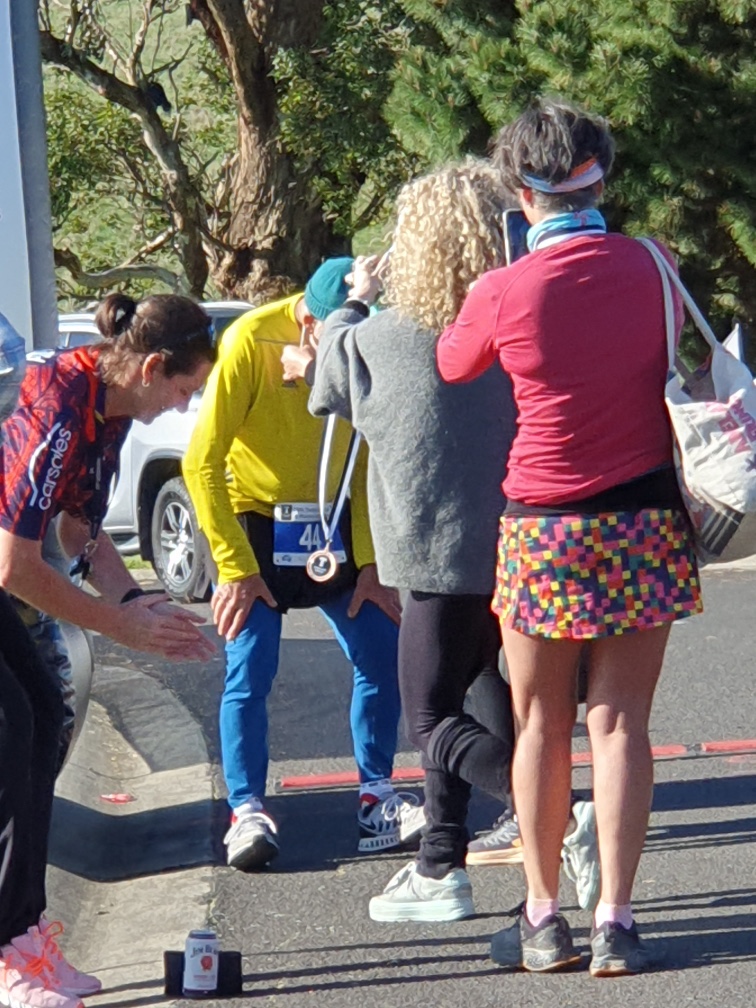
June 4, the sun shines on Traralgon and it shines on me. At 6.30m when I head out, the temperature is 4 degrees C (“feels like 2 degrees C”). A heavy fog lies upon the earth.
A mystic silence reigns as I set out on the 42.195 kilometres of the Traralgon Marathon. Although I’m starting my run one hour before the remaining 61 runners, I am not alone; my eldest grandchild drives his electric skateboard at my side.
The sun comes up at 7.30, warming my body and my spirit. The track, a rail trail, gleams as we move along towards that rising sun. Cobwebs, suspended from grasses and bushes, each of them a so-delicate necklace, that sparkles with sunkissed dew.Cows graze nearby, leaving generous splats for us to dodge. (I succeed, my grandson not quite.)
On his back the grandson wears a pack, ferrying supplies to replenish my body: planets*, reptiles** and salt tablets, and a flagon of water, as urged by Emily, the endurance sports dietitian and triathlete. My own project looks modest in comparison to Emily’s. As the weeks before Traralgon shrank to days, I rationalised: It’s not that far. I’ll run as far as I can, perhaps halfway, and when I can’t run anymore, I’ll walk… I’ll discover whether my legs remain capable of 42,000 steps.
As often as I daydreamed thus in hope, came that voice of dull prudence, Don’t be silly. You’ve never been so undertrained,you’ve never been so old…
Where lies wisdom? Where hubris, where cowardice? Thoughts alternate. Yes I am old, yes, I’ve had a stroke and, yes, the end approaches. I could sit and wait, retire from life and all risk and hope; and wait gracefully to die. An aged man is but a paltry thing/A tattered coat upon a stick/Unless…Unless soul clap its hands and sing. A decision makes itself. I’ll run!
This lovely marathon course winds and bends its ways between tall trees and low bushes and no trees at all. In nearby fields of pasture, tall grey gumtrees stand, gaunt, without foliage. What killed these survivors of fire and flood? They stand, each alone, each a memorial statue of its own demise.
At 8.00 o’clock, we pause for salts and serpents*, of which Emily commanded me to consume three every hour. This pause refreshes legs and lungs. Plenished now, those organs respond eagerly to the delights and sights on all sides. We cross little bridges over small waters and large, each bridge individual, this one of wood, this of metal, this one grassed, the next gravelled, the next paved of wood.
This being a rail trail, we reach the former rail station at Glengarry. Here, Jesse the skateboarding grandson, helps me to flout fairness in sport. He procures my performance enhancing substance, astrong latte, please Jesse, with sugar! This encourages lungs and legs already high on endorphin.
Everything smiles as we plod without pain towards Toongabbie Siding, where we sight a dark figure that moves ahead of us across the landscape. We close on this shifting shape and recognise Nick, close friend and ever-generous chauffeur. He and Jesse leave now, for their return to commitments in Melbourne.
I come to the turn, which is the half-way mark, all smiles. Ah, happy runner, happy, happy foolish, self-fooled runner, strong in the legs but too weak in the head to read a map properly. Utterly unaware that this out-and-back marathon course is not symmetrical, I discover the Toongabbie Loop, which now adds five kilometres of running. Why do I smile? What cheers me in my benighted state? It is my own laughable absurdity that cheers me so.
Forty minutes pass in happy solitude. More cows of course, more trees, more sun, and, the occasional fast marathoner, who now overtakes me, overcoming my one-hour start. Back at Toongabbie siding I’m overtaken by Kirsty, my marathon friend from Boston and the South Australian bush. Where is Sally, the third of our Boston threesome? She follows, in better time than mine. We swap stories of our morning so far, we sip salted drinks, then ahead sweepsKirsty, a real runner, on her way to finish in four- and a-half hours.
Alone again in the sunshine, recalling my first Traralgon Marathon, the first of fifty-seven. Another sunny day in winter.
Traralgon is Victoria’s Country Marathon Championship and Victoria’s first. All in all a pretty lustrous affair. Running under his nomme de jamb of Pheidipides, Howard Goldenberg completed his maiden marathon at Traralgon thirty-nine years ago. That year 181 runners started and 141 finished. I still have the official printout of the results. At the foot of the second of two roneoed sheets of paper (this report antedated the internet), you’d read: In 141st place, PheidipidesGoldenberg; time: 4 hours, 31 minutes, 31 seconds.
Every time I run a marathon I write one. That simple passage through time and space, so simple, so elemental, you mightn’t credit it worthy of remark. But every running feels remarkable to the runner. In the marathon the runner encounters his sole self, discovering some things about herself she’d prefer not to know and others that make him feel a little proud. In a marathon, as Zatopek remarked, we all die a little. The event is charged with significance for this runner because an often-solitary passage through time and space always involves encounters with others. It is the comradeship, the fellow feeling, the respect that elevate our experience. In that sense the marathon is a metaphor for our lives.
A watcher of the Barcelona Olympic Marathon might have caught images of the leading bunch of five as they passed their drink stop with seven kilometres to go. They had, running in intense humidity and heat, slowly outpaced a score of household names from Kenya and Tanzania and Korea and Japan and Australia. These five were the bravest of the brave on that particular day. One of these five, one only, would go on to become immortal. Four of the five grabbed their special drinks at the 35 KM mark. The fifth grabbed and missed. And ran on. Turning back was out of the question. The four drank and ran and drank again. One of the four passed his unfinished drink to the fifth. I do not recall whether the drink-giver won the event – I fancy he did not – but in that moment he joined the Immortals. Such small moments are the glory of the marathon.
All this reads a bit portentously. Most running – and all of mine – is more comedic or shambolic than deep. In the field of my third Traralgon I sighted at the Start the famed and cherished Cliff Young, Australia’s most famous potato farmer, a previous winner of the Westfield Sydney to Melbourne Ultramarathon. Cliffy used to train in his hobnail work boots. If he needed a haircut he’d trot the thirty kilometres from his farm to Colac, then run back home again. That day in Traralgon I wondered if I’d get close to him. Around the three Kilometre mark my legs became over-excited and accelerated and I hauled him in. Running a couple of paces behind Cliff I admired the light lacework of his tracksuit material. I drew closer. The lacework was in fact the work of a legion of hungry moths. Through the moth holes I could see and admire the pale skin of those spindly old legs…
A cry in the wilderness brings me back to now. Another cry, shrill and repeated. A flash of impossibly curly fair hair, and a form on the track ahead. The hair and the form,and now the face, I recognise as belonging to Rachel, my firstborn. A long embrace and on we race, one full kilometre, after which Rachel gasps, I’ve just done a full marathon, and retires to her car to drive to Glengarry for a stop, a planet or two and more coffee.
Phil Kayumba, Rachel’s partner, now materialises, tall, lean, young, the swift spirit of hope. Phil sings but one song:
Howard goldenberg/looking good/running well
Howard goldenberg/looking good/running strong…
and today he’ll sing it often as he pumps me full of sunshine, breathing it into my ear as he spirits me to the Finish.
A long pause at Glengarry, more coffee, more chocolate planets, more gummy serpents. After a12-minute pause, we are off and ‘running’, really just plodding. Somehow nothing hurts. The sun smiles on me, Traralgon Harriers smile on me as thy run past. They cry, Go, Mister Goldberg!
Keep going Mister Goldberg!
Who are these strangers? Whomever they be, they are in league with the elements, with my kin, with my friends, with the volunteers who bless my path.
Phil is in my ear: Only 13 kilometres to go, you can do this Howie.
No Phil, it’s eighteen.
No Howie, just thirteen.
Phil is correct. In my masterful map-reading failure, I’ve undercounted the kilometres run. Phil’s news comes as a gift. Phil’s simple song sings itself to the rhythm of our falling feet:
Howard goldenberg/looking good/running well
Howard goldenberg/looking good/running strong…
One foot strikes the grassy path, the opposite foot follows. A stranger to volition, to strain, to suffering, I float above, with love at my side, love all around, love and joy awaiting and greeting me as I puff and plod absurdly the final thirty, hilly metres to the Finish. Cheers, a medal, drinks for the hero.
In all my scores of years’ ruminating about the meaning of a marathon, time and again recurs this deep and bright truth: my life is like the marathon, an effortful passage through space and time, made rich by love and companionship. Meaning congeals within me. As Malamud wrote, I am a man, which is not very much. But it is a great deal more than nothing.
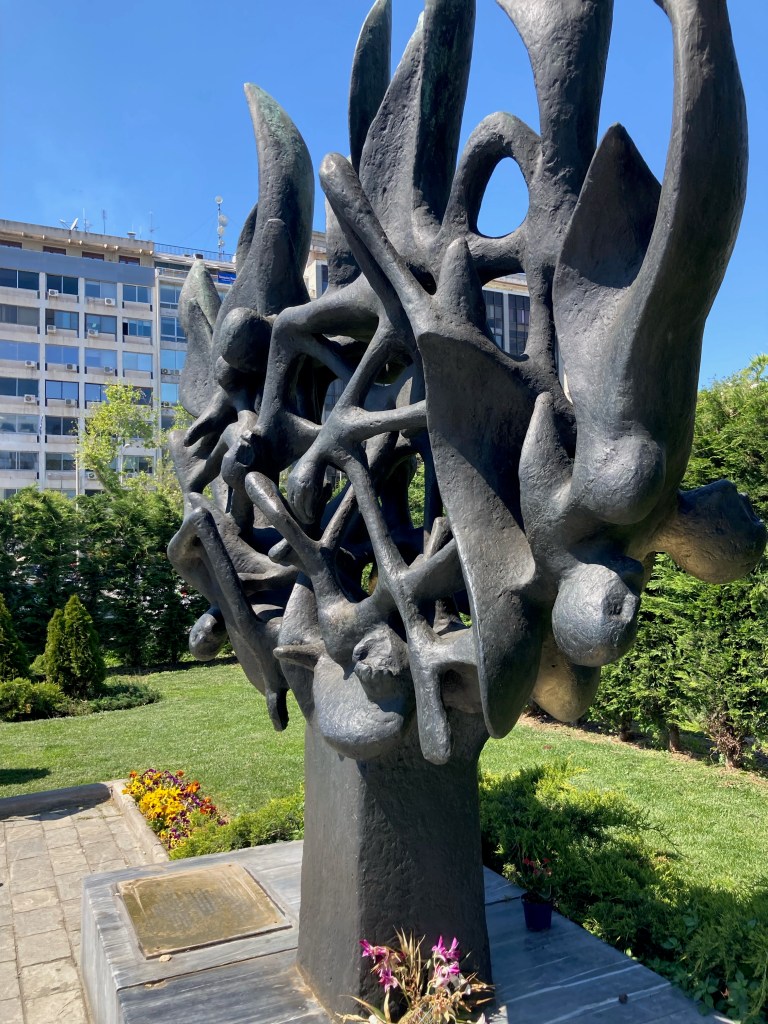
In Thessaloniki we visited the Aristotle University in the centre of the city.
The university is young, a child of the second half of the Twentieth Century.
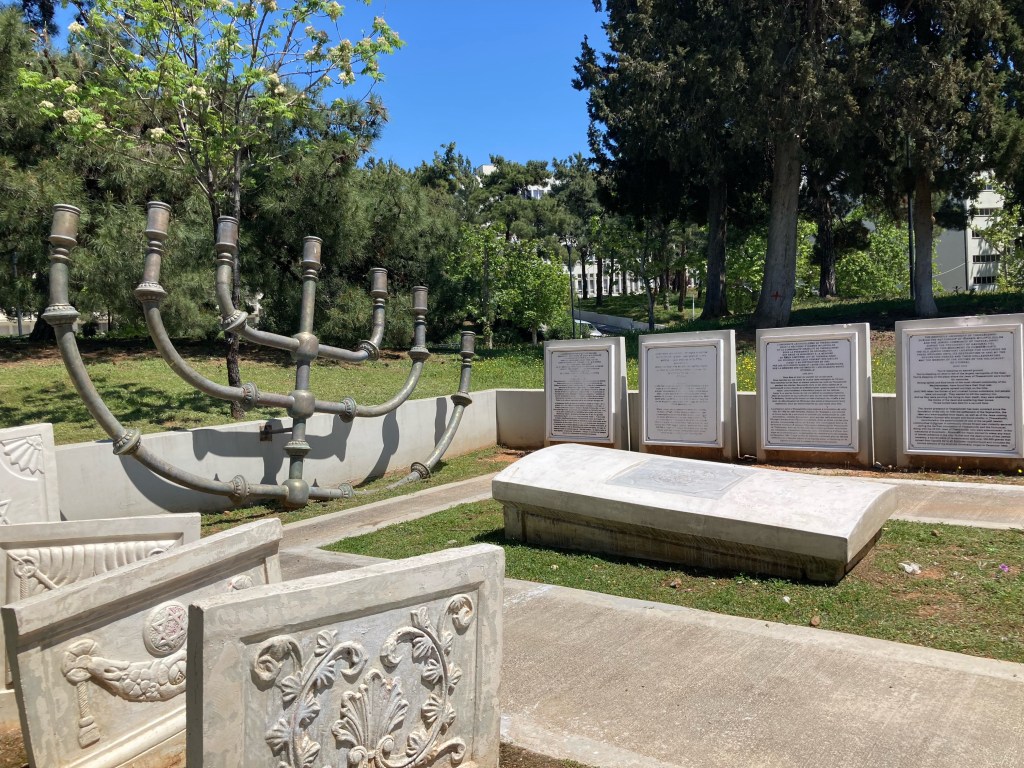
The Jewish cemetery in Thessaloniki dates back many centuries. Sages, leaders, rabbis, porters, dock workers, Jewish people of every station were laid to rest in that cemetery. Some 400,000 Jewish dead were buried there.
The cemetery occupied the present site of the university until WWII, when the Nazis desecrated the site. They seized headstones and used them for profane purposes, including building toilets. Headstones of marble were valuable: these the Nazis kept for sale.
So far, so foul, so normal in Nazi practice. What followed was unique. At the bidding of local gentiles, the Nazis then set about clearing the vast area of bodies. The ancient dead and the freshly dead were disinterred, bones and bodies exposed, food for dogs.
The dead died a second time. Nowhere else did the Nazis expend manpower on such atrocity. Their focus, their energies, lay with the living.
The Nazis deported the fifty thousand living Jews to Auschwitz. A few hundred of these were to survive.
The son of one of these few spoke to us of the literally unspeakable experiences of his father.
The city that thronged with Jews was now free of them. The occupants of vast and precious real estate in the city centre had been ‘evicted’. The university built, memory of the Jews extinguished.
***
This evening I entered a supermarket on the Island of Rhodes to buy fruit juice.
A tall man reached the checkout just before me. He paid for his purchases and I went to pay for mine. The checkout chap said, Nothing to pay.
I looked up, nonplussed. The vendor indicated the tall man. This man, he has paid, he said.
More nonplussed still, I turned to my benefactor. You don’t need to pay for that juice. It’s for me!
It’s nothing, said the tall man in English. It’s done. Forget it.
The tall man was young, fair, mild of manner. He smiled a small smile. Forget it, he repeated.
I can’t forget it, I said. What’s your name? Leon. Where are you from, Leon? Wales. He offered his hand, did Leon of Wales. I took his hand, which swallowed my own. His handshake was gentle.
I said, Thank you Leon. It’s nothing, he said, and walked away.
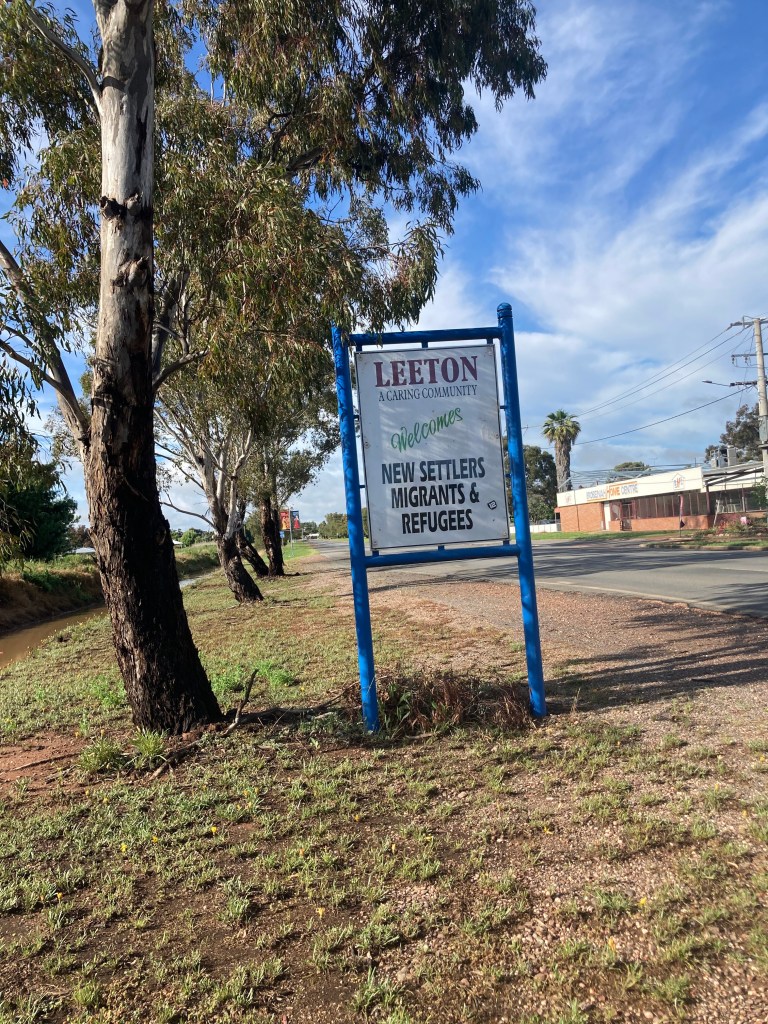
In the early years of my life I dwelled in a paradise called Leeton. Leeton is a small country town in south-west New South Wales, designed by Walter Burley Griffin. Irrigation and imagination provided the infrastructure for small boys to live a life of freedom and adventure. However, quite abruptly, at the age of nine-and-a-half years, I was kidnapped by my parents and transported to a city where I have lived in captivity ever since.
It never occurred to me until recently that this abruption might be a trauma. But ever since I have contrived to escape the city for short intervals, to breathe cleaner air, to look at horizons, to listen to the silence. It is during such an escape that I am writing this. This escape is different from the many which have preceded it; my beloved is here with me.
Together my beloved and I have journeyed around the sun almost fifty-three times, but it is only today that we will visit my hometown together. It was here, in this small town that I spent my seed time. Here the seeds germinated; it is from this soil and this sun that the shoots of my whole life spring. The roots persist and grow and they sprout, ever green. This town, those times haunt me. They haunt my loved ones too, to their puzzlement.
Today, perhaps, my beloved will feel her own enchantment. And perhaps she will not. A small town in the country is, after all, a commonplace thing. You can walk the wide streets and find them empty of sound or movement, unremarkable and untouched by charm. Perhaps the charm lies solelyin memories which I have watered and cherished and improved over a lifetime of years.
What will I show her, my beloved? How to water her imagination?
Of course, we’ll visit the old house. The new owner gave us permission to explore alone, trusting us with his own new love. She’ll see the bathroomwhere, behind a locked door, we played Murder in the Chookhouse. I’ll show her the hallway where my younger brother was circumcised. She’ll see the space where we sat in the Succah and celebrated Tabernacles. On the front doorpost we might find the scars of Dad’s mezuzah. I’ll show her the odd, circular window high in the wall of Dad’s old consulting room. That’s how the light got in.
But the obvious landmarks in town, such as the school, the kindergarten, the hospital, the olive oil factory that Dad built, do not call to me as loudly as certain unexpected sites. Will we visit the railway bridge under which we chose to play, drawn by the special allure of the forbidden? Here we’d come into the domain of the locomotive, hot and blackand noisy, the very embodiment of implacable power. On one occasion we were playing under the bridge as the train entered, with its noise and its smoke. Too thrilled even for terror, we spent perhaps thirty unforgettable seconds in intimate relation to the monster, amazed dumb. I’ve never spoken of this escapade. My beloved will learn of it before you who read this.
Before we sight Leeton, we’ll pass Wamoon, where I’ll stop and we’ll walk across the bridge over the fatal canal. What will she see, what will she feel, this person who knows me so deeply and so long?
I’ll take her into the great park across the street from the old house. I’ll show her where the man lounging on a picnic rug with his girlfriend and a bottle of beer accepted my challenge to wrestle, one slow Shabbat afternoon. Here he pulled down my shorts. I’ll show her the Police Station just around the corner, where, a few days later, I went to report that strange event. Sergeant Stewart walked me to the spot and bid me look around. He asked, ‘Can you see the man you wrestled with?’ I could not, but to oblige the sergeant I pointed to a man at random. Sergeant Stewart observed: ‘Making a false accusation is a serious matter, Howard.’ The officer enlarged my vocabulary.
I’d like the two of us to climb the high boundary wall of Number Two Jarrah Street and peer over into the odd, kite-shaped backyard of my first friend’s home. That home was as much a refuge and a place of love for me as my own home, twenty yards distant. Through one rare day of soaking rain, that friend and I played in a room filled with enormous cardboard cartons, large enough to walk in. When, years later, that house was stolen and became a pizza shop I knew the meaning of sacrilege.
On the morning of our departure in 1955, my friend’s mother stood on her front step and took me and my elder brother into her arms and embracedus. She held us there and she delivered her benediction: You two boys have the duty to become the finest Jewish gentlemen ever – because of what your parents are giving up for you.
My parents? Did they suffer their own trauma? Did this commandment from our gentile friend shape my life?
Perhaps such memories are too strong for others to feel or know. Perhaps, in time, they can become malignant. Perhaps, on the other hand, I need to share them, to lay them bare to new eyes, to exorcise a haunting from the life I share with my beloved.
Afterword:
My beloved came, admired, and fell, quite charmed.
I have a letter to send to my sister and her husband in New York City. It’s a large envelope crammed with pages I’ve selected from the papers. It’s stuff they’d have heard about, stuff they might like to read about in greater detail. I slipped in a note: Here’s the News and the Olds. (News refers to the Aussies thrashing England in the Ashes, Olds will tell them Bob Hawke is dead.) I ask the Postal Lady for stamps to New York by airmail. Postal Lady weighs my envelope: 64 grams, say the scales. Thirteen dollars sixty cents says Postal Lady. It will be delivered in twenty to twenty-five days.I wonder whether the postie walks to New York. That’s airmail? Yes. Everything is held up. Thirteen bucks? Wow! It is a lot, says Postal lady. Hold on, I’ll check. Postal lady gives her computer further instructions.Thirteen dollars, sixty, replies that avaricious device. Is it a problem of weight, or the size of the envelope? Weight, says Postal Lady, adding, If you can make it ten grams lighter it will come down to six dollars. Righto, I’ll get rid of something over at the counter, then I’ll come back to you. Over at the counter I remove two pages of Harvey Norman and Frydenberg’s Big Plans for the Budget.Three dollars something, says Postal Lady. I pay, rejoicing as one does who has just found a bargain at Harvey Norman. Do you mind if I ask you something? Are you Doctor Howard Goldenberg? I am. I thought so. You were my doctor when I was a baby in Diamond Creek fifty years ago. Really? Lucky me! I must say it’s hard to recognise you in the mask. Postal Lady removes her mask. I’ve changed since I was a baby. My mum says you told her I was the most beautiful baby you’d ever seen. I suppose you said that to all the mothers. (I suspect I did say just that.) I’d like to see a photo of yourself as a baby some time. I’ve got one here.Postal Lady starts interrogating photo archives in her phone. The queue of customers in the Post Office grows longer. It’s in here somewhere, Doctor. Further search. Matthew, Postal Lady’s colleague, gives her a Look. Postal Lady, engrossed, doesn’t notice. Found it! Here, look Doctor. Doctor looks at the photo in black and white of a newborn baby. She is in fact the most beautiful baby I’ve ever seen.I say those words once again. Postal Lady says, You’d remember my mother better than me. I’ve got a photo somewhere here…I’m sorry I’m detaining you…I look around. The post office is filling with customers. Matthew looks over towards the second half of the PO’s workforce, but lingering as his look is, and withering withal, Postal Lady is oblivious in her quest for a snap of Mum. I decide there’s a problem in this office and I am that problem, and I can solve it by removing myself. Look, here’s my phone number. Send the photo to me, later, to my phone. I leave by the side door that gives onto one of Melbourne’s famed little lanes. The lane buzzes as throngs drink and dawdle in the bright sun. I wind my way quickly into a second lane. A voice behind hails me: Doctor! Doctor Howard! I turn. It’s Postal Lady. Look, this is Mum, here. She points at the pleasant, forgettable face in black and white of a young mother. I try to recognise her, but memory fails before visions of civil unrest in the Post Office.
He’s a tall man, slim. He wears clothing of dark gray. When he gives his surname, I nominatecorrectly his country of origin in Northern Europe. It’s only after we’ve parted that it occurs to me his name translates to Big Son. He might well descendfrom a line of big sons.
Even though he’s past retirement age, I ask him what he does for a living. Out here the farmers and the miners never quite give it up. I’m a miner, he says – a shrug, a wry smile. The lure of the big find is too strong for some to stop.
– Where do you live?
– Out along the Seven Mile. I’ll take you and show you if you like. You can see the diggings.
– OK, I have your address. I’ll drive out.
– You can’t. You’ll get lost.
This rings true. The town is peopled by those who don’t wish to be found, persons escaping the Lawor vendetta or drug dealers or the tax man or the former spouse, or a life of persecution in the old country. Nobody really knows the population. The town boasts fifty-four ethnic groups. As you drive into town a sign welcomes the visitor. A little further on a sign reads: “POPULATION ?”
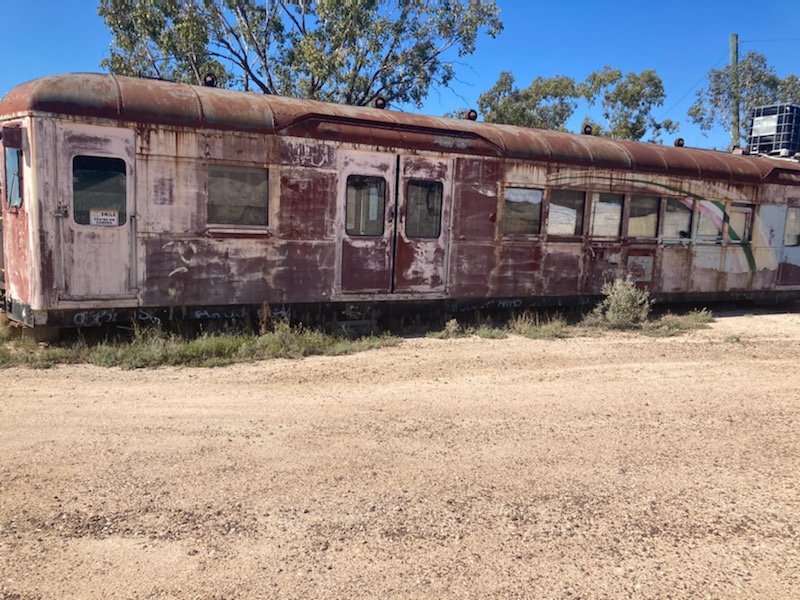
The 2016 census lists 2016 persons, a neat match, probably too neat. No one really knows. It’s though a further 3000-odd are hidden away in the hills, where they live in disused trams or railway carriages, huts and caves. In the past, the local Police designated a discrete patch of earth behind the shopping strip where scamps and scally wags were allowed to park when they came into town for supplies. Certain back roads were allotted to these folk. The Police would ask no questions so long as the miners did not bring themselves to their attention.
Big Son instructs me to meet him outside the front of the clinic after I finish work: you can follow me out along the Seven Mile. At 5.00 precisely I step out into bright sunshine where Big Son looks at my white hire car and says, Get into my vehicle. Yours is too pretty to take out bush. I jump in to a large, hard-working 4-wheel drive and we drive out of town.
The further we drive the thicker the marks of the digger. Low structures of tin and timber alternate with mullock heaps of pale stone and earth and random bit of rusted machinery. We’ve left the bitumen behind us, dirt tracks branch off and wind off in all directions into thin scrub. I’ve lost my bearings. My companion keeps up a commentary: that claim there belongs to a friend…over here you can see cabins…the people over on the right run a really good tourist operation.
Before I came to this country I moved to Roma – I had a girlfriend there, the usual story, you know – in Roma I set up a photographic studio.
Photography was my trade.
The narrating voice has taken on a note of pride.
I didn’t speak the language, but I taught myself by watching videos in Italian. I succeeded as a linguist but I struggled in my photography business. No network.
I visited Australia – curiosity, you know? Back in Roma I applied for a visa to settle in Australia. It was for adventure. I came out here and started to dig. I married once, had a couple of daughters. The marriage ended. Married again, my wife is an artist, an art teacher. We fostered a little child. He was murdered. My wife went mad. I sold up, sold all this – by now we’re at his claim and we’ve pulled up – I had to sell and take her to the city for treatment…
The young bloke who lived over the hill there, a loner, a misfit, killed the little one. He lived there, a recluse, a neighbour. No one knew anything about him until he committed murder. Of a child.
CARRIAGE HOME
My wife got better and we came back. I got a new claim just by my old one. This is it. ‘This’ is a patch of elevated stony ground with holes in it. Disparate bits of metalwork rise above the surface and disappear below. I peer down a hole walled by a cylinder of galvanised iron. The hole is a mine, about one and a half metres in diameter. My host says, it goes down eighteen metres. I consider the dark and the deep. Obviously you don’t suffer claustrophobia…
I do, to a degree. I think anyone with imagination must.
Spiral staircase for a mine
Bright blue steel steps disappear into the depth of another circular hole. Big Son says, a friend invented that spiral staircase. The friend sells them to diggers and small miners across the country. This machine here he points to a steel contraption – I built. I invented it and patented it. I’ve sold a few of them, but most diggers can’t afford $18,000…
The digging machine invention
The machine that my host devised is a complicated structure of thick steel, encasing steel cables, an electric motor and meters with dials and numbers. It stands, grey, substantial and sophisticated on the primal earth. There’s not a speck of rust. It’s a machine for digging a mine. I gaze at the device in awe. Inventor and invention alike stand solid and impressive, gunmetal grey, erect in the unforgiving sun.
Who trained you in engineering?
No one. I always liked machines, devices, gadgets. I pulled things apart, curious you know?
What does a digger do who can’t afford a mechanical digger? Pick and shovel?
Yes. If they can’t scavenge bits of old machinery. Maybe fix it up, get it working.
I consider pick and shovel work in the digital age. Out here summer temperatures reach fifty in the shade and stay there for days. But I do know why a digger might stick at it. On the way out of town Big Son pointed out a jewellery showroom: Very honest people there, prices very reasonable. They’ve got a gem there that I dug up, very valuable. They paid ten thousand for it. They’ll sell it for forty thousand, but they might have to hold it for years.
Another person, obese, not old, walking on a stick, hobbled and rolled picturesquely into the clinic this morning. Both her florid gait and her words told a story that stretched the truth in support of her quest for a medical certificate for welfare benefits.
We moved onto other subjects.
What’s your work – when you’re able to do it?
I’m a miner, she said. I’ve got forty thousand worth of raw gems in this bag.
In this town that outlandish statement might just be simple truth.
Here, gemstone is currency that doesn’t leave records. Bankers, accountants, the taxman need not know.
My tall host looks around his claim. He says, There’s always theft. You can’t make your property safe from thieves.
I ask, Do people arm themselves?
Some do, they have guns… shootings aren’t rare out here.
This here is my blower – Big Son points to a large hollow, elevated structure of steel and rust, that rises above the claim, shaped like one of those concrete mixers you see on trucks at building sites. This towers above us. It does something with mullock that I don’t really understand, but it sounds like winnowing. My host tries to explain: You see that motor there? I found it in a derelict street sweeper. It’s a three-cylinder diesel. I adapted it. It’s noisy. The miner turns a switch. A battery turns the motor over, it fires then clamour, brutal and immediate, drowns conversation. The thick steel platform vibrates beneath our feet.
Come this way, into the house. Twenty metres from the claim, just down a small slope and hidden from sight at the claim, stands an elegant modern building of steel and timber. Yes, this too was designed and built by my host. It stands on leasehold land. The house lease is separate from the mine lease: You get a home lease for twenty-five years. You renew it every twenty-five years.
We pause at the threshold. Big son points: these stones everywhere, that’s gemstone waste, that’s potch. My host leans a long way down and picks up a pebble. Here take this, a little souvenir. I look at the little grey pebble. Its centre glows with blue and green fire.
Inside, all is dark. A woman of middle age materialises and speaks in a florid French accent.
We stand in the dark room until electric light reveals walls hung with artworks in oils that startle with their mute emotional power. The artist steps from the shadow and speaks with shy pride about the paintings.
– You see that brown shading? Do you know what I use for pigment?
I regard the glowing brown and shake my head.
– Coffee. Nescafe. I’ve tried other instant coffee. Nescafe gives that fire in the brown.
We come to a bathroom whose walls are a menagerie of megafauna: emu, koala, kangaroo, in their greys and browns move across bright panels of white and lime. My hostess explains: We sit on the toilet and instead of blank walls, we gaze at animals, bounding across the walls, alive.
We pass a small portrait, the only watercolour. The painter passes it by. Big Son pauses. We regard a bright portrait of a little boy with a face full of life andwild, straw-coloured hair. He radiates light. Big Son says quietly, this is our little one.
Tonight I went to yoga as I have done just about every week since the start of the pandemic. When I say I went to yoga, on some of the occasions this was literally true: I’d run to the studio and I’d jog back – four kilometres or so each way. Frequently, however, when the germ shut the studio, I joined the class by zoom. ‘I went’ consisted simply, of turning the lights down and moving to the Persian rug on the floor. The rug feels a bit rugged (is that the origin of the term?) but it’s tolerable. I don’t imagine the Yogis of old purchased their mats from Lulu Lemon. They probably lay themselves down on bare boards or on a rug of knotted yarn like mine.
I lay down tonight and tuned into zoom on my phone. (No, I don’t have an i-pad. I don’t suppose the ancient Yogis did either.) I felt a frisson of pleasure at the the hopeful thought that tonight’s class, conducted on the eve of freedom, would be the last of enforced separation
I paid attention to the teacher. She instructed me to attend to the breath. I breathed and I attended. I like this teacher. I feel I know her well. She teaches yoga in a variety of modes, but she and I both know Yin suits me best, with its long, slow poses, its gradual transitions. She speaks: ‘Some of you will have rushed from your day’s work to this class. You might be unready immediately for stillness, so we’ll move into stillness, we’ll arrive at the unmoving state by movement, by active movement that will slow; and as we slow we’ll have the opportunity to attend to the slowing breath.
The teacher models the pose and the class follows. I gaze at my little screen. I remove my reading glasses for a clearer view. The teacher has fair curling hair with curls at the end of curls. Her skin glows peaches against her black sweater. I enjoy the sight of her.
I adopt the pose and close my eyes. My eyes remain closed through most of the following 50 minutes or so, even as, every few minutes, I move into the next pose as instructed.
Lying thus, with the senses turned inward, only the sense of hearing, of vibration, operates within my awareness. I become aware of a rhythmic percussion, a soft, recurring ‘boom’. If it’s a sound, it’s a sound too soft to actually hear. I feel this sound: boom, boom, boom, coming to me through the floorboards, eighty booms to the minute by my rough-reckoning.
The sound, the experience bears a sense of the long-known, the familiar. Eventually my ears that have worn a stethoscope for almost sixty years, recognise the soft boom, boom, boom:It’s heartbeat that I hear. This is a puzzle that solves itself when I open my mind’s eye. The sight that I ‘see’ is of my teacher, herself reclining on a mat, on a floor. Next to her is her mic through which she gives instruction. The mic picks up vibration through her floorboards and transmits the sound of the beating of her heart. I know it’s not the sound of the beating of my own heart; mine beats at forty beats per minute. I smile a smile of remembering. I remember that heartbeat. I used to listen to the beating of my daughter’s heart through the wall of her mother’s belly. I heard her heart before her mother did. Her heart beat in the womb at 120-160 beats per minute, twice the rate (in those days), of my own. It was the first way I knew her. It cued my love of her. Yes, my yoga teacher is my daughter, she of the peachy face, she of the yellow curls. I’m allowed to enjoy looking at her.
Tonight, on the eve of freedom, I hear my child’s heart, the working of her living body agitating the molecules inside the semicircular canals of my inner ear. Her living body moves my senses and once again cues love.
It is late in the third year of medical school that we watch a screening of a live birth. Until this point in my life, film was always smaller than life, an image, a series of images, fictive or documentary, but extracted, never fully real or fully human, let alone monumental. But this was a video of the eruption of life. I might have been witnessing the Big Bang so enormous was this, the advent of a human.
I remember feeling electrified, thrilled, struck and struck again by a cascade of philosophic thoughts, intense joy, a sense of being a guiltless voyeur upon the utterly intimate that was utterly universal. I was witness, by invitation, to creation. I remember too, my naive amazement that a woman would allow a camera (that shockingly lacked any sense of modesty) to show her fully naked self in this way. I looked around with a wild surmise. But my friends, more worldly, more mature? – showed no shock.
It is only a year or so later that I will deliver a baby. Between the videotape and that event, my father decides I’m ready to go to Labour Ward with him. This entails walking out the back door of our house, past the rhubarb growing in the back garden, to the side gate that opens onto the lane. Dad would hasten across the lane with me at his heels. Through a second gate and we are in the grounds of the Oakleigh Community Hospital. Here Dad frequently invites me along, to watch as he performs surgery, administers General Anaesthetics, treats heart attack and pneumonia and fracture. Dad’s patients welcome me: Dad is their idol, his son would be a godling. Today my presence will demand inordinate trust on the part of a woman of her doctor. What I will share is a series of events, of unmediated sensory experiences – the rich colour of placenta and the same colour in a woman’s face, the odour of amniotic liquor, the sounds and lack of sound, of wordless breathtaking, grunting, pushing, the sight of a calm and immensely calming doctor, his movements graceful as ballet, his stillness, his attention, his kindness and his firmness – and the huge feelings of a new mother, the joy reflected on the faces of nurses, and my own sensations, intense and too many, crammed into climactic moments, and I unable yet to unpack them and describe them calmly. For now I know only awe and thankfulness.
Perhaps a year later, I stand at the side of a young woman through hours that become a full day, during which she approaches a bridge in her life. Today I’ll cross a bridge of my own. Surrounded by calming midwives, veterans in this arena, I watch as the woman pushes. The woman pushes hard, pushes long, gasps, pushes again. Her face reddens deeply, now a beetroot, now a plum. I peer hard: is that hair? Is that scalp we’re seeing? I move into place to catch a baby.
The Delivery Room encloses the birthing mother, a couple of midwives and a nervous medical student. This room, this world comprises all animal humanity as a life spills free into air. Our air, cold upon wet skin, evokes a gasp, a cry. The cry tells a young woman she has crossed the bridge. The student gropes, grabs a slippery cord, which yet dances and writhes. He applies a clamp which slips and falls to the floor. The baby cries, the mother cries; I suppose I’m tearless, but I know I have crossed too. This is one meaning that I catch instantly.
Six weeks later I travel, as directed, to a Victorian terrace house situated next to a rail crossing in Brunswick. In the house a new mother and her young husband live with their baby. The idea of the visit is for a student to learn the consequence of those climactic events six weeks earlier; that consequence is the fact of parenthood. The mother welcomes me, the stranger who crossed with her, the intimate male who usurped the father. That father welcomes me, thanks me! It occurs to none of us three that he should have been there in my stead. A bond exists, forged in the sweat and blood and urine and shit of birth giving, in the gasping and the heaving of giving birth, in the shock and the cry of being born, in the spreading flood of love for a human child.
I never visit the family again. I would not recognise the mother today. Yet every time I drive past the terrace – which happens to stand on my preferred route to the airport – whenever I pass, I remember, through all the decades that follow. I remember that day, I feel that bond.
The birth leaves me changed. I feel called.
For the first thirty years of my working life I deliver babies. It never stales. Nothing else in a life in Medicine will rock me with that astonished joy as I witness the advent of a human. When suburban GP Obstetrics eventually dies, a part of my own life is extinguished.








 howardgoldenberg