Two Writers Wrote My Novel

One of the two, a good bloke, would get up too early in the morning, charge himself with caffeine, and – sparking with imagination and creative drive – write passages of prose that really excited me. I liked that bloke. The second, born on the same day as the first, was much older. A sour individual, crepuscular and nocturnal in habit, he’d cast a jaundiced eye over the other bloke’s matutinal erections and scorn them into impotence. He’s scratch out every virtuoso phrase, he’d cut through digression and elaboration. Mean as catshit, he believed less was more, and least was most. I found him unpleasantly convincing. I hated the bastard.

Both antagonists worked on Carrots and Jaffas from start to finish. They managed to draw out a six-month project to four and a half years. By the time the book was printed I was nearing sixty-eight and I resolved I was done with the novel: how many more fifty-four month projects did I have left? Bugger the novel, I decided. I’d read them still, I just wouldn’t write any more.

Three months later I had finished my second novel. Titled “A Threefold Cord”, it is a novel for shared reading between an adult and a child of eight to twelve. And it is a cracker. The book comprises sixty-seven chapters of action, suspense, hilarity, and the unremitting contest between good and evil. In addition there is sufficient reference to bodily functions to delight and liberate a well brought up child.

As the book raced towards Chapter Sixty I informed my oldest grandson I would end it after the sixty-seventh. “Why, Saba?”
“Because I am sixty-seven.”
“But what if it’s not finished?”
“Doesn’t matter. I’ll just stop.”
“But you can’t!”
“Yes I can. I’m the boss of this book.”
“But…” The notion of such a summary ending outraged him.
I relented: “I might just start a second book where this one finishes…”
Grandson’s 10-year old face blazed with a happy prospect: “Wow! A series!”
Where were the antagonists of “Carrots and Jaffas” during the writing of “Cord”? I sacked them. I simply wrote for my five oldest grandchildren, aged eight to ten years. No virtuoso passages, no miserly pinching, “Cord” was a conversation with five kids who knew my voice, five kids whose tastes I knew: tastes I had helped to create.
My older daughter, a combined Regan and Goneril in her criticism towards my writerly Lear, assures me no child will tolerate a book with such a title as dull as “A Threefold Cord”.

I know she is wrong. Grade Four at a primary school near Shepparton served as unwitting testers when their teacher resolved to read aloud a daily chapter. Ordinarily, she informs me, the wrigglers would wriggle, the whisperers would whisper and the autists would be up and away. But when she read a Threefold Cord all sat, transfixed. The teacher got through five chapters on the first day.
Since then the children and grandchildren of selected Australian literary figures have read Cord and approved it mightily. From time to time over coming weeks I’ll post the odd sample chapter and you’ll see I am right: “A Threefold Cord” is, as I remarked earlier, a cracker.

When I was six

When I was six the teacher said: “We’re going to learn a poem today. It’s called Ding Dong Dell.”

I knew that poem. Surely everyone knew it. But I’d also heard a Revised Version, much better than the original. I think it was my elder brother who taught it to me.
I said: “I know that poem”

“Good boy, Howard. Please recite it for the class.”

So I did:  

“Ding Dong Dell

Pussy’s in the well.

‘How can you tell?’ 

‘Go and have a smell.’”


It was funny but Mrs Paulette did not smile: “Howard Jonathan Goldenberg. Leave the class. Go to the storeroom.”


I went to the storeroom, a narrow room lined with shelves stacked with classroom necessities. 

I stood there alone and listened to the silence. I felt a thumping, fast and hard, in my chest.

I knew perdition. I knew exile. I knew terror.

I stood in fear and misery. When would a captive be released from the storeroom? How would Mum know where to look for me when she came after school?


A sound at the storeroom door. I shook harder. The door opened and I stopped shaking. I knew the face, the freckles, the buck-toothed grin, the red, red hair. I knew my older brother Dennis.

“What are you doing here, Howard?”

I shook my head.

Dennis went to a shelf and selected a piece of red chalk, one of blue and a white one.

“What are you doing, Dennis?”

“Mr Frobisher sent me for chalk.”

Dennis opened some packets, discovered a treasury of pristine plasticine. Methodically he peeled off thick strips and pocketed them.

“Does Mister Frobisher want plasta too?”

“Nope. I do. You can have some. I’ll leave a bit for you.”

Dennis left.

I looked around and saw riches. I saw Aladdin’s cave. I saw opportunity.

I touched nothing. I stood and trembled at my own thoughts of wrongdoing.


A sound at the door. Mrs Paulette’s face and pony tail and round bosoms appeared in the narrow space. I saw what she must see, the open package of plasticine. I saw the signs of theft and I thought  – not of Dennis’ actions – but of my own wicked impulse.


Mrs Paulette said, “It’s recess, Howard. Go outside and play.”

The Price of Life in Doomadgee

Just before noon the phone called me from the river to the hospital. The hospital held me until long past midnight.

A man with his jawbone fractured, pushed right out of alignment, said: “There was a fight. I was watching it and a man came up from behind, on my right side, and king-hit me.”

I called a plane to take Sampson to Mt Isa.

Eight thousand dollars.


A man came in and showed me his hand, puffed up, a boxing glove of soggy blood under the skin. Beneath the blood, the head of the metacarpal bone had snapped. I said: “You’ll need an operation. We’ll fly you to Mt. Isa.”

Eight thousand dollars.


On the TV Rafael Nadal struggled into night with back muscles in spasm. A chubby baby, feverish and short of breath, took me from the tennis. Over the previous day or two I had seen this baby at peace. He filled all who saw him with delight. Such abundant flesh, so well at home in grandmother’s embrace.

This was their third night visit in 48 hours. Grandma brought him in this time as previously. She nursed the weeping Buddha and comforted him. The rule in Aboriginal health says, “Three strikes and you’re in.”

I said, “He’ll have to go in. To Mt. Isa. You can go with him.”

“Grandmother said:” I can’t. I’ve got my own six-month old at home. I’m breast-feeding him.”

“What about his mum?”

“She doesn’t have him. I do.”

The letter from Child Protection said the same. So Aunty went.


Very late at night came an urgent call. The voice said: “A man has come in with a high temperature. He’s very old.”

The thermometer said: “39.9 degrees.”

That sort of fever says “sepsis.” In this man’s case his septicaemia arose as a complication of pneumonia.

I asked the man about symptoms. He shook his head. He had no complaints.

“What about pain?”

He said, “I think my head hurts.” He said it as if he was far from the pain. The pain was a sensation like memory; he had to summon it to name it.

The man sat bent forward, breathing quietly, speaking softly, his bushy moustache a permanent smile.

At his side sat a young woman. Her gaze never moved from the breathing old man.

I asked, “Is he your grandfather?”

She said, “Yes.”

“Will his wife come…?”

The young woman said, “No, just me. Me and my brothers.”

“He’ll need to go to Mt. Isa. Your grandfather is seriously ill.”

A sad shake of her head, She said: “I can’t go. My baby… My brother will go, one of my brothers, Ambrose.”

“How old is your Ambrose?”
“Eighteen.” Seeing the doubt on my face she said: “Ambrose will look after him 
properly. Us three – my brothers and me – we live with him, we look after him. We do everything.”


The old man’s vital signs went from worse to frightening. The sphygmomanometer said: “60/40”.

The Emergency Consultant at the Flying Doctor Base in Mt. Isa said, “The plane is on its way. Give him Adrenaline.”

We gave him adrenaline. We gave him three different intravenous antibiotics and a fourth, by mouth. Hunched forward, moving only zephyrs in and out of his chest, the old man breathed and the breath did not speak to my stethoscopic ears.

I said, “Please lie back if you can.”

He lay back, air moved in and out, the silver bush on his upper lip filled and emptied, emptied and filled, semaphoring life. The blood pressure machine said, “80/50…90/65…110/70”.

The young woman gave way to a brother. The brother, after a time, gave way to another. This was the eighteen year old, tall, thin, lightly muscled. His bearing was solemn.

The sound of an aircraft flying low overhead changed the tempo.

Quickly, quickly, gently, many hands helped the old man slide from the couch to the ambos’ trolley that he would ride to the vehicle and on to the airfield.

We pushed him towards the ambulance parked outside the front door. Lining the wall, gathering in numbers, gathering over the fretting hours of the old man’s time with us, waiting, standing quietly, were three daughters – themselves matrons – and men of all ages, boys, small kids supported on young hips and attached to slender breasts. Only minutes earlier the waiting room had been empty. All had stood outside in the dark and the heat. The chill of a hospital ward did not invite them.

All eyes now followed the old man. Hands reached for him. The ambos halted, the file flowed forward, a wave of silent care. I saw one woman, a daughter, her eyes swimming, her lips trembling. I stepped forward and said: “Your father has been desperately ill, but he seems to be turning the corner. He’s holding his own now.”

She said: ”He didn’t want to come to the hospital. He was scared. He thought you might fly him out to Mt. Isa. When they flew Mum out, she…” The voice, soft, husky, now faltered:“…Mum never came back.” 


I looked at the gathering and asked: “All these people – all his descendants?”

She said, “Yes, all his kids and his kids’ kids and their kids.

And there’ll be just as much family waiting for him in the hospital in town.”


The ambos took the old man away. The family melted away.


The senior nurse breathed out and said: “If I come to my final hours and I am surrounded by that much love, I will know I have lived a successful life.”


***


While the nurses tidied the Emergency Rooms, I wrote up my clinical notes. A nurse approached, apologetically. She said, “Would you mind? We have a lady here with a cut head. It might need stitching. It was a belt buckle.”

In ED an old lady sat. Seated opposite her, too long of limb to sit without sprawling, were two large men in navy blue with large guns at their hips.

I looked to the lady. She wore a patterned dress in black and white whorls. The bodice was splattered with red. Her head was a savannah of silver-black curls. I had to search for the laceration which was small and shallow. Blood had clotted in a thin line between the margins of skin. Nature had stopped the previously brisk bleeding.

There was not much to do, nothing medical.

I asked, “What happened.”

The nurse said: “Fifty dollars.”

The nurse shook her head. Was she angry? Disbelieving? Or simply busy with the wound?

She resumed: “Her husband demanded fifty dollars and when she didn’t hand it over he hit her with his belt buckle. Isn’t that right?”

The old lady spoke for the first time. She said, “Sixty.”

Unhappily, guardedly, I turned to the police officers and asked: “How can I be of help to you gentlemen?”

The taller one had blue eyes. His firm face softened. He said: “You can’t. We’re just waiting here until you’ve all finished, then we’ll drive her home. Don’t want an old lady to walk home alone. And it won’t be her home. We’ll take her somewhere else, somewhere safe.”
The Birthday Card

photo-1 photoI lent a book to a young woman I know. It was was one of those  works that tells you “How to Enrich your Life/Relationships/Soul” – books I find offputting because they presume to know me better than I do and to instruct me in a better path, the only path.

The young woman read to page forty or so and returned with my the volume and an expression of mild embarrassment. She opened the book and pulled out her bookmark.

I asked her: “How’s it going?”

“It’s quite helpful…”

I told her I never got past page forty: ”Too bloody know-it-all for me.”

But it wasn’t the book or its author that brought her back. The young woman handed me her bookmark.”This must be yours.” She blushed. ”I’m sorry, I found myself reading something personal…”

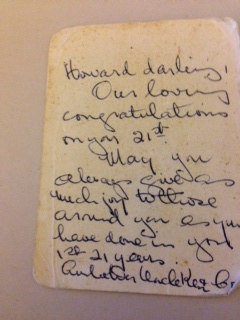
The bookmark was tiny, about two inches by three. Inches, because the card dates back to pre-metric days. It was was yellowed a little, its edges furred and thickened. On the obverse was a tiny posy of dried flowers, pressed, still intact. The date on the reverse side read January 8, 1967.

I think my mouth fell open. I recognized the handwriting – an odd and elegant hand, it looped and curled in a crisp and orderly way, warm yet somehow formal. No-one I know writes like that, not any more.

The writing was Mum’s!

The greeting was affectionate. It began, “Howard, darling…” It went on to congratulate me on my twenty-first birthday. The message spoke of my twenty one years, praising and prizing me in the way only one who had known me from birth could do.

I felt the rush and the glow of that primal love, the love that formed me. I felt deeply happy.

I looked up and faced the young woman. “Thank you.”

She averted her eyes from my face that was surely naked.

I looked down again and read the signature. It wasn’t Mum who had signed the card, but her sister, my Aunty Doreen. The handwriting so similar, the shared cuneiform of their bonded lives.

Now it was Aunty Doreen who returned to me, not displacing Mum, but present alongside her, together now as ever through their long lives. If Mum was Pollyanna, Aunty Dor saw a world in its rough reality. Orphaned early, the two turned to each other and went through their remaining scores of years love-laced and life-loving.

I held the card, soft in my hand, and thought of two women who knew me so well – better even than the author of the book I had loaned the young woman, witness to my intimate moment.

“Thank you”, I said again.

Wandering

My father’s father’s name was Joseph. Born in 1886 in Petach Tikvah in Turkish Palestine, Joseph Goldenberg stowed away on a ship at the age of twelve, passing his Barmitzvah date without celebration before disembarking alone in Australia. Papa, as his grandchildren called him, arrived here with five shillings, a working knowledge of Yiddish and Arabic, and no English.

He left his home and his family as a child, remaining an observant Jew throughout his lonely years until his marriage, and beyond, through a long life.

Dad used to say his father was like Joseph in the Bible, a faithful Jew from childhood to old age, steadfast through long exile and separation from his home and family.

Dad found lifelong inspiration in his father’s example.

My own father, Myer Goldenberg (z’l), grew up in Melbourne, married and took his bride, Yvonne Coleman, to the small Riverina town of Leeton, where the couple lived for 14 years, raising four children as knowledgeable and observant Jews. Dad never thought this was remarkable, but it was an unusual achievement and it certainly inspired this son.

Indelible memories come to me from time to time as I recite the Shema, of Dad teaching me to read and to translate every word of this, the first and the last prayer of our Jewish lives. I would sit on his knee, Dad holding his worn and oft-repaired siddur in front of me, his finger showing me each letter and his voice speaking these words time and again: and you shall teach them to your children, and you shall speak of them when you sit in your house,and when you walk by the way, and when you lie down and when you rise up…


A Jewish education of this intensity and intimacy is a rare and precious thing. It left this son with the unorthodox confidence that I could live an orthodox life fully and independently anywhere, with or without a community or a congregation to support me. My father’s example assured me that my own observances, my Jewishness, were proof against distance. Dad had taught me how to be a Jew as I walked by the way.

Dad never had any delusion that distance was a good thing. Well before we reached Barmitzvah age, Mum and Dad had resettled the family in Melbourne, where Dad showed (through his subsequent scores of years of service to Shules,) that the question was not whether he needed a congregation, but what could he contribute to one.

But the ‘harm’ was done. By the time we left Leeton, I had absorbed my father’s aberrant example of distance-proof faithfulness; and ever after I have lived a maverick belief in walking by the way, to remote places, well off the Jewish trade routes, taking with me the observances my father taught me. Over the decades, that phrase in the Shema has come to hint to me that a Jew should actively go bush – as Moses did in his shepherd days, as Elijah did while on the run from the king – to find God.

How did I know about Moses and Elijah? How too did I know about the midnight walk in the wilderness of Jacob; and of his encounter with the wrestling angel? It was Dad’s fault, of course: it had been Dad who brought these heroes of the spirit to life within me.

And so it was that I’d bake challah (read damper) in Leigh Creek, read Megillath Eicha by candlelight in Arnhem Land, host the Jewish residents of Alice Springs for Shabbat meals, discuss Zionism with a knowledgeable Elder in the Ngaanyaatjarrah Lands, sing Hebrew songs with one of the Strong Women at Galiwin’ku, sound the Shofar in Ellul at Wamoom; and celebrate Shabbat in the Andyamathanha wilderness with one of Melbourne’s leading rabbis.

(And so it was that I was been absent so often and so painfully from shules, from tolerant children and perplexed grandchildren, from a neglected wife and from a lonely mother.)

All of this unorthodox conduct had some unexpected results. I found what Joseph finds when sent by

his father to “see the peace of his brothers”. Wandering, lost in the wilderness, Joseph meets a mysterious stranger who asks – in a singular phrase – “what will you seek?”

Joseph replies, in a sentence that is equally pointed

syntactically, “(it is) my brothers (whom) I seek.”

The brothers whom I found are the first Australians. In encounter after encounter over a decade or more I have met and worked with Aboriginal people in the outback, discovering much about them, more about my

Jewish self, and writing, writing all the time of these experiences.

(That writing gave birth to a book, Raft, launched at Melbourne Writers festival in 2009.)

And deeply moving to me were those experiences as a practising Jew, when alone in God’s creation, I’d wrestle with the angel, and where I’d catch the echo of a still soft voice.

And, morning and evening, as I’d rise up and lie down in those far places, I’d recite the Shema, that prayer of portable Judaism that my father taught me.

Whale Mourning at Wilson’s Prom

My father walked these hills and steeps:

Woke early ever, walked rugged rockstrewn track

To the lookout, and back. Now he sleeps

Forever; and I rise with the sun


On this second day of the last new moon,

Of the dying year;

And sound the shofar, the ram’s horn warning*,

Then go for a run on a crystal morning.


My Father walked till his dying year; I follow his track

Across the bridge,

Then up the hill and over a ridge –

Then back; pausing to view a sapphire sea.


High here, on air, at Wamoom**, this southern

End of a continent,

Comes remembrance, a fifth element:

Midst earth and water I stand, content,


Basking in the gentle fire of an early sun

Then turn

To start the slog and gasp and sweat – up hills

And tracks on the ridge of the returning run.


Stop! – cries the voice of my companion

And turn!

And look out to sea, and see – there’s a whale!

I stop and turn and look – and sight the sail-


Shaped fin, the hump of back, the mammalian

Brown-black, a bruise

On the blue face of the sea. Now it sinks again

And as I smile, give thanks, and muse


It surfaces and plays, and sprays its spume

At the end of the dying year.

Another whale was here, beached, dead; while with my father

A decade ago, I saw it. We paid homage at its sandy tomb.


* Through the month of Ellul, Jews sound the ram’s horn, as a call to repent before the solemn days of the High Holydays.

**”Wamoom” is the Aboriginal name of Wilson’s Promontory.

Excerpt from My Fathers Compass by Howard Goldenberg. Hybrid 2007, 2008.

Cerebrovascular Accident

Ten or twelve
Only ten or twelve
Strokes of havoc
Quite unselve…

(from Binsley Poplars, Gerard Manley Hopkins)

Self-pity. It’s Amy Clampitt’s fault:
blame amy.
In her “Beethoven, Opus111” –
A poem, its title promising
Music, but its texture and girth
Thick with root and thorn, and earth,
The toil of her farmer father, the clodded
Soil his foe (and freiheit!) and moil,
She speaks of his dying, his escape
Into air, and I wondered: how will I
Go there?
I smiled to imagine his “last act,
to walk on air.”

But then I remembered: one hundred and seventy
on one hundred and ten, numbers that number my days, Dread then, of a stroke broke my smile:
To sit, endless,
Helpless, in my piss
And my shit? Well
That’s how I started, how my grandruby sits,
The happiest of souls, she laughs in fits –
Why might not I subsist, exist, persist –
Unlearn, and learn and earn to laugh like Ruby?
My Mum had strokes, stroke upon stroke –
The doctors lost count; but she, like Ruby,
Knew only stroke upon stroke
Of joy: I’ve never been happier in my life, Mum
Said. And meant it. And showed it.

Mum followed Beethoven into the quiet
Of the deaf, whither I tiptoe too: there
White noise abates, music awaits,
Remembered. And you hear less bullshite.

But if a vessel, sclerotic, brittle,
But block or blow or burst,
It’ll tear, shear, shatter my brain,
And blind me: in that pain – in that pain
Would I, could I smile again – in that dark?
If I, like eyeless Jacob upon the head of Ephraim
Rest my hand on Ruby: I’d smile again

But come that stroke
That stroke
That takes away words –
My words, coin of my world,
Uncoined then, mute, truly broke,
To speak no more, nor write –
Not to ask, nor thank, nor say: I think…
Nor pray.
Nor ask, scratch that itch;
Never again speak my love? Never indite?
Not utter?
Mouth fail, tongue in jail,
Hand flail, pen fall?
That stroke, that stroke,
What, never crack a joke?
Never?
No, not
Ever.

Self-pity is the sincerest emotion.

Sexual Misconduct

A first grader I know confided in me recently. He said, I’ve got a problem. You know my girlfriend, Tori? She kisses me and she wants me to kiss her. At school!
I didn’t see his problem: Is that bad?
Yes! What if the teachers find out?
What would happen if they did find out?
They would send me to the principal.
Why?
The child looked at me as at a simpleton. Because you can’t kiss people at school! It’s against the rules!
Really? I never saw any rule like that? Especially if the girl wants you to kiss her. And if you do.
Exasperated now: Look, if we kiss and other kids know about it, soon the whole school would be kissing…
That’s better than fighting, isn’t it?
A deep breath. He tries a different tack: What if Tori’s parents found out?
What if they did? If your parents wouldn’t mind – why should her parents feel differently?
You don’t understand. Tori’s parents aren’t like mine. They… they live in a great big house…They would go crazy if they knew I kissed Tori.

376,000 Footsteps in the Sisterhood of Man

It was the running of the Jews. Not in Khazakstan but at Melbourne’stan.

Historically, you only saw a bunch of Jews running if there was a fire or a pogrom. But yesterday hundreds of Jews were afoot, an infrequent event since the original Fun Run across the Red Sea. (On that occasion all the Israelites crossed the line. The Egyptians failed to finish.)

We Jews were not alone at the Tan: joining us were Africans from the Horn and from Mandela country; a pair of Iranians, a smiling Swiss, sundry Catholic Australians; the odd Chinese, a couple of Argentines and their Australian born progeny. And my wife and my not-very-old oldest grandchild.

If a kilometre is one thousand metres and the average human pace is one metre, and the circumference of the ‘Tan’ is 3.76 kilometres, then a single lap represents 3760 paces. Yesterday saw 376000 paces in the sisterhood of man.

My team, “Queue Jumpers”, named in honour of those disgraceful individuals who do not go through the correct channels, raised about 1800 dollars. The entire event raised in excess of $20,000, to be spent in two struggling Aboriginal communities in far north NSW and in a Community Centre for queue jumpers from Darfur.

Over coffee, before the event Akbar the Persian storyteller told a story. Akbar has elevated my runs over 25 years – ‘one quarter of a century’, he observes – with folktales from his homeland. Yesterday’s story: The revolution was coming in Iran. We knew people, Bahai, whose houses were burnt by militants. A friend said to us – do not stay in your house. It is not safe. They will burn your house next.

We decided to leave. We went to a cousin’s house. But another warned – ‘this house will be burned tonight.’

We had to leave. We all ran from the house but a man with a big automatic weapon stood outside. He said: ‘Do not go. They will burn this house only when my body is dead.’

That man was Savak. Secret Police. But we did not wait. Instead we ran. We ran to the house of the parents of this young woman…

Akbar here indicated his niece, Paloma. It turns out that Paloma -‘dove’ in Spanish – speaks Spanish fluently. This dove was born in Bristol. She takes up the story: My father was in America. He bought a red Ford Mustang. I sat in the back; there were only two doors. He brought the Ford Mustang to Bristol and he drove us, Mother and me and Father, to France, then all across Europe, all the way to Iran. I was four when we left Bristol, but I remember the red car, I remember I sat in the back.

Akbar takes up the story: We ran to the house of Paloma’s father and mother, all of us – myself, my parents and my cousin. Paloma’s family took us in and we stayed. We stayed in their house for nine months and we were safe.

And then we came to Australia.

Akbar smiled. He said it was time for a real Persian story. He told a folk story, of Mullah Nasruddin. Akbar’s story took us to a different age, a different place. We sat in the sunshine and watched and listened to the genial teller of tales as he smiled and talked.

Then we arose and ran, we Aussies, we Jews, we Muslims; we Africans and Catholics; we old and wrinkled ones, we new and sprightly ones; we arose and ran 376,000 footsteps in the Sisterhood of Man.


What Would You Do? – Part 3


 This was one of Dad’s stories that made me when I was small – probably made my brothers and my sister too:

Dad said: “We lived in North Carlton, where all the Jews lived. We were all poor. Even after the Depression, when we weren’t so poor we never forgot the poor times.

“My Father – your Papa – told us a story about King and Godfree. Papa went there once in, the hard times, to buy food.

The grocer said: What can I get you, Mr. Goldenberg?

Three pounds of potatoes, please Mr. King.

What else?

A pound of flour.

The grocer weighed the spuds and the flour.

What else, Mr. Goldenberg?

That’s all. Nothing else thanks.

That’s not enough, Mr.Goldenberg.

What do you mean?

You’ve got three sons, growing boys. They need milk, eggs.

No thanks Mr. King.

The grocer left the counter for a moment. He came back and placed a dozen eggs and a quart of milk on the counter.

Papa shook his head. No Mr. King, I won’t take those. I’ll take what I can pay for.

You take them now Mr. Goldenberg. You’ll pay for them when you can.

Papa never forgot that. From that day he always shopped at King and Godfree.”