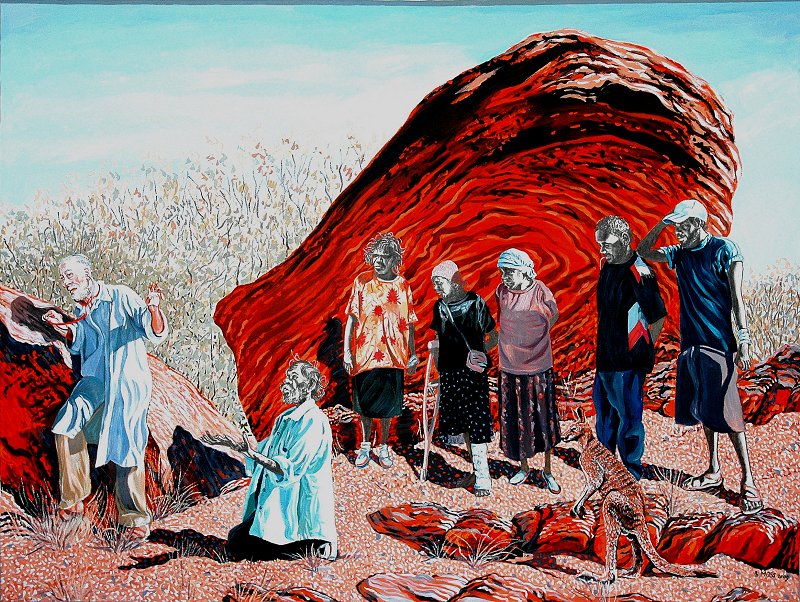
Where Do We Come From, What Are We, Where Are We Going?

This blog has spent the Passover period training for the Boston Marathon. Training has consisted exclusively of that intensive form of carbo loading which is the consumption of loads of matza. As matza is highly constipating carbo unloading has presented a challenge. Reminiscent of Martin Luther, who struggled mightily with his bowels, the Passover observer passes little.

In short I have been busy: as a result the blog has followed the admirable maxim of the ancient Sages of the Mishna: “Do much, say little”.

Shortly the blog will have much to report: of a visit to sit at the feet of another Ancient Sage, Dr Paul Jarrett, 95-year old surgeon of Phoenix Arizona; of fetching myrrh to Jack, the new babe born unto us Goldenbergs in San Francisco; of drinking GOOD COFFEE ! in New York City!!! (at ‘Little Collins’, my nephew’s celebrated joint on Lexington Avenue); of learning the latest in neuroscience from Joseph John Mann at Columbia Presbyterian; of Shabbat observing in New Rochelle; of entraining to Boston on the Sunday; and on Monday 20 April of observing Patriots Day in Boston.

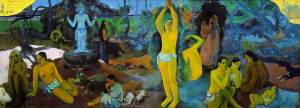
On Patriots Day much is afoot in Boston, when this Athens of the United States becomes Sparta. The public holiday commemorates the ride of Paul Revere and the start of the American Revolution. (I refer to Boston as Athens as an incubator of wisdoms but also as the place of Gauguin’s masterwork, ‘Where do we come from, what are we, where are we going?’ That painting and its title encapsulate the entire enterprise of human storytelling.
The painting is strategically located in a gallery situated directly across the road from Dunkin Donuts [Aussies must indulge the local spelling] where the donuts are certified kosher. But I digress.)
gauguin.org.au

For us runners Boston is THE marathon. More broadly, Boston, most humane of cities, hosts the most charitable of marathons. The event admits both the athletic elite and the footslogger, those who qualify by their speed over 26.2 miles and those who qualify solely by fundraising. I belong to the fundraising sluggards. This will be my fifth Boston, a further opportunity to put my feet to the service of the good. Unavoidably we come here to evil: in my old home town of Leeton a bride who loved the colour yellow is murdered unaccountably one week before her wedding day; in Boston bombs explode the innocence of thirty thousand runners and one million natives. Three die, two hundred and sixty four injured – many grievously – survive.

And I ask myself: Where do we come from, what are we, where are we going?

The small town of Leeton turns out to honour lost youth: multitudes gather in the park wearing yellow; married women hang their bridal gowns on front fences; on the victim’s planned wedding day brides all around the country add a dash of yellow to their apparel.
In Boston the city grieves, runners shake their heads, and return to the marathon with intent. Among them is one Gillian Reny.

“The Gillian Reny Stepping Strong Fund at Brigham and Women’s Hospital will support life-giving breakthroughs in limb reconstruction, bone regeneration, orthopedic and plastic surgery, and skin regeneration. Established by the family of Gillian Reny—a young, pre-professional dancer who was critically injured in the 2013 Boston Marathon bombings—the fund will fuel cutting-edge research and clinical programs in three areas:

Stepping Strong Research Scholars
: The Research Scholars project has two components: using stem cells to advance bone regeneration, and developing better methods to regenerate skin and heal wounds to reduce the suffering of amputation.  

Stepping Strong Trauma Fellowship
: The Trauma Fellowship will train the next generation of trauma surgeons in advanced techniques for treating acute and complex traumatic injury. Fellows will gain proficiency in surgical management, rehabilitation, limb reconstruction, and scar management.

Stepping Strong Innovator Awards: 
To inspire innovative research in areas including limb regeneration, limb transplant, advanced stem cell technology, orthopedic and plastic surgery, and bioengineering, BWH will offer Innovator Awards through an annual, competitive, request-for-proposal process. These awards will fund high-reward projects by our best and brightest physician-researchers.”

This is the good for which my feet will run on Monday April 20. This, like the wearing of the yellow, is the good that transcends evil. This is the good to which you can contribute. Go to:

https://www.crowdrise.com/brighamwomensboston2015/fundraiser/pheidipidesgoldenber

Abbott and Abbot: The Ethics of the Fathers

One of the more accessible elements of the rabbinic literature is PIRKE ABBOT, a collection of maxims, proverbs, pithy sayings and principles of early post-biblical sages. Literally translated, Pirke Abbot should be ‘Chapters of the Fathers’, but ‘Ethics’ is generally preferred. By curious chance ‘Abbot (fathers)’ is a homonym of ‘Abbott’ (Prime Minister of Australia).

Pirke Abbot makes lively reading. It includes some very golden rules
for living. Such are the maxims of Rabbi Hillel, a sage beloved for
his humanity. He wrote: ‘If I am not for myself, who will be for me?
But if I am only for myself what am I? And if not now, when?’
My nine-year old grandson Miles, much troubled by predictions of a
world where temperatures would rise and life be threatened, noted our
government’s anaemic response to the matter and wrote to the Prime
Minister echoing Hillel – if not now, when?
‘Dear Mister Abbott’, he wrote, ‘Please protect our planet before we
run out of water and every living thing will die.’
Mister Abbott, as befitting the Father of his country, wrote back to
the child he’d sworn to protect:

letter from tony abbott

(In summary:)

Dear Miles,

Thank you for taking the time to write to me. It is a very good thing that you are
interested in the wellbeing of our country. I hope you will continue
to show this interest in the future.’
The letter was signed (in ink), ‘Tony Abbott.’

Miles was not reassured.

“Mummy, he did not even mention the environment and what he was going to do about it.”
When Abbott succeeded Turnbull as leader of the Liberals, I felt
Australian politics might become more interesting. Here was something
novel, a potential prime minister who happened to be a conscience
politician. Noting Abbott’s sincerely held opposition to abortion and
the unpopularity he had courted in his restriction – on principle – of
an ‘abortion drug’ much sought by both doctors and patients, I
thought, ‘Well, I don’t like his politics, I don’t think he’ll last
long, I don’t much like his style, but I respect these signs of
integrity.’ Meanwhile the urgers in the Murdoch press drooled in a
chorus of relief at the eclipse of Turnbull and of the climate.

Of course, I had misjudged Tony. Moralistic but never simply moral, he
achieved a professional politician’s capacity for the flexible
backflip. His ‘style’ flowered into an idiosyncratic misreading of the
public mind that robbed the poor to enrich the already rich; and
culminated in advising the woman whose job it is to create knights to
dub her husband, a non-Australian, Knight of the Order of Australia.

At this stage the public gasped in disbelief, Abbott’s own party
gagged and even the Murdoch Urgers looked about for a successor to
anoint. Commentators commented – that’s what I am doing now – and we
all had a wonderful time frothing at the inevitable (if not imminent)
fall of this man of hubris.
Enter another grandson, Joel, aged nearly four: fresh off the plane
after three years’ exile in Britain this young citizen observed the
image of Tony Abbott appearing day after day for on the front page of
the paper.
He asked: ‘Who is that man, Mummy?’
‘He is the man the people of Australia chose to look after us, darling.’
‘Why is his picture in the paper?’
‘People are feeling cross at him.’
‘Why?’
‘You know how people in this family try to be kind to each other?
Well, people feel cross at that man because he hasn’t been kind to the
people he should look after.’
[At this stage I need to inform the reader of the Corrections
Protocols operating in Joel’s household: in the case that one child
having many toys withhold a toy he isn’t using from his smaller
sister, who then purloins said toy; and that older child then belt the
younger, the older child’s conduct is designated as ‘not kind’; and
that elder child is directed to take some time out. He is sent to the
staircase where he must sit and reflect upon his unkind action until
he feel ready to seek forgiveness and make amends]
Joel, regarding the image of the Prime Minister pictured descending
his aircraft’s steps in Canberra, said: ‘That man needs to go to the
time-out step.’
In the event, ignoring Hillel’s second clause of selflessness, the PM
followed only the sage’s first clause: ‘If I am not for myself, who
will be for me?’ He brought forward the party room meeting to deprive
plotters of time to plot. His party met and voted him not time out but
more time in.
Abbott vowed he would change. He’d listen. He’d become consultative.
Good government would ‘start today.’ No-one believed he could change.
I do not believe he can. But how miraculous would it be to witness
such change, how interesting to watch a small spirit grow and enlarge
and show kindness?

The Faithful Fibroblast

Late last October the Boston Athletic Association sent me an email which read:

‘Dear Pheidipides Goldenberg*,

Kindly advise us of your postal address forthwith so we can forward the race package for your entry to the 2015 Boston Marathon.’

I sent my details forthwith and equally forthwith I began to train for the great event. Now, my alert reader might recall the sincerity and warmth with which I wallowed in self-pity in my incapacity last (southern) winter. I posted a piece titled ‘Farewell’ https://howardgoldenberg.com/2014/07/28/farewell-farewell/, a lament for injuries that would permanently prevent running. I indulged in a prolonged period of warming sorrow, recalling better times. After three decades of running that were halcyon my winter of 2014 was halcyoff.

I know well not to expect an injured and abused skeleton, aged in its late sixties, to heal. My forty-four marathons had smashed knee joints and mashed vertebrae. Sciatica taunted my left thigh with every footfall. I stopped running and I rode a weasel bike. This morally feeble substitute served until osteoarthritis screamed from my left knee whenever I pushed down on the pedal. I stopped all exercise and sulked and nursed that achilles’ limb.

Sulking did me good. After a team of physiotherapists rubbed and probed and pressed sore spots until I squealed; and having found those sorest spots they pressed harder and I squealed the more; and after they prescribed exercises too intricate for me to conceive, to be repeated thirty times a day; and after I tried each exercise once before giving it away; after all this I sulked. And in my sulking I enlisted the faithful fibroblast and it is to that unglamorous cell that I owe thanks.

I last met the fibroblast in my second year of medical school. That was in 1965. I learned then of that industrious cell, of its role in building connective tissues. The fibroblast is the humble builder’s labourer of the foetus. It creates the neonatal skeleton and muscles. Once the human – so intricate, so cunning, so elegant in design, so glorious in execution – has been built the fibroblast might deservedly rest on its laurels. But it does not. Instead it lurks and waits for any damage it might be called upon to repair.

Sprain an ankle and fibroblasts swarm to the site, building, building, building. They create a fibrous scaffolding which, together with nests of new capillaries, is appreciated as a hot swelling at the site of the tear in the ligament. Slowly, thanklessly, this busy little cell knits new fibres to replace the old. Slowly the damaged dancer or skier or hockey player rises and flies again.
But that leaper or runner or slider is fifteen or thirty. Chockers with fibroblasts, at those ages she is indestructible.

Then the day arrives that she turns fifty, when her collagen sags, her ovaries shrink, her mood sours and she sweats her nights through and celebrates the menopause ‘and all the daughters of song are brought low.’

Her man is even more pathetic when ‘desire fails and man goeth to his long home and the mourners go about the streets.’

On the other (more cheerful) hand the poet John Donne wrote:
‘… from rest and sleep
Which but thy pictures be
Much pleasure…’

My spine had rest and my knee slept. June came and passed and with it passed the marathon in Traralgon. August came and for the first time in ages I missed the marathon in Alice Springs. In October Melbourne ran its annual marathon without Pheidipides Goldenberg.

Then Boston sent me that email.

And together with Johnny Donne my knee sang and my spine caroled: ‘Death, thou shalt die,’ as I rose and ran. Since October I have tested the knees on the rocky slopes at Wilson’s Promontory. I have tried but failed to provoke the sciatic nerve in Central Queensland and in outback NSW. I have thrashed the skeleton in Pittsburgh, in New York and in Boston where, three weeks ago I ran the slopes of Heartbreak Hill. I froze but I felt no pain. The next week I ran fast up the length of London’s Muswell Hill to the top, then I turned around and galloped down. This short run constitutes a brutal abuse of synovial membrane, of articular cartilage, ligament and tendon.

I listened for protests from the body. But neither degenerate hip nor spinal nerve made any murmur. Incredulous, I gave thanks to the long ignored, sadly neglected, ever-faithful fibroblast.

One of my favourite poems for sulking is Ecclesiastes, 12. With language like this it’s a pleasure to be sad. Here’s a fuller portion for your enjoyment. You don’t need to run a marathon or injure your body:

1 Remember now thy Creator in the days of thy youth, while the evil days come not, nor the years draw nigh, when thou shalt say, I have no pleasure in them;

2 While the sun, or the light, or the moon, or the stars, be not darkened, nor the clouds return after the rain:

3 In the day when the keepers of the house shall tremble, and the strong men shall bow themselves, and the grinders cease because they are few, and those that look out of the windows be darkened,

4 And the doors shall be shut in the streets, when the sound of the grinding is low, and he shall rise up at the voice of the bird, and all the daughters of musick shall be brought low;

5 Also when they shall be afraid of that which is high, and fears shall be in the way, and the almond tree shall flourish, and the grasshopper shall be a burden, and desire shall fail: because man goeth to his long home, and the mourners go about the streets:

6 Or ever the silver cord be loosed, or the golden bowl be broken, or the pitcher be broken at the fountain, or the wheel broken at the cistern.

7 Then shall the dust return to the earth as it was: and the spirit shall return unto God who gave it.

8 Vanity of vanities, saith the preacher; all is vanity.

*My running name

Image

The Sweet Taste of Revenge

The oldest friend of our married life is a parson. After inspiring and marrying hundreds of young believers and unbelievers and halfbelievers; and after watching their marriages fragment – fast or slow – and die, John concluded he was not a success in bringing people’s lives together. He left the parsonage and took up God’s work in a new business: in his own words, ‘I spent a year in gaol.’ The parson became a chaplain.
‘Long Bay Gaol was just like other congregations I’d worked in – lots of sinners, lots of righteous people (“I never did it… it was someone else’s fault…I was framed…”), and lots of people who couldn’t care less about religion. I didn’t mind the unreligious and they didn’t mind me. The convicted were just people, by and large. I found most of them likeable enough.
‘But a few of them were hard to like. There was one man who’d been convicted for trying to incinerate his girlfriend. She survived, horribly burned, but in the process he killed the masseuse who was treating her at the time. He was quite unrepentant, quite without conscience, but nevertheless he became one of my most frequent parishioners. He’d visit my office frequently, ostensibly for spiritual guidance. All he really wanted was the luxury of private conversation. I did not like him, but I couldn’t let on.
‘There were others in the gaol who were just as unlikeable. One was a warder, one of the ‘’screws’’, as the prisoners called them. This fellow treated the prisoners brutally. He was feared and hated. He used to visit me often and he was just as persistent, just as falsely pious and just as unwelcome as the murderer.
‘The murderer confided once how “cons” had their ways of getting back at the screws they hated most. He said, “Father, we piss in their tea.”
‘I understood how that might be. The best-behaved prisoners enjoyed the privilege of waiting on tables in the Officers’ Dining Room. That was where I ate. The prisoners prepared and serve beverages. One day I went to that Dining Room for lunch. I loaded my tray and sat at a table out of the way to enjoy some privacy. Out of the blue, bearing his own tray, that brutal fellow was at my shoulder, declaring, “Father, you don’t mind if I join you.”
I did mind of course, but I said the opposite, of course.
A prisoner turned up and asked us for our beverage order.
“Tea, white, two sugars,” said my guest.
I asked for the same. That waiter, my religious friend the incinerator, said, “Certainly, gentlemen, I’ll bring them presently.”
The con returned carrying two mugs. ‘This is yours, Father”, he said, as he laid my drink on the table. Then he walked to the other side of the table, placed the mug before the screw and said, “And this is yours, sir.” As he spoke he shot a huge wink in my direction.
‘What did you do, John?’
‘It was a moral emergency. If I remained silent I would be party to a wrong. If I spoke I would breach a confidence. I drank my tea. I watched the screw drink his.’

John’s story brought to mind my cousin’s account of certain events In Israel during the first Intifada. She wrote: ‘Consumers of a particular brand of hummus remarked on a change in the product. It didn’t taste bad, just subtly different. Closed circuit TV in the factory caught Palestinian workers wanking into the vats.’

***

Neither the hummus masturbators nor the prison micturators could have read the more recent American novel, The Help, in which a white racist woman consumes chocolate cake containing the ordure of the ‘help’ – an unfairly dismissed African-American woman.
I recount these stories to offer succour to a friend, a novelist, Margaret.
Now Margaret enjoys the attentions of a literary assassin, a relative by inheritance, a sort of outlaw-in-law. That person claims a critical authority and a mission to improve HCG by means of brutal dismissal.

The critic and the writer are destined to meet from time to time; what can Margaret do to fight back?

All the examples quoted have their appeal. The cake is of course, irresistible but time-consuming. The hummous is nourishing but beyond the resources of an unaided female. I suggest Margaret make her nemesis a cuppa tea – white, of course, with two sugars.

Once Upon A Writer

Once upon a time I was a writer… No, not once – thrice upon a time.

First time: in second or third class the teacher directed us to write a composition. We did as we were told. I enjoyed writing. My composition was chosen and read to the class. I was a writer and one year later, when the Melbourne ‘Age’ published a little piece, I was a published writer.

Second time: at medical school, achieving mediocrity in exams, I found relief editing and writing for a paper. I published what I wrote.

Third time: with a family now grown up and my own parents failing, I was a writer heavily charged with material. I wrote and my friends and family responded. Among the responders one friend in particular responded decisively. Often enough she responded derisively; and not just often enough but more often than enough.

I had good reason to pay attention to my critic friend. She had been an adult reader for many more years than I had been an adult writer. Further my critic was trained in criticism while I was untrained in writing.

Curiously my early vulgarity didn’t trouble her much. My sentimentality (an abiding tendency) excited little reproof. And even the structural shambles, the way narrative fell upon narrative by accident into a happy enough heap, provoked no rebuke.

The problem with my writing was the writer. Contrary to my critic’s command I did not write of Howard the way Howard should write of Howard. In truth this was not willful delinquency (another abiding tendency) but incomprehension. So stratospheric is my critic’s sophistication, her principles eluded me.

The pages of my first two books are Howard-haunted. Howard Bloody Goldenberg is to be found in the middle of every page or in its margin or inescapably behind every page, pages that can never be thick enough to disguise Howard. This drove my critic mad. It was not that Howard was full of himself (he is that) but that Howard was represented without precisely the ‘self-reflexivity’ (my critic’s term) that she demanded. ‘Howard’, she wagged her finger imperiously, ‘Howard, you are refusing to become the writer Howard should be. Your subject, your great subject, is Howard…’

This criticism, emphatic and oft-repeated, merely increased my self-consciousness. Eventually it would drive Howard from the page. Thus, in book number three (‘Carrots and Jaffas’) there exists a character who resembles Howard but is not Howard. Although that character is a male in his sixties, a compulsive storyteller, an outback doctor with a large nose and lavatorial obsessions, he is not Jewish, not Howard per se. In truth I no longer trusted Howard to create Howard. My critic had achieved something worthwhile; she had demolished a formerly impregnable exhibitionist. This was surely to the good, for Howard the person showed an objectionable and retrograde refusal to adopt my critic’s view of the world. (The critic started adult life as a social activist, becoming a member of a commune, a welfare worker, resolutely a conscious and conscientious proletarian. In time she learned the profound error of her ways and unlearned her early amused tolerance of Howard’s political softheadedness.)

Meanwhile Howard had become a blogger and my critic became my bloggee. I would write, my daughter would post and my critic would criticise. More and more my critic criticised Howard for not being my critic’s faithful disciple. At one stage, in outraged surprise, she accused me of being ‘green’.

Given this blog’s unrepentant diarising of Howard’s life, his thought, his memories and stories – in short this blog being Howard on the virtual page – my critic found the entire exercise personally provoking. Possibly intentionally so. Her criticisms of Howard were now unrelenting, and of course, public.

It is timely here to remind my reader that my critic is a friend, that she certainly wishes for nothing more than my improvement. She has in mind my ascension into a literary realm which exists clearly in her sight and quite outside my powers of vision. In her private love of Howard this friend is staunch. In public she is an attack dog. At first puzzled, later a little hurt, eventually wryly amused that such a thing might be, I accepted her blank rebuttal of my private objection to her tone. ‘Howard’, she wrote (publicly of course), ‘Once your writing emerges into the public sphere you cannot expect criticism to remain private.’ Fair enough. Perfectly logical, fully consistent with literary purity. And perfectly blind to the imperatives of friendship.

I came to accept a painful reality:

The moving finger writes,

And having writ, moves on;

Nor all thy piety nor wit

Can lure it back

Nor cancel half a word of it

(From the Rubaiyyat of Omar Khayyam)

Eventually the moderator of this blog published guidelines of the limits to decent blogly conduct; and the critic, declaring herself to be my ‘troll’ (to me a new concept), banished herself from these pages.

My critic helped me immensely. She forced me to examine every self-syllable I wrote. She required of me an intensification of my self-consciousness. To this day she shadows every line I write, shaping my writing to conceal my thought, as she peers through the ether for Howard malignancy, stimulating me to a meticulous attention to some standard I never grasped but for which I blindly reach. Of course the cost is a friend who, in the name of friendship, has shat upon friendship.

Life-long Friendship

My oldest friend is named John Baikie Wanklyn. Johnny calls me Doff and I call him Johnny, and sometimes, Wank. We have been friends since the summer of 1950. We first met outside the front of his father’s shop, the Leeton Furnishing Company. At least that’s how I remember it: I was playing with something inconsequential, a little stick, perhaps a toy car too, on the concrete paving. An area of dark and pleasant shade thrown by the large verandah. I became aware I was no longer alone.

Did Wank walk up and say hello? Or did I wander along and join him? I don’t know. I was playing alone and then I was no longer alone. My mind holds the scene like a dream. And like a dream there are no borders to the image: my mind sees the cracks in the concrete where my fine stick ploughs and throws up a narrow furrow of dust. There is the deep shade and beyond the shade the great heat. I know that heat in my skin. Whenever I leave the coast in summer and move inland that dry heat greets me and welcomes me home.

An additional element in the scene is our smallness in the world. The shaded area would be about five metres by, say, about twelve metres. That area encompasses two fine figures of children of four years, the margins seeming distant from us as we play. One of us asks the second his name. The second asks the same question of the first.

‘It’s my birthday next week,’ says one.

‘It’s mine the week after. I’ll be four.’

‘Me too.’

The two resume playing until a parent calls one of the children. That child and his parents and elder sibling are going to visit the Harrises. The other child – this feels like me – goes home and finds his parents are taking him visiting too. He is cleaned up and taken along. And discovers he is at the Harrises where he plays with the Harris girls and another visitor, the new boy from the Leeton Furnishing Company. The three families drive down to the river and picnic there. The Murrumbidgee is the great fact of life in the area; it shapes our Huckleberry years.

The dimension of time has a distinct character: we meet in January of 1950; we part in June of 1955. In the course of those spacious years a pavement is laid in our lives. He is Johnny, I am Doff, we are friends. In that space we accumulate experiences together that fade in detail but burn in memory, in their texture, in their felt quality, in their great mass. By the time of our parting those few years account for more than half of our lives.

We shared enough for it to remain enough. Enough for Wank to refer – thirty years later – in conversation with a friend, to his ‘brother.’

The friend, confused, says ‘Who’s this brother Howard you speak of, John? I thought your parents only had the two children, you and Julieanne…’

‘That’s true. They did. But Howard Goldenberg is the closest I’ll come in this life to having a brother.’

One night in 2014 a bad dream disturbed my sleep: John Wanklyn had died. I awoke crying aloud, ‘Wank is dead!’ I wept: I’d never see him again. A moment later I was smiling. Of course I’d see Wank again; Annette and I were to drive to Albury to visit John and Christie next weekend.

Am I Wank’s best friend? Is he mine? We have never spoken on the matter. I know I’ve never addressed it. There is no need. The questions have no weight. They would be as strange to us as to blush or nudge-nudge at the word Wank. Neither of us has ever had a friend like the other. There can be but one first friend.

Jewish education called us from Melbourne and tore our family from Leeton. The tearing was painful for me. I saw before me a great gulf open. I kissed my friend goodbye. Wank looked at me, confused by an unexpected act.

We wrote to each other, signing our letters, ‘Your old school chum, Wank’, ‘Your old school chum, Doff.’ We managed to see each other a couple of times a year, inserting the other into lives that were changing fast. The visits continued until my barmitzvah.

Johnny and his parents came to Melbourne for the celebrations. He had never been in a synagogue. I saw my friend holding the unaccustomed cap, I saw the strangeness to him of prayers in Hebrew, I saw the strangeness of Melbourne Howard to Leeton John. I saw it and I felt it all painfully.

Years passed without further visits. Through the letters that our mothers wrote I knew the events of Wank’s life and he knew about mine. The two women loved each other. Their letters, always in blue ink and lovely copperplate, continued into old age until one declared her handwriting no longer ‘respectable.’

In 1967 a phone call came from Wank in Sydney where he was studying Pharmacy. As I was not at home, Johnny left a number. I was in residence at Queen Victoria Hospital in my fifth year of Medicine. Mum rang and gave me Wank’s number. But I misplaced it. I thought of it from time to time. And the years passed.

The Jewish Sabbath doesn’t finish until nightfall on Saturday. It was eight o’clock on a Saturday night in the ‘nineties when Annette and I left Melbourne for the drive to Albury. It was midnight as we reached the border at Wodonga. I drove slowly, my eyes searching for something needed. There it was, black, silent, broad, gleaming in the moonlight – the Murray. It wasn’t the Murrumbidgee, river of Leeton days, but the river knew me and I knew it. We drove the few remaining minutes through quiet streets, turning left as directed at the Siamese restaurant. One turn to the right then we parked, got out and knocked. A giant – he’d have filled his father’s verandah shade outside the Leeton Furnishing Company – emerged from the house. He swept me into his arms and kissed me. Later we sat, Wank and Chrissie and Annette and I, speaking softly for children asleep. Wank said, ‘I kiss my boys and I just knew it would feel right to kiss you too, Doff.’

It was a hot summer’s day. A boy was playing alone and was no longer alone. Neither boy has been alone since.

Melatonin and the Meaning of Five Lives

Melatonin and the Meaning of Five Lives

– written in the high season of jetlag

Why would I wake after only four hours of sleep? Here I am, sleepless in Pittsburgh. It is 2.00am and for five days now I have slept too little. There is nothing to stop me sleeping: the house is quiet, snow falling outside hushes the world. Sleep is an ambition unrealised.

My mind has nothing useful to do other than to keep me from sleep. My mind visits my home in Diamond Creek. The date is December 7, 1974. I see it all in the dark from my bedroom upstairs in the house of friends in Pittsburgh.

Around 7.00 am

I am first to waken. I wash my hands and a noisy clanking in the pipes threatens the precious sleep of the children. Steam emerges when I turn on the hot tap. I turn it off. I pay no heed to the meaning of noises in the plumbing, to steam from the tap. These are practical concerns; I wash my hands of practical concerns. I remove my wedding ring to recite my morning prayers and go to my work, leaving the children unkissed, leaving the ring on the dresser, leaving Annette as she prepares for the day.

Around 8.15 am

The receptionist says: ‘Mrs. West is on the line. She says it’s an emergency.’ I take the call. Lynne says, ‘Howard. I think you’d better come home, straight away. There’s been an explosion at your house.’ I don’t come home straight away; Lynne West is an excitable person and I have a patient sitting before me. More patients wait in the waiting room. I see these patients and I drive to my house.

Around 8.10 am

The house exploded.

Around 9.15 am

I do not witness the explosion but Lynne is eager to regale me: ‘I heard a loud boom from your house and I looked over and a huge cloud of smoke came out of the roof. And the walls fell down.’

But before encountering Lynne and her tale of smoke and thunder I turn from the unmade road into our dirt driveway at 36 Deering Street. Lying flat on the ground to my left are the brick walls of my home. Before me the driveway leads to an empty carport. ‘Empty, ergo Annette is not at home, the children are not at home. Ergo I have lost nothing but bricks and mortar.’ And, as I will discover later, a wedding ring.

Until I married I disdained rings on men. Worse than effeminate, in my regard they were affected. A judgement made before I married. This ring was different: slender, of unostentatious white gold, engraved on the inner surface with words of love from Annette, words for my eyes only.

Around 10.05 am

I run Annette to ground at her sister’s house. She has dropped our firstborn at kindergarten early, as she always does. Earlier Annette sat in the armchair, breastfeeding the newborn while the older two watched Sesame Street on a couch in the same room. I ring Annette and tell her she is homeless. That we have been so since shortly after

8.05 am

Annette and the children left home for kindergarten. Punctual as always. Not only early, but early for early, as I was prone to point out irritably, in Annette’s overturning of my native tardiness.

11.00 am

Annette joins me at the wrecked house. We find two goldfish still alive, lying in the few milimetres of water on the surface of the kitchen table. That flimsy table is one of the few sticks of furniture that still stands. Paintings hang at angles from the walls, canvas gashed by flying debris. The dining table lies in heavy fractions, its geometry denuded. Ancestral bedroom furniture has collapsed. Of the wedding ring no trace.

My mind is fixed on the hot water service that exploded. Emplaced on the slope beneath the house, the hot water service – that ticking bomb – stood directly beneath the armchair where Annette sustained our baby with her milk; one metre removed from the suckling pair were the Sesame Street watchers, sitting in pleasant terror of Cookie Monster. Lynne West’s ‘smoke’ was the steam released by that bomb.

Annette is upset: unlike me she never held in her imagination the thought that arrested me for one second or perhaps two: that my loved ones are lost. Annette is a mother of children and she knows, as I will continue to refuse to know, that a family lacking a home is a frail thing, that we have lost our anchor upon this earth.

Our son, aged two and a half, knows something. Prior to December 7 he is a highly verbal person. From that time, for the next six months, Raphael will not speak.

I lie in the dark, useless to myself, tossing in all this unusable time. But unwelcome consciousness wastes nothing. It takes me back thirty-nine years in time. There were questions that Annette faced in those first few seconds, questions that my son asked in his mutism.

In the simplicity of 1976 I asked nothing. Now the darkness asks me:

What does it mean?

Why has this happened – this loss?

Why has this happened – this being spared from loss?

What, as our lives were spared, are our lives for?

What will you do with, how will you use this time?

A novel experience, this guilt, this sense of time debt, the debt unserviced, accruing, unpaid. The infant at the breast, her elder brother, their big sister, each of them has employed the time, each has grown and grown, grown and learned, grown and created a family. Throughout all Annette has been their home.

What have I not attended to?

I must listen to the pipes. When the pipes, the pipes are calling I must listen. I must not wash my hands of practical matters. The practical reality was shrapnel of exploding wine bottles stacked next to the suckling chair, next to the Sesame watchers. Those jagged fragments were flung with force from floor through the ceiling into the roof space. Grenades of glass shattered the room of milk and sesame and soft infant flesh.

I must learn from the steam. Steam, as Lynne might put it, is smoke – and where there’s smoke, there’s fire. The steam warned me: get your loved ones to safety, far from the fire.

Why live? Why us? These teasing whys tease. Abstruse abstractions, they distract from the concrete, the practical.

And Annette? Annette is where truth is writ plain and practical. The truth lies with Annette.

These musings are, as I suggested at the beginning, the children of the muse melatonin. I am in foreign territory here, lost, perhaps even found, somewhere between memory and regret.

As if to answer the questions of the dark, questions I never spoke aloud, my host passes me ‘The Descent’, a poem of William Carlos Williams:


No defeat is made up entirely of defeat –

Since the world it opens up is always a place

Formerly unsuspected.

A world lost, a world unsuspected

Beckons to new places

And no whiteness (lost) is so white as the memory

Of whiteness.

The Prayer of the Traveller

Many of us are on our travels as I write this. Today I will resume mine – one hundred and fifteen kilometers by road before a flight of forty minutes (in the air we register time not space), then a break before resuming for the next seventy minutes of flight. Finally thirty kilometers of suburban roads. Then home. Home – that word for an idea that houses our love; for the island we build to grow a couple into a family. After two stationery days I’ll skip from the continent of my birth to the land of the free – three flights, ten security checks (eight of these in the US) – eighteen hours in the air.

Long before the Malaysian airliner disappeared I had my misgivings. The loss of a civilian passenger aircraft over Donetsk did nothing to comfort me. And now the AirAsia tragedy. Travel is dangerous. Out here in the Outback, the roads are full of kangaroo, wandering stock, feral donkey and camel, species which share with the shahidi a zest for homicidal suicide. Air travel, far, far safer, remains hazardous.

Travel has always been thus.

If you are a wuss (I am) and if you have a prayerful bent (I am severely bent in that way) you might pray for a safe arrival – and if you are needy or greedy (I am both), you’d slip in a word for your safe return home.

The following comes from the ancient Traveller’s Prayer recited by Jews. The text catalogues a surprisingly contemporary list of hazards:

May it be Your will to direct our steps to peace, to allow us to reach our desired destination in life, in joy and in peace.

Rescue us from any enemy, ambush and danger on the way and from all afflictions that trouble the world.

Let us find grace, kindness and compassion from all who see us.

You can fill in your own particular concerns. (Afflictions that trouble the world are plentiful. I think of Ebola. I think too of violence of all kinds – both abroad and within our domestic walls.)

An anxious Jewish traveller (Jewish people are past masters at anxiety), having completed the lines above, might feel the need for elaboration or emphasis. Such persons follow on with Psalm 91. I do. I love this one: I loved this one and I quoted it to my shell-shocked teenage daughters after two hilarious hoons chucked rotten eggs through the girls’ car window, breaking on and altering the grooming of their lovely long locks.

Five years ago, grandson Toby, famous in these pages for his flirtations with danger, drew a picture in vivid primary colours. The picture, three inches by one and a half, was intricate, pulsing with the vibrancy of his four-year-old being. Toby presented it to me: ‘This is for you, Saba.’ Since that day it has sat between the leaves of my travel prayer book. It guards the place of Psalm 91.

One who lives in the shelter of the Most High abides in the shade of the Almighty. He will save you from the trap of the hunter and the deadly pestilence. You need not fear the terror by night, nor the arrow that flies by day; nor the pestilence that stalks in darkness, nor the plague that ravages at noon. Though a thousand may fall at your side, even ten thousand at your right hand, yet unto you it shall not come nigh.

I am not simple – or faithful – enough to believe that simply reciting these words will guarantee my safety. Saying the words is not the equivalent of completing the enrollment forms in supernatural travel insurance. I am not insured. But it is in the beauty of the poetics; in the relief of putting fears into words then filing them away; in the unspoken reminder that in matters in which I am powerless there is no point fretting – in these I find comfort, acceptance.

I am not insured, just assured.

I wish us all safe travels.

Manny the Marathon Man

Manny Karageorgiou ran 42.2 kilometres yesterday, racing his oldest foe. At 58 years, Manny is the youngest of the Glorious Ten who have competed in and completed every single Melbourne Marathon. ‘Forty two kilometres’ – it rolls off the eye easily, but it’s a long way to travel on foot. My car gets tired over that distance.

Manny ran with the most reluctant consent of his oncologist. He delayed his stem cell transplant so he could keep faith with the Ten. This GP consented more readily despite the rib that fractured as it filled with tumour, despite the remaining bones waiting for fracture in the merest trip, bones brittle and chalky from the medicines and radiation. The GP consented; who could say ‘no’ to that beautiful face, a child’s face, appealing, smiling through the pain and fear, gentle, mild even before the cancer, tenderer than ever since the rib broke, as Manny sought to comfort his fearful wife and his children.

They came around, the family. They ran the late kilometres with him, the bitter second half of the marathon, they ran, a caravanserai of love and hope and tearful joy, along the endless steppes of St Kilda Road. Manny’s son ran the whole distance at his side. Pana, as Manny calls him is a strapping footballer, vigorous and fearless. Afterwards he would say, ‘I don’t know how anyone could run another marathon after experiencing the pain of the first.’ But Manny has run the Melbourne Marathons thirty seven times. He has outrun the Reaper. So far.

Why does he run?

He runs for faith, he runs for pride, he runs to be humbled, he runs for the self-glory of mortifying his flesh. He runs because he lives. He runs for all of us.

IMG_3865.JPG

The Eve of the Eve of Yom Kippur

The house, emptied now of the insurrection that is a bunch of grandboys on school holidays, is quiet. These are the peaceful moments when the house exhales, the pulses slow and thought recovers.

Tonight is the night before the eve of Yom Kippur, the Jewish Day of Atonement, our Sorry Day. What am I sorry for? For what need I atone? Almost all my sins are those committed in words: I am sorry for the words shouted in anger at my grandrats, sorry for careless slights and unkind witticisms, sorry for speaking faster than my thinking.
And as this blog consists of words, I should search them.

I wrote (in How we Killed Leo) unkindly of Mister Scott Morrison. Elsewhere I have written uncharitably of Mr Shorten and Mr Abbott. All of these public people have private families who would feel wounded when writers such as I play the man instead of attacking the issue. I referred – wittily I felt – to our homegrown press baron as Murd. I should wash my mouth out. I am sorry for the hurt I have done those men and their families.

I remain sorry – and ashamed – that we Australians choose representatives who follow our baser instincts instead of those who might lead us and inspire our finer selves.

In the person of the successor in Sydney to Cardinal Pell, we might have found such a leader. On the morning after his accession the new archbishop spoke like one repentant for wrongs, transparent in confession, compassionate towards those hurt, and creative and courageous in his declared resolve to seek out his brother clerics in the Muslim community, ‘to find ways we can work together to heal our community’. This on the very morning we all read of the arrest of one Australian suspected of plotting to kidnap and behead another – any other – Australian.

A few weeks ago a Jewish democrat, tirelessly active in the struggle to improve our policies towards refugees, shared with me a bright new idea. “Howard,” he said, “Instead of attacking politicians I want to mobilise members and leaders of all of Australia’s faith communities to work together with government to create some softer policies that will be less cruel in their effects on those already here and kept in limbo.” Many, many are the Australians who wish our practices were not so harsh. Many are ashamed. Many have raised voices – as I have – in rancour. What I heard now was the echo of the quiet wisdom of Petro Georgiou, former Member for Kooyong, the man who spoke softly to a hard-faced Prime Minister and brought some humanity into policy.

As the prophet said, “Come, let us reason together.”