A Message of Love Smuggled into a Suitcase

We live in a world in pain. In that world dark deeds, harsh words, inhumane policies are normal. God is conscripted and deformed in every form of violence. Truth is lost, our planet poisoned.
Seeing all this, hearing it, feeling it,a person might surrender and despair.
Then life sends a message.
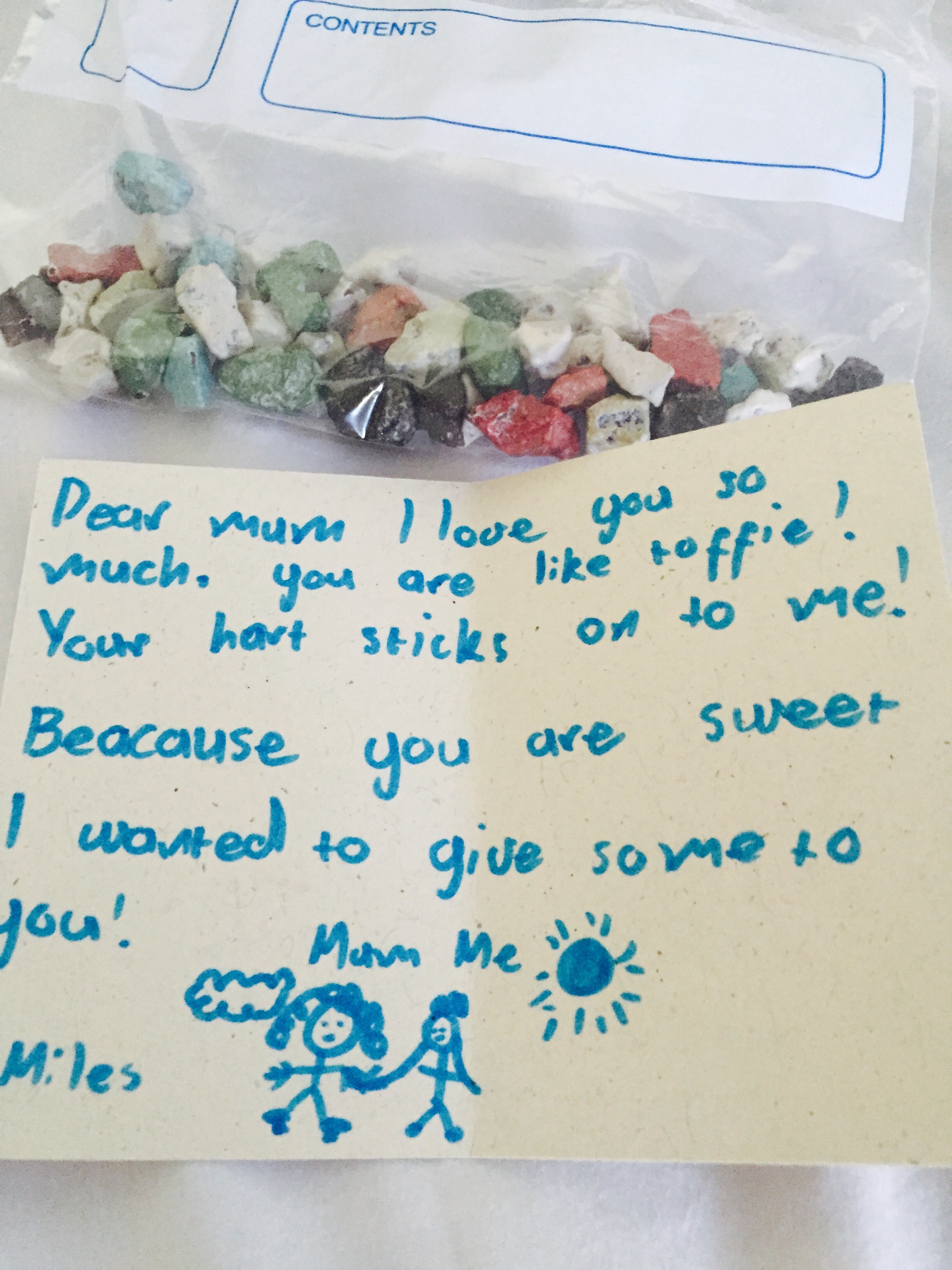
This is the message that came to me today.

  
Miles spent two weeks pocket money on this gift for his mother.

We Don’t Know their Names

An internet friend sent me some thoughts last week about the writing of the 2014 Nobel winner Patrick Modiano and his preoccupation with the lost. At the same time I was steaming towards the end of ‘Kamchatka’, a novel of the Disappeared in Argentina. Modiano wrote of Rita Bruder, a young French Jewess who went missing from her safe haven in a convent during the German occupation of Paris. Modiano is driven to search out the child’s fate. He cannot let the past and the lost rest unpursued.

I found myself acutely vulnerable to my e-friend’s story of stories. Partly it was the menace quietly gathering in ‘Kamchatka’ of the inevitable disappearing of a loved one; but more, the Modiano quest brought home a long overdue quest of my own: my destined search for my mother’s lost cousins. My knowledge of the cousins in question is slight and fragmented. It shifts in memory’s half light, lacking solidity, its textures diaphanous with the partial attention I must have paid in early childhood to a story my Mum told me. Seventy years after their presumed deaths in Auschwitz I feel the weight of silence.

My mother’s parents died of natural causes in her early adolescence. Somehow the orphan never lost her faith in living or her relish in it. Failing her Year Ten examinations she left school, trained as a bookkeeper, went to work and saved. In 1939, at the age of twenty-one Mum travelled alone to France where she had good clean fun. She spoke of dining with the Captain and the young officers on the Dutch ship which took her to Europe. She spoke of the beauty of Bali, then a Dutch outpost, almost untouched. On my mother’s return to Australia her younger sister Doreen asked her: ‘Are you still a virgin, Yvonne?’ ‘Yes,’ came the reply, ‘But it wasn’t easy.’ Mum made friends with men wherever she went, two of whom would bob up in our Leeton home while I was still too young for school. The two men, to the best of my knowledge, never knew each other. Their visits were separate and apparently independent events. We’d form a threesome for picnics by the river, the respective Continental, Mum and Howard, her four-year old chaperon. The men’s mysterious names – ‘Syd Viberow’, ‘Romain Hudes’ – intrigue me to this day. Googling has not relieved my curiosity.

These matters I recall well. I recall the smooth Continental gentlemen basking with my young and attractive mother on the riverbank. On one of those picnics we ate kedgeree. On another was it curried hard-boiled eggs? Europe was – I am confident – earnestly wooing; Mum remained Mum, Plato on the riverbank. I mean platonic; Mum might well have enjoyed being admired, but assuredly she liked her good fun clean. My memories are scatterings. Atmospheres are clearer than some factual details. Mum’s prudent inclusion in the picnics of an attention-hogging four-year old was strategic.

More scatterings: In Paris Mum’s tight black curly hair excites the admiration of a German hairdresser who marshalled her best English to compliment her: ‘You have vonderful viskers, Mademoiselle’; Mum’s accounts of the anxious urgings of the family back in 1939, to ‘come home now! There’s going to be a war.’ Mum is in no hurry. She spends time in France with her young cousins. Eventually she sails for home: ‘We slept on deck that last week, half expecting every night to be sunk by a U-boat. We arrived in Fremantle on the day war was declared.’ More good fun.

Much less clearly come memories of Mum’s cousins. The names are feminine and French, that I recall. Or I believe I recall it. They must be the daughters of Mum’s mother’s cousin. In 1939 they are teenagers, while Mum is twenty-two.

Mum says nothing to us children touching her cousins’ fate. But she must have known. I know that from the international telegrams that sped across the world late in1944; from Melbourne to Paris, from New York to Paris, with mounting anxiety. From Paris silence. From Melbourne to New York, from New York to Melbourne, in tones of deepening dread, cousins ask for word. There is no word. “Oed’ und leer das Meer”, ‘empty and waste, the sea.’ I know Mum knew; I found these telegrams among her papers after she died.

Mum and Dad bring up their four children very Jewish in the Riverina. In Leeton we children never hear of the Holocaust. We are as far from Auschwitz as Jews can be. Only three hundred miles south of us, Melbourne, thronging with survivors, is as close to Auschwitz as Australia can be. At the age of nine and a half I am translated from the Riverina to Mount Scopus in Melbourne. There, in a classroom full of Jewish children I am one of very few with living grandparents. I experience myself as a Jew whose family was safe, intact.

I regret now that innocence. A child who sat at the side of his father every Ninth Day of the Month of Av, listening to Dad as he lamented the destruction of the Temple and the sack of Jerusalem in the year 70 CE, knew nothing of Europe only a few years earlier. We sat on the thin, scratchy carpet of our dining room floor, the house lights turned off, a single candle our only light as Dad chanted the Book of Lamentations in its distinctive moaning and sighing melody. Dad translated and together we bewailed the ‘breach of my people’ at the hands of Rome. Sixty-plus years later I can feel that carpet itching my thighs. But the Third Reich never touched me.

Why was Mum silent? Assuredly she cared for ‘Sophie’ and ‘Josephine’ – names that lurk just beyond memory’s outer fringe, names that might even be true. Assuredly Mum knew. But she said nothing. No stranger to closer loss, Mum could and would speak of her beloved parents, tenderly but with a composure that unnerved this small child. Strangely disconnected from grief, Mum thrived as an orphan, much, much later as a widow, and even managed to live on in joy after losing her one lifelong companion, her sister Doreen; and after Doreen Mum lost her firstborn son. From her early years Mum knew loss but managed to keep sorrow a stranger.

At what cost, I wonder. I read Modiano and I understand the Nobel judges’ remark about ‘his art of memory.’ My mother practised her own arts of memory. Did she survive a life that was punctuated by loss by excision of sorrow? Perhaps what started as a young girl’s strategy led to atrophy and involution of the organs of sorrow. In that case my own memories of Mum’s account of Europe might be actually complete: do I in fact recall the entirety of the particles that Mum allowed herself?

I bless Mum for her faculty of joy. And now she is gone I must investigate my own faculty for grief. I want to find my cousins.

My Mum

My mother is dead. This is not news to me nor to an attentive reader of my musings on the net; Mum’s been dead since 2009. But the fact precedes the realisation. I feel the pleasure of being her son every time I think of her. That pleasure persists, felt it in the present tense. Especially today.

  To know my Mum was to smile. She was both vague and humorous, almost daffy, at least in respect of the weight of the world.

Mum knew sorrow. She lost both parents to natural causes in her childhood. She survived the death of her husband (‘he was a lovely man’) and a few years later, the death of her firstborn son, who lived, it seemed, solely to bring pleasure to Mum’s last years. A few days before her ninety-second birthday, battling the heart failure that would kill her only a few days later, Mum literally laughed at death. Already breathless, with fluid pooling suddenly in her lungs, she suffered a coughing fit, gasped, gasped more deeply, turned grey and slumped. A few milligrams of hero molecules and some litres of oxygen later, Mum awoke and grinned. From behind her mask she chuckled and gasped: ‘They thought I was going to croak, but I didn’t!’

Dad’s heart started to play up in the months preceding his demise. I felt a doctor son should warn my unworrying mother: ‘Dad’s heart disease could kill him, Mum.’

‘I know that darling. That happens to old people.’ And to comfort and prepare me, she added, ‘Death is part of life.’ 

Mum’s acquaintance with sorrow seemed to leave her unharmed. Events always had their brighter side. You could always laugh.

I wondered about this. This was not a shallowness. Mum loved generously in a way that would be reckless in any normal person. She’d invest in love, lose the entire capital and somehow end up liquid.

What was her secret?

Did she learn something early in life that helped her to surf, ever buoyant, upon the waves and dumpers?
All I have to account for my mother’s lightness of being are my memories and her stories.

Of her father: ‘Daddy was at sea on his lugger for weeks at a time. He’d spend the idle hours carving mother of pearl and tortoise shell to make jewellery for Mummy.’

‘Daddy used to give concerts at the Town Hall on his one-stringed violin. He was very artistic.’

Mum’s face is alight as she speaks. Her father is always ‘Daddy’, the affectionate diminutive bright in a daughter’s smile and lilt of voice. ‘When Daddy was dying the nuns asked the whole school to pray for him.’

‘Daddy carved this brooch from the mother of pearl and pearls he brought from the bottom of the sea. He made it for Mummy when they were sweethearts.’

‘During the Depression Daddy went bankrupt. He worked for a real estate agency after that.’ Mum points to a black and white photograph of the staff of the Agency. Four stiff middle-aged men and one commanding matron stare at the camera. As old as any but much the youngest in facial expression, my grandfather smiles impishly.

‘Then he got lung cancer and died.’

Driving past Brighton Cemetery, with a wave of a hand, ‘Daddy and Mummy are in there – just next to John Monash.’ A six year old boy cannot reconcile that champagne voice with the terrible intelligence of the death of parents. I wonder at first if ‘Mummy and Daddy’ might by some magic still live, ‘in there’.

Mum pronounces the famous surname, ‘Moanash.’

In my university years I need to correct her; ’Mum, it’s Monnash, not Moanash.’

‘No darling, it’s Moanash.’

‘Mum, three thousand people go to Monash Uni every day and they all pronounce it Monnash!’
‘Do they darling? I must be wrong then. It’s just we knew the family and they pronounced it Moanash.’
Of her mother: ‘Mummy died three years and three days after Daddy. She died of a broken heart.’ For Mum rheumatic heart disease is translated to a love that killed but never died.
‘Mummy was extremely elegant. She made her own clothes. If you look at her pictures you’ll see she always wears a half sleeve. Mummy’s arm was burned above the elbow and she always covered the scars.’ 

Of her philandering uncle; ‘Harold should never have married Grace. They lived perfectly happily while he kept her as his mistress. Once they married, Grace couldn’t tolerate his lady friends. After Harold took one lady friend on a cruise to Tahiti Grace never forgave him.’ Mum’s voice expresses wonder at the anger of a woman scorned. ‘So she tried to poison him by tampering with his heart medication. When that failed she removed the tacks from the carpet at the top of the stairs. Harold fell all the way down but he wasn’t hurt.’

Lots of stories, lots of memories, all recounted lightly. Did Mum have no bad memories? Or did she simply lack that faculty when to remember would create sorrow?

There was one. When Mum told me this in my own early childhood I felt swamped in vicarious grief. We were walking at the top of Pine Avenue in my home town of Leeton Mum paused outside the toy shop. ‘Howard I want to buy you a present. It’s important. You have to let me buy you something.’

Surprised by this; I didn’t need to be persuaded.

Mum went on: ‘When I was a little girl I didn’t allow Daddy to do that. He wanted it so much and I didn’t let him. It was a doll. Daddy took me into the toyshop and we both saw her. She was nearly as big as I was. I saw her and I loved her and I wanted her. I wanted her enough to burst. Daddy said, “Would you like that big doll, Yvonne?”

I wanted her so badly I felt it must be greedy to say yes. I shook my head. “Really?” – said Daddy. “I’d like to buy it for you. Say ‘yes.’” But I couldn’t say yes. Because I’d already said no. If I said yes now Daddy might think I was only pretending not to be greedy. He’d think I was greedy and bad for not saying what I truly wanted.

Daddy kept trying to persuade me. I kept shaking my head. Daddy looked hurt. My pride hurt Daddy and my foolishness hurt me. We left the shop, Daddy sad and confused and I too sad to cry. We left and I knew I would never have the dolly.’

One clear memory of sorrow. Clear, sharp, unbearable for the listening child. I said nothing because the sadness was stronger than my words. The only story of sadness I ever heard from my mother’s lips. All the rest – one day short of ninety-two years – is sunlight.


In an era where corporal punishment of children was everywhere and unremarked, Mum only ever smacked me on the bottom on two occasions. Afraid she’d hurt me, she didn’t have her heart in the job. On the second – and final – occasion Mum gave up when both she and I were overcome and helpless with laughter.
 
Here’s my best guess: her father (‘Daddy’) dies after a horrible illness; her mother (‘Mummy’) dies after a long, long illness. Aged fifteen she looks about her life. She sees Doreen, her younger sister, and ‘Gar’, her mother’s mother who moved in after ‘Daddy’ died. If that’s the worst life can do to her, she decides, life is worthwhile. There is still love.
In this all-female domesticity Mum learns from the example of Gar – herself an emancipated widow – that a woman ought be confident and fearless – of men (who are lovable and inferior) and of death. And Gar’s dictum, ‘what I cannot cure, I must endure,’ shapes the girl’s life.
 
Less than a decade later the girl will lose family in the Holocaust. In her seventies and eighties she will suffer stroke after stroke, culminating in a haemorrhage that tears her brain; she will lose fluency and clarity of speech, she’ll inhale perilously as she swallows, her gait will be shattered and continence lost. She will tell this son, ‘I’ve never been happier because I’m surrounded by people who love me.’ And as an afterthought, ‘I really think I could still drive, darling.’
 
She reviews her life: ‘I’ve never achieved any status, never followed a profession, never been well-known for anything. But I have four children who love me and that means something.’
Each one of the four feels so truly and well loved, we all feel morally certain we must be the favourite. All four of Mum’s children inherit, to a greater or lesser degree, Mum’s temperament. Of the four, it is Dennis whose life is most difficult, but he lives through loss and disappointment, ill health and frustration, buoyantly.
 
 
Today is Mum’s ‘yahrzeit’, the anniversary of her dying. In the Synagogue last night and again at dawn this morning, this son – this unmourning orphan – leads the congregation in prayer, recites Kaddish, and lights the memorial candle. He sheds no tears in remembering but he gives thanks.

My Sister Margot


May thirteen 1949 my sister emerged as the sun set and the sabbath arrived.


The doctor from the next town, nineteen miles distant, did not arrive – the Murrumbidgee had broken its banks and a sea separated Narranderra from our town of Leeton.

Dad was an accomplished accoucher.  The other doctors in our town did not come up to his standards so Mum had to give birth to her firstborn and to me in the City.  Third time around Dad had chosen that doctor in Narranderra – apparently he was competent enough to bring Dad’s children into the world.

But the waters held him distant.

So Dad delivered my parents’ third child, their first – and as it turned out – their only daughter.


She had red hair and she grew freckles, but my parents overlooked those abnormalities and rejoiced.

The baby’s name was Margot.

I look at the watercolour portrait of Margot that we grew up with and I see now she really was beautiful.


I could not see her beauty back then. She attached herself to her older brothers and wanted to go everywhere with them. One day when she was fifteen months old Dennis and I had urgent business at Iano’s Milk Bar. Margot, mother naked, wanted to come. We said no, closed the gate behind us and set off, ignoring her cries. 

At Iano’s someone said: Is that little girl your sister?

Margot had run across wide Wade Avenue and chased us three hundred metres. Here she was, unclothed in her girl way, and embarrassing. 

I said, I’ve never seen her before.


Margot grew taller and her golden hair grew longer. Eventually it hanged down to her freckled bum. The photographer from Melbourne Herald sighted all that flowing splendour and the photo appeared on the front page of the paper.


Margot married. In her innocence she was unaware her husband was a genius. She could not foresee how his talent would drain them from Australia to America where successive chairs in neuropsychopharmacology awaited his brains.


When Margot removed to New York our mother did the maths: a year was a twelvemonth; Mum had four children. Twelve divided by four equals three. Mum would spend three months of every twelve with Margot and the tribe she was creating in America. 

Dad stayed at home and worked and missed his freckled girl.


In my novel, ‘Carrots and Jaffas’ I create a titian-haired woman with freckled, sinewy legs who lives by the Hudson in Riverdale, New York. She runs like the wind and never tires. She is good to her brother.


She’ll turn sixty-six this may thirteenth.

An Outbreak of Bibliophilia

Children, like humans, thirst endlessly for stories. My own seven grandchildren, who range in age from twelve-year old Jesse to two-year old Ruby, love stories. They thirst for story as we elders hunger to give story.

‘My son,’ remarked Rabbi Joshua to Rabbi Samuel (Babylonian Talmud, Tractate Sanhedrin), ‘More than the calf yearns to suck the cow longs to give suck.’ How do I know this maxim? That story dates back to the commencement of the academic year in March, 1965, when I purchased the latest edition of Samson Wright’s textbook of physiology. I opened the great tome and found at the foot of an otherwise blank second page the above quotation. The sole yarmulke wearer in the class, I was the only one of 120 students likely to have knowledge of the Talmud. But the passage was new to me. And I was astonished to read the quotation and its attribution in this secular text.

What have the lactation urges of the cow to do with human physiology? Everything, it happens: that interrelation of forces, that feedback loop, that mutual energising is the very stuff of homeostasis, which operates also in markets, in the climate and in the biological relationships between humans. The sage Rabbi Joshua nailed a great truth. But I fear I wander.

The entire purpose of children is to satisfy the need of humans to regale them with stories. The reason children don’t run away is their reciprocal story hunger. The reason we don’t chuck teenagers out is the promise they’ll one day employ their disturbing sexual organs to create grandchildren for us so we can resume storytelling. And that’s what happened: my adult children used their sexual organs for the pleasure of their parents, creating seven grandkids.

All seven served their grandparents well, occupying yearning arms and longing laps, snuggling in and subsiding to the song of the story. Then they learned to walk. Two of seven, both of them boys, took to their heels and never stopped running. In time, although those two learned to read, they never took it to heart; it is in motion that they find themselves, one in organised sports, the other in disorganised sport. (Readers of this blog will recall this boy and the rescue of his fingers when trapped in a bathplug.)

Their bookish grandfather gazes upon the boys and sighs. He calls them to the couch for a story but the call of their balls is louder. Off they run, to soccer, to cricket, to mayhem.

What will become of them? What will become of grandfather?

Later the ball-players have returned home. Grandfather wanders to the toilet. Before him, on the floor, lies a cornucopia of books; the disorganised sportsman comes to a stop in this place. And in this sanctum he reads.

Abbott and Abbot: The Ethics of the Fathers

One of the more accessible elements of the rabbinic literature is PIRKE ABBOT, a collection of maxims, proverbs, pithy sayings and principles of early post-biblical sages. Literally translated, Pirke Abbot should be ‘Chapters of the Fathers’, but ‘Ethics’ is generally preferred. By curious chance ‘Abbot (fathers)’ is a homonym of ‘Abbott’ (Prime Minister of Australia).

Pirke Abbot makes lively reading. It includes some very golden rules
for living. Such are the maxims of Rabbi Hillel, a sage beloved for
his humanity. He wrote: ‘If I am not for myself, who will be for me?
But if I am only for myself what am I? And if not now, when?’
My nine-year old grandson Miles, much troubled by predictions of a
world where temperatures would rise and life be threatened, noted our
government’s anaemic response to the matter and wrote to the Prime
Minister echoing Hillel – if not now, when?
‘Dear Mister Abbott’, he wrote, ‘Please protect our planet before we
run out of water and every living thing will die.’
Mister Abbott, as befitting the Father of his country, wrote back to
the child he’d sworn to protect:

letter from tony abbott

(In summary:)

Dear Miles,

Thank you for taking the time to write to me. It is a very good thing that you are
interested in the wellbeing of our country. I hope you will continue
to show this interest in the future.’
The letter was signed (in ink), ‘Tony Abbott.’

Miles was not reassured.

“Mummy, he did not even mention the environment and what he was going to do about it.”
When Abbott succeeded Turnbull as leader of the Liberals, I felt
Australian politics might become more interesting. Here was something
novel, a potential prime minister who happened to be a conscience
politician. Noting Abbott’s sincerely held opposition to abortion and
the unpopularity he had courted in his restriction – on principle – of
an ‘abortion drug’ much sought by both doctors and patients, I
thought, ‘Well, I don’t like his politics, I don’t think he’ll last
long, I don’t much like his style, but I respect these signs of
integrity.’ Meanwhile the urgers in the Murdoch press drooled in a
chorus of relief at the eclipse of Turnbull and of the climate.

Of course, I had misjudged Tony. Moralistic but never simply moral, he
achieved a professional politician’s capacity for the flexible
backflip. His ‘style’ flowered into an idiosyncratic misreading of the
public mind that robbed the poor to enrich the already rich; and
culminated in advising the woman whose job it is to create knights to
dub her husband, a non-Australian, Knight of the Order of Australia.

At this stage the public gasped in disbelief, Abbott’s own party
gagged and even the Murdoch Urgers looked about for a successor to
anoint. Commentators commented – that’s what I am doing now – and we
all had a wonderful time frothing at the inevitable (if not imminent)
fall of this man of hubris.
Enter another grandson, Joel, aged nearly four: fresh off the plane
after three years’ exile in Britain this young citizen observed the
image of Tony Abbott appearing day after day for on the front page of
the paper.
He asked: ‘Who is that man, Mummy?’
‘He is the man the people of Australia chose to look after us, darling.’
‘Why is his picture in the paper?’
‘People are feeling cross at him.’
‘Why?’
‘You know how people in this family try to be kind to each other?
Well, people feel cross at that man because he hasn’t been kind to the
people he should look after.’
[At this stage I need to inform the reader of the Corrections
Protocols operating in Joel’s household: in the case that one child
having many toys withhold a toy he isn’t using from his smaller
sister, who then purloins said toy; and that older child then belt the
younger, the older child’s conduct is designated as ‘not kind’; and
that elder child is directed to take some time out. He is sent to the
staircase where he must sit and reflect upon his unkind action until
he feel ready to seek forgiveness and make amends]
Joel, regarding the image of the Prime Minister pictured descending
his aircraft’s steps in Canberra, said: ‘That man needs to go to the
time-out step.’
In the event, ignoring Hillel’s second clause of selflessness, the PM
followed only the sage’s first clause: ‘If I am not for myself, who
will be for me?’ He brought forward the party room meeting to deprive
plotters of time to plot. His party met and voted him not time out but
more time in.
Abbott vowed he would change. He’d listen. He’d become consultative.
Good government would ‘start today.’ No-one believed he could change.
I do not believe he can. But how miraculous would it be to witness
such change, how interesting to watch a small spirit grow and enlarge
and show kindness?

Life-long Friendship

My oldest friend is named John Baikie Wanklyn. Johnny calls me Doff and I call him Johnny, and sometimes, Wank. We have been friends since the summer of 1950. We first met outside the front of his father’s shop, the Leeton Furnishing Company. At least that’s how I remember it: I was playing with something inconsequential, a little stick, perhaps a toy car too, on the concrete paving. An area of dark and pleasant shade thrown by the large verandah. I became aware I was no longer alone.

Did Wank walk up and say hello? Or did I wander along and join him? I don’t know. I was playing alone and then I was no longer alone. My mind holds the scene like a dream. And like a dream there are no borders to the image: my mind sees the cracks in the concrete where my fine stick ploughs and throws up a narrow furrow of dust. There is the deep shade and beyond the shade the great heat. I know that heat in my skin. Whenever I leave the coast in summer and move inland that dry heat greets me and welcomes me home.

An additional element in the scene is our smallness in the world. The shaded area would be about five metres by, say, about twelve metres. That area encompasses two fine figures of children of four years, the margins seeming distant from us as we play. One of us asks the second his name. The second asks the same question of the first.

‘It’s my birthday next week,’ says one.

‘It’s mine the week after. I’ll be four.’

‘Me too.’

The two resume playing until a parent calls one of the children. That child and his parents and elder sibling are going to visit the Harrises. The other child – this feels like me – goes home and finds his parents are taking him visiting too. He is cleaned up and taken along. And discovers he is at the Harrises where he plays with the Harris girls and another visitor, the new boy from the Leeton Furnishing Company. The three families drive down to the river and picnic there. The Murrumbidgee is the great fact of life in the area; it shapes our Huckleberry years.

The dimension of time has a distinct character: we meet in January of 1950; we part in June of 1955. In the course of those spacious years a pavement is laid in our lives. He is Johnny, I am Doff, we are friends. In that space we accumulate experiences together that fade in detail but burn in memory, in their texture, in their felt quality, in their great mass. By the time of our parting those few years account for more than half of our lives.

We shared enough for it to remain enough. Enough for Wank to refer – thirty years later – in conversation with a friend, to his ‘brother.’

The friend, confused, says ‘Who’s this brother Howard you speak of, John? I thought your parents only had the two children, you and Julieanne…’

‘That’s true. They did. But Howard Goldenberg is the closest I’ll come in this life to having a brother.’

One night in 2014 a bad dream disturbed my sleep: John Wanklyn had died. I awoke crying aloud, ‘Wank is dead!’ I wept: I’d never see him again. A moment later I was smiling. Of course I’d see Wank again; Annette and I were to drive to Albury to visit John and Christie next weekend.

Am I Wank’s best friend? Is he mine? We have never spoken on the matter. I know I’ve never addressed it. There is no need. The questions have no weight. They would be as strange to us as to blush or nudge-nudge at the word Wank. Neither of us has ever had a friend like the other. There can be but one first friend.

Jewish education called us from Melbourne and tore our family from Leeton. The tearing was painful for me. I saw before me a great gulf open. I kissed my friend goodbye. Wank looked at me, confused by an unexpected act.

We wrote to each other, signing our letters, ‘Your old school chum, Wank’, ‘Your old school chum, Doff.’ We managed to see each other a couple of times a year, inserting the other into lives that were changing fast. The visits continued until my barmitzvah.

Johnny and his parents came to Melbourne for the celebrations. He had never been in a synagogue. I saw my friend holding the unaccustomed cap, I saw the strangeness to him of prayers in Hebrew, I saw the strangeness of Melbourne Howard to Leeton John. I saw it and I felt it all painfully.

Years passed without further visits. Through the letters that our mothers wrote I knew the events of Wank’s life and he knew about mine. The two women loved each other. Their letters, always in blue ink and lovely copperplate, continued into old age until one declared her handwriting no longer ‘respectable.’

In 1967 a phone call came from Wank in Sydney where he was studying Pharmacy. As I was not at home, Johnny left a number. I was in residence at Queen Victoria Hospital in my fifth year of Medicine. Mum rang and gave me Wank’s number. But I misplaced it. I thought of it from time to time. And the years passed.

The Jewish Sabbath doesn’t finish until nightfall on Saturday. It was eight o’clock on a Saturday night in the ‘nineties when Annette and I left Melbourne for the drive to Albury. It was midnight as we reached the border at Wodonga. I drove slowly, my eyes searching for something needed. There it was, black, silent, broad, gleaming in the moonlight – the Murray. It wasn’t the Murrumbidgee, river of Leeton days, but the river knew me and I knew it. We drove the few remaining minutes through quiet streets, turning left as directed at the Siamese restaurant. One turn to the right then we parked, got out and knocked. A giant – he’d have filled his father’s verandah shade outside the Leeton Furnishing Company – emerged from the house. He swept me into his arms and kissed me. Later we sat, Wank and Chrissie and Annette and I, speaking softly for children asleep. Wank said, ‘I kiss my boys and I just knew it would feel right to kiss you too, Doff.’

It was a hot summer’s day. A boy was playing alone and was no longer alone. Neither boy has been alone since.

A Visit to the Dentist

You could say it’s all my mother’s fault. It was Mum who made me go to the dentist. It was Mum who made me wash. Like many mothers Mum had a religious belief in soap and water.
When I was a small child Mum took me to the dentist, Mister Mc Auliffe. In those days dentists were Mister and doctors were Doctor. Mum tried to make it sound like a treat: ‘Afterwards we’ll go across the street to Mr Iano’s shop and I’ll buy you the biggest apple he’s got.’ I had better reasons, anti-dental reasons, for going to Iano’s. As well as being the fruit shop it was the milk bar: you could buy lollies there. Mum said, ‘Afterwards we’ll get the biggest and brightest and greenest apple in the whole shop.’ Afterwards! I heard a rat. What would happen in-betweenwards?

In between the honeyed talk and the greenest apple was the climb up to Mr Mc Auliffe’s second-floor surgery. From there I had an excellent view of Iano’s lolly shop. Inside that narrow chamber I smelt smells, I heard sounds, I felt vibrations, all novel, all taking place within my mouth. The drill moved with all the speed and softness of a peak-hour cable tram. My teeth were the rails. I felt smoke but could not cry ‘Fire!’
Afterwards, as promised, there was the apple.

Five years later, attending my expensive new school in Melbourne, I stood on the top step of the slide. A pushing-in kid, hostile to this newcomer, tried to push in. I stood my ground. Push came to shove in the back, I fell face-first onto the steel side rail of the slide, arresting my fall with my right front upper incisor. I left part of that upper front tooth in the Mount Scopus playground in St Kilda Road. My parents decided I looked odd and sent me to a dentist. A Melbourne dentist, I discovered, had modern methods of preventing pain by causing pain. The dentist – still mister – squirted local anaesthetic into the nerve nearest the front upper tooth. He said, ‘This will stop you feeling pain.’ Perhaps it did do that, but the injection hurt in a way that was new to me. Mister dentist asked me, ‘Do you want a gold filling?’ I didn’t want anything more this man might do to me. But I didn’t say no so I left those premises unaware of the new vertical glint of gold in my smile. It was a long time before I smiled, longer still before I saw myself in a mirror.

Many decades later grandchildren arrived. They learned to speak. They looked at me, they looked at other humans, and they asked, ‘Saba, how come you got a gold tooth?’
I told them the truth of course. I told them how I fought a gold toothed dragon that no-one else would fight, how I’d killed it and kept one tooth as a trophy.
Every time they saw me, the grandboys would ask, ‘Tell us how you got that golden tooth, Saba.’ I told them how I’d swum into the deepest ocean and fought barehanded the Giant Shark, fought tooth to tooth, how I’d bitten out his black heart, how his blood-red tooth had bitten my gum, had lodged there and rusted and turned gold.’
And again, ‘Saba how did you get that gold tooth?’ I told them about the dinosaurs that caused so much wreckage in my childhood days. ‘You know how Tyrannosaurus wrecks, don’t you, kids?’ I was forced to tell them of my desperate struggle in the dark jungles of Paris, how I saved the Parisees, how Tyrannosaurus died, his black blood turning the dirt streets of Paris black, his last tooth taken as a souvenir – a French word I borrowed from the Parisees – how I had that tooth implanted in my own brave gums. ‘And, kids, today you never see any dinosaurs any more, not even in the dark jungles of Paris. And the streets of Paris are all black.’

All went well for some time. The gold tooth stories nourished hungry young minds, filling them with useful knowledge of geography, of history and of pre-history. The gold tooth gleamed modestly from behind my bulbous lip, a stamp of my enormous, self-effacing courage.

Then my Mum stepped in. Not physically, but in habit ingrained and indoctrinated, Mum’s habit of soap and water, a habit I am embarrassed to admit survives her, years after her death: I showered. And while showering I ran my idle tongue along the inside of my upper teeth, where that slippery pink rasp felt something that was not there: my tooth, my gold tooth, had gone!
That’s life, I said to myself. Sixty years a gold-toothed person, now ungolden. I grinned at myself in the mirror. I looked like a failed terrorist. Something gleamed from the floor of the shower recess. I picked it up and placed it in a urine jar.
I asked the nurses, ‘Is there a dentist in this small town?’ There was, there is. And the dentist’s receptionist had more bad news, ‘You can see him today.’
So I went. The dentist is Doctor now. But he was not the real, dinkum, authentic dentist of my childhood. He covered my eyes to protect me from my own germs. He showed me a horror show on the screen above me: the images were those of my own teeth, my receding gums, my doomed dentition. He did things inside my mouth, asking me questions I never heard in childhood: ‘Does that hurt? Please tell me if I hurt you.’ He used a drill and he didn’t hurt. I think he doesn’t know how. He glued back my bit of gold. I lost my terrorist’s grin.

Nowadays a dentist has lost those old skills, those old black arts; now that a dentist is a Doctor it’s only your wallet that hurts. So a dentist who is a Doctor employs a failed dentist and calls her a hygienist. And she knows how to hurt.

You Can’t Beat a Butter Batter

Fruit cake, rich, heavy, moist, in childhood the natural partner of a glass of icy-cold-milk-not-boiled-please-Mum, an entire fruit cake became my own every January eighth – my birthday cake, dating from around the time of my maybe fifteenth birthday, as I recall – Mum baked it, back in the butter days when doctors hadn’t discovered her soaring cholesterol, (we had our good times, we had our butter times), and Mum, always a superlative baker (who never essayed a sponge cake – ‘I can’t bake a sponge cake’) who kept two tins endlessly plenished with biscuits, biscuits Anzac, biscuits corn-flake, jam biscuits, biscuits nameless now in my aged forgettings; and cakes, always one waiting and ready for the nourishing of children, four of us, four who each secretly knew that he or she was the most loved of all by this mother who would say, in her much later years, “I never achieved much in my life, but I have four children who love me and that is enough”, and enough it was, especially as fruit cake, moist, heavy, from the deep delved earth, was never even my favourite, so many, so various and numberless and so rich and so high, light, soft, moist and sweet and buttery were all of them, but somehow, early one January, Mum must have asked, “What cake would you like for your birthday, darling?”, and I must have replied – thinking of how that uncooked cake batter, all floury and viscous with brown sugar and fruits in Rhine Castle kosher muscat wine, how much better raw in the mixing bowl than after baking three hours in the slow not-too-hot oven, how this batter beat all other raw cake batters by a rich mile – “Fruit cake, please Mum”, and Mum would have decided it was my favourite, and every eighth of January thereafter she presented me with a whole one, until that year, freshly married, freshly graduated, doing my first locum in a small town in Tasmania in January, I knew this would be the first year I’d go cakeless, that I’d graduated from that child nurturing, and my darling bride, a neophyte cook who would go on to surpass all before her as a chef, had the wisdom and the discretion not to venture into the cuisine where the mother-in-law shone and the cakes of breastmilk affection preceded her, so Annette forebore and the pampered young groom understood an end had come, but a day or two before the eighth, a parcel arrived in the post among all the letters from drug companies, the parcel wrapped in brown paper – my parents never threw out brown paper or string, they never forgot the Great Depression when, as I imagined it, there came to pass the World Crisis of No String and no Brown Paper – that parcel heavy, and under the brown paper a container unyielding to my fingers, and on the brown paper and addressed in Mum’s singular and elegantly jerky hand to “Dr. Howard Goldenberg, The Surgery, Deloraine, Tasmania,” and the address incomplete, the sort of address that destined your mail for the Dead Letter Office, but in the margin Mum’s plea:
“Mr Postie, It’s his birthday cake, please try to get it to him by the eighth: This Way Up”, and inside the paper was a cake tin and inside the cake tin was the birthday cake, fruit cake, still so good with a glass-of-icy-cold-milk-not-boiled, a single slice a gobstopper, but who ever stopped at a single slice?, not me, and so the January cakes came and came, butterless now in the puritanical regime imposed by philistine doctors, the cakes still came, until the strokes came, Mum’s left hand forgetting its cunning and the birthday cakes would surely stop now, but they didn’t, because Dad, himself a cook of meat and fish who never baked a cake in his life, saying ‘I can’t bake,” Dad stepped forward and made the annual fruit cake to Mum’s recipe, under Mum’s direction, and she presented it to a son expecting nothing this year or ever again, just grateful that Mum was still alive and loving and playful, and she not the least interested in the facts of disability, and so the cakes came and came until Dad went, and here I was, a boy of fifty-seven-and-a-half years who knew his fruitcake days were over; but no they were not, for there existed Mum’s firstborn, Dennis, born with butter in his mouth, a cook who believed in fat and cream and sugar and starch and no self control and no moderation especially in helping our Mum and never more than in celebrating his younger brother, the brother whom he might reasonably have seen as his supplanter, his usurper, but no, Dennis never felt those things, writing one January eighth, “Howard, I think God must be proud of you”, and now the cakes kept coming, butter reinstated, for there were never thoughts of tomorrow with Dennis, only of the abundant now and now was Howard’s birthday and it was his joy to help Mum make cake for her boy, and then, at the age of sixty-three Dennis underwent surgery and died and the cakes finally stopped…but no they didn’t, because Mum recruited her east-european carers, masters of the cuisine of heavy stodge, as her new sous chefs and she directed as they baked my fruit cakes – until the time Mum died and that would have been the end of the fruitcakes… except Mum left one granddaughter who loves baking as much as she loves her father; and that person is my youngest daughter Naomi, a devotee of the Creed of Cholesterol; devoutly does she mix bright-yolk eggs with buttery batter for a father whose januation ever is blessed with food-as-love, and so may it continue until I come to my Full Stop.

IMG_4032.JPG

Phone Calls from my Dead Brother

My brother Dennis

My brother Dennis

This evening and tomorrow the family will mark the seventh anniversary of the dying of my firstborn brother Dennis. We’ll light candles and congregations will join us in remembering him.

Two weeks before he died Dennis underwent elective surgery. I wondered if the surgery was wise. Dennis, whose life’s creed was hope, assured me: ”Doff, this operation can eventually cure diabetes. It will transform my life.”
We spoke daily on the phone – he from his hospital bed, I from a hellhole town in the deep Kimberley. Day by day Dennis seemed to be doing well. But on day four he told me: ”I’m OK but my belly hurts”. A belly ache bad enough for stoical Dennis to mention was bad enough to alarm me.

Day five, no phone call. That day the pain was worse. Dennis collapsed, his circulation failing as his abdomen filled with blood and stomach acid leaking from his wounds.
At his bedside in Intensive Care the following day we counted the tubes entering and departing Dennis’ comatose form. One into his windpipe to make him breathe; a second into a great vessel to deliver information; a third to bypass his kidneys which had failed; a fourth to drain his bladder; a fifth and sixth into peripheral vessels to deliver fluids and the hero molecules that just might save him.
The greater the number of tubes in a patient’s body, they told us, the lower the chance he would leave ICU alive.
I sat at his bedside and I watched my brother. Behind the clicks and gusts of his life machines swelled the sounds of classical music. Annette, his loving sister-in-law, thought to play that music, those patterned sounds that ever soothed his troubled breast.
I sat there and watched as nurses, tender or tough, kept my brother alive. The tough ones, resentful of something – were we too many, was this medical brother too medical, that sister too exacting, that aged mother too accepting? – made me feel small, in need again of a big brother.

Dennis turned the corner: blood pressure held firm, sleeping kidneys awoke, fewer molecules were needed. The doctors conferred and announced: “We’ll let him wake up now and breathe on his own.”

Dennis breathed and slept on. We all breathed, went home and slept.
At four in the morning my phone rang. A crepitous, rustling sound, a broken voice in windy gusts: it was Dennis: “Doff, they want to njjhrnnujicxvclbkvn”
“Den, I can’t hear you. Say it again.”
Gales and crackles and Dennis’ voice in fragments: “Doff… inaudible… they…unintelligible…the tube back in.”
“Den, are you saying they advise you to go on the respirator again?”
More gasping, a desparate heaving of voice: “Yes!” More gasping. “Is it a good idea?”
“Den, it’s your best hope. Say yes.”
“Alright Doff.”

That was the final phone call. Dennis and I never spoke again. By the time I reached the hospital Dennis’ coma was renewed, the respirator breathing for him. Soon his circulation collapsed again, the doctors tried heart-lung bypass (“It’s only ever been shown to work in children. It’s your brother’s last hope..”) and on the eve of Shabbat Dennis died.

***

I can speak or write of Dennis dying with a composure that surprises me. Even my fatal advice does not trouble me. Perhaps it was not the dying of my big brother, but his living, that calls to me and troubles my dreams.