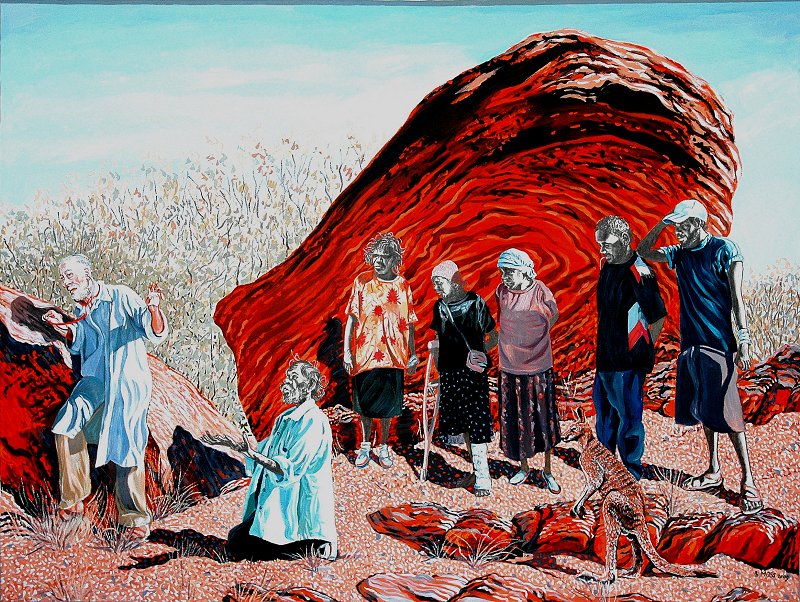

One Thousand Cuts by Rod Moss
One Thousand Cuts: Life and Art in Central Australia
A book of the dead?
Yes, explicitly so.
Names are named, a violation of all norms, all practice in both whitefella and blackfella Australia.
Rod does this by virtue of trust, explicit consent, indeed the command of Rod’s friends.
Rod Moss’ singular role – to witness, to record and transmit.
Rod Moss grew up in the country. Well, in the 1950’s the Dandenong Ranges were country-ish. But he was never “in country” until some time well into his long apprenticeship under Edward Arranye Johnson, in and around Alice Springs.
Moss’ first book, “The Hard Light of Day” recounts that apprenticeship, which began with a spontaneous act of neighbourliness and evolved through friendship to become a connection of spiritual father to son. The building and the losing of that bond are the subjects of that first book, winner of the Prime Minister’s Award. It might sound like a large statement that the second book builds on and exceeds the first in its power. It does so by the swelling sorrow of loss after loss after loss, of the weight of pain.
The present volume is unique in the way it illuminates the experience of being “in country” – an opaque expression that whitefellers who work outback hear often from blackfellers. Subtly, delicately, in a characteristic Moss undertone, being ‘in country’ becomes luminous. The light is shed by Moss as he moves around Arranye’s hereditary domain as his named spiritual heir.
Moss gives us birdsong, birdflight as he walks beneath. He breathes the breezes and tempests that flutter or flatten foliage and carry mood or prophecy.
He names and describes the fauna – from grub to reptile to marsupial – that create the country.
Moss does all this in the same manner as in his painting. His colours are florid, his verbal sallies frequently outrageous, his attack fearless. But in all this bravura there’s nothing flash or glib, as Moss walks and paints and photographs the lands of his spiritual patrimony, bearing the loss of spiritual father (and of many brothers and sisters), accruing more and more losses until their weight becomes unbearable.
Most of the losses come abruptly. Each comes with the force of a thump to the solar plexus.
Moss, with his reader at his shoulder, absorbs blow after blow.
At this point we have Moss Agonistes, crying: “It rains in my heart. One drop at a time.”
Moss misses a much anticipated funeral: “I find myself crying on Saturday morning …Though I was sad at the gravesite, it has taken until now, opening the brochure and studying the commemorative words…for me to be sobbing.”
 howardgoldenberg