The phone call comes at 3.30 on the last afternoon of term. An unfamiliar voice speaks: ‘I have your boy here. He came into the shop and collapsed.’
The woman’s voice is concerned, competent: ‘He wants to get back onto his bike and ride home but I won’t let him.’ The woman gives the address, a shop on busy Centre road, Bentleigh.
The mother of the child calls the boy’s father, cannot contact him, drives towards the place in Centre Road. The heavy Friday afternoon traffic races, stops, starts, unpredictably. The mother suppresses her urge to speed, shakes her head: ‘What if he’d collapsed in this traffic!’ Alone with her fear, she calls her father, doctor to the injured boy. She gives her father the bones of the story, adding: ‘He told the lady in the shop he was hit in the head earlier today. She says he’s talking but he’s not making sense. He couldn’t remember my number. Didn’t know the password to his phone. She rang the school and they put us in touch… I’ve nearly arrived. I’ll call again once I’m with him. ‘Bye.’
At 3.50 the doctor’s phone rings. His daughter’s voice, the boy’s, an unfamiliar woman’s voice, traffic sounds, snatches of conversation – ‘Dad, I’m with him now. He’s awake. He’s seeing double… Yes, thanks, in the back here. Sorry Dad, the lady who’s been looking after him is helping me get the bike into the car. He lost consciousness a couple of times. What does it mean that he’s seeing double? And he wants to vomit?’
Forty-eight hours earlier the doctor saw a boy in Resuscitation at the Royal Children’s Hospital. The boy had been hit by a car. He lay on a trolley, his body a gangle of bones, on his face a large bruise and the dopey smile of a child with no memory of the car that hit his head. The doctor-grandfather spends a lot of time with injured children in Emergency Departments. The doctor knows what double vision means, he knows what vomiting means. The grandfather in the doctor avoids the question, asking some of his own: ’Has he had a head injury?’
‘Yes Dad. A kid at school swung his locker door open and belted him in the head. He went to sick bay for an ice pack. After school he rode to the shops.’
The boy’s voice pipes, indistinctly, the phone set on speaker. ‘Saba, when I look at anything I see two of everything.’ The child slurs the words.
‘What part of your head did the locker hit, darling?’
‘What do you mean, Saba?’
‘Was it the front or the back or the side?’
‘Are you joking, Saba?’
‘No darling. What part of your head was it?’
‘Above my ear, a bit in front of it.’
Just in front of the ear, in the temporal region, runs a vulnerable artery which shelters behind skull bone thinner than elsewhere.
The doctor instructs his daughter to drive directly to Monash Medical Centre which is not far distant.
‘I don’t know the way, Dad.’ The father-grandfather-doctor is notorious for his lack of sense of direction. He directs the daughter, hoping. ‘I’ll call Emergency at Monash, darling, so they’ll expect you… Take a book with you. You’ll be there for hours.’
‘Dad, he’s just vomited. Now he’s falling asleep. Does that matter? Do I need to keep him wake?’
‘Try to keep him talking, darling.’
The grandfather speaks to the child: ‘Darling you’ll go into the hospital and they’ll look after you until you’re better. Then they’ll let you go home. You probably won’t be staying in the hospital.’
‘Saba, what will happen to me?’ The voice quavering:’ Will I be alright?’
‘Dad, where will I park?’
‘Drive straight to “Ambulances Only”. At the moment you are an ambulance.’
At 4.10 the doctor calls Monash, asks to be connected to the Consultant in Emergency. A young voice, informal: ‘Emergency, Preeti speaking.’
‘Hello Preeti, I’m sending you a child with concussion. I’m his GP. Are you the consultant?’
‘Yes.’
The doctor briefs the young voice. She listens, asks a couple of questions, says, ‘Thank you. We’ll be expecting him.’
‘Thank you, Preeti. I’m quite concerned… He’s my grandson.’
When the doctor’s phone rings the time is 4.40. It rings as he’s hurrying to the toilet to pee, the third time in twenty minutes. He stands still, commands his bladder to wait.
‘Dad, I dropped him and they took him straight in. Doctor Preeti was waiting. I’ve just come back, I had to move the car. My phone’s about to die.’
‘Darling, Shabbat is about to start. But I’ll answer the phone if you ring. Someone will lend you a phone. If you need me, call me, even though it’s Shabbat.’
‘’Bye, Daddy. I love you.’
The old man puts the finishing touches to his Shabbat table. His wife is away, visiting their Sydney daughter and Joel and Ruby.
He covers the loaves of challah, races to the bathroom, showers, dresses, recites the Afternoon Prayer, racing the setting sun. He finishes, checks the time, realises he’s just too late to light the Shabbat candles: he won’t make fire on the Sabbath. Ordinarily he won’t use the phone. During Shabbat he’ll allow the phone to ring, enjoying freedom from the i-tyrant, celebrating the sample of paradise that is the Sabbath. But tonight he’ll answer it.
Darkness falls. The old man recites his Evening Prayers, rich with poetry from the mystics of Safed and the Golden Period in Spain. The dying of the day, the passing of the workaday week, the beauty of the sung hymns, all these have always found him susceptible; since childhood the eve of Sabbath makes him prey to tender feeling.
He looks across at the table, set for two. He recites the She’ma Yisrael prayer, inserting, by old family custom, an improvised prayer. He prays: ‘ Heal the boy and all who love him.’
The old man sings the hymns, he welcomes the Ministering Angels, he praises his wife – “A woman of Valour, who can Find? Her Price is above Rubies” – then he sings the Kiddush dedication, drinks his grape juice, washes his hands and sits to break bread. Before him, chicken soup with noodles and kreplach, four salads, slow cooked lamb shanks, potatoes. He eats alone, wolfing the feast he prepared for two. His elder daughter won’t be finished at the hospital until very late.
The food is good. He’d made a great effort for this meal with his daughter. He eats and gives thanks. Afterwards he reads. He reads three newspapers then opens the political biography a friend gave him. Deprived of sleep as he always is by Friday, he doesn’t expect sleep will come quickly tonight.
At 8.00 the front door opens. His daughter enters and they embrace. The boy is well. He’s back home with his brothers and his father. Surprised by her early arrival, the doctor listens to his daughter: ‘Dad, they asked him questions, they checked his eyes and his pulse and his blood pressure again and again. They tested his balance. He improved and they let us go. They said once four hours had passed the danger was much less. They timed it from when he collapsed in the shop.’
While the mother speaks the father prepares a salad to replace the four he wolfed. The child-mother eats with relish. ‘I’m sorry I spoiled our meal, Dad.’
She toys with the lamb shanks that come cold to the table. ‘Dad, I can’t eat any more. It’s been a big day.’
Father and daughter look at each other. No words are spoken, none needed; each knows the content of the other’s mind. The father looks away, knowing without looking how his child’s lip trembles and her eyes fill.
A minute or two of quietness, then the daughter smiles: ‘By the time we were leaving ED his speech was perfectly clear. He was saying he wanted junk food. Then he said, “Let’s ring the kind lady in the shop and thank her.”’
Tag Archives: prayer
The Prayer of the Traveller
Many of us are on our travels as I write this. Today I will resume mine – one hundred and fifteen kilometers by road before a flight of forty minutes (in the air we register time not space), then a break before resuming for the next seventy minutes of flight. Finally thirty kilometers of suburban roads. Then home. Home – that word for an idea that houses our love; for the island we build to grow a couple into a family. After two stationery days I’ll skip from the continent of my birth to the land of the free – three flights, ten security checks (eight of these in the US) – eighteen hours in the air.
Long before the Malaysian airliner disappeared I had my misgivings. The loss of a civilian passenger aircraft over Donetsk did nothing to comfort me. And now the AirAsia tragedy. Travel is dangerous. Out here in the Outback, the roads are full of kangaroo, wandering stock, feral donkey and camel, species which share with the shahidi a zest for homicidal suicide. Air travel, far, far safer, remains hazardous.
Travel has always been thus.
If you are a wuss (I am) and if you have a prayerful bent (I am severely bent in that way) you might pray for a safe arrival – and if you are needy or greedy (I am both), you’d slip in a word for your safe return home.
The following comes from the ancient Traveller’s Prayer recited by Jews. The text catalogues a surprisingly contemporary list of hazards:
May it be Your will to direct our steps to peace, to allow us to reach our desired destination in life, in joy and in peace.
Rescue us from any enemy, ambush and danger on the way and from all afflictions that trouble the world.
Let us find grace, kindness and compassion from all who see us.
You can fill in your own particular concerns. (Afflictions that trouble the world are plentiful. I think of Ebola. I think too of violence of all kinds – both abroad and within our domestic walls.)
An anxious Jewish traveller (Jewish people are past masters at anxiety), having completed the lines above, might feel the need for elaboration or emphasis. Such persons follow on with Psalm 91. I do. I love this one: I loved this one and I quoted it to my shell-shocked teenage daughters after two hilarious hoons chucked rotten eggs through the girls’ car window, breaking on and altering the grooming of their lovely long locks.
Five years ago, grandson Toby, famous in these pages for his flirtations with danger, drew a picture in vivid primary colours. The picture, three inches by one and a half, was intricate, pulsing with the vibrancy of his four-year-old being. Toby presented it to me: ‘This is for you, Saba.’ Since that day it has sat between the leaves of my travel prayer book. It guards the place of Psalm 91.
One who lives in the shelter of the Most High abides in the shade of the Almighty. He will save you from the trap of the hunter and the deadly pestilence. You need not fear the terror by night, nor the arrow that flies by day; nor the pestilence that stalks in darkness, nor the plague that ravages at noon. Though a thousand may fall at your side, even ten thousand at your right hand, yet unto you it shall not come nigh.
I am not simple – or faithful – enough to believe that simply reciting these words will guarantee my safety. Saying the words is not the equivalent of completing the enrollment forms in supernatural travel insurance. I am not insured. But it is in the beauty of the poetics; in the relief of putting fears into words then filing them away; in the unspoken reminder that in matters in which I am powerless there is no point fretting – in these I find comfort, acceptance.
I am not insured, just assured.
I wish us all safe travels.
So Foul and Fair a Day

Howard at the Boston Marathon 2013
When I solicited funds as a charity runner in the 2013 Boston Marathon I promised to write a report on the race and my donors’ ‘investment.’ The moment the race started I started to compose my report. The mood was light, the crowd a united force of love, the events and sights all affirming a shared humanity. This would be a report of smiles. The serious counterpoint would be the 26.2 long miles.
At 2.07pm the mood changed. After that the playful response would feel profane. But I did promise a race report.
I slept on the matter. The evil was great and real, certainly. Real too was the goodness. Both demand to be written.
***
Does any runner sleep well the night before a marathon? I don’t. To prevent dehydration on race day I drink plenty through the previous day and every cupful demands its exit through the night. I am excited, nervous, a kid before his birthday party. Boston, after all, is to marathoners as Wimbledon is to tennis players. An enormous privilege, unearned by any effort of my legs, paid for in thousands of donated dollars.
The playful mind must be carried by legs that are 67 years old. Some prudence surfaces. The sixty-seven year old prepares methodically. The experience of forty past marathons insists I vaseline my second toes (which always blister), my armpits (which chafe), my nipples (which bleed) and my private bits (none of your business).
To prevent my shoelaces untying over the distance I double knot them: a trivial detail? No, not in Boston, for it was at the start line of one Boston Marathon back in the seventies that the favourite, noting his arch rival’s single-knotted shoes, bent down and double-tied them.
Back in Print
This blog wears a yarmulke. It observes the many and protracted Feasts and Appointed Times of the Jewish religious calendar. It reflects, repents, atones and fasts over the High Holydays and it prays and feasts and feasts over the endless Festival of Tabernacles. The blogger gets holier, purer and fatter but writes not, nor blogs.
I’ve brought a note to explain my absence. It reads:
I have been walking in the ways of my fathers. As a result I didn’t write blog posts. It wasn’t a case of ‘couldn’t be bloggered’, just that you aren’t allowed to write on the holy days: writing is working.
Now I am back.
I’ll tell you a story. It’s a true story: I saw it happen with my own eyes.
It was on Yom Kippur, around the year 1956, that a small girl stood in the row in front of mine in the great synagogue and read her prayers. Small, bony, freckle faced, auburn haired, she stood among the men, close to her father and her brothers, and read those endless prayers. In all the empty vastness, beneath the great vaulted roof, the girl stood and read the order of service, word by word, letter by painstaking letter, in the archaic Hebrew.
At intervals her small bony fist beat her left breast as she read the Musaph prayer, the long additional service.
After twenty minutes or so the few men standing either side of her completed their reading and sat down. The child did not notice. Head down, with her right forearm a horizontal pendulum, her fist rising and falling against her left breast in slow periodicity, she beat out her ‘sins’:
“For the sin we committed in thy sight without intent, (thump);
And for the sin we committed in thy sight by lustful behaviour (thump).”
The synagogue swiftly filled. The cantor began his sung repetition of the Musaph prayer. The child, nowhere near finished, read on, beat on:
“For the sin we committed in thy sight by oppressing a fellow man (thump);
And for the sin we committed in thy sight by lewd association (thump)…”
As the repetition continued the congregation lifted its voices in chanted responses to the Cantor. At intervals the choir burst into song. Red head bowed, slow sentence by audible thump, the dogged child continued her reading. She had commenced, with the field, thirty minutes earlier. At this rate I reckoned she’d still be standing there, reading and beating for another twenty minutes.
A latecomer, a man, arrived to take his usual seat in this all-male section of the synagogue. Shaking thrice-annual hands – Gut Yomtov, Gut Yomtov – he progressed along the row of seasonal faces towards his seat. Bonhomie, smiles, handshakes distracted him from the problem I could see coming. The man would be unable to reach his seat, let alone sit in it. A small red-headed child, a girl, oblivious of this world, stood in front of his seat reciting the Musaph Amidah, literally ‘the additional standing prayer.’
During an Amidah the worshipper stands in place, feet unmoving, until the end. Further, during this prayer speech is forbidden. I feared for the red-headed trespasser who would well know she should not yield place nor respond in speech to request or greeting or command until the grim end. What would she do?
Latecomer, standing in mutual discomfort between the feet of the incumbent in the penultimate seat, took in the sight of the obdurate breastbeater. His face registered incomprehension, then frustration, finally defeat. He backed out, apologizing, embarrassed, bonhomie eclipsed, hands not clasping friendly hands, back to the empty end of the now fully occupied row.
The man turned and left the synagogue.
“For the sin we committed in thy sight by haughty airs (thump);
And for the sin we committed against thee by scornful defiance (thump)…”
The child, all unwitting continued her reading to the end.
“I read it all, Daddy.”
Proud of herself, she trod lightly the much put-upon feet of the row of men, making her father’s seat. She climbed onto her father’s lap and settled there, sucking her thumb.
After a good while the usurped man returned to the synagogue. As he made his progress to his seat, he looked around. I saw, in addition to the normal prayer book and Tallith bag, he carried a small package. Arrived at his seat, he searched the rows for something or someone. At length he saw her, his trespasser. His face of serious purpose fell open into a wide smile. He waved to the child, caught her gaze. Uncertain, she smiled back. The man beckoned her to come to him. She looked at her father, who nodded.
Trampling again she slipped and wove her way along the row to the place of her earlier devotions. The man stood, waiting. He took her right hand and shook it. He said something to the girl and handed her the package. He pinched her cheek gently as his smile once again broke his face open.
The girl hurried back to her father. She opened her package and took out a miniature ladies’ handbag, elegantly crafted in parti-coloured leathers, an exquisite piece.
Whenever she attended synagogue I saw the child carrying that handbag, until maturity claimed her and she disappeared upstairs to the Ladies’ Gallery.
At Prayer
The pale wintry sun descends and I recite my everyday afternoon prayer. Watching me, my eight year old grandson moves to sit on my knee. “What are you praying for, Saba?”
The enquiry jolts me to consciousness. If he’s asking, what’s your purpose in praying? – it’s a good question.
I fancy he’s asking, what are you praying for – in particular?
Still a good question.
He sits on my knee, this fleaweight who holds me captive. He forces me to interrogate the ritualized murmurings that issue half-bid, half-conscious. I translate for him:
The eyes of all look to You for good news,
And You give them their bread in good time.
You open up Your hand – here I open my closed hand, enacting the gifting of food –
And You satisfy the want of all that lives
I want the child to share my sense of wonder, of providence, however unevenly it might fall.
Grandson takes my face in his hands, brings his face close. Closer. His lips touch mine. He holds my face a little longer.
I contemplate Dickenson’s telegrammatic:
Prayer is the little implement
Through which Men reach
Where Presence—is denied them.
They fling their Speech
By means of it—in God’s Ear—
Grandson is in no rush to return to Lego and the other urgencies of his life. He sits while I entertain Tennyson:
More things are wrought by prayer than this world dreams of.
What does Saba pray for? He prays because he can, because he needs to.
Another kiss and grandson descends. Thank you Saba.
I am left to wonder whether a grandchild might be the answer to the prayer I sent to God’s Ear and never knew it.
Star of the Sea
Yvonne and Doreen are among the very few Jewish girls at Firbank. Some unpleasantness occurs and Yvonne pretends it isn’t happening, but Doreen, the younger sister, is not so submissive. (At the age of four she had objected to the dentist hurting her. When he hurt her again Doreen bit his finger.)
When her classmates tease her for her Jewishness, Doreen fights back. After a few of these fights, their mother recalls how happy had been her own schooldays with the Presentation nuns in Perth. The family withdraws the girls from Firbank and sends them to the Presentation nuns at Star of the Sea.
Yvonne and Doreen arrive at Star to find they are the only Jewish girls. On the eve of the Depression their father falls ill and the whole school assembles to offer prayers for his recovery. He dies and the school prays for his soul.
Their father’s investments crash and the family is hard up. Compared to Firbank, the nuns are cheap, but Star reduces its fees so the girls can stay.
A new Jewish girl arrives. Her father has died, and she is to be a boarder. The nuns discover she has no prayer book. They are greatly concerned. They have lots of Catholic prayer books but they ask Yvonne and Doreen’s mother to find a Jewish prayer book for the new girl.
A couple of years after their father’s death, their mother’s heart fails. The school prays, she dies – of a broken heart, as the girls recall it – one day following the third anniversary of their father’s death. The whole school comes to a stop to pray for her soul and for the two orphan girls.
Neither of the girls is particularly studious, but Yvonne rewards the nuns with a perfect score in Catechism.
Years pass, the girls grow up, leave school and marry. Yvonne moves to a small town in the remote Riverina, where she raises a bunch of children without a family to support her. She misses her parents, her sister and grandmother. She bears and feeds these babies, deficient first in family, then in iron, later in red blood cells. Finally, she is confounded: fulfilled in motherhood, she is nevertheless tearful and faint. In crisis, Yvonne returns to the nuns and finds comfort. Will you pray for me, she asks.
Doreen too, turns to the nuns whenever she needs surgery. She too asks them to pray for her: You girls are the professionals, she says, I think you are better at it than I am.
As the years pass, Doreen has cancer surgery, bowel surgery, heart surgery, the list of operations grows longer, and always she goes back to the nuns. She speaks to her old school principal, now retired: Would you light a candle for me Sister?
I’d burn the whole bloody Church down for you if it would help you, Doreen.
Yvonne and Doreen go the nuns again and again. It only ends, after sixty years, when their old principal, the last of their nuns, dies at the age of 103.
The Mosque Turns Fifty
By far the most elegant structure on Christmas Island is the mosque. I come across it while running, shortly before sunset on a Sunday afternoon. It is time for me to recite Mincha, the afternoon service. I descend to the shore and gaze out to sea. Empty for now of smugglers and pursuers, the sea is a wide place of peace.
While reciting the silent devotion I can hear the unmistakeable sung sound of the call to prayer. There in front of me is the sapphire sea; behind me the towering slope; and in my ears the voice of the muezzin: I might be in Haifa.
I find myself musing on that word, muezzin. How homophonous with the Hebrew ma’azin, ‘to make hear’, to announce.
I complete my prayer. It shall be on that day, that the Lord shall be one, and His name one.
I jog over to the mosque. Its gold minaret rises from creamy walls to catch the setting sun. The green slope beyond darkens toward blackness. A great quiet falls upon the world. I walk towards the mosque’s open door and count shoes at the threshold: there are ten. How many is a quorum, I wonder?
Outside, on the grass, a plaque of stainless steel bearing the Australian coat of arms announces the assistance of the Federal Government of Australia in the construction of the mosque. I read the date: fifty years ago. The plaque is fixed to a mount by iron bolts that have rusted. The emu and the kangaroo gaze at each other across a widening stain of brown that flows down across the plaque.
My imagination begins to work. I’ve seen no-one on the island wearing Islamic dress. I have seen the slender, sinuous forms of young Malay women jogging in skimpy western tops. How many Muslims live on the island? How many of them live their faith? How does a remnant faith survive here, cut off from the root in Malaysia and Singapore?
Over the following week, some answers filter to me. It turns out that this coming Wednesday the community will mark the mosque’s fiftieth birthday. The federal Department of Immigration and Citizenship is paying for the airfares of a couple of clerics from the Islamic community in Perth. All citizens of Malay descent are invited, numerous non-Malay dignitaries are invited. Hundreds will attend this by-invitation only event. Remarkably enough, Doctor Howard Goldenberg has not been invited.
On Wednesday morning I approach the boss of the Health Team: “Have you heard about the mosque’s fiftieth birthday party this morning?”
She has.
“I think a member of the Health Team ought to attend. As a token of respect. An invitation should be obtained for one of us to go. I am willing to attend – to represent Health.”
The boss is silent. She gazes stonily at me, her face saying, “Get real, Howard. It’s a work morning. Go and do your work.”
The Islamic community marks its milestone without the presence of the stickybeak from Health. I wonder whether I might have inflated the importance of Islam in the lives of the islanders. Within the men’s compound there is a second mosque, little patronized by the detained persons. Grotesquely, the chaplain for all these Muslims is a Greek Orthodox priest.
I go to my work and I meet a man in distress. He suffers shame in simply describing his plight. I cannot control my bladder, Doctor. I wet myself, like my small baby son. I cannot pray when I am defiled, I cannot go into the mosque; I have to shower five times every day. Continue reading
Silent Companion
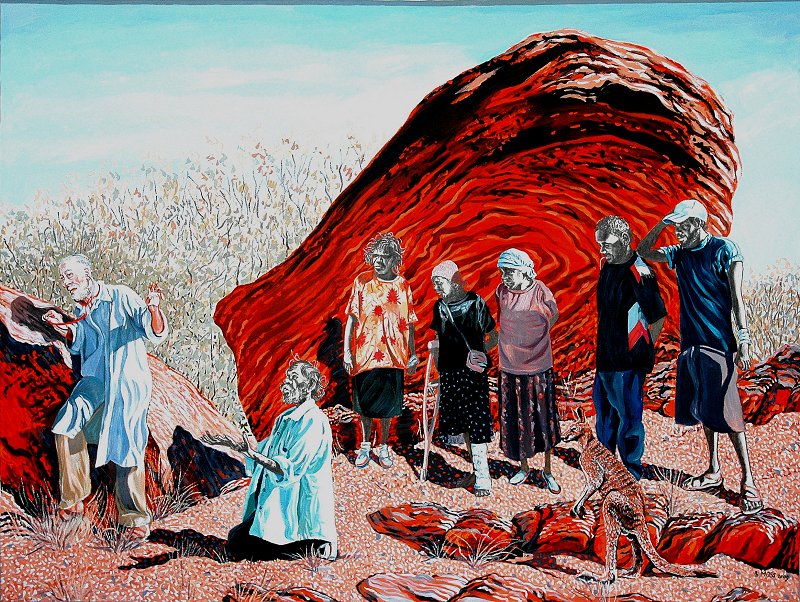
I approach as the sun withdraws. There are only two of us, the Rock and me. I glance upwards: gorgeous parabolas of stone, ferrous waterways etched in rust. One convex curve of curtained rock is fretted and tinted, purnu, an Aboriginal wood carving.
Around me all is still. I feel as I did as a child when I intruded into my grandparents’ bedroom. No-one found me, but the stillness nearly undid me.
I park the car, hide my keys, and set out, running clockwise. The rock is my companion, watching me, looking down from steeps and heights, not austerely, not unkindly nor yet tenderly. Keeping me in sight, keeping an eye on me.
Everywhere I go on earth I run; I feel the place then, I connect with its earth. I breathe its air. Well, no, not quite everywhere: not in sacred places – not on the Temple Mount, not at the Shrine of Remembrance.
The first time I came to Uluru, I drove here with my Dad. I parked and leaped from the car, crying, See you soon, Dad. Just going for a run to the top. Continue reading
 howardgoldenberg