My father was the eldest of three brothers growing up in the then Jewish suburb of North Carlton.
That suburb boasted synagogues, a thriving playhouse, a choir, houses of Torah study and a dedicated Jewish segment in the nearby Melbourne General Cemetery.
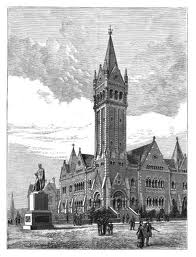
That Jewish enclave was sufficient to itself. But every shabbat morning, Dad and his little brothers walked the five kilometre round trip to the East Melbourne Shule.* They didn’t choose East Melbourne, their father did. I think Grandpa’s choice was driven by social climbing. East Melbourne was less foreign, more English, hence advantageous.
That social climb would always remain too steep for Grandpa, who arrived in Australia alone in 1898, as a twelve-year old, a refugee from Palestine, a boat person, speaking only Yiddish and Arabic. But Grandpa wanted his boys to ascend. So they went. Grandpa himself did not walk the five kms. My Dad explained, ‘Father’s knee was bad on Saturdays.’
Have you ever visited the East Melbourne synagogue? (They hold open days and host school groups. In these days of smaller congregations, the cumulative total of visitors might well exceed the tally of worshippers.) If you have seen East Melbourne Shule, you’ll feel sad as I do about the attack. For the shule is beautiful, a small Jewish gem surrounded by the august institutions of Christendom.
In conjunction with St Peter’s Eastern Hill, the rabbi at East Melbourne set up a feeding initiative for hungry people in the locality. I’ve been a friend of that rabbi since his family moved in around the corner when he was a boy of four. Nowadays he’s the Jewish Chaplain in the Australian Military Reserve. He takes his flock on a trip to country, guided by Aboriginal custodians. He’s a bloke with a beard who wants to help.
This then is the story of a bunch of very foreign foreigners who find their place in Australia. It’s an Australian story, replicated in thriving immigrant enclaves all over this land. And all of us non-Aboriginal groups are new arrivals, all of us more or less recent immigrants. This is the Australia that nurtured me, the home I cherish.
Last Friday night a person attacked that Australia. Since then, solicitous friends who are not Jewish have reached out to us in shock and anger and kindness. They ask are you alright? I reply I feel sad more than I feel scared. I feel sad for Australia, for my Australia, for this place that I love so dearly.
***
Last week I wrote the following little piece for the newsletter of my current congregation:
“Readers will not know, and certainly couldn’t care less, about the principles that underlie my daily selection of headgear. But permit me to suggest you should know and care, and ponder and decide. ‘Way back in history, there existed in the western world the phenomenon of Jew-hatred. For a good while it went out of fashion. It got a bad name in the 1940’s.

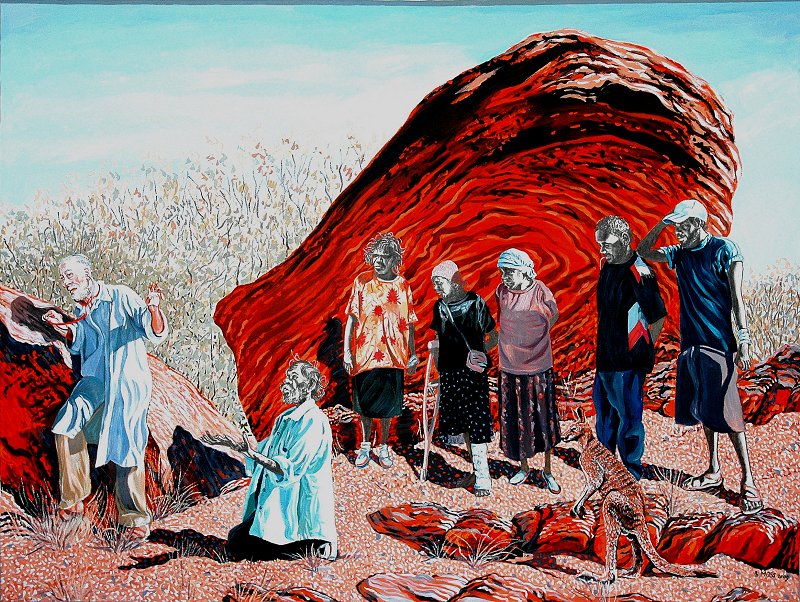
About the middle of that century, I popped up, and I lived in a world that execrated antisemitism. I walked the halls of my university beneath my kippah and encounteredonly warmth and respect. In Aboriginal Australia, I was a celebrity. The blackfella mob said, ‘You mob, you got your culture, you got back your language, you got your land. Us mob need to be like you mob.’ In whitefella Australia, I prowled the wards and corridors of greater and lesser hospitals and met only honour.
Honour? This was unexpected. For what? – I wondered. If I read the great Australian character aright, we Aussies respect oddity, wherever we sense authenticity. I think Aussies, often ignorant of history, generally devoutly secular, looked at me and thought, this bloke looks funny, but I reckon he’s fair dinkum.
About the year 2000, I began to hear antisemitic whispers. It took me a while to learn these were not whispers or mutterings but a swelling to a roar on social media, a world to which I am a stranger. From that time, when I ventured outside, I began to cover my kippah with a secular hat. I still looked odd, but not so Jewish. I was no longer living my proud Jewish Australian self.
From the time of the Opera House riot of October 9, 2023, I have resumed wearing my public kippah. My kippah asks Australia a question. It asks, ‘Is this old Jew still welcome in your world? Or does he need to piss off back to Palestine?’
I spend most of my days in gentile company. Wherever I go beneath my kippah, Australia shows me neither surprise nor hostility. Often strangers flash warm, wide smiles of surprise and recognition. Here and there an ockker delivers a small oration: I hate this antisemitism! Or, I stand with Israel. Or, Burning synagogues! That’s not Australia!
In a coffee shop well outside the ghetto, I meet my son for coffee. He wears his Let Them Go t-shirt. In Carlisle Street, flowing beards and peyot (side curls) are all the go, stout Lubavitch Hassidim waddle in their Kapottehs, and broad-chested Adassniks flash their vast public ritual fringes.
I think we all, wittingly or otherwise, are asking the same question. I think the kippah, the beard and sidelock, the pectoral tzitzith, the t-shirt all fly the flag. The flag asserts Jewishness in Australia. It’s not aggressive, but it is challenging. Thechallenge to Australia is that of diversity. Pauline Hanson rejected diversity, and Australia has largely rejected her. I urge readers to consider how you can fly this honest, and decent and respectful and proud flag.”
***
As antisemitism came out of hidingaround 2000, I suggested to my adult children they owed it to their own children to listen and watch, and decide whether the time had come to flee. They laughed then.
First the Opera House riot, with cries of Fuck the Jews. That night a carful of young men drove around Melbourne, stopping repeatedly, shouting to passers-by, Where’s the Jews? Where’s the Jews? Policeintercepted them and talked them down. Soon cars and fences burnedin Sydney, then Adass Israel Shulewas burned out. Now the attack atEast Melbourne.
The copycat is at large. Anyone who sets fire to a building with people inside is willing to harm them, to burn them, to see them die.
First, come the words of hate. Inert governments, passive police sit on their hands. The words set fire to hands; then schools burn, then a Jewish MP’s office, now sacred places.
The pace of hatred accelerates, the acts of menace mount to violence against property. We have now – following the synagogue fires -crossed athreshhold. Next comes the taking of life.
My children are not laughing today.
*Shule, a Yiddish term derived from the German word for school, has come to mean synagogue, always a place of religious instruction and learning.


 howardgoldenberg