We Don’t Know their Names

An internet friend sent me some thoughts last week about the writing of the 2014 Nobel winner Patrick Modiano and his preoccupation with the lost. At the same time I was steaming towards the end of ‘Kamchatka’, a novel of the Disappeared in Argentina. Modiano wrote of Rita Bruder, a young French Jewess who went missing from her safe haven in a convent during the German occupation of Paris. Modiano is driven to search out the child’s fate. He cannot let the past and the lost rest unpursued.

I found myself acutely vulnerable to my e-friend’s story of stories. Partly it was the menace quietly gathering in ‘Kamchatka’ of the inevitable disappearing of a loved one; but more, the Modiano quest brought home a long overdue quest of my own: my destined search for my mother’s lost cousins. My knowledge of the cousins in question is slight and fragmented. It shifts in memory’s half light, lacking solidity, its textures diaphanous with the partial attention I must have paid in early childhood to a story my Mum told me. Seventy years after their presumed deaths in Auschwitz I feel the weight of silence.

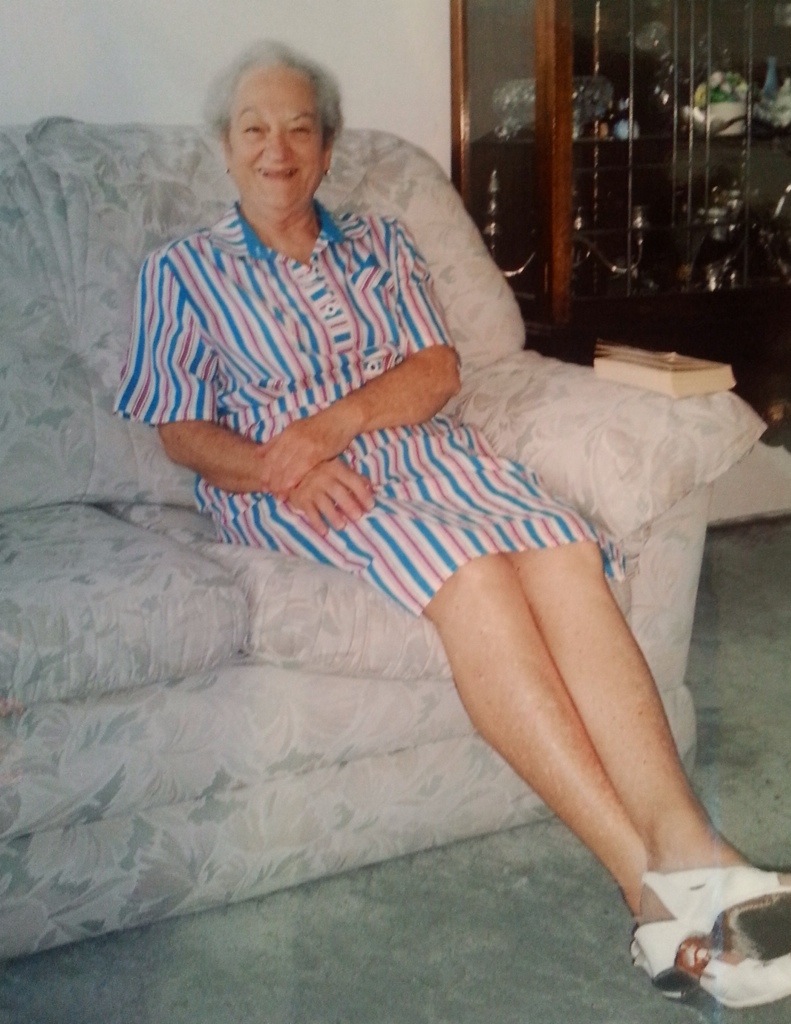
My mother’s parents died of natural causes in her early adolescence. Somehow the orphan never lost her faith in living or her relish in it. Failing her Year Ten examinations she left school, trained as a bookkeeper, went to work and saved. In 1939, at the age of twenty-one Mum travelled alone to France where she had good clean fun. She spoke of dining with the Captain and the young officers on the Dutch ship which took her to Europe. She spoke of the beauty of Bali, then a Dutch outpost, almost untouched. On my mother’s return to Australia her younger sister Doreen asked her: ‘Are you still a virgin, Yvonne?’ ‘Yes,’ came the reply, ‘But it wasn’t easy.’ Mum made friends with men wherever she went, two of whom would bob up in our Leeton home while I was still too young for school. The two men, to the best of my knowledge, never knew each other. Their visits were separate and apparently independent events. We’d form a threesome for picnics by the river, the respective Continental, Mum and Howard, her four-year old chaperon. The men’s mysterious names – ‘Syd Viberow’, ‘Romain Hudes’ – intrigue me to this day. Googling has not relieved my curiosity.

These matters I recall well. I recall the smooth Continental gentlemen basking with my young and attractive mother on the riverbank. On one of those picnics we ate kedgeree. On another was it curried hard-boiled eggs? Europe was – I am confident – earnestly wooing; Mum remained Mum, Plato on the riverbank. I mean platonic; Mum might well have enjoyed being admired, but assuredly she liked her good fun clean. My memories are scatterings. Atmospheres are clearer than some factual details. Mum’s prudent inclusion in the picnics of an attention-hogging four-year old was strategic.

More scatterings: In Paris Mum’s tight black curly hair excites the admiration of a German hairdresser who marshalled her best English to compliment her: ‘You have vonderful viskers, Mademoiselle’; Mum’s accounts of the anxious urgings of the family back in 1939, to ‘come home now! There’s going to be a war.’ Mum is in no hurry. She spends time in France with her young cousins. Eventually she sails for home: ‘We slept on deck that last week, half expecting every night to be sunk by a U-boat. We arrived in Fremantle on the day war was declared.’ More good fun.

Much less clearly come memories of Mum’s cousins. The names are feminine and French, that I recall. Or I believe I recall it. They must be the daughters of Mum’s mother’s cousin. In 1939 they are teenagers, while Mum is twenty-two.

Mum says nothing to us children touching her cousins’ fate. But she must have known. I know that from the international telegrams that sped across the world late in1944; from Melbourne to Paris, from New York to Paris, with mounting anxiety. From Paris silence. From Melbourne to New York, from New York to Melbourne, in tones of deepening dread, cousins ask for word. There is no word. “Oed’ und leer das Meer”, ‘empty and waste, the sea.’ I know Mum knew; I found these telegrams among her papers after she died.

Mum and Dad bring up their four children very Jewish in the Riverina. In Leeton we children never hear of the Holocaust. We are as far from Auschwitz as Jews can be. Only three hundred miles south of us, Melbourne, thronging with survivors, is as close to Auschwitz as Australia can be. At the age of nine and a half I am translated from the Riverina to Mount Scopus in Melbourne. There, in a classroom full of Jewish children I am one of very few with living grandparents. I experience myself as a Jew whose family was safe, intact.

I regret now that innocence. A child who sat at the side of his father every Ninth Day of the Month of Av, listening to Dad as he lamented the destruction of the Temple and the sack of Jerusalem in the year 70 CE, knew nothing of Europe only a few years earlier. We sat on the thin, scratchy carpet of our dining room floor, the house lights turned off, a single candle our only light as Dad chanted the Book of Lamentations in its distinctive moaning and sighing melody. Dad translated and together we bewailed the ‘breach of my people’ at the hands of Rome. Sixty-plus years later I can feel that carpet itching my thighs. But the Third Reich never touched me.

Why was Mum silent? Assuredly she cared for ‘Sophie’ and ‘Josephine’ – names that lurk just beyond memory’s outer fringe, names that might even be true. Assuredly Mum knew. But she said nothing. No stranger to closer loss, Mum could and would speak of her beloved parents, tenderly but with a composure that unnerved this small child. Strangely disconnected from grief, Mum thrived as an orphan, much, much later as a widow, and even managed to live on in joy after losing her one lifelong companion, her sister Doreen; and after Doreen Mum lost her firstborn son. From her early years Mum knew loss but managed to keep sorrow a stranger.

At what cost, I wonder. I read Modiano and I understand the Nobel judges’ remark about ‘his art of memory.’ My mother practised her own arts of memory. Did she survive a life that was punctuated by loss by excision of sorrow? Perhaps what started as a young girl’s strategy led to atrophy and involution of the organs of sorrow. In that case my own memories of Mum’s account of Europe might be actually complete: do I in fact recall the entirety of the particles that Mum allowed herself?

I bless Mum for her faculty of joy. And now she is gone I must investigate my own faculty for grief. I want to find my cousins.
He Wished to be an Inmate at Auschwitz

“I was born in mitteleuropa. You would say ‘central Europe.’ I had a happy life. I still have a happy life.” The man’s smile is wide, unmistakeable through the oxygen mask.

“When the War came I was a boy. My father and his partner had a business, so although there was war we had enough. But then the Nazis came and claimed my country. The great German Volk needed more livingsroom.” A smile, no bitterness, the smile of a man who sees the joke that is nationalism, the extended joke that is human history.

“The Nazis made lists, they liked lists. They made one list of Jewish businesses. My father’s business partner was Jewish, so the Nazis found it necessary to confiscate the business. My father found work as a clerk. It was not much but we got by for a while until one day they took my father away. I was at school when they came for Father. My older sister had to stop her studies. Later she disappeared, then Mother. There was just me. I stayed at home until a friend of Father said to me, ‘They will come for you tonight.’ I ran and I stayed with a friend in the country.

“This was, I think, 1942. I was bigger, still a boy, but big enough to work, big enough to become a slave for the Nazis. The Gestapo found me and were taking me on the trolley bus to their HQ for questioning. The trolley slowed for a corner and I jumped and ran. I was fast and small and I got away.

I took a train to a town where we used to ski in the mountains. I knew that place, we had friends there.

“But the Nazis found me. They put me into slave camp.

Work I don’t mind so much. It is hunger that is bad. Hungry slavery, that is very hard. They give us only one hundred fifty grams of bread a day. You know how much is one hundred fifty?”

The man shows me how much is one hundred fifty with his hands. His thumb and forefinger describe the thickness of a slice for a slave of the Nazis, something under a centimetre. His right forefinger sketches the outline of the slice on the palm of his right hand.

The small hand and the fine fingers are pink and soft. The skin has forgotten and forgiven the slave years. As he speaks the man leans forward, his neck muscles and his upper thorax working hard between phrases as he sucks in gulps of oxygen. His ribs rise and fall with his phrases. When you listen no tide of incoming or outgoing air is heard. The lungs have been burned away.

“People said slaves at Auschwitz received two hundred fifty grams. Two hundred fifty! I wished I would be taken to Auschwitz.”

The smile has not ceased. Does he need the widened mouth to get a full insuck of air? – I wonder.

“They did transfer some of us, on a train. I did not know to where we would travel, I decided I would escape again. I went to the toilet and opened the small window. The train travelled passed through snow close to forests. As we climbed a hill I jumped. The snow was soft. I ran to the forest and joined the fighters. For more than one year we fought the Jerries.” Behind the mask the smile widens in happy recollection of fighting ‘the Jerries.’

“I knew that country from our skiing holidays. I went to a farmer I used to know and his wife left food for me in the forest. I fought against the Jerries. They never came looking for us in the forest. They were too frightened, they did not know those forests as we did.

“After the War I returned to my hometown. And my father and my mother were there. And my sister. Later I came to Australia and we” – he nods towards his wife – “ we found each other and married. That was in Brisbane. We have been together ever since.”

The man and the wife live in the last house in a street that ends at the foot of a mountain. Forests of dark green stretch up the nearby slopes. When I phone to arrange my visit it is the wife who answers. Her voice, clear and steady, speaks in distinctly Australian accents. I follow her directions and find a derelict-looking building in ancient rendered cement. I approach a tall grey structure with glassless window frames. Inside a clutter of ancient debris. And silence. Clearly the wrong place.

Walking back towards my car, I am startled by a steady, clear voice: “Come around the side. Be careful as you climb the stairs.”

The stairs are steep and uneven, the building high. Surely a barrier for any aged couple, certainly an impossible mountain for a man with no lung tissue. The voice guides me up a second flight and there, on a concrete deck, at an alarming elevation above the buffalo grass below, stands a tall woman in a long navy dress, her face deeply wrinkled, her smile of good, original teeth and outstretched hand bidding me welcome. The dress and the face arrest me; the dress rises from ankle height, a deep blue teepee speckled with small stars of wattle; the face a roadmap of antiquity charged with vitality, lit withal by that smile. A woman attractive enough to haul any man up those terrible stairs.

We sit and I listen to reminiscences of a life. The man pauses and works his breathing as his lung remnants fight for oxygen. The smile never fades, never loses its expressive energy. When memory slows the woman prompts him: “Tell Howard about…” “Did you mention the time…?”

We look across sunlit mountain forest as the man breathes and speaks. He says, “My life has been a happy life. It is a wonderful life, this is a wonderful world.”

The Prayer of the Traveller

Many of us are on our travels as I write this. Today I will resume mine – one hundred and fifteen kilometers by road before a flight of forty minutes (in the air we register time not space), then a break before resuming for the next seventy minutes of flight. Finally thirty kilometers of suburban roads. Then home. Home – that word for an idea that houses our love; for the island we build to grow a couple into a family. After two stationery days I’ll skip from the continent of my birth to the land of the free – three flights, ten security checks (eight of these in the US) – eighteen hours in the air.

Long before the Malaysian airliner disappeared I had my misgivings. The loss of a civilian passenger aircraft over Donetsk did nothing to comfort me. And now the AirAsia tragedy. Travel is dangerous. Out here in the Outback, the roads are full of kangaroo, wandering stock, feral donkey and camel, species which share with the shahidi a zest for homicidal suicide. Air travel, far, far safer, remains hazardous.

Travel has always been thus.

If you are a wuss (I am) and if you have a prayerful bent (I am severely bent in that way) you might pray for a safe arrival – and if you are needy or greedy (I am both), you’d slip in a word for your safe return home.

The following comes from the ancient Traveller’s Prayer recited by Jews. The text catalogues a surprisingly contemporary list of hazards:

May it be Your will to direct our steps to peace, to allow us to reach our desired destination in life, in joy and in peace.

Rescue us from any enemy, ambush and danger on the way and from all afflictions that trouble the world.

Let us find grace, kindness and compassion from all who see us.

You can fill in your own particular concerns. (Afflictions that trouble the world are plentiful. I think of Ebola. I think too of violence of all kinds – both abroad and within our domestic walls.)

An anxious Jewish traveller (Jewish people are past masters at anxiety), having completed the lines above, might feel the need for elaboration or emphasis. Such persons follow on with Psalm 91. I do. I love this one: I loved this one and I quoted it to my shell-shocked teenage daughters after two hilarious hoons chucked rotten eggs through the girls’ car window, breaking on and altering the grooming of their lovely long locks.

Five years ago, grandson Toby, famous in these pages for his flirtations with danger, drew a picture in vivid primary colours. The picture, three inches by one and a half, was intricate, pulsing with the vibrancy of his four-year-old being. Toby presented it to me: ‘This is for you, Saba.’ Since that day it has sat between the leaves of my travel prayer book. It guards the place of Psalm 91.

One who lives in the shelter of the Most High abides in the shade of the Almighty. He will save you from the trap of the hunter and the deadly pestilence. You need not fear the terror by night, nor the arrow that flies by day; nor the pestilence that stalks in darkness, nor the plague that ravages at noon. Though a thousand may fall at your side, even ten thousand at your right hand, yet unto you it shall not come nigh.

I am not simple – or faithful – enough to believe that simply reciting these words will guarantee my safety. Saying the words is not the equivalent of completing the enrollment forms in supernatural travel insurance. I am not insured. But it is in the beauty of the poetics; in the relief of putting fears into words then filing them away; in the unspoken reminder that in matters in which I am powerless there is no point fretting – in these I find comfort, acceptance.

I am not insured, just assured.

I wish us all safe travels.

A Small Town in the Bush

Water is the secret, the theme, the meaning, the life of the town. If the town is to die it will be the failing – or the flowing – of water that will see its death.

Driving in at night I missed the river. Unaware even of the fact of the bridge, watching always for suicidal kangaroo, I followed the bitumen and missed the river. After unpacking I ran the shower. Who farted? Mother earth, is the answer: borne on bore water were those sulphurous fumes from antiquity. I lathered and rinsed. And rinsed again. Still slimy with slippery salts I towelled myself with vengeful vigour.

In the morning I brewed a bore water cuppa. It tasted fine, of coffee, not of earth’s bowel.

Before work I went for a run. Here was Terry, a cheerful sixty-year-old hosing the wide grassy expanses that surround the hospital. Modern sprinklers invented in, say,1950, would see the extinction of this man’s job.

Memorial Park with its humble cylinder of brown marble rising less than three metres from its plinth. From its pediment I read names from the Great War. This very small town offered up too many. Two of the dead bore the same family name.

Below the names from the First War were listed those who died in WWII. These names took up two of four wide rectangles of space at the base of the monument. Two rectangles remain for future names of dead from a nation that has always fought the distant wars of others.

A team of workmen clustered at a roadside. Beefy men all in their high-vis yellows, they watched as one of their number swung a sledge hammer. The hammer was a mighty instrument, the hammerer broadest of all, taller when recumbent. Four watched as one swung. A cement gutter cracked, disintegrated. Five men at work, working to undo the work of yesterday.

The shops sit behind their generous tin verandahs, shaded by rooves supported on wooden poles. The shops, house-proud but not fancy, wear old livery touched up and respectable. A notice offers me the chance to buy one of two coffee shops in the main street: it lists ‘large shop, vacant possession, on generous grounds with six-car shed and outbuildings’. “Hunter’s Supermarket” sits in dignified desolation beneath its formal signage. Its windows are covered on the inside by broadsheet newspaper. ‘For Sale’, says the sign.

At lunchtime I visit the emporium. Triple fronted, its three doorways lead to three sections. One displays work clothes, a second sells ‘guns and ammo’ and cooking implements ranging from basic aluminium to imported chefware. The third section offers saddles, riding boots, rodeo hats. The floors are of wood, the high ceilings of patterned pressed metal. ‘Handsome ceilings’, I remark to the sales lady. She nods, smiles attractively, and observes, ‘They leak when it rains. And the owners aren’t keen to repair the roof.’ Water again.

I am not here for the superstructure but for my own infrastructure: I need new undies. Sales lady leads me to them and removes to a discreet distance. Slim, tall in her tooled rodeo boots, her jeans scrolled and silvered at the seat, she’s a distraction. I find a pack of two pairs in interesting colours. The brand name is ‘Heavy Lifters.’ The sales lady keeps a straightish face: ‘It’s the name of a whole range of work clothes, not just, ah, men’s personal things.’

I buy some men’s personal things.

I show interest in men’s work shirts. These too are in electric shades of lime and purple. ‘They’d alarm my bride,’ I say.

Sales lady points me to a different rack of iridescence: ‘Why not you buy your bride one of these pretty shirts for girls?’

I settle for Goondiwindi Cream Soap, picturing my wife’s limbs, clean as Gunsynd’s.

At work my patients are generally aged. One group consists of slow moving stout people, retired, in their fifties and early sixties, who live here in town. The others, slimmer, gnarled of knuckle and sun blighted, are in their seventies and eighties. These live out of town on cattle properties which they continue to work. For the trip into town these folk dress smartly. Lots of colour, a quiet elegance.

It’s more enjoyable doctoring the farm folk with their accidents of activity than the town folk, who, although younger, are less healthy with their illnesses of inactivity.

In the waiting room no-one checks a wristwatch. All appear unhurried and relaxed and friendly. All but one, a hunched small lady, 83 years of age, who wears a floral yellow dress and a fierce mien. ‘I won’t see that other doctor! And don’t you try and give that useless tablet he gave me!’

At this stage, unaware of the identity of that other doctor or of the useless tablet or of the condition treated, I am at a disadvantage. The lady has me pinned to the ropes where she continues to batter me for the next twenty minutes. ‘Those blue tablets, don’t give me those!’

‘Which blue tablets?’ – diffidently.

‘You know the ones. I won’t take them. So don’t try to make me. I might look old but I’m still manhandling steers and I’m not simple.’

I study her file for clues.

‘Well? What are you going to do for me? Don’t give me any of your soft soap, young man. I’ve put up with this for long enough.’

I point out that I’m not her adversary, that it’s up to her to decide whether or not to trust me, and if she doesn’t trust me she should not waste her time on me.

She falls silent, her large mouth hanging slack as she regards me in surprise. I am surprised too. I’m starting to enjoy myself.

A truce is declared. Later in the waiting room, she informs the office staff, bellowing, ‘That new young doctor’s all right. Don’t you try to make me see that other one. I won’t have a bar of him.’

Day after day the skies are cloudless, palest blue, arching high to eternity. Not a cloud in sight. But yesterday low grey cloud hovered. The waiting room was full of talk. Veterans of too much faithless cumulus, the farmers were skeptical. Today all is blue again; the old men were right. One old bloke with a great hole in his leg – he came off his motor bike, digging out a divot of flesh – tells me: ‘There are three year old frogs out on my farm that don’t know how to swim.’

He laughs. A wounded leg and a dry dry spring don’t exhaust his well of good humour.

‘Any cane toads?’

‘No, no toads. Too dry for them.’

He laughs again.

Not all laugh. The visiting psychologist tell me, ‘I go out to the farms and visit the farmers regularly. In the droughts some despair.’

The temperature reaches forty – in October – and no-one remarks on it. The Bureau predicts a thunderstorm. It duly arrives. One peal of thunder, the temperature falls but the rains do not.

‘How is it on the farm?’ – I enquire of every farmer.

All respond, ‘It’s dry.’

‘Are you worried?’

‘Yes, it’s very dry.’

‘Is this the driest you’ve known it?’

‘2003 was worse. But this is bad…’

No-one says so explicitly but the floods of 2012 were worse than bad. In those few days lives turned, settled families in their dynasties saw nature’s violent face anew.

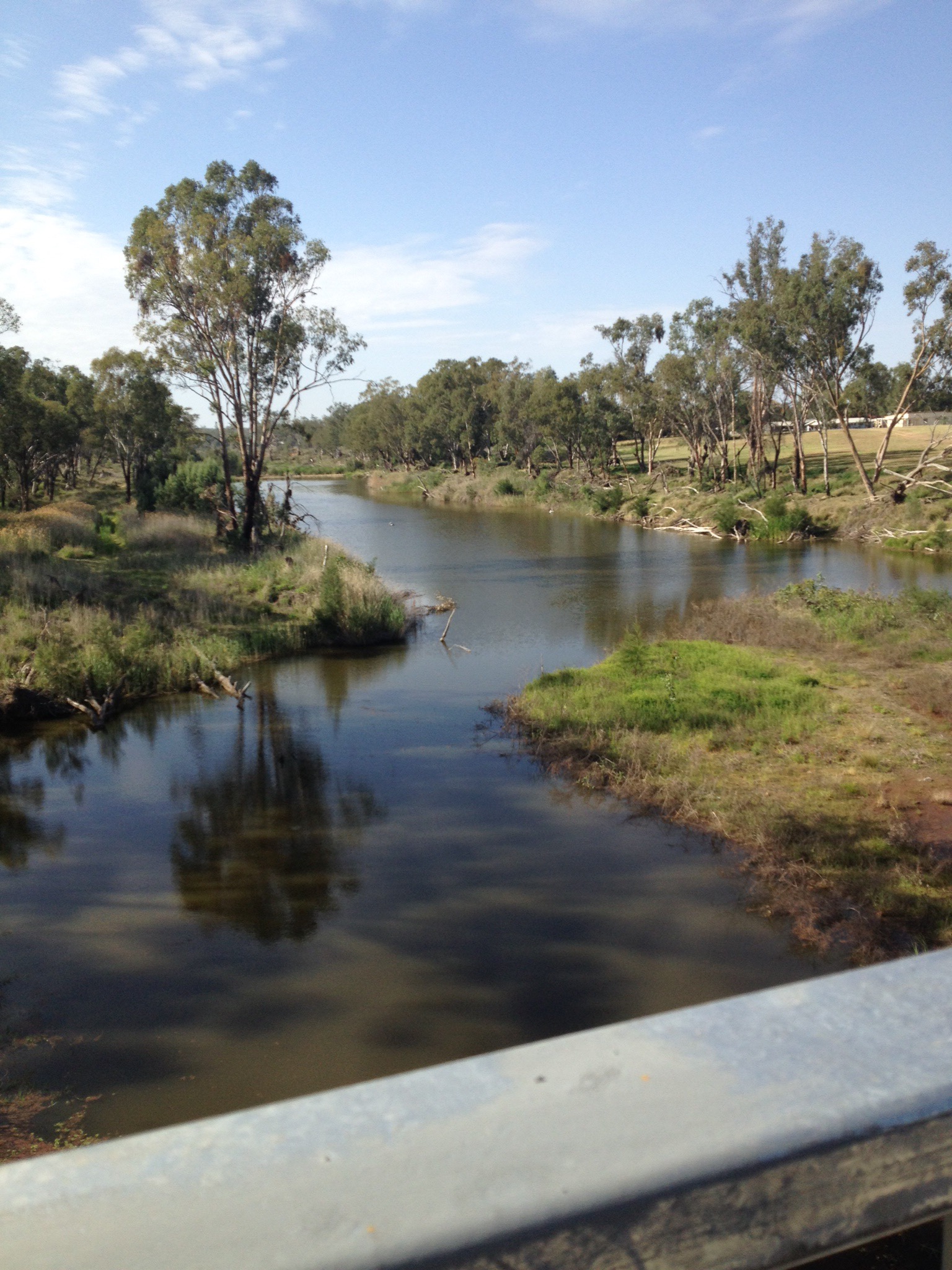
By the third morning I still had not sighted the river. On previous morning runs I headed north and south. This time I went east. Past the library on the main street in premises vacated by the extinct cinema; past the pool gleaming fluoridated blue; past The Great Artesian Spa; up a rise to the edge of town – and there was the bridge, a modern structure of cement and steel, its slow length elegant against the sky. Below, far below, indolent waters were a silver ribbon. Tall green grasses pleased the eye.

A slender roo, disturbed by this sole intruder, widened the gap in graceful bounds, then stopped and looked me over at leisure. A moment of shared wonder.

At the approach to the bridge a wall of dark granite, cuboidal, taller than me and wider than the hammer-wielder of the first morning, detailed the floods. Undemonstratively, without self-sympathy, in the manner of farmer conversation, the wall of stone gave fact and context:

1864 – 9.56 m,1949 – 4.86 m, floods in 1950, 1954,

then, in February 1956 the waters reached 7 metres; and in April the same year, 9.26 metres. Photographs show island buildings, white against the silent black of inland sea. Some left town. Most remained to face flooding again – in 1983, 1990, 2010. Then came the waters of February 2012, peaking at 9.84 metres, breaking the record of 1864. People speak flatly of ‘before the floods’ and ‘after the floods.’ I hear the same throughout the state.

One farmer replies to my stock enquiry with a quiet,’The dams are both dry. It’s fortunate we have a couple of bores.’ I look at him, his face etched with decades of flood and drought. He knows fortune.

No-one in back in the Collins Street practice uses that expression, it’s fortunate.

Something missing here. Someone not heard, stories not told. Where are the first owners? Further morning runs uncover traces. At the Information Centre an elaborate sign invites me to follow the Yumba interpretive trail: ‘Mon-Thurs mornings.’ Below this a handmade sign amends tour times: ‘Tues and Thurs.’

And to one side a larger, handmade sign advises

NALINGU

ABORIGINAL

CORPORATION

WISH TO ADVISE THE

YUMBA

INTERPRETIVE TRAIL

AND MITCHELL YUMBA

IS CLOSED

UNTIL FURTHER NOTICE.

But the first people are here. I see them with their ailments and their children at the hospital and the clinic. In the main street, Nalingu has its dusty offices, and just down the same street is the Aboriginal Health Centre. Inside this hive a small lady of middle years buzzes with purpose. She searches my face, wondering whether perhaps I might be a JP. She needs a JP to certify photocopies of documents for the tall Finn standing at my side. He’s jackerooing on a station. (The Finn does not look Aboriginal. But some say I don’t ‘look Jewish.’)

The lady finds time for my questions: Yes, this is a health centre and yes she’s here four days a week helping local Aboriginal people with transport and health appointments in the bigger town one hour east of here. And no, the bigger town doesn’t have a doctor at the Health Centre either, not regularly, just a couple of days a month. ‘But I look after things.’ She tells me all this with evident pride, vibrating with energy and quiet command. She looks up at her curious visitor, radiating confidence and belief in her role. I guess she’s the dynamo of a community that might otherwise not be a community.

Back at the clinic, a tall man in his late fifties has plenty of time to chat. He’s intrigued by the phenomenon of a Jewish doctor way out west; and I’m interested in his experiences as a cattle man. He’s been out here all his life but he sent his daughters to boarding school in the city. I ask my usual questions – how’s the farm going, water, rain, feed?

‘Well it’s hard. If it wasn’t a challenge I’d have to go and find one. But surviving here calls for something. I like that. I like to be tested. Every difficulty demands something of me. I want to create, I don’t want a dull existence. I’m lucky with my life here.’ He smiles, a smile of good teeth and good skin, the smile of broad vitality. Why has he come to see me today? ‘I’m well, but I spend my life in the sun. Will you check my skin? Any other tests or checks a fifty-eight-year old should have?’

We do the medical stuff then conversation resumes. He employs backpackers from around the world. ‘I look for people others won’t take – people with problems. With patience you find the goodness in a person and help them become productive. I’ve had alcoholics. They come to the station, I let them dry out, I expect them to be temperamental until they settle. Then you find the person with a problem has some drive that might have got them into trouble; now they have a chance to direct the drive productively. There’s pride in that. A small start to a better way. After three months they leave, and we are both winners.’

The cow man has questions for me – about my origins, any children, a wife? He tells me about his girls, working in distant places, how he encourages them to pursue their passions in their occupations, not to settle for work that won’t fulfill them.

‘Have you been to Israel, doctor?’ – in the city this is the litmus question of my decency, out here it’s a question couched in curiosity or envy.

‘Israelis inspire me. They have never had it easy but you can see their drive to survive. And they do it by innovation, by creativity. They’ve never had enough rainfall where they are, but they farm, they feed their people and they have create a surplus to export.’

IMG_3980.JPG

IMG_3980-0.JPG

The Eve of the Eve of Yom Kippur

The house, emptied now of the insurrection that is a bunch of grandboys on school holidays, is quiet. These are the peaceful moments when the house exhales, the pulses slow and thought recovers.

Tonight is the night before the eve of Yom Kippur, the Jewish Day of Atonement, our Sorry Day. What am I sorry for? For what need I atone? Almost all my sins are those committed in words: I am sorry for the words shouted in anger at my grandrats, sorry for careless slights and unkind witticisms, sorry for speaking faster than my thinking.
And as this blog consists of words, I should search them.

I wrote (in How we Killed Leo) unkindly of Mister Scott Morrison. Elsewhere I have written uncharitably of Mr Shorten and Mr Abbott. All of these public people have private families who would feel wounded when writers such as I play the man instead of attacking the issue. I referred – wittily I felt – to our homegrown press baron as Murd. I should wash my mouth out. I am sorry for the hurt I have done those men and their families.

I remain sorry – and ashamed – that we Australians choose representatives who follow our baser instincts instead of those who might lead us and inspire our finer selves.

In the person of the successor in Sydney to Cardinal Pell, we might have found such a leader. On the morning after his accession the new archbishop spoke like one repentant for wrongs, transparent in confession, compassionate towards those hurt, and creative and courageous in his declared resolve to seek out his brother clerics in the Muslim community, ‘to find ways we can work together to heal our community’. This on the very morning we all read of the arrest of one Australian suspected of plotting to kidnap and behead another – any other – Australian.

A few weeks ago a Jewish democrat, tirelessly active in the struggle to improve our policies towards refugees, shared with me a bright new idea. “Howard,” he said, “Instead of attacking politicians I want to mobilise members and leaders of all of Australia’s faith communities to work together with government to create some softer policies that will be less cruel in their effects on those already here and kept in limbo.” Many, many are the Australians who wish our practices were not so harsh. Many are ashamed. Many have raised voices – as I have – in rancour. What I heard now was the echo of the quiet wisdom of Petro Georgiou, former Member for Kooyong, the man who spoke softly to a hard-faced Prime Minister and brought some humanity into policy.

As the prophet said, “Come, let us reason together.”

Farewell, Farewell

I used to run six days a week. No longer. I used to run marathons. No longer. Farewell, farewell, a long farewell to all that.

I ran before work; sometimes I ran to work. I ran every day but Saturday, the Sabbath. I ran because I could, I ran because I needed to. I ran up the hills of Wattle Glen, up the endless alps of Kangaroo Ground, and along the river at Warrandyte and Kew.

I ran marathons in Traralgon, on the Gold Coast and in Alice Springs. I ran in the New York Marathon (thrice – never won it – home town decisions, obviously) and four times in the world’s oldest modern marathon, in Boston. The 2013 Boston was my last. I never crossed the finish line, turned back by the police at the 41 kilometre mark. At 67 years I was too old, too slow to be harmed by the bombers.

I ran in the World Veterans’ Games Marathon, and I was a Spartan at Melbourne. About 8 years ago at Traralgon, I became the Victorian Country Marathon Champion (Over Sixty, Male). There was one other sixty year old bloke – a patient of mine. He ran with an injury that I had fortunately not cured. I entered my title – Vic Country Marathon Champ – on my resume.

I ran in Havana and Amsterdam, in London and in Oxford, and on the golden stones and basalt cobbles of Jerusalem. I ran up and down Masada and in Galilee. I ran in Buenos Aires and in Capilla del Monte.

In fifty Aboriginal communities I ran to feel country, running fast to keep ahead of mobs of hungry dogs.

Through all this running I discovered strengths I never dreamed of and weakness I’d always feared. I extended my being, I joined in the joyous commonwealth of comrades that is a marathon.

I ran and I wrote what was a metaphor for my life – a passage, undistinguished, through space and through time, made rich by those I ran with and those I ran for. And always I ran with a doctor’s calibrated sense of risk. I ran with my younger daughter’s instruction ringing prayer and warning: Have a good run, Dad, and don’t come back dead.

I ran carefully, knowing if I did die I would leave wife, children, and latterly, grandchildren, grieving and aggrieved.

I ran and I gave thanks that my body held up for so long. I knew joy and pain and the joy of pain transmuted. I knew my lands and the lands of others intimately, physically. And in the stiffness and the glad soreness that followed a hard run, I knew pride, I knew joy.

***

An Australian boy knows it is in the sporting arena that his worth is measured. Excellence at sports trumps beauty and wealth. Brains lag last, far behind all. As a little boy I was timid, both physically and spiritually. A large brain served me only to imagine fearsome possibility; it was no asset in sports. Introduced to both cricket and football, in which I overcame fear sufficiently to try bravely, I achieved and sustained a modest mediocrity. I might have achieved more but for two discoveries: the hard cricket ball, travelling fast, hurt the fumbling fingers; and the elusive football, fiercely contested by other boys bigger and less timid than I, led me only to painful and fruitless collisions.20130411-184933.jpg

By virtue of very little, I rose to captain the Second Eighteen in footy and captain of the Second Eleven in cricket. My highly academic Jewish school quickly won fame for academic excellence, while earning only a reputation for awkward strangeness in inter-school sports. Generations of Jewish history had equipped Jewish boys well for debating, mathematics and playing the violin. Our ancestors in Europe learned to run only from fire or pogrom. So the best teams this post-Holocaust Jewish school produced were try-hard failures. And I was never good enough for the Firsts. Captain of the Seconds at Mount Scopus was the ultimate backhanded compliment in sports.

But at the age of fifteen came the discovery of distance running. The annual cross-country run over three miles of hilly scrubland sorted the tortoises from the hares. At the gun all the glamour boys leaped into the lead and quickly disappeared between bushes at the first bend in the course. I chased as hard as I could, my breath burning my throat, my chest aching. In a failure of the imagination I never thought of stopping or slowing. I kept going. Abrupt hills, uneven terrain, a finish line that was nowhere in sight, all conspired to daunt and defeat our gazelles of the track, our hares of the field. But I kept running. I don’t think I slowed at all. Eventually the astonishing sight of my idols bent double, gasping at the trackside, unable to respond to greeting or commiseration told me I was among the swiftest of the tortoises. I finished in the top ten that first year, improving to fourth, and eventually to third place, in the years that followed.

The barren years of sporting opportunity after school saw me gain a medical degree (summa sine laude), a wife and a bunch of little kids. And about five kilograms in weight. I was now a sedentary family man, short in stature, with a small pot belly. Then a schoolteacher friend took me running on the hills of Diamond Valley. He tired me out and he puffed me up, saying, “You have a nice running style, Howard.” One day we ran ten kilometers together. Breathless with achievement I looked at the distance – nearly a quarter of a marathon! – and with fine naivette I said to myself: I can run a marathon. And I did.

***

Seven months ago I drove for six days to and from an outback locum. My left thigh ached and it still does. Two months ago I fell onto my left knee from my bike. It screams with pain whenever I run a single step. The MRI of my spine resembles a bombed railway track – you can recognise the pattern of the original structure but you wouldn’t want to travel on it.

I used to run. Now it’s over.

Aunty Pearly’s Sorry Business

I think many families have an aunty who is not really an aunt. That sort of aunt, usually a contemporary of a parent, is a person treasured across generations. You inherit that sort of aunty.

For many of my Jewish school friends in the fifties and sixties that was the only sort of aunt and uncle they knew: their parents’ blood siblings had perished in the gas chambers. Afterwards, close contemporaries were clutched and held closer, people who shared the stories and the memories.

The auntness of Pearly wasn’t woven of that tragic weft. Pearly was the sister of the wife of my father’s brother Abe. The earliest encounter I recall with Aunty Pearly occurred on a winter’s evening at the start of half a year of exile from my home and family. My older brother Dennis and I were to board with Aunty Clare and Uncle Abe in Melbourne, while Dad sold his medical practice in Leeton, our hometown. Transactions of that type take a long time.

The evening was erev shabbat, Sabbath eve, that fulcrum in the week that still finds me emotionally suggestible. The sun set and sank, and with it my mood.

While I enjoyed a period of self-pity – always the sincerest of emotions – our cousins Ruth and Carmel spoke elatedly: “Aunty Pearly’s coming for Shabbat. She always gives us a whole Vanilla Nougat or a Cherry Ripe. Each!

I didn’t know Aunty Pearly. She wouldn’t know me. Vanilla and Cherry and Pearly would be strangers to me. My sincerity deepened.


A knock at the door, a scamper of cousins, gleeful ‘thank you’s, and a deepish womanly voice called: “Where’s Dennis? Where’s Howard?”

Down the short hallway the voice approached, a bulky figure loomed, a smell of perfume, a slash of lipstick, and we were hoisted, one after the other, up into the soft valley between two mountainous breasts. Pearly handed me a Violet Crumble Bar. To Dennis she gave a Vanilla Nougat.

Somehow this stranger knew me, liked me, perhaps even loved me. In that instant I loved Aunty Pearly and the feeling never changed.


When Pearly’s real nephew – a blood nephew – called me early on a Sunday morning sixty years later, his slow agricultural voice had slowed further. “Aunty Pearly just passed away. The funeral will be tomorrow.” The day of Pearly’s passing was filled with celebrations at far ends of a widening clan: there was a Barmitzvah to attend of the grandson of my wife’s cousin and the wedding of the son of my first cousin. Such mixing of significant life moments!


Next day a wintry afternoon found us in a garden burial ground. In this light the grass took on a deeper shade. Black clothing against the green brought a sombre richness.

A crowd, many, many scores of people, gathered. Although some of the names eluded us we all knew each other’s faces from generations of family events. This was a gathering of the many from the fringes of a number of intermarrying clans. Pearlie was one of seven siblings. All of her siblings married and multiplied. Pearlie alone never married: she’d smile and call herself an unclaimed treasure. She treasured her siblings’ children and grandchildren, and their spouses, a growing multitude. But there were non-bloods there as well, numerous as her true kin. Pearlie gathered the young in her wake and we followed her, long after our own youth had gone, to her end. Everywhere eyes shone while mouths smiled, people cradled each other, faces looked serious but not in grief; for aunty Pearly died at the right time – before her dementia could ruin her, her slow cancer suddenly accelerated and she was gone.


Aunty Pearlie led a religious life. Her sacred places were the MCG and the Melbourne Synagogue. She never wavered from the worship of her idols at the Melbourne Football Club. But today it was the curate from her synagogue who led the ceremonies. It was a sweet moment when the young man – no relation to Pearlie or to anyone present – called her “Aunty Pearlie” as we all had. He was another honorary nephew, full of affectionate personal reminiscence. Pearlie’s life of faith ensured she would not be buried by a stranger.


In Aboriginal communities a burial takes place after indeterminate delay long enough for families to scrape the money together for a funeral. Then follows a further chapter of mourning where people gather from across a life history, from across a continent, for the Sorry Business.

Jews are buried with all decent haste. Then our own Sorry Business follows, the precisely calibrated period of shiva when first degree relatives sit low to the floor and receive condolence from their community. But Aunty Pearlie had neither spouse nor children to sit in her honour. Instead we gathered the next two evenings for successive memorial services at her synagogue. Same crowd as at the garden funeral, swollen now, and at a different venue. The Melbourne Synagogue is grand, cavernous, dripping with history, but too often attended by too few. A beautiful shell, the Shule waited for throngs that rarely came. But Aunty Pearlie came, Shabbat after Shabbat, at festival times, at all seasons. Over nearly seven decades she befriended each new rabbi, kept him company in his inevitable disillusion, saw him leave and welcomed and supported his highhoping successor. In this manner Aunty Pearlie outlasted seven Rabbis.


In the course of the Sorry Business I learned more of Pearlie’s growing up in Brisbane, of her service in WWII, of her friendships there with many women and men including a young Zelman Cowen. Pearlie seems to have won and kept many devoted friends.


Poignantly, one who resided so deeply in so many affectionate bosoms left no son to recite the mourning prayer Kaddish for her. Anxiously, I waited to see who might step forward and assume the mantle of the sons who never were. An aged brother in law, still erect, together with his not young son, and a couple of his not young cousins, all recited it together. One or two, more fluent in the Aramaic, led the others as they hobbled and stumbled in and out of time with each other. The four men freighted the feeling and the yearning of us hundreds, all of Aunty Pearly’s “young ones”, all of us wanting hard for her to be sung and storied, lamented and remembered, celebrated in this her holy place. Hundreds of us, all with our personal memories of some moment like mine with a Violet Crumble Bar when I was a child missing a mother’s love.


20140616-064031-24031367.jpg

Report from Womadelaide

Early visits to Womadelaide exposed audiences to plentiful Jewish song, to Ladino and Hebrew, to Jewish and Israeli musicians, cantors, singers and folklorists.

Since Israel’s Gaza operations I find the Womadelaide landscape depleted of that Jewish and Israeli richness. That portion of the landscape has narrowed, possibly as a pioneering and undeclared expression of BDS, possibly as a coincidence. Of late Jewish people have encountered a lot of coincidence.

***

The guitarist of Tinpan Orange walks quietly onto the stage, as one might who lacks a foreskin.

I know his state: I circumcised him. (Does Womadelaide realise?)

The prepuceless one sings discreetly, sweetly, alongside the keyboardist and the violinist, as Emily his sister, publicly pregnant and wearing fruit and flowers in her hair, takes centre stage.

I know and love them so I have nothing dispassionate to say about this group, but the Frenchman sitting next to me on the grass murmurs his pleasure in the small quietness that follows every song.

At the conclusion of the concert the Frenchman stands and stretches, and we exchange slow smiles as we do after sleeping on a plane; as we do

upon waking with a person whose name we will never know, one with whom we have shared an hour of pleasure. The Frenchman says: I am at this festival three days now, and I listen to many concerts. This one is the most beautiful. This is the best, with Hanggai.

Hanggai is a gaggle of old Mongols that fiddle and bellow and sing. A couple of men of picturesque antiquity occupy either extremity of front stage wearing rags that upon closer examination are national dress. The two bow their traditional fiddles with a solemnity that belies the leaping tempi of their tunes. Behind them are instrumentalists, half-seen, whose clamorous attack upon percussion never amounts to an assertion of personality or individuality. The bellows at centre stage is a weight lifter, semi-nude in his cut-away jerkin of dyed and carved cowhide. His latissumus dorsi and pectoralis muscles are exclamation marks, his biceps are upper case. He strides to and from the edge of the stage, a lion pacing out his territory, his voice a roar.

He enjoys a good deal of self-approval in his imagined kingdom. We in the audience are charmed and amused.

And then Hanggai sings. A drone flows and rises from somewhere, higher notes join with a pounding bass, rhythmic sounds gain power and tempo, building and building to a pitch that swamps physiology: my chest is an echo chamber that pounds and vibrates to a beating from without. What is that sound? That deep, deep vibration coming from under ground, or rumbling from clouds unseen? On it drones, constant yet syllabic, hinting at a human source.

I glance to the thin old men, seated, as all leap and throb and swing about them. Sedate, studious, swinging chicken wing arms in their bowing, fiddling and singing.

From one of the two that sound emerges, that throat singing which is the group’s aural autograph. The throat releases its unearthing power through a mouth that smiles withal. I rest my pleasuring eyes upon the fiddlers: their eyes, their sparkling eyes, are gay. 

Carminho is introduced as a fado singer. She personifies (as I am informed by the braziliophone seated behind me) a classic grammatical contradiction. That is, “fado” signifies a singer is in the masculine gender while this singer is feminine. Every line, every phrase of her Portuguese lament (never really a song) seems to end in the “u” sound (heard as in “tutu”, but spelled “o”, the suffix of the masculine). After applause that never rises beyond the perfunctory, the singer thanks us: “Obligattu/o”. A woman would properly say “Obligatta”, murmurs the braziliophone. The singer is a woman lamenting, even thanking, in a man’s grammar.

I sit on the grass, one of a teeming multitude, all steaming in the Adelaide heat. The woman starts with a moan that rises quickly to a scream, her willow frame erect even as her voice shakes and shrieks and dissolves into staccato sobs. Portuguese seems to be a relative of Spanish – here, greeting a loved one, Carminho sings buon dia, amor –(good day, beloved) – but the words lack the flowing sweetness of Spanish. Portuguese, at least in fado, must be chewed and swallowed or spat out. Fado, like the Argentine bandoneon, is an instrument without a single happy note. And that is what we have come here for. For the fado, the Portuguese cry of pain, of fate. But I find this singer lacking in depth. She lacks – or neglects – the lower vocal register. However all about on the grass are figures and faces that are rapt, absorbed. Only half engaged myself I muse upon the crowd. Here are olive-skinned faces old enough to remember sons, brothers, husbands, lost in the colonies, in the wars, in Angola and Mozambique. And here are African faces, African voices conversing in Portuguese: these might have been the colonized. Fado carries the griefs of their losses too.

Afterwards my family and I exchange impressions. I am the only one who feels disappointed. Remembering Maritza, haunted by Maritza who sang here four or five years ago, I experienced anti-climax today. For me, Maritza’s is the authentic sound: I like a look of agony because I know it’s true.

My family recalls Maritza too and concedes the difference. That’s why they enjoyed Carminho better. Carminho is not a complete stranger to the light, to human joy.

Finally, Pokey La Farge. Pokey is as good as his name. This man is the antithesis of the fado singer, his music the roughhouse stuff of mid-west America. Harmonicas wail and rattle, fiddles fiddle, other strings are plucked in a frenzy, while bow-tied in his chequered shirt and his braces, Pokey paces the stage exhaling his riotous self-satisfaction in rollicking song.

And we in the audience, we inhale it deeply. The only times a saw a crowd of people so deeply and broadly happy were 1968, 1990 and 2010. And on those occasions the heavens smiled too, for Collingwood had won the premiership.

Lying Beside the Mahommedans

Ellen wants to take me to the Broken Hill cemetery. There are Jewish graves there that are neglected, and Ellen frets about them. She wants to use my masculine muscle to put the graves to rights.
I wonder what exactly is the problem and what does she see me doing to correct it. In any event my lineage will disqualify me from close proximity to any grave: members of the Jewish priestly caste avoid contact with the dead. We cohanim go to the graveside only at the funeral of a first degree relative.
Seven years ago, I went for my father; three years ago for Dennis, my older brother. Then last year for Mum. I’ve run out of older people: I am next in line.
I break the news to Ellen: “The next time I visit a grave it will be a one-way trip. I am not going to be your grave fixer, Ellen. I’m sorry.”
Ellen is troubled: “The graves are under constant attack. They are disappearing…”
“What do you mean? Who’s attacking them?”
“No-one. It’s windblown sand that’s doing the damage. The sand banks up on the graves and it damages the inscriptions. I’m afraid that the memorials will be lost.”
Ellen comes to a stop, ponders, then says: ”You wouldn’t have to go near other graves. The Jewish section is at the farthest edge of the cemetery. There should be a way.”
She seems to have forgotten that I won’t be getting close to any graves. I won’t be the tomb rescuer she needs.
***
We drive, park in a deserted side road, then bush bash through some remarkably verdant growth until we have impaled ourselves on some barbed wire, emplaced there to deter grave robbers and illegal tourists.
We trudge through mud, then loam, then sand, duck beneath boughs, push aside branches that smack the face whoever of us is following, climb a bank, plunge down into the muddy floor of the creek bed, climb again, and stop.
Ahead of us and below stretch the vistas of the dead. All those who came to Broken Hill for fortune, for the silver; for adventure or for escape; to save themselves or to save others; everyone who came and who stayed – from about 1860 – lies here, at rest.
Ellen gets her bearings and points. “There, at that edge. Do you see?”
I don’t think I do see, but I nod and we set off, skirting the suburbs of the dead in their denominated areas. Here lie veterans of the First War, here a few of the war before it, the Boer War. Then the veterans of later wars of the late, terrible century. Here are Anglicans, here Catholics, there anachronistic Methodists, Presbyterians: Christendom lying in its battalions.
And beyond all of these, a triangular section with a curved perimeter, an outlier shaped like a slice of camembert: the sign reads MAHOMMEDAN SECTION. The sons of the Prophet are relatively few. Their names, defiantly unockerized, bravely declare to the ages ‘here lies one who kept the faith.’
Just beyond the Mahommedans, in an irregular quadrilateral of peripheral land, lie the Jews.
Ellen and I have kept ourselves at a good remove from all of the graves. By dint of dirt and mud, of trudge and tumble and sweat and blood, I have avoided priestly impurity. Now, like Moses on the hills of Moab, I stand and look down and across to the land allotted to the Jews.
The patch is small, but for all that, it is not crowded, for the Jewish graves are few. Standing at my Mosaic remove, I can make out little detail. Ellen is my scout. She reads the inscriptions aloud, citing dates from the nineteenth century to the 21st. One family is represented in its generations, across those three centuries.
Ellen returns to my side, a little out of breath. She has been kicking, hefting, scraping away with a stick the sand and windblown detritus accumulating hard against the graves. She points to decaying headstones: “Those inscriptions are getting harder to read with every year that passes. There are no Jewish people here to look after them.”
From my height I can see a couple of smaller plots. Ellen investigates these for me and confirms my thoughts. These are the graves of young children. Dead now for a century, they have their names still, in English and in Hebrew. Those who buried and wept for them are now long dead. All lie in their quiet obscurity, alongside the Mahommedans.
Because Ellen cannot let their memory die, their dates, their names and lineage all live. She has her dream, which she confides, as a plea, almost as prayer: ”The synagogue in Broken Hill is a Jewish place. It must be rescued: one day, when Jewish people redeem it and own it again, they will care for these Jewish remains.”

Copyright, howard goldenberg, 28 september, 2010

I am the Community

KAKADU, JULY 1998.

I usher the next patient into my consulting room. She has fair skin
and freckles. She wears Islamic head-dress which covers her neck and
her arms. I look at her file: her name is Fatima Yasmin.
I introduce myself and she replies in a perfectly ordinary Australian accent.
Always curious, I ask: are you descended from the old Afghan cameleers?
No.
Did you marry a Muslim?
No, I’m not married.
So you converted to Islam?
Yes, and that’s when I took the name. I was a Colquhoun before that.
The rest of my family still are Colquhouns.
I wonder, then enquire: do you say your prayers five times a day?
Yes.
Which way do you face when you’re praying?
She indicates a direction north and west – the direction of Mecca, the
direction too, of Jerusalem, towards which I turn in prayer three
times a day.
Are there any other Muslims in Kakadu?
No.
So you are the entire Islamic Community of Kakadu?
Yes.
It’s a pleasure to meet you. Meet the Jewish Community.