We’re Better Than This

The Refugee people sent me a young mother today with her four-year-old child who had a cough.
She said: “Interrupter, please.”
I looked at her, not understanding.
“Needing interrupter. Not English.”
I preferred to have a go without an interpreter.
“You tell me, I listen” – I said.
“My child much coughing.”
I listened to the chest of the vivacious child whose smile would melt an official from Immigration and Border Protection. I looked at her throat, I felt her glands. She was well, simply suffering from a snot attack. I ordered an anti-snotic.
I addressed Mum: “From what country.”
“Iran.”
“Salaam.”
A look of surprise. A brilliant smile.
I hadn’t picked her nationality. Her peasant blouse, embroidered with edging of magenta and primrose, somehow made me expect she’d be Hazara. That and her creamy skin. Wrong.

“Are you a Permanent Resident?”
A shake of the head. “Commentary Detention.”
“Are you on a Bridging Visa?”
“No. Commentary. Not visa. Commentary Detention.”

“Ahh… community detention?”
Nodding, a smile, we two are doing well despite the lack of an interrupter. But the smile empty of joy.

“My husband, the police, make shee – you know, shee?” The young woman waves her hand in a whipping movement. “Shee. Sixty times, they make shee.”
The woman pulls out her phone, shows me a photo: an adult lies face down on a narrow bed. The creamy skin of a broad back, fine scarlet streaks, the skin must have been lashed with wires.

“They do this before five years. We are not marry, he is boyfriend. I have baby” – she points to her belly – “They tell, ‘You wait, you come after baby, you also sixty shee.’”

The young woman’s pregnancy approached its end, she was summoned to the police station, but fled here, arriving four years ago – pre-Rudd solution.
“My mother, police tell her ‘where is your daughter?’ Mother tell, ‘daughter in Australia.’
They say, ‘No is hiding. Is in Iran. Must come to police station, have shee.’ They call mother many times. She very scare.”

The daughter appears to believe full well the police intend to keep their promise.
So, the boat. Detention at Curtin, then in South Australia. ‘My baby, not Iran.” The smile, this one half-charged: “Born Darwin.”
 
Her visa is not permanent resident.
Her visa is not bridging.
Her visa is not.
She is community detention.
 
What are we that we might send her back?
 
Whom are we bombing in Syria and Iraq?
Why?
 
I believe it likely the tide of opinion will swing in Australia because we – not our leaders – are better than that.

http://wbttaus.org

All Those Christmases at Once

NEWS BULLETIN, DECEMBER 2010

Christmas Island tragedy: Screams, yells and then they drowned…Devastated Christmas Islanders …witnessed yesterday’s horror…

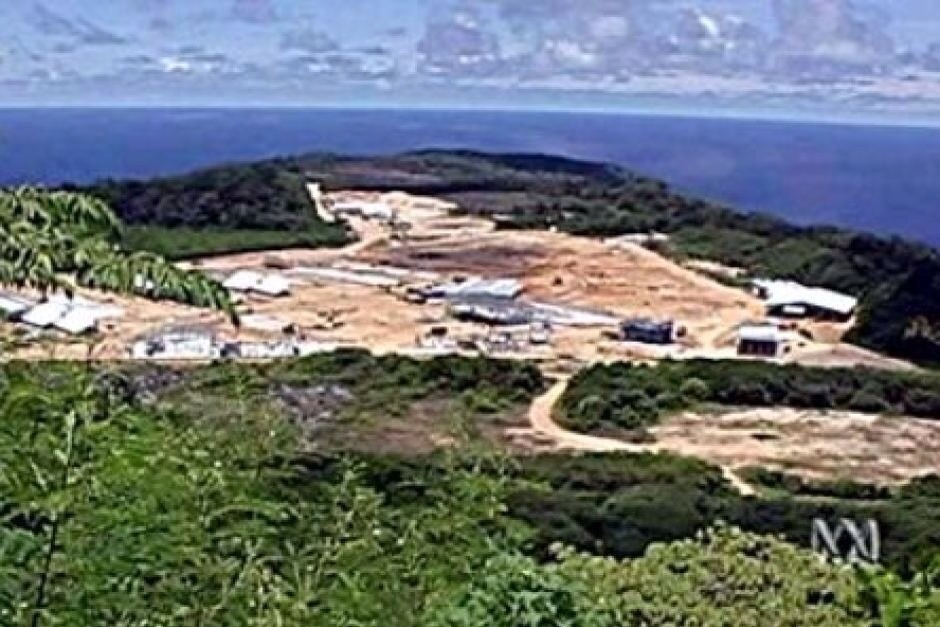
After three days on Christmas Island it is my turn to take night call as doctor at the Detention Centre. At ten PM I receive a call from Team Leader, the always-smiling Henry. I hear no trace of a smile in his voice: “Security is bringing five men in to the clinic who’ve slashed themselves and another man who tried to hang himself.”

When I arrive in the clinic, all cubicles are full. There are the five men who have cut themselves, and not one, but two, who’ve tried to hang. I don’t know where to look first. I don’t want to look at all.

In the nearest cubicle a man lies flat on his back, his throat livid in the glare of the examination light. He does not move.

I speak, asking his name.

No word, no movement.

I speak loudly into his ear.

Nothing.

I press my index finger tip hard against his sternum, a really unpleasant experience for a person whose body parts retain their connections with the brain. A person with a broken neck loses such connection. The really unpleasant stimulus evokes no response. I press harder: nothing.

I rest the pulps of my fingers against the inside of his wrist. The heart does not dissimulate: it sends a pulse of blood along the man’s radial artery, at a rate of seventy times a minute.

My racing heart slows.

I try not to look too hard at the man’s throat. The damage here is only skin deep. There are more vital sites elsewhere: I check for damage to the neck vertebrae, assess pupils and reflexes and muscle tone. All are reassuring.

Finally the throat – inescapable. It is a horrible thing to see – a human neck skinned at the front. There is little or no bleeding, just a broad scarf of raw red meat, overlying a peeled adam’s apple. It is the neck of a rooster in a slaughterhouse, grotesque, the more so with a good-looking face above it and a normal torso below.

To this delicate bodily junction the detained man applied twisted sheeting, then jumped. There was not sufficient fall to damage neck bones or spinal cord; just enough to skin him.

In the bright light he is a painting, a human still life: on one side his bronze skin sheens; on his shaded parts, it darkens. A stubble bristles on his chin. I return to my patient. His arms, lightly muscled, lie flaccid at his sides. His legs neither move, nor resist movement. I watch his thin torso for rise and fall. A hint of expansion only, unconvincing, inconclusive.

This man is alive. But he does not betray any sign of consciousness. Why?

I look at his file for his SIEV number. The lower the number, the earlier the date of arrival. His is in the low 100’s. He has been waiting here a long time. Tonight was to be the end of his wait.

Now, defeated by life, he is embarrassed to know and be known by us. He lies and he pretends his wish had come true. I can make out a faint snoring sound, very soft, almost inaudible. I think of my wife and the snorer in her bed.

NEWS BULLETIN 24 JULY, 2014:

One woman putting a bag over her head, drinking half a bottle of detergent….using a broken mirror to cut herself…

On their separate couches lie the slashed men. Rising above intact skin, parallel lines of red glisten and coagulate. The lacerations are multiple, situated on left arms and the left side of abdomens.

The sole left-hander has slashed his right shoulder. A dozen narrow ribbons of his skin lie, oozing slightly, a bloody epaulette. There is insufficient width of skin here to accept an anchoring suture. Unsutured, his wounds will heal in time, leaving a grid of ugly scar, an obscure tattoo. All of his cuts are shallow: human meat as sashimi, unrepaired.

One more, one last harmer in this outbreak of harm. The nurse says: “He’s swallowed a razor blade.” A razor blade! I am sixty five years old. I am too young for this horror.

In time, the dressing station is emptied of the skin-wounded. The hanged men will stay here overnight, under observation.

MORE FROM TODAY’S NEWS:

A spokeswoman for Immigration Minister Scott Morrison said “It is longstanding Government practice not to confirm or comment…”

There remains one man, older, silent and red-eyed. I search for the site of his wound. It is too deep to be seen. The weeping man weeps for all he has witnessed, for the sorrow, for his sons.

I look at his face. O, what a grief looks through his eyes. In his crying, his mouth twists in a tragic smile. His old eyes look into mine. Lost for words, I take his hand and sit down beside him. He gazes into my face as if into a mirror. He shakes his head sadly and presses my hand.

Why is he here? His guards were troubled and decided to bring him to the clinic. His grief overwhelmed them, those large phlegmatic men. It is they, the guards, who seek treatment for him: some sedative, some vicarious remedy for the circumambient pain.

Through an interpreter, I offer him a tablet. I tell him it will help him to sleep. Before the interpreter can translate, the old man shows me again that woeful smile. He has no more tears.

He presses my hand.

He says: Ta shakour, ta shakour. Thank you, thank you.

CLOSING TODAY’S NEWS BULLETIN:

…not to comment on individual acts of self-harm.

Now, three years distant from my term on the island, haunted by guilty dreams, I can appreciate the soundness of the minister’s judgement. One must never comment on an individual. The individual is the basic unit of the human. If the minister allowed himself to see, to feel, to know the single pulsing person, he might lose his equanimity, his tight-lipped resolve. If one human saw the plight of another he’d pale, he’d shudder, he’d cry out, he’d tear apart his self-sewn lips.

And then where would we be? The boats mightn’t stay stopped.
Sewn Lips

The “Guardian” reports on a detailed litany of sub-standard medical care at Christmas Island.

I read the piece with interest and with some recognition: I had worked there earlier, before the present ‘off-shore processing’ (the hasty export of the unwanted) was instituted. Initially I kept silent. Then I wrote the following, which is the introductory chapter to a suite of stories which will appear in 2015 in my next book of non-fiction, “Burned Man.”

“Sewn Lips

A few years back I signed up to work for a short time as a doctor caring for Asylum Seekers detained on Christmas Island. I went with every impure intent. Indignant over my country’s conduct towards refugees, I headed to the island determined to observe, to record and to betray: I would witness wrongdoing and I would expose it.

But I signed a Confidentiality Agreement: now my lips were sewn. So I would have to resort to allegory, to obliquity, to any literary device to tell unforbidden truths while avoiding forbidden fact. And of course I had every right to report on my own state of mind.

In the event the Administration thwarted my plan: I saw no wrongdoing, detected no bruises, smelled nothing: nothing to report. Stolid unimaginative warders ran a barely decent prison. Good nurses, skilled young medical colleagues, experienced mental health nurses were on hand to attend to generally healthy, universally miserable patients.

Keeping the system honest from the outside, the Red Cross visited and the Australian Newspaper snooped.

And we servants of the nation did everything by the book. We followed all the rules and Conventions. We – the system now incorporated me – we kept Australia’s nose clean. Assiduously, conscientiously, courteously, with perfectly consistent meanness, we kept our clients (they weren’t patients, my true client was the Government) we kept them healthy, we kept them confused, we provoked them by systematic delay.

We drove them mad.

Australia’s impeccable gulag calibrated its practices to equality with the countries of origin. We managed to be just as cruel without raising a bruise.

Meanwhile, doctors were drinking every night. One guard took his own life, another attempted suicide. One mental health worker was dismissed for ‘fraternising’. In fact, she visited her 18-year old client who had been held incommunicado for 36 hours in a psychiatric ‘facility’ (lovely facile word, drained empty, morally bleached) in Perth. She understood her authority ended once she delivered her patient to the Psychiatric Hospital, but his need and her care did not.

I returned to Australia proper and resumed my life. Back now with family, a free person, a citizen, surrounded by comforting supports, I found I had brought the island with me. Contaminated, implicated by national service in unkindness policy, I was troubled by dreams. Night after night, in darkness and unable to speak, I saw myself doing things I had not actually done.

In those dreams I did Australia’s work. I lived the nightmare we perfected.”

The Guardian article by Oliver Laughland: http://www.theguardian.com/world/2014/may/27/doctors-litany-of-medical-neglect-of-asylum-seekers-still-largely-ignored?CMP=soc_568

20140528-094805-35285111.jpg

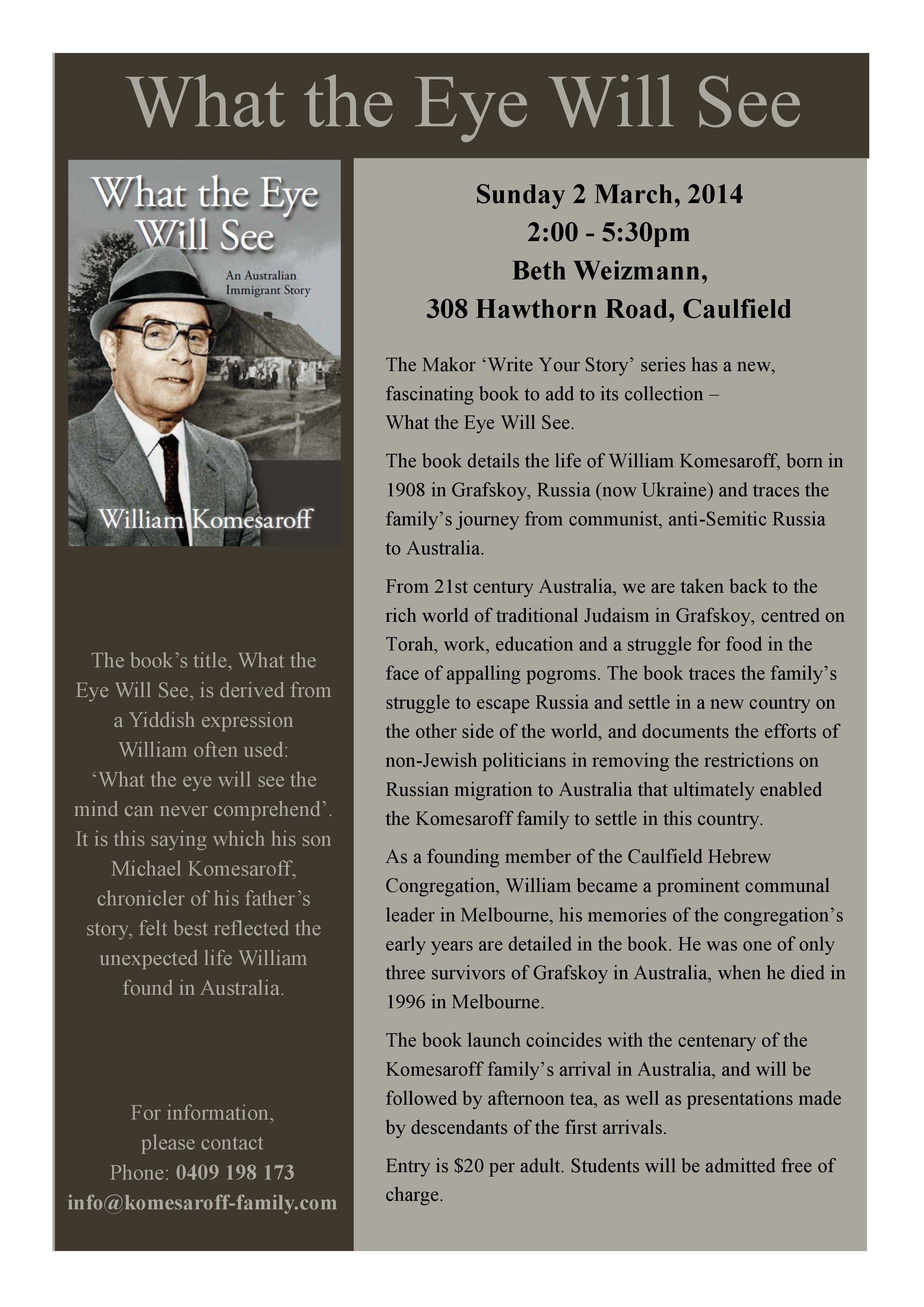
What the Eye Will See

A friend has published a memoir of his late father. When my own father passed away I wrote a memoir and published it.
The entire process was rewarding: I had honoured my father, I had told his story ‘that a later generation might know’. And I had managed my grief.
My friend Michael Komesaroff has achieved all those things with his memoir, “What the Eye Will See”. What stands out in the personality of Willie Komesaroff  (the author’s father) is his jealous protection of his good name, his deep to the bone integrity.
In addition to this private story the author has brought to bear the meticulous research skills that he employs as a visiting professor, consultant and journalist in his professional field, which is Asian mineral investment. The result is a small book with a big story. It is a very Australian story – the story of the Komesaroffs, a Jewish clan from the Ukraine; of their immigration to Australia during the years of the Russian Revolution at a time when Australian government policy expressly excluded migrants from that area.
How government policy was waived and how the Komesaroffs responded in the host country are the stuff of unseen greatness. This country’s gentile politicians who overcame public prejudice and government policy; the Moses figure of the Komesaroff clan who plucked his family from peril and set them up here; the manner in which that clan buckled down, worked hard, prospered, multiplied and rewarded Australia; this is the story of Australian migration success, writ large – but written as it were – in invisible ink. Such is the characteristic modesty and self-effacement of the Komesaroffs (noisy scion Michael conspicuously excepted) that although the clan is Melbourne’s biggest Jewish family and its members are giants of professions, they stay away from limelight.
“What the Eye Will See” allows us all to see and appreciate elements of the greatness of this country and the hidden greatness of some of its quieter achievers.
Michael invites my readers to the launch of the book. It will be a good afternoon.

What the Eye Will See launch invitation

What the Eye Will See launch invitation

How Many Camels?

I
How many camels will you take for your daughter?
Not such an unusual question in the Gulf perhaps, but on the deck of a
large passenger ship bound from Genoa for Fremantle, it takes Herbert
unprepared.
I will give you ten camels. What do you say – ten camels for your daughter here?
The man indicates the elder of the two girls.
Herbert looks at his girls. He looks and sees Helenka, his firstborn,
an elf flitting and dipping at will as she plays with Masha, who is
not yet ten. They are playing with their dolls.
At this lull in adult conversation, Helenka looks up. She sees no sign
that she is the subject of the stalled conversation – nor an object.
She takes Masha’s hand and pulls her across the deck to play
hopscotch.
The stranger is watching too. His appraising eye follows the movement
of the elf as she leaps and glides at hopscotch. He sees slim legs
flashing, a hint of fulness at the hips. He looks at the child – a
question still unasked, sees womanhood – a trader’s answer.
The stranger takes Herbert’s silence as rejection of an insufficient
offer. He speaks again: Twenty camels then. What do you say to twenty?

II
In his little dress shop, Herbert is in the clothing trade. Fort
Street, Fremantle is not a chic address, but his clientele is worldly
enough – they come from all corners of the world: in the course of
their escape to Australia, to Fremantle, they have seen the worst of
the world.
Worldly – and fussy too. Never mind the quality, is it cheap? Never
mind style, what’s the price?
But Herbert is worldly too. He understands that his heavy accent is
not a marketing advantage, but that a pretty face and a winning manner
might be.
His older daughter is worth twenty camels: this is Helenka whose face
might have launched so many ships of the desert. So, every day, after
school finishes and on Saturdays, Helenka works as a marketing
advantage in the clothing trade.

III
A couple comes into the shop. The lady has little English, has brought
her man as interpreter. They converse in a Slavic language, which the
marketing advantage happens to comprehend. Helenka shows a seemingly
intuitive understanding of the lady’s needs and her budget. She
selects and shows the lady dresses which cost no more than she is able
to pay. No more, but scarcely a penny less. The lady makes her
purchase and is content. Her bored interpreter notices the imminent
woman inside the child’s school uniform, and loses his languid air.
The child is the only person in attendance and his hungry eyes take it
all in.
A week later, the couple returns to the shop, this time as last time,
well after school closes. The lady needs her new dress altered, which
is quickly arranged. Hungry Eyes is not quickly ready to leave,
however. He chooses dresses, brings them to the young shopgirl, makes
slow enquiries, appears very interested but makes no purchases. He
says he will think about it.
I come again back, he says.

IV
Here in Australia, people are slow and casual. Herbert and Alida are
intense and restless. After a short time, they open a second shop,
this one in Station Street, Fremantle. They still live above the Fort
Street shop. Alida has newly-arrived cousins, fresh from Europe. They
have no home and no income. Alida and Herbert install them above the
second shop, where there is sufficient space for the cousins to live,
and to sew dresses for the shops. Now the newcomers have both a home
and a business.
Freda runs the Station Street shop and it consumes her.
Herbert is an early riser. Each morning he practises yoga, standing on
his head for up to an hour at a time. During this time, his scrotum is
suspended upside down, practically weightless. At all other times, he
feels its full weight and urgency. As soon as Helenka returns from
school, she takes over in the shop from Herbert and he is free to go
elsewhere and attend to his urgency.
And above the shop, Helenka’s mother, back from Station Street,
mothers Masha, washes and cleans, and cooks for two households. Soon,
more cousins arrive in Fremantle, then more, washed ashore, wave upon
wave, generated by the after shocks of Europe. Alida helps them all,
feeding as many as will come and eat.
At such times, Helenka is alone in the shop. She is alone when – true
to his word – Hungry Eyes comes again back.
He asks for an item of apparel which cannot be found on the racks in
the showroom. Helen says she’ll go and look for the item in the
stockroom. She is taken by surprise when Hungry Eyes follows her
there. She turns to explain that he can wait in the shop – she will
bring it, but he moves forward, keeps on moving until he has backed
her against the back wall. She discovers then, as his body rubs
against hers, upwards, downwards, forwards and backwards, that he is
just like her violin teacher back in Hamburg: he is a rubber. At least
he is not like her French teacher, not a feeler.
She is not surprised when the rubbing abruptly stops, nor by his
moments of gasping, nor by his rapid retreat with that funny gait.
And she is not surprised when he comes again back, again.
For his part, Hungry Eyes is most surprised by the large Alsatian in
the stockroom, which Helen has borrowed from the Greek boy next door.
And when the Alsatian snarls and bares large fangs at him, Hungry Eyes
runs, with very efficient gait, from the shop and does not return. Continue reading