Robert Hillman’s ‘Gurrumul’ – Review by Howard Goldenberg

Gurrumul by Robert Hillman  Publisher: ABC Books

Gurrumul by Robert Hillman
Publisher: ABC Books

If autobiography is the least reliable genre in fiction then the authorized Life sits at its flakiest edge. That this is not true of Hillman’s “Gurrumul” is on account of the slipperiness of the subject.

Geoffrey Gurrumul Yunipingu emerges as shy, remote, elusive, cryptic, mischievous – an outer island in an archipelago of tongues. He does not so much emerge as submerge himself. Blind from birth, Gurrumul seems at times to be mute by choice. At others he makes himself perfectly clear to a whitefella, especially when working with his intimate collaborator, Michael Hohnen.

By book’s end Gurrumul remains hidden; only his music and the beauty of his features – a beauty we can enjoy and he can never perceive – speak to us.

No biographer could truly represent this life, (nor for that matter could he successfully misrepresent it). Wisely, Hillman does not attempt either. Instead he places the artist in his context. Chiefly that context is the complex of family (especially his bevy of aunties), community, land and Dreaming: in short, culture.

“Culture”, a term used promiscuously in conversations between the races, embodies meanings that are layered and expressed in dance, in music, in painting, in song, in storytelling and in land husbandry. The meanings are traditionally expressed obliquely, which is to say they are in part obscured. What Gurrumul does with these enfolded meanings appears to be a risky enterprise of his own, with calibrated departures from liturgical norms, a sort of jazz move in which he improvises within a theme and extends it beyond the limits of permitted custom.

Such a variation on a theme must be perceptible only to a tiny number of the millions who respond to Gurrumul’s music making. In this sense it is a secret, yet another, in  practice that skates ever along the outer edge of theunshareable.

When Gurrumul sings, whitefellas listen, enthralled. Literally, we are in a thrall, under a spell cast upon us by the spellbinding singer. We scarcely hear the words, we cannot parse them; and when we read their translations in Hillman’s book, the words in English are so simple as to appear banal: a profoundly false impression. And yet, and yet, we are transported. If beauty be truth, then truth is shown to us precisely as it is withheld. The subtlety of all this magic is clearly rendered in Hillman’s book.

To those who have read “My Life as a Traitor” and “The Rugmaker of Mazr a Sharif”, Hillman’s skill in rendering an alien culture will be familiar. It is in his later work, “The Honey Thief”, that Hillman manages to capture the artist in the act of working his art, in this case the sublime art of the Afghan (Azari) storyteller.

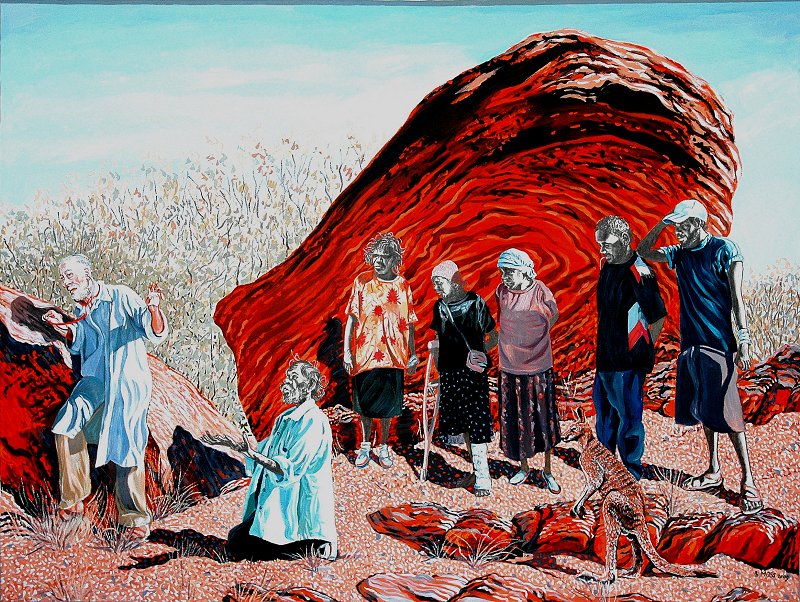
In the present volume Hillman attempts the extremely ambitious exegesis of the utterly untranslatable term, “Dreaming.” He succeeds, in this reader’s view, brilliantly. In twenty five years and over sixty working visits to remote Aboriginal communities, I have never felt I came so close to apprehending (I doubt any whitefella will ever comprehend) the Dreaming, as in Hillman’s “Gurrumul, his life and music.”

Hillman has succeeded remarkably in penetrating the life of art and ceremony (the two amount to much the same thing) on Elcho Island. Seven years ago while I worked on Elcho ceremony was active but off limits for whitefellas. Clearly Robert Hillman won the trust of capable cultural brokers on the island, who ‘let him in’ wherever this was permissible. In return, Hillman repays trust with respect that neither fawns nor condescends. In this his text avoids the vapid tone of comments on the book’s photographs.

Which leads me to the one regret I have about the book, a quibble perhaps, but an important one. In an important sense Hillman’s publisher subverts the author’s enterprise, which is to render in words an art that is ineffable. It is the format of the handsome volume that works against the writing. You look at the book, you find the cover images arresting – and to one familiar with the singing – quite new. The book itself cannot be held in the hand and read: it is biography in a coffee table format. You open the book, you start to read and you find yourself distracted repeatedly from the text by beguiling photographs which tell their own story quite compellingly, but quite out of sync with Hillman’s theme at any point.

Better justice might have been done to both text and photos by physically separating them.

In the end the book succeeds to a remarkable degree. Importantly, it demonstrates how, as whitefellas embrace Aboriginal culture, Australia is becoming more Australian.

Hillman’s book is bound to succeed beyond these shores as Gurrumul’s audiences around the world drink deeply in their thirst for some understanding of his life and his music.
Lost in the Garden of Sweden

The family sends me to the big Swedish store to buy a wall unit. I’ve seen the brochure; it’s a handsome thing, tidy, somehow compact while commodious. Elegant actually. It has a first name, something like Edmund. The e-savvy ones (my family) who despatch me to the big shop have checked, and yes, they have Edmund in stock

It’s a big place. You should ask for directions when you arrive.

This should worry me. I am willing but stupid. I was born with one organ missing – a sense of direction.

They have parking there.

This is intended to reassure but it simply reminds me that I have to get this Edmund bastard into the vehicle. I have seen the dimensions: Edmund is large, Howard is not.

They’ll help you load up.

Well, that’s good. But they won’t be at the other end when I need to unload the monster.

I find the parking lot. I park my son’s vehicle, a sort of truck pretending to be a car. They call it an SUV.

Emerging from the parking lot I walk to the street and look for the Swedish shop. I can see it clearly from the street – only about 2 kilometres distant.

Wrong car park.

I drive to Sweden and park again. This car park is a multi-storey affair, like the one at the airport, only bigger. It turns out that I have arrived at a mall, a place where shops metastasise, where the air is a thick substance imported from the natural world and treated to a muzak consistency. If you have never visited a mall, allow me to congratulate you. A mall is a maze designed to amaze – meaning to lock you into a mental state and a physical state. COSTCO is such a state. It is one of the states of the American Union. You need your passport to get out.

But I digress.

In this particular mall-state the Swedish shop is a city. Designed by Dante: give up all hope, ye who enter here.

I look for the Information Desk. There isn’t one. Instead a route map advises me: You are here. Edmund lives at 19. Follow the numbers.

I follow numbers all the way to 4, a dead end.

I need directions. There are no shopkeeper people in sight, but there are plenty of shoppers, gathering coat hangers, light fittings, pillows. All of them push trolleys. Where did they get those? I suppose I’ll need one if they do. Who told them about the trolley phenomenon?

Whom to approach? All the shoppers are young women, all somehow pregnant yet skinny. Slim catlike creatures, they wear black leggings and tops. Leopards in leotards.

They walk quietly in the altered mental state, the amazed state that is the mall phenomenon. How to ask directions from a person in a trance?

Hello, here is a shopkeeper person. Fair of skin and hair, healthy and unmalled looking, she wears a shirt that is a Swedish flag. She speaks in a Swedish accent. Charming. She smiles and points the way to 19 and utters the fatal words: You can’t miss it.

I follow pregnant trolley-pushing women through 4 to 12.

No more numbers. A Swedish person – male – listens courteously to my problem. He looks at me kindly; he has helped the mentally infirm before. The numbers resume “down the stairs, one level, maybe two.” Of course. Stupid of me. Mister Sweden doesn’t actually know the whereabouts of the staircase: “Should be there, somewhere.” Vasco de Garma setting out on oceans unknown, I find the stairs.

Now in a basement in the Underworld I follow numbers to 18. Here, at the end of the counting, is a cafeteria. “Foods from Sweden”, reads the notice. No sign of Edmund.

A third Swede directs me to 19. Nineteen exists in its own suburb, an unpeopled wilderness like Docklands. It has no connection to 18. Nineteen is a unique destination at the end of the world, a cavernous space traversed only by nomadic tribes of pregnant women.

Someone tells me there is a blue desk where someone will help me. The blue desk is sighted in the distance. One kilometre further on I approach the desk with racing heart and altered breathing: this is either a panic attack or orgasm.

There is indeed someone at the blue desk. A good bloke. Yes, he knows Edmund. Yep, Edmund comes in white and a desert sand colour. Yep, we should get supplies again soon – possibly in four weeks. World shortage. None in this store, none in any store in Australia. None in Japan or China or Malaysia either. Those well-known offshore provinces of Sweden.

“But we checked on the net. Your website says it’s in stock.”

“When did you check?”

“Last night.”

The good bloke shakes his head. “You don’t want to look at our website, not at night. Better to check on the morning- before you come in.”

So no Edmund. “Would anything else do? Since you’re here, look around…”

I do. Billy is available. I call my son who lives in the outside world, on the surface. He checks the net. Yes, Billy will do.

Billy is a bookcase two metres in height and three metric tonnes in weight. Howard is 1.7 metres high and 72 kilograms. We will need two Billies. One Howard: an unequal proposition.

The good bloke directs me to the suburb, kilometres back, where the wise have collected their trolleys. When I return he helps me lug the two long flat boxes that are Billy Incognito onto my trolley. “How do I pay you?”

He smiles, shakes his head, directs me towards Payment: I know, I know, I can’t miss it.

I pay with plastic. Naturally.

Ms Payment sings me “have a nice day’ in Swedish singsong.

There is a way to get out. I go there.

No escape. I haven’t validated my parking ticket.

Of course.

Back to the payment-accepting Swede who is my validator. Once valid I head for Loading Help. The helper is a tall, bulky bloke, built like a centre half back. He’d match up ok on Dermott Brereton or Wayne Carey. He’ll guard my trolley and my two Billies until I return with my SUV.

Back to the car park. I know where my vehicle is parked – close to the entrance. I can’t find the Entrance. I don’t know my son’s rego number. There are columns with helpful letters of the alphabet that register your vehicle’s whereabouts. But my particular column letter did not register with me. Keep calm.

There are three hectares of car park. Mine is not the only SUV. In fact every vehicle is an SUV. I walk the three hectares in a cunning grid devised by myself as I go. Whenever a dark SUV looms before me in the underworld dark I click the electronic gadget that unlocks an SUV without touching it. A lot of vehicles have these remote gadgets; you click and your car lights up, sometimes farting a short musical beep to cheer you. I click but nothing lights light up. No music either.

Keep calm.

I keep calm, keep walking, keep breathing exhaust fumes that cheer me; they remind me of real life. Outside.

Calmly, I ascend one level, walk the alphabetic columns, walk the clever grid. Nothing.

There remain two more levels. More calm ambulation, more gridding.

Here is a vehicle that looks just like my son’s. (Down here they all do.) I click like mad – no light. I peer inside and sight my red striped jumper. I click again. No lights, but the door opens to my touch. I examine the remote controller. I have been pressing the wrong button, the button you press when you want nothing to happen.

I drive out. Well, no I don’t, actually. Instead I find myself driving in circles – wrong level. The same happens on the next two levels. The circling offers a comforting familiarity.

On the fourth level I find the Centre Half Back who will help with the Billies. He bends, hoists, grunts, herniates a disc and retires, allowing me to complete the job alone. I do so.

It is time to say farewell to Sweden. Travel broadens one. A better and a broader being, I drive carefully, calmly, out into the sunlight.

Patriots Day 2013

The Boston Marathon is the oldest and most celebrated of the mass marathons. You need to qualify. Twice I qualified and ran. in 2005 I ran again, this time as fundraising runner. I never won the race: hometown decisions, I guess.

Today’s Boston was to be my fourth. I was running as a fundraiser, this time for the Michael Lisnow Respite Centre. This morning I visited their HQ in Hopkinton, near the starting line. I met people who face their colossally difficult lives with genuine joy. I met the fundraisers who punctuate their serious marathon training by devoting themselves for months to help fund this small enterprise.

Why am I going on at this length about these small matters in the face of the bombings?

You need to be in Boston on Patriots Day to appreciate the celebration that is the Marathon. A city of less than one million comes to a stop; people take their chairs, their picnic rugs, the treats they will give to the runners; they line the 26.2 miles and stay all day, cheering on every runner; they hold banners – everything from “You are all Kenyans” to “Kiss me, I’m flexible”.

Picture Melbourne on Cup Day or Grand Final day without the booze.

Boston is high on its marathon and the runners. Patriots Day is the time to enjoy the embrace of the people of Boston.

If you have the good fortune to be a charity runner, you run at the tail of the field, feeling that embrace, the surges of love for the people – usually young – who are supporting local causes. Often the fundrunner commemorates one lost or saved or suffering the disease she runs for.

One young woman survived melanoma; another is in remission from her leukaemia. I have close relatives saved from those diseases. So, apparently, do hundreds in the crowd who roar their gratitude.

One, a spoonerist, runs with the words: Cuck Fancer. The crowd echo her sentiment.

Someone else came to the Marathon today with a different purpose than to celebrate. Someone whose malignity exceeds his knowledge: his bombs exploded near the finish around the four-hour mark; in an elite marathon like this, the ‘bulge’ – the greatest concentration of finishers – occurs 30 to 60 minutes earlier. The terrible toll might have been much heavier.

I plodded to the 22 mile mark, when a spectator offered me a slice of orange. His kindly young face looked troubled. “There have been explosions near the finish line. The marathon has been temporarily suspended.”

Naively I ran on. Perhaps they’d resume the event.

A mile further on, I was one of very few still running. Police and runners were mingling on the course, faces troubled. Hands held mobiles, sending text messages; local phone coverage was out. Some wept wrenchingly, their features distorted in grief or shock or anxiety for others ahead on the course. Many had relatives waiting near the Line.

My progress from mile 22 to 25 was slow. The crowds fell quiet. Overhead, helicopters gathered and clattered. Police vehicles racing everywhere, ambulances, sirens shrieking, tore between barriers as the crowds melted out of their path. Not for the first time, the matter of placing one foot in front of another felt slight. Here was immediate danger and evident bloodshed.

Police turned back those of us who were running into danger. I needed to contact family – in Boston, in New York, in Israel, in Australia (where I had bled my friends to donate to the Respite Centre). I had no phone. Strangers handed me theirs, refusing my offers to pay. I asked a teenager for directions to the Citgo sign, a local landmark, where my relatives would collect me; the teen insisted on escorting me the mile distance to make sure I found it.

As I waited, strangers seeing this stranded runner, stopped to offer help. One bloke, himself a (non-marathon) runner, wanted to give me his jacket so I wouldn’t get cold. Passers by touched me, or took my hand to shake. One stopped, gazed at me, shaking his head. He said, “I am sorry.”

Boston silenced, in shock, in grief. Its citizens reaching out to each other in spontaneous solidarity,as we see repeatedly in Israel following such atrocities. More than that, people felt implicated in a wrong, embarrassed: their guests had been hurt, frightened, frustrated. They turn their goodness upon me and I feel like crying.

A terrible beauty born.

Loss

My friend Paul Jarrett is a retired surgeon.  He lives in Phoenix, Arizona. A wise and humane man, Paul is now in his mid-nineties. Every day he sends a volley of emails that entertain, edify and enlighten me. Visited by a spark of memory, he writes:

A Moment in Time

There was a girl in our class at Phoenix Jr. College whose last name I could not recall until Catherine  McComb reminded me. 

She was remarkable in many ways, lovely, tall, brunette, bright and friendly, but pleased to help any of us duller students with our physics, chemistry or biology studies.  She was a lady of beauty, charm and talent.

Over time she married, became a columnist for the local newspaper and wrote under her married name.

I lost track of her during the war, but after return when I was in practice, I ran into her at St. Luke’s while making rounds.  She recognized me, gave me a hug and a kiss, broke into tears and left, crying, without saying a word.  I do not usually have that effect on girls.

I have no idea what that was about.  I wish I did.  She died some time later and I finally concluded that she must have just received some bad news about her condition prior to seeing and recognizing me.  I do not know to this day what burden she bore however silently.

The memory of an experience like this remains over a lifetime and although names may be forgotten, emotional experiences are not.  Whatever was hurting her, she did not deserve and I was powerless to help.  The scene flashes in my memory once in a while.  I am pleased that Pete provided me with her last name, but disturbed when I recall that last recognition and meeting.  Had she spoken to me, probably all I could have done was help her cry, and she did not want that.

This sparked something. I wrote back.

Dear Paul,

Your story moved me. It disturbed a memory of my own of an event that took place about twenty years ago. It is something I think about infrequently, but when I do so, it affects me still.

It’s nearly lunchtime and I’m running thirty minutes behind time. I collect the last patient from the waiting room. To my delight it’s Lucy. I haven’t seen her for seven years or so.

Ten years ago Lucy and her young husband moved interstate to serve their church full time as youth chaplains. She bobbed up a few years later seeking my help:  I have a problem no-one in South Australia can diagnose. So I’ve come back to Melbourne to see you. Lucy’s problem turned out to be an ectopic e. And she prayed for babies.

The babies, a boy and a girl, arrived soon after. And now Lucy is here today.

In this country practice the doctor treats the whole family. I was the family doctor. I knew Lucy’s father parents, a broad man with deep dimples in his wide face. He’d smile readily and his loose features would collapse inwards in genial embrace of whatever passed. He was the first of my patients to undergo hip replacement surgery.  He died in hospital of an infection. I looked after her sorrowing mother and the four girls. I treated Lucy’s younger sister for the fatigue illness that followed Dad’s death. Lucy was the eldest. She married and moved to a parish on the farthest edge of the metropolitan area, but when she was troubled she’d drive across the city and come back to the doctor of her childhood.

Then she and her husband Christian moved interstate and created a family and I haven’t seen them since. And here she is…

Hello Lucy, how lovely to see you.

Hello Howard. It’s good to be here.

Something is missing from Lucy’s face. The wide smile that always raced across her fine features like a flash of brightening is a small pinched effort today. Something’s up.

What’s wrong, Lucy?

I have a lump in my breast.

Lucy is petite, still slim after the babies. The lump in her right breast is easy to find and hard. My anxious fingers check under her arms. There is an enlarged lymph node in her right armpit. The same side.

Can you feel it, Howard?

Yes, I can.

Lucy looks up from the couch at her old doctor. Her small face looks terribly young, her little body swims beneath the white sheet. She looks to the old doctor, that old look from the time when doctor would make everything alright. Doctor feels suddenly too young, or too old, or too something for this news.

My hesitation tells Lucy everything. Her face speaks. She knows. She understands. Her voice is steady, calm: what will we do, Howard?

I’ll let you get dressed, then we’ll talk.

The things we will do are much easier than the things we must think, the things we must say or must not say.

I arrange an immediate mammogram and an ultrasound. I request a fine needle biopsy of the lumps. And I secure an appointment for Lucy to see a breast surgeon within days.

These phone calls consume the minutes. Today Lucy and I have ninety minutes; by a mistaken stroke of a receptionist’s cursor my lunch hour has doubled. There is time to describe the nature of a mammogram, its discomforts, its austere indignities, its impersonal delays and interruptions. There is time to describe the relative painlessness of a fine needle biopsy. A result will take up to a week.

We sit quietly for a while, thinking our thoughts. More precisely, Lucy thinks and I guess what at she must think: What will I say to Michael? What will we tell the children? How will I tell Mum? And my sisters? They’ve had enough of loss?  I think that I know that none of Lucy’s thoughts will be for herself, for the support that she will need.

I notice Lucy glancing at her watch: Have I made you late for something, Lucy? Your children?

A shake of her head: No, the kids are with Mum.

Tears gather, tremble, fall.

My children…

How old are they now, Lucy?

Michael is six, Hetty is four.

A pause. Lucy mops her face, blows her nose, a long unselfconscious, snotty blow. Then more tears: They might not even remember their mother. At least I had Dad until I was twelve…

Lucy, I think it is cancer. If so, it is serious. But we don’t actually know. We don’t know anything at this stage. I promise I’ll tell you everything that I know as soon as I know it.

Lucy gets to her feet and tidies her face again for the world outside. She thanks me and turns to go. She stops before my door, turns back and reaches, draws me into a hug. I hug back. Hard.

I have finished my hug and let go. But Lucy holds on. Her body is shaking. She is crying again, she will not let go. My arms are gentle around her. After long minutes, Lucy has finished. She steps back, looks up and says: That hug, that’s what I crossed Melbourne for.

Paul, I never saw Lucy again. Her specialist kept me informed. The imaging showed a tumour, the biopsies confirmed cancer that had spread to the lymph node. Lucy underwent mastectomy followed by chemotherapy.  Eight years later Lucy died. Her boy, Michael, was fourteen, her little girl was twelve. Old enough to remember, old enough to grieve.

Some time after Lucy’s last visit a routine letter arrived from the Medical Registration Board. It warned all practitioners against any contact with a patient beyond that necessary for their clinical management. I thought about Lucy. Paul, that hug was as intimate as it was chaste. It was important.

I told my wife about it at the time. And last week when I received your letter I spoke about it with Annette again. As I did so tears gathered in my own eyes and my voice thickened. I felt the pain more keenly than before. And Annette understood and she comforted me. Continue reading

On Quietly Going Deaf

IMG_1696 IMG_1646 IMG_1046“What?”

“What did you say?”
My family is sick of my hardness of hearing. It seems that hearing hardens and arteries harden at just the time that other things soften.
One of my body’s pumps has softened noticeably. I refer to the one with the ventricles.
What human heart can stand firm against the arrival of grandchildren?
This happy, happy stage of life where our children use their sexual organs for the pleasure of us, their parents!
Technological Man has invented old age. Nature, blind and base, has no use for us once our litters have matured and reproduced. We are supposed to wither quickly and politely die. But doctors have intervened and prolonged the moments of aging into an epoch. From fifty to ninety we live on, noting the failing function of joints and arteries, of ears and eyes. Our teeth desert us, our balance fails, our uteri prolapse, our prostates swell, our bladders leak and we dare not trust a fart.
But we have grandchildren. I can hold a newborn on my knee and croon off key and she will not object. I can hold the toddler in my arms and tell him a thousand stories, long after my eyesight darkens, for just as long as memory holds strong. And when memory fails, I can confabulate.
Who needs hearing aids, dentures, titanium hips, dental implants? We have grandchildren.IMG_0009 IMG_1603 IMG_0482

Spring is Here – Get Ready for Summer

Great Britain, April, 2013.

There is news of a sighting. More precisely, there’s a report that someone in Bristol claims a sighting. It might even be true – perhaps the someone did sight the sun in Bristol, briefly, the day before yesterday. The day before I arrived.

In Whiteladies Road, Bristol, a sandwich board is full of sunny optimism: SPRING IS HERE, it sings, GET READY FOR SUMMER. The advice that follows makes alarming reading:

FULL LEG 10 pounds

BIKINI 15 pounds

BRAZILIAN 18 pounds

No-one in Bristol should shed nature’s protective fur. For that matter, no-one anywhere in Britain ought to follow that advice.

***

Gippsland Lakes, Victoria, Australia, March, 1990.

A lady, middle-aged, bellows across the water from the deck of her rented yacht. She projects her fruity English accents in the direction of Dad’s boat. My aged uncle sits on Dad’s deck, enjoying the day’s end.

The early evening has turned decidedly cool. Dad and his crew shelter below decks, while Uncle sits above, nodding pleasantly from time to time in the English lady’s direction. As dusk descends, Uncle, who is deaf, drinks in the peace.

The English lady and Uncle have not been introduced. The lady is pleased to share her life story with Uncle. She tells him about her travels and her maritime experiences.

Visiting the daughter, actually. Lives here in Orstraliah. Married here, what?

Uncle nods, smiles.

Always enjoyed boating, all of us. Cowes Regatta, what not. Husband’s vice commodore there.

Another nod.

Cool evening. Reminds one of a coolish time at Cowes. Husband and I went for a quiet evening sail. Left the club, tooled around till dark, turned for home. Monster squall blew up. Caught us unawares – below decks taking cocktails. As one might – moon above the yardarm, what?

Uncle – watching a pelican gracefully spilling air, gliding, teasing his sight in slow, elegant inevitability – misses his cue, fails to nod.

His locutor raises her voice helpfully.

Nasty Squall. Tipped the bally boat over. Husband and I took to the dinghy. Squall passed. Squalls do. Boat out of sight, had to row to land.

Uncle, enjoying the first stars behind the lady, looks attentive. From time to time, as her jaws come to rest, Uncle obliges with another nod.

Rowed all night. Dashed cool by morning. Rowed right up to the jetty at the Club, there’s Reginald, Club Commodore, strolling along the pier. Calls out to us: “Lovely morning for an early row.”

One had to explain: ”Not rowing for fun, Reggie. Bally shipwrecked. Learned something from the experience, though: never knew the purpose of hairs on one’s pussy, Reggie – keep one warm in a shipwreck.”

Copyright, Howard Goldenberg, 7 April, 2013