A Small Town in the Bush

Water is the secret, the theme, the meaning, the life of the town. If the town is to die it will be the failing – or the flowing – of water that will see its death.

Driving in at night I missed the river. Unaware even of the fact of the bridge, watching always for suicidal kangaroo, I followed the bitumen and missed the river. After unpacking I ran the shower. Who farted? Mother earth, is the answer: borne on bore water were those sulphurous fumes from antiquity. I lathered and rinsed. And rinsed again. Still slimy with slippery salts I towelled myself with vengeful vigour.

In the morning I brewed a bore water cuppa. It tasted fine, of coffee, not of earth’s bowel.

Before work I went for a run. Here was Terry, a cheerful sixty-year-old hosing the wide grassy expanses that surround the hospital. Modern sprinklers invented in, say,1950, would see the extinction of this man’s job.

Memorial Park with its humble cylinder of brown marble rising less than three metres from its plinth. From its pediment I read names from the Great War. This very small town offered up too many. Two of the dead bore the same family name.

Below the names from the First War were listed those who died in WWII. These names took up two of four wide rectangles of space at the base of the monument. Two rectangles remain for future names of dead from a nation that has always fought the distant wars of others.

A team of workmen clustered at a roadside. Beefy men all in their high-vis yellows, they watched as one of their number swung a sledge hammer. The hammer was a mighty instrument, the hammerer broadest of all, taller when recumbent. Four watched as one swung. A cement gutter cracked, disintegrated. Five men at work, working to undo the work of yesterday.

The shops sit behind their generous tin verandahs, shaded by rooves supported on wooden poles. The shops, house-proud but not fancy, wear old livery touched up and respectable. A notice offers me the chance to buy one of two coffee shops in the main street: it lists ‘large shop, vacant possession, on generous grounds with six-car shed and outbuildings’. “Hunter’s Supermarket” sits in dignified desolation beneath its formal signage. Its windows are covered on the inside by broadsheet newspaper. ‘For Sale’, says the sign.

At lunchtime I visit the emporium. Triple fronted, its three doorways lead to three sections. One displays work clothes, a second sells ‘guns and ammo’ and cooking implements ranging from basic aluminium to imported chefware. The third section offers saddles, riding boots, rodeo hats. The floors are of wood, the high ceilings of patterned pressed metal. ‘Handsome ceilings’, I remark to the sales lady. She nods, smiles attractively, and observes, ‘They leak when it rains. And the owners aren’t keen to repair the roof.’ Water again.

I am not here for the superstructure but for my own infrastructure: I need new undies. Sales lady leads me to them and removes to a discreet distance. Slim, tall in her tooled rodeo boots, her jeans scrolled and silvered at the seat, she’s a distraction. I find a pack of two pairs in interesting colours. The brand name is ‘Heavy Lifters.’ The sales lady keeps a straightish face: ‘It’s the name of a whole range of work clothes, not just, ah, men’s personal things.’

I buy some men’s personal things.

I show interest in men’s work shirts. These too are in electric shades of lime and purple. ‘They’d alarm my bride,’ I say.

Sales lady points me to a different rack of iridescence: ‘Why not you buy your bride one of these pretty shirts for girls?’

I settle for Goondiwindi Cream Soap, picturing my wife’s limbs, clean as Gunsynd’s.

At work my patients are generally aged. One group consists of slow moving stout people, retired, in their fifties and early sixties, who live here in town. The others, slimmer, gnarled of knuckle and sun blighted, are in their seventies and eighties. These live out of town on cattle properties which they continue to work. For the trip into town these folk dress smartly. Lots of colour, a quiet elegance.

It’s more enjoyable doctoring the farm folk with their accidents of activity than the town folk, who, although younger, are less healthy with their illnesses of inactivity.

In the waiting room no-one checks a wristwatch. All appear unhurried and relaxed and friendly. All but one, a hunched small lady, 83 years of age, who wears a floral yellow dress and a fierce mien. ‘I won’t see that other doctor! And don’t you try and give that useless tablet he gave me!’

At this stage, unaware of the identity of that other doctor or of the useless tablet or of the condition treated, I am at a disadvantage. The lady has me pinned to the ropes where she continues to batter me for the next twenty minutes. ‘Those blue tablets, don’t give me those!’

‘Which blue tablets?’ – diffidently.

‘You know the ones. I won’t take them. So don’t try to make me. I might look old but I’m still manhandling steers and I’m not simple.’

I study her file for clues.

‘Well? What are you going to do for me? Don’t give me any of your soft soap, young man. I’ve put up with this for long enough.’

I point out that I’m not her adversary, that it’s up to her to decide whether or not to trust me, and if she doesn’t trust me she should not waste her time on me.

She falls silent, her large mouth hanging slack as she regards me in surprise. I am surprised too. I’m starting to enjoy myself.

A truce is declared. Later in the waiting room, she informs the office staff, bellowing, ‘That new young doctor’s all right. Don’t you try to make me see that other one. I won’t have a bar of him.’

Day after day the skies are cloudless, palest blue, arching high to eternity. Not a cloud in sight. But yesterday low grey cloud hovered. The waiting room was full of talk. Veterans of too much faithless cumulus, the farmers were skeptical. Today all is blue again; the old men were right. One old bloke with a great hole in his leg – he came off his motor bike, digging out a divot of flesh – tells me: ‘There are three year old frogs out on my farm that don’t know how to swim.’

He laughs. A wounded leg and a dry dry spring don’t exhaust his well of good humour.

‘Any cane toads?’

‘No, no toads. Too dry for them.’

He laughs again.

Not all laugh. The visiting psychologist tell me, ‘I go out to the farms and visit the farmers regularly. In the droughts some despair.’

The temperature reaches forty – in October – and no-one remarks on it. The Bureau predicts a thunderstorm. It duly arrives. One peal of thunder, the temperature falls but the rains do not.

‘How is it on the farm?’ – I enquire of every farmer.

All respond, ‘It’s dry.’

‘Are you worried?’

‘Yes, it’s very dry.’

‘Is this the driest you’ve known it?’

‘2003 was worse. But this is bad…’

No-one says so explicitly but the floods of 2012 were worse than bad. In those few days lives turned, settled families in their dynasties saw nature’s violent face anew.

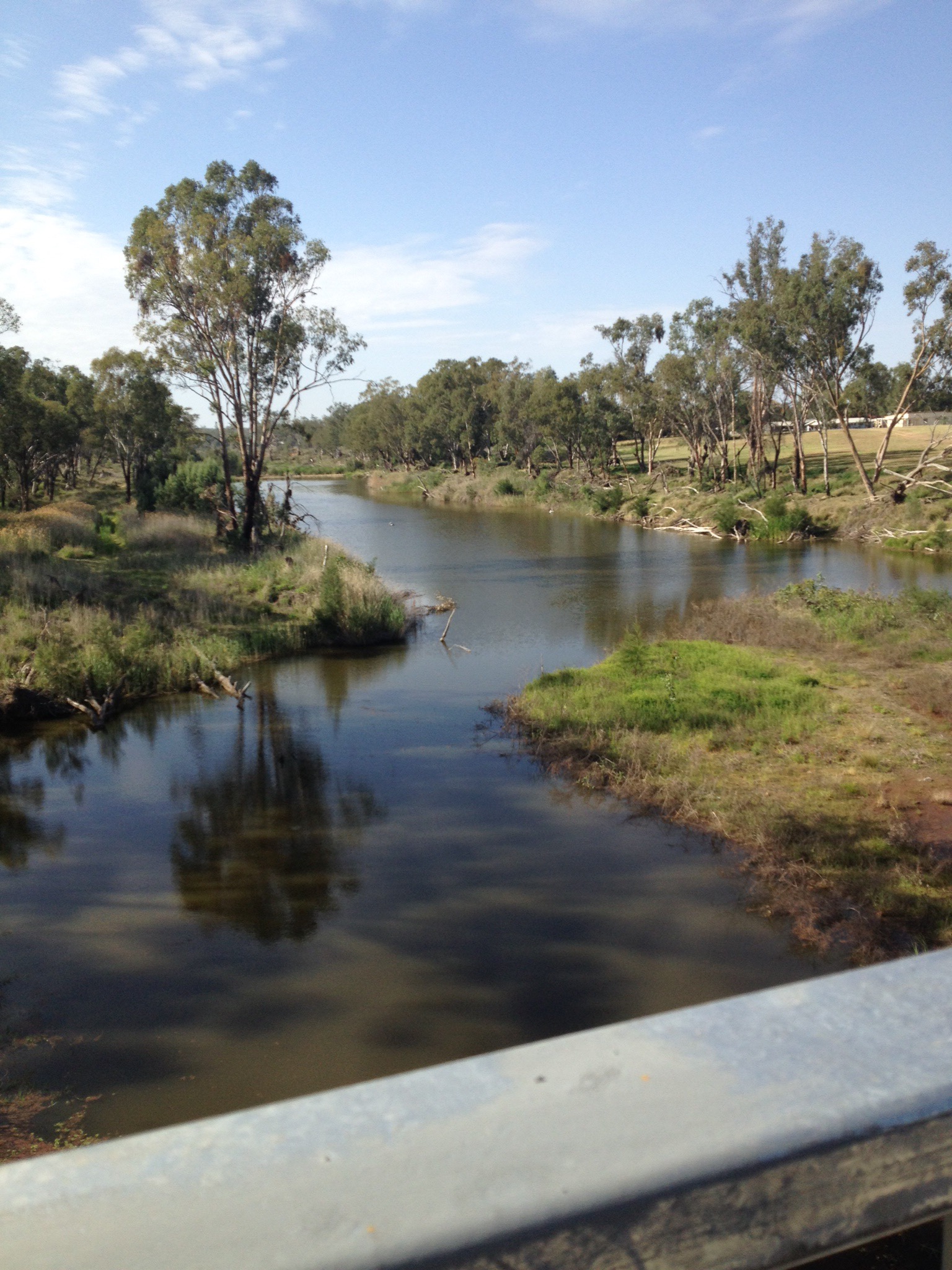
By the third morning I still had not sighted the river. On previous morning runs I headed north and south. This time I went east. Past the library on the main street in premises vacated by the extinct cinema; past the pool gleaming fluoridated blue; past The Great Artesian Spa; up a rise to the edge of town – and there was the bridge, a modern structure of cement and steel, its slow length elegant against the sky. Below, far below, indolent waters were a silver ribbon. Tall green grasses pleased the eye.

A slender roo, disturbed by this sole intruder, widened the gap in graceful bounds, then stopped and looked me over at leisure. A moment of shared wonder.

At the approach to the bridge a wall of dark granite, cuboidal, taller than me and wider than the hammer-wielder of the first morning, detailed the floods. Undemonstratively, without self-sympathy, in the manner of farmer conversation, the wall of stone gave fact and context:

1864 – 9.56 m,1949 – 4.86 m, floods in 1950, 1954,

then, in February 1956 the waters reached 7 metres; and in April the same year, 9.26 metres. Photographs show island buildings, white against the silent black of inland sea. Some left town. Most remained to face flooding again – in 1983, 1990, 2010. Then came the waters of February 2012, peaking at 9.84 metres, breaking the record of 1864. People speak flatly of ‘before the floods’ and ‘after the floods.’ I hear the same throughout the state.

One farmer replies to my stock enquiry with a quiet,’The dams are both dry. It’s fortunate we have a couple of bores.’ I look at him, his face etched with decades of flood and drought. He knows fortune.

No-one in back in the Collins Street practice uses that expression, it’s fortunate.

Something missing here. Someone not heard, stories not told. Where are the first owners? Further morning runs uncover traces. At the Information Centre an elaborate sign invites me to follow the Yumba interpretive trail: ‘Mon-Thurs mornings.’ Below this a handmade sign amends tour times: ‘Tues and Thurs.’

And to one side a larger, handmade sign advises

NALINGU

ABORIGINAL

CORPORATION

WISH TO ADVISE THE

YUMBA

INTERPRETIVE TRAIL

AND MITCHELL YUMBA

IS CLOSED

UNTIL FURTHER NOTICE.

But the first people are here. I see them with their ailments and their children at the hospital and the clinic. In the main street, Nalingu has its dusty offices, and just down the same street is the Aboriginal Health Centre. Inside this hive a small lady of middle years buzzes with purpose. She searches my face, wondering whether perhaps I might be a JP. She needs a JP to certify photocopies of documents for the tall Finn standing at my side. He’s jackerooing on a station. (The Finn does not look Aboriginal. But some say I don’t ‘look Jewish.’)

The lady finds time for my questions: Yes, this is a health centre and yes she’s here four days a week helping local Aboriginal people with transport and health appointments in the bigger town one hour east of here. And no, the bigger town doesn’t have a doctor at the Health Centre either, not regularly, just a couple of days a month. ‘But I look after things.’ She tells me all this with evident pride, vibrating with energy and quiet command. She looks up at her curious visitor, radiating confidence and belief in her role. I guess she’s the dynamo of a community that might otherwise not be a community.

Back at the clinic, a tall man in his late fifties has plenty of time to chat. He’s intrigued by the phenomenon of a Jewish doctor way out west; and I’m interested in his experiences as a cattle man. He’s been out here all his life but he sent his daughters to boarding school in the city. I ask my usual questions – how’s the farm going, water, rain, feed?

‘Well it’s hard. If it wasn’t a challenge I’d have to go and find one. But surviving here calls for something. I like that. I like to be tested. Every difficulty demands something of me. I want to create, I don’t want a dull existence. I’m lucky with my life here.’ He smiles, a smile of good teeth and good skin, the smile of broad vitality. Why has he come to see me today? ‘I’m well, but I spend my life in the sun. Will you check my skin? Any other tests or checks a fifty-eight-year old should have?’

We do the medical stuff then conversation resumes. He employs backpackers from around the world. ‘I look for people others won’t take – people with problems. With patience you find the goodness in a person and help them become productive. I’ve had alcoholics. They come to the station, I let them dry out, I expect them to be temperamental until they settle. Then you find the person with a problem has some drive that might have got them into trouble; now they have a chance to direct the drive productively. There’s pride in that. A small start to a better way. After three months they leave, and we are both winners.’

The cow man has questions for me – about my origins, any children, a wife? He tells me about his girls, working in distant places, how he encourages them to pursue their passions in their occupations, not to settle for work that won’t fulfill them.

‘Have you been to Israel, doctor?’ – in the city this is the litmus question of my decency, out here it’s a question couched in curiosity or envy.

‘Israelis inspire me. They have never had it easy but you can see their drive to survive. And they do it by innovation, by creativity. They’ve never had enough rainfall where they are, but they farm, they feed their people and they have create a surplus to export.’
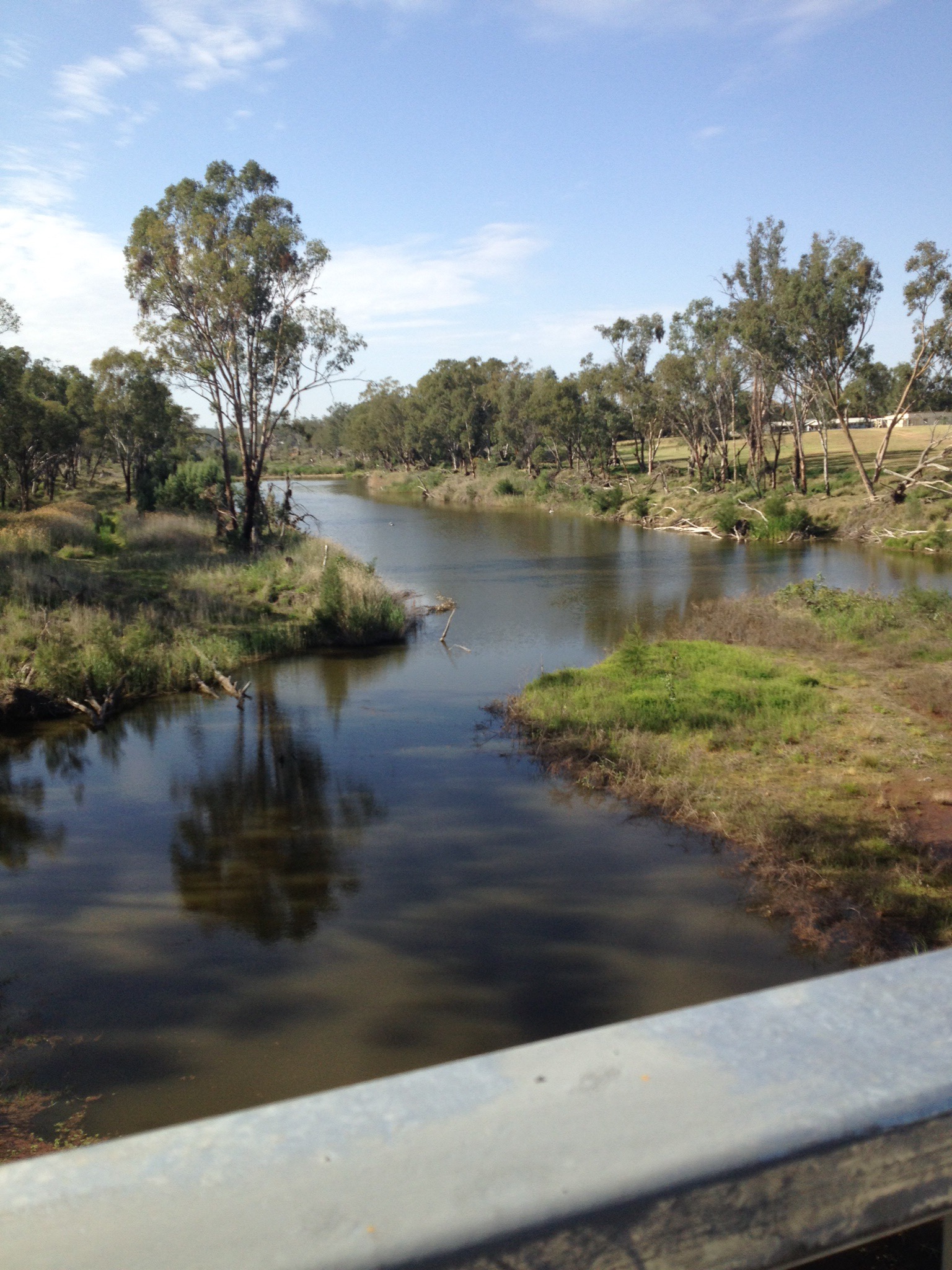
IMG_3980.JPG

IMG_3980-0.JPG

Outrage at Whitegate

A few weeks ago someone cut the water supply to a town camp on the outskirts of Alice Springs. The ‘camp’ belongs, by ancient practice and by government fiat, to a local clan of Aboriginal people, heirs to a tradition of tenure that goes back beyond white settlement, beyond the dawn of written history. Whitegate is far from how we might imagine a camp, being neither an attractive resort nor a place of refugees. Whitegate Town Camp is not in any sense a place of temporary habitation. It is habitat, it is country. It belongs to the Hayes clan as the clan belongs to Whitegate.

Governments wish to take over the camp, ostensibly to modernise and improve it. They seek to unseat tenure and replace this with long leases. The longest paper lease imaginable would be but momentary in the context and the conception of the Hayes family. Such paper devalues and threatens a connection which is inalienable in nature and beyond secular legal conception.

So someone cut the water supply. Just possibly the government is not responsible. Responsible or not, government could quickly supply water but this has not happened. Nor has repair of the camp’s long defunct solar generation. Whitegate, long a garden of neglect is now a wilderness, occupied by human Australians. Other Australians, notably whitefella writer-artist Rod Moss, supply water and burnable fuel for heating and cooking.

In the present historic moment of human barbarity it is noteworthy that none of the parties to the conflict in the Middle East – not even Assad’s Syria – has ever cut water supplies to its foe. Such an act seems to be beyond human imagining. Except in Alice Springs.

Actions to protest this barbarism will take place in coming days and weeks, actions that are notably harmonious in nature and intent, ‘Aboriginal way.’

How have we fallen so low?

IMG_4041.JPG

Two Flies on a Wall and Darky Harris

fliesWhen I was a boy I came across cultural truisms like, “Aussies will bet on anything; they’ll bet on two flies walking up a wall.” What I heard was something to celebrate, a playfulness in the Australian spirit. When I inherited from a great uncle a curious little plank with two identical circular depressions, someone had to explain this relic of “two-up”, a national pastime. It spoke to me of the irrepressible Aussies of  “Songs of a Sentimental Bloke”. As a more than commonly sentimental bloke myself, I was not disposed to judge or diagnose any malady.

In 1972 I met Darkie Harris. I was the new GP in an ethnically homogenous semi-rural community, an oddity in a skullcap. Somehow the community embraced and included me while excluding the pig-raising Maltese and my only co-religionists ‘the Jews on the hill’.
Darkie Harris differed from everyone and in ways solely his own. Unprepossessing, short, stocky, swarthy, with a face marked by scars and improved by large purpling lips and a vocal tone that ranged from a growl to a bark, he looked older than his fifty-four years and fiercer than anyone so old (I was then exactly half his age) had a right to look.
Darkie distinguished himself by a sort of verbal pugilism. By word and facial expression, and yes, by facial complexion, Darkie dared everyone he encountered to fight him.

What was it that Darkie wanted to fight against? One thing, one thing only. Racism: I don’t care if you’re a chinaman or an abo or a white man. If I cut you, you’re blood’s the same colour as mine.* Darkie was the only person in the town who saw this Jewcomer doctor as undifferent. In equal parts alarmed and charmed, I found I liked him. To most in town I seemed exotic, to some a too shiny exception (‘you’re not like the others’), to some an emblem of a nobility I never earned.

Darkie was retired by the time I met him. He’d take up his position on a bench outside the Chinese café and the fish and chip shop run by a pair of Maltese brothers. He’d sit and glower, softening into a winning chivalry towards women (a sweep of the hat, a flash of gaptoothed smile, “Good morning, Ladies”) and to engage toddlers in amiable conversation while uncertain mothers tried to hide their nervousness and drag their children away.
Darkie sat on his bench and kept vigil. He was waiting for the unguarded comment, any reference he could take exception to, any sneer at the immigrants he championed.
Young hoons and would-be thugs about town learned to shy away from Darkie. As he informed me on a number of occasions, I’d sooner have a fight than a feed. Darkie was referring to his younger self in the Depression days when he was a runner for an illegal bookie, a risky position in a volatile industry. But in 1972 his interlocutor would take Darkie at his word as he’d rise and stride, frothing, barking menacingly to confront the casual bigot.

Darkie never gambled. Those were not the risks he’d take. He described his working life as an honest buccaneer. He served his boss – some degree of criminal – honourably. He’d take the blows and deliver his own and he’d return home and hand his earnings to Joyce, his leathery wife, who subsisted in a cloud of tobacco. Before Joyce Darkie would humble himself, confess his escapades and worship.

The stories of Darkie and flies on a wall and two-up created the sketchy image I had of gambling in Australia. We must have had gambling addiction but I never knowingly met one. I knew dimly of the ancient rabbinic edict that disqualified a gambler as a witness in court proceedings because an addict could neither trust himself or be trusted by others.

In 1976 I went for an early morning run in Launceston, pausing to poke a curious nose into the local casino, a gruesome cellar where women in curlers and moccasins sat mechanically before fruit machines from six in the morning.
Shaken, I ran away.
For some years in the late nineties my younger daughter, a psychologist, worked as a therapist at Gambler’s Help. Her stories of human wreckage at our dinner table opened my eyes. In 2000 I met Alan, a shining youth who became my patient. He starred at hockey, graduated from his elite school, studied business, was recruited by a leading financial institution that trained him as a currency dealer. Two years ago Alan married his golden girl Helen, a primary teacher. They bought a house together in the regional city were she grew up. Neither Alan nor Helen yet realised the bank Alan worked for had trained him as one of their corps of gamblers.
A year ago doctors in the city’s ICU worked on Alan through a Saturday night and all the next day and night. At 27 years of age, Alan’s life seemed at its end, his blood pressure unrecordable, his breathing and heartbeat negligible. It must have been his hockey that saved Alan, his underlying fitness, that brought him back from where his overdose had taken him. After gambling away the contents of the joint bank account, Alan punted on the marital home and lost it. On a weekend when Helen was out of town for a friend’s hen’s night, Alan wrote a note and swallowed the tablets that were to end his self-loathing and his shame. Only Helen’s dog, locked out of the house all Friday night and Saturday, raised the ire of neighbours with her barking.

The marriage died and was buried in a divorce. In the settlement there was little to apportion: Helen took her dog, Alan his shame. His need, his comfort, his fateful hoping – I mean his urge to gamble – survives. It is a daily battle which Alan does not always win.

I turn on the TV to watch sport. Sport still has the power to inspire me, to express nobility, to create wonder, to delight, to unite and uplift. Before and after and between plays, the gambling industry shouts its messages of slim hope, seducing, reducing the game to mere exchange. It is not possible for a child to watch sport on TV without seeing gambling ads. I turn off and prowl my bitter old mind and think of Alan.

In these wrinkled years the past glows, the present moulders, the future threatens. We need someone to blame. That’s why we elect governments – there are some things you just can’t blame on your wife. In the matter of our gambling pandemic I blame governments. Governments bankrupt of funds fall hard for the revenue that streams from gambling. Soon the treasury is addicted to gambling. A few budgets later, we have a government bankrupt of judgement and ultimately of morality. In their lonely amorality, our representatives fall into bad company, the Gambling Lobby. Governments collude with the industry to prevent and foil the simplest attempts to ameliorate our national malaise.

Over two decades I have witnessed the card games in remote Aboriginal communities. Large numbers, women usually outnumbering men, sit on the ground beneath huge trees and gamble from first light to nightfall. Darkness falls and the players shift to the bitumen and sit on the roadway and play through the night.
In Arnhem Land once a nurse and I battled through a long day to save an underweight, undersized infant with life-threatening pneumonia, the child starved because his mother had no money for food. After the necessities – I mean cigarettes and Coca Cola – the young mother consumed the family income at the card games.

Continue reading

Coincidence

“My grandfather happened to be in Britain at the start of the First World War. He and his brothers farmed the family property in the Victorian high country. Somehow though, he was visiting England, a war was on, we were part of the Empire, so he joined up.
Meanwhile back in Australia, his brother volunteered. They wrote to each other with their news: it turned out both had been posted to the Middle East, but to different units in different locations.

“Grandfather and great-uncle tried to keep in touch, and when Grandfather was given leave on Christmas Day he wrote to Uncle Bob promising to meet him outside the General Post Office in King George Street in Jerusalem on that day. He’d meet Grandfather there at noon. It didn’t surprise him that he didn’t receive a reply – there was a war on. His brother’s silence didn’t make him change his plans.

“At noon on December 25 – I think it was 1916 – Grandfather took up his station outside the Post Office and waited for Bob. By 1.00pm Bob hadn’t appeared, but Grandfather wasn’t worried or surprised. There was a war on, they both had to cadge lifts from army transport vehicles. He waited. Grandpa was excited and nervous; he and Bob hadn’t seen each other since before the war.
Grandfather said he needed to go to the toilet but didn’t dare in case Bob came and found he wasn’t there and they’d miss each other. He told me he danced around for hours with his bladder filling and his hopes fading.

“By four o’clock it was getting cool, the day was coming to its end and Grandfather feared he’d wet himself. Bob never showed. Another soldier passing by told Grandfather there were public toilets around the corner and one block down.
Grandfather strode down the street, turned left and collided with another man in uniform. “Sorry mate”, he said, untangling himself. Through the gloom came the same words in the same voice. The two men peered at each other. It was Uncle Bob.
‘The funny thing was’ – Grandfather told me – ‘Bob never received my letter!’”

That story was told to me by a workmate in 1974. It has stayed with me these forty years. I know that post office, I know the cold and dark of evening in Jerusalem at Christmas.

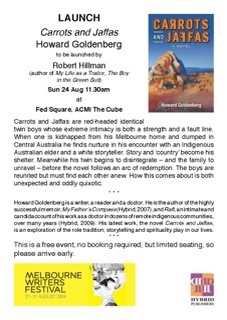
Today I received a flattering (and I must say insightful) review of my novel “Carrots and Jaffas” from a lady I’ve never met who lives, reads, reviews and blogs in France. (Coincidentally, we found each other by chance.) Claire McAlpine is my reviewer’s name. Somehow Claire managed to compose her review through a period of family medical crisis. How the empty page draws the pen!
Towards the end of her piece Claire McAlpine remarks on the long arm of coincidence that reaches out towards the end of my novel. She is right. As I wrote the section in question I had in my mind the accidental finding of kin, of brothers, between my friend’s grandfather and her great uncle Bob. This closing stage of the book gives voice to a daydream that I fall into from time to time in my work as a locum doctor in outback Aboriginal communities. Medical work in those places is full of nightmare: so much loss, so much suffering , almost all of it preventable. In my reverie I dream of a utopian resolution of the actual. My writing always hopes for redemption. In the closing pages of “Carrots and Jaffas” I gave voice to that wishful state; I allowed the intelligence and the questing longing of my character ‘the Doc’ to be rewarded by coincidence.
And I know from first hand stories of Holocaust survivors who have been separated from kin, for decades beyond hoping, that fate is not always cruel, that brothers are sometimes found.

I Reblog her review and thank Claire for the time and effort she put into it during a difficult time.

Claire 'Word by Word''s avatarWord by Word

Allia NurseAll quiet on the blogging and reading front recently as life’s dramas intervened and demanded my full attention. Our daughter had a diabetic crisis 2 weeks ago and has been in hospital, she is stable now and happy to be home and said I can use this new picture she created for her Facebook page.

Consequently I have been carrying Carrots and Jaffas around with me and rereading passages, though I finished it more than 2 weeks ago and finally today had time while our son was at hip hop to move my scribbles here. Apologies Howard for taking so long to share your wonderful book.

Carrots and Jaffas is a wonderful example of how the virtual world allows us to come across writing voices that we don’t always find in bookshops or through mainstream publishers, that don’t require one to have publishing connections or be in the know. Just to be open…

View original post 836 more words

Aunty Pearly’s Sorry Business

I think many families have an aunty who is not really an aunt. That sort of aunt, usually a contemporary of a parent, is a person treasured across generations. You inherit that sort of aunty.

For many of my Jewish school friends in the fifties and sixties that was the only sort of aunt and uncle they knew: their parents’ blood siblings had perished in the gas chambers. Afterwards, close contemporaries were clutched and held closer, people who shared the stories and the memories.

The auntness of Pearly wasn’t woven of that tragic weft. Pearly was the sister of the wife of my father’s brother Abe. The earliest encounter I recall with Aunty Pearly occurred on a winter’s evening at the start of half a year of exile from my home and family. My older brother Dennis and I were to board with Aunty Clare and Uncle Abe in Melbourne, while Dad sold his medical practice in Leeton, our hometown. Transactions of that type take a long time.

The evening was erev shabbat, Sabbath eve, that fulcrum in the week that still finds me emotionally suggestible. The sun set and sank, and with it my mood.

While I enjoyed a period of self-pity – always the sincerest of emotions – our cousins Ruth and Carmel spoke elatedly: “Aunty Pearly’s coming for Shabbat. She always gives us a whole Vanilla Nougat or a Cherry Ripe. Each!

I didn’t know Aunty Pearly. She wouldn’t know me. Vanilla and Cherry and Pearly would be strangers to me. My sincerity deepened.


A knock at the door, a scamper of cousins, gleeful ‘thank you’s, and a deepish womanly voice called: “Where’s Dennis? Where’s Howard?”

Down the short hallway the voice approached, a bulky figure loomed, a smell of perfume, a slash of lipstick, and we were hoisted, one after the other, up into the soft valley between two mountainous breasts. Pearly handed me a Violet Crumble Bar. To Dennis she gave a Vanilla Nougat.

Somehow this stranger knew me, liked me, perhaps even loved me. In that instant I loved Aunty Pearly and the feeling never changed.


When Pearly’s real nephew – a blood nephew – called me early on a Sunday morning sixty years later, his slow agricultural voice had slowed further. “Aunty Pearly just passed away. The funeral will be tomorrow.” The day of Pearly’s passing was filled with celebrations at far ends of a widening clan: there was a Barmitzvah to attend of the grandson of my wife’s cousin and the wedding of the son of my first cousin. Such mixing of significant life moments!


Next day a wintry afternoon found us in a garden burial ground. In this light the grass took on a deeper shade. Black clothing against the green brought a sombre richness.

A crowd, many, many scores of people, gathered. Although some of the names eluded us we all knew each other’s faces from generations of family events. This was a gathering of the many from the fringes of a number of intermarrying clans. Pearlie was one of seven siblings. All of her siblings married and multiplied. Pearlie alone never married: she’d smile and call herself an unclaimed treasure. She treasured her siblings’ children and grandchildren, and their spouses, a growing multitude. But there were non-bloods there as well, numerous as her true kin. Pearlie gathered the young in her wake and we followed her, long after our own youth had gone, to her end. Everywhere eyes shone while mouths smiled, people cradled each other, faces looked serious but not in grief; for aunty Pearly died at the right time – before her dementia could ruin her, her slow cancer suddenly accelerated and she was gone.


Aunty Pearlie led a religious life. Her sacred places were the MCG and the Melbourne Synagogue. She never wavered from the worship of her idols at the Melbourne Football Club. But today it was the curate from her synagogue who led the ceremonies. It was a sweet moment when the young man – no relation to Pearlie or to anyone present – called her “Aunty Pearlie” as we all had. He was another honorary nephew, full of affectionate personal reminiscence. Pearlie’s life of faith ensured she would not be buried by a stranger.


In Aboriginal communities a burial takes place after indeterminate delay long enough for families to scrape the money together for a funeral. Then follows a further chapter of mourning where people gather from across a life history, from across a continent, for the Sorry Business.

Jews are buried with all decent haste. Then our own Sorry Business follows, the precisely calibrated period of shiva when first degree relatives sit low to the floor and receive condolence from their community. But Aunty Pearlie had neither spouse nor children to sit in her honour. Instead we gathered the next two evenings for successive memorial services at her synagogue. Same crowd as at the garden funeral, swollen now, and at a different venue. The Melbourne Synagogue is grand, cavernous, dripping with history, but too often attended by too few. A beautiful shell, the Shule waited for throngs that rarely came. But Aunty Pearlie came, Shabbat after Shabbat, at festival times, at all seasons. Over nearly seven decades she befriended each new rabbi, kept him company in his inevitable disillusion, saw him leave and welcomed and supported his highhoping successor. In this manner Aunty Pearlie outlasted seven Rabbis.


In the course of the Sorry Business I learned more of Pearlie’s growing up in Brisbane, of her service in WWII, of her friendships there with many women and men including a young Zelman Cowen. Pearlie seems to have won and kept many devoted friends.


Poignantly, one who resided so deeply in so many affectionate bosoms left no son to recite the mourning prayer Kaddish for her. Anxiously, I waited to see who might step forward and assume the mantle of the sons who never were. An aged brother in law, still erect, together with his not young son, and a couple of his not young cousins, all recited it together. One or two, more fluent in the Aramaic, led the others as they hobbled and stumbled in and out of time with each other. The four men freighted the feeling and the yearning of us hundreds, all of Aunty Pearly’s “young ones”, all of us wanting hard for her to be sung and storied, lamented and remembered, celebrated in this her holy place. Hundreds of us, all with our personal memories of some moment like mine with a Violet Crumble Bar when I was a child missing a mother’s love.


20140616-064031-24031367.jpg

Budget 2014

As a family doctor I’ve been thinking about the co-payment to be made for bulk-billed visits to the GP. It has taken me weeks to come to some sort of appreciation of what is going on. A surprisingly long time, really given that I have average intelligence and a keen direct interest. Let me tell you what I have discovered – three things.

The first is no-one has a very clear idea of how the system will work. Will it work like the GST where the provider of the service acts as the government’s tax collector? Will the literally penniless who attend a GP be seen and treated, or must the GP send that person to a public hospital? Or will we be permitted (thanks Messrs Abbott and Hockey) to treat that person gratis? WHAT IS CLEAR HERE IS OBSCURITY. OBSCURITY FATHERS CONFUSION, WHOSE OFFSPRING IS ANXIETY. THE POOR WILL GET SICKER.

I work both in middle class clinics where we bill patients privately and in outback Aboriginal communities where bulkbilling is universal and absolutely and literally lifesaving. Privately billed patients will hardly blink. Aboriginal patients will revert to the traditional healer. If you aren’t appalled at this thought please consider the case of your own child, 500 kilometres from a hospital, feverish, endangered, and effectively unattended. Dickens wrote of this plight in the London of his day. Messrs Hockley, Abbott – go bush, sit down, listen and reconsider!

Finally, I gather the bulkbilled will enjoy a safety net. After ten co-payments, the system bulk-bills them again, free of charge. Ten times seven equals seventy, equals 1 and a smidgeon dollars a week, equals less the cost of one icy pole every five days. Where’s the gain? The gain is derisory: that means BUGGER ALL help to the bottom line. The gain comes at the cost of derision. Messrs A and H hold us in derision. Where’s the pain? The pain is in the deterrence. Don’t go the doctor if you are poor. It’s not government policy. Where’s your mateship? Your citizenship? Your sense of responsibility? The age of entitlement is over. Get real. Get rational. Harden the f-up.

I know how hard hard can get. That condition is called rigor mortis.

The Elephant not in the Room

A roomful of people in the dusk of the inaugural Melbourne Jewish Writers Festival, expectant, keen to hear and discuss “Carrots and Jaffas”. I anticipated we’d be fewer. I should have known Emily Lubitz (from Tin Pan Orange) and Martin Flanagan (journalist) would attract people. But Emily sent a series of text messages.

2300 last night: “Howie, we might need a rain check. My waters just broke. I’ll see the doc before tomorrow’s gig. Am keeping my legs crossed.”

1100 today: “Howie, I’m in hospital but not contracting. I asked the doc can I duck out for a couple of hours. She looked at me as if I was crazy. Still hoping I’ll be the elephant in the room.”

1300 today: “I’m contracting. If it’s a redheaded boy we’ll call him Jaffas or Carrots.”

So, no Emily.

Martin Flanagan, journalist, novelist, anthropophile, led a conversation about the book, about my choice to turn from serious non-fiction to the novel, about stolen children – the ultimate wound, about twinness, about the problems and pitfalls of the whitefella writing about blackfellas.

An audience of committed, highly informed and compassionate people engaged us in a conversation about the interfaces between Australia’s first peoples and later comers. They explored the curious and recurrent engagement of blackfellas in Jewish affairs that started with William Cooper, and the reciprocal engagement by Jews in Aboriginal advancement.

Martin and our audience created an atmosphere of the most distinctive quality. Humans and their stories, people and their dreams, the mystery and the sanctity of the Dreaming, the heritage that is memory, the sacrament that is storytelling – all these were raised up and seen at their height.

We went home fulfilled.

20140602-210544-75944388.jpg

Tracks

Tracks

Tracks

Tiny cinema. Although the tickets are numbered, you can sit where you like, the audience is so sparse.
Opening images of a waif, a child in a yellow dress, walking. You see her from behind as she walks before you. The camera – and your eyes – follow her tracks.
The remainder of the slow movie is much the same: the waif, now of adult years, walks and the watcher follows her tracks. “Tracks” is the name of the movie and the name of Robyn Davidson’s book that preceded it by some decades.

The adult waif informs unbelieving Centralians, “I am going to walk to the ocean.” She speaks with an affect of subdued dourness. There is a tinge of defiance in anticipation of skepticism. The character is defensive, often enough sour. A person alone, she imagines she is independent of approval, of fellowship. Halfway from Alice to the WA coast she discovers, suddenly, violently, her human need. She practically rapes her astonished companion, the awkward photographer whose incursions into her aloneness she resents and finally accepts. Clumsy in his American optimism and belief and cheer, he saves her life by dropping jerry cans of water ahead on her route.

The movie has little dialogue. The silence speaks, the emptiness of the continent speaks. Motifs recur – sand as the tabula rasa of existence, fire as companion, water as vivifier. And the land, “country” in the language of her Aboriginal friends ( she makes a few friends, all of whom exist on the uttermost edges of Australian society. In the unexpected sweetness of the waif’s friends the movie approaches caricature. The traces of sentimentality are forgiven, offset as they are by the central character’s acerbity.)
The land, on the other hand, is eloquent and true. No matter how dramatic the image of hill, of shimmering emptiness, of spinifex, of purpling distant ridges, those images are true. The land – tracked in this way only by Davidson, the lost Leichhardt and Aborigines – is immutably itself.

This viewer, watching Davidson’s traverse, felt the flood of deep knowing, of coming home.
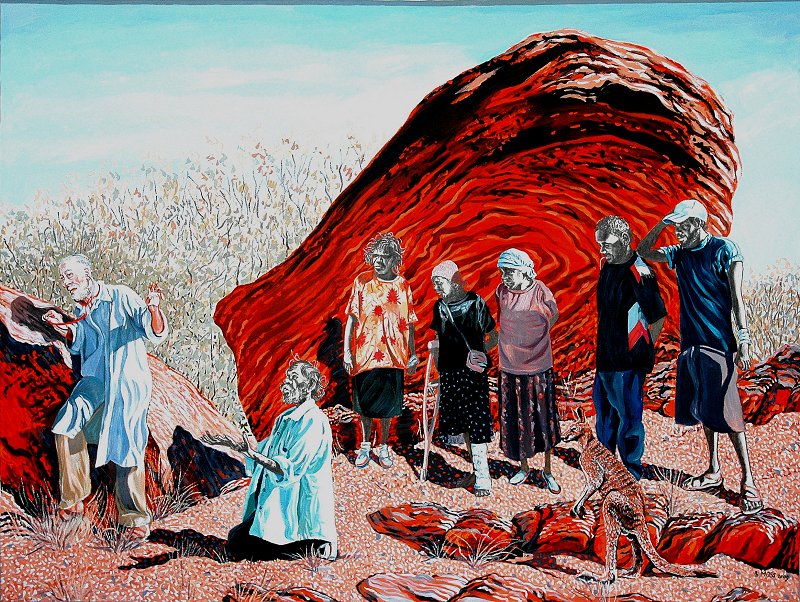
This land is the home of us whitefellas, a home known uniquely to relatively few, characters like Davidson, like Rod Moss, (artist and author of “The Hard Light of Day” and “One Thousand Cuts”). Their knowing is informed by the blackfellas who have shown them their home.

If you’ve missed this movie, don’t worry. Here for five minutes, gone tomorrow, I think it will never disappear. Like Davidson’s book the movie will be sought and valued so long as whitefellas are curious about the land, so long as we ponder our human aloneness.