Favourite Books

After he died, my brother Dennis’ lifetime collection of books was set out on tables and benches, in boxes and on shelves at our parents’ house, for family members to choose and keep. Revealed before us was a catalogue of the brilliant and searching mind of my big brother. Biographies, especially political, books on management, art books and book after book on music. And cooking books, books on sailing, on fishing. The study and the joys of a big appetite for life and ideas. Books of all sorts, but not much literature and very little fiction. 


Dennis always named his three favourite books as the biblical Book of Ecclesiastes, Kahlil Gibran’s, ‘The Prophet’, and Siddhartha’, by Hermann Hesse. I knew and loved the first of the three, I knew and liked (and mistrusted) the second, and – as for the third – I didn’t know Siddhartha from Hiawatha. 


Dennis would read my writings, shaking his head, unhappy with my obliquity and my complexity. ‘Read Siddhartha’, he’d say, ‘And learn the beauty of writing simply.’ Dennis admired narration that was free of ornament and artifice. ‘You make me think too much,’ he said. I felt flattered and confirmed in my path. And I did not take up Siddhartha.


‘Ecclesiastes,’ I read religiously, every year, entranced by The Preacher’s philosophic quest, as he tastes and tests every idea and temptation, as he broods and takes up and sets aside every sacred and profane thing. And the rhythms of the text, whether in Hebrew or in English, have always entranced: 


To every thing there is a season,

and a time to every purpose under the heaven:
a time to be born, and a time to die;
a time to plant, and a time to pluck up that which is planted;
a time to kill, and a time to heal;

a time to break down, and a time to build up; 
a time to weep, and a time to laugh;

a time to mourn, and a time to dance; 
a time to cast away stones,

and a time to gather stones together;

a time to embrace, and a time to refrain from embracing;
a time to get, and a time to lose;

a time to keep, and a time to cast away;
a time to rend, and a time to sew;

a time to keep silence, and a time to speak;
a time to love, and a time to hate;
a time of war, and a time of peace.


Dennis’ birthday falls on November 22. Each year on that day the stated gap between our ages would open up from two years to three. On November 22, 2016, Dennis would have turned seventy-three. But he never reached even threescore years and ten. He died aged sixty-three. Ten years later I pick up Siddhartha and read it, to mark his birthday and to honour the wishes of the older brother who always willed me to be better in the particulars that he selected. I read the work, too, to learn more of my brother’s questing soul.


I need to digress here, to my misgivings about ‘The Prophet’. I find it calming, pleasing, gently uplifting. It is as smooth as gravy, as sweet as the dulce de leche upon which my Argentine relatives were weaned. That’s my problem: ‘The Prophet’ lacks grit. You read and you wallow. As an essayist remarks in the New Yorker: ‘In “The Prophet” Gibran (mixed) a warm, smooth, interconfessional soup that was perfect for twentieth-century readers, many of whom longed for the comforts of religion but did not wish to pledge allegiance to any church, let alone to any deity who might have left a record of how he wanted them to behave. It is no surprise that when those two trends—anti-authoritarianism and a nostalgia for sanctity—came together and produced the sixties, “The Prophet” ’s sales climaxed.’


Raised as we all were, in a strictly Orthodox Jewish family, Dennis chafed against God the father and against our godlike father. He found the courage – indeed the compulsion – to rebel, but he never ceased to feel the pull and the lull of the old-time religion of his early nurture. He tried to relinquish Jewish restriction but the ritual would not let him go. Hence the enduring attraction to him of ‘The Prophet’, with its ‘anti-authoritarianism and its nostalgia for sanctity’.


Back to Siddhartha, another huge hit among those who were young adults in the seventies. When a book is so uncritically adored as this I start to feel uneasy. When I take up my newly purchased copy and discover that Paulo Coelho has written the introduction, my unease deepens. For – possibly alone among its millions of readers and adorers – I found the pretentious simplicism of ‘The Alchemist’ alienated me.


So you see, these works find me out as cynical.


But cynicism falls away as I read Hesse’s account of his searcher for enlightenment. Dennis sought enlightenment with his strong, rational mind. I recognise Dennis as the Buddha’s chastens Siddhartha: ‘You are clever…,’ said the Illustrious One; ‘you know how to speak cleverly, my friend. Be on your guard against too much cleverness.’

I see here Dennis, my too clever brother, the troubled searcher, endlessly testing his traditions, endlessly questing. This is the brother who embraced ‘Ecclesiastes’, in which The Preacher seeks but never finds a truth that satisfies. ‘Vanity of vanities, saith the preacher, all is vanity.’ It is an honest quest, brave and lonely. That was my brother Dennis, brave and lonely, longing, as his son remarked at the funeral, ‘to love and to be loved.’


But unlike the monk Siddhartha, Dennis did love: most particularly he loved our mother, and he loved me. And I loved him, and I miss him still.


The Voice of Victor

For a few years my daughter lived in England where she met lots of other young mothers, ordinary white middle class women with orderly lives, healthy babies and toddlers. They all had husbands with jobs, all were native English speakers in an English speaking country. They were all OK. Their babies got croup and cradle cap and they saw competent doctors in a timely way and had access to suitable, safe and effective medicines, and soon their babies were OK again; and they were all OK. 

But one day, one of my daughter’s friends saw the papers, watched the TV news and she stopped being OK. The friend’s name is Ros. And although Ros – a person in London with an ordinary life, who abandoned her day job and roused herself and roused one hundred thousand other ordinary English mothers and fathers and children to demonstrate and campaign for refugees, and this led to David Cameron rousing himself and his government, and this roused Britain to admit many whom they previously would have turned away – this story is not about ordinary Ros.
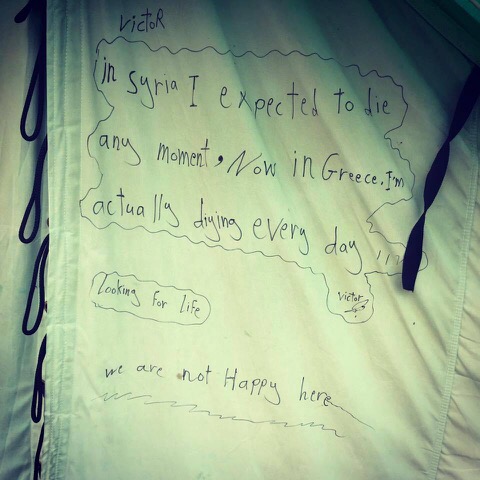
My daughter left England and returned home to Australia. She and Ros remain in touch. Ros sent a photo that broke my daughter’s heart. She wrote me a letter that included the image below:
 

My daughter’s friend Ros sent her this photo in a letter she came across in a camp on the Greek Island of Thessaloniki. In shrinking lettering near the foot of the letter the writer signed his name, “victor”.

 
My daughter says Victor’s is the despairing voice of one refugee so desperate to be heard he writes on the wall of his tent. He knows no-one hears. She says the world has turned its back. My daughter turns to her writer father with a plea of her own: “Maybe your writing could give Victor a voice. I’m just saying it made me think of you. Do with that what you will.”
I read my daughter’s letter. I read Victor’s letter.
Do with that what you will, she says, then adds, “Going to sleep with a heavy heart.”
Days pass and I don’t do anything.
Every time I switch on my computer, my daughter’s letter asks me, what will I do to make Victor’s voice heard? Something indistinct echoes, something about the unheard voice. It is a voice from a cattle car.
WRITTEN IN PENCIL IN THE SEALED RAILWAY-CAR:

here in this carload 

i am eve 

with abel my son 

if you see my other son 

cain son of man 

tell him I


What can I do? What can any of us do? We can try to emulate ordinary Ros. We can write to our local Member of Parliament, write to our faith leaders, speak to our friends. We can do as an ordinary friend of mine does – she organises aid packages. (That friend – a lapsed fundamentalist Christian – writes annually to this Jewish friend, seeking donations of Christmas gifts for Muslim refugees.) We can adopt a Victor – there are so, so many – and write to him. We can send him books. We can remind him he is not alone, not forgotten.


What good will these ordinary acts do? In the case of Ros they led to the saving of thousands. In Australia, our ordinary voices were raised enough to encourage our very ordinary leaders to find our captives place of safety in the USA. Our leaders are timid. It is for us to lead them.
(You can find out how to emulate ordinary Ros if you visit http://www.swruk.org/ )

Reverend Horton Heat and…

Sheltering from the rain where the tram meets the train it occurs to me I’m at a hub, the locus of the hurrying many. A good spot to promote your goods or your services or your gig. At my feet, on a patch of dry asphalt, a sort of yellow mound takes my eye. The mound turns out to be a pile of magazines, the strong yellow blazoned with bold script in magenta. It’s intended to catch the commuter’s eye.
 

When it comes to reading material I am my mother’s son. The printed word always lured Mum from the world of people and food and things: if it was legible Mum would leg it.

Me too. This was readable material so I read. I read CHOPPED. None the wiser I peered at the words in a smaller font. These are the words I read:


REVEREND HORTON HEAT


THE MEANIES


Hmmm. I guessed these were musical groups, bands, we used to call them. There was more:


Guantanamo Baywatch. Clever. I liked it.


Puta Madre Bros. Rude, naughty. I liked it.


Drunk Mums. Why not? 


The Cherry Dolls. Chris Russell’s chicken Walk. Ho hum.


The Pinheads. If you have that originality you aren’t one.


West Thebarton Brothel Party. I recalled the two occasions I went window shopping in a brothel. That was Hong Kong, not Thebarton West.


The Shabbab. Shepparton Airplane. There’s a ring to these.


La Mancha Negra. What can that mean? Probably nothing. Word stuck, word-drunk, I always want to decode the metaphor. A mistake: listen to the music.


The Reprobettes. Pretty literate. A snob, I am mildly surprised.


Flour. Hmmm.


Amyl and the Sniffers. Naughty again, very naughty. I am enjoying my morning’s reading. 


Racing on (I hear my tram approaching) – Slim Customers. King Puppy & the Carnivore. Thee Cha Chas. Was that three or thee? The eye wants to see what it wants.


Tape Wolves. Red Brigade. Do the members of this group know much about the Red Brigades?


Itchy Scabs. I love it.


The team pulls up as I read: Double Yad. Golly. I feel no doubt at all the namegiver intends this name. Understands the acronymic coupling of the Hebrew letter yad. Knows it to be the abbreviated form of the Ineffable Name.


My God!


Report of the World Preview of ‘A Threefold Cord’ 

 
they came from barwon heads

they came from the usa

they came from king david school

they came from haredi schools

they came in their numbers

they came with their foreskins and without
they numbered ten – plus adults
they fell instantly and hard in love with tali lavi, my interlocutor

she told them the book was exciting

and rude

and scary

and funny

and sad

and wonderful
i said the same – especially wonderful
i read, tali and i spoke and discussed, kids made comments
and i collected phone numbers and email addresses to advise attendors – there is no such thing as attendees (in this context) – of publication details
it was a triumph

NOW I HAVE THE PLEASURE OF SHARING THE TRIUMPH WITH YOU, DEAR READER OF THIS SOMETIMES SLUMBERING BLOG:
I’d be grateful if you would open the link below and watch and listen to the video in which the author reads from the first five chapters of this quite outstanding work.

https://drive.google.com/file/d/0B5WiuKpPeWv9RHlTQlRTeWdjTEk/view

IN RETURN I HAVE A FAVOUR TO ASK OF YOU: After enjoying the viewing of my video would you very kindly respond to two questions:

1. Please indicate whether you would buy a copy of the E-Book of ‘ A Threefold Cord’ at $5.00
2. Please indicate whether you would buy a copy of the print book at $15.00
3. (Yes, this is the third of two questions): Would you purchase additional copies as gifts?

Invitation to a Preview of my Next Book 

I INVITE THE ENTIRE WORLD TO 
THE WORLD PREMIERE
OF 
 A THREEFOLD CORD 
THE LONG-AWAITED NOVEL BY HOWARD GOLDENBERG FOR CHILDREN OF 8-12 YEARS

AND THEIR PARENTS 

AND THEIR GRANDPARENTS 

AND THEIR CHILDREN

AND ANYONE WHO HAS EVER BEEN 8-12 YEARS OLD 

AND ANYONE WHO HAS LOVED A PERSON 8-12 YEARS OLD

AND ANYONE WHO LOVES A TERRIFYING, EXCITING, HILARIOUS, RUDE, OR INSPIRING STORY
COME TO LIMMUD OZ AT 5.30PM AT MONASH CAULFIELD, TOMORROW, 27 JUNE, 2017
CHILDREN WHO ACCOMPANY A PAYING ADULT ARE ADMITTED FREE OF CHARGE

while the adult is ripped off to the tune of 30-40 bucks  
http://sched.co/77uX
Limmud Oz Melbourne #books #literaryevent #authorreading 

Maranoa Writer

In the Maranoa I met Billy Dodd, author of ‘Broken Dreams’ (UQP). I met his life. I recount his story to an able-bodied listener, who recoils on hearing how, three days before Billy’s eighteenth birthday, he came to fracture his neck and became quadriplegic. It’s the sort of shiver we feel as we recognise ourselves. As a child I dived into unplumbed streams. It was a normal action, part of the exuberant membership of the mad organism of many limbs without a brain that is a group of boys at play. We dove, we surfaced, we swam, we shouted, we splashed. Everything worked. We never thought on it. 

But here in the singular house of Billy Dodd I do think on it. Alone of the houses in Ann Street in his Maranoa township, Billy’s is not a Queenslander. That is, the structure is not elevated above flood level; it squats, its threshold at street level, hospitable to a wheelchair. Billy is glad for my visit. Although he is the town’s literary celebrity the rhythms of his life are slow. His partner is devoted and admiring, her child attentive and respectful, but the days are many, the years long.

‘How old are you now, Billy?’

‘Thirty three.’ A smile moves across his face. His chest plays its rise and fall. Nothing else of him moves.

That’s fifteen years. Fifteen years to look back, so very many to look ahead.
From across the street Billy’s house looks small. From the corner of the parlour where he reclines in his motorised conveyance the quiet rooms yawn. The spaces feel too large.
‘I’ve started to write another book.’

‘Good on you, Billy. What’s it about?’

‘About my father, my family.’

‘How’s it going?’

‘Well, I’m taking a bit of a break…’
We talk about his family, about his father’s example, his standards. Billy’s admiration outlives the old man, who never reached oldness.
Billy’s partner speaks, ‘Tell him what else you create, Billy. The paintings.’ She fetches some paintings, done by mouth, like all of Billy’s acts and works. After only a few weeks the paintings do not stand clearly in memory.
‘A cup of tea?’ The lady – Billy’s wife, as I discover – smiles her offer. ‘No thanks, no. I’m on duty, just sneaked out of the hospital, due back now. But thanks…’

Awkward, uncomfortably conscious of advantage, of my spontaneous mobility, I feel some need to redeem the situation, to rescue the moment. I speak: ’ Where can I find a copy of your book, Billy?’

‘Take this one there, on the table, it belongs to the school across the road.’
I take the school’s copy and I take my leave, running away from Billy’s empty spaces. I liked him, I liked the woman and the child. Perhaps that’s why I ran.
I read the book that evening. A short book, written in unvarnished narrative fashion, a book of real energy, written with drive. The voice is young, it speaks of family and friends, of ordinary wildness. In his retrospect Billy marvels quietly at his own transmogrification, shedding few tears. The energy of the telling contrasts with the slowness of our meeting.
And yet there was energy in the house: the child, proud of his painter-writer-stepfather, loves him. The woman, large and kind, ordinary, extraordinary, loves him too.

The lack was my own. I alone felt heaviness, defeat.

The Rubaiyat of Zoltan Klein

A Book of Verses beneath the Bough,
A Flask of Wine, a Loaf of Bread – and thou Beside me singing in the Wilderness –        And, Wilderness were Paradise enow!

I accepted the invitation to the launch event of ‘Bread, Wine & Thou’ without curiosity. But as the series of emails from the Event Manager mounted I sensed I should look a bit spiffy for the launch. So I wore my English Schoolboy Blazer. The addition of my backpack subtracted from the elegance of my outfit and together with my skullcap ensured I would look quite as odd as usual.

At the last moment I invited a friend, an art impresario held by all to be ineffably elegant.

The security man at the door, a gym giant in Armani, consulted a guest list longer than the Pentateuch. A show of expensive teeth: “Your names, gentlemen?”

“We are both Howard Goldenberg”, I said.

“Thank you sirs. Please take the elevator to the Second Floor.”

A disembodied voice from the rear of the elevator was heard: “Hi Howard”. It took a while to identify our host Yossi (also Zoltan Vinegar) Klein, obscured as he was by a cluster of tall, expensively draped women, mounted on very steep heels. Taller than all others in the lift a wide man with an interesting face stood next to Yossi. He did not speak.

The lift released us into the highly geometric womb of Cox Architecture, a space as inventive and unexpected in its proportions and planes and shapes as Federation Square. I had not previously heard of Cox, but I was given to understand its iconic condition.

Filling the space, throngs of elegant females and stylish males kissed a lot of air as they greeted each other with little shrieks and harmless hugs. I noted my companion and I were not the most expensively dressed persons present. Wine was sipped, quite exquisite looking entrees were served and everyone accepted a copy of ‘Bread, Wine and Thou.’

Eventually Zoltan took a microphone and spoke. For a time no-one noticed, for Yossi is, as his surname suggests, not tall. After a bit all fell silent. He spoke informally, disarmingly, unpretentiously. He said, “I wanted to create a literary magazine on the themes of food, wine and culture.” Those were precisely the words he used when he spoke to me a year earlier in ‘Batch’, the Kiwi coffee shop where he and I had sighted each other without speech over years. On that occasion Yossi said: “I’ve read your writing on Aboriginal Australia. I want you to write a piece on Aboriginal Cuisine for the first Number of ‘Bread, Wine & Thou.’ I can’t pay you.”

I accepted the commission and wrote something and turned up in my blazer and kippah and backpack. It must be clear from the harsh tone of my introductory remarks that I felt uncool, unfamous, outranked by the figures of beauty. But as Yossi spoke all that fell away. This man in his forties spoke of his dream and its fulfilment, the magazine – really a handsome book – that we held in our hands. Yossi opened with a joke about his Jewish mother. It was a good joke and we all laughed and Yossi relaxed. He thanked a legion of first names, burnishing each name with his deep appreciation. As Yossi spoke one hundred and fifty smart people from the uppermost echelons of food and wine stood, arrested. Cynicism and self-consciousness fell away. We were human together as Yossi stood, naked in his feeling. He said he was overcome. His voice cracked with emotion.

Later a Very Great Man accepted the microphone. He sat down and whispered, exercising the powers of greatness and of near-inaudibility over his audience. Just as Howard Goldenberg alone had never heard of Cox Architecture, neither had I recognised the Greatest Chef in the World, the tall wide man of the interesting features who rode the rising elevator at Yossi’s side.

  
The room worshipped. Upon completing his remarks the man folded Yossi in an embrace that hoisted him from the floor. Evading believers*, he strode from the room, disappearing into the night.

That this personage should have descended to Melbourne for Yossi was felt to be an enormous compliment to our host. As I listened to the chef speak of his career at length and in breadth I felt increasingly the greatness of Yossi. And when you read Yossi’s magazine I think you will feel the same.

Although ‘Bread, Wine & Thou’ is accessible on-line, I urge you, do not go for the virtual book; for modest moneys you can acquire the real volume. Collectors will treasure this, the first edition, a thing of truth and beauty.

IMG_6132

* I stole this lovely phrase whole from Les Murray’s ‘ A Perfectly Ordinary Rainbow’.

Writing as Healing

The mother of identical twin boys sent me this story by Ranjava Srivastava.


“Losing my twin baby boys for ever changed the way I treat my patients.

I will never know the kind of doctor I would have become without the searing experience of being a patient, but I like to think my loss wasn’t in vain.

‘My obstetrician’s tears stunned me but also provided immediate comfort. They normalised the mad grief that had begun to set inside me.’
Around this time 10 years ago, I was poised to start my first job as an oncologist when personal tragedy visited in a way that would forever change the way I would practice medicine.

I had returned from my Fulbright year at the University of Chicago, blessed with only the joys and none of the irritations of being pregnant with twins. Landing in Melbourne, I went for a routine ultrasound as a beaming, expectant parent. I came out a grieving patient. The twins were dying in utero, unsuspectedly and unobtrusively, from some rare condition that I had never heard of. Two days later, I was induced into labour to deliver the two little boys whom we would never see grow. Then I went home.

If all this sounds a little detached it is because 10 years later I still have no words to describe the total bewilderment, the depth of sorrow and the intensity of loss that I experienced during those days. Some days, I really thought my heart would break into pieces. Ten years later, the din of happy children fills our house. But what I have found myself frequently reflecting on is how the behaviour of my doctors in those days profoundly altered the way in which I would treat my patients.

An experienced obstetrician was performing my ultrasound that morning. Everything was going well and we chatted away about my new job until he frowned. Then he grimaced, pushed and prodded with the probe, and rushed out before I could utter a word. He then took me into his office and offered me his comfortable seat. Not too many pregnant women need a consultation at a routine ultrasound.

“I am afraid I have bad news,” he said before sketching a picture to describe the extent of the trouble. I thought for a fleeting moment that my medical brain would kick in and I would present him with sophisticated questions to test his assertion that the twins were gravely ill. But of course, I was like every other patient, simultaneously bursting with questions while rendered mute by shock.

I was well aware that doctors sometimes sidestepped the truth, usually with the intent of protecting the patient. I knew he could easily get away with not telling me any more until he had more information but I also knew that he knew. I read it in his face and I desperately wanted him to tell me.

I asked the only question that mattered.

“Will they die?” 

“Yes,” he said, simply holding my gaze until his tears started.

As I took in the framed photos of children around his office he probably wished he could hide them all away.

“I don’t know what to say,” he murmured, his eyes still wet. 

Until then, in 13 years of medical training, I had never seen a doctor cry. I had participated in every drama that life in bustling public hospitals offers but never once had I seen a doctor cry.

My obstetrician’s tears stunned me but also provided immediate comfort. They normalised the mad grief that had begun to set inside me. Yes, the doctor’s expression said, this is truly awful and I feel sad too.

“You are sure?”

“There is a faint chance that one lives but if you ask me, things look bad. You know I will do everything I can to confirm this,” he said.

The obstetrician had told the unflinching truth and in doing so almost surgically displaced uncertainty with the knowledge that I needed to prepare myself for what lay ahead. I had test after test that day, each specialist confirming the worst. I think I coped better because the first doctor had told the truth.

Two other notable things happened that week. Among the wishes that flowed, another doctor wrote me an atypical condolence note. His letter began with the various tragedies that had taken place that week, some on home soil and others involving complete strangers. “I ask myself why,” he wrote, “and of course there is no answer to why anyone must suffer.”

Until then, everyone had commiserated only at my loss – and I was enormously grateful – but here was someone gently reminding me that in life we are all visited by tragedy. All the support and love in the world won’t make you immune to misfortune, he was saying, but it will help ease the pain.

Finally, there was the grieving. I lost count of the pamphlets that were left at our door to attend support groups, counselling sessions and bereavement seminars but we were resolutely having none of it. My midwife called me out of the blue – it was a moving exchange that taught me how deeply nurses are affected too. But I didn’t need counselling, I needed time. I valued the offers but I knew that my catharsis lay in writing. I wrote myself out of suffocating grief, which eventually turned to deep sadness and then a hollow pain, which eventually receded enough to allow me to take up my job as a brand new oncologist. How I would interpret the needs of my patients was fundamentally altered now that I had been one myself.

Cancer patients are very particular about how much truth they want to know and when. I don’t decide for them but if they ask me I always tell the truth. A wife brings in her husband and his horrendous scans trigger a gasp of astonishment among even the non-oncologists.

“Doctor, will he die from this?” she asks me.

“I am afraid so,” I answer gently, “but I will do everything in my power to keep him well for as long as I can.” 

It is the only truthful promise I can make and although she is distressed she returns to thank me for giving her clarity. Sometimes honesty backfires, when the patient or family later say they wanted to talk but not really hear bad news. I find these encounters particularly upsetting but they are rare and I don’t let them sway me from telling the truth.

Oncology is emotionally charged and I have never been afraid of admitting this to the very people who imbue my work with emotion. I don’t cry easily in front of patients but I have had my share of tears and tissues in clinic and contrary to my fears, this has been an odd source of comfort to patients. In his Christmas card, a widower wrote that when my voice broke at the news that his wife had died he felt consoled that the world shared his heartbreak.

It can be tricky but I try to put my patients’ grief into perspective without being insensitive. It’s extraordinary how many of them really appreciate knowing that I, and others, have seen thousands of people who are frightened, sad, philosophical, resigned, angry, brave and puzzled, sometimes all together, just like them. It doesn’t diminish their own suffering but helps them peek into the library of human experiences that are catalogued by oncologists. It prompts many patients to say that they are lucky to feel as well as they do despite a life-threatening illness, which is a positive and helpful way of viewing the world.

I will never know what kind of a doctor I might have become without the searing experience of being a patient. The twins would have been 10 soon. As I usher the next patient into my room to deliver bad news, I like to think that my loss was not entirely in vain.” 

……… 

I read this story with alarm. It made me feel anxious because I have and love a pair of identical twin boys. I felt involved because, like the writer’s doctor, I am a doctor who cries; and like the writer, Dr Srivastava, I am a doctor who writes. Finally we two are products of the same medical school (Monash) – Dr Srivastava graduated at the top of her class, in the present century, I graduated at the opposite end of my class, in antiquity (1969).

A final point of commonality was her reassuring remark that ten years after her doctor wept her home is full of the noise of happy living children.

I found the piece helpful. Dr Srivastava identifies and untangles the strands of her experiences with surgical deftness. Her doctor weeps, her colleagues show support and care and empathy and she heals. As a trained observer, the writer dissects her experience of grief, lays out its anatomy and reflects upon its organs and parts.

Like the writer, I find relief and understanding in the act of writing. I suspect that a part of this relief results from word search. The writer is obliged to seek the precise word for the experience. In my case this forces me to test and taste a number of words. Perhaps a dozen words might work more or less passably, but the acts of searching, of choosing, of trialling, help me to clarify what my feelings were not quite like. I mean I discover what I mean. Perhaps this functions as a working through, a self-conversation, something between analysis of an experience and re-imagining it. In my case too, the pleasure of words is an aesthetic joy that comforts me.

Medicine is a pursuit conducted with the living in the shadow of death. It is a pursuit packed with anxious questions: what is wrong with me, will I die, what can be done, will it hurt, how much, how will I know the answers, when will I know? This crying doctor feels the patient’s fear and his own and has to know the border that divides the two. My fears are for the patient, of the patient, of failure, of failing a person of flesh and feeling. My fears include the terror that strikes me when I see my patient slipping away, the knowledge of my mortal inadequacy.

The writer who lost her twins precisely names the elements in her emotional experience. With remarkable poise she traces the costs and the benefits of the loss. So coherent are her reflections I could feel myself learning as I read. I learned about her life and her work, how the two are not the same but never severable. I learned more of how a doctor feels, who she is, who I am.

A Musing

At first hearing the term “blog” feels slightly ingenious (web log – right, I get it). More than that the word falls heavily upon the ear, unsubtle, ugly and crude – the more so since in the vernacular of childhood the bog was the lavatory. When we visited the lavatory whatever solids we deposited there were collectively a ‘bog.’ The term remains current but not predominant.

Initially I disdained the term ‘blog’. I knew instinctively that a blogger must be vain and unselfconsciously vulgar. I knew I would never write one; I would never be one.

Yet here we are. Of course I am flattered that over  two hundred and fifty persons have managed to overcome these unpleasant redolences and ‘follow’ these postings. Yet, two or more years after embarking on the practice I remain unreconciled to blogs and blogging. The words suggest turds.

So what are we sharing? I think this is Howard Goldenberg’s column, too occasional to constitute a diary, yet intimate enough to be that. This is Howard thinking aloud, thinking personally. Self-absorbed in tone, vain in ambition, unexpectedly enriching to the writer in its fruitful exchanges.

Being now FED UP, I resolve that so long as I remain a bogger, I’ll no longer be a blogger. When King George V lay on his death bed a friend visited and remarked encouragingly, ‘You’ll soon be up and about and able to take your annual holiday at Bognor.’ To which the king replied: ‘Bugger Bognor!’ – and died.

As for me, Bugger Blogger! I am glad to announce this blogger has died, executed, the punishment for linguistic ugliness well overdue.

Good morning, welcome now and henceforth to the occasional musings of Howard Goldenberg.